Blocher is making headlines once again. What happened? The NZZ am Sonntag broke the story: Robinvest has been awarded a consulting contract by Tito Tettamanti, the majority shareholder of the Basler Zeitung, and Martin Wagner, the minority shareholder and chairman of the board of directors.
Editorial
-
November 17, 2010
The aim is to bring the currently loss-making company to a return of ten percent next year. So far, a normal process. But the Chairman of the Board of Robinvest is none other than Christoph Blocher. The whole thing was not exactly a clever move. The two main shareholders can go on for a long time stating in a press release that "they had decided to seek the advice of persons with sufficient industry experience. With this in mind, Dr. Tito Tettamanti recommended Robinvest as advisor. Dr. Tettamanti has had excellent experience with Christoph Blocher in industrial investments." The statement "that BZM is in a turn-around phase and it is quite common that external consulting services are obtained in connection with the strategic and operational management of the industrial portfolio" also goes unheard. The irritant word Blocher drowns out everything. Now there is outrage in the competitor press. "New strategy: Blocher takes power at "BaZ"" headlines 20 Minuten online, "Blocher determines course of "Basler Zeitung" writes NZZ online. Politicians are also outraged. Christine Wirz-von Planta, a member of the Basel parliament, fears that the newspaper is being "remote-controlled" and that "Basel could lose its local newspaper. FDP National Councilor Peter Malama thinks that BaZ could mutate into a daily Weltwoche. But popular sentiment is also boiling: By Monday evening, over 400 comments had been counted on Bazonline.ch, "Blocher Zeitung Nein Danke!" badges are being sold in Basel, and the Facebook group "Eine neue Zeitung für Basel ohne Tettamanti, Wagner, Somm und Blocher" already has 980 members. The editorial staff also reacted: In an open letter, it wrote that the "political influence" on BaZ alluded to in the NZZ am Sonntag was endangering credibility and journalistic independence, and thus the highest good of a newspaper. However, the editors' protest is also directed against the unloved editor-in-chief Markus Somm. In a conversation with the editorial staff, Wagner guaranteed journalistic independence. The chaos has been created. Whether this is conducive to the desired return on investment is doubtful. And another thing: Blocher may be a good entrepreneur, but whether he knows anything about the media is questionable: In 1996, his attempt with the Bündner Tagblatt ended after high losses in a closing of ranks with the competitor Bündner Zeitung. Pierre C. Meier, Editor-in-Chief [email protected]
No siesta in the sun room
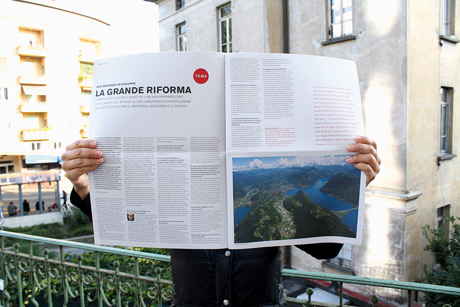
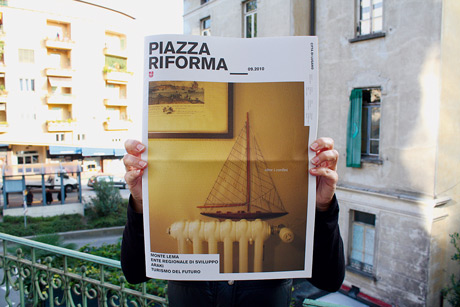
With its magazine *Piazza Riforma*, the city of Lugano is breaking new ground in communication.
Editorial
-
November 17, 2010
The goals are ambitious, the will to shape the city is remarkable despite all the resistance: with the so-called Grandi Progetti, Lugano, the economic engine of Ticino and the third largest financial center in Switzerland, is making itself fit for the future. Major projects such as incorporations, the LAC cultural center, a modern mobility concept around the new northern access tunnel and plans for a new district close to the city center with an exhibition and congress center are changing the city. Piazza Riforma is accompanying this change, taking a close look, allaying fears and making connections clear. It has been going out to all households in the city every two months for almost a year, with a total circulation of 42,000 copies. With Piazza Riforma, Lugano is breaking new ground: communicative change management that creates participation and consensus through a special mix of topics and offers is not usually part of a municipality's standard repertoire. You won't find reports on the commissioning of new ticket machines or impressions of a business delegation's trip to Moscow, as they often appear in the self-portrayal of municipalities, in Piazza Riforma. The magazine wants to set topics, other topics. A report on the night shift of the municipal police is just as interesting as the questions of how best to get around the city on foot or why it makes economic sense to invest 180 million francs in a new cultural center. A thematic focus on the new regional development office, an interview with a well-known trend researcher on the city tourism of the future and a portrait of a fellow citizen suffering from insomnia who has spent his nights reading for years are all presented in Piazza Riforma in loose succession. And because Lugano has not yet lost its human scale (and does not want to lose it), you will discover many a face that you have just seen well photographed in the magazine in the real Piazza della Riforma, the town hall square with its many cafés. The city and its people can be rediscovered in the journalistically prepared texts, the images by (local) photographers and the work of (local) illustrators. The magazine is characterized by openness and a willingness to engage in dialogue, always linking the dynamics of change back to people's concrete problems and questions. Embedded in a high-quality, credible and at the same time fresh medium, information becomes comprehensible and can be experienced as an identification offer through broad contextualization. Poster campaigns, radio broadcasts on the magazine topics and soon an interactive online platform with audio texts, among other things, ensure target group-specific follow-up communication. Piazza Riforma thus helps to tie centrifugal forces in a capillary, highly differentiated and heterogeneous system such as a city back to the center and to sustainably increase the acceptance of change. Piazza Riforma is published by the Lugano City Council. The concept was developed by the Ticino CP service provider comunicAzione, which is also responsible for project management. The editor-in-chief is Eleonora Bourgoin, the city's communications officer, and Piazza Riforma is graphically designed by Studio Ackermann dal Ben. Eckhard Sohns
Advertising Week on Star TV: «A top-notch music video show.»
On Thursday at 7:45 p.m., Star TV will have you in stitches. The 30-second commercials are a real treat, proving the saying: “Brevity is the soul of wit.”.
Editorial
-
November 17, 2010
With minimal dialogue but double the impact, these award-winning clips certainly don’t fail to resonate with their audience, because after watching this show, men and women want only one thing: to eat a cheese sandwich fresh out of the shower while enjoying a Bud Light. You can currently watch the exclusive clip show featuring the best commercials of 2010 on «Die Werbewoche» on Star TV on Thursdays at 7:45 p.m., in reruns, or via stream at www.startv.ch.
The Impact Check of Werbewoche
We show how current campaigns are performing with consumers.
Editorial
-
November 17, 2010
In terms of awareness, the training campaign for Coop by the advertising agency Valencia ranks first, followed by the Aldi ad by Contexta and the Snickers ad by the advertising agency Wirz. Snickers also comes out on top in the “Uniqueness” category, followed by the ad for Zurich Airport by Jung von Matt and the VBZ ad by Ruf Lanz. In the “Brand Fit” category, the ad for Zurich Airport takes the top spot, followed by the VBZ ad and the ad for the Suzuki Vitara by the advertising agency Metzgerlehner. In terms of “Likeability,” the ad for Zurich Airport takes the top spot, closely followed by the VBZ campaign and the ad for Snickers. > Results at a glance > Detailed results
Question and methodology Method: Computer Assisted Web Interviews (CAWI). Instrument: Online interviews via the Marketagent.com reSEARCH platform. Target group: Internet users in German-speaking Switzerland between the ages of 14 and 59. Sample size: n = 500 net interviews, random selection by quota. Survey Period: November 3, 2010 – November 11, 2010. Questions: - We introduced you to some ads at the beginning of today's survey. Which of these ads do you remember? Please name the advertising companies or the brands advertised. (Awareness) - In your opinion, to what extent do these ads stand out from other advertising in newspapers, magazines and journals? Please rate each from 1 (= lifts does not stand out at all) to 6 (= stands out very strongly). (Uniqueness) - To what extent do these ads fit the image you have of the respective brands/companies? Please rate each from 1 (= does not fit my image of this brand at all) to 6 (= fits my image of this brand very well). (Brand Fit) - To what extent do you like the following ads? Please rate each from 1 (= I do not like at all) to 6 (= I like very much). (Likeability) The values printed are in each case the top box ratings "stands out very strongly", "fits very well with my image of the brand", "I like it very much". The author of the representative study «Switzerland’s Favorite Advertisements» is Marketagent.com Switzerland, a company specializing in online market research that has a registered panel of 20,000 respondents in German-speaking and French-speaking Switzerland. Marketagent.com Switzerland is a subsidiary of the leading Austrian market research company Marketagent.com online reSEARCH GmbH and the Swiss communications agency Contract Media AG.
Q-Award 2010: Economic pressure increases quality
Thirteen entries—twice as many as last year—were submitted for the 7th Q-Award. The Swiss Media Association presents this award annually to recognize outstanding publications in the field of trade and specialty media.
Editorial
-
November 17, 2010
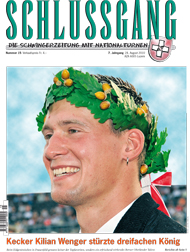
Compared to previous years, the quality was above average. The jury therefore presented two awards: to the weekly trade journal Baublatt and to the newcomer, the wrestling newspaper Schlussgang. A further five projects received an honorable mention. The jury thus thanks the industry for the significant increase in performance, which also applies to the online sector. The dossiers submitted were more substantial and complete than ever before; the market seems to have definitely recognized the seriousness of the award and is honoring it with careful documentation, according to a press release from the Swiss Media Association. It almost seems as if the obvious economic pressure in some places has spurred creativity and increased the willingness to perform. The jury, made up of practitioners, saw creative and user-oriented online solutions and intelligent cross-media approaches as significant progress. The winners According to a press release from the Swiss Media Association, Baublatt is an institution with an exceptional, up-to-date service section. And Schlussgang is the contrasting program: a demonstrably successful newcomer title in a decidedly conservative but fast-growing market, namely among wrestlers and national gymnasts. At Building sheet The weekly newspaper for the booming and highly competitive construction industry is dominated by its direct utility value for subscribers (tradesmen, building contractors, general contractors, suppliers, architects and other service providers), the press release continues. The Internet offering impresses with daily access to the latest news. A newsletter for registered subscribers creates additional added value. The website impresses with its attractive, clear and straightforward design and visible investment in content. User numbers in print and online are clearly on the rise.
Final round the wrestling newspaper with national gymnastics, which follows the festival events in its publication rhythm, has been on the market since 2004 and sells 6480 certified subscriptions, whereby the "target mailing" to free addresses, which is heavily used in other places, is used extremely cautiously. The comprehensive and detailed reporting by the publishing outsider makes people self-confident: they know that they are worth something and can demand something, as the press release goes on to say. The layout of the paper is very hand-knitted, but it is a newspaper with rough paper that is suitable for the target group - an "animal world" for rustic athletes and their fan base, so to speak. The variety and abundance of advertisers confirms the acceptance of the paper in the scene.
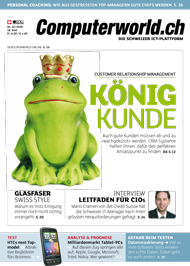
Five further nominations In contrast to previous editions, this year the jury was satisfied with the level of "cruising altitude" of all the projects submitted. None of them really fell short; more than one, however, seemed to have the potential for future awards. Here are the five honorable mentions; they can also be seen as nominations for future years: At the Swiss ICT platform Computerworld Despite the strong expansion of cross-media activities, print circulation also increased. Special issues, studies and more underpin its leadership in the field. Competence, topicality and in-depth coverage are indisputable, according to the press release from the Swiss Media Association.
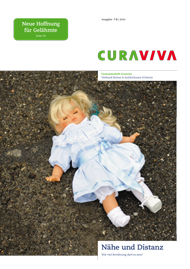
CuravivaThe Swiss Association of Care Homes & Institutions, which focuses on care home managers, has a surprisingly strong journalistic emphasis in a narrowly defined specialist area, but is still somewhat hesitant in its online presence.
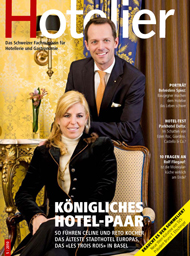
The Swiss trade magazine for the hotel and catering industry, HotelierThe magazine presents a sensual industry attractively, i.e. lavishly and richly illustrated. Since the relaunch, the editorial team's consistent stylistic device has been personalization, whereby original journalistic forms of presentation and strong opinions are of great importance.
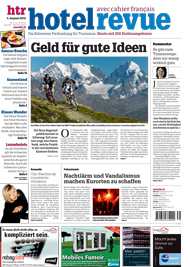
The 2009 award winner, HRT Hotel Revuethe Swiss trade newspaper for tourism, confidently maintains the high quality of its content and form under popular design criteria and impresses with daily online news and clever use of social media.
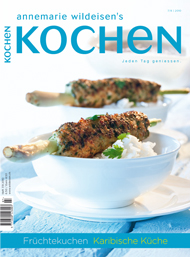
Annemarie Wildeisen's cooking was judged by the jury to be a convincing media platform, with a very successful relaunch of the website.
The Q-Awards The award is still based on reasonably plausible market success that has been proven over a longer period of time. It is the results that count, which is why convincing concepts such as that of Hotelier and Computerworld will have to wait a little longer, as the press release goes on to say. The award for trade and specialty titles is part of the ongoing quality offensive in favor of print media that the Swiss Media Association has been conducting for many years. Against the same background and with the same motives, the publishers' association has also been awarding the Q seal of quality for some time now. It is currently held by 102 specialty and trade journals published in German and French. The jury 2010 The jury for the 2010 Q-Awards was unchanged from previous years. It consisted of Pepi Burch, publishing consultant (Zurich), Dr. René Grossenbacher, Managing Director of Publicom (Kilchberg), Josefa Haas, Head of the Media Institute of the Swiss Media Association, Karl Lüönd, publicist and author (Elsau), Urs Schneider, owner of the media agency Mediaschneider (Zurich) and Jürg Siegrist, Managing Director of SWA (Zurich).
Flop of the week: Anthrazit no longer in printed form
The print edition of the Swiss magazine Anthrazit is being discontinued. After seven years, the publisher, Anthrazit AG, is discontinuing the print version of the digital lifestyle magazine and will focus on content and products for the mobile Internet.
Editorial
-
November 17, 2010
The September issue of Anthrazit, published in a print run of 65,000 copies, is the last regular printed edition, as the company writes in a press release. Anthrazit will continue to explain the digital lifestyle, but digitally: firstly on Anthrazit.org, and secondly with iPhone and iPad applications that can be downloaded free of charge from the App Store. It is not yet clear whether Anthrazit will continue to present the awards "The 200 best websites in Switzerland" and "The 100 most useful e-shops in Switzerland" in printed form. The company is currently negotiating with various publishers. With the move from publisher to software house, publishing director Gabriela Benz, who built up and expanded the publishing house with Christian Schwengeler, is leaving Anthrazit AG. Schwengeler intends to offer his expertise to publishers and companies in the form of applications and data.
AZ Medien: completion of consolidation measures, reduction of 9 jobs
The consolidation measures announced by AZ Medien in the spring will be completed with the elimination of 9 positions in editorial and publishing support departments.
Editorial
-
November 17, 2010
A total of 15 employees are affected. They will be covered by the AZ Medien social plan, according to an AZ Medien press release on Wednesday. The sales departments and editorial offices are not affected by these measures. The package of measures implemented in recent months has ensured the conditions for sustainable positive development, the press release concludes.
Schoch&sonders: Get Fit and Happy with Vif Fitness Club
Editorial
-
November 17, 2010
An agency is only as good as its people."
Dominik Oberwiler and Martin Stulz, both long-time employees, have taken over creative leadership of Advico and Exxtra within the Y&R Group.
Editorial
-
November 17, 2010
Advertising is always a team effort. «While you have to be able to push your idea through as an individual, it can only be brought to a successful conclusion as a team.» With this conviction in mind, the new creative leadership team at Advico and Exxtra didn’t want to appear alone in this profile. «This is a great opportunity to introduce our team. As Creative Directors, we’re responsible for the agency’s creative output. But so is every single one of our employees—day in and day out. Without them, nothing here would get done,» say Dominik Oberwiler and Martin Stulz. «We’re well-positioned. A first generation brought the Y&R Group together. Since then, many new, young people have joined us. Together with them, we want to carry creative advertising into the future.» Dominik Oberwiler has taken on the role of Executive Creative Director effective immediately. Martin Stulz has been promoted to Creative Director. In their day-to-day work, the two plan to act as a unified team. «This ensures quality control. At the same time, it helps prevent the sudden emergence of two factions within the agency.» Likewise, the two new leaders want to be able to work with the consulting team as constructively as possible. In times when budgets are under ever-tighter scrutiny, we simply cannot afford a rift between consulting and creative. For Stulz and Oberwiler, therefore, the title «Creative Director» has nothing to do with vanity. They see it more as a sign of appreciation and derive a role from it: «We’ve both been here a long time and know the agency. We know where its heart and strengths lie and how to bring them to the fore.» Dominik Oberwiler’s goal is to support the talented people and «provide a platform for new ideas.» Martin Stulz wants to «just let people do their work—so they can develop as freely as possible.» That’s what would have worked best for him in the past, too. Martin Stulz started out with an apprenticeship as a graphic designer. Afterward, he devoted himself to his band «Sitting on a Cornflake.» To get closer to their goal of a «record deal,» «we had to constantly meet increasingly demanding expectations and make compromises. In the process, the fun of it all fell by the wayside,» recalls Stulz. A danger «that’s always present in advertising, too»—yet he ultimately chose to pursue a career in this industry. Though no longer as a graphic designer. «As a copywriter, I could focus on the ideas.» He got his start as a junior at Publicis. This was followed by a «round of agencies»—Euro RSCG, WHS, Lowe—and now, for the past five years, Advico. Dominik Oberwiler also started out with an apprenticeship in graphic design. Because he found the work in the smaller design studios around St. Gallen a bit «too lonely,» he wanted to move to a larger agency in Zurich at age 23. «I missed the exchange and creative interaction. I wanted to communicate on a broader scale and tell stories.» Oberwiler found that opportunity at Guy & Partner. Danielle Lanz and Markus Ruf were also working there at the time. As art director, Oberwiler formed a team with copywriter Petra Bottignole. Later, the two moved on to WHS, Publicis, and Euro RSCG. Oberwiler was promoted to Creative Director and was later poached by Y&R. He is now also a member of the board at the Creative School. Andreas Panzeri > About the Team (pdf)
Kooabaization of our print articles: Using interactive functions with image recognition technology
Our partnership with Kooaba—an ETH spin-off—makes it incredibly easy for you to tweet any article from the print edition, share it with your Facebook friends, or email it to a colleague.
Editorial
-
November 17, 2010
This is how it works: If you have a smartphone (iPhone or Android), simply download the Kooaba-Paperboy app to your phone and then take a photo of the page you want. The app recognizes it and sends a digital image to your cell phone. You can then benefit from all the interactive functions. And it's free of charge. You also have the option of saving the relevant article as a digital copy in your personal archive. If additional material is available for an article (films, images, studies), the shutter icon, the Facebook icon and the Twitter icon appear next to the article in the printed edition of Werbewoche. The additional information can then be accessed directly from the Paperboy app. For those who do not yet have a compatible smartphone, our tried-and-tested web code will of course be available for a while yet. Simply enter the relevant web code on Werbewoche.ch as before and you will have access to the corresponding additional information. One small disadvantage: direct sharing on Twitter or Facebook is not automatically possible. So you will need to make an additional effort! We are convinced that the Paperboy app marks the beginning of a new way of using print media that better reflects today's information behavior. Print and online are growing together without media discontinuity. Articles can not only be read in a quiet little room, but can also be taken away, shared with colleagues, commented on, praised or criticized. Additional information is available at the touch of a button and the personal archive suddenly becomes manageable and clearly structured. More and more newspapers are relying on Kooaba software, and as a specialist newspaper in the communications industry, we didn't want to be left behind. We want you to be able to benefit from the fascinating new possibilities.
Condor produces new image film for Völkl
Condor has produced a new promotional film titled «Passion—Precision Drives Emotion.» The film showcases Völkl’s latest and most advanced ski technology and apparel.
Editorial
-
November 17, 2010
The film also focuses on the precise manual work involved in the manufacturing process and Völkl's rich history. Condorfilms announced this in a press release on Wednesday. The film was shot on location at Völkl in Straubing, Germany and in Saas Fee on the Allalin Glacier. With this image film, Condor is continuing its collaboration with the internationally active ski, tennis and snowboard manufacturer Völkl, which began in 2004.
New foundation to promote culture on the radio
A new foundation promotes culture on the radio. The Swiss Foundation for Radio and Culture SRKS supports programs, productions, cultural events or training and further education related to radio with around CHF 650,000 per year.
Editorial
-
November 17, 2010
According to Frederik Stucki, President of the Foundation Board, the number of projects supported each year remains open. He told SDA in response to an inquiry that he did not want to stand in the way of any creative ideas before they were known. However, it is likely that the Board of Trustees will strive for the greatest possible diversity when awarding grants. The foundation therefore also supports projects in all national languages. The conditions that applications must meet are explained on the foundation's website. The SRKS is sponsored and funded by the collecting society Swissperform, which represents the ancillary copyrights of performing artists, audiovisual and phonogram producers and broadcasting companies. 10% of its income goes to independent cultural and social institutions.