Wapico Designs Visual Identity for AOC-IGP

Wapico, an advertising and communications agency based in Bern and Fribourg, has produced eight films for the Swiss Association of AOC-IGP, created and photographed a new visual identity, and is currently revising all advertisements and printed materials.

27 products, 19 of which are AOC (Appellation d'origine contrôlée or Protected Designation of Origin) and eight IGP (Indication géographique protégée or Protected Geographical Indication), are certified throughout Switzerland. They are represented by the Swiss Association of AOC-IGP in Bern.

Last summer and autumn, Wapico conceived and produced eight films for individual products or product groups. These were shown for the first time at the Swiss Wrestling and Alpine Festival in Frauenfeld in 2010 and are currently being shown on TV on all national channels. The concept is to show origin, production and product, but to name them differently; roots, craftsmanship and character. Wapico has shot one film for each of these three elements, the one of the manufacturers in black and white. This trio is also used in print. In addition to the advertisements, all PR appearances, product sheets and other printed matter are currently being revised.

Responsible at the Swiss Association AOC-IGP: Alain Farine (Managing Director) and Ramona Cattaneo (Communications). Responsible at Wapico: René Walker (CD), Olaf Pilleri (consultant). Film and production: Peter Guyer (Rec TV, Bern). Photo: Charlotte Walker (Freiburg).
 

The whole of Switzerland can inherit

Since 2008, the Rhaetian Railway line from Thusis to Tirano has been a UNESCO World Heritage Site. Now the RhB wants to share this heritage with the Swiss people. Specifically, it is reaching out to over 3,000 organizations to form what are known as 'heritage communities.”.

The rules of the game are simple: upload a group photo in club clothing or other eye-catching attire to the www.rhb.ch/erben website. Then vote for your own photo and promote the campaign to others. Unofficial "clubs" are also invited to take part - from the "Club of Cooking Men" to the "Friends of the Extreme Sauna". The two groups with the most votes will travel together to the UNESCO World Heritage Site for a photo shoot for the upcoming RhB advertising campaign. Accompanied by a professional camera team, the winners will be photographed in the heart of the Grisons mountains - including an adventure weekend for the whole group. The winners will also win CHF 3,000 for the association's coffers. The aim is to achieve a high level of distribution right from the launch and encourage many clubs and groups of friends to form a legacy community. The competition will be communicated via various offline and online channels. For the campaign launch, Erd¬mannpeisker has produced a teaser film in which the Rhaetian Railway's Grampers play the leading roles and encourage people to take part. Goldbach also developed various online tools and supported the campaign with targeted search engine marketing. pan

Personnel change and reinforcement at Publica Data

Publica Data has appointed Thomas Zesiger as its new Key Account Manager for Radio/TV. He will take over from Richard Blatter on July 1, 2011; Blatter will assume a new position in Central Switzerland in August 2011 and will leave Publica Data in mid-July 2011.

Richard Blatter was Head of Key Account Management at Publica Data for six years, was a member of the Group's management team and acted as Deputy Managing Director until November 2010 and as Deputy Head of Marketing and Sales from December. Thomas Zesiger, who graduated from the MAZ, has a broad knowledge of radio, having worked at Radio Pilatus and currently as a member of the program management team at Radio Sunshine, as Public Data reported on Thursday.

Publica Data is also strengthening its team with Nico Gurtner as its new Head of Communications. In his role as Head of Communications for the Mediapulse Group, Gurtner will work for Publica Data and Mediapulse. This will also take effect at the beginning of July. After studying media psychology at the University of Bern and further training as a quality assessor, Nico Gurtner is currently Head of Communications and Quality at Privatklinik Wyss in Münchenbuchsee.
 

New PR and Communications Manager at Ikea Switzerland: David Affentranger

David Affentranger has been heading the PR and Communications department at IKEA Switzerland since early April. He is a member of the executive board and oversees the areas of internal communications, external PR, and social engagement and the environment.

David Affentranger has worked for the last six years as Head of Press for Swiss Television, where he was responsible for all program communication and advising all editorial managers and presenters. Before joining SF, Affentranger worked as a communications consultant and media spokesman for the Canton of Zurich's building department. During this time, he completed his management training to become a federally certified PR consultant. He learned the PR trade from scratch at the two communications agencies Trimedia Communications Zurich and L&W Marcom.
 

Pension funds: Like

By Manuel P. Nappo, Head of Studies CAS Social Media Management HWZ.

What fascinates me so much about the whole social media idea is the fact that you can also use it to get across more difficult topics in an interesting way. A good example of this is the topic of pension funds. Until ten years before retirement age, most of us only think about our pension fund to the extent that we pay money into it so that we can afford to live a reasonably comfortable life later on. However, if you only start thinking about retirement age and its maintenance at 55, things can become financially tight. So the topic is definitely relevant. But for many people it is (understandably) somehow unsexy. How do you make something like this accessible? How do you appeal to the "digital native" generation?

Through my appearance on the podium at the SKO Leader Circle, I came across a website that could also make it appealing to young people to think about their future as an "oldie but goldie". The site is called www.mit-uns-fuer-uns.ch/blog and provides important input in an exciting, communicative way.

The site is set up as a WordPress blog. It contains letters (and inquiries) from prospective pensioners (aren't they all?) who want to know what their bonuses would be like if they continued to work despite retirement age. And just below that, a reply from someone in charge explaining their options to the pensioner. The posts are concise and are sure to be read. The tabs and categories make searching easier and keep things organized.

In addition to the (now obligatory) "Like" button, the page (which, by the way, is kept in a calming and fresh green) has Facebook, YouTube and Twitter links. I (naturally) took a look at these sites. Here are a few thoughts.

Facebook seems rather pro forma. Only just under 42 fans can be found there. And the posts are more like reused tweets. A few pictures and a bit more dialog would certainly not hurt here. Twitter, on the other hand, is managed (even if not on a daily basis). That pays off. 206 followers and 7 listings. Let's not forget that we are talking about pension funds and not consumer goods.

But what I find excellent is the YouTube channel. Sharing the ECO article may be compulsory. The casual "The 2nd pillar in a nutshell" video is not compulsory, but rather optional. Really webbig and 2.0-like, the film explains in 2.21 minutes what the pension fund is: a must-see.

Conclusion: The site appeals to me because it succeeds in making the topic a center of interest, because it (playfully) prompts me in dialog to think seriously about my future as a pensioner and because it allows me to access the topic in a way I am familiar with.


Let Likers share in the brand - and profit from it

Ovomaltine's social media presence as an example of a modern dialogue with customers.

It was not Wander AG in Neuenegg, just outside Bern, that set up a Facebook page for Ovomaltine. That was the initiative of a private person and so the Ovo team had to switch to "Ovomaltine Switzerland" for its first attempts at walking, which was hardly noticed. Contact was sought and soon the right site could be taken over. Brand manager Sandra Stirnemann thinks it's "super" when fans lead the way like this, and sees it as a sign of the brand's strength. Even without much activity on the site at the time, 17,000 fans had already gathered on it, demonstrating the potential it has.

Since January 2010, the site has been regularly maintained in-house, which has "much more potential" than outsourcing, because it is felt that the brand behind it is present. Something new is posted on the site about three times a week, and the company always tries to respond to postings from fans. The focus is on customer loyalty, especially the contact between the brand and the Likers or even between Likers, which they try to promote, Stirnemann reports. Questions and comments have to be answered quickly, because this is the way to show an authentic presence. It is also important to give Likers added value, for example with samples, coupons and background information, so that they know before other consumers that a new product is available. Samples are particularly well received by Likers and "we'd like to do more of that in the future," because that's how you reach an audience with a connection to the brand. Customer service can also be handled easily and efficiently via social media channels, which Wander AG also sees as part of customer loyalty, but which is not the main focus on its own.

Stirnemann estimates the effort required to maintain and develop the social media presence at around 15 percent. Most of the work is done by herself, varies greatly and also involves Saturdays and Sundays, because you always have to keep an eye on what's going on on the site. But it's by no means just spontaneous reactions. Daily brand monitoring on the Internet shows what is being said about Ovomaltine on Twitter, in blogs and forums, and sometimes blog posts from third parties are taken over and posted on the site. In finding ever new topics, she is helped by the marketing team, where other products and other projects are also looked after. To cover topics that don't just come from marketing, a cross-divisional social media editorial team, which includes members from R&D and production, meets every two months for a half-hour brainstorming session. The vast majority of posts appear in German and French, with differences for certain regional aspects. They are translated by an Ovo fan at a texting agency, who answers simple queries straight away himself, and everything else is also coordinated with Neuenegg via Facebook.

It is particularly important to let Likers participate in the brand and then benefit from their input and feedback, reports Sandra Stirnemann, mentioning two examples: In the project for a chocolate for the tourism sector, there was internal disagreement about which packaging was better. So fans abroad were asked which of two packages they would buy and why. The feedback not only provided a clear result, but was also very good, with a response rate of just under one percent in German-speaking countries (59 comments) and almost two percent in France (13 comments). The response rate was similarly good when Ovo fans were asked for their opinion on the "Allez Didier" chocolate, with which the Ovo marketers wanted to support their best-known brand carrier, ski star Didier Cuche. "On Facebook, you get quick and honest feedback on such small questions," says Stirne¬mann, summing up her experience.

When it comes to key figures, it's clear: "I weight the right fans more than the total number of fans. More important to her than the number of followers is the interaction: How intensively do fans react to a post and how do they interact with the brand? To be able to assess this, Facebook provides good statistics. These are "very, very important" to her, because they give her a good sense of which types of post work better and which work less well, and that is an important indication for future action.

The demographic data of the Facebook fans corresponds very closely with the target group of 15-35 year-olds targeted by Ovomaltine. Around two thirds of Likers live in Switzerland, the rest in neighboring countries, where the brand presence is lower and not all products are available. Because this makes work on the social media platforms more difficult, the company is considering using separate websites to address the different countries. After all, "if you have to compromise too often, you end up communicating almost nothing.

For the past six months, the Facebook presence has been consistently promoted cross-media. Brand activities such as promotions from other channels are also posted on Facebook and the Facebook button is integrated in all print advertisements. Stir¬nemann also does not want to do without Twitter, although it is the clear number two among the social media channels. She often works here with retweets and publishes only about every tenth post here, that what works on Facebook does not necessarily also arrive on Twitter. Price promotions are only announced on Twitter, as there are no reactions or dialog on Facebook. There are often questions about distribution and products on Twitter, which gives the company the chance to respond to them.
Christoph J. Walther

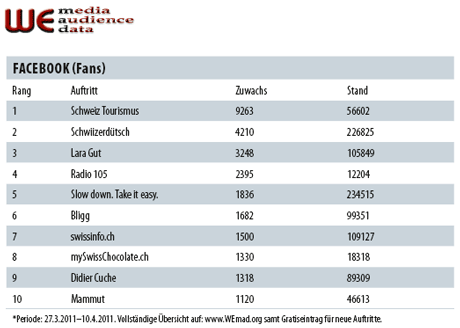
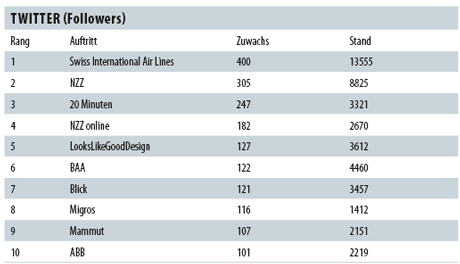
The current social media high flyers
Who has gained the most in the social media hit parade on WEmad.org in the last two weeks*.

socialmedia1
socialmedia2

Mini Case Studies
Topics relating to the professional use of social media are omnipresent. Much is new and proven recipes for success are scarce. That's why Werbewoche is publishing a series of mini-case studies to provide insights into everyday work with social media channels and thus contrast the pure numerical statistics surrounding fans and followers.

So far, these posts have appeared in the social media portrait series:
"Slow down. Take it easy": Werbewoche 06/1.4.2011,page 31
 

Media Focus: Excellent advertising market trend in March

The advertising market trend looks excellent following the close of the first quarter of 2011. With over one billion Swiss francs in gross advertising spend, Q1 2011 closed at a high level, surpassing the corresponding periods of previous years.

According to Media Focus statistics, the volume of advertising in March 2011 exceeded CHF 403 million. Compared with the same month last year, this represents a slight decline of 2.3 percent and a drop of CHF 9.7 million. Overall, over the first three months of 2011, the top three sectors of vehicles, food and retail accounted for around one-third of the advertising print. This is according to a press release issued by Media Focus on Thursday,

Compared with 2010, advertising pressure in the areas of vehicle advertising and cross-sector product range and image advertising in the retail trade was increased by 17.4 percent and 20 percent respectively. The measured advertising franc for food was just able to maintain the previous year's level. In the first quarter of 2011, small cars made it big. Within the passenger car sector (NEW), they pushed SUVs + SUVs into second place with an advertising print of just under 14 million Swiss francs. The lowest advertising print was recorded by the luxury class with a drop of 21 percent compared to the previous year. In the retail trade sector, advertising for mail order, shopping centers, retail, department stores and kiosks + stores accounted for just under a third of the sector total for the first quarter. More than CHF 57.6 million, or over 73 percent, was spent on advertising for major distributors.

It is interesting to note that advertising pressure for cross-sector product range and image advertising by major distributors increased by almost 30 percent compared with the first quarter of 2010, with an increase of 13 million Swiss francs, but the figures for the other areas of the sector remained almost identical.

As of March 31, 2011, the daily, regional weekly + Sunday press outperformed the TV media group by almost CHF 10 million. While the two media groups were still in a neck-and-neck race in January and February, the daily, regional weekly + Sunday press pulled ahead in March, closing the month with gross advertising revenues of just under CHF 129 million. TV reported around CHF 118 million in March 2011.
 

Combined instead of either - or

EGL makes its annual reporting easily accessible through an integrated online-offline approach.

Online or print? Many communications managers face this question anew every year. EGL, an energy trader operating throughout Europe, opted for an integrated online-offline strategy. A look at a tailor-made strategy for success. 

As an energy trader, EGL keeps its finger on the pulse of market developments every day—and understands the importance of having information readily available. To best meet its target audience’s need for accessibility, EGL aims to make its reports increasingly available online and as a working tool.

Initial costs refinanced

schneiter meier’s new concept therefore focuses on the online annual report rather than developing an online adaptation of the printed annual report. The additional effort required of the client was kept to a minimum, as the existing copywriting process was retained. The content was condensed for media-appropriate presentation and adapted to a new reader flow, content structure, and narrative structure. Furthermore, the initial financial investment was largely offset by the reduction in printing costs.

Modular and expandable with multimedia capabilities

All legally relevant information from the annual report remains available for download as a PDF on the EGL website. Another strength of the concept is that it can be efficiently expanded over the next few years with multimedia modules. Gradual expansion—for example, through CEO interviews—can also lay the foundation for the multimedia expansion of corporate communications.

People actually read these annual reports

«The positive feedback shows that the concept has struck a chord—in its language, reader experience, design, and aesthetics,» explains Philip Meier, CEO of schneiter meier. The wait-and-see attitude of recent years is now a thing of the past, and clients are realizing that a stronger online focus is both feasible and sensible. This is because media-optimized presentation and narrative structure in online annual reports greatly improve accessibility.

Target Audience Needs as a Starting Point

Schneiter Meier does not follow a standard formula in its conceptual approach; on the contrary, the starting point is always the client’s goals and the readers’ needs. Based on this analysis, Schneiter Meier Külling develops a customized solution for each client.
Gregor Herbst

Schneiter Meier increases the corporate value of its clients: As one of Switzerland’s leading providers of brand development and management, schneiter meier has been creating nationally and internationally successful brands for its clients for over 20 years through strategically sound brand consulting and design services.


Advertising agency: Campaign for burgers and meatballs from Bell

The Swiss Advertising Agency is promoting Bell’s burgers and meatballs, which are now also available with poultry. Designed to be visually and verbally eye-catching, the campaign aims to appeal to consumers who enjoy eating burgers and prefer to make them at home.

With ingredients that suit their personal taste. So what could be more obvious than to tell them exactly that? "Make your own burger" is therefore the slogan on the subjects of burger and meatball creations with names inspired by well-known burger suppliers. The campaign with four different subjects of burger and meatball creations is being used throughout Switzerland.

The motifs will be displayed for two weeks as bus and streetcar posters and for four weeks in various print media with advertisements. An OnPack leporello on all burger and meatball products will draw attention to the competition on Facebook and the entire product range.

Maxomedia is responsible for the implementation and programming of the online presence. The competition under the motto "Make your own burger and win" takes place on Bell.ch and is communicated on all advertising media. Consumers are asked to create their own burger, photograph it and post it on Facebook. The Facebook community and the Bell jury will choose the winner together.

Responsible at Bell: Davide Elia (Head of Marketing/Communications), Ramona Baumer (Project Manager Advertising Marketing/Communications), Micha Roth (Project Manager Marketing), Renato Zeller (Webmaster). Responsible at Werbeanstalt Schweiz: Reto Dürrenberger (strategy), Melanie Nolte (consulting), Sarah Hiltebrand (CD), Mike Surovka, Daniele Pucci (art direction), Beat Fedier, Claude Catsky (text), Andi Laub (DTP). Responsible at Maxomedia:  Christian Achter (Technical Management), Patrick Lauterburg (Frontend), René Schwarz (Consulting). Photography: Eugen Leu & Partner. Image processing: Felix Schregenberger.
 

Urs Wyss photographs for Besi Esec

Urs Wyss, the internationally active Swiss photographer, realized key photos for the industrial group Besi Esec, which are used internationally in various media.

The industrial group commissioned the photographer with the task of creating images with movement and dynamics. Certain areas of interest to the competition were not to be visible. Together with those responsible at Besi Esec, Urs Wyss opted for the motion blur technique, a targeted use of dynamic motion blur. This is achieved by moving the camera so that the defined part of the image section disappears in the "blur".

Urs Wyss also used the motion blur technique to put the management in the right light for a portrait shoot. Besi Esec began his collaboration with Urs Wyss in 2007 and this project marks his fourth shoot.

Responsible at Besi Esec: Frida C. Hirt (Communications Manager).
 

The brand builders

Fashion is the passion of Stefan Andorfer and Denise Ender. Together they run the Davilla advertising agency, which specializes in print advertising for fashion, lifestyle and sportswear. At Davilla, everything revolves around the brand - because that alone makes the difference when it comes to comparable offers. That's why every advertising campaign has to fit the brand one hundred percent. Davilla makes sure of that.

kdw
Fashion is not for conflict-avoiding, harmony-addicted advertisers." Davilla's credo pops. But Stefan Andorfer (47) and Denise Ender (37) are not trying to provoke with this statement. They are simply convinced that fashion advertising needs clear differentiation and radical paths, far away from the cuddly course on which average advertisers navigate with their clients. "Building and managing a brand is actually quite simple," says Andorfer. "The quintessence of a true brand can be stated in three sentences. You have to recapitulate these again and again to check whether planned activities fit the brand." When fashion designers focus on their collections quarterly or semi-annually and discuss colors and cuts, Davilla sees himself as a guardian of the brand. "Many who try to be a brand keep destroying themselves with inappropriate actions," Andorfer knows. Of course, Davilla doesn't influence his clients' collections. But Andorfer and Ender make sure that the focus of a campaign is not exclusively on the latest designs, that the brand remains at the center. With this focus, Davilla provides its clients with the complete design of campaigns, brochures or magazines, from concept to shooting to the finished product. The agency would also be the right partner for a young designer who wants to build his brand first. "We offer support there, too," Ender emphasizes. "We know about brands and what it takes to get a start-up off the ground."

Davilla was founded by Andorfer in Bregenz in 1991. "Davilla means Andorfer in Italian," the founder explains the agency's name. "My father is South Tyrolean and there they used to translate German names into Italian. So for fourteen days we were called Davilla. As a child, I often heard this story and I just liked the name." For 15 years, Davilla was a normal advertising agency with no specialization. Andorfer advertised very successfully for clients such as Swatch, ABB, the Vorarlberg state government and Migros. Ender joined the team in 2005. She brought with her extensive experience from the fashion industry, and so in 2006 Andorfer and Ender decided to say goodbye to the belly-loading system and to focus in future on print advertising for fashion, lifestyle and sports. Only ABB, a long-standing customer, remained in their portfolio. "We already had a few clients from the fashion industry for whom we were already managing great projects," says Ender. "It made sense to specialize in this field instead of trying to serve everyone on a one-size-fits-all basis. In fashion advertising, there are so many nuances and subtleties, something is always changing. We thought it made sense to focus on that." Today, Davilla works in Germany for Ara Shoes, fashion and lifestyle house Breuninger, Burlington and Hudson, Romano Accessories, and hosiery manufacturer Kunert. In Austria, Davilla advertises for Estebe Menswear, Hefel comforters, Huber lingerie, Revital and fashion house Strolz, and in Switzerland for L'hommage men's cosmetics and Schlossberg bedding.

Leg Bregenz, leg Switzerland

Davilla's expansion to Zurich took place in 2005. "Bregenz is far from the action and not very well connected," Andorfer explains. "We both have a good relationship with Switzerland and Zurich is a great city, the smallest big city in the world. We found: An optimal starting point." Not only Davilla's Swiss customers, but also the German and Austrian ones welcomed the choice of location.

Andorfer and Ender employ eight people, seven in Bregenz and one in Zurich, and the agency even has its own illustrator. However, Andorfer and Ender hire final artists, photographers and copywriters as needed. And even when it comes to programming websites, the two bring in specialists. This means they can always rely on state-of-the-art professional work. Andorfer commutes back and forth between the Bregenz and Zurich branches, while Ender works mainly in Bregenz. And of course they are both on the road a lot, especially when shoots are scheduled. The photo shoots often take place in studios in Vienna, Lucerne, Zurich, Hamburg, Munich, Berlin, London or Milan, but occasionally also outdoors, for example on Mallorca, in Cape Town or Lech am Arlberg, where the crew was snowed in to the hilt in April 2010, even before they could take the first pictures. "For us, it's not just locations in the far south that are important, but also those in the regions where our customers are rooted," emphasizes Andorfer. "Especially with Swiss clients, we try to stay in Switzerland with the shoots. The regional reference is very important here."

Andorfer and Ender handle around 25 shoots a year with twelve different photographers. During the photo shoots, a storyboard specifies in detail how the makeup and hairstyles must be, which colors and accessories may be used, which positions the model must take and how she must be photographed. Every step is meticulously prepared so that there are as few surprises as possible on set. Nevertheless, there are regularly. Says Ender, "One or more representatives of the client are always present at the shoots, and every time at least one of them comes up with something creative on the spot." For example, during a shoot in the Maggia Valley, a sporting goods supplier came up with the grandiose idea of photographing a pair of skis on a rock. That may look nice. But anyone who skis knows that there are few things worse than scraping over a rock with your skis. "Sometimes shoots are like a big kiddie garden, where it's difficult to stick to the line we've discussed," Ender says. "But that's crucial for brand management. We also put up with friction with our customers because, after all, our job is to ensure the brand's image. If one of the team didn't keep calling everyone on their way, there would be chaos." In an emergency, Ender refers to the storyboard that has been approved by all sides. So far, she has been able to recapture every client who was bubbling over with ideas.

Of course, Andorfer and Ender need a lot of intuition for fine-tuning with their clients. They often use a simple trick to convince clients of their approach: they not only photograph subjects as they imagine them, but also try to capture the client's ideas in the picture at the same time. "We do that with the first shot, with the second one as well, and by the third one, time is already threatening to run out because another seven shots have to be done on the same day ..." says Andorfer. "But often the client only recognizes which approach is the better one through this concrete comparison of the shot material." Some clients also get impatient when Davilla chooses the same visual language for several consecutive shoots. They constantly want to change things up, innovate, place new accessories. "Watch out," Andorfer warns. "It takes at least three years for the visual language and the message of a campaign to reach the consumer. So a company needs a bit of patience until its campaign makes an impact, until trust in a brand and its products has grown."

The two advertising professionals also have to keep a tight rein on their photographers. Andorfer: "If you tell a photographer after the first picture that this is already super, then he shoots down the next pictures exactly according to this mode and everything really always looks the same. We're the ones who say, 'Stop, this can be better, this can't be it yet.'" Last but not least, Andorfer and Ender also have to worry about the well-being of their models. When the entire crew was snowed in in Lech, some of the models panicked because of the four-meter-high snow. That's when it was Denise Ender's job to calm and comfort. "It was a great April in Lech," she says looking back with a laugh.

The advertiser and the fashion expert

Stefan Andorfer was born in Dornbirn, Austria, in 1963. As a boy, he dreamed of becoming an aircraft engineer; as a teenager, he wanted to study architecture. But Andorfer's parents intervened: The job prospects for architects were poor. So Andorfer studied economics in Innsbruck, a rather interesting course of study, as he found. Specializing in marketing is at least a ray of hope, which then determines Andorfer's further career path. After graduating, he worked for two years in an agency, then, at the age of 28, he set up his own advertising agency, Davilla. So this year Davilla celebrates its 20th birthday. "From the very beginning, I had the ambition that my clients get more than advertising from me," Andorfer says. "Because advertising, in my eyes, is only meaningful if it pays in for the brand." Andorfer's role model is New York star advertiser David Ogilvy. That makes further explanation unnecessary.

Denise Ender was born in St. Gallen in 1973 and even as a little girl she knew: I want to be a graphic designer. "For me, graphic design is not just a job, I live it, it's part of me." Ender is fascinated by the consistent, straightforward work of Austrian graphic designer Stefan Sagmeister, whose designs adorn the CD covers of the Rolling Stones, Lou Reed and David Byrne, for example. After graduating from high school, Ender attended the Advertising Academy in Vienna for two years, then went to Milan, first to the Istituto Superiore di Comunicazione and then to the Istituto Europeo di Design, where she earned her master's degree in graphic design. She then worked for two years in New York at a design agency specializing in fashion and perfume brands. There she produces newsletters and magazines for Clarins, Chanel and DKNY. After so much abroad, home calls again in 1999: Ender works for seven years at her father's advertising agency in Au SG and in Lustenau, Austria, which she is supposed to take over. But things turn out differently. In 2002, at the anniversary event of a magazine, Ender meets Stefan Andorfer, one of her competitors. Nevertheless, everything fits. A short time later, Ender joins Davilla.

The difference between bikini and screw

Davilla has a very unique signature. The agency's images should be very aesthetic and stylish, while remaining natural and emotional. "We want skin to still look like skin, for everything not to be smooth and artificial, for fine hairs to be visible on the face, and for it to still look beautiful," Ender emphasizes. "If faces and bodies are retouched to death, no consumer can identify with it anymore." Davilla intends to continue on his path of specializing in fashion photography with an almost artistic ambition over the next few years, and an expansion of the Zurich branch is on the cards. Consistently, Andorfer and Ender turn down requests from representatives of other industries who like the agency's style of imagery. "Emotions are 'in' these days, and even technical companies want photos that lend emotion to their screws or engines," Andorfer says. "But we're definitely not the right people for that."

And then the two fashion experts have another dream in common, which they hope will become reality in two to three years: "We have been working with a lot of energy for some time now on two projects that are very close to our hearts. If everything works out the way we imagine, we'll suddenly be our own customers and no longer have to rely on convincing our clients of our definition of quality." The two don't want to reveal more at the moment. But apparently they are in the process of building two brands of their own. We'll be hearing more from them soon.

Andorfer and Ender also have something in common: their two children Anna (4) and Paul (2). The two advertisers are not only a good business team, they are also involved in a private relationship. In their often limited free time, they have no time for skiing or cross-country skiing. Instead, they enthusiastically attend exhibitions and art openings. And then their kids are also part of the party.
Anne-Friederike Heinrich

In a nutshell
Denise Ender
*16.10.1973 in St. Gallen
1993-1995 Advertising Academy, Vienna
1995/1996 Master of Graphic Arts, Istituto Superiore di Comunicazione, Milan
1996/1997 Master Art-Direction, Istituto Europeo di Design, Milan
1997-1999 Design agency 360° Degrees, New York
1999-2006 Ender Advertising, Au/Lustenau
since 2006 Managing Director Creation Davilla, Bregenz/Zurich

Stefan Andorfer
*19.4.1963 in Dornbirn (A)
1981-1986 Studies of Business Administration, major in Marketing, University of Innsbruck
1989-1991 Konzett, Bregenz
since 1991 Founder and Managing Director Consulting Davilla, Bregenz/Zurich
www.davilla.com
 

get_footer();