Energy shower at the expert seminar

A lot is expected of future marketing experts. So it's only right that the experts also keep up to date. Around 70 marketing experts in the field of presentation and communication techniques attended an expert seminar on presentation skills. Speaker Brigitt Walser astounded, educated - and enthusiastically demonstrated the topic herself.

Anyone expecting answers from the speaker had to retrain right at the start. Because Brigitt Walser, business coach and TV presenter trainer, first had a bunch of questions for the audience: "What do you think my training is? What do you think my favorite sport is? Am I single, divorced or married? With a man or a woman?" The fact that Walser began by focusing on an unusual interrogative made perfect sense: "Everyone forms an image of their counterpart or a messenger at lightning speed," explained the communication trainer, "and congruence only arises when the messenger and message match. Anything else is irritating."

Key values Authenticity

Walser launched the topic just as quickly as we form an image of our new counterpart. A topic, said Peter Gilli, that deserves the highest relevance: "Appearance skills and the associated authenticity - these are key values in any presentation. What good is a glossy presentation if it is delivered with little credibility and no energy?" For the marketing expert examiners of the "Presentation and Communication Techniques" subject, this was therefore a priority. Around 70 experts came to get an update in this sector.

After Walser had solved the puzzles she had posed - she was an actress for 15 years, enjoys yoga and biking and is married (to a man) - she turned to the topic of energy. And before that, she highlighted a shortcoming in Corporate Switzerland: Companies in our latitudes have probably made huge progress in the technology and structure sectors in recent years, but have tended to forget about people - the weakest link in the chain. When a Walser deals with the subject of "energy", she does not do so passively. There was hardly a moment when she herself was not standing on a chair or the visitors had to become active themselves. Brigitt Walser - a Red Bull_bunch of energy on two legs. The energy level in the room was noticeably increased with the first exercises. For example, when the participants first had to study each other closely in pairs, then turn their backs on each other, change three things about themselves and then ask the other person to look for the changes. The effect: those who concentrated on all the details during sampling were often no longer able to name major changes afterwards.

Activate the inner smile

Brigitt Walser had an easy time with the experts present. Instead of being skeptical about the sometimes unusual methods used by the communications expert, the six dozen people in attendance joined in wholeheartedly and did not miss the opportunity to gain new insights. Walser's message was not dissimilar to that of the voice coach who held a seminar for marketing specialist examiners last year. The message itself is one part, but how it is delivered vocally is just as important - that was Michael Berndonners message in 2010. Brigitt Walser followed on from this in 2011: The content of the message is one thing - but the nature of the messenger, their energy, commitment and emotion - is much more important. "The messenger is the message" - everyone was sure to take this mnemonic home with them. "90 percent of communication between people happens purely at the energy level," Walser reminded those present.

But where do you get the energy you need to communicate convincingly and enthusiastically? How do you manage to let your inner smile glow reliably and successfully despite the many small sources of annoyance during the working day? On the one hand, through a whole series of physical exercises, but also by knowing yourself and being able to assess yourself well. For example, you can put yourself in a positive frame of mind by thinking about your last vacation. Or by imagining how you will reward yourself after the presentation. Or by listening to music that inspires you before your performance. What Brigitt Walser also found important was the silent power of compliments. In the business world, people too often assume that no news is good news. But if a sincere and precisely worded compliment is delivered, "it opens doors and hearts". Naturally, this was also practiced immediately in the hall, which was getting closer to the outside temperature of 24 degrees every minute.

Retrieve personal peak performance

But what if, at certain times, your energy never wants what your head wants? It can be worth getting to know your own energy rhythm better. The testers, for once subjects of themselves, filled out energy charts for themselves. And realized: hardly anyone has the same energy curve as their counterpart. How do you deal with this? By getting to know yourself better and scheduling rather monotonous tasks, such as checking emails, for those phases of the day when your energy levels are below average. Creative and conceptual activities should therefore be shifted to high-energy phases. "Energy competence also means," said Walser, "being able to get through the working day despite personal energy fluctuations." This also includes closing your eyes for a moment, because the vast majority of work today is done through the visual channel and it can make sense to activate your other senses from time to time.

Conclusion of Walser's energy shower: People often go into a presentation too unconsciously. It is important to keep an eye on emotional coherence - and to prepare for it. If you want to motivate with a speech, for example, you should also radiate motivation. If you have delicate messages to convey, you need to come across as credible. The interactive workshop made it clear how you can reach your personal peak performance through holistic preparation, how you can achieve what is so often mentioned in sporting circles: Calling up your best performance.

Direct applicability

The experts, who have certainly all experienced plenty of presentations, were given a proper energy splash. Which was exactly what Peter Gilli wanted. The head of the "Presentation and Communication Techniques" exam for marketing specialists was pleased with the lively, informative and sometimes somewhat unorthodox way in which speaker Brigitt Walser got her message across. The energetic event, which was anything but a "revision course" but rather a seminar with a refreshing and refreshing character, fits in with Gilli's line and the way he sees the professional examination for marketing specialists with a federal certificate and their examination professionals: "It is important that the experts - just like the candidates - prepare intensively for this federal professional examination, which is carried out by Swiss Marketing (SMC) under the supervision of the Federal Office for Professional Education and Technology OPET. Today, the experts were once again able to professionally raise themselves to the desired level, learn new things and gain important insights that can be directly applied in the exams. That's exactly how it should be."

Before the seminar room began to steam up, everyone moved outside. An aperitif awaited them there, which encouraged enjoyment and networking. For once, everyone's personal energy levels had probably peaked on this instructive day.
marketing_0

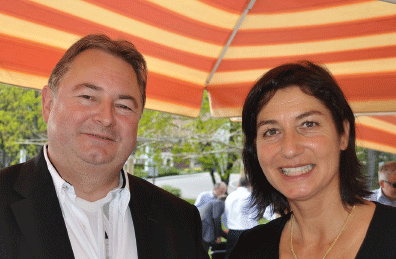
Here's to good cooperation: Peter Gilli, responsible
Head of the Marketing Specialist Examination Subject
Presentation and communication techniques with speaker
Brigitt Walser.

 

Questions are welcome

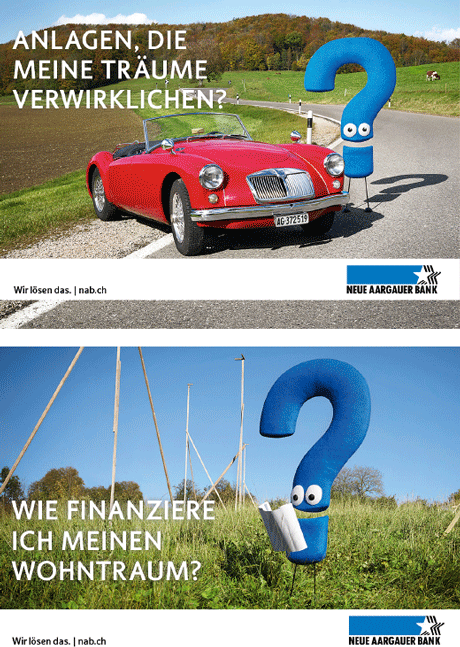
Euro RSCG has created a fresh new look for Neue Aargauer Bank (NAB) that strays somewhat from the well-trodden paths of banking advertising. At the heart of all the ideas and communication efforts is a question mark.

Neue Aargauer Bank (NAB) is going on the advertising offensive with a fresh image and a broad-based campaign by Euro RSCG. At the top of this campaign, a blue question mark serves as the new symbolic figure. This is representative of all kinds of financial questions that customers are concerned about. NAB offers competent answers to these questions and promises this with the claim: "We'll solve it." Beat Ruch, Head of Marketing Communications at NAB, answered a few more questions about the idea.

WW: How can you build trust with a question mark as an advertising figure?
Beat Ruch: The campaign strategy is based on the insight that at the beginning of a need there is a question. For example: How do I finance my dream home? How do I make the right provisions? However, these questions are not asked by people, but by a key symbol that stands for NAB's three core competencies: solution leadership, advisory expertise and innovative strength. To differentiate itself in bank advertising, the agency created an advertising figure. A question mark that embodies the needs of the target group. It asks financial questions that ordinary people also ask themselves.

In recent months, various banks have had to put up with uncomfortable questions. Can't it be dangerous to advertise a bank with a question mark?
Quite the opposite. We look forward to daily contact with our customers. Because that way we can prove our performance promise "We solve that" in practice. Certainly, the new appearance will provide a certain polarization. With the key visual "question mark", NAB communicates in a very innovative and in a rather untypical and thus strongly differentiating language in the banking world. This is precisely where I see the opportunity, because only advertising that is seen and also conveys relevant messages moves something in the market. And this rule certainly also applies to banking communication.

A question mark instead of satisfied smiling customers: What do you personally like about this concept?
The process from strategic campaign development to creative implementation took almost twelve months. An intensive time of daily interplay between head and gut work and of rational and also emotional persuasion to leave the "learned" path of classic banking and service communication. Based on the result, I am very proud that Neue Aargauer Bank has decided to take this courageous and differentiating step in all consistency. Consistent in every respect, because the question mark was also fully integrated into the new www.nab.ch website. The positive, in some cases even euphoric, internal and external reactions directly to the management prove us right and I personally like it quite a bit.

Is the question mark used in the longer term?
The question mark currently characterizes all our communication measures - cross-media and fully integrated. In the course of the year, further ideas will follow, which will bring NAB's services and events in the canton of Aargau into the conversation. In the future, we will also rely on the quick recognition value of the question mark. Interview: Andreas Panzeri

fragezeichen1
fragezeichen2
 

Questions about the doctor's certificate

How quickly can an employer request a medical certificate from an employee, what does it say and what should be done if anything is unclear? Answers to frequently asked questions about medical certificates. By Gabriela Baumgartner (lic. iur., LL.M.), lawyer for the Beobachter Consulting Center and employment law specialist. In addition to this work, she lectures on employment law for managers in the healthcare sector.

If an employee is unable to work due to illness, they are entitled by law to continued payment of wages for a limited period. However, at the request of their employer, employees must prove that they are ill. In most cases, a company will ask for a doctor's certificate. According to the law, the employer may request a medical certificate from the first day onwards. Many individual or collective employment contracts contain a provision stating that the certificate only has to be submitted after 3 or 5 days. If this is the case and the employer has doubts about the employee's incapacity to work during this period, he must be able to justify his concerns.

What happens if there is a disagreement between the trusted doctor and the family doctor?

The question of whether the employer has the right to send an employee to a medical examiner if they have doubts about a medical certificate is still controversial. To prevent conflicts, it is advisable to stipulate this obligation in the employment contract or company regulations. The costs of a medical examination are borne by the employer. If, after examining the patient, the medical examiner comes to a different conclusion than the family doctor, two so-called party claims are legally opposed. It is then up to the judge to assess this evidence. In practice, it can be helpful to confront the family doctor with the different findings of the medical examiner and ask him for a statement. It should be noted that both doctors, the medical examiner and the family doctor, are subject to a duty of confidentiality with regard to diagnosis and treatment. They may only provide information that is related to the fulfillment of the employment contract, for example, whether the employee is restricted or able to work on another task.

Doctors often write their patients as partially unfit for work. But what does "50% unfit for work" mean? Unless the doctor states otherwise, the employer may assume that the percentage refers to the time restriction with the same performance and not the reduced performance with the same working hours. According to a ruling by the Zurich High Court, the percentage stated in the certificate always refers to a full-time workload. A part-time employee with a 70% workload is therefore able to perform 50% of a full-time workload in the event of a fifty percent incapacity to work.

When sick employees still work or submit certificates late

But what happens if an employee who is one hundred percent on sick leave comes to work anyway? Has he thereby proven that he is still fit for work, contrary to the medical certificate? Not in every case, says the Federal Supreme Court. But only if it is only an "insignificant impairment of health". In all other cases, the employee is considered unfit for work, which means that they may not be dismissed during this period until the end of the qualifying period. According to the Swiss Code of Obligations, a dismissal is null and void if it takes place while an employee is on sick leave and must be reissued after the qualifying period has expired. The situation is similar if an employee submits a certificate too late. Here too, the decisive factor is whether the employee was demonstrably unfit for work at the time of termination. If the employee can prove this, the dismissal is null and void, even if the medical certificate is submitted later.

Do you need legal advice?

The Beobachter Advisory Center offers you and your employees expert advice by telephone on legal issues relating to your company - 6 months for just CHF 99. Order the consulting package for SMEs at www.beobachter.ch/kmu or 0800 83 0800.

Book tip

Labor law, from the contract
until termination, 11th, expanded and updated edition, March 2011, Beobachter Verlag, CHF 36.-, ISBN 978-3-85569-440-2

beo
 

Letter to the editor: The Motz of Butz from April 1, 2011

Dear Mr. Butz We read your latest complaint. At first, we thought it was an April Fools’ joke. Upon reading it a second time, we came to the conclusion that, if anything, it was a bad joke.

Admittedly, this is from a subjective point of view, as a contracting organization/member of swissdirectmail and SwissMail - the private postal service and therefore also in the interests of our clients.

In your article you get upset about unaddressed, poorly produced advertising and announce that 20 years ago you advised customers to produce a TV commercial instead of having brochures distributed. A statement from a former star advertiser that is quite astonishing, as you must have earned good money with this "junk", as you disrespectfully call it!

You should know that television advertising is not suitable for all products and that small and medium-sized companies cannot afford it. More importantly, as an advertiser, it is up to you to make unaddressed advertising upbeat, interesting and exciting for your customers instead of demonizing it. In addition, you may not belong to the target group of Vögele, Lidl and Möbel Märki, but many other people do. In general, however, it can also be said that the unspeakable and long commercial breaks on television annoy many viewers and are therefore zapped away! In contrast, unaddressed and addressed commercials have the unbeatable advantage that they are watched when the reader has the time and inclination to do so. So much for your suggestion "entertaining advertising on TV with flip and success".

As we all know, there are two sides to everything in life. The other side of advertising mailings is that many jobs depend on them - from the client to advertising agencies, printing companies, the paper industry and contract organizations. Your call for a boycott of direct mail will result in the loss of numerous jobs in Switzerland. Which will hardly be in the interests of all parties involved.

Last but not least, a word about your planted tulip bulbs, which hopefully have now developed into full-grown tulips and will give you much pleasure. Instead of ordering them on the Internet (directly from Holland?), we suggest that you visit your local nursery or specialist market next time and support local suppliers, some of whom also advertise their range of products and services.

Your
AWZ AG
The Swiss direct advertisers since 1895
 

Last but not least: Are media the new cigarettes?

Most students around the world appear to be addicted to media. Withdrawal from media—cell phones, Facebook, and MP3 players—led to an emotional crisis. These were the findings of a study conducted by the Salzburg Academy on Media & Global Change at the University of Maryland.

To investigate this, 1,000 students from ten countries gave up their cell phones, laptops, televisions and MP3 players for just 24 hours. They wrote down their experiences. The media deprivation led to emotional chaos in students, which was described with the adjectives "angry, anxious, insecure, crazy, lonely, unfree, nervous and depressed to paranoid", according to the study's press release. Study director Susan D. Moeller reported that the most surprising thing was that despite differences in cultures, economic situations and political systems, the consequences of media deprivation were the same everywhere. The study was carried out in Argentina, Chile, China, England, Hong Kong, Lebanon, Mexico, Slovakia, Uganda and the USA. Most of the participants were bored and had problems filling empty hours with other activities. A few reported positive effects of online abstinence, such as better self-reflection, higher quality of direct encounters and even a return to simple pleasures.

It seems as if a new era has dawned: away from the stigmatization of all smokers and towards the fight against the new media - the new addiction. In Germany, and on the web, an association has already been formed to combat this addiction. It calls itself "Active against media addiction". In an interview with Pressetext, Christoph Hirte from this association describes the problem as follows: The misuse of electronic media has long since become a wildfire and a widespread disease for an entire generation. Not only does it take away concentration for everything else and impair writing and speaking skills. It also demonstrably reduces the work performance of one in three people. According to Hirte, society is suppressing the problem. This is due to economic interests. Even though every family is affected.

Armin Koeppe from the German Center for Addiction Issues sees the concept of addiction in the media primarily as being appropriate for online gaming, online sex and online betting addicts, while addictions to everyday use are difficult to assess. As he told Pressetext, even students on vacation are happy not to be reachable all the time. However, it always makes sense to regularly review your own relationship with media by consciously giving it up, just as you would with sweets during Lent.
 

Fukushima: With and without experts

A disaster changes the world. People have questions and want answers. At first, experts are called upon to explain the situation, but then they disappear. Are they even necessary? Guest commentary by Hans Stutz, freelance journalist.

One Friday, exactly two weeks after the tsunami, I meet a friend. She is worried: the Fukushima catastrophe, lots of news snippets, a nuclear power plant operator that only provides information in dribs and drabs and experts who can't be trusted.

I have little objection to this: During the various rounds of cost-cutting in recent years, many editorial offices have outsourced the explanation of the background to experts, and in the debates all of them are lobbyists - either one of them is in favor of the construction of nuclear power plants or he opposes it. However, the thinning out of editorial teams has also led to a loss of specialist knowledge, and colleagues who are familiar with the subject of nuclear technology and the nuclear industry are usually absent.

My friend then reported that Fukushima had left her no peace, she had researched online and came across images showing that all the reactor buildings had been largely destroyed. (This was not yet public knowledge at the time.) She was convinced that a lot of radioactive material would soon leak out, especially into the sea.

I insist that she should tell me the sources. I know that rumors and conspiracy fantasies thrive in times of uncertain news. The following days confirm most of her fears.

So have the Swiss media failed?

Let's look back. In the first few days of the Fukushima disaster, Swiss media also reported extensively, persistently and up to date. Although the news situation is poor, this is not surprising in the case of a major disaster. Independent media professionals are also unable to work on site.

However, it soon becomes clear to the observer that both the nuclear power plant operator Tepco and the Japanese authorities are either playing it down or are overly hopeful when it comes to planned rescue measures. Based on little information, experts have to make assessments, and they usually do so cautiously, sometimes even dismissively. In Switzerland in particular, it is predominantly men who work in the nuclear industry or who generally monitor it benevolently.

But the experts are gradually disappearing from the news programs. The media are still broadcasting the daily agency reports, occasionally also texts from correspondents. They all summarize little more than the Japanese news situation: the catastrophe is progressing, placated by the "cartel of government and media". According to correspondent Martin Kölling, in an effort to prevent panic, the Japanese media "voluntarily joined in".

In plain language: the deliberate Japanese disinformation is reflected in the Swiss media - with hardly any questioning. The basic tenor is that although there are major problems in Fukushima, there is no danger to the population. The radioactive water discharged into the sea is quickly diluted there, so there is no cause for concern. As is often the case, calm should be the first civic duty.

A report from Bavaria fits in poorly with this: many wild boars have to be disposed of. They are radioactively contaminated because the soil contains caesium-137 and accumulates in mushrooms, which wild boars like to eat. The nuclear cloud after Chernobyl deposited a lot of waste in the soil over southern Germany.

So what about the current conditions in the Pacific Ocean? And how does the food chain work there? Is there even an expert on this? Or will the Fukushima disaster now become a large-scale scientific experiment that experts will only be able to report on with certainty in a few years' time?

The conclusion is contradictory. Fukushima news without further explanations from experts turned Swiss media into loudspeakers for the trivialization strategy of the Japanese nuclear power plant operators and the government. However, the catastrophe has now reached such proportions that no expert can yet estimate the long-term consequences with any degree of reliability.


Superhuman powers

Ochsner Sport, the industry leader in Swiss sporting goods retail, is turning 50 and is celebrating its anniversary year in 2011 with a record-breaking campaign by Wirz.

Ochsner Sport is celebrating its 50th birthday with a year of records. With "record-breaking offers and promotions", customers will always have something to celebrate in 2011. For the matching campaign, the Swiss ski stars of the Ochsner Sport Racing Team show that Ochsner Sport is not the only one giving its all in the anniversary year. The campaign by Wirz includes a variety of measures from advertisements and brochures to POS and TV commercials. The protagonists Carlo Janka, Daniel Albrecht and Didier Défago did not stand on every podium in the last winter season. However, the team is fully convincing in the campaign. To this end, Wirz has transposed the previously used idea of "fighting against oneself" into a new dimension. "The sporting experience was dramatized to the extreme," explains CD Thomas Kurzmeyer. The ski stars sponsored by Ochsner can be seen using completely new, but "guaranteed effective" training methods.

Year of records

"Associating the ski stars with Ochsner Sport in a new way, even detached from skiing, is a step in a new direction and also a great benefit for the campaign, as our athletes perfectly embody the anniversary motto," says Patrice Dupasqier, CEO of Dosenbach-Ochsner. For the athletes themselves, the new campaign offers a unique platform, as they will be present in Ochsner sports communication throughout the year. The first Ochsner TV commercials to be broadcast throughout Switzerland were filmed in Mallorca this winter. A crane was brought in especially for the scene where Albrecht had to carry his colleague Janka up a mountain in a rucksack. But Albrecht carried Janka, who weighed 95 kilos, without any problems, even without this aid. Nobody from Wirz's creative team wanted to reveal how the record-breaking training scene with the water skiing came about. Andreas Panzeri

History

Since the opening of the first Ochsner Sport store in 1961, founder Max Ochsner has had the same idea as all passionate athletes: to win victory after victory and one day be at the top! In the first three decades, the company gained respect in the market with six new sales outlets, but Ochsner Sport wanted more. The merger with Dosenbach and Deichmann followed in the nineties. Today, Dosenbach-Ochsner AG is part of the Deichmann Group, headquartered in Essen (Germany). They are the largest shoe retailer in both Germany and Europe. Internationally, the Deichmann Group sold around 152 million pairs of shoes in 19 European countries and the USA in 2010. At the end of 2010, the Group operated 2939 stores worldwide.

Ochsner Sport is the largest sporting goods retailer in Switzerland with over 90 specialist stores. Around 1500 trained sporting goods sales staff "give their all to provide personal, expert advice and first-class service". Five new openings are already planned for 2011 in all parts of Switzerland.

ochsner1
 

Publisuisse with successful business year 2010

Publisuisse closed out the 2010 fiscal year very successfully, with operating revenue of 311 million Swiss francs—a 12 percent increase over the previous year—and net income after taxes of 1.4 million Swiss francs.

In terms of francs, the biggest contribution to this revenue increase came from TV advertising on SRG's channels. Overall, TV advertising sales generated net revenues of around CHF 300 million, an increase of CHF 33 million and 12 percent compared to the previous year. Publisuisse writes this in a media communiqué.

At plus 13 percent, TV and radio sponsorship recorded even slightly higher growth in relative terms. Net sales from this business segment amounted to around CHF 21 million. In total, Publisuisse generated net sales of CHF 322 million in the 2010 financial year. The main reasons for the increase in sales were the strong economic recovery following the global economic crisis and the live broadcasts of the two attractive major sporting events, the Winter Olympics in Vancouver and the FIFA World Cup in South Africa, according to the statement. In addition, intensive market cultivation, particularly in the area of new customer acquisition, had a positive impact on Publisuisse's sales development.

The General Meeting took note of the resignation from the Board of Directors of Gérard Tschopp, Head of Overall Project Convergence & Efficiency SRG SSR. He will not be replaced.
 

Flop of the week: Affichage shareholders demand special audit

Shareholders are fighting back at the outdoor advertising group Affichage following its loss-making expansion in Greece. A group led by investment advisors Max Müller and Antoine Spillmann has sued the Board of Directors for CHF 150 million and is demanding a special audit.

In addition, the Annual General Meeting on May 26 is to replace all members of the Board of Directors with the exception of Gilles Samyn, who has only been in office since 2008. The Group is proposing four new candidates for election. These are publishing specialist Franziska von Weissenfluh, restructuring experts Jürg Müller and Claude Piccot as well as another candidate who does not yet wish to be named, as Antoine Spillmann, head of Geneva-based asset manager Bruellan, said at a media conference. The group of shareholders led by him and Max Müller from the investment company Starlet Investment together hold a 5.27 percent stake in Affichage. The largest shareholders, France's JC Decaux and Albert Frère, hold capital shares of 30 and 25.3 percent respectively, but are only entitled to vote with 5 percent each. According to Müller, support of 10 percent of the voting rights is sufficient for the requested special audit.

PR on the Social Web: Learning from the WWF

As a representative of an endangered species and a beloved icon, the panda has been the WWF’s emblem from the very beginning. But founding father Sir Peter Scott also chose it for practical reasons: It was perfectly suited for the cost-effective black-and-white use of the logo. To this day, the panda as a design element has hardly changed, but the way the organization communicates has certainly evolved. It has become much more colorful. *WerbeWoche* spoke with Fredi Lüthin, Head of Media at the WWF, and Gabriela D’Hondt, Social Media Manager, about what PR on social media means for a nonprofit organization.

wwf

While many companies are still rubbing their eyes in disbelief at social media, WWF Switzerland no longer needs any explanation of what communication on the social web means. The non-profit organization already uses Twitter, Facebook, YouTube and Flickr just as naturally as media relations and corporate publishing. The fact that WWF sees PR on the social web as a long-term and careful commitment is clear from the following four strategic goals:

Inform: Changes in media usage mean that people are spending more and more time on social networks on the web. WWF provides them with relevant information wherever they are. And in an appropriate form, depending on the channel. On Facebook, for example, the WWF talks about its successes in the form of a quiz and then invites the community to give the panda their face.
Provide emotional and social experiences: As part of the community, users should be able to share their experiences with other members and find an ideal home where they feel comfortable, as well as having fun and entertainment.
Maintaining dialog: Web 2.0 thrives on interaction. Topics that concern people are discussed, their opinions are encouraged and exchange is promoted.
Mobilize: The web community should support WWF's goals - both in terms of environmental impact and fundraising.

It is a particular challenge to be part of the world of fans and to build a functioning community. The WWF has recognized that companies and organizations must first be guests in a community and prove themselves to be valid discussion partners. This has worked quite well so far, says Fredi Lüthin: "We are proud of our strong community on both Twitter and Facebook." For him, it is clear that a non-profit organization must be supported by volunteers, donors and other dedicated places in order to be able to act. Although the WWF gained around 170 new fans on Twitter almost overnight to mark its anniversary and cracked the 3,000 mark, those responsible remain sober. They know that a large community is not enough. It only becomes valuable when it participates. Two thirds of our fans are active and with this figure we achieve better results than many internationally active companies, says Gabriela D'Hondt.

A climate that allows for dialog

Although the WWF does not show any faces, the commitment appears very human. The panda is in the spotlight, because the primary aim is to strengthen the organization's image. Incidentally, this has the advantage that the team can be put together flexibly depending on the workload. The human touch is ensured by a very conscious use of language that is adapted to the target group. The communication managers have opted for a consistent "you" approach. They also make sure that the content is conveyed in a relaxed, fast-paced language appropriate to the target group, with a good dash of humor thrown in for good measure. Even if the WWF wants to make a name for itself, the organization - with the exception of the anniversary activities - is not permanently the focus of attention. Links to external sites are just as much a matter of course as space for other opinions. This also creates space to develop and discuss topics. Gabriela D'Hondt is convinced that the fans are engaged because they are not bombarded with marketing. Like every community, the WWF community also has particularly active participants. We know most of the key players personally, because it is important to us to strengthen and deepen online relationships through personal encounters - that is simply part of the process.

What makes social media attractive?

PR on the social web is comparatively cheap, the only thing you have to factor in is the manpower. WWF Switzerland also created a guidebook app for iPhone and Android to mark its anniversary. The organization sees the social web as an opportunity to set topics, communicate in an opinion-oriented way and react quickly and flexibly to other points of view. It is also possible to create thematic worlds in which stakeholders can settle in and get involved. In this way, the goal of mobilizing people is not lost sight of in all activities, be it with online petitions or playfully with the WWF actions on Facebook.

Changes in media use mean that people are online more and more often and are increasingly using content on their mobile phones. For Fredi Lüthin, it is clear: "I want to get to the people, and today that increasingly means: I want to be visible on their phones." He is saying nothing other than that the WWF goes where the people are, namely online. A blog is not an issue for the WWF at the moment; this is more a case of classic PR. The organization conducts extremely intensive media work with up to 80 releases per year, which has proven its worth and should remain so. Nevertheless, the next step is to create a social media newsroom, modeled on that of WWF Germany. Such a newsroom, which brings together all online activities, is not only interesting for editorial teams, but also for bloggers and other interested parties. In addition to the newsroom, increased work with videos is also on the wish list: Films allow for very emotional and informative communication.

As attractive as the social web is, it also has its limits. Facebook in particular is a constant source of frustration for those responsible: Constantly changing policies, Facebook's data claw, the Open Graph, which also gives Google access to a large amount of data, and opaque, changing algorithms for displaying posts can make life difficult for social media managers.

PR on the social web has changed the WWF

And how does the WWF measure its success? Lüthin: At the moment, we're still measuring the change in our fan and follower base, the number of 'likes', recommendations and, most importantly, the comments we receive. However, we also evaluate the links that we shorten with bit.ly. This allows us to monitor how often the link has been used. However, this is not enough for us: we are currently trying to bundle the most important values for a meaningful ROI. Monitoring is also important for the WWF: through monitoring, we not only find out which topics are current and which issues are emerging, we can also determine which waves we have made. In this sense, monitoring is part of qualitative success control for us. We also use monitoring to identify opinion leaders, who we then try to involve in our communication in a targeted manner.

PR on the social web has changed the WWF. Yes, something is happening," says Lüthin. It has become clear to us that all areas of our organization, especially marketing, corporate communications and social media, need to work much more closely together. This is particularly crucial for our campaigns, where the social web will play a very important role in the future. But we are also paying more attention to the cross-media design of our member magazine, which has a circulation of 220,000 copies. This also has an impact on internal processes.

The WWF is trying to motivate its employees to get involved. Many WWF employees are still rather skeptical about online communication. We are trying to show them through our actions that it is worth investing in this channel, emphasizes Lüthin. However, it is clear to us that the employees must recognize a benefit. They see this when social media makes their work easier, be it in research or when it comes to finding out what is on people's minds. We therefore have the clear goal of broadening our internal basis for online communication and involving employees from the various subject areas.

Getting started is easy, but sticking with it is hard, Lüthin has learned about PR on the social web. If you want to be successful in the long term, you need additional resources for social media, otherwise it won't work. It is therefore very important that communication on the social web is embedded in the entire organization and integrated into the processes.
Marie-Christine Schindler

In a nutshell
WWF Switzerland's communications department has seven employees, including one person in French-speaking Switzerland and one in Ticino. WWF is also trilingual on Facebook and Twitter on separate accounts. Today, 60 percent of staff are employed on social media, and this figure is rising, with Fredi Lüthin primarily responsible for the Twitter account and Gabriela D'Hondt mainly for Facebook. The plan is to provide broader support for communication throughout the organization.

Reading tip:
Marie-Christine Schindler (2011): PR on the Social Web. O'Reilly-Verlag; 36.20 francs.
 

To the point: Online first?

The BZ Prize for Local Journalism had been awarded for 25 years. After Tamedia acquired Espace Media, the prize seemed to lose some of its appeal.

Many saw the prize as a pure marketing tool, and some newspapers did not report on the prize at all, at most perhaps when one of their journalists won the award. Competition and jealousy are just too strong in our industry.

In 2010, the award was repositioned. In addition to the print and press photography categories, there were now also radio, television and online categories. The prize money per category was increased to 20,000 Swiss francs. The awards were given the name Diamant. As the "Swiss Prize for Local Journalism Print.Online.TV.Radio," the Fondation Reinhardt von Graffenried launched it with great élan. A top-class jury was sought and found.

Last week was the big day of the award ceremony. More than 700 invited guests gathered at the Stadttheater Bern to celebrate the award winners. As Guido Albisetti, President of the Board of Trustees of the Fondation Reinhardt von Graffenried and CEO of the Von Graffenried Group, explained in his welcoming speech, local journalism is the supreme discipline of journalistic creation. It was a real celebration with glamour and music. Not to be compared with the rather stuffy and stiff award ceremony of the last years. Afterwards, the party went on in the packed Kornhauskeller until the early hours of the morning.

The proud winners in the individual categories were: Sabine Kuster (Aargauer Zeitung) in the Print category, Stefan Kohler (DRS 1) for Radio and Matthias Achermann (Tele M1) for TV. The Swiss Press Photo Award went to Christian Lutz and the well-known photographer René Burri received the Swiss Press Photo Lifetime Achievement Award for his life's work.

So far, so good. But what about the online category? No prize was awarded here because the journalistic criteria for the prize were only partially met, according to the jury. Too bad. At a time when everything is talking about online and the online editorial teams are being expanded or merged with the print editorial teams, this is astonishing. Were the contributions really so mediocre or did the online journalists not dare to submit contributions at all? Or were the good stories possibly relegated to the print edition? Maybe things will work out better next year, because a prize would do online journalists working under the greatest pressure a world of good. It would enhance the value of their work.

Pierre C. Meier, Editor-in-Chief
[email protected]
 

The "forgotten" argument process management

Process management for corporate publishing projects is so self-evident that it is often "forgotten". Yet it can become the all-important criterion for a full-service provider. This is demonstrated by three major projects at Publishing House Infel.

Many people can fill and design a magazine with content. But not all of them can master all the steps of a publishing project right through to delivery to readers' letterboxes. This requires a finely tuned process flow that includes the editorial team as well as the postal logistics at the end of the value chain.

The editorial team is at the start of a complex process in which everyone involved works hand in hand. It has to adapt to the needs of other service providers and partners in terms of scheduling and topic planning. For example, a large number of stakeholders within a company need to be coordinated, as does the submission of print data for the desired medium.

The three case studies illustrate why corporate publishing is not "just" about editing and design - it also requires the management of complex logistics.

Logistical challenge 1: "1 to 1 energy forum"

As an identity-forming communication tool, the customer magazine combines the messages of around 140 Swiss energy suppliers united under the "1 to 1 energy" brand - from large listed companies to small municipal electricity suppliers. The magazine makes something possible that many small energy suppliers would not be able to do on their own: It conveys the qualitative leadership in the field of energy to the outside world. The readership includes over one million electricity customers of the "1 to 1 energy" energy suppliers - mainly private and household customers.

The magazine is produced in German and French in two basic versions each (24 and 20 pages); several partners also produce their own split editions. The magazine is published in up to 22 varieties. The energy suppliers individualize up to 8 pages in their edition or supplement them with their own cover. Texts are not only translated, but in some cases also replaced, their content adapted to the region and written by journalists in their native language. "This regionalization increases relevance for our readers and strengthens customer proximity," says Romano Zgraggen. He is Managing Director of Abonax AG, the association of "1 to 1 energy" partners in Eastern Switzerland.

"The coordination meeting with the print shop and the post office is just as important as the editorial meeting," says Andrea Weedon, Head of Marketing & Administration at Youtility AG, a successful cooperation in the Swiss energy market. This is because the 22 different types of magazine plus any bound inserts, posters or booklets must be put together correctly, the approx. 120 additional partner imprints on the front page of the basic version must be produced without errors and delivered on time. This only works if it is clear at the start of the layout process how and in what sequence the individual types are scheduled on the printing press and for further processing.

The "good to print" phases for each of the 22 varieties represent a further challenge: the final approval from a total of 25 to 30 people is collected at Infel and processed accordingly. Infel carries out the final inspection for each variety. Nevertheless, it is not uncommon for corrections to be made at the last minute - after the "OK to print" has been given. "At such times, everyone's flexibility is required and optimum cooperation between us and the print shop is essential," explains Denise Liebchen, who is in charge of the editorial side of the "1 to 1 energy forum". Depending on the progress of the process, these corrections are made directly by the printer and checked by Infel. It takes two very labor-intensive months for each issue to go from topic planning to mailbox contact.

Logistical challenge 2: "Strom" magazine

Almost identical signs also characterize the magazine "Strom" - the customer magazine of around 140 Swiss energy supply companies. The 32-page basic edition, which is published four times a year, can be almost completely customized by all companies: Be it that they choose their own regional cover picture; be it that they exchange pictures, graphics or box texts in individual articles - be it that they completely replace entire double pages. "Handling this logistical value chain - individualization from content to distribution - requires the highest level of process expertise and coordinated interfaces. This strength of Infel gives the customer the necessary security and guarantees efficient and cost-saving production," says Marcel Maspoli, Head of Media Services at Infel.

Logistical challenge 3: "T Magazine" magazine

"T Magazine", an international magazine published by the consulting and auditing firm Ernst&Young (E&Y), is distributed in Europe, the Middle East, India and Africa (EMEIA). 30,000 copies of the full version will be delivered to around 70 E&Y branches in the EMEIA region.

170,000 copies are published in a reduced form (booklet) as a supplement to the "Financial Times" (FT) . It is printed in Switzerland and Abu Dhabi and delivered to a total of nine distribution centers in the UK, Germany, Belgium, Sweden, Italy, Spain, Singapore and South Africa. "We coordinate the mailing lists for the E&Y branches and the FT delivery stations," says Michèle Meissner, Deputy Head of Media Services at Infel. "Quotations, scheduling, insert booking, cost calculation, price negotiations and rescheduling at short notice in the event of circulation changes are all part of the job," she explains, while also pointing out how important it is to work with reliable partners: "Print quality, adherence to deadlines and distribution are just as crucial to success as professional content and graphic implementation," she emphasizes. "Our project management and quality assurance ensure production from A to Z. Worldwide." Andy Schärer
 

get_footer();