

Media Trend Journal: Educated people read digitally
In connection with the publication of the Total Audience 1.0 pilot study, it is also interesting to compare the user demographics of print and online offerings. Ueli Custer


The Swiss Multiple Sclerosis Society provides numerous services to help people with MS achieve the greatest possible independence and quality of life. Every day, one person in Switzerland is diagnosed with MS. Normal everyday life is an immense challenge for those affected and can only be managed with an iron will and the help of relatives and professional helpers. Instead of glamorous top athletes, the new campaign focuses on MS sufferers and surprises with strong statements. The individual motifs with statements such as "Giving up is not an option", "Every step is a marathon" or "Life is not a training session" are intended to raise awareness of MS and at the same time encourage those affected to persevere. The creative team of Draftfcb/Lowe Group with ECD Daniel Comte realized the new appearance of the MS Society, from the design concept for printed matter to the revised website and the campaign subjects. pan


WW: For two years now, you have been racing the remote-controlled Helldriver cars to liven up corporate events. Now there is a new game show called "Supergrips". Is this a development program for the gifted?
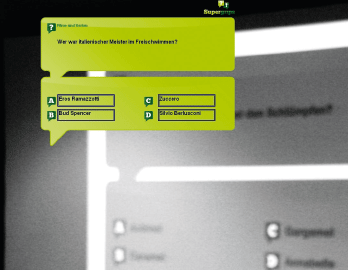
Manuel Angelini: No, Supergrips is a kind of quiz show. It works as follows: Various questions are projected onto a screen, which the participants can answer using a voting device. Around six to eight people are given such a device together. They have to put their heads together and discuss in order to select a solution together. This immediately leads to a lively exchange. There is a different constellation of people at each table, all of whom have different levels of knowledge. They complement each other. The questions are colorful, funny and always asked with a wink, for example: "What do women in northern Siberia throw at men to flirt? Popcorn, chicken droppings, slugs, icicles." One of the answers is actually correct. The show is hosted by comedy presenter Antonio Caradonna, who welcomes the guests, instructs them on how to use the voting machines and performs show interludes between the voting rounds. Our pianist Mr. Simonetti also accompanies the questions with appropriate melodies, and from time to time the songs themselves become the subject of riddles. And at the end, of course, there is an award ceremony for the cleverest minds.
What is the idea behind the quiz show?
We try to activate the guests at events. Because events often have the same routine: Overlong speeches, cloned aperitifs and artists that you've usually seen somewhere before. At some tables, a conversation gets going at some point, at others there are extreme communication barriers, people talk about the weather and the daily press. We want to break that down. The quiz questions can also spark a conversation after the show - even if it's about flirting habits. In any case, the ice has already been broken between the people at the table. If the guests get an introduction like this, if they have laughed and marveled together, it gives the evening a completely different feel.
The whole thing sounds like Trivial Pursuit interactive. So the idea is not entirely brand new ...
That's right, the concept of the show is nothing earth-shattering. We are actually just combining voting software with a game show. Nevertheless, there is no show that can compare with Supergrips - and above all, there is no show that was designed to liven up corporate events, presentations or trade fairs and get people talking to each other.
Where did you get all the questions - and above all the answers to them?
My business partner Caradonna and I spent three quarters of a year putting them together ourselves, and in some cases we even invented them. We did an incredible amount of research to compile the stock of questions for various categories. We now have around 300 questions. If a company books us, they can also customize the questions and we are happy to supplement ours with questions of their choice. For an anniversary, for example, we could weave in questions about the company's history, or collect information about employees at an employee event and develop questions from this, such as: "Which of our employees has ever been to the Himalayas?" If we know which target group the event is aimed at, we compile the questions accordingly. At very serious events, you may not be able to come across as too funny, but people always appreciate it when something unexpected happens and an event has a little more spice than usual. Such events are remembered.
So Supergrips is intended for customer and employee events ...
First and foremost, yes. But you can also use Supergrips for product presentations, advertising campaigns, marketing events, award ceremonies, to attract people to your trade fair stand or as a substitute for boring speeches in which information is to be presented. Why not combine a speech with a game? Knowledge can be conveyed with Supergrips in the same way as with a speech, but it will probably be remembered better. We have already considered offering Supergrips as a public game show, for example at the Casinotheater Winterthur. People pay admission and can then play along, individually or as a team, an evening of games en masse. That could be exciting.
What about events in a more critical context? Would Supergrips also be suitable for lightening up the already tense atmosphere at an event to mark a company takeover?
Absolutely, I can imagine that. However, the strong comedy aspect of the show and the overly jokey questions would have to be toned down so that employees don't get the feeling that the company is trying to make something unpleasant funny. It's a balancing act that requires a sure instinct. But Supergrips is perfect for gauging moods, finding out where the company stands and where there are problems - because you can of course also simply ask factual questions, even individual surveys are possible. Questions such as: "Is what was announced before the merger congruent with the situation six months on?" are conceivable. As the survey is anonymous, people will certainly answer very honestly. You could also split the show into two parts. In the first, you ask the more serious questions that serve to paint a picture of the mood. In the second, funny questions are asked and it's all about fun and entertainment. It would be extremely appealing to tackle such critical topics with Supergrips.
How many people can take part in Supergrips?
20 to 2,000 people of all ages. At the moment we own 100 voting machines, but we can hire more if required.
How did you come up with the idea for the brain quiz?
We have been offering the "Helldriver" game show for two years now, where you can race with remote-controlled cars. Like Supergrips, Helldriver is perfect for employee or customer events, but is also suitable for promotions. For example, we accompanied the launch of the new Audi A 1 with our vehicles. Now we also wanted to offer a game show for the brain that is just as much fun as Helldriver and that can be integrated into the setting of a gala dinner or a small employee event without a great deal of technical and organizational effort. This is how the idea for Supergrips came about. Of course, the two game shows can also be perfectly combined.
How far in advance do I have to book Supergrips?
As we only need a small amount of technical equipment, we are ready for action very quickly. A lead time of two weeks is sufficient if it's just about pure entertainment. However, if we are also to develop individualized questions for our client, a little more time would not be a bad thing. It also makes sense for us to find out what goal our client is pursuing with the event and what they want to communicate. Then we can tailor Supergrips to these concerns.
Have you already been able to liven up events with the game?
Yes, after a test with 30 friends and acquaintances, which went very well, we have already organized an event for a St. Gallen law firm, but without music and moderation. But even this lean version was very well received by the 200 or so employees and customers. We have already received inquiries from Coop and Siemens, who were very interested in using Supergrips for employee training. And two other companies have already announced that they want to do something with Supergrips. We are very excited to see how things develop.
And what does it cost to test the Supergrips of your customers or employees?
Of course, this depends on how much company-specific text work is required. The basic version costs around CHF 7,000 per event. For this, our client receives between 20 and 90 minutes of entertainment, in several blocks if desired. This depends on the organization of the rest of the evening. If Supergrips is combined with a classic dinner, I would recommend two blocks before and after the main course. The show should not be too long, short and crisp is better.
Interview: Anne-Friederike Heinrich
Contact
Manuel Angelini
Agency for Emotion
Martinsbruggstrasse 35
9016 St. Gallen
Phone: +41 71 280 20 92
E-mail: [email protected]
Internet: www.supergrips.ch, www.helldriver.ch
At Yjoo, Marcel Baumgartner will increasingly contribute his expertise in the editorial content area, be it offline, but also online and social media. This was announced by the agency on Thursday. He is an editor and former co-owner and founder of Wortwerk Medien.
Following the sale of Wortwerk to Metrocomm in 2008, Baumgartner worked for the company as a member of the management board and as editor-in-chief of the business magazine Leader, which was founded in 2002. Over the past eleven years, he has also worked as an editor and coordinator for various media companies in Eastern Switzerland and designed several online news platforms.
At Yjoo, Marcel Baumgartner will continue to drive forward the successful area of corporate publishing, as the press release explains further. In addition to annual reports, Yjoo also produces and manages employee magazines, online dialog portals and blogs for its clients.
With the simultaneous relaunch of the three Swiss business media into an integrated network for business news, Axel Springer Switzerland aims to raise the bar for online business reporting in Switzerland. In addition to news, the new website also offers in-depth reports and stock market prices, all linked to detailed background information on the leading players in Swiss economic life. The agency made the announcement in a press release on Thursday.
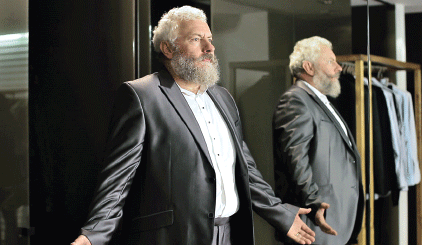
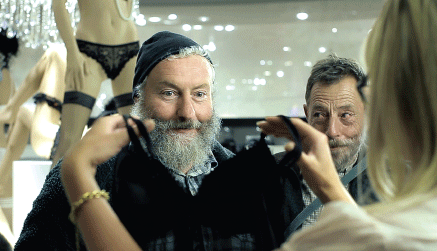
Actually, they are already familiar with many of the world's major cities, as Sebi and Paul have been on a pilgrimage from festival to festival with their film over the past few months and then had to carry well-deserved prizes instead of stones on the way home. Now the two rustic mountain dwellers are once again starring in a new commercial. For Switzerland Tourism's international summer campaign, the mountain climbers advertise a trip in the other direction. In the film by Spillmann Felser Leo Burnett and Michael Fueter, Sebi Küttel and Paul Betschart visit a Swiss town for the first time. The two mountain dwellers travel there in an old Rapid and experience a completely different world to the one they are used to: they visit museums, eat in fancy restaurants, go swimming, buy underwear for their wives and enjoy the nightlife late at night - until they drive back to the countryside early in the morning. As CD Peter Brönnimann reveals, Betschart, a mountain farmer, and Sebi Küttel, who works for the Rigi Railway in real life, proved to be very talented actors. But they didn't have to do much acting at all. In fact, Betschart from Muotathal has never been to a swimming pool in his life, as he confessed during filming in Geneva. This summer, Sebi and Paul will not only be seen in city commercials in England, Germany, France, Portugal, Spain, Russia and China. As part of the partnership between Switzerland Tourism and UBS, they will be used as protagonists in numerous activities. From mid-May, the two will also be featured in a completely new, interactive film on MySwitzerland.com. pan
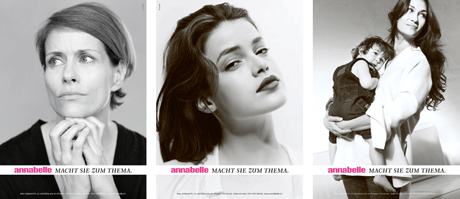
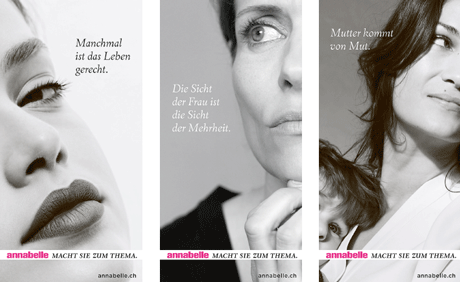
As the most traditional Swiss women's magazine, Annabelle has always focused on the concerns, interests and passions of women. However, it is no longer just "the woman" who is the focus of Annabelle, but women in all their diversity, their differences and their individual life concepts. Because if the social development of recent decades has brought women anything, it is the opportunity to go their own way today in a much more individual and unrestricted way. This is exactly what Annabelle wants to portray on its pages. Also by means of a new advertising campaign that focuses on different women and their personalities. For this campaign, communications agency By Heart developed a unique visual language that "draws attention to individual personalities and their character traits", as CD Hans Siegwart explains.
International star photographer
A photographer of international renown, who is already very familiar to Annabelle readers, was chosen for the realization: Brigitte Lacombe has not only repeatedly portrayed countless greats from film, art and politics, such as Barack Obama, Meryl Streep, Bob Dylan or Martin Scorsese. Brigitte Lacombe has also left her mark in the editorial section of Annabelle with her natural, sharply drawn portraits. For editor-in-chief Lisa Feldmann, the photographer's black and white shots are particularly successful in depicting "more than just the beautiful surface of the people" in front of her lens. This is also one of the key points of the Annabelle concept.
To be continued
By Heart created four portraits for the launch of the campaign. The mix ranges from a graphic designer and a mother to the successful model Julia Saner and the actress Sabina Schneebeli. A mix that also does justice to the diversity of Annabelle's readers and topics, as publishing director Daniel Schnüriger explains. The claim is: "MACHT SIE ZUM THEMA", capitalized so that "SIE" can mean both the woman in general and the targeted reader. The campaign is still being expanded. The ads are intended to be striking on a full page each. There are also fillers. Annabelle, published by Tamedia, has 303,000 readers with a circulation of 70,000. 21 percent of these are men. pan
"Why should I deny myself something nice just because I'm clever?"
Annabelle editor-in-chief Lisa Feldmann on women's issues, lifestyle, surface with depth and the latest campaign of Switzerland's oldest women's magazine.
WW: Fashion changes regularly. Is the new communication appearance also a fashion adaptation or do you want to change more?
Lisa Feldmann: The campaigns never change anything, but ideally the campaigns should reflect what changes in the magazine. Our advertising accompanies the process and communicates to the outside world on a different level, which is what we normally do with the cover picture. With the current subjects, we have succeeded in creating an image campaign that says: "Who are we? How do we feel?" It was very important to us that we could signal this feeling to our readers. Those who have been reading us for a long time should be able to say: "Aha, that's me, that's who I am." Or those who don't read us at the moment or no longer read us or don't read us yet should discover: "Ah, these are Annabelle readers, that's interesting." Image doesn't mean sales, it's about creating feelings. I think our agency By Heart has pretty much summed up what we wanted. This mixture of great emotion, sophistication, aspiration, IQ and smartness. That's what our readers want, who say to themselves: "It must be possible for me to have it all at the same time." We want to convey this comprehensive attitude to life with our Annabelle. We try to modernize this feeling again and again over the years. Women change, life changes. And of course we change too.
What problems do you face when you want to make a women's magazine?
No problems. We just have to be alert to the fact that we are in this world. Fortunately, the Annabelle team is totally diverse. We are a pretty accurate reflection of our readership. Everyone has their say, everyone gets involved, including the men, quota men so to speak. We have a culture of discussion and a culture of finding topics, which is important. Listening, keeping our eyes open and not just talking amongst ourselves, but also out there in the world where we are out and about - as a single woman looking for men, as a mother with the problem that I want to have everything at the same time. We have female editors at many stages of their careers, just before retirement as well as just after training. The whole spectrum.
So what is the external reason for the campaign?
The campaign has reached a point where we ourselves have reached a very good point with the magazine. We had the feeling that we now needed someone to make this clear to the outside world. So that those who haven't noticed our development can once again say: "Ha, that's Annabelle!"
The black and white appearance of the subjects is appealing. How is it justified?
We have built up a relationship with the American photographer Brigitte Lacombe over four years. She has photographed many great and important stories for us. For example, the magazine where we took erotic photos of women over 50. For example Lys Assia, who was already 80 at the time. That was my first contact with Brigitte Lacombe. I simply plucked up the courage because I really admired her and asked if she would do it. To be able to expect women to take such a courageous step, it had to be a photographer with class. Someone who would present the women with dignity. Brigitte loved the job and the idea became a huge success for us, which of course also provoked people. This led to a relationship and ultimately a regular collaboration. In the current issue, we show that age is not an issue in a series of portraits of Brigitte Lacombe. The youngest girl in this portfolio is 13, a very successful blogger, while the oldest woman is 104. Not forgetting our female Federal Councillors. Brigitte had read in the New York Times that Switzerland is governed by four women and contacted me immediately. We had a precious 45 minutes in Bern where we had all four female ministers in front of the lens at the same time. And so Brigitte Lacombe has become something like our house and yard photographer, with whom we were very happy to do this campaign. We believe that she portrays women the way we want to. Full of respect and with an eye for the real beautiful sides of a woman and not the made-up ones.
You put the four Federal Councillors on the cover: How important is politics in Annabelle?
The split is a classic fifty-fifty. Annabelle has now been around for 73 years. When things started to take off for women in the 1950s and they set out to take their careers into their own hands, Annabelle was already a very important companion. The magazine has always had a strong women's political focus, right up to the present day. Always where there is something to do. Remember our weapons story with the successful petition that we launched. We researched a major story on non-voting behavior. The booklet with the female federal councillors was also the anniversary booklet "40 years of women's suffrage". We commissioned a large survey: Where were our mothers back then? Were they out on the streets fighting or didn't they care? Annabelle is perhaps not politically engaged, but socially engaged. We report on things that affect our lives. That's the beauty of Annabelle: We can show the circumstances in which we live and move socially - and we also show the shoes in which we do so.
How does Annabelle deal with lifestyle?
This aspect of life is just as important. The nice thing for me is that there is no contradiction here. Swiss women find it totally normal to be very critical and committed to the issues that concern them, while at the same time spending 1,000 Swiss francs on a shoe if they have the money. They don't think that's contradictory.
Successful men can also drive a sports car ...
That anyway. But successful women always have the feeling that something cheaper will have to do. That's a bit like the world of our competitor magazine Brigitte. We are much more relaxed in this respect. Why should I deny myself something nice just because I'm clever? I can be just as against nuclear power and still be enthusiastic about other things that are superficial and funny. This mixture is very special. I also get good feedback from Germany.
What sets Annabelle apart from women's magazines from Germany?
There is nothing like Annabelle in the women's magazine sector. We have the worlds of Vogue, Elle, Madame, where it's all about fashion and lifestyle, plus a bit of culture. But no story longer than 120 lines, please. Because these women just want to browse. There used to be a Marie Claire in Germany for a while. It had a very similar concept to our Annabelle. The English Marie Claire and, for a while, the American Marie Claire also used this style. For me, these are good examples that bring together this mixture of both sides. But they no longer exist in Germany. That's what makes Annabelle so special and many colleagues who come to us for a magazine review say: "Come to Germany at last!"
Would that be an idea?
Distribution in the German market is very expensive. Even the Süddeutsche Zeitung can't afford a Sunday paper because the space is too big. We have 2,000 copies at the central newsstands in Germany and Austria. We see this as a service for our Swiss customers who are currently abroad.
Another supplementary market is men. What role do they play in the concept?
We are read by 21 percent men. I find that a bit strange because I think we are a women's magazine. And therefore want to convey a different feeling than a SonntagsZeitung written for both sexes. I find it irritating when it comes too close together. The 20-minute Friday edition is also deliberately designed for both sexes. Such a concept also works up to a certain age. Your interests are much more congruent, especially when it comes to fashion and going out, when you're young. At some point, however, you have a different way of looking at life. As much as we see ourselves as a "general interest" women's magazine, we also want to create a space for women. I want people to have the feeling that you're going into your world a bit. The husband has gone off to Alpamare with the children and the wife now has time to read Annabelle for two hours. After all, our wives read us for 81 minutes on average, which is very long. That's the famous "me time". You need a world that excludes men for a few reasons. As a reader, I want to feel that they are talking to me and not to everyone in the same way. It's all very well for my husband to read along and find a lot of things interesting. But first I want Annabelle for myself. Interview: Andreas Panzeri
LISA FELDMANN
Lisa Feldmann has been editor-in-chief of Annabelle since May 2004. Born in northern Germany, she is the successor to Christa Löpfe. She has a wealth of experience in the field of women's magazines. Lisa Feldmann was deputy editor-in-chief of Elle between 1992 and 1995 and was editor-in-chief of the women's magazine Cosmopolitan from 1995 to 1998 - where she "regularly argued with publisher Jürg Marquard about the right direction for the magazine". Until 2000, she was head of department at the Süddeutsche Zeitung magazine and then helped shape the relaunch of Life & Style magazine. In 2002, she became editor of the trend section of SonntagsZeitung, after having worked as a freelance author in the meantime.
For search engines, social signals, like links, are an expression of a website's reputation and have a major influence on the ranking. With the new Google "1+" function, social signals will become even more important. The structured acquisition of social signals is a new discipline in search engine optimization that is equivalent to building link popularity.
Cherry-picking does not pay off
Links from third parties, especially from websites with a high authority, have a major influence on the ranking in the search results. However, if you have only acquired links from websites with a high authority, you may lose positions in the search results, as search engines value a heterogeneous link popularity that also contains links from websites with a low authority or from websites with "nofollow" links, such as Wikipedia or blogs.
Reference texts that are too professional are useless
The reference text for a link (anchor text) to another website should contain the keyword that corresponds to the content of the linked website. If the anchor text for a website is based exclusively on precisely matching keywords and is not mixed with URLs or company names, search engines will get the impression that this is a manipulation, which can lead to a penalty.
"Exact keyword domains" are losing importance
Previously, it was relatively easy to occupy top positions in the search results for keywords such as "washing machine price" or "washing machine" with a domain such as www.preise-waschautomat.ch or www.waschautomat.ch, as the domain already contains the keyword. However, these times seem to be over, as the quality of the website content is more important than the keyword in the domain.
"Quality score" for the content
The mission statement of search engines is to offer users the best possible results. In order to improve the quality of search results, Google regularly carries out algorithm updates, such as the current Panda update. With the Panda update, Google places particular emphasis on the "quality score" and penalizes websites with poor content. Therefore, the text of a website must meet the following requirements for top positions in the search results: For Google, a concise text contains too little information for the visitor. A relevant text has a certain length, i.e. at least 200 words. A poorly designed text is not easy for visitors to grasp. A structured text with subtitles, sections and highlights is an indication of high quality for search engines. Search engines do not appreciate the consistent repetition of exactly the same keyword. Keyword extensions (e.g. continuing education, continuing education offer, continuing education opportunity) and the use of synonyms (e.g. continuing education, training, course, course) increase the quality factor. Copying text from another website, as is sometimes done by price comparisons, industry portals, recommendation platforms or local directory services, is penalized by the search engines. Some US and UK sites that operated on this principle suffered massive setbacks with the Google Panda update. The new ranking factors and the Panda update make it clear that search engines are becoming less and less manipulative and are striving to offer their users good information. This is where the great influence of content quality on the ranking comes from. Good content is distributed with links or social signals, which in turn is an important prerequisite for top positions in the search results. For website operators, this means nothing other than constantly working on the topicality and relevance of the content. Imre Sinka *www.slideshare.net/randfish/smx-munich-keynote-mozranking- factors

They don't want to strain the cliché. But it's just the way it is, they say: "We hung on the rope together a lot as climbers. We both have an idea of how the other thinks." Adrian Schaffner and Christian Sutter met at the Basel School of Design. Later, they both honed their skills at Interbrand Zintzmeyer & Lux. Since 2007, they have jointly run their own agency, Evoq Communications. "However, it has always been a concern that we don't want to go down any well-trodden paths with our know-how," explain the two owners.
In a strategic analysis, they first developed the concept for their agency. They want to work primarily for clients who have diverse needs in terms of size and category. In other words, clients for whom the tasks of branding, corporate design and advertising overlap, but whose focus is clearly on the brand.
Evoq thus offers its services in four areas. In brand consulting, analyses, positioning and structures are developed. In the design area, corporate design programs are created with logos, business stationery and manuals. In the area of communication, Evoq offers a wide range of implementation services - from annual reports and websites to entire campaigns. A fourth specialty is information design. Here, for example, SBB is served in the area of customer information and signal ethics. For two weeks now, Schaffner and Sutter have been working with an expanded team in larger offices in Zurich's Ottikerstrasse. With the move into an entire building, has the agency now also reached the point where it has reached its ideal size with 15 people? "We've thought that several times. We do plan, but as opportunists we are also always open to new tasks. Currently, we have expanded the consulting team, but still have space in the new house," Schaffner and Sutter are full of optimism.
In managing their agency, the two see themselves as "generalists who have a wide range of experience. We can't do everything, but we have specifically hired people with whom we could build up the competencies in the team," they explain their strategy. Susanne Pfäffli as a consultant comes from classical advertising, the recently hired CD Christoph Stalder stands for the high design standards of the agency.
Founding member Adrian Schaffner first completed a technical apprenticeship in the construction industry, but never worked in that profession. "I realized early on that I was interested in everything that somehow had relevance to the public." So in 1986, he joined local radio as a journalist and was able to experience the pioneering days of the medium at Radio Raurach and Basilisk. "It was an El Dorado, you could try everything. There were no limits and hardly any broadcasting schedules. " Later, he wrote satirical texts for Nebelspalter. He was also very interested in photography. "Out of Gwunder" Schaffner attended the preliminary course at the Basel School of Design and then also got hold of one of the coveted places in the specialist class for graphics. "That made it a moot point for me to decide whether to stay in journalism, where I had good offers, or go more into visual communications."
Evoq Communications is an owner-managed, independent agency based in Zurich. The company was founded in 2007 and evolved from the previous sole proprietorship Sutter Design
Identity emerged. The two founders, Christian Sutter and Adrian Schaffner, each have over 15 years of experience in online, print and 3-D brand management as well as in offer communication. Evoq employs 15 people.
Jürg Krebs has worked in various functions since 1998, first for the Limmattaler Tagblatt and later for the AZ Limmattaler Zeitung. Bettina Hamilton-Irvine is promoted to deputy editor-in-chief. She lived in Australia for almost seven years, where she obtained a Bachelor of Journalism and worked for various media. She joined AZ Limmattaler Zeitung in October 2008.
The focus of the campaign is on conveying emotions: Mini is to present itself as a self-confident, avant-garde, cheeky brand, the agency said in a statement. Instead of mainstream, the focus is on difference, liveliness and colorfulness.
The roadshow will take place in summer 2011.