Wirz Corporate makes wine house Château André Ziltener known

The Swiss wine house Château André Ziltener has entrusted Wirz Corporate with the task of sustainably increasing awareness of the company through various PR measures. The activities focus on the Hôtel Château André Ziltener and various products from the wine house's range.

The Swiss wine house Château André Ziltener has entrusted Wirz Corporate with the task of sustainably increasing awareness of the company through various PR measures. The activities focus on the Hôtel Château André Ziltener and various products from the wine house's range.

The castle hotel is located directly on the Route des Grands Crus between Dijon and Beaune and was named the most beautiful hotel in Burgundy by Wine Spectator. The wine house Château André Ziltener from Reinach (BL) specializes in top French wines. Run by the second generation, the company has built up a reputation for wines from Burgundy in particular.

Significant judgement

Although the ruling on Street View directly affects Google, it may have further implications for the media.

Anyone who is pleased that Google has been hit on the roof with the Federal Administrative Court's ruling on Google Street View may be overlooking noteworthy connections to the media industry. After all, Google is not offering Street View for free out of pure altruism, but as part of a strategy to attract local businesses as advertising customers. The keyword here is local search and refers to the last major advertising market that online providers can still conquer. Various companies have been trying to gain a foothold in this market and develop it for years - no one is thinking of giving up. The software giant Microsoft, for example, is now also trying to photograph streets in Europe with a Street View clone called "Street Side".

In order to keep up with the business on their doorstep, it is quite possible that regionally active publishers will one day make it their business to document their distribution areas with their own street photography. Competitors can only be outdone with better images: more up-to-date, higher resolution and, above all, compliant with data protection regulations. Such images are primarily used for own products in the local search area, but can also be lucratively licensed to third parties. If this were to happen, easy-to-use data protection regulations would also be in the interests of publishers. However, this is not currently in sight: according to company spokesperson Christoph Zimmer, street images are "not currently planned" at Tamedia subsidiary Search.ch.

This can also be done differently than Google does today. With a bit of event marketing, such camera drives can become a happening that strengthens your own brand and improves your market position. For example, artistic and other roadside activities can be called for, which are then rewarded. The Allgäu town of Oberstaufen has shown how this can work: a huge event was prepared for the arrival of the Google car and the PR effect of this huge event was used for its own community. An active fan community can be encouraged in the sense of crowdsourcing to contribute to the completion of the pixelation. Google has recently taken a step in this direction and launched a corresponding tool, Google Map Maker.

Journalists in particular would do well to consider the possible consequences of the ruling. After all, ubiquitous cameras, whether in smartphones or on car roofs, are a reality in the 21st century and are becoming part of the reporting repertoire. Installing webcams at the scene of an event - for example at the Chilbi or in the event of flooding - and publishing the images live online is nothing new and will naturally be seen as a media task in the future. This can certainly be done with genuine journalistic motivation: A camera with motion sensors can be used, for example, to document how often critical traffic situations occur at a particular location and thus draw attention to the urgency of measures. However, the ruling is likely to influence journalistic practice. Legal considerations as to whether media freedom has been restricted or not are of little use here. Rather, the point is that with this and other similar decrees of recent times, the famous "scissors in the head" are becoming increasingly effective. Nicole Aeby, Head of Photography Studies at the MAZ School of Journalism, notes that the attitude of young photographers has "already changed". Today it is "rather unethical" to take pictures of strangers without being asked and to publish the photos. Young female photographers were "more inhibited and overcautious" and some no longer dared to photograph people in public spaces. Just as it has long since become common practice in this country for respondents to proofread their quotes and, if necessary, change them, photojournalists will also have to take on additional administrative expenses in the future - or simply want to avoid them in view of the time and budget pressure. As a result, more and more journalists will refrain from obtaining an additional point of view or from taking and offering an additional picture - thus indirectly restricting media freedom. Christoph J. Walther

Images: Keystone

THE JUDGMENT

Services such as Street View are practical: remote and unfamiliar areas can be explored on the screen to find out whether a visit meets expectations or how best to navigate the area. According to Google, 25 percent of Swiss people have already used Street View. However, not everyone is happy about this, which is why the Federal Data Protection Commissioner and former Green Party National Councillor Hanspeter Thür felt compelled to take the search engine giant to court for violating privacy. The bone of contention is faces and car license plates that are still recognizable despite the automatic post-processing of the images. Now, at the end of March, the Federal Administrative Court has clarified the legal practice with its ruling on this issue, stating that the right to one's own image also applies to so-called staffage, i.e. images in which people appear as an accessory to the landscape, surroundings or event, so to speak, and that the right to informational self-determination must therefore be observed. It is therefore illegal and punishable by law to depict a person in public without their consent. It remains to be seen whether a court will be prepared to make a distinction between a comparable publication in Street View and in a journalistically managed medium in the event of any future legal action by private individuals against established media. The ruling states that Google's offer does not represent a public interest and is "primarily of a financial nature" - but this applies equally to the vast majority of media products.
 

Blu: "pack easy" repackaged

Der traditionsreiche Schweizer Reisegepäckhersteller pack easy wurde von der Agentur Blu neu verpackt.

The Uri-based ASW agency BLU redesigned the brand and developed an image campaign to launch the new image. In addition to creating the new corporate design, BLU also supported the CI process.

Responsible at Blu: Irene Denzler, Chantal Manella (consulting), Roger Moser (CD), Marc Wöltinger (text).


Eyjafjallajökull put to the test

Für die Fluggesellschaft SWISS werden Social-Media-Kanäle im Kundenservice zunehmend wichtiger.

When asked for a prime example of the benefits of SWISS's own social media activities, Christian Lüdi, who is responsible for social media in SWISS's online marketing department, answers immediately: When the eruption of the Icelandic volcano Eyjafjallajökull paralyzed air traffic over large parts of Europe a year ago, the hotlines were barely able to cope with the rush of stranded customers. Instead, many inquiries were made via Facebook and Twitter, where SWISS published 31 updates on the subject and handled around 1200 comments and questions. Many customers looking for forecasts and information on rebooking found these in previously answered inquiries from other customers in the same situation. For Lüdi, this FAQ effect is a key advantage of the new social media channels and he is convinced that they will play an increasingly important role in customer service, especially for service providers. This is because customers can be contacted much more quickly and, thanks to mobile devices, regardless of their location. Lüdi is certain that contact via social media is much more personal and faster than communicating via email or a contact form on the website. Customers appreciate receiving a quick response from a representative of the company who has listened to them. They are often much more satisfied if they are referred personally to the feedback form on the website. Many such inquiries start on Facebook or Twitter, but are then continued on other channels. This is because e-ticket numbers, for example, cannot be mentioned on social media channels due to data protection regulations. Lüdi has noticed clear differences between Facebook and Twitter. Twitter is mainly used by Americans and English people and a response is always expected. It is mainly about customer service, questions and complaints and this can be handled faster and more quickly via Twitter. Facebook is more emotional, simply because it offers more possibilities with photos and videos. There is feedback such as "I love SWISS" or photos and videos on the pinboard that do not require a response. Although just under half of the fans are from Switzerland (there are no reliable figures on Twitter), SWISS has opted for a presence for the whole world and therefore for English from the outset. There are occasional comments about this, but it is always understood, especially as English is the language of the Internet, says Lüdi. If there are inquiries in German or French, these are also answered accordingly. In addition to Facebook and Twitter, SWISS also uses YouTube and Flickr. These visually oriented platforms are used to share the images that SWISS already has with the community.

In an interim assessment, Lüdi sees these success factors: they took their own social media commitment and the community very seriously from the outset and invested a lot of time and resources right from the start. And it takes patience, because you can't just register 100,000 fans overnight, not even with a super campaign. It is important to listen well and carefully, to take people seriously and to respond to them. In order for the offer to be used, you have to offer interesting added value. The company has achieved a "very good social media reputation" and has also noticed that this is appreciated by the community, "which is sometimes a very important point". SWISS now values dialog with the community and repeatedly asks fans whether they like this and that and what their input is. In this way, the company is always learning and allows the community to participate in developments. For example, when it comes to desktop backgrounds with SWISS subjects, as was recently the case, where the question arose as to the desired resolutions. But among the 30 to 40 responses, there was also demand for images for the iPhone and Blackberrys, which had not been thought of. When it comes to flight offers, it has been agreed with the community that such posts are welcome once a week and will not be perceived as spam. Unlike Asian and American airlines, there are no exclusive offers on SWISS's social media channels as yet.

At SWISS, social media is part of the online marketing department, which also manages campaigns on other websites, search engine marketing and online games. Lüdi works closely with Corporate Communications and takes part in the weekly meetings of this department. Social media has already become a matter of course for many in the company and many departments are now coming up with ideas and suggestions themselves. A social media board is also being set up, where all interested and affected departments will meet weekly to plan together. On the other hand, there is no group strategy for social media within Lufthansa, but there is an exchange of ideas.

When it comes to key figures, people initially always thought it was about having as many fans as possible, but this is no longer the most important criterion. Like other social media practitioners, Lüdi now believes that qualitative analysis, i.e. having the right fans and followers, is much more important. When asked about the future, Lüdi mentions the expansion of customer service in order to be able to offer more options. There are also plans to do more in the cross-media area (an article on social media activities will appear in the next issue of the in-flight magazine) and local markets are also to be addressed directly more often in their respective languages. A major competition on Facebook is also in preparation. Apart from the fact that it will be "a novelty" and should go live in June, Lüdi did not reveal any more. Christoph J. Walther

The current social media high flyers

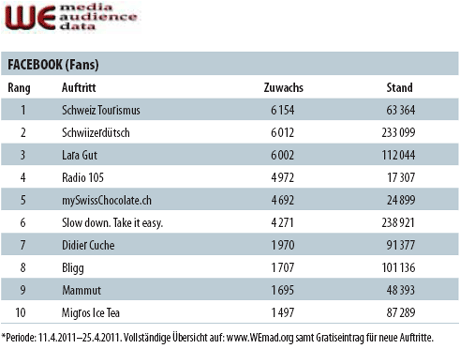
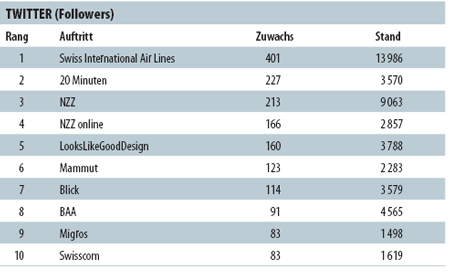
Who has gained the most in the social media hit parade on WEmad.org in the last two weeks*.

we1
we2


Blue Spirit wins mandate from SBB

The Blue Spirit advertising agency BSW prevailed in the pitch and won the mandate from SBB. As the landowner, SBB is developing the new Europaallee district right next to Zurich's main train station.

The commercial area of construction site A will be opened on September 21/22, 2012 as the first retail area of this major project. Blue Spirit won this mandate with its marketing concept including naming. The agency has already started work with SBB, which holds the lead on the marketing side.
 

Americanization, Europeanization, Berlusconization

In the advertising industry, the right «catchphrase» can move mountains; in the world of research, however, buzzwords often create trends that do not hold up to the complexities of reality. Guest commentary by Stephan Russ-Mohl, director of the European Journalism Observatory at the University of Lugano.

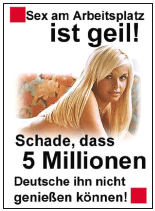
Over the decades, many social researchers have repeatedly used the "Americanization" of our living conditions - a formula that, although simple, hardly holds up on closer inspection, as researchers have recently shown in two very different fields of communication. At the annual conference of Swiss communication and media researchers on image communication, Roger Blum and Marlis Prinzing questioned the flat Americanization thesis using the example of party competition. In election campaigns, they reported, it is no longer the case that all campaign planners only look to the USA. The academics therefore prefer to speak of the modernization, professionalization, medialization and de-ideologization of campaigns. Their most drastic example: In America, it would be unthinkable to present naked people on posters. In Germany, on the other hand, candidates have undressed - and because they have apparently "caught on" with voters thanks to their original excess of transparency and without emperor's clothes, this has also found imitators in Switzerland, Belgium and Poland. When questioned, Ms Prinzing also emphasizes that the Americanization thesis is "also a distraction, especially when it is conveyed in the media". Americanization is misunderstood "as a synonym for Hollywood election campaigns" and this overlooks "the major role that issues play in the USA, which are also given a forum in the media". The nude egg example shows: Election campaign professionals thus observed each other in international exchanges - a pattern of behavior that one would also like to recommend to journalists and publishing managers in search of new revenue models. After all, the Americanization hypothesis is not very coherent in the media business either. In any case, researchers at the Reuters Institute for the Study of Journalism at the University of Oxford are by no means certain that the crisis in journalism in the USA will also have a full impact in Europe. It is premature to predict the death of newspapers, television or even commercial news media, say David A.L. Levy and Rasmus Kleis Nielsen, who in their latest book on the effects of changing journalistic business models shed light on very different development paths in various European countries, the USA and the two BRIC states of Brazil and India. "If the major news media in America are facing a more serious crisis than elsewhere, it is by no means to say that they are leading the way for the rest of the world. The US could be an exception rather than the harbinger it is often portrayed as in discussions about international media development."

The fact that the Americanization thesis is rather nonsense can be seen not least from the fact that in the USA, researchers such as Everette Dennis observed a "Europeanization" of journalism years ago - for example, because many US news media no longer strictly maintain the separation of news and opinion, or because - more recently and partly inspired by the opinionated nature of users on the Internet - entire channels such as Fox are building their recipe for success on politically one-sided (right-wing) populism. Incidentally, the buzzword "Berlusconization" of the media in Eastern Europe has been circulating for years. It was coined by a respected researcher and has been quoted more or less thoughtlessly by many others. "Tabloidization" as a trend - that would probably have hit the nail on the head, and "Italianization" might also have made sense if it had been intended to refer to the growing (party) political controversy and entertainization - or to the "infantilization" of the media, as Umberto Eco once called it with regard to conditions in his home country. But Berlusconization? Actually, the emerging democracies in eastern and south-eastern Europe should be grateful that they have been spared the media supremacy and the many years of abuse of office by Berlusconi, which was cushioned with their help - incidentally also thanks to the (admittedly not selfless) commitment of western investors, who tend to stay out of political affairs, from Ringier to Springer and the Passau publishing group through to the WAZ Group and Scandinavian newspaper publishers such as Schibsted.

Obviously, even scientists, precisely because they want to make an impact, are not immune to adopting buzzwords from time to time - even if they tend to achieve the opposite of the enlightenment that research should actually be aiming for.
Sources: Roger Blum/Marlis Prinzing (2011): Bad pictures - good pictures. Lecture at the Swiss Society for Communication and Media Studies (SGKM) on March 25/26, 2011 in Basel. Levy, David A.L./Nielsen, Rasmus Kleis (eds.) (2010): The Changing Business of Journalism and its Implication for Democracy, Reuters Institute for the Study of Journalism, University of Oxford.

russmohl1
russmohl2
 

"Making a clean slate"

One year ago in April, two long-established Swiss agencies merged to form Marti Seiler. Owner Peter Marti looks back on the process of integrating the two firms.

seiler

WW: Seiler Communications and Marti & Partner have been pulling in the same direction for a year now. What forces have been developed during this merger?
Peter Marti: We have a good year behind us and have even exceeded our sales targets. Profit is where we wanted it to be. It's always a bit difficult in a merger year because there are merger costs. We are now well established and can look ahead.

How have customers reacted to the merger?
The fact that Seiler guarantees continuity and the retention of employees has been very well received. On the Marti customer side, people are happy about more substance. People did ask whether we were now becoming more expensive. But we haven't become more expensive, we've become more efficient, especially in creation. We haven't lost any customers. Just one, to be precise. It was strongly linked to Roland Weiss. The former managing director of Seiler is now with GGK. We now have 23 employees, all fully motivated and full of drive.

Two alpha animals in one enclosure: how is the collaboration with Herbert Seiler going?
The collaboration with Herbert is very good. He really is known in the industry as an alpha dog. I couldn't make that observation. We have always had very factually correct discussions and I am glad that he is on board during this transition phase. He will still be involved on a daily basis until the end of 2011 and will then take on a much reduced role. Herbert Seiler is celebrating his 70th birthday this year and it is a pleasure to see him much younger.

What has changed internally?
We have converted the entire IT from a hybrid to a Mac solution. We have expanded two areas. Social media now has its own social media director. The second reinforcement is the entire pre-press area, which we are increasingly offering in-house due to price and flexibility considerations. We have also hired a new Head of Internet Marketing. This area is growing very quickly for us, just like social media. We are focusing on the cross-media concept. Everyone says that, but we are doing it extremely consistently.

Is the merger also a happy ending in private life?
I have to work even harder. Take even more risks. But it's exciting. I enjoy coming to Zollikerberg, even though I miss Seefeld, our former office location. It's nice here in the great outdoors, but there are a few pubs missing. I'm satisfied all round. Things are moving in the right direction.

Has the agency reached its cruising altitude?
No. But our positioning and our success with new customers confirms to me that we are on the right track. We are also currently involved in a number of pitches. So growth is definitely an issue. We have two extremely creative people in our company who may not be so well known in the industry, but they are very strong. Copywriter/conceptual designer Stefan Beck has been with us for ten years and Stefan Künzler is our long-standing Senior Art Director. Both are very conceptual. With the entire off- and online creative team, we haven't lost any of last year's competitor presentations.

Are creative prizes an issue?
Yes, we want to win creative awards. But perhaps more in the Effie category than at the Art Directors Club. Since I left the club after 20 years of membership, I can no longer get my own campaigns "on the table" and thus into the ranks. We also decided to leave the BSW. Seiler was a member. Marti & Partner was not. The Association of Swiss Advertising Agencies today consists mainly of foreign agencies, which makes the term "leading swiss agencies" a little ironic. It should actually be called "leading agencies of Switzerland", because the first term is no longer accurate. There are only 2 of the top 15 agencies in Switzerland that are still fully owned by Swiss people, namely Contexta and us. And in my case, owned by one owner and not several. All the other agencies are owned by international networks and/or, sooner or later, by their owners via options. What annoys me about BSW - apart from many good initiatives - is therefore its credibility. Especially in the area of competitor presentations, where the BSW code of ethics is not adhered to at all.

BSW agencies breaking the rules?
I see it when we are invited to a competitor presentation. You quickly realize that others are offering their services for free. As a non-BSW member, we also present for free - I stand by that - if the assignment is interesting and a good creative performance is possible and the pitch is fairly advertised. However, there are renowned BSW agencies that present large clients - including ours - with a ready-made campaign free of charge and without being asked, without ever having received a briefing. I have seen this and I have to say: either BSW changes its code morale or the agencies stick to it.

Is the exit the last word?
The BSW needs a clean slate first, then we can talk about membership again. I think it's important that the industry is somehow organized with the 20 most important agencies and can have a certain impact on the public. But the BSW has to be credible, that's the basic requirement. I hope that this is now the case with the new president and managing director. Interview: Andreas Panzeri

NEW CUSTOMERS
Peter Marti and his partner, board and management member Nadine Kündig, can look forward to many new customers. Diethelm Keller Brands is a new addition to the portfolio. Also the Federal Office for the Environment with the basic campaign for the Swiss nature parks, a first project for Nestlé Switzerland. Also new is the electrical engineering company Jaisli with 400 employees. Domino's Pizza has generated additional business with a new license concept. With the Hotel Belvoir in Rüschlikon, Marti Seiler can now look after the "most beautiful 4-star-plus hotel in the Zurich region", which has just opened. The existing international campaign for long-standing client Lindt & Sprüngli is being revalidated and restructured. Leo Burnett Milan is also involved. Vögele was founded in 2009, when it was still run by Marti & Partner. The repositioning with Penelope and Monica Cruz has been successfully implemented. Til Schweiger is a new brand ambassador. "Now we have to see what happens next. " Vögele itself has a fully-fledged marketing and advertising department that handles many things internally.

The detailed results of the Impact Check April 2011

We show how current campaigns are performing with consumers.

Last but not least: Cheers to Kate and William

On Friday, all eyes will be on London as Kate and Prince William, the heir to the throne, tie the knot. The Paulaner brewery is taking this opportunity to congratulate the bride and groom with a commercial.

The 20-second program, which has been specially converted for the wedding, will be shown on Friday as part of all special broadcasts. The first broadcast will be at 8.47 am on N24. Horizont.net has already put the spot online a day earlier. It features the same characters as the original. In the converted commercial, regular Max speaks one "Yes" after another into his cell phone. A voice from off-screen finally clarifies: "In London today they say yes, and mia sogn dazu: Cheers and all the best".

To the spot

The fact that people on the island promise each other eternal fidelity with "I do" should probably be neglected here. After all, it's about Kate and William's wedding - and Paulaner beer. Well then, cheers.
 

To the point: irritant words

Last week, Martin Hitz posted a small story on Medienspiegel.ch about a correction in Weltwoche. It was about the confusion of a perfume brand in an article.

Nothing earth-shattering, the message was - so it seemed to me - meant ironically. But then it started. The word "Weltwoche" is an irritant for all self-appointed media critics. That's when all the blog commenters' alarm bells rang and their keyboards began to glow. Within a short time, there were ten comments. But anyone who now thinks that the comments have something to do with the matter is seriously mistaken or does not know the generally valid mechanism of blog comments.

It is usually the case that the first two or three comments deal with the matter at hand. The more time goes on, the less it is about the incriminated facts. Who cares about that. It's all about mutual sniping, indirect or direct insults and, of course, self-profiling. In addition to
"Weltwoche," there are, of course, other appeal words. One that also works very well is "quality in journalism". That's where the action is and you can let off steam: Journalist haters go after blog despisers.

Blog lovers piss off journalists. Fronts are forming. Sparks fly. The fact that the opponents often know each other, or at least know or think they know who is behind the pseudonyms, makes things even more exciting. Now you can finally get down to business and punch the unloved opponent or the current or former colleague in the face. It's amazing how much time people have for this kind of thing. From the "professional commentary" now to the quite normal "civil commentary". To study best on Blick.ch. The same mechanisms apply to amateurs as to professionals. Who cares what the article says, after five more or less article-related comments, it's down to business here too. The only thing that changes are the irritant words. Popular irritant words here are "Alex Frei", "FCB", "referee". But "Blocher" and "foreigner" are also popular. "Fighting dog," on the other hand, is no longer doing so well.

What I like about the whole thing is that for once the professionals are taking an example from the amateurs. So no one should say anymore that media critics are out of touch. Here, too, real life shows itself.

Pierre C. Meier, Editor-in-Chief
[email protected]
 

News Aktuell is looking for the best PR picture of the year

The SDA subsidiary News Aktuell is once again seeking the best PR photo from Germany, Switzerland, and Austria in 2011. Media departments and PR agencies from across the German-speaking world have until June 10 to submit their outstanding photos in six categories.

For the sixth time, News Aktuell is launching the search for the best PR image. The competition became known as the "OBS Awards." This year, the name has been changed to "PR Picture Award - The Best Photos of the Year," according to a News Aktuell release. Until June 10, media outlets and PR agencies from all over the German-speaking world can submit their outstanding images in six categories at Pr-picture-award.ch advertise. The Swiss media partner is the industry magazine Persönlich.

In the summer, a jury of six experts will select a shortlist of around 60 images from an expected total of more than 1,000 entries. All PR managers in Germany, Switzerland and Austria will then be able to select the PR image of the year online. The winner will be announced on November 1.

Participants can submit their images for the following categories:
Corporate Communications, Events and Campaigns, Product Photo, Portrait, NGO Photo and Tourism (as this year's special category).

The expert jury of the PR-Bild Award 2011 consists of the following journalists and PR experts:

- Matthias Ackeret, Editor-in-Chief of the Swiss communications magazine Persönlich
- Klemens Ganner, Managing Director, APA-PictureDesk
- Uwe Gottmann, Head of Picture Editing, 20 Minutes
- Sebastian Gülde, CvD, press spokesman
- Frank Schleicher, Product Manager OBS, News Current
- Harald Schneider, Head of Picture Editing, APA


Junghäni's: New catalog for Armin Racing

The Junghäni’s creative studio designed a catalog for the new Arming Racing watches. Junghäni’s was founded in the fall of 2010 by Julien Junghäni, the former art director at the Bern-based advertising agency Cosmic.

Three weeks ago, the new Arming Racing watches, a product of the cooperation between the Biel-based watch manufacturer Armin Racing and the Formula 1 racing team Virgin Racing, were presented live for the first time at the Basel Watch Fair. In order to launch this market innovation appropriately, Armin Racing engaged Atelier Junghäni's to design and produce a catalog. Entitled "No Speed without Time", the catalog is intended to unite the worlds of the cooperation partners. The two opposing and yet inseparable components "time" and "speed" merge visually and textually.

The quintessence is the Armin Racing Series. The image compositions form the heart of the catalog. After a seven-day photo shoot at the Grand Prix race track in Abu Dhabi and at the manufactory in Biel, the best images were selected from 3,000 and combined.

Responsible at Armin Racing: Serge Michel (CEO) Claude Greisler (Head of Product Development). Responsible at Junghäni's: Julien Junghäni (AD/CD), Heinz Helle and Martin Arnold (text), Crocidu Fresne (photography), W. Gassmann (print).
 

get_footer();