Meta Design gives Quicar its name

The Meta Design agency has developed a brand character and visual identity for the new Quicar brand. The agency also designed the rental stations that will open in Hanover this fall.

With the internationally understandable and easy-to-remember name Quicar, Volkswagen's new car-sharing brand is intended to appeal primarily to young people in large cities who want to live a lifestyle-oriented, cost-conscious and sustainable life. The name Quicar is thus fully in line with "Think Blue.", Volkswagen's corporate stance on ecological sustainability, according to a press release from Meta Design. The personality of the car sharing brand will be communicated at all touch points such as rental stations, website, posters, advertisements and vehicles. It should be understood as "fresh, young and modern".

The claim "Share a Volkswagen" is also intended to make it clear that "Quicar" offers car sharing with Volkswagen quality.
 

Who uses which social media today?

Marketagent.com conducted an extensive social media study and found out who uses what the most and where, as well as: A fan is a fan, whether online or offline.

The two words "I like", which at best used to express polite interest, now get the blood of marketing bosses boiling. Because "I like" is one of the highest honors that consumers can receive on the Internet. But how does a fan become one? Which applications are used and which communication measures are also perceived? These and other questions were asked in a comprehensive study by Marketagent.com of around 1,500 Swiss people.

Facebook is social media! Top of Mind 45.8 percent name Mark Zuckerberg's social network when asked about social media platforms. This is supported by 95.9 percent of the online population. Youtube (90.6 percent) and Twitter (80.1 percent) also enjoy a high level of awareness. When it comes to usage, however, the picture is somewhat different: While 51.9 percent use Facebook and 41.2 percent use YouTube at least weekly, Twitter usage is a miserable 5.8 percent. The commercial development of social media platforms is exciting, as one in four people now use social media platforms to find out about products and companies. The highly praised blogs are almost insignificant, because only 3 percent of the online population read or comment on company blogs. By contrast, every second Facebook user (51.3 percent) expresses their "affection" for companies and products by means of "I like. Around 40.1 percent are prompted to do so by friends whose "fan statement" they have seen, or 39.7 percent by recommendations. Further details on the "Social Media Study Switzerland 2011" are available for download at Marketagent.com. pan
 

The Social Royal Wedding

By Manuel P. Nappo, Program Director of the CAS in Social Media Management at HWZ.

Kate Middleton is something of a Diana 2.0, at least according to @mikeschwede recently, and this was indeed the impression of those who followed the buzz surrounding her wedding to Prince William. As soon as the wedding was over, various sources published some very interesting figures on the use of social media during the wedding. I took a closer look at them.

YouTube was the center of the royal online activities, with its own "Royal Channel". On the page set up especially for the wedding, I felt as up-to-date as if I were traveling behind the bride and groom in a gilded carriage. Not only was I able to follow the entire ceremony, but I could also check the route the royal cars and carriages took to Westminster Abbey, where the rest of the guests and the celebrating crowd (2274 people checked in on Foursquare) were waiting for their monarchs-to-be. I was also able to immortalize myself in the "social media book of congratulations". By uploading a self-recorded video message. According to Techcrunch, the Royal Wedding has been viewed over 100 million times to date. On Facebook, British users (during the wedding itself) posted 47 updates per second. 684,399 status updates in total. The word "Royal Wedding" was mentioned 1.77 million times on Facebook in the four weeks leading up to the wedding. In addition, there were 1.8 million posts from the USA.

However, Twitter experienced the biggest buzz on the topic. The event was tweeted about 2.1 million times during the wedding week. There was a special Twitter chat where viewers could share their opinions and impressions live with others. 3.5 million tweets have passed through the social media portal since the engagement was announced.
Impressive. Or ...? But when I compared these figures with the estimated 2 billion people who are said to have watched the event on TV, I thought: "Oppla ... Not even that much." Or is it?

Well, while you can simply consume TV, with social media you have to be active yourself. At least when posting. However, there are two other reasons why #royalwedding still heralds the beginning of a new era. And not just for the House of Windsor.
Firstly, the convergence between traditional and social media. All of the world's major TV stations have combined social media and TV to enable their viewers to engage in this mutual dialog. With Facebook questions on "Who is the best dressed?" or with a Facebook chat stream. ITN went even further and integrated its live broadcast on the Facebook page. It reached 3.5 million streams.

This leads to the second reason: the social component. There is hardly any other occasion that is discussed as much as a wedding and this goes hand in hand with my thesis that social media is "people talking with people about things they care about". No wonder the topic "wedding dress" dominates the social buzz with 72.9 percent.

Conclusion: The British prince's wedding will go down in media history as the first major "two-screen" event. And the way in which events are dealt with in the media is reaching new - i.e. participatory - dimensions.
 

Bertelsmann: Quarterly profit doubled

Bertelsmann, Europe's largest media company, has more than doubled its quarterly profit. Low interest payments on the group's debt are said to be a major reason for this.

Bertelsmann reduced net financial debt to 1.74 billion euros by the end of March. At the end of 2010, it had still amounted to 1.91 billion euros. Net income for January to March rose year-on-year from 45 million euros to 94 million euros. This was announced by Bertelsmann on Thursday.

Sales rose by 2 percent to 3.63 billion euros. As a spokesman explained, almost all business sectors contributed to this growth. The fact that Easter was so late this year had depressed revenues somewhat. Some advertising customers had postponed campaigns into the second quarter.

According to the annual forecast, the 2010 profit of 656 million euros is expected to be exceeded this year because managers expect fewer write-downs, the spokesman confirmed.


Scotti makes the communication appearance for Elex Cemcat

The Scotti Agency has been commissioned to develop Elex Cemcat's corporate identity and communication strategy. The resulting design is now on display.

Elex Cemcat was founded in 2010 as a joint venture between Elex and Polysius. Scotti's brief for the company was to focus on the message that the company can offer advanced solutions thanks to the many years of expertise that the two parent companies have brought to the company. The image developed by Scotti can be seen in the form of a brochure, a website and advertisements in the cement trade press.

Responsible at Elex Cemcat: Franz-Josef Zurhove (Managing Director), Hanspeter Keel (Technical Director). Responsible at Scotti: Nina Rossier (consulting/strategy), Ivan Scotti (CD), Robert Tobler (text), Florian Schumacher (AD and graphics).


Goldbach Award Night at Kaufleuten

On May 10, awards for the best work in cross-media and social media were presented at the Goldbach Award Night at the Kaufleuten in Zurich. A total of 36 cross-media campaigns were submitted, along with 23 in the social media category.

There were prizes worth 20,000 Swiss francs up for grabs. Works from Germany, Austria and Switzerland were eligible. The public was allowed to vote on the Goldbachaward.ch website. The voting was included by the jury in the main judging.

The jury for Crossmedia included: Marco Taborelli, Consulting (President) Geri Aebi, Wirz Werbung Josi Bauer, Starcom Adplus Nadine Borter, Contexta Bernhard Christen, Ricola Regula Fecker, Rod Kommunikation Valentina Herrmann, Art & Creative Direction Urs Schneider, mediaschneider Jürg Siegrist, SWA Walter Tagliaferri, Euro RSCG Zurich/Eurad Dominique von Matt, Jung von Matt/Limmat

Social Media Jury: Leila Summa, Migros-Genossenschafts- Bund (President) Geri Aebi, Wirz Werbung Gerhard Andrey, Liip Thomas Brühwiler, bloggingtom.ch Oliver Fennel, Rod Kommunikation Beate Geppert, Netbreeze Laura Gerritsen, Brandpulse Nils Hafner, Lucerne University of Applied Sciences and Arts Thom Nagy, NZZ online Philipp Küng, Webworker and Student Manuel P. Nappo, HWZ (Zurich University of Applied Sciences) Marie-Christine Schindler, mcschindler.com Cary Steinmann, Zurich University of Applied Sciences.

> To the winners (PDF)
 

Working with freelancers

Employing permanent staff is expensive. The fixed costs are high, even when there is less to do. In order to save costs and administrative effort, it can therefore be worthwhile to work with freelancers as required. By Irmtraud Bräunlich Keller, lic.rer.pol., editor and employment law expert at Beobachter Beratungszentrum.

But what are freelancers? There is no legal regulation of this form of work under Swiss law. In principle, a freelancer is a person who works for a company without being as closely integrated into the company organization as an employee. Freelancers often perform their work within the framework of an assignment or contract for work and services, i.e. as self-employed persons. This means that they take care of their own social insurance and you as the employer are relieved of the burden. However, freelancers can also legally become employees if the client provides them with a workplace and requires them to adhere to working hours and follow instructions from a superior. According to the Federal Supreme Court, mixed contractual forms are also possible. One example is freelance journalists. Although they are not employed by their clients, they are considered to be employed by the AHV. This means that newspaper publishers pay social insurance contributions for their freelancers. One thing is certain: you cannot decide at will whether you want to employ someone or regard them as self-employed and simply pay them their fee at the end of the month - without any further obligation. Whether a worker is legally self-employed or employed depends on the specific circumstances (and not on contractual agreements). The classification is made by the responsible AHV compensation fund. An activity is recognized as self-employed if it is carried out:

- for its own account and at its own risk,
- with its own infrastructure (office, work equipment, address),
- for several clients
- and if the self-employed person had to make significant investments in order to be able to work.

In case of doubt, the extent of subordination and integration into the work organization of the client or employer is decisive. The more dependent and externally determined a person performs their work, the more likely they are to be an employee.

Important: Ask freelancers to show you confirmation that they have actually been recognized as self-employed by the AHV. Otherwise you run the risk that an AHV employer check will reveal that it is an employment relationship after all and you will have to make hefty additional payments - for social insurance contributions, vacations, sick pay, etc. If a freelancer is recognized as self-employed, you can regulate the collaboration very freely. The legal provisions on the contract (Art. 394ff. OR) apply.

Do you need legal advice? The Beobachter Advisory Center offers you and your employees expert advice by telephone on legal issues relating to your company - 6 months for just CHF 99. Order the consulting package for SMEs at www.beobachter.ch/kmu or 0800 83 0800. 

Book tip
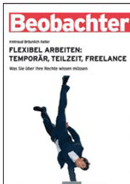
Working flexibly: Temporary, part-time, freelance What you need to know about your rights Flexible working models present opportunities and risks: This unique guide provides information on the legal basis and helps you to recognize dubious offers and avoid grey areas. 144 pages, Fr. 24.- 1st edition, 2007 ISBN 978 3 85569 377 1 Beobachter-Buchverlag

beo
 

To the point: trouvailles

Browsing through the media is always full of surprises—often amusing, but sometimes embarrassing.

Amusing is for example the story of the dormouse in the toilet, which was to be found this week on 20 minutes. Quote: "A dormouse looked out of his toilet bowl at an apartment tenant (...) early in the morning. It is not known which of the two was more frightened. The protected animal could not leave the supposed watering hole by itself (...) The surprised apartment tenant reported the animal find to the city police. By the animal protection officer, the dripping wet dormouse was picked up, dried and fed." Great story. Everything is in it, a poor little animal, the police your friend and helper and the frightened animal lover. Stupid only that as a picture credits with the photo of the dripping wet dormouse "Kapo SG" was written. The friend and helper must therefore be doubted, because apparently the brave law enforcement officers threw the poor animal back into the toilet for the purpose of taking a photo. Far from it: Only the picture reference was wrong, it should have called "zVg", because the reader reporter had printed. High praise for the editors: The next day, the photo credit was corrected. Online ads are also a source of hilarity time and again. It's not the editors' fault, but it's still amusing. Under an article on a murder case, the reader sees an ad "Cleaning without leaving traces" (blick.ch). The Google ad "Die Schweizerische Post Alles Wichtige gibt's im Postshop" also fits perfectly with the article "Die Post leert viele Briefkästen später" on nzz.ch. That's what you call environmentally friendly!

Captions are such a thing. Either they show exactly what you see in the picture, in which case it's called Man in front of hut (okay, in the past such a legend was called something else in a politically incorrect way), or they are completely incomprehensible, as in this example from BaZ: You see the footballer Shaqiri juggling a ball and the caption says "I'm being watched everywhere. Huh?

Embarrassing then a report on the news channel N24: In a report about the killing of Bin Laden the channel shows a false emblem of the Seals. One that a Star Trek fan had designed for a fictitious Maquis Seals Team Six based on the real one. Pictured is a skull (for Star Trek fans: a Klingon skull). And in the report it was said that it was clear that the Seals had a skull in their emblem. Of course! I prefer a scenic introduction to a well-written report, even if the jury of the Nannen Award sees it differently and denies the journo the prize.

Pierre C. Meier, Editor-in-Chief

Deregistration rate constantly in focus

Swissinfo.ch uses social media in a very targeted way, not only to inform users, but also to receive contributions from them.

Swissinfo.ch, the SRG business unit then known as Schweizer Radio International, was already using unusual broadcasting channels with its various shortwave stations. Today, the "Voice of Switzerland" is present on the Internet and relies not only on websites with up-to-date information in nine languages, but also on communities in the social networks. And it does so in a very targeted manner and with a view to sustainability, as becomes clear in conversation with Christophe Bruttin, who is responsible for online communication and therefore also for the social media campaigns. Like others, he also looks at the fan numbers on Facebook, but a low unsubscribe rate is much more important to him. After all, anyone who has clicked on "Like" and thus become a fan of a page can later rule out that new posts on this page will be displayed on their page in the future and remain registered as a fan. If fans unsubscribe in this way, they are lost, as they can no longer be reached. For other media, an unsubscribe rate of 30 percent is considered normal, says Bruttin and is satisfied that it is around one percent at Swissinfo.ch. We also pay close attention to how many people come back with comments. If there is a lack of feedback or an increase in unsubscribes, "we take this as an alarm signal that we are starting to bore the fans - and that is the last thing we want, because then they will perceive us as spam and stop contributing."

For Bruttin, it is therefore clear that social media should not simply be used as another distribution channel through which all kinds of messages are sent to as many people as possible. "Once you realize that social media invades users' privacy, you start to think about it in a completely different way." In total, Swissinfo.ch publishes news and information about Switzerland in nine languages. It was therefore important for the social media presence to study the various markets carefully in order to choose the right platforms. Pages were set up on Facebook for the different language groups. One for English, German, French, Italian and Spanish (with around 110,000 fans) and one each for Arabic (94,000 fans) and Japanese (3,800 fans). As Facebook is not accessible in China, Kaixin is used, which is aimed at a well-to-do younger audience (34,000 fans). There are also four Swissinfo. ch channels on YouTube and one account per language on Twitter with an automatic feed with a total of around 5,000 followers.

In this way, targeted information can be provided: A report on the deployment of the Swiss Disaster Relief Corps in the Japanese disaster area is only mentioned on the Japanese Facebook page. And on the Arabic page, there are in-depth reports on the blocking of Mubarak's or Ben Ali's accounts. On the Chinese channel, there is mainly soft news, such as information about the Swiss pavilion at Expo Shanghai last year. A separate community was set up on Facebook for a few months around the "Border Stories" project (the American mountaineer and journalist John Harlin circumnavigates Switzerland on foot, by bike and kayak and sends texts, pictures and videos). Swissinfo.ch also uses the geo-targeting and language targeting options offered by Facebook. "When we publish a story about Ecuador, we only send it to people in Ecuador or who we think might be interested." The targeting options on Facebook are "fantastic", for example, only users in Switzerland who speak Spanish can be targeted. "This way, we are 'one hundred percent sure' that there is interest," says Bruttin and would like to be able to select content by nationality and age of the user, just as with advertising on Facebook. "That would be brilliant, then we could also target articles for senior citizens, for example."

Social media is becoming increasingly important, and Bruttin estimates that up to ten percent of the audience today comes via social media channels. When it comes to increasing reach, search engine optimization (SEO) methods are still the backbone. But even if there is no link to an article and 500 readers re-tweet the story, this can lead to certain articles taking off. However, Swissinfo.ch not only uses social media channels to reach communities, but also does a lot to get something back from them - in other words, to maintain a lively dialog. Take the Ticino dossier, for example, which documents the lives of emigrants from southern Switzerland and their descendants and for which users have sent numerous pictures of their ancestors. Because this project has shown the rich possibilities of user-generated content, 2011 is set to be a key year in this respect. "We are now talking to journalists primarily about social media." Unlike a few years ago, it is now much easier to convince editors that social media and SEO work and that a little extra effort is therefore justified. "But it's still not easy." The Ticino dossier in particular helped to change many views in-house, as it became clear that material had been obtained that would otherwise not have been accessible. This shows new paths for journalism at a time when many believe it is dead.

In future, Swissinfo.ch would like to reach new users with targeted projects. For example, a business channel on Twitter in English is being considered. "The demand is there, it could work," says Bruttin, but it has to be a real product with full commitment behind it. And this is also Bruttin's insight from his social media efforts to date: Do it right and don't invest in half-baked projects that aren't fully thought through and aren't supported, or otherwise better leave it alone because otherwise the brand could be damaged.
Christoph J. Walther

Mini-Case Studies
Topics relating to the professional use of social media are omnipresent. Much is new and proven recipes for success are in short supply. This is why Werbewoche is publishing a series of mini case studies to provide insights into the daily work with social media channels and thus contrast the pure statistics on fans and followers. These articles have appeared in the social media portrait series so far:
-Slow down. Take it easy": Werbewoche 06/1.4.2011, page 31 
- "Ovomaltine": Advertising Week 07/15.4.2011, page 27
- "Swiss": Advertising Week 08/ 29.4.2011, page 29

minicase1
minicase2
 

"PR on the social web without strategy - that time is over".

Content is king, context is queen. But that’s not all you need to keep in mind if you want to do successful PR on social media. In an interview with Werbewoche, PR and social media specialist Marie-Christine Schindler explains how companies, organizations, and individuals can make the transition to social media without stumbling, where they can get help, and how they can avoid a communications disaster.

top1

Werbewoche: Nowadays, PR no longer just means writing press releases that are rewritten three times by the company's board of directors before being released, maintaining an Internet presence and perhaps answering a few e-mails. PR 2.0 is dialog on all channels, often with very short response times. What does that mean for public relations staff?

Marie-Christine Schindler: This means that public relations staff today follow somewhat different rules when they prepare information. They no longer have to follow the rules of the media and journalists alone, who have very precise ideas about how they want information to be prepared, namely as neutrally and objectively as possible, as a basis for their work. In addition, companies today have the opportunity to shape information the way they want it and to build up a flow of information. This does not mean that media work is dead. But social media are a complementary way for companies and organizations to make their mark online.

When a PR department has to react quickly, for example to tweets, it's impossible to go through various approval loops. Will bosses and boardrooms have to have more trust in their PR team in the future? Allow them more room to maneuver?
The position of PR officers has changed several times and has become very complex. This is because broadcast communication, in which press spokespersons issue messages on behalf of companies, is over. Multiple voices from within the company are now in demand. There is a growing awareness that each employee is a part of the whole and each is an expert in his or her field. This does not mean that every individual in the company becomes a communicator. But more than ever, the various departments should designate a social media-savvy employee and encourage them in their communications. This makes coordination much more challenging, because the meticulous clarification of posts is no longer possible. This is still possible with the original text and the core message. Once the text is published, the reactions from the social web can no longer be controlled and require flexible action.

So in the company of the future, several people will take care of PR, and there will no longer be one person in charge over whose desk everything runs?
The PR or communications manager still exists. He or she has two tasks: On the one hand, he or she must hold the threads together so that everything that is communicated interacts well and makes sense together. To prevent everyone from doing what they want, a company needs an authority that controls the overall appearance. On the other hand, the PR person must assume a kind of coaching function. He should teach the people, who can report and give answers much more authentically than he can from their field of work, what the company's goals and messages are, how communication works on the social web, what to watch out for and what to avoid. The biggest challenge is to make the employees linguistically fit as well.

For example, in a large company with several thousand employees, most of whom have a technical or engineering background, are there people who would be willing to take on such a communications job?
I think that has yet to be proven. We don't have that experience yet, because it's only this year that companies are really starting to realize that they should be active on the social web. I hope we're now past the stage where it was, "We'll make a Facebook presence and then it'll be fine." Companies and organizations have realized that more planning and, above all, a strategy are necessary to succeed on the Web. You can't demand an additional communications task from all employees, but in executive positions, it should gradually become part of the job profile to represent the company to the outside world. Under certain circumstances, however, this is a generational question; it certainly won't happen overnight.

So is it always the head of department who becomes the PR officer in addition to his professional work? Or can it also be any person from the department?
This can also be a person from the department if he or she enjoys the trust of the management, is equipped with the necessary competencies, has the desire to do so and is loyal to the company. It does not have to be the head of the department - he or she is the person most likely to be expected to take on such an activity as part of his or her duties. In any case, everyone should not have to communicate, because that also has something to do with personality. There are people who do not want to be seen on the Internet. You have to choose the employees in question with a lot of sensitivity. But I believe that if people see a benefit, they will also be more willing to contribute their share to communication on the social web.

Is a certain corporate culture necessary to operate convincingly in social media?
People always talk about openness and transparency. But the most important thing is actually management's trust in its employees, trust that they do what they do well. There needs to be a culture of reinforcing strengths rather than harping on weaknesses. And employees need to be able to take their cues from their managers and hold on to them. If everyone is allowed to do everything, that's no good either. There needs to be a middle ground between giving freedom and setting limits. And, of course, management has to find out who is actually fit for communication on the social web. Not everyone can do that, and not everyone has to be able to do that. By the way, I recommend defining the do's and don'ts in social media guidelines and training key people.

What additional qualities and skills do PR people need today compared to PR people of the 1980s and 1990s?
Besides holding on, also letting go. Today, it's also about enabling other people to communicate. PR people have always needed curiosity, but today they also have to be very flexible and agile. Of course, they also need a certain standing, because there are always situations where you have to react quickly and can't ask anyone for advice. By the time you reach the board, a topic on Twitter may have long since run its course. We still need very well-trained PR people who know what overall communications are all about. Then social media is simply an additional dimension that the company can shape in line with everything it has already done.

Does the work of in-house PR people differ from that of a PR agency?
Both must have an equal understanding of the craft. At the moment, there is simply a danger of acting on the basis of little expertise. In the start-up phase, it's good to get an agency on board that has people who have already gained experience and have dealt with the subject in depth. It's important that the agency doesn't go into a company and say, "Now everything is new and different. What you've been doing is no longer state-of-the-art and not good enough." You have to approach people very carefully, because they have thought about everything they have done so far, and they are proud of their work. After taking stock, you can then look together at what the company could achieve with social media. For the start, i.e. for strategy development, topic setting and resource estimation, a company can get knowledge from outside. But when it comes to the subsequent implementation of content and, above all, language, an agency can't do that in the long run. Because it doesn't get to see the subtle movements in a company, it can't hear the grass grow and can't respond quickly and sensitively enough to reactions on the social web.

Is PR more difficult today than it used to be?
Yes, PR is much more demanding today. If you want to position yourself as a company, you have to operate quite a few channels, are confronted with a huge flood of information, and there are no clear courses of messages. Added to this is the time pressure: people exchange information when and where they want. A company that communicates on a topic that extends into leisure time cannot work from Monday to Friday between 9 a.m. and 5 p.m., and on weekends there is radio silence. After all, its readers and customers are mainly active on weekends. Whereas I believe that a company has some control over managing expectations. It's perfectly within its rights to have something like opening hours on the social web, too. If it's not exactly a hotline that should be available if there's a fire somewhere, that's OK and is also accepted without any problems at the moment, at least in our latitudes.

Nevertheless, it can be a problem for a company if a heated discussion about its business practices or products develops on Twitter or Facebook over the weekend and it doesn't respond to it until Monday.
That's true, communication crises have tended to build up over the weekend in the past. But you have to distinguish between observation and action. Every company must observe what is being said and reported about it on the social web. Responding to that is a second step. Nevertheless, you notice the difference between an account without an owner and one that is monitored, but where the person responsible decides that someone has a problem that can still be solved on Monday. If, on the other hand, something is brewing, the PR person should react quickly. But even then, he doesn't have to have the solution ready. It's often enough to signal: "We heard you and we're taking care of it. There is also good self-regulation on the social web. If there is justified criticism, a service does not work, etc., then the company must ensure an adequate response to the complaint. However, if criticism is not fair or is made up out of thin air, it is not uncommon for other users to react to it. For example, I followed a case where a company had announced a competition and a user commented that he had not won anything and would now no longer buy anything from this company. The company just let that stand and it didn't take long for two other users to come forward to make it clear how ridiculous that reaction was. This regulation comes relatively quickly.

So then, in some cases, it may be more clever for the PR officer to delay his response a bit?
Yes. Sometimes it's not bad not to react immediately. You also have to give people the opportunity to reflect and contribute their own opinion. You prevent that if you always acknowledge everything immediately. Of course, it's challenging to figure out when speed is needed and when you should wait a bit.

How can the PR manager keep track of everything? It could be that he regularly checks YouTube, Facebook and Twitter, but a discussion on a blog passes him by.
You can get a good grip on this with professional monitoring - which still doesn't mean that you always see everything. For monitoring, there are various tools that you can put together yourself or buy as licensed products. With the same search specifications, however, completely different results can emerge. That's why a company has to take a close look at which tool it can work best with.

The social web is almost uncontrollable: anyone can write anything about anyone at any time. Should companies and organizations not even try to intervene here in a steering and controlling way? What do you recommend?
I would advise every company without exception - and every person - to monitor themselves. That is the minimum. You should look at what's being said about you and what's going on in your environment; that's a mixture of observing the competition, continuing education and planning for the future. Incidentally, this also determines which activities make sense on the social web. Because not everyone needs to have a Facebook or Twitter account. If, for example, I notice that my audience is discussing my topic in a very differentiated way in special forums, then it makes sense to become active there as well. You shouldn't choose certain tools just because they are talked about a lot, but you should decide where to engage based on the content: What is being talked about, where are we in demand, where can we profitably join in the discussion? Companies must cleverly stage the world of experience around their brands and weave this content into the exchange on the social web. Consumers don't buy certain brands just because they like the products, but because they associate something with the brand. Companies can and should take advantage of this.

How much preparation time does a company need to cut a good figure on the social web?
PR on the social web starts with listening. I would allow six to eight weeks for the development of accurate monitoring with the appropriate keywords. How long it takes in total depends on how far a company has come with the preliminary work and what activities it is planning on the social web. But it will certainly take six months to a year for a company to establish a standing, for employees to learn how to use the social web and to build up a routine, until they have figured out which information to place in which channel and how to interlink the channels. For those who will later be in charge of communications, it's not a bad idea to practice all this on a private account first in preparation. The best thing for them to do is to pick a specialist topic or a hobby that they can talk about with others. That way, they develop a feel for how the social web works.

You advise companies on their PR entry into the social web. How do you go about it?
Before I make a presentation in a company, I preferably take the six to eight weeks I mentioned to first find out where the company stands. A certain period must have elapsed for a picture to emerge. Then I try to find out what the customer wants and evaluate the next steps: In the past, a customer came in with his media release and wanted us to send it out. Then it was our job to make sure the customer did his homework. We would ask, "What exactly do you want to say? What do you answer when journalists ask? Have you selected contact persons and are they prepared? Have you prepared visuals?" And it often turned out that the media release was not the right choice at that point. When it comes to a presence on the social web, a company must also ask itself: what do I want to say? What do I want to achieve? It's not enough to simply want to be present in the media again. My starting point is not measures, but goals. That's why it's important to me what a customer has done so far, why he wants to be on the social web, what his motivation is. Some simply want to be there, others already have clear ideas. You can see how realistic they are, and monitoring helps here as well. At the moment, we're in a phase in which we still have to explain exactly how the social web works, how people talk there, and what mechanisms exist. My customers are often not even aware that conversations really take place on the social web and how interconnected the various channels are: that blog posts are commented on Twitter or Facebook, or a Facebook or Flickr post can reappear on Xing. To clarify this interconnectedness, I'm talking about social web, not social media. A company can even make its mark with a YouTube account without ever uploading its own videos - simply by compiling posts. Curating knowledge is something very important on the social web. But many companies don't realize that either.

There is always talk of THE company. But of course there are individuals who tweet for a company, look after the Facebook account or are active in blogs. Should they appear with their name and a photo, or would it be better for them to remain anonymous behind the company logo?
It's always said that you can give the company a human face on the social web. But that's a platitude - because how do you imagine the face of Swiss, for example? If the Swiss press spokesperson tweets or faceboots, then of course he can appear with his name and picture. But what does Swiss do once he leaves? Or how does it manage it when several company representatives communicate? Does it have to introduce them all now? Here, it's a matter of weighing things up.

This is likely to be a strategic decision on the part of the company. Because as you say, if the person to whom the communication is linked quits, the company literally loses face. Does that mean that a company should distribute communication on the social web among several employees right from the start?
Yes, definitely. Because it's much more authentic, it's more broadly distributed in terms of knowledge areas, it's more lively, and there's a diversity in the language as well. In social media, there is not such a clear corporate language as in the rest of corporate communications, apart from certain terms. So everyone communicates in a slightly different style, and users are addressed differently. They like that - after all, everyone has different preferences. Dividing communication among several shoulders also takes the pressure off the PR people. If a small company shows all its heads, that's OK, because often the team consists of just two people. But not every company should show all its communicators. On the one hand, not every employee wants to see his or her photo on the Internet, and on the other hand, human communication is already done through language, so you don't necessarily need a face. On the radio, you don't see the face either. The situation is somewhat different when it comes to support and advice, where the consumer naturally likes to have a contact person. As soon as you have a case together, it is advisable to have at least an abbreviation.

Swissair's former press spokeswoman Beatrice Tschanz made a name for herself with her open communication during the company's grounding in 2005 - not least because she was able to control exactly what information leaked out and when. Do you think Tschanz would have done as well if social media had already been an issue back then?
Yes, I think so, but she would have been even more challenged than she was then. Tschanz had a decisive advantage: she was directly attached to the CEO. Today, it's more important than ever to have backing and full trust from the top. You have to be able to coordinate quickly with the boss, but you don't have to coordinate every detail with him. Tschanz was able to portion out the information, but she had to be very quick. She simply had the right mix of intuition, experience, humanity, support from the boss and freedom of action.

Is it especially important to be present on the social web when it comes to crisis communication?
I wouldn't necessarily push a crisis out into the social web. But you can assume one thing: When there's a crisis, it's on the social web in a flash. The killing of Osama bin Laden, for example, spread first and foremost on Twitter, even before Obama had a chance to speak out. But if you have the special case that there's a crisis that hasn't hit the web yet, I wouldn't push that either. Today, crisis communication is much more sophisticated. In the past, you could pull back, clarify facts, advise on how to formulate a statement, and then inform. Today, the first photo of a plane crash is already on the Internet before anyone in the company has really understood what happened. Today, companies are forced to adopt salami tactics. Because they are expected to communicate in real time: They have to provide ongoing information about what is happening, which is enormously demanding in complex cases. What you should definitely do when people are discussing your company on the social web is signal, "We heard you and we're working on it."

Social media are a huge challenge. Are there organizations or companies for which it is fundamentally not worth investing energy, time and money in Facebook, Twitter, blogs and the like?
Every company has to make a minimum effort for monitoring, there is no way around it. If you want to be perceived in public with your services and offers - and this will apply to every company - you can and must assume that people will talk about you. I also say "may" because people don't always just talk badly. People don't really want to criticize, they want to be left alone. As a rule, they only complain when there are really serious shortcomings. At any rate, I can't observe people on the Web simply looking for a fight. Quarrelsome people are quickly cut off. The important thing is to take a lot of things from everyday life and approach them with common sense.

How do you monitor your success on the social web? The number of fans and followers is probably not meaningful.
Fans and followers alone are not a good indicator, if only because they can be bought. One sign of success is the exchange with users. If a company only provides information on Twitter without links, it appears isolated. If it links, the communication goes a little further. But there should also be interaction beyond that, on Twitter, for example, through @username, which indicates a conversation. An exception is media that is about spreading news - in this case tweets or posts are only justifiable with links. But with any other company, I don't understand why, if they have followers, they don't follow anyone back. To me, that says, "We don't want to talk to you, we want you to listen to us." Another mark of quality, of course, is when a company's messages are retweeted and shared.

What are the three most important rules for successful PR on the social web?
First, the company must know what it wants to say and achieve on the social web. Second, it must be willing to let go. Once a piece of information is out there, it's a matter of listening to how users react to it, what their points of view are, and responding to them. And third, the company must remain authentic. The social web is neither a cheap marketing tool nor a transmitter of brand messages, but an opportunity to distinguish and share content in its own way that adds value to the target audience.

How does a company or organization find the right person or agency for their PR on the social web?
In our book*, we have listed some points to look out for when choosing an agency. The person who takes care of it should already have their own experience in the social web, but also understand something about overall communication. I don't think much of agencies that only offer social media - I don't think that's the right approach. A solid communications education, experience in the social web, the ability to listen actively, analyze what you hear and implement it conceptually are all part of the core competencies for me. Ultimately, it is crucial that the chemistry between company and agency is right. What's important is a relationship of trust that allows for an open conversation and in which both sides work together to find out which path the company could take in the social web.

How long will it take for PR on the social web to become more professional?
That will develop over the course of this year. Last year, you could still experiment around, as an agency and as a company. That time is now over. Companies can no longer go into the social web without a strategy.

Interview: Anne-Friederike Heinrich

In a nutshell
Marie-Christine Schindler is an independent PR consultant and Master in Writing and Corporate Publishing. She worked for eight years at the international PR agency Trimedia Communications, where she served clients such as Mövenpick, Federal Express, ABB, Lufthansa and Zurich Insurance. She then spent 14 years in PR education, including at SPRI. In 2010, Schindler founded her PR agency mcschindler.com. www.mcschindler.com

*Reading Tip:
Marie-Christine Schindler / Tapio Liller (2011): PR on the Social Web - the handbook for communications professionals. O'Reilly-Verlag; 36.20 francs.
 

Miami Vice Scool

The Miami Ad School is considered the most creative advertising school in the world because its students win so many prizes. Now a Swiss man has also taught in Miami. René Eugster from Agentur am Flughafen was a lecturer for a week and interviewed the school's director Pippa Seichrist.

top2

René Eugster: What can you tell us about the history of the Miami Ad School?
Pippa Seichrist: Talking about the future of the school is more fun than digging into the past. But perhaps more interesting is our motivation that led to the founding of the school in 1993. My husband Ron and I were both creative directors and we had the idea: let's start the school that we would have liked to have attended ourselves before we entered the industry. We then searched all over America for a suitable location and finally found what we were looking for in South Beach. We wanted to realize our dream here. In earlier times, our school building was a Masonic lodge, a Jewish temple, a theater and a Hispanic Protestant church. The place had great karma.

What concept did you use to build your new school?
The school is very practically oriented. We offer on-the-job training from the very first day. All tasks are projects that a young student at our school would also have to supervise in an agency. The teachers are also experts in the industry. We have a very close relationship with agencies all over the world. They support us by offering internships to our students and also regularly have their specialized employees work as guest lecturers at our school. We even work on real projects with these agencies and their clients. We have worked for Wendy's, Yahoo, The New York Times, Saturn, Dunkin Donats, Apple, Mini and most recently Starbucks. For our students, the school is the bridge between their education and their desired job. For agencies, our graduates are profitable right from the start. Our graduates don't need much additional practical training later on. They can be immediately assigned to a project. It's a win-win situation for everyone involved.

Which students make up your target group?
We want outsiders. Interesting people with interesting prospects. Most of our students have already been to college or had a job. Former lawyers, cab drivers and teachers come to us. One was even previously a porn producer. What they all have in common is that they were not entirely happy on their previous path. They wanted to live out their creativity more. With us, they can learn the necessary skills and build the network they need to be successful in this industry.

How do these people find your school?
Most of them come via word of mouth. Many professionals have positive things to say about Miami Ad School. Then they do some research and soon find out which prizes our students regularly win and which jobs the graduates have ended up in. In this way, students from all over the world find their way to us.

Do you take anyone who brings the necessary change, or is there an entry test?
We have a rigorous selection process and candidates have to show us their creative work. They have to write an essay from which we want to see how they think. A video must be produced. We also ask for letters of recommendation and we interview everyone. We want to make sure that a candidate is suitable for both our school and the industry. We find that most people really enjoy this selection process. Advertising is fun and anyone who doesn't enjoy pitching has probably chosen the wrong profession.

There are now many branches of the school. Why and where did this expansion begin?
Right at the beginning, we regularly invited guest lecturers to Miami. They taught for a few days and enjoyed our sunshine. We were able to present our students with extraordinary personalities from all over the world: a Japanese art director, a planner from England, an entire creative team from New York, a game developer from San Francisco ... This experience gave us the idea: instead of just bringing thought leaders to Miami, we could also send our students out into the world to learn from these experts. This is how our "quarter-away program" came about. This enables our graduates to study in Miami and, coupled with this, to do internships in up to five other cities in which we now have offices. At each location, our students are confronted with new processes and techniques and can also build up a valuable network of contacts in the agency scene. The first branch was in Minneapolis, then came Chicago with a year-long internship at Leo Burnett. This was followed by San Francisco, New York and London. Later, we supplemented the internship opportunities with further full-time schools in the respective locations. This meant that we no longer had to start our studies in Miami. Today, we have eight full-time schools and also offer internships in Amsterdam, Barcelona, Berlin, Brussels, Buenos Aires, Chicago, Hamburg, Madrid, Moscow, Miami, New York and Sydney. I'm sure I've forgotten a few more.

When did you start in Germany?
That was in 2004, when Oliver Voss, then the top CD at Jung von Matt and the most decorated creative in Germany, came to us as a guest lecturer - just like you now from Switzerland. It was his second guest appearance with us and we wondered why he officially asked for an appointment with Ron and me before arriving. We have very close and frequent contact with all our lecturers during their time here. It all became clear at dinner. Oliver Voss asked us if he could open a Miami Ad School in Hamburg. He said that teaching had been one of the most rewarding things in his life. And he was convinced that Germany needed a school like the Miami Ad School. He introduced us to Niklas Frings-Rupp, who was an account manager at Springer & Jacoby at the time. Together we decided to found the school. In our lobby in Miami, we have clocks with the times of all the places where there is an ad school. Now we also have a cuckoo clock showing the time in Germany.

What are your plans for the future?
Oh goodness, there is so much! We are launching Miami Ad School Istanbul in the summer. This will be the first school for advertising in this region. Schools in Mexico City and Mumbai are also in the pipeline. We are also experimenting with how we could offer an online study program. All our locations are very well connected with video conferencing capabilities and we often have classes from different schools connected in class. We are developing platforms where students and lecturers can exchange ideas worldwide. Our curriculum is available online and teachers can make their own suggestions. We are also planning a global student award show with work from all our students. They can log in worldwide and follow the development of the best cases of their fellow students in Moscow, Sydney, Madrid or San Francisco. Jury members can comment on why they chose certain ideas and what could be improved. We are also developing an online partner program with universities. This will allow students to join us online while still physically attending classes at a university. After graduating from university, these participants can then attend a Miami Ad School of their choice anywhere in the world for a year. We call this program "Jump Start" because it offers students a good starting point for their job search. We also offer short online courses for professionals in a variety of specialties. These courses can be followed online, partly via video and chat. Of course, there are also several blogs about our school.

How many students do you teach worldwide?
We have over 700 students around the world. There are 200 at our largest location in Miami, and Hamburg already has around 100. In total, over 2000 have passed through our institution and now have jobs in companies around the globe. I know of 22 visitors from Switzerland, 13 from Austria and 126 from Germany.

Am I the only teacher from Switzerland?
Of course you are.

Last question: How rigorous do you think the studies at Miami Ad School are?
Our students spend over 12 hours a week in class. However, they also spend at least twice as much time on their projects. That's why they say here: You can recognize Miami Ad School students on the beach by the fact that they usually have no tan at all.

A Swiss in Miami

eugster

This spring, René Eugster from Agentur am Flughafen spent a week as a guest lecturer in Miami. The Miami Ad School's program announces such industry experts as "Industry Heroes". "That makes you feel a bit strange as a Swiss person. That's not our word," says Eugster modestly. But he knows that the job in Miami is highly coveted by many colleagues. The agency boss from Altenrhein came to the job after getting to know principal Pippa Seichrist on the jury of the Caples Award last November. She was a delegate on the board for the USA and "a much sought-after discussion partner" among the 80 judges from all over the world. However, Eugster did not actively seek an invitation to Miami. He only found an email from Pippa Seichrist when he returned home. She was impressed that René Eugster has not only been running an agency with ten people for 18 years, but has also founded his own school, IQ Management Center, where he and his team train 60 marketing planners and sales managers every year. He also used to teach at the management school. This made the Swiss national the ideal candidate for Seichrist. Eugster had to submit a task. "Because we don't have any big brands in Switzerland like Coca-Cola or Nike, which other lecturers like to use as cases, I decided to use the Swiss brand." Together with Rafael Enzler from Switzerland Tourism, he opted for the "word of mouth" task. This was to be increased by ten percent among foreign tourists. In Miami, Eugster first gave an introductory lecture to 130 students. Then, for the rest of the week, "entire campaigns were created out of thin air" in group work. pan


Prize for art journalism awarded

This year's R&R Prize for Art Journalism has been awarded to Paulina Szczesniak of Zurich. The prize is intended to support young art journalists in their professional development.

The main prize is endowed with 6,000 francs. Szczesniak has worked as an art editor for the Tages-Anzeiger and Züritipp since 2010. She previously worked in various galleries and as a freelance journalist. This is according to a press release issued by those responsible for the R&R Prize on Wednesday.

The sponsorship prize of 4,000 francs goes to Sylvia Mutti from Bern, who writes for the art and culture magazines Artensuite and Ensuite. The third prize goes to Pablo Müller from Switzerland, who lives in Berlin. He receives prize money of 3,000 francs. Among other things, Müller writes as a freelance art critic for Kunstbulletin Zürich.

The R&R Prize was established in 2008 by gallery owner Raphael Rigassi and Daniel C. Rohr, the owner of a communications agency. The award is intended to support the quality of media coverage of the visual arts.
 

get_footer();