A Cardinal, freshly tapped

A new draft beer from Cardinal has recently hit the market. The creative team at Wirz is targeting young partygoers rather than the older regulars at the bar with their advertising.

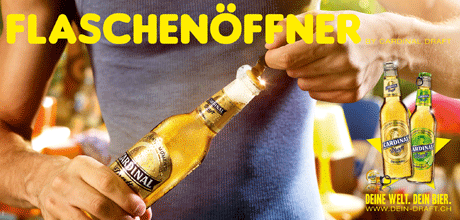
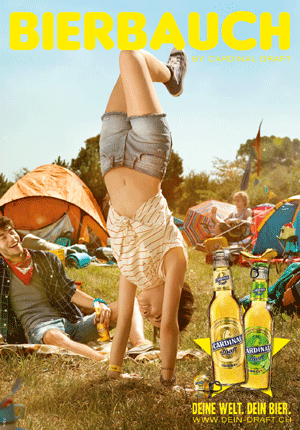
The new Cardinal Draft has been available in two varieties in stores, bars and restaurants since the beginning of May. The first is the refreshingly mild Cardinal Draft Original with the typical character of a modern draft beer. On the other hand, as the tangy, fresh Draft Lime Cut. This mixed beer drink with a touch of lime promises the perfect way to cool down on hot summer days in a correspondingly cool campaign by Wirz Werbung. In order to position the new fashionable drink with the targeted young audience, Philipp Skrabal and his team worked with trendy images from the young party scene. For ten films, which are designed for viral distribution online as well as on TV, the creation brought an "authentic lifestyle of the target group" into the picture. Traditional terms from the world of beer such as "beer belly", "regulars' table" or "master brewer" are reinterpreted and break with old beer habits. What is refreshingly new and different about Cardinal Draft 2011 is not only the content, but also the surroundings. This starts right at the top: with an innovative pull-off mechanism. This makes it easy to open the beer by hand or even with charming lips, as the commercial by Markenfilm Schweiz shows. It is accompanied by the currently very popular music of the Round Table Knights. A soundtrack that also fits in with Cardinal's sponsorship commitment. The label is an important partner at all major open airs in Switzerland. pan

cardinal1
cardinal2

TV advertising goes online

Online video advertising is booming - and Switzerland has a special starting position in this respect.

Last but not least: The third dimension of book publishing

Now that new media and the Internet have already had a lasting impact on print journalism and book publishing, it’s time for a third dimension of the written word: the «living library.» Here, books are borrowed the old-fashioned way—but instead of books, it’s people.

This Sunday, May 25, the former Rosengarten restaurant in Zurich will be transformed into a public Living Library. Instead of books, people can be borrowed there for discussions. These people belong to groups of people in the city of Zurich who are often confronted with stereotyping or prejudice.

The books are: A Muslim woman with a headscarf, a housewife, a sans-papier, an HIV-positive person, a policeman, a member of the Jewish religious community, a private banker and a prostitute. They can be borrowed free of charge from the "living library" for a 30-minute conversation. The living books are not non-fiction or academic literature. They are people who are repeatedly confronted with prejudices. In this way, the "living library" can build bridges between people who think differently. According to the press release, the event aims to facilitate contact with social groups that are politicized in the broadest sense and promote a more differentiated examination of these foreign worlds, which are otherwise mainly known from the media. Visitors can choose such a "book" and talk to it alone or in pairs. Through the organized exchange, they can directly ask the living books - with which they would otherwise probably not be able to come into contact so easily - questions that interest them personally and that go beyond the abbreviated prejudices and stereotyping. Living Library events are thus characterized by tolerance and personally imparted knowledge.

The first Living Library was held at the Roskilde Festival in Denmark in 2000 as part of the "Stop the violence" youth initiative. It attracted attention beyond the country's borders and similar events are now held in numerous countries. The concept is still little known in Switzerland.

The Living Library Zurich will be held in the "blue salon" of the former Rosengarten restaurant (right next to the Kalkbreite streetcar stop in district 4). On May 29, 2011 between 15:00 and 21:00 people can be borrowed there for 30-minute talks. Participation is free of charge. The event is privately organized by David Gaus (graphic designer) and Simone Isliker (philosophy student).
 

Top 1 of the week: Zurich Journalism Prize awarded

This week, the 31st Zurich Journalism Award was presented at the Casinotheater in Winterthur. Each of the four awards comes with a prize of 10,000 francs.

Michael Meier (Tages-Anzeiger) received the prize for his work as a whole for his reporting on the subject of religions. Meier has been writing about religion and society as a specialist journalist for the Tages-Anzeiger for almost 25 years. The winners in the newspaper category were Dagmar Appelt and Katharina Baumann. They were honored for their elaborate series of articles "Leo's path to freedom" and "Poverty in Winterthur" published in the Landbote. In the magazine category, Otto Hostettler and Dominique Strebel (Beobachter) impressed the jury with their article "A dark chapter" about children in orphanages and Verdingkinder. Maurice Thiriet (Tages-Anzeiger) won in the young talent category with his article "Die eingebildete Astronautin". The award ceremony was attended by numerous prominent guests from the worlds of business, media and politics. Urs Rohner, Chairman of the Board of Directors of Credit Suisse, gave a speech before the jury paid tribute to the work and the work as a whole. The satirical finale of the event was provided by cabaret artist Lorenz Keiser.

best YET 2011 - Creative with tie

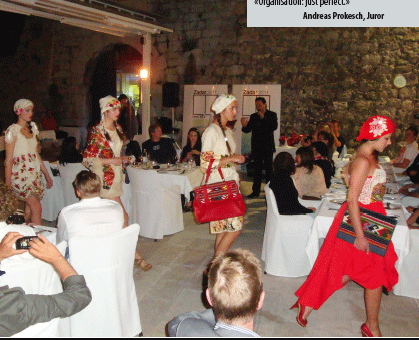
This year, the European competition for creatives under 28, «best YET – best Young European Team,» took place in Zadar, Croatia. As a media partner, *Werbewoche* covered the event online and live on Twitter.

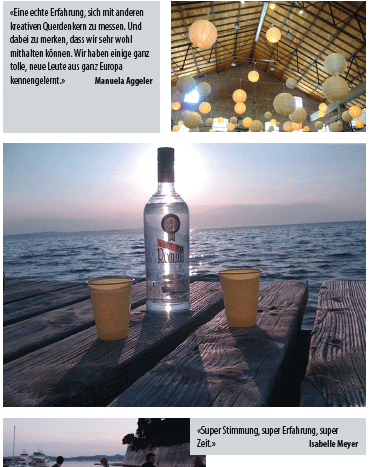
The challenge for the 43 participants from eleven countries: they had to design a print campaign within 24 hours that would position Croata ties worldwide as a premium brand for men's ties and make the tie an indispensable styling element for every man. The creatives were only allowed to use paper, scissors, glue and a few pens. A real challenge for digital natives. England was rewarded with a double victory: Poulami Chakraborty and Julia Earthrowl took first place, Ed Redgrave and David Wigglesworth second. Third on the podium was the Irish team: David Bowen and Ross Hardiman. The subject of the two winners will now be published throughout Europe. They will also be able to travel to the Lions Advertising Festival in Cannes from June 19 to 25. The two Swiss teams - Manuela Aggeler from Miux and Isabelle Meyer from Umantis as well as Patrick Ryffel and Manuel Rohrer, both from Contexta - did extremely well, but were unfortunately unable to convince the eleven-member jury. Next year, best YET will take place in Oslo. Anne-Friederike Heinrich

> To the impressions, Part 1 (PDF)

Further impressions:

bestyet1
bestyet2
bestyet3

Küttel Laubacher presents AZ Medien marketplace

AZ Medien's marketplace is intended to offer all companies in the Mittelland region a platform for presenting themselves simply, free of charge, and to the public on a local Internet marketplace. In order to have as many company owners as possible present on the platform as quickly as possible, the Küttel Laubacher advertising agency set up a multimedia campaign for AZ Medien.

With a mailing featuring a disembodied person, recipients are invited to complete their profile and thus enhance their presence on A-z.ch. The message "Give your company a face" is supported by an augmented reality application that can be accessed directly via the URL printed on the mailing. If the mailing is held up to the webcam, the figure depicted comes to life and demonstrates the value of presenting and positioning one's own company correctly on A-z.ch.

In addition to the interactive mailing, the new online offering of the Aargauer Medienhaus is also advertised in ads, on online banners and in a commercial.

Responsible at AZ Medien: Roger Knabenhans, Fatima Gmati. Responsible at Küttel Laubacher Werbeagentur: Nicole Laubacher, André Laubacher. Raphaël Surber. Video shoot: Maybaum Film. Augmented Reality Application: Notch Interactive.

To the spot

Club Med: Luxury vacations from the tailor

Club Med, the Geneva-based specialist in all-inclusive vacations, has returned to German-speaking Switzerland after years of staying out of the advertising spotlight. And it’s not just launching a new campaign—it’s introducing a completely new positioning: Going forward, the travel company will offer tailor-made, luxury all-inclusive vacations.

With the new campaign, Club Med wants to move away from the image of a provider of loud club vacations à la Ballermann, where every guest has to take part in the entire entertainment program. Instead, the travel provider is positioning itself as the first address for premium vacations on five continents - still all-inclusive, but at four- and five-star level. For example, holidaymakers can book private villas in Mauritius with their own pool, butler and private golf and tennis lessons with Club Med. These accommodations are exactly the opposite of what is commonly thought of as a "club vacation". This makes them a perfect fit for the travel company's new strategy. "By 2012, we will have upgraded the majority of our 80 resorts to premium level and built more luxury resorts," emphasized Pierre-André Gremaud, Marketing Director of Club Med, at the launch of the new campaign. "Our core message is that in future everyone will be able to enjoy a luxury vacation tailored to their needs at Club Med."

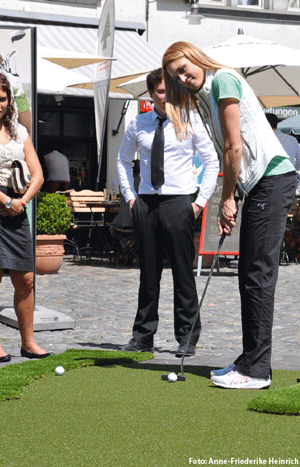
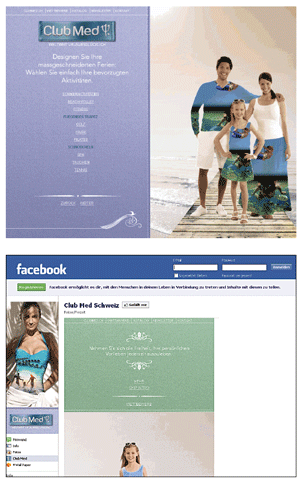
The campaign includes print motifs, online banners, a Facebook page, a microsite and surprising ambient activities such as clothes hangers, which are distributed in dry cleaners with the message "So that you too can return from your vacation in top form". The four print subjects visualize the "tailor-made" message with dreamlike scenes from the beach, the golf course or tennis court and under water, which were printed on the clothing of the testimonials - because tailor-made vacations feel as good as a shirt tailored to your body. The print subjects are placed in the daily press, magazines and special interest titles, the banners on Annabelle.ch, Schweizerfamilie.ch and Gofeminin.ch, for example. "We deliberately focused on women when addressing them because they are more open to new ideas than men and usually have the most important voice when planning a vacation," explains Gremaud. Club Med is also using events to draw attention to its repositioning: Last week, Jennifer Ann Gerber, Miss Switzerland 2001 and presenter of the SSF program "Golfers Only", played mini-golf with passers-by on Zurich's Hechtplatz. A similar event also took place in Basel. Both events were filmed and the films will be incorporated into the campaign. All subjects, banners and activities refer to the microsite Der-neueclub- med.ch, which explains what "the new Club Med" actually is: a guarantee for a luxurious and tailor-made vacation.

Tailor-made and playful

The microsite also plays with this idea, where users can click on whether they want to book a vacation alone, as a couple or with children and what their needs are: The selection ranges from a varied sports program in summer and winter to pure romance and a luxury spa. The travel provider even offers childcare for children from the age of four months. Once users have made their selection, they are offered various Club Med resorts that fulfill their wishes. And those who are already in vacation fever can even upload a photo of themselves, swap their face for that of the testimonial and take a look at themselves in their dream environment. The new communication campaign was designed by Saatchi & Saatchi Zurich and was launched on May 9. "For the realization of the campaign, Club Med has found a partner who is very familiar with German-speaking Switzerland and can assess the needs of our target group well," says Gremaud.

Anne-Friederike Heinrich

clubmed1
clubmed2
clubmed3
 

"The next generation to have children will be digital natives"

Nicole Althaus has been editor-in-chief of *wir eltern* since September 2010. In an interview with *Werbewoche* editor-in-chief Pierre C. Meier, she explains how she plans to steer Switzerland’s largest parenting magazine toward new horizons.

althaus

WW: Nicole Althaus: Who is the typical reader of wir eltern?
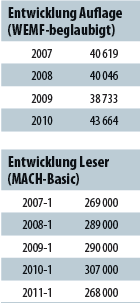
Nicole Althaus: There is no such thing as a typical reader. The biggest advantage, but also the most important challenge of our magazine is that the readership changes approximately every three to four years. And with it, the demands on the magazine. When you have a child, that's when the need for information is greatest and people subscribe to wir eltern. Of course, there are also very long-term subscribers - some even across generations - but the vast majority of women feel they have a handle on their new life and new role after three or four years.

What does this mean for the magazine?
Women are changing. They have different problems today than they did 10 years ago. The majority are working. Fathers are also more involved at home. This is creating new everyday experiences. The next generation to have children are digital natives. This is extremely important for the brand.

Hence the relaunch?
Yes, we thought about what we needed to do with the wir eltern brand so that it would meet the needs of this new target group.

What does the relaunch look like?
We are focusing on a multimedia concept and have asked ourselves which needs we need to cover in print and which online. Previously, the brand consisted of the magazine. The same print articles could be found online. The content was very service-oriented. Among other things, readers' questions were answered in the style of "My child is bedwetting, what should I do?". The answer was then given a month later. Of course, this form of reader service no longer works at all with digital natives. They google and find answers to their questions within seconds. So we will move the service to the Internet. And we will also add service to the topics that we have initiated in the print edition.

What does this mean for the print edition?
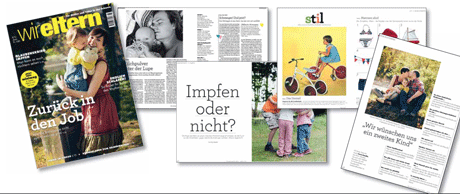
The magazine must fulfill other functions. It should become the brand's calling card. The reader should be welcomed into the new target group of parents. They should find themselves, their problems, but also their joys in it and have the feeling that yes, that's exactly how it is, that's exactly how I feel. For the first time, the magazine will therefore have a lifestyle section in which we show the beautiful sides of being a parent. But the magazine also needs to become more political and socially relevant. It is important to me that we reflect what is happening in society in the magazine. Politically, women are moving away from the home and into working life (the quota debate) and the opposite is happening to men (the custody battle). We have to do justice to this development. In the past, the magazine should have been called "wir mütter" (laughs). When fathers were featured, it was in the sense of "Dad takes over for a day". The proportion of male readers is relatively high at around 30 percent, but fathers were not picked up editorially. I want to change that. What's more, women are also interested in the fathers' point of view. Hence the monthly column "From the Fatherland" with alternating authors. We are also demonstrating our closeness to our readership with our new cover concept. The families of our readers are depicted. Depending on the cover story, you can see the offspring with mom or dad, alone or with both parents. The whole family then has their say on the last page.

Who was responsible for the new graphic concept?
The visual concept comes from Adrian Hablützel. He realized the first two issues in close collaboration with the editorial team.

Back to the Internet. How important is the idea of community?
This is very important. There are already some parent communities on the Internet. But the important field of education and development is still largely untapped. We have the know-how and the brand to occupy it.

You designed the mommy blog for Tagesanzeiger.ch and ran it successfully. Will there be parallels here?
The mommy blog mainly discussed political topics. The participants were primarily news readers who were also mothers or fathers. On Wireltern.ch, readers are looking for help and guidance. Our blog entries are read the most when they are very close to everyday life. First and foremost, we have to provide tips and tricks for everyday life.

You mentioned a multimedia concept. What is planned for the iPad?
Of course, we are also working on this. As a small team, however, we have to concentrate our resources and unfortunately cannot do everything in one go. We are starting with the relaunch of the print edition. From issue 7/8, readers will have access to additional information and services via the "Paperboy" app. The renewed online presence will then be available in the 4th quarter.

How will the new concept be publicized?
There will be presentations as part of the largest family fair in Switzerland, FamExpo, from May 27 to 29 in the Eulachhalle, Winterthur, as well as promotions in individual sales.
Interview: Pierre C. Meier

wireltern_tabelle

Vita
Nicole Althaus studied German philology and art history in Zurich and Berlin. After graduating, she managed the theater and dance program at Boa Lucerne. In 1998 she completed an internship at the Museum of Modern Art in New York. She then began working as a cultural editor at Annabelle. In 2004 she went to Facts as a reporter and in 2007 she returned to Annabelle as deputy head of department. At the beginning of 2009, she became a freelance copywriter and concept developer. She launched and managed the Mama blog for Tagesanzeiger. ch, for which she was voted Journalist of the Year 2010. In the fall of 2010, she took over as editor-in-chief of wir eltern.

wireltern
 

Konstantin Neven DuMont back in the media world

Konstantin Neven DuMont is set to return to the media world. There, he plans to focus on politics and the media.

To be more precise, the publisher's son wants to work with the company KNDM-GmbH to address grievances in politics and the media and also make suggestions for improvement. He revealed this to the Tagesspiegel according to Kress.de. The company will produce moving images, journalistic content and podcasts. The texts and commercials will be published on a website. Neven DuMont has already secured the addresses Kndm.de and Kndm.com. As he told DPA, he initially wants to try to start the whole thing with three or four people.

Konstantin Neven DuMont was shown the door by the Board of Directors of the Cologne-based DuMont Schauberg newspaper group in November last year.


German newspaper publisher throws heirs out the door

New job

In May 2009, Peter Leutenegger sold his shares in the Draftfcb/Lowe Group and wanted to have more time for culture and sport. He has now been elected as the new Managing Director of BSW leading swiss agencies, taking over the role from Walter Merz.

leutenegger

WW: Did you return to the industry because you saw a need or because life without advertising wasn't exciting enough for you?
Peter Leutenegger: BSW President Peter Felser asked me to take on this role. I was very pleased about that. The BSW is something that interests me and always has. I have time and a good network and can contribute my accumulated industry experience. The commitment is certainly mutually beneficial.

Did you already know when you sold your agency that there would be something within the industry again later on?
I led a relatively quiet and comfortable life for two years and knew that I would start something again at some point. At first, my main plan was to travel and explore the world. I wanted to live in a different country for three months every year. Learn the languages, experience the cultures. I would have been interested in Argentina, Spain, Italy. That fell through, or at least was postponed. Instead, I took on a few mandates for companies that I advised within a very narrow framework. No advertising. I showed these companies how to organize themselves, how to approach and select an advertising agency. But I didn't accompany them through a pitch. I have also advised advertising agencies, I am a commercial judge and I have a mandate in the cultural sector.

In which division?
I am on the board of the Rigiblick Theater. My agency used to do the advertising for this fantastic theater and continued to do so after I left the Draftfcb/Lowe Group. After I left the agency, I was elected to the board of the Theater Rigiblick association.

What is your connection to the theater?
At FCB Leutenegger Krüll, we supported Theater Neumarkt for five years. Then Daniel Rohr, then an actor at Neumarkt, took over the Rigiblick as theater director. Because he is a likeable guy, I wanted to help him make his theater known. We created the corporate design, program flyers, theater posters, etc. In the meantime, I became treasurer of the Theater Rigiblick association and am responsible for financial monitoring. Today, the Rigiblick has a budget of over a million francs and has become quite a complex operation. Incidentally, most of the money is generated by the theater itself, with a lot of work by the multi-talented Daniel Rohr. I also make sure that everything runs smoothly from an organizational point of view.

You also wanted to have more time for sport after selling the agency. How is the training going?
Yes, that's right. When you run an agency, you hardly have any time for yourself and I missed that. I could only marvel at how others apparently found time to jog for two hours every morning, read two books a week, go to the opera and attend the most important theater performances. They are also the perfect husbands and fathers. How do they do it? I never found time to do all that. After the sale, I wanted to catch up on a lot of things. Since then, I've been going to the opera, concerts and museums more often in addition to the theater. It's really exciting to simply have time for myself. I've also played golf, more badly than well, and I've been riding my mountain bike again. Nevertheless, something was missing again.

So you want to know again?
I was approached on the basis that I know the market and the market knows me. The experience from my agency life was also helpful and positive. I can also act relatively freely and really do what the Management Board and I think is right. I am and always have been an independent spirit. Of course, you could ask yourself why I'm doing this. I'm also wondering why I'm sitting in the office doing an interview in this beautiful weather instead of enjoying the sunshine by the lake. But it's an exciting and interesting industry that I like to stay connected to.

You were already President of BSW leading swiss agencies from 2004 to 2006. Now you are the new managing director. What can you expect?
The industry in general has changed a lot. It has become tougher. There are many new players on the market. Many new agencies are being founded, especially outside the traditional advertising sector. However, the cake itself has not grown to the same extent. We have noticed that the industry is doing decently well today and that the BSW agencies representing the top level are even doing very well. Much better than the average. But if we want to keep our distance, we have to become even better in the future. To do this, we will have to do a lot for our members within the association and we will certainly have to raise our profile in the market as BSW.

Against the foreign competition?
No, on the inside. There are always new providers in the communications industry. There are always providers in the media who are trying to get into the agency business. That's why we need to raise our profile and "sell" our advantages better. If you can unite the best agencies under one roof, then you can say it a little louder. The profiling strategy is therefore my most important concern that I want to implement at BSW. I will certainly not just be a nice managing director. I will act with more emphasis. But let's not forget that I am not the president. The policy and strategic goals come from the Board and the President. I work together with the Board and implement what is decided there. I am "only" the executive.

You wouldn't have been interested in a new agency?
No, going back to an agency was never an option. I did that for thirty years. It was exciting. But enough is enough now. And I believe that my agenda should now be determined by me and no longer by my clients. My agenda has been filled with the wishes of my clients, which is normal for an agency boss, but not always amusing. And that brings us back to the topic at hand, namely that I still want to pursue my extra-professional interests despite working. So never again an agency.

Where do you see potential construction sites at BSW?
We have no real construction sites. Walter Merz has done a good job. I just want BSW to have a higher profile in the future than in the past. This includes training as well as the aforementioned self-profiling. And we have to think about whether we want to remain alone as an association on Konradstrasse. Perhaps it would be better if we merged organizationally with one or more associations? In a relatively small industry or market, there are several associations that all maintain their own infrastructure. Is that still in keeping with the times? Incidentally, I have no reservations about so-called competitor associations and could imagine an organizational merger there too. I am open to all sides.

You already work together with others during your training.
We do not work primarily as a BSW, but as a sector primarily with the Sawi and the HWZ. That's a good thing and it works. What we need to do more of, however, is internal association training and more exchange of experience. This is another way in which BSW agencies can differentiate themselves. Training and education exclusively for BSW members or making know-how resources exclusively available to BSW members is an issue.

The pitch situation is always a talking point. What do you think of free pitches?
I don't believe in free competition presentations at all. My experience shows that. An intelligent client is looking for a good agency with a good solution, and that doesn't come for free. That's why he first evaluates agencies without asking for a presentation. If he still can't make a final decision and still wants a presentation from a competitor, then he does this with at most three good agencies, demands top performance and pays for it. There is no such thing as top performance for free. But there are no recipes against the attempt to force agencies to give free presentations. The good agencies are sensible enough not to go along with this. Working out good communication solutions or developing good ideas is very hard work and therefore a pitch that is supposed to show solutions that are also useful to the client is a lot of work. This effort is normally only compensated to a very small extent, even with a large pitch fee. For this reason, it is sensible for a quality agency never to take part in a competitive presentation where more than three people are involved. Otherwise, the effort involved and the chance of winning are not in any reasonably calculable proportion.

Will BSW continue to turn a blind eye or two to offenses?
Within the BSW, we have a code of ethics that all members have accepted and which can normally be relied upon. However, the BSW is neither pitch police nor pitch judge. There are no sanctions that we can impose if someone does not adhere to it. We can only keep pointing out that we have to behave sensibly in the market, otherwise we will ultimately harm ourselves.

A decision was made at the AGM: Groups will now be ranked together for the BSW ranking. Will this degrade the small agencies to extras and drive some of them away from the BSW?
It wasn't about the ranking, but about group membership. It has not yet been decided in detail what will happen with the ranking. It could well be that there will be two rankings. A group ranking and an individual ranking. After all, group membership is not a revolution, but primarily an economic one. Group members can become agency groups in which different agencies are united under one umbrella brand. This allows them to accumulate their gross operating revenues and become members of BSW leading swiss agencies at a lower price. However, the prerequisite is that each individual agency in the group fulfills the admission requirements. Each agency in the group must therefore first be admitted individually and only then can it be cumulated. This does not mean that the smaller agencies are downgraded. On the contrary: smaller agencies can also benefit greatly from the large ones. The argument that the best agencies in Switzerland are in the BSW and I am one of them is also interesting for small agencies.

How do you ensure that the BSW leading swiss agencies are really only the best?
Firstly, we are very rigorous in our screening of applicants. It's not that easy to become a BSW member. The agency needs a good track record. Then we constantly review our members in terms of their performance consistency and we may even have to say goodbye to existing members. This is not easy, but it is necessary if we want to maintain our credibility.

Strong leaders also make Swiss advertising attractive to other countries.
Yes, that is true, but it is only possible if we can fulfill and prove this qualitative leadership. The latter applies above all to multinational companies. If excellent agencies can develop and implement outstanding communication solutions in a country with three main cultures, why shouldn't they do the same for the multicultural European market?

How does the BSW react to new developments in advertising, such as new specializations?
BSW is no longer the association of advertising agencies, but of all good agencies in market communication. That's why we changed our name to BSW leading swiss agencies a few years ago. However, a minimum size and certain qualitative conditions are also required for agencies from non-traditional disciplines. Only then can they be accepted.

How is the BSW reacting to the ongoing monopolization of marketers?
The marketers are dependent on us and we are also dependent on them. Marketers will not want to mess with BSW members. As long as the marketers behave fairly, I don't see a problem. After all, competition stimulates business and quality should prevail in the end. However, the BSW will not remain calm if the situation comes to a head and the playing field is no longer level. But you have to move in line with the market and cannot oppose it. We remain partners on the one hand and competitors on the other.

How are you networked in the area of lobbying?
I simply know a lot of people. It's easier for me if I can call someone and be directly connected to the important people than if I have to fight my way through. But I certainly don't have a better network than Walter Merz had.

With Michael Kamm on the Board of Directors, Western Switzerland will be strengthened. Have the people of Zurich neglected this until now?
We have previously elected members from French-speaking Switzerland to the Board. Hervé Devanthéry was on the Board for a long time and did a good job. Now, with Michael Kamm, new dynamism is coming back into the association. The BSW can certainly become even more important in western Switzerland and this can only be achieved through a good profiling strategy.

How did you get into the industry?
These are always coincidences. I was at Unilever at the time. The former Lintas managed my advertising budget there. Lintas had Bankverein as a very large client and was looking for a consultant for this key client. I came from a business administration background and the Client Service Director at the time, Gerry Heller, thought I was the right man for the job. That's how I got into advertising. After a training program at Lintas Hamburg - with over 400 employees at the time - I came back to Zurich and the world. I was completely overwhelmed. I had totally underestimated the work of a consultant for a demanding client. After a few months, I was fit for purpose. A few years later, I took over the small Dubach agency, later joined by Mike Krüll as a creative partner, the best concept developer I've worked with in my career. Ten years later, we joined forces with Bozell Worldwide, which became FCB Leutenegger Krüll, and then the Draftfcb/Lowe Group, with over seventy people.

How long do you want to work for BSW?
I'm quite busy at the moment. To do my job properly, I first have to dig deep and reorganize myself. Apart from the commercial judge and the Rigiblick, I don't have any other side jobs. Once I have everything under control, we'll see. But it will be a few years.

Interview: Andreas Panzeri


Broad field of pursuers

Many well-known Swiss companies have not yet made a major appearance on social media, but are actively pursuing the topic.

If you want to assess a trend, it's best to look not only at the avant-garde, but also at the field of followers - because sometimes this field is thin on the ground and the media hype surrounding a topic soon dries up. That's why this series of case studies on the use of social media is not about pioneers for once. In order to find out how well-known companies that have not yet attracted attention with large fan bases and huge numbers of followers deal with social media, Werbewoche asked a number of them. The fact that not all of them responded should not go unnoticed when assessing the development of social media. Nevertheless, it is clear that sooner or later the pioneers will be caught up.

Swiss Post: At the end of 2009, the yellow giant launched a project to develop a social media strategy, as Gundekar Giebel, Head of Electronic Media, reports. In July 2010, together with the launch of an iPhone and Android app, a Facebook page also went online, which "gave an initial boost" to the creation of a fan community. The two other Swiss Post brands, Postfinance and PostBus, also have their own social media presences on Facebook and have between 1000 and 3000 fans each. PostBus has also been present on YouTube for a year and a half, and Postfinance recently opened a Twitter channel, primarily for journalists. "These are still small communities, but we haven't advertised them heavily yet," says Giebel. A strategy of small steps is being pursued: opening channels in order to be there and serve customers with the quality they are used to from Swiss Post. In principle, the social media strategy is being developed and implemented uniformly, with a focus on solid structures. For the past two months, two people have been working on social media, with a half-time position at Postfinance and a quarter-time position at PostBus. In addition, a central social media management office is responsible for the framework conditions and coordination within the Group. "This will grow, and we assume that we will have to expand these channels considerably over the next few years," says Giebel. Nevertheless, Swiss Post does not want to massively promote the social media channels, but sees them as additional dialog channels to the Group's homepages. The focus here should be on customer service. "If a customer decides to get in touch with us via Facebook, we will serve them there." Considering that Swiss Post as a national company has 60,000 employees alone, it is clear what a large community could be created online. For the time being, an internal guideline (netiquette) for dealing with dialog media is currently being drawn up so that all employees know how they should behave and also make it known that they are insiders when commenting on post topics, for example.

Kuoni: While, according to Simon Marquard, Kuoni in the UK "communicates very actively and successfully with its customers on Facebook about attractive travel offers", Kuoni Switzerland is not yet doing so and uses social media to communicate special travel topics and for general dialog about travel trends. Social media is a new way for Kuoni "to communicate directly with our customers and make the Kuoni brand tangible". The company believes that the brands of the future and their image will increasingly be shaped by customers and communities. There is a risk that anyone can express their personal opinion and spread unverified or false information, which can quickly and naturally have a negative impact. This loss of control when using social media is an opportunity to receive feedback from guests and fans and to respond to it directly. As Marquard puts it, the aim is to "open ourselves up further to dialog". Social media guidelines are currently being developed for the individual country units.

Hotelplan: "We are in a 'testing and learning phase'," reports Prisca Huguenin-dit-Lenoir, Head of Corporate Communications. The main thing is to get to know the target group: "What do they react to? How do they react? What do they tell us? What do they like, what don't they like?" Last December, the travel brand Hotelplan started to build up its social media community on Facebook and Twitter with the horoscope campaign. Once the current test phase has been completed, the opportunities, significance and importance of this tool will be evaluated and a decision will then be made as to "whether and how the necessary structures need to be established".

Axpo: According to media spokeswoman Anahid Rickmann, the electricity giant is "closely" following developments in the area of social media. So far, however, social media platforms have "not played a significant role" in Axpo's corporate success.
Sulzer: "As a B2B industrial company, we naturally have a different starting position; there is less experience of the industry in general than in the consumer goods industry, for example," says Verena Gölkel, Head of Media Relations. The current focus is on information distribution, and the company is active on Twitter, YouTube, LinkedIn and Xing. Social media is another channel to get in touch with the various target groups, i.e. customers, IR & media representatives, (potential) employees, sustainability specialists, technical experts, etc. In principle, the company would rather actively participate in the dialog than be "outside". We are working on finding out which target groups can be reached via which social media channels and how, in order to then expand our own activities accordingly. Last year, for example, a "how to start" concept was created that follows the "listen, speak, engage" approach. The focus is currently on the "Speak" phase and the concept will be revised for the transition to "Engage". No specialized employees are planned for social media support, as this is seen as an integrated activity in the area of media relations. As it is crucial to be able to react quickly in the area of social media, good networking within the company and professional and functional decision-making skills are important. In future, responsibility will therefore probably be extended to the Marketing, Sales, Customer Support Service and HR departments. Before it is clearly defined who will act or react, the company does not want to take hasty action, as this would entail risks.
Christoph J. Walther

minicase2
minicase3
minicase

Advico Young & Rubicam: "Onion rings are always a win"

After a 15-year hiatus, Snacketti’s onion rings were reintroduced last year. Now, the creative team at AY&R is proving with a new campaign that onion rings are «always a winner.».

Advertisements draw attention to the fact that it is impossible to lose with Onion Rings and refer readers to Facebook. The Facebook app and classic banners then invite users to play a round of Tic Tac Toe with the Onion Rings. The joke is that the game is programmed so that you can't lose. As a reward, you can download the "Onion Ring" ringtone for free.

The campaign was launched in mid-May.

Responsible at Zweifel Pomy-Chips: Roger Harlacher, Christoph Ernst, Stefan Märki, Andrea Scherer. Responsible at Advico Y&R: Dominik Oberwiler, Martin Stulz (CD), Lukas Wietlisbach (AD), Marietta Mügge (text), Annik Weber (graphics), Lisa Indlekofer, Rafael Tucev, Michael Hoehn (Flash and multimedia development), Cédric Demierre (programming), Pablo Koerfer, Pascal Trütsch (consulting), Sound: Jingle Jungle.

Doubt_Onion_Ring_Rington.mp3

get_footer();