TBS Identity: Core media of the University of Zurich in a new look

Just in time for Dies academicus 2011, TBS Identity produced the new image brochure, the 2010 Annual Report, and the new accompanying publication Facts & Figures 2010 for the University of Zurich, all featuring the university’s new visual identity—which the agency designed last year for all of the university’s organizational units and which took effect last November.

The new image brochure sets out the variety of tasks that the university faces as an international center of research and teaching, and presents the seven faculties with their main research areas in text and images. The annual report was revised in terms of design by TBS Identity and also conceptually by the university's editorial team. The financial reporting was adapted to the new legal requirements. Editorial contributions on important topics and events of the reporting period complement the accountability reports from governing bodies, faculties and stands. A new feature is the "Facts & Figures" booklet: the annual publication accompanying the annual report and image brochure conveys the most important facts and figures of the reporting year.

Responsible at University Management of the University of Zurich: Carole Siegfried, Project Manager Annual Report, Christina Hofmann, Head of Communications and Roland Gysin, Head of Publishing (image brochure). Responsible at TBS Identity: Michael Schädelin (communications consulting/concept), Thomas Geissberger (CD), Katrin Zbinden (project management), Maura Zimmermann and Andreas Gloor (polygraphy). Photography: Marc Latzel (annual report), Ursula Meisser (image brochure). Editorial/Text: Thomas Gull, Roger Nickl, Carole Siegfried (annual report), Sabine Hunziker Schmid (image brochure).
 

Conversion is not everything

It is well known that search engines can be used to acquire new customers efficiently and cost-effectively. The effectiveness of search engine marketing depends on controlling. Those who do not manage their campaigns with data and tactics are not investing their money optimally.

Most companies manage search engine marketing by monitoring the number of conversions or the costs per conversion (sales, inquiries, downloads). Other key figures are also crucial for a comprehensive assessment of search engine marketing efficiency. For example, the administrative costs per order: how high are these for an online order compared to a telephone order? Is it worth investing more money in online acquisition and thus saving administrative costs?

The influence of branding & reputation on ROI

In addition to the directly measurable returns, "soft facts" must also be taken into account - in particular the influence of branding and reputation on the brand image. In the search results, reputation is expressed in the perceived competence of a provider or brand. This manifests itself through a targeted presence in the search results under specific topics with an affinity for supply. The combination of reputation and branding results in a perceived brand perception among search engine users. Reputation can be controlled by the presence in the search results, taking into account the typical behavioral patterns of search engine use:

- "Informational search": Search for information on a specific topic or need. The search results in an offer (brand, product).
- "Transactional search": Search for a specific product. Consumers are often price-sensitive when choosing a provider and place an inquiry or order.
- "Navigational Search": The customer jumps directly into the decision set as they know exactly which provider they want to buy a product from and skips the "Informational Search" and "Transactional Search". The relevance of the website in the three search patterns can be measured using web analytics.

If you cover your potential in "informational search" broadly and deeply with your keywords, you have the opportunity to bring your offer or product into the consumer's decision-making set, bypassing the price argumentation.

Of course, it is also important to ensure that the offer or brand also appears at the top of the search results for "Informational Search" and "Transactional Search". Imre Sinka
 

Meta Design creates website for Raiffeisen Privatbank

Since May 12, the former Raiffeisen Bank has been called "Raiffeisen Privatbank Liechtenstein". The Meta Design agency developed the new brand positioning together with the management in Vaduz and used it as the basis for the development of the new brand.

The previous yellow and black appearance, which was closely based on the familiar appearance of Raiffeisenbank Austria, was replaced. The gable cross remained as a bridge from yesterday to today. All other visual and content elements of the current brand identity were redefined. Together with the new name, they are intended to emphasize the bank's desire to stand for sympathy, reliability and experience.
 

Fribourg: Recommended by the therapist

The Franz & René agency wants to raise the profile of the Fribourg region as a tourist destination.

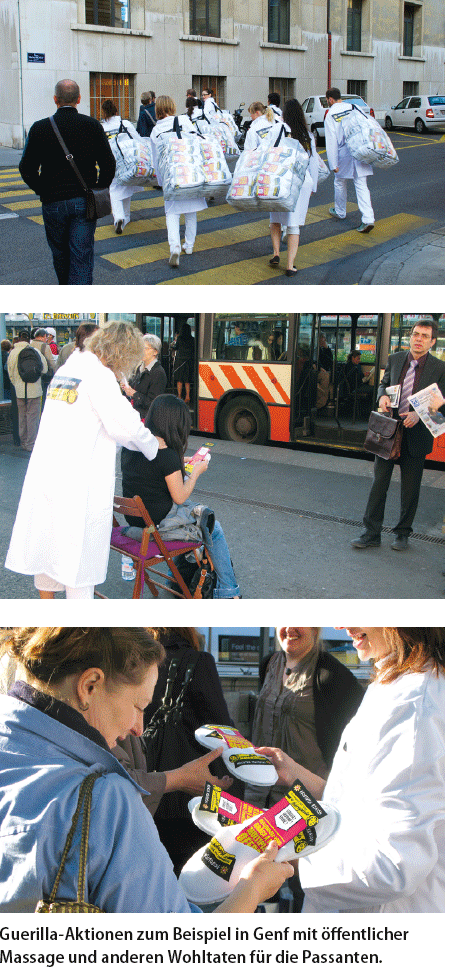
The agency Franz & René signs a 360° campaign for the Fribourg region. A dynamic and innovative communication campaign combining TV commercials on SF1 and TeleZüri, mailings, viral campaigns and guerrilla marketing. The major Swiss cities are to be made aware of the Fribourg region's assets. The arguments are: easy to reach, very varied tourism offers. The concept is based on the idea of "Recommended by your therapist". In other words: Get natural. Feel good! The message is based on Fribourg's reputation for being a welcoming, amiable and warm population. You simply have to feel good there. "Therapies are in vogue and several studies confirm that this is an important factor in urban populations in particular when deciding where and how to spend their leisure time," explains Valérie Pecalvel from the Franz & René agency. Thanks to the wide variety of cures proposed, there is something for everyone to relax. "This year's campaign aims to raise the profile of Fribourg Region," explains Christophe Renevey, Marketing Director of the Fribourg Tourist Board. The summer campaign is an invitation to discover the unspoiled nature, the lakes, the cities and, above all, the incomparable joie de vivre of the people of Fribourg. To this end, existing offers have been transformed into truly beneficial cures. These offers can all be won in a "Grand Cure Competition". This will take place on www.fribourgregion.ch and will be distributed on the various social media channels. Participants can multiply their chances of winning by inviting their friends via Facebook, Twitter, LinkedIn or email. pan

tourismus1
tourismus2
 

The Impact Check of Werbewoche

We show how current campaigns are performing with consumers.

The ad for Die Mobiliar from the Wirz advertising agency came out on top in the Awareness criterion, followed by the Orange ad from Publicis and the ad for Bell from the advertising agency. The subject for Love Life by Euro RSCG won the Uniqueness criterion well ahead of the ad for Die Mobiliar and the ad for Bell. In the Brand Fit criterion, Love Life again won, this time ahead of the ad for Uncle Ben's from the advertising agency Business & Design and the ad for Die Mobiliar. Love Life is also ahead of Bell and Die Mobiliar in terms of likeability.

> To the results at a glance (PDF)
> To the detailed results (web code)

Question and methodology

Method: Computer Assisted Web Interviews (CAWI).
Instrument: Online interviews via the Marketagent.com reSEARCH platform.
Target audience: Internet users in German-speaking Switzerland between the ages of 14 and 65.
Sample size: n = 501 net interviews, random selection according to quotas.
Survey period: 12. 05. 2011-20. 05. 2011.

Questions:
- We introduced you to some ads at the beginning of today's survey. Which of these ads do you remember? Please name the advertising companies or the brands advertised. (Awareness)
- In your opinion, to what extent do these ads stand out from other advertising in newspapers, magazines and journals? Please rate each from 1 (= does not stand out at all) to 6 (= stands out very much). (Uniqueness)
- To what extent do these ads fit the image you have of the respective brands/companies? Please rate each from 1 (= does not fit my image of this brand at all) to 6 (= fits my image of this brand very well). (Brand Fit)
- To what extent do you like the following ads? Please rate each from 1 (= I don't like them at all) to 6 (= I like them very much). (Likeability)

The values printed are the top box ratings "lifts" and "lowers".
stands out very strongly", "fits very well with my image of the brand", "I like it very much".

The author of the representative study "Switzerland's advertising favorites" is the company specializing in online advertising.
Marketagent.com Switzerland, which specializes in market research and has a registered panel of
20,000 willing respondents in German-speaking and French-speaking Switzerland.
Marketagent.com Switzerland is a subsidiary of the leading Austrian
market research company Marketagent.com online reSEARCH GmbH and the
Swiss communications agency Contract Media AG.

Convinced by a visionary idea

Maya Reinshagen, through her company Mayoris, based at the Technopark in Root, is Switzerland's leading provider of email marketing solutions. The company now plans to expand into Germany as well.

kdw

Even as a child, Maya Reinshagen was very creative and had a flair for communication. That's why she wanted to become a graphic designer. She attended the preliminary course at the School of Applied Arts in Bern and was also accepted for an apprenticeship in Thun. But because the graphic artist had to move his studio unexpectedly, the start of the job was postponed for a year. The teenager, full of drive, didn't want to wait that long. "At the arts and crafts school, I had to realize that I was always the best at drawing during my nine years at school. But when you're suddenly measured against the best of the year from all over the Mittelland, you become a little more sober." Maya Reinshagen feared: "I couldn't be creative on command."

So she chose a commercial apprenticeship as an alternative, but then "didn't know for a long time what to do next" - and finally ended up at a bank. Seven years at CS turned out to be a stroke of luck. The creative businesswoman was brought in to work on the Match project. Here, the merger of Schweizerische Kreditanstalt with Volksbank to form today's Credit Suisse was prepared. "I was on the team with the specialists from McKinsey and thus right in the middle of the control room of the historical events." This world fascinated the young woman. Not the bank itself, but the insight that something could be moved here. When the largest merger in Swiss economic history was successfully overcome, Maya Reinshagen knew: "I also want a job where I can make a difference." She gained further experience during the integration of Neue Aargauer Bank into the CS Group. As with the merger of Kreditanstalt and Volksbank, here she trained the staff of all branches in responding to customer complaints received as part of the merger.

"When the two mergers were over, I was kind of left over; there was no job for me anymore. I no longer felt comfortable in the normal banking world. The daily routine was not exciting enough and too slow for me," the entrepreneur looks back today. At that time, an invitation to an event in Bern promised more novelty. Here, the Stauffacher bookstore wanted to present its first website. "That was a real sensation in 1998." Daniel Grossen, the founder of Xmedia, presented the pioneering work, and Maya Reinshagen was immediately "electrified." After the vernissage ended, she intercepted the speaker, asked him for a job - and was lucky that Grossen could use an assistant right away.

In addition to the classic Webfactory business, Xmedia was already operating online ad markets at that time, including the "Autopool", to which every Swiss garage owner had access due to the cooperation with the Swiss Automobile Industry Association. "Grossen was already convinced back then that the future belonged to content. He was to be proven right." Reinshagen took over the administrative reorganization of Autopool customers as his assistant and threw herself into marketing the platform as well as the developing affiliates. A chance encounter with consequences. The Internet slowly came to life. Otto Beisheim and his Metro Group expanded into Switzerland and took a stake in Autopool, which was then renamed AutoScout24. In this pioneering company, later worth millions, Reinshagen was promoted to the management board. The beginnings, however, gave little hint of the gold-rush atmosphere that was to follow. Even before the company was renamed AutoScout24, the Autopool salesmen had been visiting garage owners all over the country. They took a modem with them, connected the garage owner's computer to the Internet and showed him how to place a "line ad" online in AutomobilRevue. Cars advertised in this way automatically ended up online on Autopool. Initially, however, the line ad in the AutomobilRevue was much more important to the garage owners; however, they then noticed that their cars found a buyer via the online ad rather than via the print ad.

While Scout24 continued to grow rapidly, Reinshagen studied business administration at the HFB on the side. Shortly thereafter, she met her current husband - a man from Lucerne. The demanding job and the time-consuming commute between Flamatt and Lucerne gradually became too strenuous, so Maya Reinshagen decided at the end of 2000 to look for a new job in the Central Switzerland area. She found this in the position of online marketing manager at 4MEDiA in Baar, which specializes in cross-media publishing. "The idea of crossmedia publishing was actually ingenious - but unfortunately a bit ahead of its time. The lines were simply still too slow for the fast exchange of content."

Her tasks as Head of Online Marketing also included supporting 4MEDiA customers in the area of e-mail marketing. 4MEDiA already offered its own newsletter solution at this early stage. "After a few weeks, however, I had to realize that the big part of my job was to calm down the angry customers because the technology simply didn't work." The mails weren't going out, were going out twice, or were going out incorrectly. So Reinshagen sought out 4MEDiA's best developer, Boris Chiavi, and described the problem to him. Together, they wanted to fix it. The goal: an email marketing solution that combined ease of use and high quality output. Together, in their spare time, they drew up a business plan, including a concept and database model, and showed how this could solve the technical problems. However, the presentation to the management did not arouse much enthusiasm. No one wanted to invest more money because the dotcom bubble was already showing signs of bursting. As a result, Reinshagen as well as Chiavi looked for new jobs. 4MEDiA actually had to file for bankruptcy a short time later. "But we had invested so much work in our idea in the meantime that we didn't want to just give up."

While Boris Chiavi found shelter at the IT outsourcing specialist Trivadis, Maya Reinshagen continued working at Moneycab and then at the online agency Planetactive. As "a kind of hobby," both continued to tinker with their concept for e-mail technology until one day a former colleague from 4MEDiA called. He was now working at Coop and was supposed to introduce e-mail marketing there. The computer scientist therefore asked if they didn't have "hurti" some good advice. "Hurti" was a bit difficult, Reinshagen and Chiavi replied, because the two had actually been developing for two years. When they were finally summoned to Coop headquarters, they were prepared for a two-hour presentation. But they had reserved only 15 minutes for the "greenhorns." "I therefore didn't even start the computer, but simply told a bit about our ideas and the solution we had already developed." A turnaround with consequences: Coop's IT manager, August Harder, was so impressed that he canceled all subsequent meetings and spent the entire afternoon asking Reinsha¬gen and Chiavi about the details of their ideas and being shown the approaches already developed for the unique new software. "The phone rang the other morning at nine o'clock, and we had our first customer, Coop." Reinshagen and Chiavi were able to convince with their concept for a system that is "highly professional and at the same time very easy to use." The fact that Mayoris was also multilingual throughout was the deciding factor.

Nevertheless, the two still felt "like greenhorns who simply had an idea. They wanted to offer solutions for small businesses that wanted to advertise the low-cost capabilities of email but couldn't hire their own IT specialists to do so. Thus, the system had to be "dubelisicher" and very simple and user-friendly from the front end.

Thanks to her basic training in design and various further training courses in online publishing, Reinshagen was able to design the front end of the new solution as a "clickable dummy" completely according to her ideas and based on a strict usability concept. Chiavi then implemented this "backdrop" technically. The original business plan of the two was to offer a highly standardized solution especially for SMEs, so that they could benefit from the advantages of e-mail marketing. With the order from Coop in 2002, the focus inevitably shifted. "We had to develop a highly customized solution that met Coop's diverse requirements."

At the beginning, the two managed the support for the customer Coop in parallel with their 100 percent jobs at Trivadis and Planetactive. As the number of newsletters for Coop grew and other customers showed interest, the team began to think seriously about becoming independent and founded a limited liability company in 2004. This was converted into an AG in 2006.

During all those early days, Mayoris never had to canvass. "The customers all came on their own." This was to become even more extreme when Maya Reinshagen was persuaded to take part in a TV docu-soap in 2007. At the end of 2006, the Institute for Young Entrepreneurs was looking for suitable candidates for the TV documentary "SF Start up," in which the ten most innovative young companies in Switzerland were to be found and crowned. "What nonsense. Without me," said Maya Reinshagen. There was no way she wanted to be on a TV show in the style of "Dream Job." But the IFJ staff assured her that this was about a completely different broadcasting concept - and adamantly reminded her to submit the business plan. "For the sake of peace," Reinshagen finally sent off her application. The "Mayoris" project was convincing. Out of more than 1000 candidates, Maya Reinshagen was voted into the top ten by the jury. In the ten-part documentary "Start up" on SF, Maya Reinshagen was ultimately the only woman among all the young entrepreneurs portrayed. Naturally, this brought with it a huge media hype. A great opportunity for the young company, which had actually come into being more "by chance". The winning prize at "SF Start up" was the presentation of the business idea to a group of illustrious investors. Heliana Canepa, Urs Wietlisbach, Christoph Ringier and three other business angels were so convinced by Mayoris that they wanted to invest. "Although we had never thought of seeking investors before, we were now offered money to implement our further plans. We were admittedly a bit caught off guard."

Now the moment had come to turn the original idea into reality: A highly standardized email marketing suite for any budget that delivered highly professional results and could be customized to individual needs and any CI at the click of a mouse. The necessary employees could now be hired with the investors' money. The first to be hired were husband Oliver Reinshagen and Martin Bisang. Oliver Reinshagen, before he was hired head and product manager of various online projects, is now head of services and thus responsible for support, customer care and administration. Martin Bisang, an old colleague from 4MEDiA days, is still working at Mayoris as a software developer. With further specialists and consultants in the areas of editing and marketing, Mayoris today employs 18 people.

The continuous expansion also just brought a second round of financing. This time with Luzerner Kantonalbank as lead investor and Zürcher Kantonalbank as co-investor. With the support of these two highly professional financing partners, Mayoris intends to further maintain and expand its position.

Mayoris is already the leading provider of email marketing solutions in Switzerland. The company demonstrated this at the beginning of May with the launch of the "First Swiss Email Marketing Day". 165 interested people attended the high-level presentations by five proven experts at the Technopark in Lucerne. In the future, the event is to become a fixed meeting place for the industry. The strategy behind this idea: In Germany, the market for e-mail marketing is already oversaturated. In Switzerland, Maya Reinshagen sees a need to catch up. "Many foreign providers therefore want to move to Switzerland for their expansion. We can only counter this competition here with quality."

Reinshagen sees its market advantage in the fact that Mayoris offers the quality and personal service that are so important in Switzerland. Another USP is still that with Mayoris, the creation, dispatch and evaluation of multilingual e-mailings are much easier than with competing systems. Last but not least, thanks to data storage at Swisscom IT Services, Mayoris also has a "direct line" to Bluewin - an important argument for customers such as Coop, Swisscard or Mercedes-Benz Switzerland, for whom secure data storage and flawless delivery in Switzerland are important.

For the further growth of the company, Mayoris is focusing mainly on Switzerland for the time being. To this end, the network of partner agencies, which in turn serve their own customers with Mayoris, is now to be expanded in a targeted manner. "Agencies responsible for their clients' communications are able to create, send and evaluate highly professional e-mailings quickly and without technical knowledge thanks to Mayoris. Not to mention the attractive commissions, this gives agencies the opportunity to offer complementary services such as conception, editing and implementation." In addition, Mayoris has also put out feelers to Germany. The first step in this direction is the recently concluded partnership with Rabbit eMarketing. The cooperation with the renowned dialog marketing agency means that the "hares", who are already successful in Germany and internationally, can offer their consulting services in Switzerland using the Mayoris system. "A great advantage for us; because this gives us access to the best e-mail marketing experts in Europe for advising demanding major customers." Conversely, Mayoris is now also distributed in Germany via Rabbit.

For Maya Reinshagen, growth has meant that her duties have increasingly evolved from operationally "building" a newsletter to building a company. "The job has shifted towards management. Now that wasn't really planned - but is actually exactly what I was looking for. I wanted to make a difference". Andreas Panzeri
 

Radio 24: Layout artist Christian Bisang switches to music production

Radio 24 layout artist Christian Bisang is leaving the Zurich station at the end of August after six years. As part of Hitmill Studios, he will be responsible for music productions for bands and films from the fall.

The drummer of the Zurich band "Subzonic" is thus following the call of his long-time musical companion Roman Camenzind. Christian Bisang has significantly shaped the new layout of Radio 24 produced in Los Angeles with his highly musical productions, said program director Karin Müller in a press release on Wednesday.
 

Rivellution in the cinema: 3D cinema spot

The Rothrist-based beverage company Rivella has commissioned its media agency, OMD Switzerland, and the production company Skycube.tv to adapt the existing «lang-lebe-anders» Cédric commercial (Erdmannpeisker) for 3D cinema. The goal of the 3D adaptation is to increase attention, thereby boosting brand awareness and driving impulse purchases.

The timing is very deliberate, as Patrick Marty, Group Product Manager Soft Drinks, Rivella confirms: "We planned the 3D conversion to coincide with the theatrical release of Pirates of the Caribbean - On Stranger Tides in 3D, in order to offer our target audience a special pre-show experience." Skycube is the production house of 3D Impact Media, based in Montevideo, New York and Zurich. The company is a leader in the production of 3D content for cinema, television and out-of-home media, according to the release.
 

High Voltage: "I bike Züri

Since May 2011, a poster campaign in the city of Zurich has been inviting residents to to get around more by bike. Under the motto "From Zurich to Zurich the right way", the Zurich advertising agency Hochspannung created a key visual that shows cyclists as they are often seen in Zurich: With one trouser leg rolled up.

The campaign is intended to show that the bicycle is the right means of transportation for everyone in the city and has also created its own cool style. Whether lawyer, banker, student or artist, the slogan "I bike Züri" applies to everyone. The aim of the campaign is to make Zurich residents want to switch to bicycles and to raise general awareness of the variety and peculiarities of means of transport.

The poster campaign was created and implemented by the Zurich advertising agency Hochspannung. The models were found through street casting and photographed by Zurich photographer Katharina Lüscher. The campaign has been running since the beginning of May 2011 and can be seen throughout the city of Zurich.

Responsible at Hochspannung Zurich: Tom Fäh, Marco Huber, Matthew Katumba,
Julian Murer, Elisa Stahel, Alex Taiganidis, Angela Van der Sman. Photographer: Katharina Lüscher.
 

Etextera receives support from the National Council

The Etextera copywriting agency has received support from four members of the National Council. On the agency’s website, the politicians comment on the company’s business philosophy.

National Councillors Ursula Wyss (SP Bern), Franziska Teuscher (Vice President of the Swiss Green Party), Barbara Schmid-Federer (CVP Zurich) and Kathy Riklin (CVP Zurich) comment on the agency's website. "Qualified women with families still find work only under difficult conditions. Etextera is combating this problem," says National Councillor Barbara Schmid-Federer (CVP Zurich) on the Etextera website.

According to Ruth Hardegger-Wickli, Managing Director of Etextera, the popularity among politicians and companies is also reflected in a rapidly increasing number of customers. This is because the business philosophy has become a PR factor for many companies.
 

Last but not least: Advertising expert charged with "mosque baba"

The public prosecutor's office in Graz has brought charges of incitement to hatred against the Swiss advertising expert Alexander Segert and the FPÖ leader in Styria, Gerhard Kurzmann. The reason for the charge has to do with the online game "Moschee baba".

The aim of the anti-minaret game entitled "Moschee baba" is to click away mosques, minarets and muezzins in order to collect points. The Styrian FPÖ developed the game together with Segert for the 2010 election campaign, triggering a wave of outrage in Austria, as the SDA writes in a press release. According to Segert himself, 100,000 people took part in the game within 48 hours.
The predecessor of "Moschee baba" is called "Minarett-Attack". This internet game was also created by Segert and was used in the campaign for a ban on minarets in Switzerland. The game served as a model for the Styrian version.
The Graz public prosecutor's office now wants to prevent Segert from being given a free hand. After all, the penalty for incitement to hatred is up to two years imprisonment. As Hansjörg Bacher, spokesman for the public prosecutor's office, confirmed an Austrian media report on Wednesday, the Ministry of Justice has given the go-ahead for the prosecution. The public prosecutor's office also requested that a fine be imposed on the FPÖ Styria and the advertising agency. The amount of this fine will depend on the economic circumstances and will serve to skim off the financial advantage gained.


One1: Triggering a new movement for World Vision

People can make a lasting difference in the food situation in developing countries by changing their own eating habits. World Vision’s innovative online campaign, «It’s my part,» shows how in a creative way.

World Vision is launching an initiative to combat world hunger. This is about the contribution that can be made to improving the food situation in developing countries - reducing meat consumption. This is because meat production consumes an enormous amount of resources that are lacking elsewhere - and especially in developing countries - for the production of basic foodstuffs.

In order to draw the attention of new, younger target groups to this topic, the Winterthur-based communications agency Eins1 has developed "it's my par "t, an independent brand that involves the viewer and encourages them to take action. The aim of the campaign is to motivate as many people as possible to take concrete action and consciously limit their meat consumption.

On Its-my-part.ch, you can participate as an individual, family, shared flat, team or entire company and define the intensity and length of your commitment. The effect achieved in terms of resource savings becomes visible. In the meal quiz, you learn a lot about your own nutritional balance and determine your "food type". An animated short film, background information on the global connections between domestic consumption and worldwide food security and concrete examples from World Vision's project work round off the offer.

The majority of distribution takes place via viral movies, social media, e-letters and other online channels and is supplemented by advertisements. Rolf Hiltl was also recruited as a campaign supporter. Cooperation measures also take place here and delicious veggie recipes by Hiltl can be downloaded from the website.

Responsible at World Vision Switzerland: Esther Bodenmann (project management), Irene Fogwe (research + coordination), Clemens Schuster (online communication). Responsible at Eins1: Tom Mörker (overall management/concept), Peter Krebs (consulting management/concept), Alain Schwaar (project manager), Attilio Leonardi (design), Caroline Odermatt (text/web), Paul Girard (text/advertising), Jeannine Hitz (DTP); Bruno Bolliger (animation movie). Responsible at Web Com TV: Kai Hofmann, Louis Golay (post-production movie), Adrian Oberle, Victor Künzig, Olivier Dahinden (website programming).
 

get_footer();