The Impact Check of Werbewoche

We show how current campaigns are performing with consumers.

In terms of awareness, Publicis’s 20 Minuten/Swiss campaign ranks first, ahead of Werbeanstalt’s Bell ad «Big Benny» and TBWA’s McDonald’s ad «Schwiizer Wuche.» The «Stop Piracy» ad by the advertising agency Maxomedia ranks first in the «Uniqueness» category. In second place is the HEKS ad by Advico Young & Rubicam, followed by the Bell ad in third place. McDonald’s ranks first in the «Brand Fit» category, followed by Zweifel-Snacketti by Advico Young & Rubicam and the “Stop Piracy” ad. In terms of “Likeability,” “Stop Piracy” comes out on top, ahead of Zweifel-Snacketti and HEKS.

> To the results at a glance (PDF)
> To the detailed results (PDF)

Content & Commerce: Vitamin for corporate publishing

Content + Commerce + Community. This is the new magic formula for successful corporate publishing (CP). But how do you reconcile the three disciplines? "The art is to create a uniform appearance from the infinity of possibilities," says the Zurich-based design and communications agency Crafft, which is one of the pioneers in the field of the three magic Cs.

In the print sector, everything has been there before. There were catalogs, tomes full of offers, prices and order numbers. Later, people came up with the idea of telling a story about each product. Storytelling was the way to stand out from the competition. The Sharper Image, Praktikus and Manufaktum were well-known trendsetters. The print products fluttered into mailboxes every month or four times a year.

In the age of the internet, everything is different: the letterbox of yesteryear is now a computer, smartphone or tablet. Catalogs have turned into countless online stores with millions and millions of products. And the trendsetters today are those providers who try to offer visitors added value with content & commerce or editorial shopping. These include Mini Magazine, Selects from American Express and Migros Magazine.

People - Shop - Community

One of the pioneers of the three magic Cs - content, commerce, community - is the Zurich agency Crafft. "Our clients have high expectations," says partner Michael Rütti, "they want a credible presence that convinces and inspires - and generates as much turnover as possible at the same time. " The possibilities are indeed tempting: "Thanks to the Internet, content is available around the clock," says Rütti, "every day, every hour, every minute and every second there is an opportunity to add, update or link to new content." In order to avoid communicating haphazardly in all directions, another important C should not be lost sight of: corporate identity. Because: "The cleaner the brand image, the more effective the communication measures."

What the CP professionals in the Crafft office understand by Content & Commerce is best illustrated by a comprehensive dialog platform that Crafft is currently developing for a Swiss company. According to partner Cédric Tribolet, this is made up of three parts: "People, Shop and Community". And will go live in summer 2012.

People like you and me

The first part will portray people who have something to do with the product. "We won't be showing actors or models like in traditional advertising," says Tribolet, "but people like you and me who come across as completely authentic." In the second part, the products are presented in an appealing and sometimes entertaining way. "A high level of credibility, quality and topicality are important here," emphasizes Tribolet. Finally, the third section is reserved for discussions, blogs and social media. The aim here is to create a loyal community in constant exchange with the target groups, which also sometimes tackles controversial topics.

"More and more people are gathering information online, shopping online and maintaining their social contacts online. That's why you have to offer more than just an online store to survive in the market today," Tribolet continues. The "CP-Barometer Fall 2011 - Content & Commerce" confirms this statement. Based on surveys and many examples, the study shows how content enriches shopping portals and ensures traffic, customer loyalty and increased sales.

Good forecasts for the future

According to the industry barometer, almost two thirds of respondents recognize great potential in corporate publishing. More than half of those surveyed consider editorial shopping to be a good alternative to traditional advertising. 75 percent are also convinced that journalistic content is an effective sales driver. According to the CP-Barometer, editorial shopping has even greater potential in the future thanks to mobile devices. Good predictions for the communication specialists on Zurich's Hohlstrasse. With their expertise, they complete the magic formula: with a C for Crafft. Roy Spring

Information:
www.crafft.ch
www.facebook.com/crafft.ch
Michael Rütti
[email protected]
 

Swiss typography - just a generic term?

In the book city of St. Gallen, the Gewerbliche Berufs- und Weiterbildungszentrum (GBS) hosted a three-day symposium devoted entirely to Swiss typography.

GBS launched a new series of events under the name "Tÿpo St. Gallen" from November 18 to 20. Does Swiss typography still exist and, if so, what is typically Swiss about it? These two questions were the focus of the three-day symposium, which was organized by the St. Gallen School of Design together with the College of Art, Design and Design. "GBS St. Gallen has been involved in typography since 1738," says Thomas Gerig, Head of the School of Design. "Our aim with this event is to promote the exchange between experts and companies even more and to enable students to experience top-class design." The organizers were able to engage 13 luminaries from Switzerland, Germany, Austria, England, the Netherlands and the USA as speakers and workshop leaders. These included book designer and typographer Jost Hochuli, poster and book designer Bruno Monguzzi, type designer, type theorist and typographer Gerrit Noordij, poster designer and lecturer Ralph Schraivogel and design blogger Tina Roth Eisenring aka swissmiss. The speakers did not really agree on the answers to the two key questions. For Andreas Maxbauer, CEO of Forum Typografie Deutschland, for example, one thing is clear: "Swiss typography is a generic term. A genre in which the greatest ornamentation is the addition of a second color." For the Swiss Jost Hochuli, the term "Swiss typography" is even misleading. This is because in the 1930s and 1960s, it was mainly people from German-speaking Switzerland who represented this ideology. However, everyone agreed on the success of the event: the symposium attracted around 450 participants. For Gerig, this is a good reason to continue the "Tÿpo St. Gallen" project. However, it remains to be seen when this will be. Simone Fankhauser
 

Last but not least: Occupy Christmas Tree

On December 1, the Occupy movement is launching an Advent calendar that features an activist surprise in a public space every day. The calendar’s themes range from «Distributing a »thank-you« currency» to «Broth instead of funds» to «Occupy Christmas Tree» and “St. Nicholas & Schmutzli monitor conformist behavior.”.

The actions are being organized and carried out by Neue Dringlichkeit and Occupy activists. The kick-off will take place today, Thursday, as part of the "Dada New York II" exhibition at the Cabaret Voltaire in Zurich. Everyone is invited to contribute their own ideas for the calendar. The locations and exact schedule of the Advent calendar actions will be announced every morning at the Occupy Movement information tent at Stauffacher and on the Occupzuerich.ch website.
With the Advent calendar, the activists of the Occupy movement and the artist group "Neue Dringlichkeit" (New Urgency) want to set a system-critical tone in the consumer-driven Christmas season. The Advent calendar surprises are intended to inspire passers-by in public to think and show that the rules of society are man-made and that the world can be changed. The Occupy Paradeplatz movement shows solidarity with the worldwide protest movement, which is rebelling against the globally ailing financial system and standing up for new solutions in economic, political and social coexistence, according to a statement from the activists. The movement can be found online at Occupyzuerich.ch, Occupy-switzerland.ch, on Twitter at occupyparadepl and on Facebook, Occupy Zurich.

Publigroupe: Restructuring and reduction of 200 jobs planned

Publigroupe plans to carry out a major round of job cuts through 2015. Among other measures, the advertising agency will sell a large portion of its real estate portfolio and cut approximately 200 jobs by 2015.

The largest sales division, Media Sales, is being restructured with new, "drastic measures to ensure profitability and increase digital sales". This was announced by the listed Publigroupe on Thursday morning. The implementation by Beat Roeschlin, CEO of Publicitas, will be overseen by a management committee consisting of Publigroupe Board members under the leadership of Pascal Böni.

Publigroupe CEO Hans-Peter Rohner will step down from his dual mandate at the 2012 Annual General Meeting, but will remain Chairman of the Board of Directors.

Furthermore, "the sale of a large part of the real estate portfolio" is planned for next year, according to the statement. Four properties in Lausanne and Bern will be put up for sale. The net proceeds from the sale, which will be in the mid double-digit million range, will largely go to Publigroupe's shareholders.
 

Accounting changed

In spring 2012, Publigroupe will change its listing on the Swiss stock exchange (SIX Swiss Exchange) from the main segment (Main Standard) to the national segment (Domestic Standard). This will result in a change in accounting from IFRS to Swiss GAAP FER. According to Publigroupe, this is intended to achieve greater transparency for the Zanox and Local.ch holdings, both of which are managed with partners. Publigroupe shareholders will be able to follow the development of these two investments more closely thanks to the simple proportionate consolidation. In addition, goodwill on acquisitions will no longer be capitalized in future, but written off directly to equity.

Job cuts

The so-called optimization steps at the group company Publicitas with 1,300 employees are to build on the decentralized strengths in print marketing. The restructuring will lead to a net reduction in staff of around 200 employees by 2015, with more than half of them working abroad," writes the company on the job cuts. However, the marketing of digital and multimedia media platforms will be expanded rapidly and sustainably. The marketing of advertising space in cinemas will continue.
 

Top of the week 1: NZZ, Ringier and Tamedia with online advertising network

Under the name PPN—Premium Publisher Network—the NZZ Media Group, Ringier, and Tamedia are launching a joint online advertising network.

On Ppn.ch, advertising customers will in future have the opportunity to book performance and targeting advertising in the environment of 20 Minuten online, Blick.ch, Newsnet, NZZ-Netz, Search.ch and other media company websites, as detailed in a press release issued on Wednesday. According to Netmetrix Profile, the network reaches 74 percent of all Swiss Internet users and will also be open to high-reach websites of other companies after the introductory phase. By working together in the area of performance and targeting advertising, the media companies aim to actively develop the Swiss online advertising market. The aim of PPN is to create a neutral performance and targeting network that can be booked by all media agencies, marketers and direct advertising clients. The NZZ Media Group, Ringier and Tamedia attach great importance to transparency in the collection and use of the recorded user profiles.

Maz: Certificates for social media professionals

In early December 2011, 18 participants completed the second social media training course at Maz. During the three-month «Social Media Compact Course – Companies in Dialogue,» they explored Facebook, Google+, Twitter, YouTube, and other networks and platforms from the perspective of corporate communications.

Together with professionals, the participants learned how to strategically assess social media, plan appearances, embed dialog via social media in internal and external communication (also in crisis situations) and check the effects. Certificates from the Maz department for communications professionals were awarded to those who wrote a sophisticated concept paper. The "Compact Course Social Media - Companies in Dialog", which the Maz developed in cooperation with Bernet_PR, comprised 10 attendance days in about three months. The course was led by Frank Hänecke. The third run begins in March 2012 and lasts until June 2012.

Completed:
Julia Antoniou, ABZ Allgemeine Baugenossenschaft Zürich, Zurich
Regula Beetschen, Zühlke Engineering, Schlieren
Claudia Bosshardt, eloquent, Basel
Nadine Fieke, Stiftung Mercator Switzerland, Zurich
Karin Frei Dostal, Swiss. Bank Staff Association, Berne
Heike Freiberger, University of Basel, Basel Danica Gröhlich, Swisscom (Switzerland), Zurich
Brigitte Heinrich, Nettwerk, Lucerne Beat Jost, Zurich Cantonal Police, Zurich
Daniela P. Küng, Gadget, Zurich Reto Liniger, Angestellte Schweiz, Zurich
Sarah Nünlist, Die Schweizer Post, Berne Ruth Schmid-Iser, Leibstadt Nuclear Power Plant, Leibstadt
Patrick Stämpfli, YJOO Communications, St. Gallen
Daniel Stuber, EKAS, Fribourg Jörg Suter, FelderVogel, Lucerne
Uschi Tschannen, Task Line Tschannen, Seeberg
René Walker, Thömus Veloshop, Niederscherli

PIN data hardly before 2014

The new era of TV planning using PIN data, which PDAG ushered in during the summer of 2011, is still a long way off. On the contrary, it is unlikely to begin before 2014.

The age of PIN data begins. This euphoric sentence was written above an offer that the Mediapulse subsidiary Publica Data (PDAG) presented to media agencies and TV marketers at the end of April 2011 - an offer for the purchase of "personalized usage data" (PIN) from TV research, including the GfK evaluation tool EvoAd. PDAG set the start of the new "era" for July 1, 2011. Corinna Schneider, employed by PDAG specifically as Senior Project Manager for PIN data and EvoAd sales, did what she could. Her job was to find enough agencies and marketers who wanted to sign the contract for PIN data and the EvoAd tool in time and take the plunge into the new era. Mediapulse CEO Manuel Dähler did not want to put an exact figure on how many at least, but he spoke of "less than ten".

Continue in the text - without PIN data
But when Werbewoche asked Mediapulse, agencies, marketers and the Interessengemeinschaft Elektronische Medien (IGEM) about initial experiences with PIN data last week, there was not the slightest hint of a new era. On the contrary: all agencies continue to work with the previous, aggregated TV data and the old Publisuisse tool Mediaoptimizer. The reason: demand for the PDAG offer was too low, there was "more than one interested party missing", said Dähler. Elsewhere it has been reported that PDAG has only found two or three real interested parties at most. One thing is certain: So far, no PIN data has been delivered at all.

Read more in the current print edition of Werbewoche

ADC Competition 2012: The race for the nails is open

The starting gun has been fired for the most important creative competition in the German-speaking world: The Art Directors Club for Germany (ADC) is now accepting submissions for the best work from the current year and from January 2012.

In the race for the coveted ADC nails, works can be submitted for the eight competition areas of Classic Media, Digital Media, Dialog Marketing/Promotion/Media, Design, Editorial, Spatial Production, Craft - with the categories Text, Typography, Photography, Illustration as well as Music and Sound - and Holistic Communication. New this year is the simplified submission procedure, which was developed in September 2011 in a workshop with 15 competition participants, award coordinators and representatives of the ADC Executive Board. Among other things, the participation platform was adapted to the wishes of the submitters and simplified once again both technically and organizationally, according to a statement from ADC.

The five most important simplifications of the submission at a glance:
- Advertisements no longer have to be sent in the publication format.
- Files are checked before upload. Thus, the submitter now receives a hint about incorrectly formatted files before the upload.

- Save temporarily: An entry can now be saved directly after it has been entered on the mask and not only at the end of the entry process.

- Modifiable inputs after the upload are still the title of the work, the credits, the short description and new: the number of parts. Further parts of the submission can still be added after an upload.

- Only a few relevant mandatory credits (for example, principal, major contributor, or category-specific credits) are still requested. All other credits can be provided by the submitter voluntarily and at their own discretion. The credits Creative Direction (CD), Art Direction (AD) and Text are one team and will stand together in the future.

The ADC Mediathek, introduced last year, is a particularly useful submission tool again this year, according to ADC. All files (image, audio or film files) already uploaded in the Upload Manager are stored in the Media Library and can be reused - without having to upload them again - for further submissions in other categories of the ADC Competition 2012.

The deadline for entries from 2011 is January 17, 2012, for works from January 2012 is February 07, 2012. The early bird discount of 10 percent on the entry fees in the respective categories is valid until December 20, 2011. Each submitted work will be discussed and evaluated live on site by a jury consisting of over 300 ADC members and will be presented in the large exhibition during the ADC Festival 2012 from May 09 to 13, 2012 in Frankfurt am Main.

PIN data hardly before 2014

The new era of TV planning using PIN data, which PDAG ushered in during the summer of 2011, is still a long way off. On the contrary, it is unlikely to begin before 2014.

The age of PIN data begins. This euphoric sentence was written above an offer that the Mediapulse subsidiary Publica Data (PDAG) presented to media agencies and TV marketers at the end of April 2011 - an offer for the purchase of "personalized usage data" (PIN) from TV research, including the GfK evaluation tool EvoAd. PDAG set the start of the new "era" for July 1, 2011. Corinna Schneider, employed by PDAG specifically as Senior Project Manager for PIN data and EvoAd sales, did what she could. Her job was to find enough agencies and marketers who wanted to sign the contract for PIN data and the EvoAd tool in time and take the plunge into the new era. Mediapulse CEO Manuel Dähler did not want to put an exact figure on how many at least, but he spoke of "less than ten".

Continue in the text - without PIN data

But when Werbewoche asked Mediapulse, agencies, marketers and the Interessengemeinschaft Elektronische Medien (IGEM) about initial experiences with PIN data last week, there was not the slightest hint of a new era. On the contrary: all agencies continue to work with the previous, aggregated TV data and the old Publisuisse tool Mediaoptimizer. The reason: demand for the PDAG offer was too low, there was "more than one interested party missing", said Dähler. Elsewhere it has been reported that PDAG has only found two or three real interested parties at most. One thing is certain: So far, no PIN data has been delivered at all.

The flop of the PDAG offer is hardly surprising. After all, tests a year ago had shown that the EvoAd tool developed at great expense by GfK was only suitable as a reporting instrument, with which the historical values of TV programs could be evaluated in greater depth than before. However, it was only suitable to a limited extent for the company's own forecasts, planning, optimization and monitoring. In addition, PDAG charges CHF 19,000 for an annual licence - eight times what agencies currently pay for the current planning tools TC2000, Mediaoptimizer and Publiplan (around CHF 2,300 per year - including data). "The costs for the reporting part alone are very high," states IGEM President Stephan Küng.

A new glimmer of hope despite setback

After years of breakdowns and delays, the PIN data issue is thus entering another round. The two TV marketers Publisuisse (SRG) and Goldbach Media (Swiss and foreign private broadcasters), in coordination with IGEM and Mediapulse and with the involvement of the other marketers, have now taken the lead in evaluating advertising planning tools. "These will be presented to us in the near future and we will carry out initial tests," says Publisuisse Director Martin Schneider. Depending on the tools available and the initial test results, it will then become clear whether an "all-in" tool (from forecasting to reporting) will be used in future or a pure planning tool that needs to be supplemented with appropriate tools.

Mediapulse, stick to your last!

The working group that will test the tools should evaluate the tool requirements and market needs in close coordination with the IGEM. Specialists from the various application areas (e.g. agencies for planning, marketers for forecasting) will be delegated to the working groups. However, this also means a new distribution of roles between marketers and Mediapulse. This is what both Küng and Schneider say. Specifically, Mediapulse will in future concentrate on operating a panel and collecting TV usage data, while the TV marketers will procure and operate the tools suitable for the advertising industry. "This is based on the view that in the TV market, the provision of data is primarily in the interests of marketers, as has long been the case in the print and poster sectors," says Küng. And then he adds: "So now we finally have the right distribution of roles with regard to TV data."

Everything is waiting for Mediapulse

At the moment, however, the entire TV industry is looking to Mediapulse. In recent months, the three providers Kantar Media, Nielsen and GfK have been evaluating a new TV measurement system, which is expected to replace the current Telecontrol system from 2013 (see box). The decision on the successor system is expected in December. However, the new system will also have an influence on the choice of future evaluation and planning tools. "Because the new measurement system will also provide a new generation of PIN data, it makes sense to adapt the evaluation of the forecasting and planning tool accordingly," says Schneider. He continues: "The decision in favor of the new measurement system is therefore the next decisive milestone on the way to TV planning with PIN data. The PIN data is therefore automatically a sub-project in the course of replacing the current TV measurement system." The next few months will therefore decide whether the new tool landscape will be ready by 2013 as planned. If not, the introduction of PIN data will also be delayed. However, a postponement to 2014 is to be expected anyway. This is because if planning with PIN data is already possible from 2013, a corresponding tool will have to be available in May or June 2012 so that agencies and marketers can still practice before bookings open in fall 2012. "The timing for an introduction in 2013 is certainly tight. In addition, it is still unclear how exactly the transition from the 'old' to the 'new' data will take place," says Stephan Küng. Markus Knöpfli

Today's panel does not measure around 8 percent of TV usage
At the end of May, Mediapulse announced that it would be renewing the TV panel called Telecontrol as of January 1, 2013. The reason: the current TV panel, which measures 1,918 households across Switzerland, is unable to measure time-shifted television, which, according to Mediapulse CEO Manuel Dähler, accounts for around 7% of total TV usage. Web TV (live streaming via Zattoo or Wilmaa, for example) is also not reported, with only around 1% of TV currently being used via this vector. However, Mediapulse wants to close both measurement gaps with the new panel. Dähler reckoned that the investment in the panel renewal would be "in the single-digit millions".

Unbenannt-10


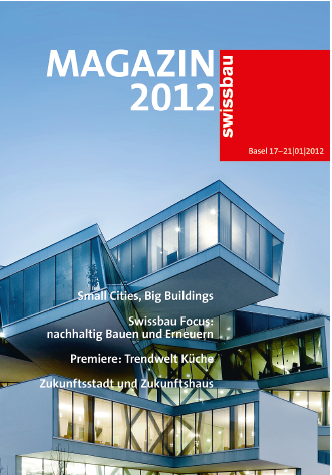
New Swissbau 2012 magazine from Basel West

The Swissbau 2012 magazine was published in early November. Switzerland’s leading trade show for the construction and real estate industries aims to use this publication to demonstrate its leadership in the field and highlight key events and premieres that enhance the show’s appeal.

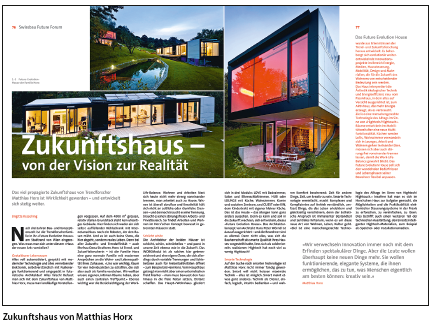
The magazine addresses current topics in the industry with a focus on sustainability and shows future trends along the life cycle of real estate. Numerous events on this topic will be held at the trade fair under the title "Swissbau Focus". The 64-page booklet is an analysis of the latest findings in the fields of architecture, planning, building technology, energy, interior design, renovation, vocational training and ventures a look into the future of urban development. A portrait of Herzog & de Meuron shows their international work as well as their significant urban development projects, taking the city of Basel, where a new exhibition hall is currently under construction, as an example. New building materials and trends in the recycling of building materials will also be presented. Trend researcher Matthias Horx's newly built Future House in Vienna will serve as an example of innovative construction. Horx will be discussing urban development of the future at Swissbau together with landscape architect Christophe Girot. The production of the magazine was financed by advertisements.

Unbenannt-5
Unbenannt-6

"Going it alone is better"

Urs Heller, Managing Director of Ringier Switzerland’s magazine division, speaks with *Werbewoche* Editor-in-Chief Pierre C. Meier about the reasons behind *Landliebe*’s success, circulation goals, success factors, and credibility.

q

WW: What tipped the scales in favor of launching Landliebe?
Urs Heller: Clearly the success of Landlust in Germany. It's fascinating that such a rustic magazine is suddenly dueling with Spiegel at the newsstand in Germany. Of course, something like that stirs the imagination. At first, we followed the development from afar, then we negotiated with LandLust-Verlag.

So the original plan was to merge with the German Landlust?
We thought about a license. Then we found out: it's better to go it alone!

Why did it not happen?
We could not come to an agreement financially. Our discussion partners had relatively high ideas for a license fee; it would not have been worthwhile in a small country like Switzerland. At the same time, we realized that the synergies are not that great: We Swiss tend to be "mountain-loving" people rather than flatland subjects; you can't score points with us with heather reportage. In retrospect, we are glad that we risked going it alone. We wouldn't have had this huge initial success as a licensed product.

Who developed the Swiss concept?
I'm responsible for new developments and new editorial concepts at Ringier magazines. So also for LandLiebe. I was able to count on the support of a few real professionals.

Read more about this in the current Print edition of the advertising week.

get_footer();