Weak euro weighs on Swiss gaming market

The Swiss market for video and computer games declined in the third quarter of 2011 compared with the same period a year earlier. This was primarily due to the weak euro and the fact that the reporting period was shorter than in the previous year.

However, there was a clear recovery from the middle of the quarter onwards. This is evident from the figures compiled by Media Control, as the SIEA, Swiss Interacitve Entertainment Association, writes in a press release on Thursday. The overall market (consoles as well as games for consoles and PC) lost 14.1 percent (sales/units) and 29.1 percent (turnover) compared to the same quarter last year.

Two special factors had a significant impact on the quarterly result: Firstly, the 2011 reporting period was one week shorter than in the previous year. Secondly, the effects of the strong franc did not spare the games industry. Around 15-20% of the decline in sales is likely to be attributable to the weakness of the euro, which has led to price adjustments in favor of Swiss consumers. In addition, there continues to be a shift towards games for smartphones and online games that are not sold over the counter and are therefore not included in the SIEA market figures.

Marketing begins long before marketing

The Swiss tourism industry faces major challenges: The strong Swiss franc and low consumer confidence are keeping foreign visitors away. And structurally, particularly in terms of destination development, there are still some issues that need to be addressed.

It's that time of year again: the winter sports resorts are beating the advertising drums for their offers. In Switzerland Tourism's TV commercial, "weatherman" Martin Horat promises a snowy winter. However, there is not much sign of this yet. Many regions can only dream of pictures like the one above. Switzerland is experiencing the driest November since measurements began 130 years ago. However, global warming is just one of the challenges facing the local tourism industry. In addition to globalization, as a result of which offers are becoming increasingly interchangeable, the fourth strongest export sector of the Swiss economy is currently suffering above all from the strong franc and the generally poor consumer sentiment. Accordingly, BAKBASEL expects overnight stays to fall by a total of 2.6% for the current winter season. Foreign demand will fall by around 4.2 percent and the domestic market by 0.4 percent. Switzerland Tourism is responding to this development by stepping up its marketing activities for the current season (see interview).

If you take a closer look at the Swiss tourism landscape, the enormous density of brands used for tourism is particularly striking. Every region, every destination and every municipality has its own logo, its own slogan and its own website. According to Urs Wagenseil, Head of Tourism at the Institute of Tourism at Lucerne University of Applied Sciences and Arts, this doesn't make much sense. Joining forces is necessary in order to remain competitive. The so-called destination formation has been underway for some time. A necessary, but also very emotional process, as Wagenseil emphasizes. "You have to move away from the idea that a geographical name is also a brand," says the expert. For many people, no longer being able to use their own place name on a brochure or on the internet is a kind of loss of identity. This is easier to understand if you remember the origins of tourism: "100 to 150 years ago, the radius of the guest was very small. Accordingly, every village, every valley community developed its own tourism product. That's why today we have several hundred geographical names that are used like tourist brands." This strategy worked until around the beginning of the 1990s. Then tourism came under severe pressure due to globalization.

Re-analyze the competitive situation

According to Wagenseil, it is therefore important to take a fresh look at the competitive situation. In many cases, the existing guest pie in a valley is divided up between the various villages. Anyone who wants a bigger share will only achieve this at the expense of someone else. Wagenseil is convinced that this is a bad strategy. "The idea behind the merger should be to increase the size of the cake in the first place. Then the competitors will no longer be the neighboring village, but at least the next valley, the next canton or even the next country." There is a clear benefit for the individual destinations: The marketing budget is increased with a proportional reduction in costs for the partners involved. "By forming a destination, an organization often also achieves the size required for the specialization of employees and thus a sustainably profitable professionalization," explains Daniela Bär. Joining forces also facilitates the work of Switzerland Tourism, i.e. the global marketing of Switzerland as a vacation, travel and conference destination. "By bringing together tourism service providers, a uniform brand can be established with a clearly recognizable profile and clearly assignable values." The offer and service chains for the respective guest segments could thus be coordinated and individually designed in the marketing mix. Not least, Bär continues, because of the increased independence from historically grown political borders.

The successful marketing of a destination, once it has been established, begins long before the marketing. Urs Wagenseil: "It starts with the definition of the development goal. What does the destination want in the medium to long term?" A tourism strategy, including strategic business areas, must then be defined together with the destination's stakeholders. And: "Operational marketing in the destination sector is extremely complex. Accordingly, it needs competent people. However, destination marketing can only be successful if I can also provide adequate resources." A good controlling system is also essential. It is not enough to simply evaluate the development of overnight stays.

The destinations also receive marketing support from Switzerland Tourism. As part of the "Enjoy Switzerland" project, those responsible are coached in terms of developing offers and staging experiences. In addition, the regions and destinations within the campaign and market partnerships have the opportunity to participate in joint marketing activities at home and abroad at attractive conditions. Daniela Bär: "Switzerland Tourism's broad international network enables a wide range of cooperation opportunities in the areas of promotion, e-marketing, media work and collaboration with tour operators."

Modest perception in politics

Wagenseil sees structural changes in the direction of larger, more powerful units, an increase in expertise in management, strategy, marketing and finance as well as a massively optimized positioning and the development of a clear brand policy as the greatest challenges in destination marketing. For the tourism expert, destinations that have successfully overcome these hurdles include the entire canton of Lucerne, Engadin St. Moritz, Gstaad Saanenland and Montreux Vevey. "The canton of Uri could also be a very good case. It also has a large number of small tourist offices that are being reorganized as part of a new strategy," says Urs Wagenseil. However, there are still many regions and towns that have not yet completed this restructuring and consolidation process. But there is not only structural potential for improvement in Switzerland as a tourist destination. Daniela Bär sees this in the range of offers, among other things: the summer season needs to be developed further. In addition, quality in the mid-range hotel sector must be consistently improved. According to Urs Wagenseil, one weakness of Switzerland as a product as a whole is the modest perception of the importance of tourism in the economy, among the population and at a political level. "The tourism industry is not a homogeneous mass, which is why there is no lobby like in other sectors of the economy." Nevertheless, the parliament granted Switzerland Tourism 10 percent more budget for the period 2012 to 2015 than four years ago. And it is helping the marketing company with a one-off subsidy of CHF 12 million. Simone Fankhauser

"We have a franc problem, not a product problem"

Unbenannt-1

WW: The strong franc and the uncertain global economy continue to pose a challenge. For the coming winter season, BAKBASEL is forecasting a 4.2 percent decline in foreign demand and a 0.4 percent drop in domestic demand. How is Switzerland Tourism (ST) responding to this problem?
Daniela Bär: We are intensifying our activities and investing significantly more resources in winter marketing. With the funds from the current impulse program, measures are planned for the Swiss market that should have a direct impact on booking figures. For example, a special winter brochure with a high mood component and attractive offers from our winter partners. We will be distributing this publication at the beginning of 2012 via high-profile titles. A strong franc calls for strong offers. And there are plenty of them in Switzerland: we have collected ideas and offers for the price-conscious at MySwitzerland.com/preiswerteschweiz.

ST has created its own competence center for social media marketing. What advantages does this channel offer for marketing Switzerland?
The most widespread and credible marketing tool in tourism is and remains personal recommendation. Social media are ideal for passing on personal experiences, far beyond the possibilities of the word-of-mouth method. Good personal experiences gain wings. Stimulating this is the fine art of social media marketing. The ST competence center for social media has been in operation since 2012, because the digital communication flow via social networks has become an integral part of our marketing mix. With interactive apps, for example, personalized and emotionally oriented, you can create deep customer loyalty.

What are ST's most important communication channels?
The strongest channels through which our guests find out about Switzerland as a tourist destination are both online and offline: the MySwitzerland.com website, the ST brochures for the main and product campaigns, worldwide media work and our presence at trade fairs. These channels are all effective in their own way - depending on the market of origin and the guest segment.

Have there been any shifts within the marketing mix in the recent past?
Yes, we have moved away from "thick" print brochures and are investing more in the development of digital formats, such as iPad brochures.

ST must market Switzerland as a vacation destination at home and abroad. Is the Swiss product right?
Yes, the Swiss tourism product is right overall. We primarily have a franc problem, not a product problem. However, this does not mean that we can be content to stand still. Working on quality is a never-ending process - this is particularly true for Switzerland: as it can only position itself through the experience value and not the price, we are required to always offer our guests the maximum in terms of performance. This aspiration must always accompany us.

Where do you see the greatest challenges for the future in marketing this product?
The biggest challenge lies in the continued successful positioning of the Swiss summer. This is because competition from vacation destinations on the Mediterranean is much stronger than in winter. The second challenge we see is the consistent increase in quality in the mid-range hotel sector. There is still potential for improvement here - and this is not an opportunity, but a necessity.
Interview: Simone Fankhauser


Prominent and still on Facebook

What are Baschi and Christa Rigozzi up to on Facebook? How do Kurt Aeschbacher and DJ Antoine present themselves online? The Zurich-based communications agency Evoq investigated how well-known Swiss personalities portray themselves on social media.

With just a few clicks, it becomes clear that not every celebrity can be found on Facebook. Six of the thirty famous Swiss people selected at random do not have a Facebook profile. Daniel Vasella doesn't have one. Neither does Roman Kilchsperger, Beni Thurnheer and Beatrice Weder di Mauro. Beni Thurnheer explains that he does not need this platform to make contacts as a celebrity. "Thanks to my celebrity status, my social contacts are very numerous even without these tools, so my job is mainly to ward them off," writes Thurnheer on request.

In his case, others take it upon themselves to give "Beni National" an existence on Facebook. A "Beni Thurnheer" page provides the most important facts in neutral Wikipedia style. An administrator talks about Beni in the third person. However, he does not identify himself by his own name. As "Beni Thurnheer", however, Mr. Unknown writes on the pinboard and entertains the fans. When searching for celebrity profiles, you are always faced with the same problem. There are lots of Linda Fähs and Fabian Cancellaras on Facebook. In proper style with a portrait picture from the latest photo series or from the last bike race. But which one is the real celebrity? This much can be revealed: It's often not the one with the most fans.

8'913'657 fans

Nevertheless, there are big Facebook users among Swiss celebrities, and their posts show that the celebrities themselves write here (at least some of the time). Private photos are published and the public is regaled with personal messages. Roger famously showed the first photos of his twins on Facebook, putting a whole crowd of paparazzi out of work. With 8,913,657 Facebook fans (as of September 2011), he is not only the most successful tennis player of all time, but also clearly leads the Evoq statistics. Alongside the world-famous sportsman, other Swiss celebrities have a hard time. Far behind, but still number two in the Evoq survey without any claim to completeness: DJ Antoine with 326,022 friends. Fabian Cancellara is another athlete on the podium with 173,276 friends. He is followed by Didier Cuche with 102,991, Stress with 97,168 and Simon Ammann with 49,488 fans.

The probability of having many friends or "fans" as a sportsman or musician is therefore high. Baschi currently has 19,185 friends, DJ Bobo 18,322 and Seven 15,292. Kurt Aeschbacher as presenter follows with 13,149, then come musicians again: Adrian Stern with 12,573, Fabienne Louves with 7592 friends. All musicians choose official pages to present themselves. These pages are not limited to 5000 friends like the pages chosen by normal users. This fact alone demonstrates the greater professionalism of this group when using the online service compared to other groups of Swiss celebrities.

Professional support

The musicians' home pages are equipped with large tabs. The latest videos can be found directly on the homepage and inserted players lead to purchase platforms. A professional "Baschi Team" takes care of communication with the fans. Baschi invites fans to take part in a competition for the best stage photo. Seven gives away a free song download if you click on "like". DJ Antoine is promoting Clerasil with a competition and Fabienne Louves is linking to the Facebook pages of her sponsors. The group of politicians is a long way down the scale with a small number of friends. Micheline Calmy-Rey has 2719 friends, Natalie Rickli 1445, Pascale Bruderer Wyss 1238 and Christophe Darbellay 398. The pages are still mostly hand-knitted. But politicians and especially new politicians are catching up. A veritable "video mania" has broken out among politicians in the run-up to the fall elections, as 20 Minuten writes. Many are discovering the possibility of advertising their own cause on Web 2.0 and are creating Facebook profiles and publishing video statements.

Natalie Rickli - who can be described as an early adopter among politicians - sees the benefits of Facebook in the fact that it reaches a wider audience than traditional media. She calls her political communication "Democracy 3.0". Facebook can be used for more than just "one-way" communication with citizens, she notes. Felix Gutzwiller presents an app on his own behalf. He has set up his own Facebook profile for the talking double "Talking Felix" (32 friends). C

Christophe Darbellay should actually appear ahead of Micheline Calmy-Rey in the ranking, as he probably has around 4956 fans. But these are "misdirected", as the Evoq investigation reveals. In a "post" that has since been deleted, "Christophe Darbellay" with 398 friends asks a "Christophe Darbellay" with 4956 friends on his wall to reveal his identity ("Question de Christophe Darbellay (le vrai) à Christophe Darbellay (page fan sur FB) ... Auriezvous la gentillesse de vous faire connaître?"). So behind "Christoph Darbellay" with 398 friends is the probably real Darbellay, while most fans follow the fake one.

In principle, you are obliged to act on behalf of name owners when you post a profile. But a lot of mischief is done with other people's identities. DJ BoBo had various fan pages blocked. According to René Baumann, it really hurt him to start all over again when others already had so many friends. Today, DJ BoBo has 18,322 friends - there were already many more. Many of Christa Rigozzi's friends probably also don't know that it's not the real name behind "Christa Rigozzi " with 3138 friends. Misguided fans also with Linda Fäh. Up to 5899 fans miss the "real" messages on the official fan page. This means that six out of thirty celebrities surveyed do not have a Facebook profile. But for the majority, the benefits clearly outweigh the disadvantages. They take on a great deal of maintenance work. For Kurt Aeschbacher, the Facebook profile is a strategic component of communication. Just a few days ago, for example, only Facebook fans were invited to an Aeschbacher program. For Fabienne Louves, this is the specific channel to her "fans". If you're a celebrity, you don't need Facebook! But even more so if you want to promote yourself as a celebrity and make your fans happy with an authentic statement. Posts of all kinds can be posted on the pinboard for open profiles. Commenting on these posts and thus entering into a dialog with fans is the specific benefit of this Web 2.0 channel. The tedious search for the unwanted is an inevitable part of this. Those who actively respond to the entries and learn to react calmly to the formation of groups are rewarded with fan loyalty. It becomes clear that anyone who is worth something also has a virtual presence. Even if only as a placeholder for various fun groups. Adrian Schaffner

The agency
Evoq Communications AG is an owner-managed, independent agency based in Zurich. 15 permanent employees specialize in the development and communication of brands and their offerings. Evoq supports clients from the industrial, service, consumer goods, tourism and public sectors in online, print and 3D brand management and communication. www.evoq.ch


Steeple for inner cohesion

Corporate publishing is a team sport, and an efficient approach is the result of well-rehearsed routines. In the case of Wander’s employee magazine «Unter uns,» a close relationship with the customer is also a key factor. This made it possible to produce a special issue to support an internal change management process in a very short time.

Quick passes, precise passes through many stations: In soccer, big teams like FC Barcelona celebrate this style of play. An ideal image for aligning employees with the new goals and processes in the company, thought the management of Wander AG (Neuenegg), the producer of traditional Swiss brands such as Ovomaltine, Caotina or Isostar.

GL strategy made understandable

Wander developed a change management program that was to be presented at an employee event in FC Thun's new stadium and sustainably anchored with an accompanying employee magazine. No easy task; to complete it with a "goal" requires efficient cooperation between all the "players": the event team, the management, but also the Infel agency, which learned the first details of the strategy at a kickoff meeting at the end of July 2011, which was to be translated into exciting, comprehensible stories in the shortest possible time - within a week of the event, every employee was to have a booklet in their hands that would anchor the management's core messages in their minds for the long term. A stand-alone issue or a special edition of the existing employee magazine that Infel has been producing for years and whose content is normally largely the responsibility of an internal editorial committee? Clearly the latter:

The new strategy was not to be communicated from "on high," but harmoniously integrated into the existing magazine. Within a few days, the Wander managers received a content concept and a page plan. The special issue was to be devoted entirely to the topic of soccer and GL's strategy. Attractive, exciting, clear and unambiguous. No dry managerial German, entirely dedicated to the spirit of cohesion between the various departments, from production to accounting. Bottom-up communication in the pleasing dress of previous "Unter uns" editions. For the special edition, Infel also took over the copywriting and editing of the stories: The arc spans the baking recipe of a success cake, notes from the world of soccer, an interview with FC Thun coach Bernard Challendes on the similarities between soccer and the company; added to this are an affectionate portrait of two hardcore soccer fans who work at Wander, an interview with striker legend Stéphane Chapuisat and a multi-page photo album with pictures of the employee event at the soccer stadium. But the centerpiece of the booklet - on a three-page fold-out - is clear, brief statements by the members of the management team on the new strategy. On a full page, seven icons developed by Infel present the new basic rules simply and concisely - accompanied by a text that fills the rules formulated by the GL with content.

A short time window for production

The production of the magazine immediately followed the staff event, which took place on a Friday. By midday on Saturday, the photographers had already delivered around 3,000 images, from which a selection for the magazine had to be made in a short space of time. There was a time window of three days for the design, image processing (around 200 images) and final text production - because the employees were supposed to find the magazine in their mail a week after the event at the latest. The client was completely satisfied, not only because all deadlines and milestones were met: "Infel implemented our specifications as requested and with foresight," says Franziska Schuler, who is responsible for internal communications at Wander. As a result, she says, the effort on their side remained low. "The agency knows us very well." You could put it another way: The agency and its client understand each other blindly - like soccer players who win matches efficiently. And like Wander employees, who now work together even more successfully. Bruno Habegger

Information:
Infel AG
Andy Schärer
[email protected]
 

Axel Springer Switzerland: Samsung and Tele launch new smart TV app

The Swiss TV magazine with digital program Tele is now also available as a Smart TV app. Samsung Smart TV owners can now enjoy the convenience of navigating through all of Tele's editorial TV tips using the remote control.

The free Tele Smart TV app offers comprehensive information and ratings on current programs. In addition, the latest movie trailers can also be watched from the comfort of your sofa with the Smart TV app, Axel Springer said in a press release on Thursday.

Publigroupe: Profit warning causes share price to plummet

Publigoupe's profit warning on Thursday was not appreciated by investors. The share price plummeted, although the company also announced drastic measures to get the business back on track.

The share was down 8.5 percent to CHF 13.90 by around 11.30 am. In contrast, the overall market (SPI) rose by 0.4 percent. According to the news agency AWP, the analysts' tenor is that the strategic direction is the right one. Because the printed advertising business is on the decline, Publigroupe wants to push further into the online business.

Publigroupe: Restructuring and reduction of 200 jobs planned

Although the measures announced are far-reaching, they are not the big hit that one could have speculated on, Zürcher Kantonalbank (ZKB) wrote in a commentary according to SDA. A division of the group, the discontinuation of Media Sales, which includes the traditional advertising business with newspapers, as well as a full takeover or a sale of the holdings in Zanox or local.ch would also have been conceivable. Analyst Andy Schnyder from Bank Vontobel also welcomed the fact that Hans-Peter Rohner's dual mandate would come to an end at the 2012 Annual General Meeting and that a new CEO would take the helm. And the announced special dividend from the sale of real estate should outshine the new profit warning, according to the analysts. The sale of the properties should bring in a mid double-digit million amount.

New management duo at Radio Basilisk

At its meeting today, the Board of Directors of Radio Basilisk resolved the issue of succession for the outgoing program director, Jean-Luc Wicki, and approved a new management structure. The program director’s responsibilities will be divided between the editor-in-chief and the head of programming in the future. Both are members of the executive board.

The Board of Directors has appointed Moritz Conzelmann as Editor-in-Chief. Pascal Bloch has been appointed Head of Presentation. Both candidates have many years of radio experience and have been associated with Basilisk for many years. As of January 1, 2012, the management will be composed as follows: Pascal Bloch (Head of Presentation), Moritz Conzelmann (Editor-in-Chief), Sandra Wagner (CFO), Daniel Weick (Head of Sales), Matthias Hagemann (Chairman).

Corporate design is corporate publishing is corporate design

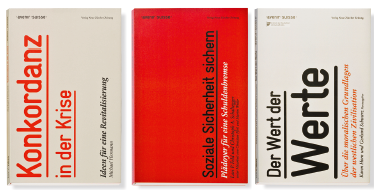
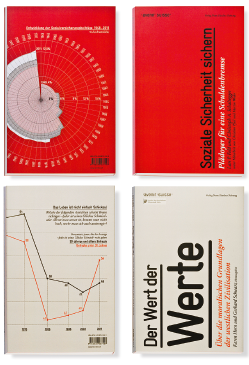
What should an organization do if its perception by the target group and its unique message are suffering from the flood of information? Have its visual appearance refreshed? Avenir Suisse opted instead for a corporate publishing concept that meets the requirements for a new image in a more sustainable way.

In many companies, the classic applications of corporate design have become increasingly irrelevant. The uniformity of office communication is ensured with electronic templates. Letters (if they are not replaced by email) and forms are printed entirely on color printers, business cards are produced "on demand" with web-to-print applications. Presentation templates are obtained from the cloud. And if a company's presence on social media platforms soon becomes more important than its headquarters, building identification will only play a minor role.

At the same time, the importance of content and visual consistency in corporate publications is increasing. Visions, ideas and values should be conveyed and the company should be immediately recognized as unique on every communication channel. This requirement applies just as much to marketing communications publications as it does to corporate communications. The company should be perceived as a single entity, from the brochure to the website and social media presence to the annual report.

Ensuring this is difficult when control over perception increasingly lies with the stakeholders. Email, Facebook, Twitter, blogs and newsletters and especially mobile devices, on which, for example, reviews of services can be created and received anytime and anywhere, have changed and continue to change the behavior of customers, suppliers and employees towards companies. The amount of data written, spoken, filmed and created when visiting websites is exploding. Companies need specialized help in extracting information from the flood of data, while consumers are using it confidently and influencing their stakeholders without restraint. So what can companies do to stand out from this information overload? Publish, and on all channels! The "strategic telling of a story", also known as storytelling, is crucial for the attractiveness of publications. This editorial form of communication can be used to convey corporate history, culture and values.

What does this mean for corporate design? Has it become superfluous? Not quite; however, some corporate design agencies have recognized that corporate publishing encompasses and achieves far more than the production of printed corporate information. Avenir Suisse, the "think tank that deals with the future of Switzerland as a business location", commissioned Arnold Inhalt und Form to give its visual identity a "gentle refresh" - a classic corporate design assignment. After analyzing Avenir Suisse's most important form of appearance and expression - publications! - it became clear that the available resources should instead be invested in a corporate publishing concept. And in content and visual as well as economic and technical changes.

The variety of publications - from the website to newsletters to studies and discussion papers to books - required precise knowledge of the target groups and led, for example, to the new handy best-of for on the go and for imparting knowledge in schools through a poster. This was the basis for differentiating the functions of the publication channels and platforms, such as a website based on the technology of blog and news portals or a newsletter format suitable for tablet computers. This in turn influenced the dramaturgy of the content and the reader guidance and especially the design of the omnipresent graphics. And - yet another classic corporate design: fonts and colors, papers and production processes were redefined. One example is the targeted use of the binding process to control the value and durability of each publication. The goal of the new visual identity - first to ensure and then to increase the credibility and authenticity of Avenir Suisse's messages - was achieved more sustainably with the first publications produced according to the new concept than by simply refreshing the logo, colors and fonts. All of these measures together lead to the desired unique appearance that meets the highest standards in terms of content and form. Lukas Huggenberg

Unbenannt-7
Unbenannt-8_0
 

Argus has the Federal Councillors in its sights

Argus has been monitoring on Twitter how our federal government is influencing the Swiss Twitter community. Since May 2011, Argus has been tracking all Twitter posts in which individual Federal Councilors were mentioned by name.

In November, Argus added the officially nominated Federal Council candidates to its search program. It is still noticeable that not all Federal Councillors are equally actively "twittered". What became apparent between May and October was also confirmed shortly before the Federal Council elections: Eveline Widmer-Schlumpf, Micheline Calmy-Rey and Johann Schneider-Ammann occupy the top positions. However, the challengers are catching up.

The possible dismissal of Eveline Widmer-Schlumpf seems to be keeping the Twitter community busy - according to Argus, there are numerous tweets on the subject. The outgoing Federal Councillor Micheline Calmy-Rey is also still being discussed. However, her presence decreased significantly in November. Johann Schneider-Ammann and the SVP's possible attack plans caused the Twitter channel to heat up again in November.

Didier Burkhalter is still not causing too much of a stir - the number of tweets about him is still extremely low compared to the other federal councillors.

Quo vadis, hospes?

A few days ago, Google enabled the «Visitor Flow» and «Goal Flow» Analytics features for Swiss websites. These features visualize the paths visitors take through a website and toward a conversion.

The "Visitor flow" feature is located in the "Visitors" section of Google Analytics, while the "Target process flow" is located under "Conversions" in the "Goals" section - both "flow reports" are presented interactively and graphically. L

- The "visitor flow" visualizes the typical visitor paths through the website from the entry source via the entry page to the exit page.
- The "target process flow" reveals the visitor paths up to a conversion (the nodes are taken from the defined target funnel).

Numerous segments (region, language, search engine, keyword, mobile device...) can be used to display the paths. The individual paths can be highlighted and isolated, which enables detailed analysis.

With the new features, questions about website usage can be answered quickly and comprehensibly:

- In which order do visitors call up individual chapters and pages on their way through the website? What information is ignored?
- How do visitors who have opened the shopping cart behave? Do they finish the order process or do they jump off, and if so, where do they go?
- Which pages did the visitor visit in which order on the way to conversion?
- How do new visitors behave compared to returning visitors? A purchase decision is not usually made on the first visit.
- At what point in the website visit do website visitors bounce disproportionately? Do they stay on the website afterwards or do they leave it completely?
- How do visitors who access the website using mobile devices navigate through the website, what are they particularly interested in?

With these new features, you can immediately see how visitors navigate through the website. The numerous segmentation options enable in-depth analyses to optimize website performance. The examination of these new features is interesting and provides new insights that can be capitalized on. Imre Sinka
 

Why 3D printing is also communication

Today, 3D printers are already being used to create personalized products and objects on demand via the web or using web-based devices—there’s even a project in the works to build a house using a type of 3D printer.

Personalized product design must be communicated in an understandable way as value creation. A brief insight shows how new technologies could be successfully communicated.

Communication with production
Until today, most production processes of three-dimensional, physical parts are disconnected from the common communication and ordering tools. Or to put it another way: any personalized requests are executed by separate production processes and the corresponding systems.

Personalized configuration processes
That will change pretty quickly. Because 3D printers can already be used to "produce" some interesting product or accessory parts directly from the customer. Clever communication and configuration platforms can show customers their products or product parts (through online rendering and 360-degree views). Once the customer has defined his part, he also triggers the production process with the order process.

The customer becomes the inventor and licensee
In the new Smart, there is a plastic accessory that is intended for smokers. However, the insert part could be configured in such a way that it would be useful for another use. The part is exactly the size that 3D printers in the price segment of about 20,000 francs could produce. So the customer creates the product, puts it on the web, and a partner produces the part to order - all via one click and without preliminary consultation, but just in time.

Social networks as an advertising platform and augmented reality as a catalog
Groups on the social platforms recommend and rate the parts and - to put it somewhat exaggeratedly - trigger recommendations and production processes. Whether parts fit into an environment or a decoration can be easily checked using augmented reality. Since the files for 3D printing will be typical construction files, which a 3D rendering program also needs (from CAD applications), the data can be used for both processes.

The technical service produces its parts itself
Technical services, furnishing houses and service people can start configuration processes on site, adjust parameters and start production of the new or spare parts. This could mean that in the future, development and construction can be even more customer-specific; without storage costs or time-consuming intermediate steps.

Have you constructed your house yet?
Various universities are already working on groundbreaking projects in which buildings are to be created using the principle of 3D printing. Shapes are possible that were hardly conceivable. Ornaments and other style elements can be easily integrated and thus become affordable. The infrastructure channels are all integrated in the structure as well - everything accurate to the centimeter according to CAD drawings.

Those who communicate cleverly produce
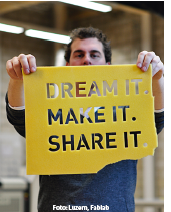
The proximity of communication and production will enable completely new processes and business models; the first steps have already been taken. And fab labs around the world are already exploring the many possibilities of 3D printing. Hansres Emch

Interesting links:
http://luzern.fablab.ch/
http://www.heise.de/artikel-archiv/tr/2011/4/62_kiosk
http://www.ponoko.com/
http://www.irisvanherpen.com/site/about
http://www.makerbot.com
http://www.3d-printers.com.au/

Unbenannt-3


Text agency Supertext frees Romandie from speaking German

The Zurich-based copywriting agency Supertext has launched a copywriting service in French. After five years, the first online copywriting and translation agency is now available not only in German but also in French.

"At last, the Romands no longer have to speak German when they need a German text, but can enter their text and translation orders entirely in French," says Supertext founder Rinaldo Dieziger. The text agency Supertext from Zurich-West was nominated for the Ernst & Young Entrepreneur Of The Year for the second time this year with its online service. With 10 permanent employees, a freelancer pool of more than 300 contracted authors, copywriters, editors, proofreaders, translators and clients such as Swissmilk, Ovomaltine, Ochsner Sport, Coca-Cola, Hirslanden, Toshiba, Billag, Migros Kulturprozent, as well as agencies such as WIRZ, KSB, Unic and Burson-Marsteller, Supertext is one of the largest Swiss language service providers.
 

get_footer();