Top of the week 2: NZZ launches "Equity"

Starting February 9, 2012, an additional insert titled «Equity» will appear in the Neue Zürcher Zeitung every Thursday. This move coincides with the discontinuation of Swiss Equity Media’s print publications as of the end of 2011.

From March 8, the "Equity" magazine will also be published once a month on Thursdays as a supplement to the Neue Zürcher Zeitung, as the media company announced on Tuesday evening. The content of the magazine is directly related to events accompanying the topic and is dedicated to a specific sector or specialist topic from the world of entrepreneurs and investors. The first issue focuses on the "Watch industry in transition". According to the press release, all print publications will also be available digitally. In addition, specific additional online services in the area of business and financial information will be developed step by step. The overall editorial management is the responsibility of Peter A. Fischer, head of the business section of the Neue Zürcher Zeitung. Daniel Imwinkelried is responsible for the "Equity" section and the magazine, while Martin Lanz, Beat Gygi and Michael Rasch are responsible for the specialist editorial teams.

Business4you moves to Biel

The marketing company Business4you, previously based in Pieterlen, is moving to Biel at the weekend. The company began as a start-up in the fall of 2003.

Andrea Roch and Patrizia Bianco founded the company eight years ago. Today, Business4you employs a total of 23 people in the areas of marketing project management and implementation, online marketing, web programming, graphics and copywriting, as well as two apprentices. This development meant that the previous premises on Bielstrasse in Pieterlen no longer met the requirements in terms of space and infrastructure, the company said in a press release.

"Theoretically, Bern or Solothurn could also have been considered, but we deliberately chose Biel," says Andrea Roch, Managing Director. A not insignificant reason for this is that customers from all over German-speaking Switzerland appreciate the central location.

The move will take place on December 2 and 3, 2011. Business4you will be officially domiciled at the Biel site from December 5.

Advent messages on Facebook.com

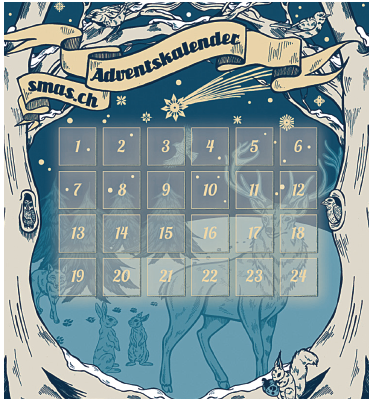
«Imagine if there were no people left—then we wouldn’t need God anymore, would we?» This message was sent to Smas.ch subscribers on their cell phones on December 11, 2010. The name «Smas.ch» stands for Short Message Advent System Switzerland and is the country’s first free SMS Advent calendar.

The calendar was invented in 2002 by the youth pastoral care team in the Liestal deanery under the motto "Heart instead of commerce". It was born out of a need on the part of young people to counter today's consumer-oriented festivities with actual Christmas values such as love, friendship and peace. The aim of the project: depth in 160 characters, in the language and on the medium of young people. Today, Smas.ch is supported by the Catholic churches of AG, BL, BS, FR, GR, LU, SG, TG, ZG and the Reformed churches of BL, BS, BE, GR, JU, SG, SO, ZG as well as Jungwacht and Blauring. Smas.ch is run by the youth offices of the respective cantonal churches.

In 2011, they returned to their pioneering role and enlisted the help of Kargo Kommunikation, an agency for networked communication, for the tenth anniversary. The brief: to program and design the "very first real" Advent calendar for the social media channel. At Facebook.com/theadventcalendar you can open a little door every day in December and find a picture and a text to think about behind it. The agency has also created the Smas.ch editor under the direction of Christoph Balsiger. This allows users to design the individual doors with their own text and image and send them to their friends. This leap onto Facebook is possible thanks to the financial commitment of many churches in German-speaking Switzerland, who want to give young people something that suits them.

Unbenannt-11
 

To the point: joy and sorrow

The profession of journalism has a lot in common with an Advent calendar. Every day, you’re curious to see what’s in store for you after opening the little door or unwrapping the small package. Every day is different—just as a real Advent calendar should be. Sometimes it’s a bigger surprise; other times, a small delight.

In contrast to an Advent calendar, however, there are also minor or major annoyances in journalism. One of the daily occurrences is the nag who inquires - of course to the editor-in-chief personally - why the press release, which is so incredibly interesting, was not printed. And then adds the immensely intelligent sentence that the competition would have published the report in the case. Good for them! Or the charming PR lady who just wants to know - directly from the editor-in-chief, of course - whether the press release was received safely. You never know. Of course, it could have disappeared into Internet nirvana. Malicious remark: Maybe it was addressed incorrectly, because they were too lazy to look up the correct e-mail address of the editorial office. And because we know that it's always best to write directly to the editor-in-chief, it doesn't matter whether this is in line with the news workflow or not.

But there are also many pleasant moments that make up for it. Interesting background conversations with intelligent people, or interviews with people who have something to say, express themselves pointedly, and stand by their word even when they see it printed in black and white. Very often, it's much easier to discuss things with professional people than to deal with amateurs or - even worse - would-be professionals.

Here are two more current examples. Our "Head of the Week" column is very much appreciated by many of our readers. One of the reasons for this is that we try to portray people in a realistic way. It is not meant to be PR babble. But time and again, unfortunately, we find that there are people who see this publication as a kind of self-promotional space, an advertisement - but free of charge, of course. We don't go along with that. That's why there is no "head of the week" this week. We tipped it early Wednesday morning.

The counterexample to this is my interview with Urs Heller, head of magazines at Ringier Switzerland. An interesting conversation, pointed statements and professional authorization. That's how it should be, my dear wannabes!

To all I wish a joyful, relaxing Advent season.
Pierre C. Meier, Editor-in-Chief
[email protected]
 

Corporate communication in dialog

The twelfth .HarbourClub. symposium focused on dealing with assertive stakeholders.

Unbenannt-2

This year's symposium, which was chaired for the first time by new HarbourClub President Corina Atzli, featured two familiar faces from the world of politics. Former Federal Councillor Leuenberger and Heiner Geissler, former German Federal Minister, spoke about the communication challenges facing companies and politicians. Prof. Manfred Brun from the Center for Economic Sciences at the University of Basel and the Head of Communications at Axpo Holding AG, Rainer Meier, had previously spoken. As every year, a very important part of the symposium consisted of the various breakout sessions in which HarbourClub members presented and discussed their very specific communication projects. There were case studies from Kuoni (Peter Brun), Coca-Cola (Mathias Schneider), Swisscom (Philip Kübler) and SRG SSR (Iso Rechsteiner). This year, the 130 participants were hosted by Siemens in Zug.

Social media demands a new culture

Manfred Brun began the symposium by explaining how corporate communications will change under the influence of social media.

To this end, he put forward seven theses:
1. the social media hype has passed its zenith. Now it's time to deal with the
relevant issues.
2. communication and media mix experience a serious shift in forces. Social media is now steering consumer behavior.
3. tomorrow's world of communication will be fundamentally different. Transparency, democratization and loss of control are on the agenda.
4. social media does not differentiate between marketing and corporate communication. Communication content is more important than channels.
5 Social media places new demands on the communication behavior of companies. The content, tone and form of communication must be put to the test.
6 Not everything is becoming less controllable. Social media provides valuable new insights into the perception of companies.
7 The successful use of social media requires an adaptation of internal systems, structures and culture. However, established (mental) barriers prevent the creation of a "social media fit".

The thread between top and bottom is broken

In a humorous speech, Moritz Leuenberger spoke about communication in general and specifically during his term of office as a member of the government and Federal Councillor. He did not hold back with criticism, including of his own performance. In particular, he had learned that you can rarely win on the defensive. Or, as Leuenberger put it: "The first serve or it must be struck immediately." He sees communication not only as a means of fighting, but also as a responsible task for the community to avoid being driven further apart and paralyzed.

Heiner Geissler picked up on this thread and used his appearance to deliver an unsparing critique of society. The thread between "those at the top" and "those at the bottom" was broken. The power of the unleashed financial markets had undermined the basis of citizens' trust in decision-makers in politics and business. Only when we return to a genuine social market economy will the foundations be laid for a real dialog between citizens and politicians, consumers, employees and companies. Andreas Jäggi

Social media study 2011: Professionalization of companies
As part of the .HarbourClub. symposium, the online communication service provider Namics surveyed leading Swiss companies on the organization of their communication in social media and identified clear differences between the organizations experienced in social media and the laggards. The study gets to the bottom of the key success factors of corporate communication in social media and concludes that the time for experimentation on social media is over and the rising expectations of target groups no longer leave any room for error.

Social media has become an integral part of corporate communications: 84% of the 51 organizations surveyed are active on social media. A third of these are B2B companies. The 16% non-active organizations - all of which operate exclusively in Switzerland - have decided against getting involved, mainly due to a lack of resources or the unpredictability of the media.

Almost half of the companies surveyed consider their organization to be in the initial phase with regard to social media. Only 15% of the companies consider their organization to be very mature in the area of social media. But what is their recipe for success? On the one hand, social media activities are supported by the management and underpinned by a strategy. On the other hand, their commitment thrives on new or specially prepared content. The analysis therefore shows that companies that are now starting with social media cannot avoid a strategy and guidelines in order to avoid mistakes and quickly meet the expectations of their target groups.

Swiss companies see limited resources, the creation of suitable content, the unpredictability of interactions and dealing with trilingualism as the biggest challenges. And although limited resources are proving to be a central problem on social media: Most companies operating internationally foresee the same resources in 2012 as in 2011, while 30% of respondents plan to increase their social media resources by 50 to 300%. Download the Namics social media study free of charge: www.namics.com/social-media-studie aj


"Going it alone is better"

Urs Heller, Managing Director Magazines Ringier Switzerland, talks to Werbewoche Editor-in-Chief Pierre C. Meier about the reasons for LandLiebe's success, circulation targets, success factors and credibility.

Unbenannt-9

WW: What tipped the scales in favor of launching LandLiebe?
Urs Heller: Clearly the success of LandLust in Germany. It's fascinating that such a rustic magazine is suddenly dueling with Spiegel at the newsstand in Germany. Naturally, something like this stirs the imagination. At first, we followed the development from afar, then we negotiated with LandLust-Verlag.

So the original plan was to merge with the German LandLust?
We thought about a license. Then we found out: it's better to go it alone!

Why did it not happen?
We could not come to an agreement financially. Our discussion partners had relatively high ideas for a license fee; it would not have been worthwhile in a small country like Switzerland. At the same time, we realized that the synergies are not that great: We Swiss tend to be "mountain-loving" people rather than flatland subjects; you can't score points with us with heather reportage. In retrospect, we are glad that we risked going it alone. We wouldn't have had this huge initial success as a licensed product.

Who developed the Swiss concept?
I'm responsible for new developments and new editorial concepts at Ringier magazines. So also for LandLiebe. I was able to count on the support of a few real professionals.

Where does the layout come from?
The graphics were done in-house. André Frensch, a former deputy art director at Schweizer Illustrierte, drew the first pages and played a big part in their success. I then brought Uli Beling and Nina Thoenen on board. The two young women are actually always there when I develop a magazine. I discovered them for the launch of SI Style.

What is the philosophy behind LandLiebe?
There is a longing for deceleration, people need a balance to the ever more hectic everyday business life. In our free time, we are urged to get back out into nature, out into the countryside. I can well remember times when there was no rush at the mountain railroads on Sundays in summer. One knew to wait until sometime again a little train drove. Today, the parking lot is full at seven o'clock. Hiking is a megatrend that the media are gloriously oversleeping - apart from colleague Thomas Widmer, who writes excellently about it in the Tages-Anzeiger. Discussions with the heads of the sporting goods industry confirm this: In Switzerland, hiking is the number one sport by a huge margin. A football boot or Didier Cuche's skis follow at a distance. We are glad that we jumped on this trend at the last moment.

How does LandLiebe distinguish itself from SI GRUEN?
SI GRUEN was our first foray into the green scene. We are satisfied, SI GRUEN is doing very well. SI GRUEN has a pronounced lifestyle component. We also put that on the front page: 100 percent green, 100 percent lifestyle. The target audience is the famous Lohas (Lifestyle of Health and Sustainability), i.e. people who gear their lifestyle to health and sustainability. SI Green can also have an international touch. LandLiebe is very clod-connected, very Swiss, very normal. Luxury is not an issue. I can show it with the example of food: For SI GRUEN, a nature-loving Gault Millau chef can supply the recipes. That's out of the question for LandLiebe: It's about countrywomen's cuisine, home-made sausage and alpine cheese. Not about GaultMillau points.

Who is the typical reader?
There are two target groups. One group lives in the countryside. The others dream of living in the country. The latter live in the city, but start thinking about how they want to spend their weekend in nature on Thursday evenings. The typical LandLiebe reader probably also tends her small garden or at least a few pots on the terrace. She revives old hobbies. Knitting, for example, is a real trend!

Today LandLiebe is published four times a year, next year five times. What is the goal?
We would like to publish six times a year in the future. But you can't dupe nature: We didn't do enough pre-production last year to create two spring numbers in 2012. So we're coming out with five issues now and not increasing to six until 2013.

Why is LandLiebe not published monthly?
The bimonthly publication frequency is also a form of deceleration. Our readers don't want to be weighed down by too many issues. He wants to have the magazine on his desk, leaf through it again for a bit, then put it on the page and continue reading later. The stimulus threshold is six to eight issues. At least that's what my gut feeling tells me, and it's reliable in most cases.

The initial print run was 200,000 copies. What marketing measures were there at the launch?
We follow the same approach for all new launches. We have a wonderful address base that we can select for each launch. We do large-scale mailings to make the title known and in demand quickly, plus some classic advertising. Then we wait with bated breath to see how many readers get hooked. We did it like this for the first time with SI Style and were completely taken by surprise by the response. At the time, I had reckoned with a 24 percent conversion rate to a subscription. But it was 42 percent! With LandLiebe, the math works out again: a referral/gift mechanism has now kicked in that we never imagined in our wildest dreams. Most letters to the editor end with, "I immediately made my mother/sister/girlfriend/daughter a subscriber."

What is the subscription price?
At 24 francs, the price of an annual subscription is affordable for everyone. We deliberately set the price so low. That is also part of our marketing. As the "new kids on the block," we have to be very modest in the market. In the 1980s and 1990s, new magazines could still be sold on the newsstands at steep prices. Today, buyers no longer accept that. They want to get a lot in return for relatively little money. We are also friendly and cautious when it comes to setting advertising prices. Take SI Style, for example: although we have quickly overtaken Annabelle with 100,000 readers, we are still cheaper in terms of advertising rates. Our message to the customer: Annabelle has been on the market for seventy years, the magazine is well made. But we are new. So we remain cheaper (for now) - even if we already have significantly more readers.

How many subscribers does LandLiebe have today?
We now sell 74,431 copies after four issues. Of these, 47,000 are subscriptions and 27,000 are sold at newsstands. The winter issue has been available for two weeks, and we already have an additional 2,000 subscription orders. LandLiebe is really a bull's eye.

Where is the circulation target?
I never set myself a circulation target. You can't buy anything with that. My goal is to pay back Mr. Ringier's initial investment within two or three years and to be in the black. The circulation with which we achieve this goal is secondary. Magazines have to earn money quickly, otherwise there's no point in launching them.

The editorial structure is small.
Yes, that's true. In the difficult start-up years, you can't afford a large editorial team. I'm also taking over as editor-in-chief for the first few issues. Because I can save money that way and because that's part of the business: There's something eunuch-like about developing magazines and not launching and taking responsibility for them yourself. But from the very first issue, I look for editors who can take over the magazine quickly. This has proven very successful at SI Style, for example: Sabina Hanselmann-Diethelm was on board from the very first minute, was trained hard and paid good attention. Today, she's an outstanding young editor-in-chief and hardly needs my help anymore. Unfortunately, I only see the Style editorial team, which has actually grown close to my heart, at Christmas dinner... I also want to proceed in the same way with LandLiebe. I would like to say goodbye to the editorial director job already in the course of the next year. We have good people in the team!

...and then comes the next project for you?
There is no lack of ideas. But back to the small Land- Liebe troupe. The core team may only consist of four people, but we have the whole SI family to fall back on. SI Style provides us with a first-class photo editor. Two of the best SI authors write regularly for LandLiebe. They like it very much, by the way, because in the new magazine the stories are longer, the pictures bigger and the time pressure less than in Schweizer Illustrierte, which has a different concept. I'm in a privileged situation: If I need reinforcements, I can find them right on the floor. So you can start with a small team and a reasonable budget. That also applies to the publishing house: The Ringier magazine team led by Thomas Passen pushed LandLiebe and can now toast its success.

You've already launched many magazines. What was different about LandLiebe?
The pioneering spirit was identical. Everyone gives everything, pulls together. What was difficult for me was that I'm not a professional myself. My garden is tended by the gardener, and I don't know how to knit either; so it was easier for me to develop gourmet, sports or women's magazines. But my lack of expertise also had an advantage: From the very first minute, I had to gather around me journalists who knew a lot about the subject. And I had to trust them one hundred percent. It was actually a fair deal: I show the team how to make magazines. And the team tells me what is particularly important for LandLiebe readers. One thing I quickly noticed in the green scene. You can't play tricks, every detail has to be right. That's why our master gardener Lippus reads through every article and guarantees that no technical errors creep in.

Are you satisfied with the volume of ads?
Very satisfied! We sold 100 pages of ads in the four issues. What's helpful, also for the ad market, is our close relationship with readers. It is a true love affair. We receive letters "for years we have been waiting for...", "thank you for granting me this wish". We receive poems. We don't get this closeness with other magazines. With the other titles, I communicate with readers by email. With LandLiebe, there are also still many handwritten letters, not just emails. That speaks for a high level of credibility.

In the booklet you have very good link information to the individual articles. But if you visit LandLiebe on the web, it is rather meager.
We are starting with a small editorial team and want to keep costs under control. We can't yet afford an actual online editorial team. But we provide the best links to each story and try to close the gap. LandLiebe is a lay-back magazine; you read it on the sofa or on the garden bench, not on your computer.

One more thing about Schweizer Illustrierte. SI is 100 years old, and has been a people magazine for 15 years. What will SI look like in ten years' time?
Same in principle. Schweizer Illustrierte will remain a people magazine with a clear focus on Switzerland. But it must continue to develop. The task has become more difficult for the editorial team, but it remains the same: We have to show important Swiss people from their private side, talk to them about their talents and their passions. We can't shy away from this job. Fortunately, after 100 years of decent work, we are met with a certain goodwill and time and again open doors that would otherwise remain closed.
Interview: Pierre C. Meier
 

Shaping convergence with "coopetition"

The SRG and publishers should collaborate to a limited extent rather than fighting each other. Op-ed by Stephan Russ-Mohl, director of the European Journalism Observatory at the University of Lugano.

There are still surprises in life, sometimes even two: in the summer, Hanspeter Lebrument took a swing at us communication scientists and terrified us: "The inferior guard of those called to science" had "conquered the field of media and communication". Their work is useless, "characterized by a lack of systematics, questionable research and highly questionable training criteria as well as results that are difficult to understand", he wrote in his association magazine Flash extra on the subject of the "perennial issue of quality".

A few months later came the volte face: Lebrument's association invited four "renowned media scientists" (in the words of the Swiss Media Association) to a hearing in Zurich to "think about possible solutions to the conflict between the SRG and private publishers in the online market from their point of view".

The second surprise came at the hearing itself. Without any prior consultation, the four invited experts came to very similar conclusions. Roger Blum, Heinz Bonfadelli, Kurt Imhof - who had taken an additional beating from the publishers shortly beforehand for his yearbook "Qualität der Medien " - and I recommended that the publishers sit down at a table with the SRG and think together about how they can shape the convergent media future to their mutual advantage. Instead of fighting over the peanuts that will be generated by future online advertising, and instead of waging war in terms of online presence, they should strive to preserve journalistic diversity and ensure the best possible service for Swiss media users with limited resources that are likely to become even scarcer. The future of the media is online, where the old media of TV, radio and print are converging.

Anyone who wants to continue to have a "public service" in times when commercial media are less and less able to fulfill their public task due to falling advertising revenues, the public's declining willingness to pay and shrinking editorial teams should be careful with demands for SRG to restrict itself on the Internet.

In any case, media diversity in Switzerland is more likely to be threatened from outside, i.e. from heavyweights such as Google, Apple and Facebook, but also from large European media companies such as Bertelsmann/RTL, Springer and Mediaset/Mondadori - as well as from the largest private Swiss player Tamedia - than from the SRG.

It is worth thinking ahead in the Internet world and exploring possible synergies if high quality journalism and "Swissness" are to be preserved. "Coopetition" is the keyword. We could learn from the software companies in California how cooperation between competitors can be organized - for example, by allowing competitors who become cooperation partners to strengthen what they already do best: SRG could also provide moving images and podcasts for publishers' websites - as well as foreign, science and media reporting, in other words making more widely available everything that we have already paid for with our license fee money and which many newspaper publishers either cannot do at all or have already greatly reduced. In turn, newspaper publishers could also contribute texts to SRG's online platform in return for appropriate remuneration and play to their strengths in regional and local reporting, where they have always been the news suppliers of the major news agencies anyway. Advertising revenues for online offerings - this is and will probably remain a side issue, because news websites will only generate low advertising revenues anyway.

Anyone who has recently had the opportunity to listen to SRG Director General Roger de Weck or the head of RSI in Ticino, Dino Balestra, will attest to their thoughtfulness, which many publishers still lack. De Weck comes from the press, he was editor-in-chief of the Tages-Anzeiger and Die Zeit. With him as a discussion partner, publishers should be able to actively shape the future of media in Switzerland. To do this, however, they will first have to give up a few prejudiced positions - and perhaps also teach their great chairman that scientific advice is not completely useless, and can sometimes even be groundbreaking.
 

Campaign of the Year 2011: Vote now on Facebook

Which campaign did the audience like best and which one has left a «lasting» impression? The editorial team at Werbewoche dug up 18 campaigns from last year and compiled a shortlist.

You can vote for the best campaign in keeping with the spirit of the times onFacebook.com/advertisingweek. There you will also find detailed instructions on the procedure. Thanks to the support of the Publisuisse database, all 18 campaigns can be viewed on the voting portal.

The "Campaign of the Year" will be announced on February 2 at a gala in Zurich's Lake Side. The "Advertiser of the Year" will also be chosen at the same dinner.


Eurobest: SFLB/Smly "Holiday without Internet" wins Grand Prix

A success for Spillmann/Felser/Leo Burnett and the Zurich-based social media production company Smly: The «Vacation Without the Internet» campaign has sensationally won the Grand Prix in the PR category at the European Eurobest Awards. SFLB also received three gold awards.

The "Vacation without Internet" campaign made national and international headlines this spring. First of all, because the idea was a counterpoint to constant accessibility. In an interactive film, Sebi and Paul, the two farmers from Switzerland Tourism Advertising, analyzed each user's Facebook profile and commented on it. The two then recommended Internet junkies to take a vacation without the Internet in a remote Swiss mountain hut. After just three days, Facebook stopped the app, which in turn made headlines. And for correspondingly high visitor numbers a week later when the app was running again.

SFLB wins three Golds in addition to the Grand Prix: for Fleurop in the Print category, for the design of the Gotthelf Emmentaler (Design cat.), and another Gold for "Holidays without the Internet". Swiss Life's reversible sets are also awarded silver twice. Also awarded silver in the Outdoor category is the SFLB campaign "Broken Vase" for Fleurop.

Medal Winners:

The agency Saatchi&Saatchi wins a silver medal in the film category with the campaigns "Classroom Craft" and "Shoe Laces" for Novartis' Otrivin Nasal Spray.

Jung von Matt/Limmat is awarded a bronze medal in the Outdoor category for the campaign subjects "Greta", "Wolfgang" and "Wiebke" for Mercedes Benz. In the same category wins Euro RSCG a bronze medal for the "Violin, Clarinet" campaign for the Zurich Chamber Orchestra.

With a bronze medal in the Interactive category, the agency Jung von Matt/Limmat a second medal: she is awarded for the campaign "Application for Citizenship" for Graubünden Ferien.

The agency JWT factory owner receives a gold medal in the Print & Poster Craft category for the "See you later" campaign for Hakle. In the same category wins Walker a silver medal for the campaign subjects "You and us", "Promises", "Risk" and "Botox".

In the category PR wins the agency Wirz/BBDO a bronze medal for the Donated Songs campaign for the Salvation Army.
 

Stailamedia cooperates with Adwave in French-speaking Switzerland

The online marketing company Stailamedia and the French-speaking Switzerland-based online marketing company Adwave are entering into a partnership effective immediately for the French-speaking Switzerland market. As part of this new collaboration, the two companies are combining their portfolios and launching a joint «Romandie News Pool.».

The pool includes the widest-reach French-language news sites such as rRmandie.com, Tf1.fr, Lefigaro.fr and Lemonde.fr and generates more than 25 million page impressions per month. The cooperation with Adwave starts immediately.
 

Which idea will be campaign of the year?

Which campaign did the public like best and also have a "lasting" memory? The editors of Werbewoche have dug up 18 campaigns from the past year once again and used them to compile a shortlist. The "Campaign of the Year" will be announced on February 2 at a gala in Zurich's Lake Side.

Which campaign did the public like best and also have a "lasting" memory? The editors of Werbewoche have dug up 18 campaigns from the past year once again and used them to compile a shortlist. The "Campaign of the Year" will be announced on February 2 at a gala in Zurich's Lake Side.

The "Advertiser of the Year" will also be chosen at the same dinner. Votes for the best campaign can be cast in keeping with the spirit of the times at Facebook.com/advertisingweek. There you will also find detailed instructions on the procedure. Thanks to the support of the Publisuisse database, all 18 campaigns can be viewed on the voting portal.

> To the nominated campaigns

Four. advertises the Laax winter experience on posters

The Zurich-based multichannel creativity agency Four. has designed a poster campaign for the winter sports destination Laax. Laax’s positioning is conveyed through catchphrases that are meant to take on a broader and new meaning through the emphasis placed on individual letters.

The subjects are complemented by differentiating, dynamic visuals from the ski resort. The aim is to convey important messages for Laax in a quick and target group-oriented way.

Responsible at Weisse Arena Group: Andreas Bärtsch (Executive Board, Marketing and Sales), Tobias Treichler (Marketing and Communications). Responsible at Four. Advertising agency: Björn Brinkmann, Philipp Sträuli (CD), Andrea Heierli (graphics), Sandra Genge, Daniel Gerber (consulting), Claudio Hagmann (DTP). Photography: Gaudenz Danuser. Image editing: Sota.
 

get_footer();