Actually, Weltwoche is superfluous, unless...

A weekly newspaper is only worth reading if it manages to set itself apart through surprising questions, arguments, and writers. Guest commentary by Karl Lüönd, freelance journalist and author.

It has been a frequent topic of conversation over the past ten days—and not just among journalists: Why did *Die Weltwoche*, of all publications, break the story about Bruno Zuppiger’s «original sin»? Its close ties to the SVP are well known, after all. What did Köppel and Engeler (and perhaps Blocher, one of the possible masterminds behind the scenes) intend to achieve with this scheme? Cui bono (Latin for «To whose benefit?»)

Anyone who asks this question is mistaken, because they are assuming from the outset that journalists have fixed partisan political positions and corresponding strategies. A good journalist, however, is always where the good story is. They don’t need to suppress their own political viewpoint, but it takes a back seat when assessing facts and stories. The worst of all journalistic sins in such a case would be cowardice in the face of one’s friends.

Ideally, a good story meets three criteria: it is true, it is relevant, and it interests people. As far as one can judge from the outside, all three criteria apply in a virtually textbook manner to the Zuppiger scoop in *Die Weltwoche*. To date, not a single line of the article written by Urs Paul Engeler has been denied or refuted.

Anyone who enters the selection process leading up to a Federal Council election exposes themselves and their past to in-depth journalistic scrutiny. This has been common knowledge at least since the Kopp case. In the case of Bruno Zuppiger, however, this investigation was not very thorough at first. Not even the Tages-Anzeiger, which has never held back when it comes to other SVP figures with shady pasts, deemed it necessary to follow Zuppiger’s business trail. The fact that there had been a debacle at the cantonal trade association—for which Zuppiger shared responsibility—had been an open secret in Zurich’s political circles for many years. To have initially overlooked this story and then, in hindsight, to accuse colleagues at the *Weltwoche* of having dishonest—that is, unjournalistic—motives is simply cheap.

Urs Paul Engeler is self-critical and independent enough to treat even promising sources with care and skepticism. Whoever tipped him off about the story—and it was more than just a tip; it included documents—must have been pursuing their own agenda. It is not the journalist’s job to morally judge the motives of his informants; rather, his task is to see through those motives and identify any gaps in the files. In other cases, I have found Urs Paul Engeler to be tenacious in his investigations, but also extremely careful and level-headed. Until proven otherwise, and given my knowledge of his integrity, I do not assume that Engeler allowed himself to be used as a pawn in a political game.

But *Die Weltwoche* of all places! My friends objected, saying that didn’t fit with its track record at all. But yes, it did fit—namely, with *Die Weltwoche*«s main problem. That problem is that it is superfluous. No one today needs the kind of weekly newspaper with its reflective essays that Karl von Schumacher and Manuel Gasser invented in the early 1930s. Ever since electronic and online media have pushed daily newspapers out of the »breaking news” business—a shift that began when the NZZ stopped publishing twice a day—the major daily newspapers have shifted toward the former core competency of weekly papers: in-depth analysis, background coverage, explaining the world, original articles, and exclusives. A newspaper like the *Weltwoche* is only worth reading and economically viable to the extent that it succeeds in setting itself apart through surprising questions, theses, and authors.

Young publisher Köppel, who loves to put himself under pressure, realized this long ago and has consistently put it into practice. His motto is: Be a thorn in someone’s side, and you’ll make a name for yourself. If he fails to surprise, provoke, and amaze readers every week, his project is over. That’s why, for years now, he’s placed Peter Bodenmann alongside Christoph Mörgeli. It’s less about ideology and more about excellent marketing.
 

Remember November: The month of talent

Swiss Marketing had three reasons to celebrate in Interlaken and Zurich. In the Bernese Oberland, marketing and sales managers received their diplomas; in Zurich, the very first class of marketing managers was honored. Swiss Marketing brightened up this gloomy month.

We usually only hear good things about May: awakening spring fever, summer sunshine. Shareholders collect their dividends the month before. July and August shine as vacation months, September often brings an extension of the warm season. November has a harder time of it: month eleven is usually associated with fog, pre-winter gloom, difficult wage and budget negotiations. And the thirteenth month's salary is already owed to the cantonal treasurer. Yet November has a truly unique selling point in the Swiss education landscape. At least as far as the activities of Swiss Marketing are concerned: sales and marketing talents are honored at three new diploma ceremonies.

235 Talents for the real economy

At the end of November, there is always a double accolade: first the marketing managers and then the sales managers, usually just a few days apart. This year, the two events were also held very close to each other in terms of location: on Friday, November 25, 80 marketing managers were given their brevet, while 136 new sales managers were welcomed the following day. Both events took place at the five-star Victoria-Jungfrau Palace in Interlaken. Also in the supposedly gloomy month, on November 24, there was a premiere in Zurich: the first 19 marketing managers were graduated in Zurich. All in all, a total of 235 new talents from the Swiss Marketing kitchen that the real economy can only look forward to.

Marketing manager: Celebration with sax appeal

When 80 talented people have successfully completed the royal road of marketing, a first-class location is of course a must for the celebration. The Victoria Jungfrau in Interlaken was one of the most radiant gems in the Swiss haute hotel industry for the marketing managers' graduation ceremony. 107 candidates took the demanding marketing manager exam; 80 or 75 percent passed. "Certified marketing managers prove that they are masters of their trade and have many years of extensive practical experience," praised examination director Peter Gilli in Interlaken. The event was accompanied by music from Zurich saxophonist Roland Graf, aka G-Sax, who had brought guitarist Felix Utzinger along to the ceremony. A graduation ceremony with a real sax appeal. And one that proves that the royal road of marketing is a real road to success: the number of candidates in 2011, 107, was considerably higher than in 2010, when 93 candidates took part in the selection process.

Sales Manager: Aeschbi rules

Just as G-Sax always hits the right notes with the marketing managers, there is a constant companion at the sales managers' graduation ceremony who knows: C'est le ton qui fait la musique. TV personality Kurt Aeschbacher hosted the sales managers' ceremony after the marketing managers' event. At the same venue, the Victoria-Jungfrau Interlaken. A total of 192 people took the exam, 136 or 71 percent passed. "The future belongs to those who are active in the present," Jean-Paul Zürcher, Chairman of the Examination Board, told the young talents. Aeschbi once again managed the feat of conducting an event with many prizewinners in a way that was both confident and entertaining. Not for a second did the TV professional feel like he was reeling off a commissioned piece of work. On the contrary: Aeschbacher understood perfectly how to pick up each award winner exactly where he or she was. And to turn it into perfect infotainment. Here someone sells the core messages (and himself) close to the optimum.

Marketing Manager: Premiere at the Grossmünster in Zurich

On November 24, in the heart of Switzerland's number one business metropolis, the first ever diploma in marketing management HF was awarded. After six challenging semesters at the SIB (Swiss Institute of Business Administration), 19 of the original 24 talented students were awarded their diplomas. This first generation of marketing managers received their diplomas in Zurich's Grossmünster church, after which they moved to the Zunfthaus zur Meisen for an aperitif riche. The graduates of this brand new management training program combine marketing expertise with leadership and management skills. In the European EQF levels, graduates of the new course are classified at level 5 (Marketing Manager, Master). Graduate sales managers are ranked at level 6 (Sales Director, Bachelor) and graduate marketing managers at level 7 (Marketing Director).

The dovetailing of theory and practice is a very important asset for the HF Marketing Management degree: as the culmination of their studies, graduates write a thesis that bridges the gap between theory and practice and must offer a concrete practical benefit for a company. A practice partner, usually the client from this company, is involved in the assessment and invited to the final presentation. Dr. Peter Petrin, Director of the SIB and Swiss Marketing Vice President, emphasized the key quality of the diploma students: "They don't just know what marketing could be, but how it should be managed in order to be successful."

With this in mind, Swiss Marketing President Uwe Tännler also addressed the first generation of marketing managers: "Success depends not only on knowledge, but also and above all on action, on doing. It will therefore be crucial how you put your acquired knowledge into practice."

Unbenannt-13_1
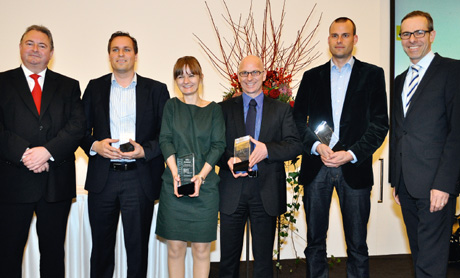
Winners among themselves: Test director Peter Gilli, Stefan Gygli, Elke Heinert,
Martin Huber, Frank Lang, Audit Chairman Marc Heim (from left to right).


«It's okay if it shows some wear and tear.»

Spray everything with hairspray or coat it with gelatin. Food stylists used to resort to such tricks from time to time. A lot has changed since then. When it comes to «dressing up food,» Christian Splettstösser focuses above all on naturalness.

«From my perspective, everything has become much more authentic,» says Christian Splettstösser, a longtime food stylist, commenting on developments in his profession. «In the past, there was no sense of naturalness on the plate. Every crumb, every peppercorn, or even a dollop of sauce would have been unthinkable. Everything had to be perfectly clean, precise, and striking.» When Splettstösser works today, his goal is to present everything as naturally as possible. It’s okay for it to look a little lived-in, he says. «Jamie Oliver-style.»

So the food stylist no longer relies on hairspray and gelatin to give food the right shine. A little water and oil usually do the trick, he says. In any case, that “spectacular” element in photography—those little tricks—isn’t really necessary anymore. At most, when it comes to packaging, that’s when they’re more likely to reach into the bag of tricks. If Splettstösser had to source black currants out of season for a packaging shoot of a granola bar, he’d resort to so-called dummies. But he emphasizes that this is very rarely done.

From Chef to Food Stylist

Christian Splettstösser discovered his passion for food at an early age. Becoming a chef was his childhood dream. Raised in Hamburg, he decided to pursue an apprenticeship as a chef despite all the warnings from his parents and friends. He loved working with food. But he soon realized that the restaurant industry «wasn’t his world.» After completing his training, he continued working in the field for another three or four years. «But I knew I had to make a change.»

Splettstösser got into food styling in 1987 through a friend who was working as a photographer at an advertising agency at the time. After spending a whole day looking for a food stylist, the friend said to Splettstösser when he picked him up at the agency that evening: «Christian, you could have done that, too.» That’s how the trained chef learned about the job of a food stylist. His interest was piqued.

However, finding information about the profession proved difficult. Even in Hamburg—which is now considered the hub of food photography in Germany—there was almost no one working as a food stylist at the time. That’s when Splettstösser came up with the idea of trying his luck with publishing houses.

At Gruner + Jahr, he joined the editorial team of the food magazine *essen & trinken*. During an internship, he observed how things were done in the test kitchen and the photo studio. Three months later, he was offered a permanent contract with the food editorial team. He didn’t want that. After negotiations with the editorial board, he was ultimately hired as a freelancer. «That meant a fixed fee, but it also gave me time to develop my skills, experiment with young photographers, and put together a portfolio.»

After two years, Splettstösser wanted to become completely independent. By then, he had put together a nice portfolio and set out to find clients with it and a homemade promotional item—a soup can with a tear-off lid, containing an elaborately designed business card with a small slide featuring a food motif incorporated into it. It was a success; he’s been working as a freelancer ever since.

After about ten years in the field, Splettstösser finally founded a food photo agency in Hamburg with a friend. When he met his current wife, who is from Basel, he began commuting between Hamburg and Zurich, where he took on his first assignments. Three years ago, he finally left the photo agency to focus entirely on family life in Switzerland. Splettstösser now lives with his wife and two children in Riehen, near Basel. However, he still spends one week a month in Hamburg to keep in touch with friends, family, and clients.

Food styling, recipes, and props

Christian Splettstösser doesn’t want to limit himself to just a few core competencies. He has repeatedly shifted the focus of his work throughout his career. «There were years when I mainly worked on cookbooks, then it was more advertising, and then again a lot of editorial work.» It’s important to Splettstösser to always have variety, to avoid getting stuck in a rut, and to maintain a diverse client base.

His job goes far beyond simply preparing food. For many projects—especially those he’s been overseeing for some time—the trained chef is also responsible for recipe development and, on top of that, for the visual concept. This is also the case with his client Schweizer Fleisch, for whom he has been designing the butcher’s magazine «en Guete» for two years now, featuring recipes centered on meat and meat products.

Splettstösser receives a brief from the advertising agency outlining the current theme of the issue. Based on this, he develops recipe suggestions. After working with the agency to create the visual concept—What kind of material world are we exploring? Is it something modern or rustic? What is the color scheme?—he gathers the props, selects surfaces, backgrounds, plates, cutlery, glasses, and napkins. Everything that goes with it.

The food stylist showcases his work on his website, Dersplett.com. «Splett» originally started as a joke, because that’s what his family was called. The name has stuck, though. These days, many people simply call the Hamburg native “der Splett.” If you search for Splettstösser online, you’ll also find the food stylist on Stylingpool.com, a collective of 13 stylists that was founded three years ago by Jeanette Blättler and Regula Wetter. From there, you can access Splettstösser’s own website, where his work—including projects for Betty Bossi, Coop, Migros, and Bell—appears as a collage on the homepage.

Christmas Cookies in the Middle of Summer

Christian Splettstösser seems to thrive in his job: «I’m totally happy. I’m incredibly satisfied with the projects I’ve been able to work on over the past few years.» The food stylist also has a lot to look forward to next year. His collaboration with Schweizer Fleisch will continue, a new Betty Bossi book is in the works, and he’s already been approached for projects by the food magazine Marmite and by Bell.

While Christmas recipes are now popping up everywhere in December, Splettstösser will soon be back in summer mode. Food photography operates on a significant time lag. During the winter months, «outdoor shoots» are often already taking place—in South Africa or Asia, and starting in late March, in Europe as well. The Bell commercials, for example, which aired last summer, were filmed in Portugal in the spring.

While Splettstösser finds it relatively easy to put himself in a summer mindset during the cold season, the reverse is more difficult for him. Baking Guestli in the summer, creating chocolate and pralines—it’s not always easy. «It’s a challenge when you’re standing in the studio at 30 degrees and you’re supposed to be getting into the Christmas spirit.»

However, this doesn’t seem to be much of a problem for «Splett.» «I hope that I’ll still be doing what I’m doing now ten years from now,» Splettstösser replies when asked about his future plans. He says the job as a food stylist is varied and that you’re always meeting new people, adding: «Every day, I have to open myself up to something new. No two photos are alike. That’s what makes it special for me.»
Isabel Imper

Unbenannt-10
Christian Splettstösser next to a commissioned work featured in Stern magazine
was published.

Unbenannt-11
 

2012: Right-Sizing Social Media

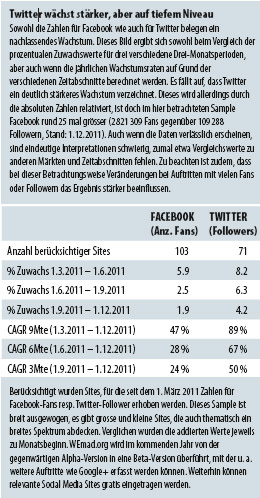
Enthusiasm for social media is waning, and companies are adjusting their expectations and approaches—with community building emerging as the ideal solution.

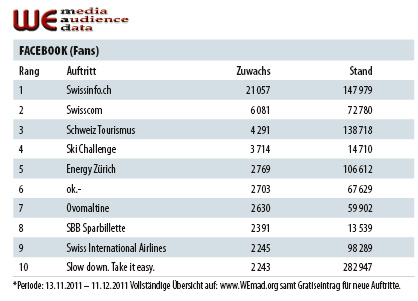
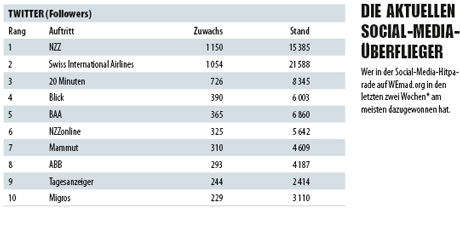
An analysis of the social media sites registered on WEmad.org over the past nine months reveals clear findings (see box): Companies' social media presences have been less and less popular with the public since the summer. The data points to a trend towards a more mature approach to social media. This applies to both users and companies. For example, a survey of marketing managers in the USA showed that they attach less importance to sales-related key figures when assessing social media activities compared to 2010. This is not least evidence that the C-level is becoming increasingly familiar with the special features of social media and no longer uses familiar standard metrics to assess them. It is therefore foreseeable that each company will develop its own assessment criteria that best suit its different social media intentions. From this perspective, even desirable industry-wide comparative values for social media are becoming a distant prospect. Meanwhile, in Switzerland, the agency Yourposition documented in a blog post using web analytics data from four (anonymous) e-commerce sites that social media traffic only generated 0.4 percent of sales. The above-average initiation character of social media, which was clearly superior to all other traffic sources, was also documented.

None of this should distract from the fact that social media has finally become an established media genre for professional communication. This is why the future professional use of social media will not be about down-sizing, but about right-sizing. Many will be satisfied with a trivial zero-eight-fifteen presence in order to be present but avoid the costs of a more far-reaching commitment. It will be attractive to use social media primarily for customer service in order to handle inquiries more cheaply than is possible with existing call center solutions (see the article in this series on Swiss). Although a number crunching tool can still be useful in the context of campaigns, it is advantageous to set up a separate presence for this purpose and limit expectations to the campaign from the outset. After all, once Likers have been won, they are retained even after the campaign has ended (see the series article on the slow-down campaign). In contrast, it is advisable to set up and maintain separate presences where a sustainable and correspondingly long-term dialog with the audience can be maintained. Those who want to strategically anchor social media will primarily introduce in-depth metrics, develop a CRM mindset and deal with new keywords such as social commerce and mobile.

The key word for the next phase of social media use is "community building". This is not about mass, but about class: a dialog should be conducted with the audience about the company, the brand and the products or services. Unlike short-term campaigns, it will be possible to attract far fewer people for this, but they can lead to a higher return on investment: For example, if users help each other in a support forum, call center costs are reduced. They can contribute good ideas to product development. Marketing is supported when brand ambassadors promote the products to the outside world, and cross-selling and up-selling can be promoted in sales support. An active community can also provide valuable insights for market research. Florian Wieser, partner at the online marketing agency coUNDco, is one of the Swiss online scene's community building experts. In an interview with Werbewoche, he reveals: "Our experience shows that communities take up to three years to build up before they even play a commercial role." And he complains that this long-term approach means that community building is at odds with advertisers who think from one campaign wave to the next. He sees a further challenge in reconciling analytically oriented social media monitoring with the more emotionally oriented community support. More important than the number of likes is the engagement rate, i.e. the number and frequency of likes and comments in relation to likes on Facebook, for example. This shows whether the community is active or asleep. This allows you to recognize which content moves the community - both on your own site and on competitors' sites. It is important to find out how customers actually talk and then to meet them in your own personal style, which should not be characterized by the often soulless language of corporate communication. You also have to learn to understand which people write frequent and good articles and what profile they have so that you can align yourself with them. "I'm interested in the customers and how you can get in touch with them and get to know them. It is also important to invite them properly and give them the opportunity to interact, share and contribute in a way that is good and relevant to them." It is the job of a community manager to lead this with campaigns, technology and good ideas. The first steps towards community building, for example at Migros, Swisscom or the health insurance company Avanex, show that this is a challenging path for which - at least in its pure form - not all companies have the same chances of success. Christoph J. Walther

social2
social3
social4
social1
 

Half dare to increase the price

Publishers show no signs of recession fears: In any case, nearly half are raising the advertising rates for their publications—whether openly or covertly. A similar picture emerges from a long-term comparison: In 2012, about half of all publications cost significantly more than they did in 2008, the first year of the crisis.

Of the 132 print titles from all over Switzerland listed here, 45 are increasing the price per advertising page as of 2012, while only two are reducing their page prices. The latter are GuideTVLoisirs from Edipresse (now: Tamedia Publications romandes) and the Ticino daily newspaper LaRegione Ticino. While GuideTVLoisirs now has a quarter fewer readers following the concept and name change almost two years ago, a rate reduction was also appropriate. However, at -14.7 percent, it remains well below the loss in readership, which is why the thousand-reader price (TLP) for the program guide has increased - at least compared to before. The situation is different at LaRegione: although its rate reduction of -0.3 percent appears to be small, the fact that the newspaper has 7.8 percent more readers results in a lower TLP. This is probably primarily for strategic reasons, as LaRegione has to hold its own against the new 20 minuti.

You can read more about this in the current print edition of Werbewoche.

20 Minutes: Change in the editor-in-chief

As of February 1, 2012, the editorial team of the free newspaper 20 Minuten will be reconstituted. Editor-in-chief Andy Fischer is leaving for the Tagblatt der Stadt Zürich. In addition, the head of the entertainment department and member of the editorial board, Bernie Brehbühl, is leaving the newspaper.

Gaudenz Looser, currently Head of News, will now be responsible for the domestic and business teams as well as the local editorial teams in Zurich, Basel, Bern, Lucerne and St. Gallen. In addition, he will act as a coordinator with the online editorial team. The writes 20 Minuten in a statement on Thursday.

Sandro Compagno remains Head of the Sports Department and will assume overall responsibility for the newspaper together with Gaudenz Looser in the absence of the Editor-in-Chief. Gaudenz Looser will be succeeded as head of news by the current deputy Desirée Pomper. The joint print/online entertainment department will be headed by deputy department head Niklaus Riegg.
 

Google publishes top Swiss searches of the year

Today, Google Switzerland announced its annual Zeitgeist report: the most-searched terms and the fastest-growing terms that were Googled in Switzerland in 2011.

Zeitgeist terms are intended to provide a perspective on the most important events of the year and the biggest trends as seen by the Swiss population. The analysis of search queries from Switzerland in 2011 shows: This year, Google users were again primarily interested in social networks. The fastest growing search term this year is DSDS, followed by SBB timetable and DSK (Dominik Strauss-Kahn), who also takes first place in the fastest growing people search. Things get sporty when it comes to the most searched-for Swiss personality on Google.ch: Roger Federer is number 1. The momentous earthquake and tsunami in Fukushima, as well as the events in Libya, had a clear impact on search queries.

The most searched terms
1. facebook
2. YouTube
3. hotmail
4. google
5. view
6. SBB
7. ricardo
8. GMail
9. autoscout24.ch
10. wikipedia

The fastest growing search terms
1. DSDS
2. SBB timetable
3. DSK
4. iPhone 5
5. battlefield 3
6. minecraft
7. iPad 2
8. Amy Winehouse
9. steve jobs
10. deindeal.ch

The fastest growing people searches
1. DSK
2. Amy Winehouse
3. steve jobs
4. adele
5. Kate Middleto
6. fernanda brandao
7. angela martini
8. alexandra stan
9. pietro lombardi
10. pippa middleton

The most wanted Swiss personalities
1. Roger Federer
2. bligg
3. angela martini
4. patrick nuo
5. stress
6. francine jordi
7. lara good
8 Didier Cuche
9. Jörg Kachelmann
10. michelle hunziker

The most searched news from Switzerland
1. apple
2. YouTube
3. iPhone 5
4. facebook
5. Kosovo
6. DSK
7. fukushima
8. real Madrid
9. libya
10. japan

The most searched car brands from Switzerland
1. BMW
2. audi
3. VW
4. Ford
5. Mercedes
6. honda
7. opel
8. peugeot
9. Toyota
10. fiat

The most searched Swiss events from Switzerland
1st Paléo Festival
2. greenfield
3rd Openair Frauenfeld
4. circus knee
5th Montreux Jazz Festival
6. moon and stars
7th Bern Expo (BEA)
8. street parade
9th Gurtenfestival
10. ewigi liebi

The most searched Swiss places from Switzerland
1. Zurich
2. zermatt
3. basel
4. lausanne
5. bern
6. lucerne
7. lenzerheide
8. davos
9. winterthur
10. lugano

The most searched movies from Switzerland
1. black swan
2. transformers 3
3. twilight 4
4. avatar
5. hangover 2
6. thor
7. cocowaea
8. sucker punch
9. cars 2
10. inception

The most searched Swiss mountains from Switzerland
1. pilate
2. rigi
3. virgin
4. säntis
5. Matterhorn
6. titlis
7. sneezing
8. schilthorn
9. stockhorn
10. stanserhorn

Google determines the Internet Zeitgeist based on the millions of search queries people enter into Google every day, the search engine giant writes in a statement. In addition to the year-end Zeitgeist, which lists the top topics of the year, Google also offers other tools that provide information on global, regional, past and current search trends. Google Zeitgeist tools cannot be used to research personal user data because Google exclusively publishes anonymous, aggregate numbers about the frequency of search queries. These tools are available all year round on Google.com/zeitgeist available. Own Zeitgeist lists can be created with Google Insights for Search be created.

Close to nature doesn't have to be unworldly

Maxomedia makes the public proud of Swiss wood and provides information about sustainable timber use in our forests.

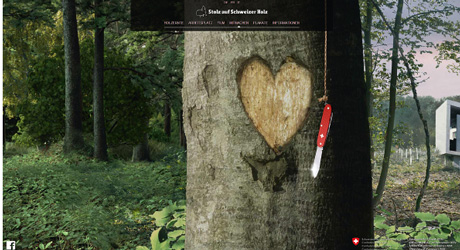
If you take a walk in the forest to get away from the hustle and bustle of everyday life, you sometimes find more than just peace and quiet. Large machines rattle through the forest, forestry workers wield chainsaws, logs lie ready for removal. Many people react to such scenes of logging with questions and a lack of understanding. This is where the awareness-raising campaign of the Federal Office for the Environment's Timber Action Plan comes in. The campaign by Maxomedia provides information about the sustainable use of wood. It provides arguments as to why Swiss wood should be harvested and used, and explains why even a near-natural forest is compatible with more intensive wood use thanks to careful management. So far, a TV commercial by Solid & Hallerfilm has been shown. Posters will follow soon, some of them made of real wood. Information is available at Stolzaufschweizerholz.ch. pan

Unbenannt-2_0
Unbenannt-3

Südostschweiz Medien launches regional voucher platform

«50 percent off or more» is the promise of the new coupon platform Deal.suedostschweiz.ch. Starting Friday, December 16, heavily discounted offers in the leisure and lifestyle categories will be posted regularly.

The voucher platform is being launched with a 50 percent discount offer for tickets to the Christmas show Swiss Christmas. Further offers from a wide range of subject areas will follow in the next few days. All deals will be cross-media promoted with newspaper advertisements in the Südostschweiz daily newspaper, online advertising on the Suedostschweiz.ch portal, regular newsletters and on Facebook and Twitter.

This huge promotional package sets the company apart from its competitors and will reach over 120,000 people between St. Moritz and Rapperswil from day one with all deal offers, explains Lukas Joos from Südostschweiz Medien. Südostschweiz Medien's goal is clear: "We want to become the market leader in the couponing market in the Südostschweiz region," continues Joos.

After an introductory phase, exclusive deals for subscribers to the Südostschweiz newspapers will ensure reader loyalty. In future, subscribers will also benefit from additional convenient payment options. The online platform was developed by Newmedia AG, a subsidiary of Südostschweiz Medien. The platform was developed in such a way that cooperation with other publishers is possible.


To the point: Year in, year out

It’s that time of year again. This issue of *Werbewoche* features two of the magazine’s classics: first, the creative rankings, which are always eagerly anticipated by the industry, and second, the presentation of the nominees for the 2012 Advertiser of the Year award.

Werbewoche's creative ranking is about the creative performance of agencies that have won awards in national and international competitions. The selection of the competitions and their corresponding weighting was made in collaboration with a delegation from the Art Directors Club of Switzerland. The ranking is based on the self-declarations of the participating agencies. In individual cases, the editorial team made corrections based on the official rankings of the creative competitions.

This year we encountered a problem that was unfortunately overlooked last year. The Clio Award is very highly weighted in the creative rankings, being one of the most important competitions internationally. Since 2009, there has been a separate Clio Healthcare Award, which was founded in order to be able to separately evaluate pharmaceutical advertising, which obeys different laws. It is therefore also clear that such a special award cannot actually be counted with the same weighting factor as the Clio. Since we no longer wanted to change the rules of the game, we decided for this year to keep the weighting factor, but to show the healthcare awards separately. Of course, this has an impact on the ranking. Without the Healthcare Awards, the Y&R Group slips from first to fourth place, and Saatchi & Saatchi from fifth to ninth. All other agencies with the exception of JWT/ Fabrikant would gain one rank.

Six personalities from the Swiss advertising scene have been nominated for the Advertiser of the Year award. Werbewoche subscribers can now choose their favorite from the nominees. For this purpose, they will receive a corresponding election form at the beginning of January. On February 2, someone from the round of candidates will then receive the coveted Egon from Werbewoche in Zurich's Lake Side and be able to celebrate the evening as the newly crowned Advertiser of the Year 2012.

But we are now taking a short Christmas break first. The next printed Werbewoche will appear on January 20, 2012. Until December 23 and from January 3, you will find ongoing news from the communications and media industry on Werbewoche. ch will be full of news from the communications and media industry. We would like to thank you, dear readers, for your loyalty. We wish you a pleasant and peaceful time over the Christmas period and hope, together with you, for a successful and exciting 2012.

Pierre C. Meier, Editor-in-Chief
[email protected]


Adobe Design Achievement Awards 2012

Adobe Systems invites you to submit creative work for the 12th Adobe Design Achievement Awards (ADAA) starting now. The competition recognizes the world’s best student graphic designers, photographers, illustrators, animators, digital filmmakers, developers, and computer specialists who have created innovative projects using Adobe software.

Students can compete in one of 13 categories, including game design and development, application development and mobile design. For the second year running, outstanding teaching achievements will also be recognized in three special categories for university teachers. Since the ADAA competition was launched in 2001, around 25,000 students from 73 countries have taken part. A record 4,600 entries were received in 2011, Adobe said in a statement on Thursday.

Students, teachers and university staff from all over the world can take part in the ADAA. The 2012 jury consists of international design experts who will evaluate the projects in three independent rounds. The closing dates for entries are January 27, April 27 and June 22, 2012, and the semi-finalists will be announced after each round of judging. In October 2012, the finalists will be invited to the award ceremony in Los Angeles, where the winners will be announced and honored with Adobe software and cash prizes.

Icograda (International Council of Graphic Design Associations) is organizing the ADAA competition together with Adobe for the fourth consecutive year in 2012.
 

Plan.Net sends news for Pepe Jeans London

Following their collaboration on display advertising, Pepé Jeans London has now also commissioned the agency Plan.Net Suisse to design its new newsletter. The assignment was to carry out a complete relaunch of the email newsletter.

The result is a newsletter concept with a contemporary look and feel that will be sent to Pepe Jeans customers and interested parties in Switzerland every month from now on. "After thoroughly analyzing the target group and the label's communication universe, we decided how we could organize the wealth of information from and about Pepe Jeans - including the YouTube channel, Flickr page, Formula 1 sponsorship, etc. - in a new concept," says Yvan Piccinno, Partner at Plan.Net Suisse. The relaunched newsletter is now a mixture of emotional appeal combined with a clear information structure and user guidance.

The aim is to make the communication medium more emotional, exclusive and informative. The various information and specials are teased and lead to the respective target platform. The entire content is also embedded in an up-to-date design and a matching layout, which should perfectly reflect the character of the brand. Monthly issues of the new newsletter are planned for the future and will be sent to Swiss customers and interested parties of Pepe Jeans London with immediate effect.
 

get_footer();