SF seeks sponsor for "Giacobbo/Müller"

Since early November, Swiss television has known that the insurance company Mobiliar will not be renewing its sponsorship contract with «Giacobbo/Müller.» No successor has been found yet.

Since the start of the new season at the end of January, the satirical program has had to make do without its previous sponsor Mobiliar, as Blick.ch writes. Previously, the show began and ended with the insurance company's animated damage sketches. Brand expert Daniel O. Schindler is surprised by this - he is quoted as saying that those who advertise prominently and wittily have a high recognition value. He is convinced that if a survey were conducted, at least one in three people would know who presented the program. Schindler sees "a coffee brand" as a possible sponsor, for example; after all, Mike Müller makes an espresso week after week "in George Glooney style".

(Image: Sf.tv)

Analog distribution obligation to be gradually lifted

Switzerland is focusing on the digitization of cable networks in the medium term. The department headed by Federal Councilor Doris Leuthard intends to exempt cable network operators that currently offer both analog and digital services from the requirement to provide analog broadcasts.

This is intended to support the digitization efforts of cable network companies and create the possibility of abolishing the analogue broadcasting obligation in the longer term, as reported by the Uvek according to SDA. The broadcasting obligation in the analogue sector is to be gradually reduced when a high proportion of households are equipped with digital devices and analogue programming is only marginally used.

One analog TV channel requires the capacity of ten digital TV channels. According to Uvek, maintaining an analog network therefore prevents the development of new digital offerings. In addition, cable network operators would be at a disadvantage compared to those competitors who are not forced to distribute their channels in analog form - such as Swisscom TV.

Gradual discontinuation of analog broadcasting

Depending on the region, there is currently a broadcasting obligation for almost twenty domestic and foreign television channels: in addition to the SRG channels, these are the regional television channels with a license in their coverage area as well as eight foreign television channels (Arte, TV5, 3Sat, ARD, ORF 1, France 2, Rai Uno, Euronews).

According to the Uvek, a realistic scenario would be to first abolish the analog broadcasting obligation for foreign television channels. After that, analog broadcasting of the second SRG channels could be dispensed with before the broadcasting obligation is lifted completely.

Before implementation, the Uvek still has to set threshold values - for example, those for the number of households that already have a digital end device. In its report on the consultation process, the department mentioned that at least 80% of households would have to receive digital television for it to be implemented. According to industry experts, this figure will be reached in 2014. Switzerland currently has 2.8 million households with a cable connection, 1.1 million of which have digital access.

Furthermore, the Uvek relieve the financial burden on regional television stations with a public service mandate in future. The self-financing ratio of TV stations is to be reduced from 50 percent to 30 percent.

Stakeholders have until March 30 to submit their comments on the draft amendment to the Radio and Television Ordinance (RTVO) to the Federal Office of Communications (OFCOM).

New York Times: Correspondent in Syria dies

Anthony Shadid, a Pulitzer Prize-winning correspondent for the U.S. newspaper *The New York Times*, has been killed in eastern Syria.

The 43-year-old American with Lebanese roots apparently died of an asthma attack on Thursday, the New York Times reported. According to the newspaper, Shadid was in Syria to report on the resistance against the government of President Bashar al-Assad. Shadid was twice awarded the Pulitzer Prize for his reporting on the Iraq war, in 2004 and 2010. Last March, he was arrested in Libya by Muammar al-Gaddafi's troops and held for six days. (SDA/DAPD)
 

FBM Communications: Sustainability brochure developed for Wipf

Wipf has been active in the packaging industry for nearly 100 years and has been making the company more environmentally friendly since 2003. The company aims to highlight this to its customers and partners in a brochure.

The illustrations for the 20-page sustainability brochure are the result of a collaboration between Wipf and the Küsnachter Lakeside School, writes the Zurich agency FBM Communications in a press release. This is because sustainable management is primarily done with future generations in mind. Pupils from two classes at the school spent several weeks studying the topic of sustainability and also visited the Wipf plant as part of this.

At the end of the project, each pupil recorded their message on sustainability in a drawing, as the story continues. These pictures were printed on T-shirts so that each child could be photographed with their motif. The sustainability brochure and a poster with Alyssia Matter's winning T-shirt will be sent to Wipf's partners and customers in a folder entitled "You're never too young to take care of the environment".

Responsible at Wipf: Karin Weidmann (Marketing). Responsible at FBM Communications: Carmen Schiltknecht (overall responsibility/text), Daniel Käser (art director), Marianne Kieser (graphic design), Kim Unholz (order processing), Nathalie Blumer (public relations)
 

Cannes: The Swiss Jury Members are Elected

The international jury at Cannes Lions will once again be joined by members from Switzerland this year. The Swiss jury members will judge the «Media,» «Direct,» and «Promo & Activation» categories.

Cosima Giannachi, Country Leader and CEO of Mindshare Switzerland, Karin LangManaging Director & Head of Dialog of Publicis Communications Switzerland and Andreas MädlerCreative Director & Member of the Board of JWT/Fabrikant, will be traveling to Cannes this summer to judge the entries. Of the 15 categories that will be judged this year, Cosima Giannachi will judge the "Media" category, Karin Lang the "Direct" category and Andreas Mädler the "Promo&Activation" category.

Publicitas Cinecom is the Swiss representative of the "International Festival of Creativity" in Cannes and supports, among other things, the festival participants during the preparations and the organizers during the implementation. This year's festival will take place from June 17 to 23, 2012.

> More information about the submissions and the festival is available at here.
 

Let yourself off the hook

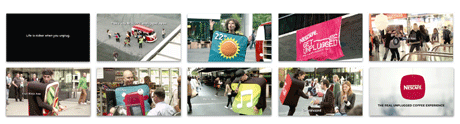
Publicis has brought some of the best apps from the internet into the real world for Nescafé. The «Get unplugged!» campaign reached around a quarter of a million young people in a very short time.

Nescafé is prepared entirely without a machine - unplugged. "Get unplugged!" is also the motto of a new campaign for Switzerland's most popular soluble bean coffee. Nescafé wants to motivate people to step out of their hectic everyday lives every now and then to enjoy coffee breaks together. The challenge was to make the popular evergreen attractive to a young target group. "A challenge that could not be solved in the classical way," says CD Sacha Moser. Since digital natives are most likely to be addressed on the Internet, Publicis wanted to prove to the target group precisely there that the digital world can be even more exciting in analog form.

For this purpose, under the motto "Nescafé. Get unplugged! "the most successful apps were unplugged and made even more exciting - for an event that lured the target group away from Blackberry, iPhone and the like to live up to the unplugged promise. For the Unplugged Fruit Ninja app, for example, the world's most exciting ninja fighter was sought. At the casting in L. A., 70 candidates stepped in front of the camera to prove their skills as a fruit ninja. The public was then able to vote on the website Get-unplugged.ch The response exceeded all expectations: Within a few days, the number of likes on the Nescafé Facebook page doubled. This new community was invited to the "Apps unplugged" event, where they could see for themselves that apps unplugged are a lot more entertaining than online. The event in Zurich's Sihlcity was commented by ZSC commentator Walter Scheibli and at the same time used for the shooting of a web film, which once again illustrates that the digital world can arouse even more emotions when implemented in real life. (pan)

publicis
The webfilm on Nescafé Switzerland's Facebook page has so far been viewed over 200,000 times, the number of likes doubled within a week, and media coverage of the event reached over half a million people.
 

Butz's moth: The level of car advertising has plummeted

The auto show kicks off again on March 8. So they have to go all out with the advertising, come hell or high water. But from what I've seen so far, it's more like a "sleepy-as-an-angel" ramble.

What is at stake today: none of the many car manufacturers has the courage to focus on a single core message. They all talk about all the benefits and all talk about the same euro discounts, leasing options, environmental friendliness, model diversity and endless inclusions. Apart from the fact that a car radio is also included, everything is packed into the communication. Only one brand image is forgotten. The Teaser spot from VW for the Superbowl was viewed by 3.6 million people on YouTube in one day. I wonder why? In this commercial with the barking dogs, they're not trying to tell me that the VW has 4 wheels and even a steering wheel. But how awesome VW is.

My theory is that cars have all become more similar in recent years. If someone makes a new headlight shape, it is immediately copied by many others. This problem is not recognized by advertisers and marketing specialists. This would be the task of communication to position such similar models differently. Seat is at least trying to sell me Spanish fire. When we launched Lexus on the Swiss market back then, we used the visual, tonal and perfectionist world of Zen Buddhism. Today there is nothing left of it. Everything looks the same and the advertising promises are all rational. The emotional aspects have all fallen by the wayside. The fact that a car also offers driving pleasure and can transfer an image to the owner has apparently been forgotten. "We don't make pretty pictures here. The advertising has to sell and every millimeter has to be used on paper. 1 main model, at least 6 secondary models, the Eurobonus, the warranty, etc.", is probably how the advertising manager speaks. Volvo asks me to get in using the XL60 picture (from behind). Or: I am the Giulietta. Test me. With a picture of the Alfa from behind. But not sexy at all. Or: BMW should be in top form. Chevrolet has the winter bonus to offer, but only until the end of February. All unprofiled nonsense.

There would certainly be a few words of praise to write. But I'm responsible for the moth. The stand-up was that the Cruz siblings and Till Schweiger - just as I announced as the missing testimonial for Vögele - have now been said goodbye after all.

Theophil Butz, once a star advertiser (Ringier), now an inspirer and, from now on, a mocker. "Not an easy role, but a necessary one, which I perform here every 14 days." Please send any relevant information to [email protected].

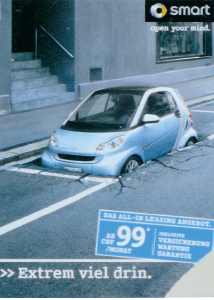
smart
Smart is symbolic of the level of car advertising. But does the "more inside" carry so much weight? Could also be interpreted as declining market share.
 

New appearance of Silverspotrecording Studios

As of February 1, 2012, Silverspotrecording Studios has been renamed Silverspot.ch Productions and has a new logo.

Silverspotrecording Studios has been operating under the name Silverspotrecording Studios since February 1, 2012. The new brand identity is part of a strategic and operational realignment, according to a press release. The old logo with the microphone will be replaced by the new font logo with .ch. The term "Productions" covers the entire range of services offered by Silverpot.ch:

silverspot


The computer: bicycle or hamster wheel?

The constant distraction from tablets and smartphones doesn't help us think or work—it just wastes our time. On the digital dream: Oliver Reichenstein, an information architect, lives and works in Tokyo.

Tools are extensions of the body: glasses are an extension of the eye, a hammer is an extension of the hand, a hat is an extension of the hair on the head. What is a computer? An extension of our mind? Steve Jobs said that the computer is a bicycle for the mind. A beautiful idea. But if you look at what the cell phone in particular does to us, the contemporary computer seems more like a hamster wheel.

The old skeptics' favorite trick was to ask you to prove that life is more than a dream. With this trick, you can question everything, and that is the goal of the skeptic. Not to find the truth, but to always question everything.

Kant put a temporary end to the skeptical trick by explaining that there is something in us that even a radical skeptic cannot reasonably question: mathematics. Mathematics, according to Kant, is based on two principles that can no longer be doubted: Space and time. Everything we think, we imagine in space and time. And everything that happens in space and time, according to Kant, we place in causal connections, analogies and mutual relationships. In other words: Reality takes place in the continuum of space and time. The states through which we pass in this continuum are connected with each other. I am not in a position to judge whether this is exactly the case or not, but Kant has found a fairly reliable lever for distinguishing between dreams and reality. We cannot think clearly in dreams because of the lack of continuity. Dreams are not rationally connected. As soon as we ask ourselves: Where am I? How did I get here? Where am I going?", we are either torn out of the dream or, like idiots, put into another confused state that only seems to answer the question or makes us forget it. The stupid thing is that this test only works when we are awake.

Why am I interested in this as an information architect? Because we often behave exactly the same way in front of the screen as we do in dreams. As soon as we descend into the depths of the computer, operating system and browser and ride back and forth, up and down in the parallel worlds of Google, Facebook and Twitter, we lose our footing, just like in a dream, and start communicating with people in other places and times, clicking here, clicking there and forgetting where we are, where we came from and where we want to go.

The perfidious thing is that we think forgetting time is a sign of pleasure or happiness. We seek the loss of reality when we enjoy ourselves: forgetting where we are, where we came from and where we want to go.

This confusion of the digital dream with conventional pleasure is perfidious because we often don't really enjoy ourselves in front of the computer, i.e. we don't tense up and relax like we do at chess, in a movie or at a concert, but simply get bogged down. This can turn our now almost 24-hour dream program into a nightmare. If you only look at the screen, you come into conflict with reality. "First we shape our tools, then they shape us," says McLuhan. This becomes clear at the latest when you lose your bearings and the back button is missing. And why am I interested in this as an information architect? Because I don't see the general lack of orientation as the end of society or as a digital necessity, but rather as a sign of the dominance of poorly structured programs. The crazy thing is that the computer, the tablet and, above all, mobile telephony are so successful because they offer ubiquitous distraction. But we forget what the original promise was: the computer is supposed to help us think and work. It should save us time, not cost us time. We should control it, not the other way around. But perhaps, as is so often the case with technologies that we cannot relate to our bodies, this is itself little more than a silly dream. Steve Jobs was a salesman, not a designer.
 

Farner: Roman Geiser takes over operational management

This fall, Christian König will transfer the majority stake and operational management of Farner Consulting to Roman Geiser. At the upcoming annual general meeting, König will take over as chairman of the board of directors from Niklaus Knüsel.

Christian König has led the agency for years together with partners Jacqueline Moeri, Daniel Heller and Urs Knapp, according to a statement on Thursday. Roman Geiser, 44, is currently chief operating officer EMEA (Europe, Middle East and Africa) of Burson-Marsteller International and acting president of the Federation of PR Agencies in Switzerland (BPRA). Until recently, he was also Chairman of the Board of Directors of Burson-Marsteller (Switzerland) and Vice President of Young & Rubicam (Switzerland). Prior to his international career, Geiser headed Burson-Marsteller Switzerland from 2003 to 2009. Roman Geiser will take office as CEO and Delegate of the Board of Directors of Farner Consulting on October 1, 2012.

Christian König will accompany Farner's development over the next few years as active Chairman of the Board and will continue to manage consulting mandates. He remains a partner of the agency.

Farner Consulting is active in Zurich, Bern, Basel, Lausanne/Geneva and Lugano and has been the market-leading PR and communications agency in Switzerland for years. Internationally, Farner Exclusive is an affiliate of Fleishman Hillard as well as Porter Novelli in Switzerland.
 

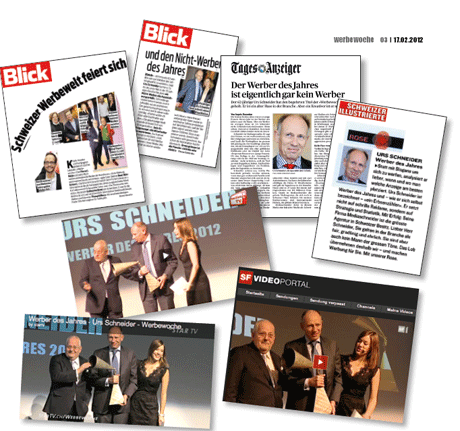
Non-advertiser of the year made the best advertisement for the industry

It's not easy to invite the industry back to the table just four days after the big ADC Gala. So Werbewoche was all the more pleased that on February 2, an illustrious group at Zurich's Lake Side gave the new "Advertiser of the Year" a worthy reception.

With "Glanz & Gloria" and in front of the lenses of the TV of the Stars and the camera team for Action, Urs Schneider received the trophy named Egon. For the first time in history, a media specialist was named the industry's new ambassador in 2012. We congratulate our well-deserving and much-loved colleague and are convinced that Urs Schneider will add to the glitter of the title.

The vouchers worth a total of CHF 5,000 offered by the Coopzeitung went to: Marco Schmidt, Laura Hutzli, Manuel Cilurzo, Alba Rau, Silvia Peter, Urs Krucker.

Great media response
As the organizer of the "Advertiser of the Year" award, Werbewoche is delighted with the response in the media. Argus reported a total of more than 70 mentions to us, including 8 major articles with a total circulation of 924,000. On the Internet, Urs Schneider was reported on 62 news portals, mostly with a picture. For television, teams from "Glanz & Gloria", Star TV and Action TV were in action. There was also an interview on Swiss Radio 4.

wdj_0

Regional TV stations to receive financial relief

Regional television stations with a public service mandate are to receive financial relief in the future. The stations’ self-financing requirement is to be reduced from 50 percent to 30 percent. This is provided for in an amendment to the Radio and Television Ordinance (RTVV).

On Thursday, the Federal Department of the Environment, Transport and Energy (DETEC) presented the draft for the partial revision of the RTVO. Until now, the annual fee share of regional television broadcasters that have a license with a public service mandate could not exceed 50% of operating costs. This share is now to be reduced by 20 percent.

TV stations now only have to finance 30 percent of their operating costs from other sources such as advertising and sponsorship. The revision thus takes into account the ever-increasing production costs, as announced by the Federal Office of Communications (OFCOM) on Thursday.

This adjustment is not associated with an increase in the fee share. However, the conditions for obtaining the fee share provided for in the license will be made easier. Furthermore, the digitization of cable networks is to be facilitated by reducing analogue distribution obligations. In the medium term, the partial revision of the RTVO provides for the complete abolition of the analog broadcasting obligation. The affected parties have until March 30, 2012 to submit their comments to OFCOM. The new provisions should then enter into force on July 1, 2012. (SDA)

The draft amendment to the RTVO is available online: Bakom.admin.ch. 

(Image: Keystone)

get_footer();