Blogworld & New Media Congress in New York

Beat Hürlimann reports on the "Engage or Escape!" social media conference in New York.

It was the evening of my first of three convention days at Blogworld & New Media 2012. I was walking east on 40th Street from Hudson towards Times Square. And there was this house with an escape staircase. I took this picture and walked past....

bild_0_160x120

Read more about this in the Blog by Beat Hürlimann.
 

Ogilvy promotes Allianz Swiss account protection letter

The Ogilvy & Mather agency has created a new TV commercial for Allianz Swiss. The commercial promotes Allianz Swiss's account protection plan.

The account protection policy comes into play when it comes to stolen pin codes, copied magnetic strips, or emptied accounts. Allianz Suisse offers it as part of its household insurance. Ogilvy & Mather stages these and other expectations around protection against credit and bank card fraud in the new TV spot for Allianz Suisse, which like last year's spots was developed on the so-called ONE concept.

The spot goes on air in time for the summer vacations, a time when experience shows that credit card fraud is particularly topical, according to the agency. In addition to the TV spot, the account protection letter will also be promoted with online and video banners as well as Facebook ads.

Responsible at Allianz Suisse: Urs Bretschger (Head of Marketing Communications), Jolanda Heimann (Advertising/CI), Simone Schmitt (Online Marketing Manager). Responsible at Ogilvy & Mather: Thomas Bolliger (Creative Direction), Tino Heuter (Art Direction), Markus Sidler (Text), Dominik Abt, Sabine Furrer, Samuel Hug (Consulting). Production: Solid & Hallerfilm.
 

The head coach

He once landed a job at Jung von Matt Hamburg under the name Pamela Anderson. Now, after more than 16 years in Germany, Thomas Wildberger has returned to Switzerland and, as Publicis’s new chief creative officer, aims to propel the agency back to the top of the rankings.

Bells and whistles don't come to Thomas Wildberger's office. His new workplace in the creative department at Publicis is one thing above all: bare. Neither pictures on the wall nor personal objects on the desk. "Bourgeois office individualization" is what the creative calls it when people clutter up the workplace with bits and pieces. "That kind of thing is just distracting." But after all, Wildberger's job is not to live out his creativity as an interior decorator, but to prove it as Publicis' new Chief Creative Officer. After several years in Germany, the Zurich native has returned to Switzerland.

From a huge market with over 80 million people back to manageable Switzerland, from the capital of Germany back to the city on the Limmat, from agency owner back to employee. A big change. But change is something Wildberger has always sought. "I'm a Sagittarius, and as such I always want something new," the creative says of himself. "After all, you always long for change, and you should go through with it every now and then, " is his motto. Wildberger has acted accordingly since the beginning of his career.

When the agency Jung von Matt Hamburg advertised in 1996 for copywriters and - as a joke - also for a Pamela Anderson for the position of receptionist, the then 22-year-old threw himself into a red bathing dress, put on a blond long-hair wig and posed for a job application photo with a lascivious look into the camera (see picture below: Werbewoche article from 1996). He convinced the creative agency - not only of his travesty skills, but also of the fact that his strength lies more in copywriting than in making coffee.

That was unusual, a big step and a risk, Wildberger recalls. By moving to the northern German city, he was not only leaving his parents' home in Zurich-Limbach, but also Switzerland, which was not his primary goal. But the idea of working for the then young, up-and-coming agency was spectacular, too tempting. So he started as a copywriter in Hamburg.

A good five years later, he was looking for a change again. He wanted to get out of the agency routine, be free, work for other agencies and other clients. Together with Alex Römer, who was working as a CD at Jung von Matt/Spree in Berlin at the time, he founded a freelance team in 2002. A text-text team - a combination that was unusual at the time and initially caused irritation among many agencies. Wildberger was often asked why two copywriters should be booked. Wildberger thinks that a copywriter and an AD have to be a team - an entrenched and outdated idea. The cooperation of two copywriters or conceptioners can be very enriching. In any case, Römer and he were not deterred and built up a foothold as a text-text team. In 2007, the tandem founded their own agency under the name Römer Wildberger and worked for clients such as Vanity Fair, Berliner Morgenpost, Die Welt, Natural American Spirit and Ferrero.

Now Wildberger has once again folded up his tents and left the advertising agency he helped build for Publicis. Going to a small agency was out of the question for him. If he was going to leave Berlin, he wanted to go to a large agency with a lot of interesting clients and the budgets to make films.

Still the boss

At Publicis, the top creative can also pursue one of his favorite disciplines, car advertising. During his time at Jung von Matt, he already worked for Audi, BMW and Mini and built up a car expertise in the years that followed. He calls car advertising the "supreme discipline," since it involves convincing customers to buy a very expensive product. "It's not something you just buy like a Snickers bar," he says. You have to be present throughout the process - from the decision to buy a new car to the actual purchase - and influence the customer, he says.

A period that lasts an average of 15 months. It's a shame, he says, that the trend is still heavily toward sales campaigns. "No one has the time to build or maintain an image anymore." After all, in his view, the interesting thing about car advertising is precisely the long-term aspect of binding customers to a brand so that they remain loyal to it even after they have made a purchase - ideally for the rest of their lives. Despite his fascination with car advertising - Wildberger is not a car nut. For the past six years, when he lived in Berlin, he didn't even own one.

For Wildberger, the move to Publicis also means working for a company again as an employee after years as an agency owner. It's quite a change, says the new creative director, but he doesn't see it so narrowly: "I still act as if I were self-employed. I feel Publicis is my agency, my future that I'm shaping." He wants to regain the top positions with the agency, which has slipped down the creative rankings, and ensure that advertising from Publicis becomes more creative again. He doesn't want to control this from the executive suite, which for him is a relic of the 1980s, but rather as creative director in the midst of his teams. "The people here are hot to make good stuff." When Wildberger says it like that, he could just as easily pass for a coach of a football team. And in fact, he doesn't find the creative director-head coach analogy far-fetched at all. The organization of an agency reminds him of a soccer club with a president, managers, players, a head coach and various co-trainers. And he, as head coach, has to motivate the players, the creatives to a point, to spur them on, to make advertising that causes a stir. "When people get off on advertising, they don't get off on it - that's the best thing that can happen to you. That's what Publicis needs to get back to."

The problem solver

Wildberger thinks it's bad when advertising doesn't arouse interest. Or even worse: advertising that misleads people. For example, when products are promised to keep the intestinal flora in good shape or to strengthen the immune system. Or that a detergent makes laundry even whiter. "That's so far-fetched and in some cases can't even be justified," he criticizes. Advertising must convey the truth, he says. In a surprising and unseen way.

He sees his role as solving customers' problems. "We are all problem solvers," says Wildberger. He likes to compare himself to Mister Wolf, the man from the cult movie Pulp Fiction, who has a solution ready for every problem. No matter how delicate the situation, Mister Wolf always knows what to do or who has to do what. However, Wildberger has yet to find out the best way to solve the problems of Publicis clients together with the creative team, as he has only been with the agency for a few weeks.

Fast and impatient

Last but not least, a feeling-out is necessary because he has become accustomed to the German mentality over the years. In Switzerland, things are sometimes too leisurely for him. In his opinion, many things could be done a little more quickly. Long discussions before finally getting down to work get on his nerves: "If you already know what it's all about, you can save yourself the preliminaries and get straight to work. He also learned to appreciate during his time at German agencies that idea generation is not too firmly in-depth, but more broad-based. When energy is not spent on working out a few ideas, but rather on hinting at as many different ones as possible. "On the basis of two to three advertisements and a film, you can tell immediately whether an idea works," he is convinced. "And then you can move on to the next one right away."

Wildberger often can't move fast enough. He is impatient, very much so. When he has the feeling that a strategy is the right one, he has to act immediately. Then he sometimes stands on people's toes.

Nevertheless, if necessary, Wildberger can exercise patience and delay decisions until the last minute. If the right idea still doesn't seem to have been found three days before a pitch, he doesn't get discouraged. "You just have to stay cool," he says, not without pride. If others get the jitters shortly before the presentation, Wildberger spurs his team to try again. It cannot be ruled out that the brilliant idea will come after all. In such situations, Wildberger's impatience is offset by his ambition. After all, as a shooter he is automatically ambitious.
Isabel Imper
 

http://www.youtube.com/watch?v=v_a669RdV2c

The Power of Touch

For the fourth time, Promoswiss has honored the best promotional gifts with the Promo Fritz award at its promotional products trade show.

People are happy to receive them and often carry them around with them for months: ballpoint pens, UBS sticks or key rings. T-shirts, teacups and beautifully designed notepads have also been popular for years. With the logo of the person giving the gift, these small tokens of appreciation can remind us in the most unlikely of places, even away from TV commercials or online games, which company we value as a partner. True to the motto: "Small gifts keep customers coming back!"

Just as important as posters

"Promotional gifts are the only form of advertising for which people say thank you," says Marcel Spiess, President of Promoswiss. His association of the Swiss promotional products industry estimates that around CHF 500 million is spent on promotional gifts in Switzerland every year. This is almost as much as the CHF 515 million spent on all outdoor advertising - excluding production costs - for posters, neon, transportation and sports stadiums in 2011, according to WEMF. In Germany, expenditure on promotional gifts is estimated at 3.4 billion euros. According to a study, high-quality items are particularly popular at Christmas. An average of 42.5 euros is spent on this. Cheaper giveaways are mainly used at trade fairs and customer visits. Only 10 percent of the exhibitors in Lucerne were local companies. Most of the items were supplied from Germany. There is no discernible trend here. Calendars, pens and lighters are still very popular. However, it is impossible to overlook the increasingly imaginative creations for USB sticks. Interested companies are also immediately grateful for the ever more amazing gimmicks. The effect of promotional gifts is rarely "measurable" in concrete terms. However, all market people agree that you can have a much more lasting conversation with a customer at the trade fair stand or during a direct visit if you leave them with a small gadget as a memento. Andreas Panzeri

For the fourth time, the industry association Promoswiss presented the Promo Fritz Award at the PSF Forum (Swiss Trade Fair for Promotional Products and Textiles) at the Hotel Schweizerhof in Lucerne. The creative paint box from Faber Castell (top left) won gold for its design. In the "Campaign of the Year" category, the Fritz went to Cadolino by comTeam from Schlieren. The Promoswiss member developed a football and a magic cube for the biotechnology company Bachem to present amino acids in a playful way (top right). Promotional gifts from over 65 exhibitors were on display at the congress in Lucerne's Schweizerhof. Nobody wanted to identify a specific trend. "It always has to be new."

Unbenannt-9_8
Unbenannt-10_7
 

SF: Iris Radisch leaves the "Literature Club

On Tuesday, June 26, 2012, Iris Radisch will host her final episode of «Literaturclub» on SF 1. After that, the content of Swiss Television’s “Literaturclub” will be revamped.

The literary critic has led the show for six years. It is not yet known who will replace her. Not only will Iris Radisch step down as host, but the panel of critics will also be reconstituted in the future. This writes SRF on Thursday.

Iris Radisch, literary director of the Hamburg weekly "Die Zeit," took over the "Literaturclub" in 2006. She had previously been a member of the legendary "Literary Quartet" on ZDF. In both programs, she proved to be a committed and passionate campaigner for the interests of literature. In the past six years, she has succeeded in further cementing the reputation of the "Literaturclub" as the outstanding book program on German-language television, SRF announced on Thursday. After six years, the program is now to be renewed somewhat, said an SRF spokeswoman in response to an inquiry from SDA. This also includes a new moderation. However, there will be no major changes in content. "It will remain a talk show," she said.
 

Back from the construction of the Munggä

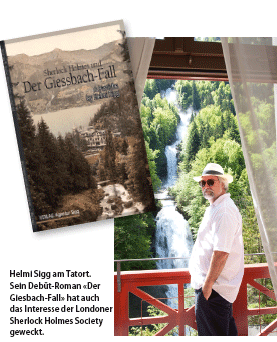
Even "Ewigi Liebi" can't last forever. Helmi Sigg has enjoyed his detour to the stage and now wants to do more advertising again. He started with a guerrilla novel.

The manuscript was "discovered in a rusty botanizing drum in the basement of 221b Baker Street after a major water damage. The manuscript was in the worst possible condition ... After several attempts, we succeeded in reconstructing the story almost completely". These are the words in the foreword to "The Giessbach Case". The previously unpublished story of Dr. John Watson, the fictional chronicler of Sherlock Holmes, has now come to a happy conclusion some 80 years after the death of Arthur Conan Doyle, the real-life creator of the father of all detectives. The case was scrutinized by Helmi Sigg. Not only exciting to read, but also quite stylish. After all, the London Sherlock Holmes Society bought 50 copies of the novella from "Verlag Agentur Sigg" for its collection. "Of course, that makes us a little proud, right from the very first book," says Helmi "Dr. John" Sigg. Helmi Sigg came up with the idea of the not quite flawless Holmes story when he and his wife Barbara were looking for some relaxation at the Grandhotel Giessbach. Helmi was suffering a little from too much unbridled creativity at this "place of power on Lake Brienz". His wife therefore wanted to calm him down with a task. "Sherlock Holmes died at the Reichenbach Falls. Why couldn't he be brought back to life in a literary way at the Giessbach Falls?" A stupid idea, the husband thought. "There's no point in just writing," the long-time media professional knew. But then the specialist in below-the-line advertising finally came up with the idea of offering his case to the Grandhotel Giessbach as a "gadget for its customer loyalty". The book with a story "where the hotel is the main setting" is now being distributed in German and English to loyal and potential guests. Advertising off the beaten track has always been one of Helmi Sigg's trademarks. Film, words and audio are his areas of expertise. His favorite thing to do is guerrilla campaigns when someone is "looking for a crazy idea". He has numerous references from the field of movie advertising. However, the guerrilla communicator will first have to take care of his own relaunch this summer if he wants to fight his way back into the cake.

"It's like being in prison for five years," says Helmi about the state of his current network. However, his "prison experience" was a "pretty awesome time" and instead of bars, there were standing ovations every day.

Past with film, radio and television

Helmi Sigg has appeared on stage more than 800 times as the marmot mother Martha in "Ewigi Liebi". Over half a million fans have seen the versatile creative in Switzerland's most successful musical in these five years. "As an artist, you can only dream of something like that," says Helmi. It was also one of the most rewarding roles. "We were a kind of intermission clowns." "Ewigi Liebi" takes place in two time periods, the past and the present. The marmots had to create a connection between the two. "The others sang themselves a wolf and had to give a great performance. We came on stage and simply made people laugh." "We" is the Eden trio, which includes Helmi, Guy Landolt and Midi Gottet. The comedy troupe made a name for themselves in 2007 with six funny product films for Bico mattresses, before being struck by eternal love in the same year. In the 1990s, the comedians produced over 150 "Eden TV" shows for Forum Zürich and the private broadcaster Züri 1.

During this phase, Sigg also produced around 200 other TV formats such as the weekend show "Downtown" and the cult cinema magazine "Hitz Sigg" for Star TV, among others. In 1997, the trio made their stage debut with the play "Jenseits von Eden". They now have seven stage shows to their name. Helmi Sigg entered the world of showbiz as a "scenery pusher" on "Teleboy" with Kurt Felix. It was there that Karl Suter discovered him. The old master of the Swiss tabloid engaged him as an assistant director. Sigg later became stage manager in classics such as "Die kleine Niederdorf Oper" with Ruedi Walter and "Der schwarze Hecht". As an assistant director for television and theater, Helmi Sigg also worked with Inigo Gallo, Jörg Schneider, Cesar Keiser, Günther Lamprecht, Maria Schell, Gustav Knuth and Werner Düggelin.

Because she had the feeling that he would "go on tinkering forever", his wife Barbara, now a mother of a son and later a daughter in addition to being a self-employed photographer, "secretly signed him up for radio". Helmi became a presenter at Radio 24 before returning to his versatility after two years at the microphone. Troubleshooter Helmi Sigg was the name of the start-up that has now been woken from its slumber after many years. Andreas Panzeri

Unbenannt-8_11
 

Vernissage 37 years Geissbühler

The latest opera house poster by K.D. Geissbühler has just gone to press. For 37 years, Geissbühler shaped the Zurich opera scene with his works.

To celebrate this moment, Galerie Vogtei is hosting a vernissage this Sunday and will be showing originals of his award-winning posters alongside newly created works. Geissbühler and his team led by his daughter Nadine have won the pitch for the new directorship of Zurich Opera House. This means that Studio Geissbühler is an integral part of the opera house. His signature was the Zurich Opera House brand.
 

House of creation

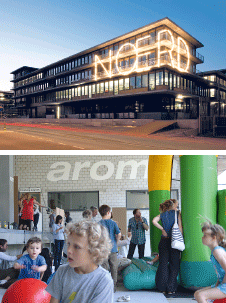
The name is a combination of Nerd and Nord. A new center of creativity has emerged in the Noerd in Zurich Oerlikon.

An unusual commercial building will soon be celebrating its first birthday. In the Noerd in Zurich Oerlikon, an exciting group of creatives has opened a new chapter in history. Where previously financial service providers, technology companies and, in the past, armaments companies shaped the spirit of the district, the creative industry with its "nerds" - which can also be translated as freaks with above-average ideas - has now found a new home. The "Gewerbehaus der Kreativen" is the result of an initiative by Remy Fabrikant with his JWT/Fabrikant, the Freitag brothers with their bags and Lukas Meier from the Aroma agency. Over 20 companies have now moved into the Noerd. Last Saturday, they invited visitors to their offices, studios and workshops for an "Open Day". The "Werkschau" was a complete success.

Unbenannt-7_10

Remy Fabrikant, JWT/Fabrikant

WW: JWT/Fabrikant was already involved in the planning of Noerd. Why did the agency move from the trendy Zurich West area to Oerlikon?
Remy manufacturer: This has more to do with urban development than with trends. District 5 is developing in an extreme way into a center of the city of Zurich. This means that banks, insurance companies and many industrial companies are moving in. This automatically increases prices. Our sector can no longer keep up. As in all large cities, this means that advertising has to move to the outskirts of cities in order to finance its space requirements.

Will Noerd be the new Seefeld?
Because Oerlikon is almost considered a foreign country by some people in Zurich, there is still the opportunity to build on a large scale out here and still at a reasonable price. This naturally makes it interesting for our industry.

How much space does JWT/Fabrikant have?
We have 600 square meters, before I had 1,500, but I deliberately reduced the size and concentrated on the core business of brand management.

What does Remy Fabrikant like about Noerd?
Firstly, the building. This is designed as a space for creatives. Freitag, Aroma and we as initiators definitely said that we didn't want any companies other than creatives in it. We were able to push that through, and I think that's great. It will become a bit of a model.

Do you feel the contact with each other?
It was designed from the outset so that everyone has their own office space. But people should meet each other. We had the restaurant in the Maag Areal. We wanted to revitalize that here with the canteen and the roof garden as a meeting place. This creates a permanent mix. We see each other again and again, and it also works that we exchange ideas with each other.

How is the "Open Day" going?
We had our doubts. Who wants to walk through an office? But we realized that despite the beautiful weather for swimming, there was a huge rush. It was a big guess as to how many sausages we were going to order. We are now pretty much right with 2500.

Lukas Meier, Aroma

WW: Aroma was one of the initiators of the Noerd. What was the motivation?
Lukas Meier: Construction is taking place around our former location at Giesshübel station and we had to find a new home. We also wanted to take advantage of this. Previously, we only had the workshops and the office together and the warehouse externally. The rooms were also too small. Now we've been able to move everything together and have enough space for the joinery, a large CNC machine and a large print shop where we can produce our own displays. We are also in Noerd together with other creative people. That makes for a good exchange.

How big is Aroma under the new roof?
We have our consulting and creation team here. That's around 15 people, plus 15 project managers and site managers and another 30 carpenters, fitters and logisticians. Aroma's USP is that we offer everything from a single source - from the concept and idea to implementation with construction and logistics. We handle an exhibition stand or an event from A to Z.

Does the groove really work with other companies?
That works. Today is certainly an important milestone where we can get to know each other even better. We're having a big party on the roof tonight, where 250 employees from all the companies are coming. On normal days, the canteen is our central element, our microcosm. That's where we see each other. Interview

East Switzerland Media Prize 2012 awarded

The Eastern Switzerland Media Prize was awarded for the twelfth time on Wednesday evening. A total of eleven media professionals were honored in five categories.

The prizes went to photographer Benjamin Manser (Thurgauer Zeitung), the editorial team of the Engadiner Post (Myrtha Fasser, Marie-Claire Jur, Franco Furger, Stephan Kiener, Nicolo Bass, Reto Stifel) and radio journalist Rahel Boksberger (Radio Top). This was announced by the sponsoring foundation according to SDA. Katrin Meier (St. Galler Tagblatt) was honored in the Reportage/Background category. Two prizes were awarded by the television jury: In addition to Anita Bünter and Jonas Bischoff (TVO), Mona Vetsch (Schweizer Fernsehen) received an award.
 

Top of the week: Weltwoche's lawsuit against NZZ dismissed

The Zurich District Court has dismissed a lawsuit filed by Weltwoche against Neue Zürcher Zeitung. In an article dated February 16, 2010, the NZZ had rightly raised the question of editorial influence by third parties at Weltwoche.

The reason for the question was the lack of transparency in Weltwoche's ownership structure, which the court also considers to be the case. The author of the article "No transparent information world" printed on the media page of the NZZ was allowed to ask the question about the exertion of influence in the public interest. This is of particular importance in the media industry, according to the district court ruling of May 16, which is not yet legally binding and which the NZZ reported on Tuesday. The interference with the personality of Weltwoche and its publisher and editor-in-chief Roger Köppel is therefore justified, writes the court. Other violations of personality were not recognizable. Weltwoche and Roger Köppel had complained that their personality had been unlawfully violated by the NZZ article. They demanded compensation of CHF 10,000.

Spiked: Bad publicity for King Football

Anne-Friederike Heinrich, freelancer for Werbewoche, talks about the round, which is currently going a little unevenly.

Oh my goodness! The Swiss distrust UBS and the SVP. This was the result of a recent survey of 1277 opinion leaders conducted by advertising figurehead Frank Bodin. This means that two pillars of Swiss society have already been shaken to their foundations - and two of the most important Swiss brands to boot. But that's not all: football, THE Swiss national sport (so to speak), is also in a huge crisis at the moment. And all this at the start of the European Football Championship! This could actually leave us cold, because after all, Switzerland is not playing in 2012. But on the other hand, it's also stupid. Because this time we really could have been European champions. At least if the Italians weren't playing.

Sorrow for the women

Because the Squadra Azzurra, Italy's neighbor to the south, is in a real crisis due to a betting scandal, the head of the Italian European Championship team, Demetrio Albertini, has had enough. That wouldn't bother him so much when playing football. But last week, Cesare Prandelli, the national coach of the most beautiful footballers in the world, no longer ruled out the possibility of the Italians chickening out completely at the European Championships. After all, if goalkeeper Gianluigi Buffon is hanging around the betting office and defender Leonardo Bonucci is in the dock, the Azzurri can't kick a ball. And fielding other players? "Kasche nitte macke!" In Italy, not only the earth is shaking, but also the turf. And many a bosom is shaking with fear that the handsome men might not make an appearance on the European pitch this year.

Much ado about nothing

The true football fan always has the defibrillator to hand in these wild times anyway. It's not just the news from Italy that makes your heart stop. Last week, "Fox Sports" tweeted that world footballer Lionel Messi had died of a cardiac arrest (!). Ten minutes later, the channel brought the Argentinian player back to life. A malicious hacker had planted the false report, probably to test how quickly a hoax can flutter through the media. But he hadn't reckoned with the alert defense of the Sport Foxes. Nevertheless, ten minutes is half an eternity on Twitter, similar to extra time. So there was a lot of noise about a (fortunately) undead man.

One shot, one hit

Perhaps a Swiss court jester of all people will come to the aid of the beleaguered king of football. FIFA President Sepp Blatter recently had a "good idea": in order to create a monument to himself and never be forgotten, he wants to abolish the penalty kick. It's a bit like depriving opera of its finale or love matches of their climax. However, Blatter does not yet know exactly how he wants to decide drawn matches in the future. Perhaps with a brisk round of poker "bin emänä güetä Fendant"? The FIFA boss is already said to be in talks with the Italian national goalkeeper and professional gambler Buffon.

In the middle instead of not there

A good option would also be a small swinging match between the respective team captains. After all, fresh sawdust smells almost as good as freshly mown grass. I for one would love to see Gianluigi Buffon and Cristiano Ronaldo rolling around in the sawdust. It would also mean that a little bit of Switzerland would always be present when football is played. Even if we don't play. So much brand awareness is a must. Well then: have a nice EM!
 

IGEM with two new board members

At the 2012 general meeting, IGEM had a vacancy on the board to fill. In addition, the first IGEM Sponsorship Award was presented, and Alexander Tschobokdji from Samsung demonstrated all the things TV sets can do today and how this could change the way people watch TV.

The statutory business of the general meeting was quickly completed. All motions of the board were approved unanimously. President Stephan Küng and the board members running again were also unanimously confirmed for a further term of office of one year.

StephanKueng_300x170
(Stephan Küng)

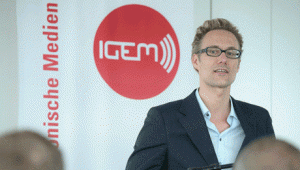
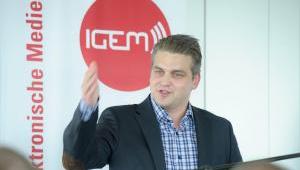
To replace Andrea Haemmerli, who will be leaving Belcom, two candidates stood for election: her successor Philip Hofmann and Dominik Kaiser from TV 3 Plus.

DominikKaiser2_300x170
(Dominik Kaiser)

PhilipHofmann_300x170
(Philip Hofmann)

After both received the same number of votes, the meeting decided without further ado to expand the board accordingly. With Dominik Kaiser, a representative of a TV broadcaster joins the IGEM board.

For the first time, the IGEM sponsorship prize of 5,000 Swiss francs was awarded. It went in equal parts to Corina Burri with her bachelor thesis at the Lucerne University of Applied Sciences and Arts and to Vincenzo Tremonte with his bachelor thesis at the Zurich School of Economics.

Following the award ceremony, Alexander Tschobokdji, Head of Marketing Switzerland, explained Samsung's "Smart" strategy. Now that smart screens are part of everyday life on both cell phones and tablets, they are also conquering the living room. With smart TVs, the viewer goes from passenger to captain, can discover new things and spread his personality, according to an IGEM release. In contrast to the past, the device adapts to the user with a smart screen. It is networked, can be further developed and allows the exchange of information by networking the devices. For example, the cell phone serves as a remote control.
 

get_footer();