Last but not least: pure carnal pleasure

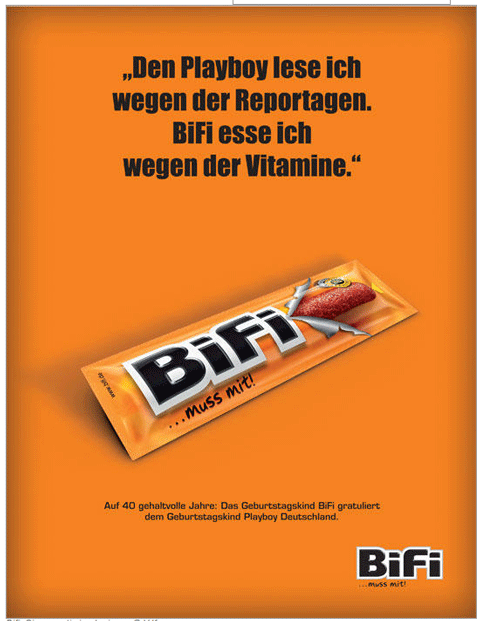
People buy *Playboy* just for the exciting articles. And they eat Bifi just for all the vitamins. Yeah, yeah, sure.

To mark Playboy's 40th birthday, the men's magazine has launched a competition together with W&V. The task: advertisers were to design motifs for customers and create a reference to Playboy and everything that goes with it. In March, we have already Winning motif presented. Today you can enjoy another motif - this one is from Wuv.de from the G.V.K. agency and makes a relatively subtle connection between a sausage with plastic skin and men's carnal desires - hopefully we can all agree that it could be a lot more crude:

zgl

(Image: Wuv.de/Unilever/GVK/Playboy)


Comet: Experts in portrait

The Komet agency has created two new ad concepts for Mobiliar Insurance and Pension Plans. These are part of the current «By Experts, For Experts» campaign.

Once again, the focus is on specialists. This time, glaciologist Andreas Bauder and fashion designer Kazu Huggler were portrayed. The two new visuals will be used in advertisements with immediate effect. As an additional measure, the agency has implemented a short documentary-style film about each of the two experts. These short film portraits were shown for the first time at the 2nd Pillar trade fair in Zurich from May 2 - 3.

Responsible at Die Mobiliar: Patrick Tharin (Head of Advertising Mobiliar Life), Christoph Ott (Head of Advertising & CI/CD). Responsible at Komet: Thom Pfister (CD), Joël Weber (Junior AD), Antonia Bekiaris, Raffael Futterlieb (Text), Simon Schatzmann (Head of Consulting), Suzanne Scherer, Emma Isolini (Consulting); Photography: Maurice Haas.
 

G+J Switzerland markets Financial Times Germany in Switzerland

Gruner + Jahr (Switzerland) has taken over the marketing of the Financial Times Deutschland FTD in Switzerland from commercial agent Stefan De Muynck. The agency will market the print and online editions of FTD with immediate effect.

FTD is in the tradition of Anglo-Saxon interpretive news journalism and, as a pioneering business and financial medium, is aimed at decision-maker target groups. Its readership has a very high level of education and income, the agency wrote in a press release on Wednesday. In addition, FTD's readership often occupies top positions in the economy.

Matter & Gretener: New customer with Movis

Matter & Gretener has acquired a new client. The agency will develop a new logo and brand identity for Movis.

In addition, the agency was commissioned to revise the entire communications presence. The first implementations are to be seen soon.

Magazine experiment Mag20

From mid-August, the magazine Mag20 will be printed in a print run of 50,000 copies and distributed free of charge every Friday morning at 25 locations in German-speaking Switzerland. It will also be available as an e-paper.

The owner and editor of Mag20 is Markus Bucheli. Mag20 is a free platform for media partners, students in the media sector and people with interesting articles who would like to benefit from the attention of the readership. This is what Markus Bucheli writes about the planned project. Compliance with the author guidelines, which are based on the specifications of the Swiss Press Council, will be monitored on an ongoing basis, as in a traditional media operation. The publication is intended to offer advertising partners a high-quality and attractively priced alternative to existing print products. The magazine relies on the social networks Facebook, Twitter and Google+.

Markus Bucheli, the owner and editor of Mag20, is a business economist FH and qualified auditor. He has been working as an auditor in the financial industry for around 5 years and has been fully dedicated to the Mag20 magazine experiment since the beginning of April 2012. With Mag20, he wants to make a contribution to greater media diversity.
 

BSW: Change of president and five new board members

Categories

Uncategorized

Former Prime Minister Major accuses Murdoch of attempted interference in EU policy

Former British Prime Minister John Major has accused Rupert Murdoch of attempting to interfere in the country's European policy. Major spoke on Tuesday before the Ethics Commission, which is tasked with uncovering abuses in the British media landscape.  

Shortly before the 1997 election, the media entrepreneur had made it unmistakably clear to him that he would turn against him with his newspapers if the London government did not change course vis-à-vis the EU, said Major. Shortly after the conversation, the two most important Murdoch newspapers at the time - News of the World and The Sun - backed Tony Blair's Labor Party. The Conservative Major was British head of government from 1990 to 1997. (sda)

JWT/Fabrikant: The French Job is taken

About a month ago, JWT/Fabrikant made an offer to the web community: under the title "The French Job", they were looking for bloggers for Maurice Lacroix to report live on the freediving world record attempt by Swiss diver Sébastien Murat.

The social media project for the new Pontos diver's chronograph from Maurice Lacroix made big waves: After six weeks, the campaign achieved over 10 million page impressions, generated 1.5 million views on YouTube and activated over 5 million fans on Facebook, as the agency writes in a press release on Wednesday. In total, the campaign was viewed online for more than 25 million hours.

Now "The French Job" is entering its second phase: eight of the most popular job aspirants have been selected and flown to the south of France. They will report live from the French Job Villa on Murat's attempt to dive deeper than anyone before him without oxygen. The latest events and developments are continuously updated on The-french-job.com published. Over the next few days, Séb "The Sub" will make several attempts to break the record.

The agency took the response to the campaign as an opportunity to publish a practical blueprint for social media campaigns and thus offer all interested parties a blueprint of successful techniques, the press release continues. In seven simple steps, it shows what it takes to attract attention on Web 2.0 and achieve ambitious goals.

Social media case - initial figures

The French Job on Facebook.

Last but not least: Lets go - Shell

Free political newspaper Dieci Minuti is discontinued

The weekly newspaper *Dieci minuti*, published by the right-wing populist party Lega dei Ticinesi, published its final issue on Wednesday after 77 editions. The editorial staff, led by Boris Bignasca, son of Lega President Giuliano Bignasca, bid farewell to its readers in Wednesday’s issue.

According to Bignasca, around 20,000 people read the paper every week. Dieci minuti - or Des Minüt in Ticino dialect - first appeared last September. The name was chosen in reference to the commuter newspaper 20 Minuten, which was also newly launched in Ticino at the time. Initially, the newspaper was published three times a week, but in February it was switched to a weekly edition. The topics covered revolved around politics, sport and events. It was financed by advertising.

Boris Bignasca continues to work for the Lega Sunday paper Mattino della Domenica. He resigned from his father's party in May after being severely attacked by party colleagues and political opponents for an insulting article against a writer. (SDA)

Zurich publicist Ulrich Saxer dies

Zurich-based journalist Ulrich Saxer died last Friday at the age of 82. Saxer was a leading figure who represented the academic community in Swiss media policy.

Saxer was born on January 6, 1931 in Küsnacht ZH. He died unexpectedly on a trip to Munich, as various media reported on Wednesday. According to the obituary, the funeral will take place in a close family circle. A memorial service will be held on June 22 at 2.30 p.m. in Zurich's Wasserkirche church.

Saxer completed his habilitation at the University of Zurich in 1970. He had studied law, German and English here and in Great Britain and obtained his doctorate in 1957 with a thesis on Gottfried Keller. In 1973, he was appointed assistant professor of journalism with a focus on the sociology of art at the University of Zurich, as the university writes on its website.
 
From 1975 until his retirement in 1996, he was head of the Department of Journalism. From 1977 as an associate professor, from 1983 as a full professor. He developed it into an "open-minded teaching and research institution for journalism studies", writes the university. Countless journalists completed their academic training there.

Local radio experiments accompanied
Saxer also played an important role in media policy. At the end of the 1970s, he was a member of the federal expert commission for an overall media concept. In the 1980s, when the monopoly of "Swiss radio" was crumbling, he led the accompanying research into the local radio trials, among other things.

After his retirement, he established the Institute of Media Studies at the University of Italian-speaking Switzerland. He was also appointed honorary professor at the University of Vienna, where he held seminars until the end.

A few weeks ago, Saxer completed his most comprehensive academic work to date. It will be published in the summer, as the research and consulting company Publicom writes on the death of its honorary and former long-standing Chairman of the Board of Directors.

Saxer established the Ulrich Saxer Foundation in 2000. Its aim is to promote young talent in journalism and communication studies. (sda)

City of Zug continues to focus on social media - pilot project completed

The city of Zug has been active on the social media platforms Facebook, Twitter and YouTube since November 2011. The aim of the pilot project is to address younger target groups and engage in a dialog with the population.

This has been well received by the population, as the rapidly growing fan community on Facebook shows. Fans are constantly uploading pictures, posting tips, commenting on posts, taking part in competitions or simply liking what they like, according to a statement from the city of Zug. The test run with the new media has also paid off for Mayor Dolfi Müller: "Within a very short space of time, we have gained several thousand fans and have become one of the leading cities in Switzerland." Only the city of Baden has more Facebook fans than Zug. It is followed by the cities of Geneva, Lucerne and St. Gallen.

The integration of social media with the other communication channels already played an important role during the pilot project. "We added articles from the city magazine as photo reports on Facebook, posted media information and short city news items on Twitter and uploaded the first video clips on city topics to YouTube," says Michaela Eicher, Head of Communications at the City of Zug. Input from the public and politicians was also taken on board. Since the end of February, the Communications department has been tweeting live from the meetings of the Grand Municipal Council. And the city is working closely with the youth organization Radio Industrie to expand the video offerings on YouTube. Individual areas or major projects are also using the potential of new media: the Zug City Culture Office and the "Freiraum-Zug" project have their own sub-page on Facebook. The Zug Library will soon also be communicating on Facebook.
 

get_footer();