New LGK communicates timetable change

Bernmobil’s «Nüni» tram will soon be running on a new section of the route. A new LGK ad is drawing customers’ attention to this.

The centerpiece of the new timetable from December 9 is the extension of the "Nüni" streetcar of line 9 to Wankdorf station. In the campaign of the Bernese agency Neue LGK, the line will not only be proverbially longer on the street, but also on advertisements, posters and hanging boxes, according to a statement. In addition to ads, posters, hanging boxes and online banners, the campaign also includes a radio spot and will be on air until the end of the year.

Responsible at Bernmobil: Monika Scheiwiller, Head of Marketing Communications. Responsible at Neue LGK: Hans Tanner (Creative Direction), Antonio Lopez (Text), Stephan Wittwer (Art Direction), Nina Geissbühler (Graphics), Claudia Shatri (Consulting).

nueni

René Rhinow becomes ombudsman of AZ Medien

René Rhinow, Professor Emeritus of Constitutional and Administrative Law at the University of Basel, was appointed Ombudsman by the Board of Directors of AZ Medien AG.

Rhinow was president of the Basel-Land administrative court from 1978 to 1981, a member of the Council of States for the canton of Basel-Land, from 1987 to 1999, and president of the Council of States in 1998/1999. From 2001 to 2011, he was president of the Swiss Red Cross (SRC). Rhinow is the author of various scientific publications and books on topics of constitutional and economic law. AZ Medien thanked René Rhinow in a statement for his willingness to take on this challenging office as of December 1, 2012.

As ombudsman, René Rhinow deals with complaints from individuals, companies or institutions about editorial content and advertising in newspapers, weeklies, advertisers and magazines, as well as their online presences. He helps to resolve or defuse conflicts, improve the quality of reporting and ensure diversity of opinion. The ombudsman is an independent person and is not bound by the instructions of AZ Medien. If courts or the Press Council are approached at the same time, he will not take action.

Complaints against editorial contributions of AZ Medien's TV stations are handled by the Ombudsman's Office of Radio and TV Broadcasters RTV, which is responsible for stations in German and Romansh-speaking Switzerland, with the exception of SRG SSR stations.
 

Last but not least: Having fun against leukemia

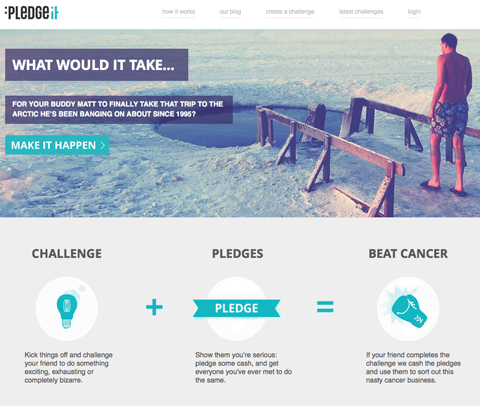
Raising donations is a lot of work—unless you have a really good idea to help. Pledgeit.org.uk had one.

Just in time for Christmas, letterboxes are once again stuffed with begging letters. On closer inspection, every request is justified. Driven by a guilty conscience, people try to at least help where the need is greatest. On the way to work, brash students tell you what a bad person you are if you don't immediately sign up for a lifetime membership ("Don't you have a heart for the deaf?"). Of course you have a heart for the deaf - but you also have one for children's homes, hungry children and homeless street dogs. And rumour has it that the first membership fee will flow entirely into the fundraisers' pockets before the first lakeshore in the Midlands is finally restored to its natural state.

Donating could be so easy - if it were fun. After all, our wallets are loose when it comes to the joyful things in life (cf. going out, the). The English platform Pledgeit.org.uk has made use of this: In the service of leukemia research, people can ask their friends to do strange things, as Pressetext writes. If the task is successfully completed, a predetermined amount flows into the charity's coffers. A charitable bet - simple idea, good idea. As the platform is also linked to Facebook, challenges can be shared. The successful participant receives the "pledgent" label and is seen in their social network as someone who keeps their promises. Friends can be encouraged to also contribute money for an entertaining task. Everyone decides for themselves whether and how much. Anyone who receives a request but is unwilling or unable to fulfill it deletes it.

The idea is a success. For example, someone is said to have raised over 400 francs for the charity by completing a karaoke performance. The model is to be made available to other charitable organizations in the future and the donation fun will also be possible in other currencies. (hae)

pledgeit
 

Lesch+Frei: wood carved Pastorini campaign

The Lesch+Frei agency has created a campaign for traditional toy manufacturer Pastorini that is intended to highlight wood as a sustainable raw material.

The poster campaign is reminiscent of good old wooden toys, as the agency writes in a press release. This is also intended to say something about the philosophy of the third-generation company: Pastorini offers high-quality toys made from natural, sustainable materials. You will therefore look in vain for war toys, consoles and games in the stores on Zurich's Weinplatz and in Schossacher in Dübendorf. Toys from Pastorini bring imagination into play and encourage children to think and act independently.

The agency has created three different motifs. They show the toys - rabbit, castle and digger - not as a finished product, but as they are created. Artfully carved, they grow out of a tree stump.

Responsible at Pastorini toys: Christa Pastorini, Felix Schumacher (owner). Responsible at Lesch+Frei Zurich: Natasha La Marca (AD), Irene Stutz (consulting), Barbara Meier, Désirée Guzzo, (polygraphy).

Pastorini_Plakat_1
Pastorini_Plakat_2
Pastorini_Plakat_3
 

PWC study: Media and entertainment industry grows thanks to digitization

Globally, two-thirds of the media and entertainment industry’s growth over the next few years will be driven by the digital sector. This global trend also applies to Switzerland, as shown by the PWC study «Swiss Entertainment & Media Outlook 2012–2016.».

Consumers will spend around 2.3 percent more annually on media, entertainment and Internet access: from CHF 12.6 billion in 2011 to CHF 14.1 billion in 2016. Time-shifted TV consumption is one of the biggest challenges for TV advertising. Spending on TV advertising will grow only slightly from CHF 735 million in 2011 to CHF 803 million in 2016. Although consumer magazines are increasingly available digitally, spending will fall from CHF 1.1 billion in 2011 to CHF 921 million in 2016.

Most of the forecast growth will come from the "Mobile Internet Access" segment. The corresponding revenues will increase by 21.6 percent annually and will reach CHF 2.1 billion in 2016 (2011: CHF 784 million). By 2016, 9.3 percent more will be spent annually on Internet advertising, so that expenditure will rise from CHF 769 million in 2011 to CHF 1.2 billion in 2016.

Changed TV consumption

"In the TV and video sector, providers of time-shifted and individually orderable programs are causing a change in user behavior," explains Patrick Balkanyi, Partner and Industry Leader Technology, Telecommunications, Infocomm and Media at PWC Switzerland. Spending on TV fees and licenses will grow from CHF 2.1 billion to just over CHF 2.2 billion over the next five years, an annual increase of 1.5 percent. In 2011, the sector had still grown by five percent. "New forms of TV consumption are also influencing the corresponding advertising revenues. Time-shifted TV consumption is one of the biggest challenges for TV advertising," Patrick Balkanyi continues. By 2016, TV advertising spending is expected to grow from CHF 735 million in 2011 to CHF 803 million in 2016.

Analog is followed by digital

The Swiss market for music files is growing steadily over the next few years, following a slight decline in 2011. In 2011, consumer spending was CHF 891 million; in 2016, it is expected to be just under CHF 1.1 billion. "Physical sound carriers continue to lose ground in favor of digital files and inexpensive streaming offerings. The same applies to the film segment, where digital downloads are on the rise, thanks mainly to mobile players," says Bogdan Sutter, Head of Digital Transformation at PWC Switzerland. In 2016, Swiss people will spend CHF 643 million in the movie segment (2011: CHF 562 million). Digital downloads will grow from 50 million to 188 million Swiss francs in the same period. The video and online games segment is one of the smaller revenue generators in the entertainment and media industry, but will record proud growth averaging 5.4 percent over the next five years. In 2016, projected spending will be CHF 531 million (2011: CHF 407 million).

Modest radio and outdoor advertising

The radio market had grown by 1.4 percent to CHF 599 million in 2011. By 2016, spending will increase by just 0.9 percent a year, bringing it to CHF 628 million in 2016. Outdoor advertising is also expected to grow modestly by an average of 1.9 percent over the next five years, generating sales of CHF 720 million in 2016 (2011: CHF 655 million).

Declining spending on magazines and newspapers

Although consumer magazines are increasingly available digitally on the web, smartphones and tablet devices, spending will fall from 1.1 billion in 2011 to 921 million Swiss francs in 2016. In the Swiss newspaper market, spending is expected to fall by 4.8 percent annually, leaving a turnover of CHF 1.7 billion in 2016 (2011: CHF 2.2 billion).
 

New technology could change ratings

From January 1, 2013, audience ratings in Switzerland will be recorded using a new technology. A new device and special software will make it possible to measure time-shifted television and TV consumption via computer.

The new technology makes it possible to map the TV consumption of the Swiss resident population more precisely. Since the 1980s, this has been recorded using devices connected to the TV sets of a representative selection of households. However, these devices do not adequately reflect viewing habits, which have changed significantly in recent years.

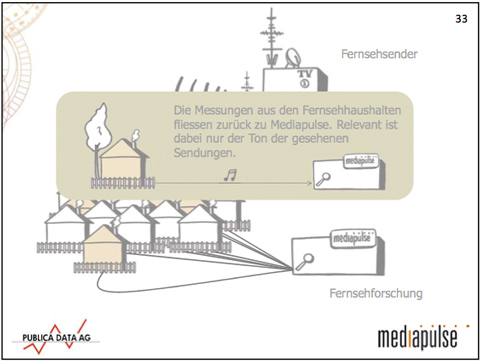
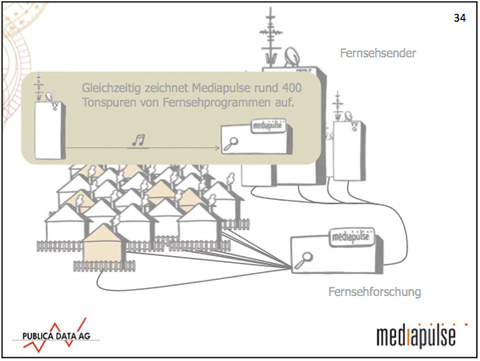
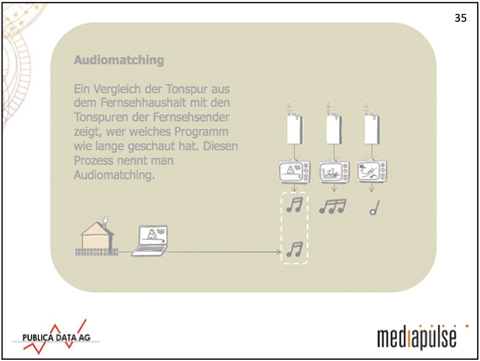
Mediapulse, the foundation for media research, is therefore switching to a new measurement system on January 1, 2013, which it hopes will provide a very precise picture of Swiss television consumption. This is a "paradigm shift," Isabel Wenger told the media in Zurich on Tuesday. She is responsible for the introduction of the new technology at Mediapulse. The new technology compares the sound broadcast by the TV station with that received by the viewer. With this so-called "audio matching," it is possible to identify a television program even if it is viewed days after it was broadcast.

Larger deviations possible

With the introduction of the new devices, the ratings are likely to change. After all, none of the households that currently own a meter will be represented in the future. This can lead to greater deviations, as Mediapulse Managing Director Manuel Dähler explained. In addition, many more households are now eligible for measurement than in the past. Whereas a TV set used to be a prerequisite, now only a "TV-capable screen" is needed. This can also be a computer monitor. This results in a change in the measurement values. In the future, two quotas will be used instead of one. One covers consumption on the day of the first broadcast (including time-shifted playback), and the second maps consumption over the next seven days. According to Dähler, it is currently only possible to speculate how the results will change from January 2013. A large proportion of the new participants have already been recruited. In total, around 2000 households are taking part in the measurements.

The Mediapulse Group measures television and radio consumption in Switzerland. It has a statutory mandate. It also receives contributions from the federal government for collecting usage data. (SDA)

Audio Matching:

am01
am02
am03
am04

Goldbach: In Stream meets In Page video advertising

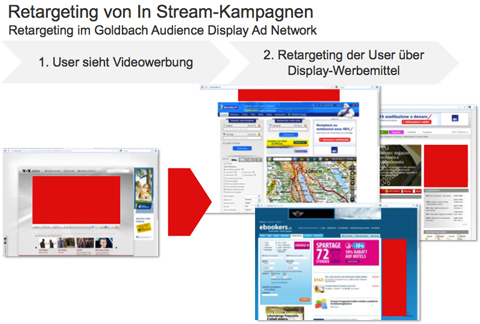
Goldbach Audience is the first company on the Swiss market to offer user retargeting through in-stream video ads. This is expected to enable advertisers to multiply their user interactions and significantly increase their reach.

The new in-stream retargeting offer in Goldbach Audience's display ad network allows users to be targeted specifically, according to a statement. It is now possible to deliver either the same or a different video or display ad to the user. Furthermore, it is possible to address only users who have never had contact with the corresponding advertising material.

The advantage for advertisers is obvious, writes Goldbach: The desired target group can be addressed precisely and without wastage, and the frequency of contact per advertising subject can be defined, irrespective of an In Stream or In Page campaign. In-stream advertising can reach around 4.1 million unique clients per month on the Goldbach Video Network. Thanks to in-stream retargeting in the Goldbach Display Ad Network, advertisers can effectively multiply these user contacts with in-page advertising and significantly increase reach.

With the newly launched Skyfloat, Goldbach Audience wants to offer its customers the ideal advertising format for this retargeting. The Skyfloat is a large-scale video advertising format that enables the delivery of moving image campaigns on any website of the Goldbach Display Ad Network without additional effort. According to the announcement, this should correspond to an ideal extension of TV and in-stream campaigns and significantly increase user attention.

retsysgoldbach
 

Statement: Donate and subscribe to sneakers

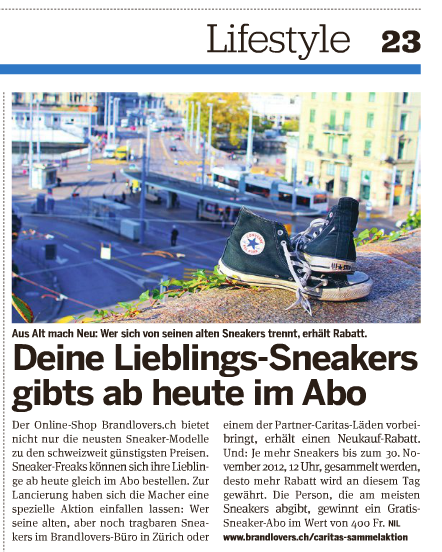
To mark the launch of Brandlovers.ch's sneaker subscription service, the Statement agency has come up with a charitable initiative in collaboration with Caritas. People can donate their old shoes—and in return, they'll receive a discount.

In collaboration with selected Swiss Caritas stores, the agency has launched a sneaker collection campaign for people who simply cannot afford new shoes. They are looking for old but still wearable sneakers that have not been worn for a long time, according to a press release.

The campaign runs until and including Friday, November 30, 2012, at 12 noon. Anyone who brings their old sneakers to a participating Caritas collection point will receive a discount voucher from Brandlovers.ch. The person who brings in the most sneakers will receive a sneaker subscription worth CHF 400 as a gift. The more sneakers collected, the greater the discount on the online store's entire range on the day the campaign ends. From 701 pairs of shoes donated, a voucher code published on Facebook leads to a 50 percent discount.

Responsible at Brandlovers.ch: Jan Hedlund (Managing Director), Philipp Bareth (Marketing). Responsible at Statement: Philipp Brunner (idea and concept), Renato Auer (consulting).

brandlovers-caritas
Sneaker-Sammeltag_20Min_27112012
Media response: Print edition 20 Minuten

ADC Switzerland: Deadline extended

Attention last-minute entrants: The deadline for submissions to the 2013 ADC competition has been extended to December 3, 2012.

The annual ADC Switzerland judging is one of the country's most important and largest platforms for discussing and judging creative achievements. It has long since expanded beyond advertising to include virtually all aspects of the creative industries, such as digital, design, film, photography and illustration, according to a statement. Discussions and judging will be based on qualitative criteria according to international standards using Michael Conrad's 7+ and Frank Bodin's 3Q systems.

The best advertisers, designers, filmmakers, programmers, photographers, illustrators, musicians, marketers, graphic artists, copywriters, conceptual designers, media planners, innovators and inventors are consequently invited to submit forward-looking work to the ADC jury. The call for entries can be downloaded under the link  Adc.ch/tender can be downloaded.


Comet brings Shoppyland in Christmas mood

The Bern-based agency Komet has created a Christmas-themed design for the Shoppyland shopping center, which, among other things, adorns the exterior facade in an oversized version.

This year, the shopping center is once again accompanying visitors through the Advent season with a supporting program, according to a statement. Activities such as gingerbread decorating and handicraft events are intended to create a Christmas atmosphere from the end of November. In keeping with the festive season, the center's logo has also been dressed up to brighten up the dark winter days as an Advent candle. Komet's implementations can now be seen on various communication media.

Responsible at Shoppyland: Karl Gorsatt (Center Manager Shoppyland), Rahel Waelti (Marketing & Communication), Diana Weber (Administration). Responsible at Komet: Thom Pfister (CD), Roland Zenger (AD), Joël Weber (Junior AD), Antonia Bekiaris, Christoph Albrecht (Text), Simon Schatzmann (Head of Consulting), Emma Isolini (Consulting), Guy Jost (Photography), Patrick Salonen (Retouching).

Bild_Fassade
Bild_Leuchtkasten
Bild_Xmas_Plakat
 

Travel.ch: New Head of Marketing, Sales and Operations

As part of a restructuring, the online travel service provider Travel.ch is consolidating its marketing, sales, and operations divisions. Effective December 1, Inka Nobel will take over as head of the newly created department.

The personnel and structural changes at Travel.ch were decided at the most recent management meeting. 37-year-old Inka Nobel, who has been responsible for Travel.ch's Sales & Operations division on an interim basis since September, will head up the merged Marketing, Sales and Operations divisions from December. The position of Head of Marketing, most recently held by Yvette Saxer at management level, will no longer exist in future.

Optimization and further development in several phases

According to the press release, Inka Nobel is considered by the management to be the ideal person to manage the areas of marketing, sales and operations at the travel portal from a single source in future and to successfully implement the upcoming modernization process. "She has a huge amount of expertise in IT and sales issues and will put this to profitable use for the company," Simon Lehmann is convinced. The long-standing CEO of Interhome is currently also interim Managing Director of Travel.ch and knows Inka Nobel well. As Executive Director between 2009 and 2012, she managed the Czech call center service provider Dialogs 24/7 with 74 employees, which ensures Interhome's global sales and service activities.

In the first phase after taking up her post, Inka Nobel will initiate and implement various developments in consultation with the Travel.ch management. For example, marketing activities via the online channel are to be expanded and optimized, new sales partnerships concluded and customer service further improved. "We want to defend our leading position in city breaks and at the same time position ourselves even more intensively as a specialist for flight and beach vacation offers," says Inka Nobel. Fabian Wismer has also joined the management team as the new Product and Project Manager. He previously headed Travel.ch's Sweden business unit, which has since been discontinued.

Inka_Nobel-gr
 

Mobile adblocker: Adello analyzes the situation

Among other things, the report on Werbewoche.ch about adblockers in the mobile sector has made waves. Adello takes a stand and says what to make of the looming threat to the advertising industry.

A lot has been written about adblockers in the last few days. The ball was set rolling by the simple news that the browser extension Adblock is now also available for Android phones. Werbewoche.ch reported in Tuesday's newsletter about the looming possibility of blocking advertising on mobile devices. Adello, a Swiss company specializing in mobile ad targeting, was contacted by unsettled advertisers and publishers and consequently analyzed the situation. While consumers expectantly hope for ad-free times, publishers and advertisers see their mobile advertising revenues in danger. The company has tested the app in recent days and confirmed: Basically, the app does what it promises. However, with certain limitations, which should be pointed out at this point.

How Adblock works

 
Adello has installed Adblock on a common Samsung Galaxy S2. This went off without a hitch, according to the release. Mobile sites and apps were tested. Adblock was tested on various ad servers, from Adition and Adtech to Smartadserver, and on the Chrome, Dolphin and Opera browsers. The ad suppression worked well and blocked quite reliably in the test. Adello concludes:
 

- Adblock suppresses advertising not only on apps and mobile sites, but also on "normal" websites that are surfed on the cell phone.

 
- The Adblock app only works on Wi-Fi. It cannot suppress ads when browsing on the go via 3G/4G. That should be the main purpose of the app.
 
- In contrast to the online version, it is not possible to recognize and then block advertising that appears on the cell phone anyway.
 
- The app only crashed once during the test.
 
- Solution seems more compelling on mobile sites than on apps.

Arguments against the use of Adblock
 
If you look at the Swiss mobile advertising market, you can see that currently the majority of mobile traffic still runs via iOS (Apple), Adello notes. But Adblock is not available on these devices. And Apple will hardly let itself be banned from lucrative advertising by an app provider. This is how Adello summarizes the points that speak against the use of the Adblocker:
 
- The app has to be turned on and off manually. Android users know the situation: To save power, apps that are not needed are often closed. However, Adblocker must remain active to fulfill its function.
 
- Some apps seem to close themselves (or crash) when Adblock is installed. At the latest when the favorite app doesn't work because of Adblock, the blocker is probably uninstalled.
 
- With certain apps, an empty frame or black background simply appears instead of the advertisement. The area is there, but it looks unattractive.

- It should not be forgotten that Adblock also wants to earn money at the end of the day. So anyone who has installed the app and then enters an invalid address in the browser, for example, will be redirected with an affiliate cookie so that Adblock can collect the commission.

 
Conclusion: What to make of Adblock?
 
The fundamental desire to keep advertising moderate is understandable from the user's point of view, says Adello. The advertising industry, on the other hand - and contrary to common opinion - has no interest in excessively annoying advertising. After all, good advertising is also positive entertainment or information. For this reason, Adello started the development of AdCTRL a few months ago, which will be completed in Q1. In simple terms, AdCTRL matches the interests of users with the advertising of publishers. From the user's point of view, this could reduce the number of ad impressions to zero in extreme cases. Instead of simply blocking ads, the control is put in the hands of the consumer. The publisher launch event for AdCTRL will take place at the beginning of February 2013.

adblocker
get_footer();