Susanne Mühlemann becomes a partner at Lemongrass Communications
Susanne Mühlemann has joined the Zurich-based strategic communications firm Lemongrass Communications as a partner and co-owner. She served for many years as head of communications at the SNB.
Editorial
-
November 20, 2024
(Image: zVg.)
Susanne Mühlemann was Head of Communications at the Swiss National Bank SNB until June 2024. She will now join Lemongrass Communications as a partner on January 1, 2025. In her role, she will focus in particular on advising on the public positioning and reputation of companies and individuals, crisis communications and the positioning of companies in internal and external communications.
Mühlemann combines experience from 15 years in business journalism and 15 years on the corporate side - in both the private and public sectors. During her career in corporate communications, she has accompanied prominent Swiss institutions and leaders through challenging phases.
Before joining the SNB in 2017, Susanne Mühlemann was responsible for strategic communications at UBS Switzerland. From 2010 to 2014, she was Head of Media Relations & Internal Communication at Swiss International Airlines. At the airline, as in her positions in the financial industry, she led communications in exceptional situations and supported change management processes and major projects.
Susanne Mühlemann laid her professional foundations in business journalism. She worked for 15 years in the leading media of various publishing houses. Her academic career includes a degree in political science from the University of St. Gallen and a degree in international relations.
Base and Terre des hommes call for the protection of children worldwide
To mark International Children's Rights Day on Wednesday, the Terre des hommes Foundation is launching a national campaign. The visuals, created by the Geneva-based agency Base Design, focus on the more than 46 million children worldwide who have been forced to leave their homes and whose rights are being threatened and violated.
Editorial
-
November 20, 2024
With this campaign, the Terre des hommes Foundation is drawing attention to the rights of children on the 35th anniversary of the adoption of the UN Convention on the Rights of the Child. To this end, it is focusing on the potential and innocence of children whose rights are threatened and disregarded. Symbolically, the visuals consist of white words such as "hero:inside" or "dreamer:inside" on a black background. The campaign is now being played out digitally and on social media and will soon also be available out-of-home in French and German.
Children's magazine and learning platform launched
At the same time, two further instruments for promoting children's rights are making their debut: the children's magazine Orange illustrates children's rights in a playful way. And the trilingual learning platform Childrights-mooc.ch for professionals and students who work with and for children. Together with the International Institute for Children's Rights, the University of Geneva and over 40 other renowned partners such as UNICEF and Amnesty International, Terre des hommes is thus launching the first online training course for professionals in Switzerland.
Neu cleans up for Rotho in the Galaxus campaign
Rotho, a home goods manufacturer based in Würenlingen, is promoting its current campaign with special posters. Neu Creative Agency is responsible for the campaign's execution.
Editorial
-
November 20, 2024
The campaign launched a few weeks ago by household manufacturer Rotho is being activated by the Neu agency with additional measures. With special posters placed in suitable locations, Rotho is cleaning up the neighboring posters.
A Galaxus advertising campaignwhich recently attracted attention throughout Switzerland, provided the perfect opportunity to implement the idea. The special posters are currently hanging in and around various train stations.
Responsible at Rotho: Agnes Nowicki, Luca Marcigot. Responsible at Neu Creative Agency: Romana Schmidtpeter, Nico Ammann, Simon Rehsche, Andrea Braschler. Media: Biggie.
New work in communication: balance instead of burnout
For the majority of communications professionals, working independently and autonomously, flexible work hours, and managers who support autonomous work are increasingly becoming a reality in the «new world of work,» as shown by the PR Trend Monitor from News Aktuell and Per.
Editorial
-
November 20, 2024
(Graphic: News Aktuell)
According to the survey, a large majority (91%) of PR professionals are able to carry out their work independently and autonomously. In addition, 78% of communication experts are able to organize their working hours flexibly. And management is also increasingly relying on a modern understanding of leadership: 75 percent of managers actively support self-determined work and give their teams more responsibility. This development is supported by clear company guidelines on remote work and the free choice between working from home and the office - 71% of respondents say this about their company.
Almost two thirds (65%) of communications experts also state that their company promotes a learning culture that supports continuous training and personal development. At the same time, almost as many companies and PR agencies (63%) ensure that work and private life are in balance (work-life balance). Diversity is already promoted in 62 percent of companies, according to the PR experts.
For 58% of PR professionals, it is now possible to increasingly work from home, and exactly half (50%) of those surveyed state that managers are increasingly handing over responsibility in their companies. Agile working has become the standard for almost as many (49%).
Only one in three (31%) say that everyone in the team works in the same city, and just under a quarter (24%) even work completely remotely. For a good one in five PR professionals (22%), the respective company even promotes remote work in other European countries.
Communicators have stated that
I can do my work independently and autonomously 91 %
I can organize my working hours flexibly 78 %
In my company, managers support, encourage and empower their teams to work autonomously 75 %
My company has clear guidelines on remote work 71%
I can choose whether I work from home or in the office 71 %
My company promotes a learning culture that supports continuous training and personal development 65 %
In my company, care is taken to ensure that work and private life are in balance 63 %
Diversity is promoted in my company 62 %
I am increasingly working from home 58 %
In my company, managers are increasingly handing over responsibility 50 %
I have a say/participation in company decisions 50 %
Agile working is standard in my company 49 %
Everyone in my team works in the same city 31 %
Everyone in my team works remotely 24 %
My company promotes remote work in other European countries 22 %
For the PR Trend Monitor News Aktuell and Per conducted an online survey in February 2024 among 327 communications professionals from companies, organizations and PR agencies in Switzerland and Germany.
Best of Swiss Apps: A gold hat trick and a quadruple software freestyle
At this year’s Best of Swiss Apps Awards Night, four custom software and system integration projects were honored for the first time as part of the «Best of Swiss Software» category. With three gold medals and the Master title, the «Helion One App» was the big winner of the evening.
Editorial
-
November 20, 2024
Helion One App wins the master title of Best of Swiss Apps 2024 (Pictures: Eduard Meltzer Photography)
For the twelfth time, Best of Swiss Apps has shown who sets the tone in the Swiss app scene. The industry met on Tuesday in Zurich's Kongresshaus to celebrate the best app projects of the year. This year, the organizers recorded record participation: 241 submissions vied for the favor of the juries and the guests in the hall.
The program also included a premiere: Best of Swiss Software awarded prizes to individual software and system integration projects in four categories for the first time. In a two-stage process, the University of Bern and the expert juries had previously examined all submissions for their quality and innovative strength and selected the winners. 25 projects nominated.
Shortly before the Best of Swiss Software award ceremony: Pascal Sieber from Sieber&Sieber, Simon Perrelet, research assistant at the University of Bern, presenter Alexandra Maurer and Jens Dibbern, professor at the Institute of Information Systems at the University of Bern.
Four trophies for Enterprise Software
The "InsightLoop" project was the winner in the Data & AI Solutions category. The data analysis software from Coresystems combines large language models with RAG technology and impressed the jury with efficiency gains of up to 20 percent for manufacturing companies.
The "Apriko" platform from the Zurich-based software manufacturer of the same name came out on top in the Business Solutions category. According to the jury, the platform sets standards in the digitalization of staff leasing and shines with its user-friendliness and wide range of functions.
For the first time, Best of Swiss Software awards trophies to outstanding individual software and system integration projects.
With the "Service Portal 2.0" project, the health insurance company Sanitas brought a business-critical core application, which also contains sensitive customer data, into the cloud - and thus won the prize for the best cloud native solution. Valtech implemented the project on behalf of Sanitas.
In the Core Business Integration category, the trophy went to Baloise Bank and its implementation partner TI&M for the "New e- and mobile banking" project. With the highest security standards and innovative functions such as push TAN and QR-bills, the platform offers a future-proof, user-centered solution, the jury found.
A Master with three gold medals
The big winner of the evening was the "Helion One App", which claimed the title of Master of Swiss Apps 2024. The app for the energy management of solar systems was developed by Dept and Solar Manager on behalf of Helion Energy. In addition to the Master title, the project also won three gold awards in the Customer Experience, Design and Functionality categories.
In terms of customer experience, the jury praised the app for its ability to inspire users with clever micro animations for a complex topic. They also liked the consistently coherent design of the app and the infographics it contains. And in terms of functionality, the judges were impressed by the successful balancing act of appealing to both end users and professionals.
The winners of the evening: the team behind the "Helion One App".
Help for spills and bituminous VR
The Barryvox app received the second most votes in the Masters of Swiss Apps poll. The app is used to prepare for the search for avalanche victims with the Mammut search device of the same name. Users can train for emergencies using various scenarios - with live feedback via Bluetooth.
The third most votes went to the "Bitumen VR" app, which also won gold in the Extended Reality category. The training app is designed to support the training of trainee plumbers. Thanks to VR, the application not only conveys a good basic understanding, but also solid handling of the tools. In addition, training with the app is safer than live training - and it saves 25 tons of bitumen per year, as the jury noted.
Double gold for an occupational safety app
Two gold awards went to the Uepaa app from the ETH spin-off of the same name, which specializes in occupational safety solutions for people working alone. The app excelled in the Innovation category, with the jury particularly highlighting the life-saving functions such as a digital dead man's function or a motionless detector, 24/7 emergency call, first responder search and precise location.
The app also emerged as the winner in the Business Impact category. Originally developed as a protection system for mountaineers, Uepaa has successfully transferred its expertise to the field of occupational health and safety and established itself in a new, promising market, the jury explained.
"No digitalization without young talent"
Another highlight of the evening was the presentation of the "Hack an app" award. Young talents between the ages of 11 and 14 were able to qualify for this award. The aim is to find the best apps developed by children and young people as part of TI&M's IT youth development program "Hack an app".
Presenter Alexandra Maurer interviews 12-year-old Rahel Panosian, who won the "Hack an app" award; OIZ Director Andreas Németh prepares for the laudatory speech. (Image: Netzmedien)
The prize was won by 12-year-old Rahel Panosian from Bern - with an app on the subject of first aid. Andreas Németh, Director of the Organization and IT Department of the City of Zurich, began by emphasizing the importance of the award. "Without young talent, there is no digitalization," he said and then praised the winner for her creativity, innovative spirit and especially for her ability to convey a serious topic in an accessible and entertaining way. "The combination of different elements that are not only informative, but also make learning easier and more appealing through humor and musical accents is particularly successful."
A prize for accessibility is a win for everyone
"The fact is that every second person in Switzerland has difficulties with digitalization," said Markus Riesch, Head of the Federal Government's E-Accessibility Office, introducing the special category of accessibility. By "difficulty", Riesch did not mean aversion, but difficulties with hurdles in accessing digital services. After all, accessible websites and apps are still nowhere near as widespread as they should be. With the aim of changing this, the jury, in cooperation with the Allianz Digitale Inklusion Schweiz (ADIS), awarded prizes to apps that are characterized by above-average accessibility.
Gold in the special category Accessibility went to SBB Inclusive - an app explicitly designed for people with disabilities. Live functions such as door button recognition are proof that mobile apps and the use of haptic feedback bring added value for people with disabilities, said jury president Markus Böni from the "Access for All" foundation, adding: "At the same time, it is clear that we all benefit from accessibility: Information such as the carriage number, exit page and written announcements are a plus for everyone!"
Jury president Markus Böni (left) congratulates the creators of SBB Inclusive on winning the special category Accessibility. (Image: Eduard Meltzer Photography)
A community of practice assistants, floorball on the street and a health insurance app
The "MyLab app" won gold in the Web Apps category. The app is used for networking and the professional development of medical practice assistants. Although the application was implemented as a progressive web app, it feels like a native app, said jury president Claes Lennman. "User engagement through the points system, the appealing design and good usability round off this package for this year's gold award in this category."
The "Level Sports" app triumphed in the User Engagement category. With this application, the Swiss Floorball Association aims to anchor the clubs' offerings more firmly in the regions. The app encourages users to meet up outside and compete in games. And thanks to the practical map, it is also easy to find places where opponents are playing, said jury president Matthias Sala. "The hip avatars also make street floorball a cool sport for the target group."
MyCSS" was the winner in the User Experience category. The Lucerne health insurance company's app has a refreshing layout and offers a number of personalization options, said jury president Nino Cometti. Among other things, he praised the micro-animations and the subtle use of colors and pictograms. "MyCSS combines all the touchpoints of an insurance app and is also fun to use." (Joël Orizet/tme/swi)
«Real21» plans to fund 15 investigative and reporting projects this year. The reports will appear in publications such as the NZZ am Sonntag, Republik, the NZZ, and the Woz. The association is providing a total of 47,000 francs for this purpose.
Editorial
-
November 19, 2024
Reports on developments in Africa, Asia, Latin America or Eastern Europe are often subject to cost pressure and rarely attract attention - usually when it comes to disasters, conflicts or wars. The financial support provided by the association "Real21 - understanding the world" to cover research and travel costs is intended to help us understand the world a little better. The reports deal with Colombia versus the Glencore company, Greenland between climate crisis and raw materials boom, the future of drinking water or the power of the cashew nut.
This year, the independent Real21 jury of experts decided to fund 15 projects with amounts between CHF 1,000 and CHF 4,600 - a total of CHF 47,000 was awarded. The funded projects in 2024 are planned for the following media in print, radio and online:
The lamb
Observer magazine
Magazine NZZ am Sonntag
NZZ
Polar Journal
Radio Bern RaBe
Reflect
Reformed
Republic
Tentacle, Le Courrier, KNA, Luzerner Zeitung
Woz
The association "Real21 - Understanding the World" was founded in 2015 by the Maz Institute for Journalism and Communication and Alliance Sud, Competence Center for International Cooperation and Development Policy. With the media fund, Real21 supports journalists who look behind the headlines and report on global development issues in the Swiss-German media. The fund makes financial contributions up to a maximum of CHF 10,000 to cover research and travel costs. An independent jury of experts decides on the allocation of funds.
The Real21 expert jury consists of David Signer (NZZ Editorial Office International), Monika Bolliger (producer at SRF for "Echo der Zeit"), Karin Wenger (SRF, freelance journalist and author), Martina Fehr (CEO Maz) and Marco Fähndrich (Media and Communication Alliance Sud).
Job cuts: Ringier Advertising lays off six people
Six employees were laid off at Ringier Advertising on Tuesday. Ringier’s marketing division is taking this measure as a «response to declining advertising revenue in the print sector,» according to a statement.
Editorial
-
November 19, 2024
(Image: Keystone/Ennio Leanza)
Ringier Advertising announced this "extremely difficult but necessary step" internally on Tuesday, it added. The Brand Studio, Media Services and Sales Steering divisions are affected by the redundancies. The move is justified by the challenging situation in the print sector, "which has been in decline for years" and has worsened in the current year.
In order to "remain sustainable and competitive in the long term", proactive countermeasures are essential. In addition to a strategic adjustment of the business model, this includes the adjustment of resources. Ringier's social plan applies to the six employees affected.
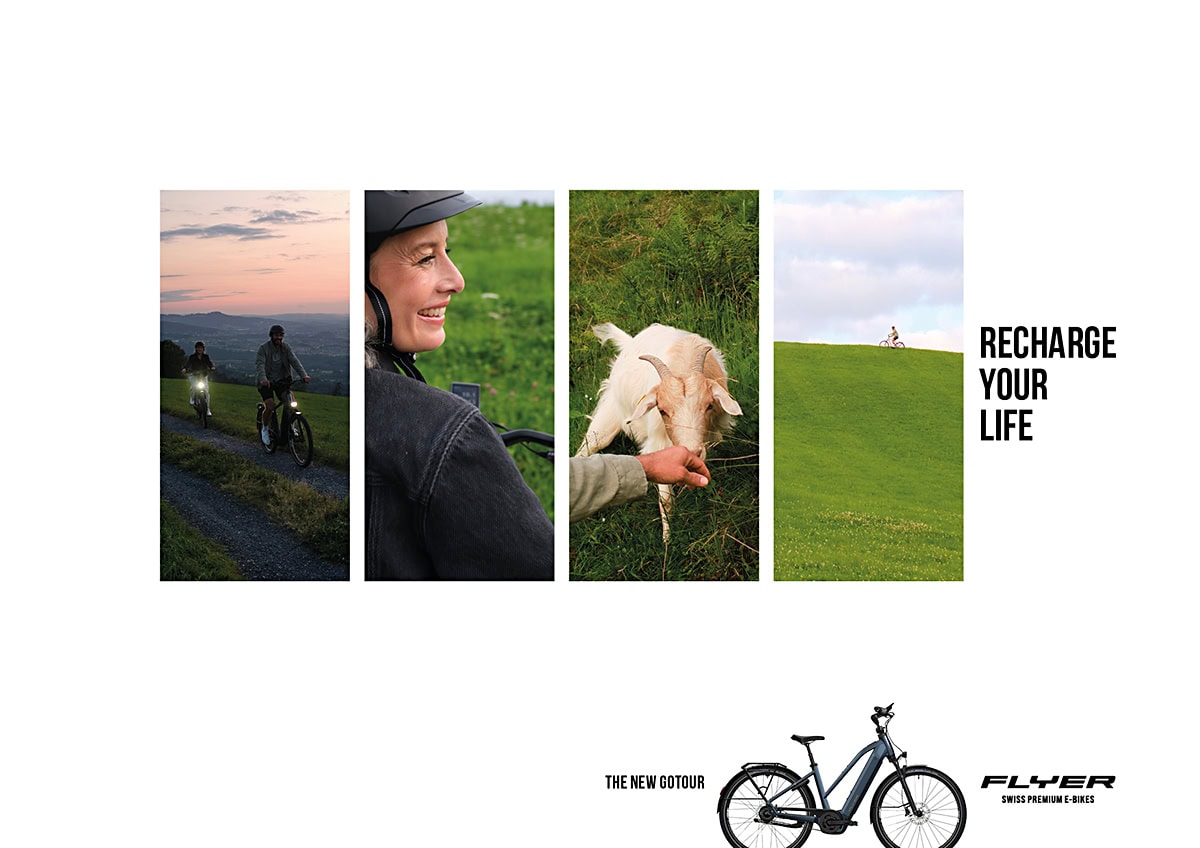
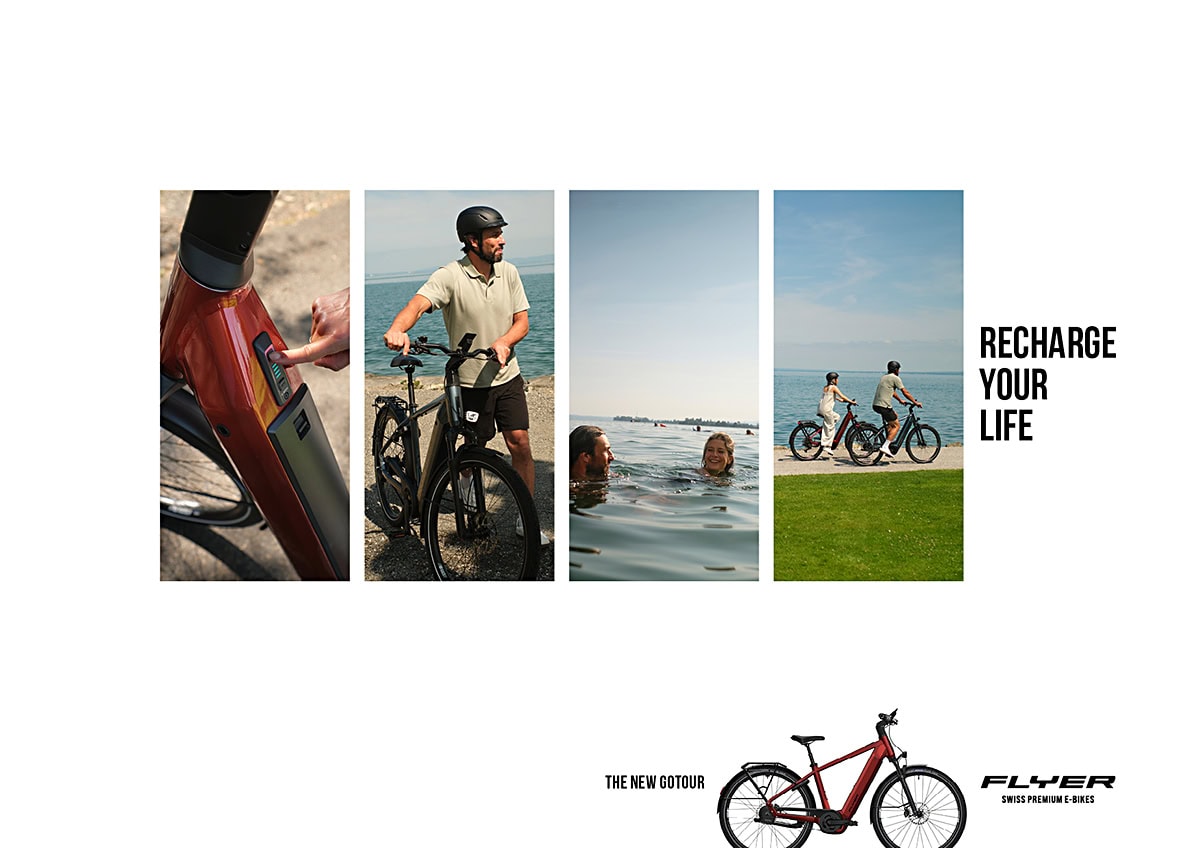
Studio Wurst for flyers: Recharge your Life
As part of the launch of a new «Gotour» model, Studio Wurst has implemented various communication initiatives for the e-bike company Flyer. Despite recent developments—which have resulted in job cuts and the relocation of production abroad—marketing activities are continuing.
Editorial
-
November 19, 2024
Touring bikes are still the most popular e-bike category in Europe. The smartly designed e-bikes are family-friendly and perfect for everyday use.
The claim "Recharge your Life" for the implementation of the new Gotour bike shows how stress-free and carefree you can be on an e-bike in the great outdoors, discover new places and recharge your batteries. This resulted in various photos for print, social, online and POS measures as well as two short films for social and video ads.
Update Wednesday: On Wednesday, it was announced that Flyer will cut 150 of 170 jobs and relocate production abroad. In response to an inquiry, it was reported that marketing activities will continue for the time being. The Gotour campaign will not only be used for the Swiss market, but also internationally.
Responsible at Flyer: Marco Alessandri (Head of Marketing), Nicole Bucher (Marketing Manager), Felix Kühni (Multimedia Creator). Responsible at Studio Wurst: Pedro Moosmann, Nino Zuberbühler. Photos: Sebastian Donath.
Internet use in Switzerland differs according to gender
Internet use and the frequency of use vary significantly by gender in Switzerland. However, this is particularly true for people aged 60 and older. Gender equality in the relevant educational programs and professions has not yet been achieved across all age groups, as shown by the latest survey from the Federal Statistical Office.
Editorial
-
November 19, 2024
(Iconic image: Unsplash.com)
Across all age groups, men in Germany use the internet more frequently than women. The proportion of men who have used the internet in the last three months is 98.2%. For women, the figure is 96.5%, as reported by the Federal Statistical Office (FSO) on Tuesday.
In addition, men use the internet more frequently on a daily or almost daily basis (93.4%) than women, who according to the FSO use it 89.9% of the time. The differences are even greater when only intensive Internet use is considered: While 80.2% of men stated that they use the internet several times a day, this figure is only 75.6% for women.
However, these differences are exclusively attributable to the 60+ age group, the FSO added. Within the other age groups between 15 and 59, no notable difference was found between the sexes.
Gap widens for older people
The same applies to advanced digital skills: In the age groups between 15 and 59, the FSO found no significant differences between men and women in the areas of advanced "information and data skills", "communication and collaboration", "problem solving", "security" and "content creation".
In terms of educational level, the only significant difference between women and men is in the digital skills for "content creation". In this area, men with a tertiary degree are more likely to have advanced skills than women with the same level of education.
Meanwhile, there are major gender-specific differences in the area of advanced digital skills among people aged 60 and over. In almost all areas mentioned, fewer women than men in this age group have such skills.
Marked inequality in occupations
The FSO survey also states that gender equality has not yet been achieved in the relevant training courses and professions. And this applies across all age groups. The low representation of women in the so-called STEM professions has existed for a long time. MINT stands for mathematics, information technology, natural sciences and technology.
Most recently, there were proportionally almost eight times as many men as women who obtained a tertiary degree in the field of information and communication technology (ICT) in Switzerland. Consequently, there is still great potential for improvement with regard to a more balanced gender ratio of qualifications and specialists in the ICT sector.
This can also be seen in the example of programming code: Among 16- to 24-year-olds, men were proportionally much more likely to have programmed code than women in 2023. 28.2 percent of 16 to 24-year-old men in Switzerland stated that they had written programming code - compared to 14.3 percent of women in the same age group. According to the FSO, one explanation for the differences could be the gender-specific distribution of the youngest population groups across different educational careers and fields.
Digitization can amplify effects on both sides
One way or another, digital change affects the whole of humanity. However, its effects are not felt equally by everyone, writes the FSO. Women and men do not participate equally in the development of digital technologies, which are always associated with certain values. (SDA/swi)
Modesty makes researchers appear more trustworthy
«According to a study, researchers who come across as »modest” appear more trustworthy. As a result, people are more likely to follow their recommendations when they convey that they do not claim to know everything and that their knowledge is also limited.
Editorial
-
November 19, 2024
(Iconic image: Unsplash.com)
Crises such as climate change or the coronavirus pandemic show how important trust in science is, an international team involving the University of Vienna has found. In order to investigate the role of "intellectual modesty" in this context, a study published in the journal Nature Human Behavior study, around 2000 participants in the USA were surveyed and involved in online experiments.
Under the direction of the University of Pittsburgh, the researchers presented scientific texts that were formulated either with "high intellectual modesty", "low intellectual modesty" or no particular style.
"High intellectual modesty" stands for the willingness to admit gaps in knowledge, to listen to the contributions of others and to reconsider one's own findings in light of this, explained Nina Vaupotic, a psychologist from the University of Vienna who was involved in the study, in an interview with the APA.
It has been shown that people who read texts that were formulated accordingly rated the scientists and their results as more trustworthy. This also meant that they were more willing to follow the scientific recommendations or search for further information.
Science is limited
They also tested the form in which "intellectual humility" can be taught and the results that can be achieved. In addition to the personal admission of knowledge limits, the researchers also looked at two other approaches.
It was communicated here that science is limited in its methods and results, for example in terms of generalizability. Even if this could increase trust in the person, there was a slightly negative effect on belief in a particular research topic, according to Vaupotic.
Overall, there were very small differences in the various types of communication, which is why these should be tested in further studies. According to the research team, "personal intellectual modesty" is helpful in strengthening trust. (SDA/swi)
Saloon develops new image for the Alpine Initiative
The «Alpine Initiative,» which aims to protect the Alps from transit traffic, was founded 35 years ago. The organization is now called «Pro Alps.» The Zurich-based design studio Saloon was commissioned to handle the rebranding.
Editorial
-
November 19, 2024
Last February marked the 30th anniversary of the success of the "Alpine Initiative" referendum. However, the name of the association has mutated into a communication stumbling block, especially for the younger contact group, and there is nothing left to vote on. Instead, the aim is to continue campaigning for the protection of the Alps - even beyond transit freight traffic.
The association has therefore decided to change its name from "Iniziativa da las Alps" to "Pro Alps". The new and still Rhaeto-Romanic association name will become a self-explanatory brand promise. It is also concise, cross-language and does justice to the expanded commitment and sharpened brand values, according to the association. "We remain true to our roots, but we are more than just a successful popular initiative from the past. We are therefore reflecting our long-term commitment to the Alps by changing our name from Iniziativa da las Alps to Pro Alps," explains Katrin Dorfschmid, Head of Communications and Marketing at Pro Alps.
Modern and approachable appearance
Following an evaluation process, Saloon was commissioned with the rebranding project as a consulting and design implementation agency. The design studio is supporting the association in terms of strategic brand development, naming and the new appearance to increase the qualitative perception.
The result is an activating and approachable design that communicates the activities of Pro Alps with a lot of freshness and a rejuvenated visual language. It shows the sensitive mountain world that needs to be protected. It is interspersed with bold and powerful pictograms that are based on the logo.
In collaboration with the web agency Getunik, the digital world of Pro Alps has been brought to life. The new brand identity will be implemented at the same time as the name change from Tuesday.
Susanne Schgaguler becomes CMO Cosmetics at Weleda
Susanne Schgaguler will assume the position of Chief Marketing Officer (CMO) for Cosmetics at Weleda in January 2025. The current CMO, Lars Zirpins, will leave the cosmetics company to pursue new opportunities.
Editorial
-
November 19, 2024
(Image: zVg.)
Schgaguler has been with Weleda for five years. In spring 2022, she took on the role of Head Group Brand Management Cosmetics. Schgaguler brings with her twenty years of experience in the consumer goods industry, including marketing at Novartis, product & sales management at LVMH and brand management at Procter & Gamble. "Susanne has shown that she can make a significant contribution to the growth of the brand with her distinctive industry and brand expertise, her strong implementation skills and leadership strength," says Weleda CEO Tina Müller. Susanne Schgaguler will report to Tina Müller from the head office in Arlesheim.
The previous CMO, Lars Zirpins, will leave the company by mutual agreement in December after two successful years at Weleda. With him as CMO, the brand has modernized and developed significantly, says Müller: "Under his leadership, we were able to implement the transformation of Weleda's marketing and make our organization fit for the future."