The numbers from the event industry are devastating
What already seems logical is now being revealed with alarming clarity by a major industry survey: One year after COVID-19 turned life upside down in Switzerland as well, the local events industry is teetering on the brink of collapse.
Editorial
-
March 8, 2021
In order to provide itself and the authorities with a representative overview of the situation, the Swiss LiveCom Association Expo Event, in collaboration with its partner associations Svtb and Tectum, called on its members to take part in an in-depth survey. Business owners and executives from 153 companies provided binding information - on sales figures, the employee situation, project prospects, the receipt of aid measures and numerous other relevant topics.
In the crisis year 2020, a total of over 17,000 projects were canceled by the event industry. This resulted in a 57 percent drop in sales, equivalent to 3.19 billion Swiss francs. Around 4,460 jobs were lost in 2020. Spread across the entire industry, quite a few companies have ceased operations or completely reoriented themselves. The loss of trade shows, events and congresses leaves a hole of 10 billion Swiss francs in the gross value added.
The results of the survey would indicate how much the survival of most companies in the events industry depends on whether a protective shield for Corona-related cancellations is enshrined in the Covid 19 Act, Expo Event writes in a statement. That's because even with an end to the pandemic, an end to the emergency will be far from in sight for many companies. More than 70 percent of survey participants, for example, have applied for a Covid 19 loan that will take years to pay off. In addition, potential clients are unable and unwilling to provide any certainty about future activities, which will certainly prolong the planning uncertainty that has prevailed for a year now until well into 2022.
Based on the current epidemiological situation and the current Swiss vaccination plan, it can be assumed that there will be a horrendous number of cancellations in 2021 and 2022 as well, as Expo Event writes in the press release. Without the required protective shield, thousands of jobs would thus be at stake - and the short- to medium-term competitiveness of Switzerland as an event location.
The current situation in the event industry
According to a survey in January 2021, the event industry still comprises 1,030 companies, 18,500 employees, 40,000 volunteers (freelancers) and still generates sales of 2.37 billion Swiss francs in 2020 (previous year 5.56 billion Swiss francs). After a massive downsizing in 2020 and without financial support, the event sector is threatened with a wave of bankruptcy with the loss of many more jobs, Expo Event said.
Patrick Farinato new Chief Marketing & E-Commerce Officer of Läderach
Effective May 1, 2021, Läderach Chocolatier Suisse is expanding its executive team with the appointment of Patrick Farinato to the newly created position of Chief Marketing & E-Commerce Officer. The company aims to drive growth through marketing and communications, investments in digital transformation, and further strengthening of the brand.
Editorial
-
March 8, 2021
Following the first global Corona shutdown last year, the chocolate manufacturer Läderach Chocolatier Suisse has repositioned itself to return to its previous growth path. In addition to the expansion of the international branch network, the flagship store "House of Läderach" in Bilten GL and the takeover of the leases of 34 Godiva locations in the USA, Läderach has invested in strengthening the brand as well as digital distribution channels.
"We want to offer our customers a special customer experience with our fresh, high-quality chocolate products, both on-site and digitally, and thus take advantage of future growth opportunities in the premium segment. With Patrick Farinato, we have been able to attract a personality to our team who brings international experience from various industries and will help us not only to implement the growth strategy we have embarked on, but to accelerate it," says Johannes Läderach, CEO, Läderach Chocolatier Suisse.
Patrick Farinato has many years of international experience in the areas of brand management, marketing, communications and digitalization. Most recently, he was responsible for the global investment house Vontobel as worldwide Head of Marketing & Analytics and member of the current Global Executive Board.
Blick.ch Romandie editorial team works in specialized "labs
The editorial team of Blick.ch's French-language counterpart is divided into three "labs": the "Investigative Lab" for research from French-speaking Switzerland, the "Editing Lab" for translations and agency reports, and the "Creative Lab" for production on all digital channels.
Editorial
-
March 8, 2021
Michel Jeanneret (left) and Thomas Deléchat are jointly responsible for Blick.ch's editorial operations in French-speaking Switzerland.
With the 47-year-old Michel Jeanneret and the 29-year-old Thomas Deléchat an editor-in-chief and a product owner are jointly responsible for an editorial team for the first time. "We want to exploit the full potential of a purely digital medium and be present with the appropriate narrative forms wherever our audience happens to be," Deléchat is quoted as saying in a communiqué. "To ensure that we succeed in this, product strategy and journalistic considerations go hand in hand for us." The 20-strong editorial team is divided into three overarching labs: "Investigative Lab," "Editing Lab" and "Creative Lab.
In the "Investigative Lab", networked journalists work on exclusive research from Suisse Romande - from politics to sports, from business to society and people. The "Editing Lab" adapts articles from German-speaking Switzerland and edits agency reports. This is intended to guarantee journalistic exchange between the language regions and ensure comprehensive, national reporting on Blick.ch/fr.
The "Creative Labbrings together digital experts as well as social media and video specialists who produce interactive content for Blick.ch/fr. They ensure that the journalistic content is optimally prepared and told for each channel. "We want to retell the stories online, surprise our user base and engage them in the topics." explains Deléchat, who is responsible for setting up and managing the Creative Lab. draws. The unit focuses on audio, video and social media to appeal to a younger audience in particular.
Jung von Matt launches the #gisler protocol
Stereotypical portrayals of gender are still ubiquitous; marketing and communication are often still stuck in the lifestyle models of the 1950s. For this reason, Jung von Matt is launching the #gisler Protocol, which advocates for a multifaceted representation of gender.
Editorial
-
March 8, 2021
In 2021, communication and advertising agencies, clients and content creators have a greater responsibility than ever to reflect Switzerland's diversity in their work. The project launched by Jung von Matt #gisler protocol is intended to give this responsibility a voice. The discussion about diversity is not only about equality, but also about the equal value of different life models and their representations in the media, as the agency writes in a statement. The #gisler protocol is therefore intended to give all those who profess this a framework for their own work and to remind them not to remain stuck in 1950s clichés.
The minutes are dedicated to Doris Gisler Truog, an advertiser who campaigned for women's suffrage from 1969 onwards.
A protocol with pot plant test
The protocol consists of five concrete points that companies and individuals can commit to. These include an inclusive language, the conscious questioning of ideas, scripts and concepts or the sensitization of one's own customers. Also part of the #gisler protocol is the "pot plant test". The test is a simple way to check how diverse the roles are within a script or an idea. If the role of a woman can be replaced with a potted plant or a dog, you should probably go over the books again.
"With the protocol, we focus on what we use to realize the greatest impact: Our work. We play a key role in shaping the public perception of roles and life models - so it's high time to say goodbye to backdrop mothers and overburdened cliché fathers. That's why we stand up for a # cliché change in communication and marketing. And we would be delighted if other agencies and companies were to commit to the #gisler protocol," says Roman Hirsbrunner, CEO of Jung von Matt Limmat.
78 Tamedia female journalists protest against discrimination
At Tamedia, women are "thwarted, rebuked and paid less" than men. This was written by 78 female Tamedia journalists in a letter to the editor-in-chief and management.
The letter, which was published on Twitter over the weekend, says that women have less say at meetings, and their suggestions are not taken seriously or are ridiculed. The company culture is dominated by men.
Men outnumber women on editorial boards and occupy almost all key positions. Men are promoted and women are passed over. The problems are structural.
The signatories of the letter demand immediate action to improve their situation. "We expect the insults and abuse to stop; we expect to be treated with decency and respect," they wrote.
Apparently, the editors-in-chief also see a need for action. Tamedia Editor-in-Chief Arthur Rutishauser told Persoenlich.com on Sunday: "We are aware that the measures taken so far to increase the proportion of women in the editorial teams and especially in management positions are not enough and that it is time for a binding strategy." (SDA)
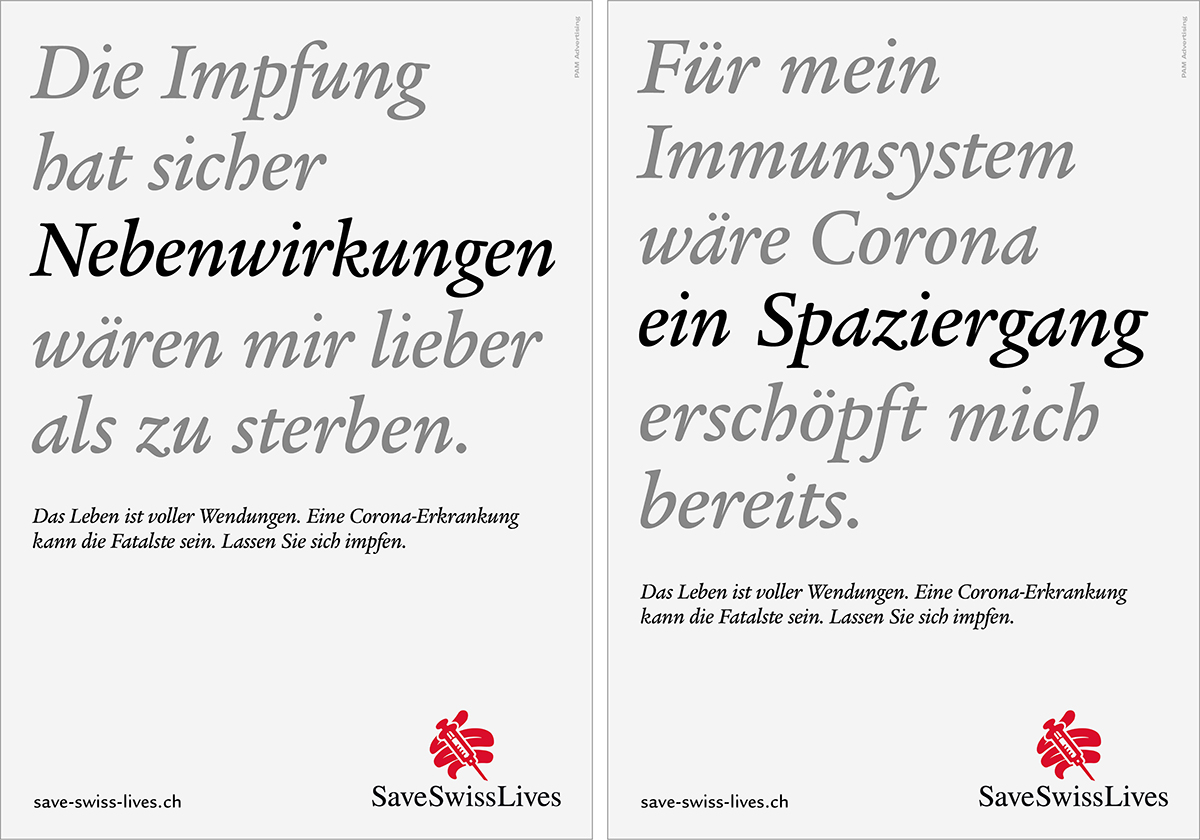
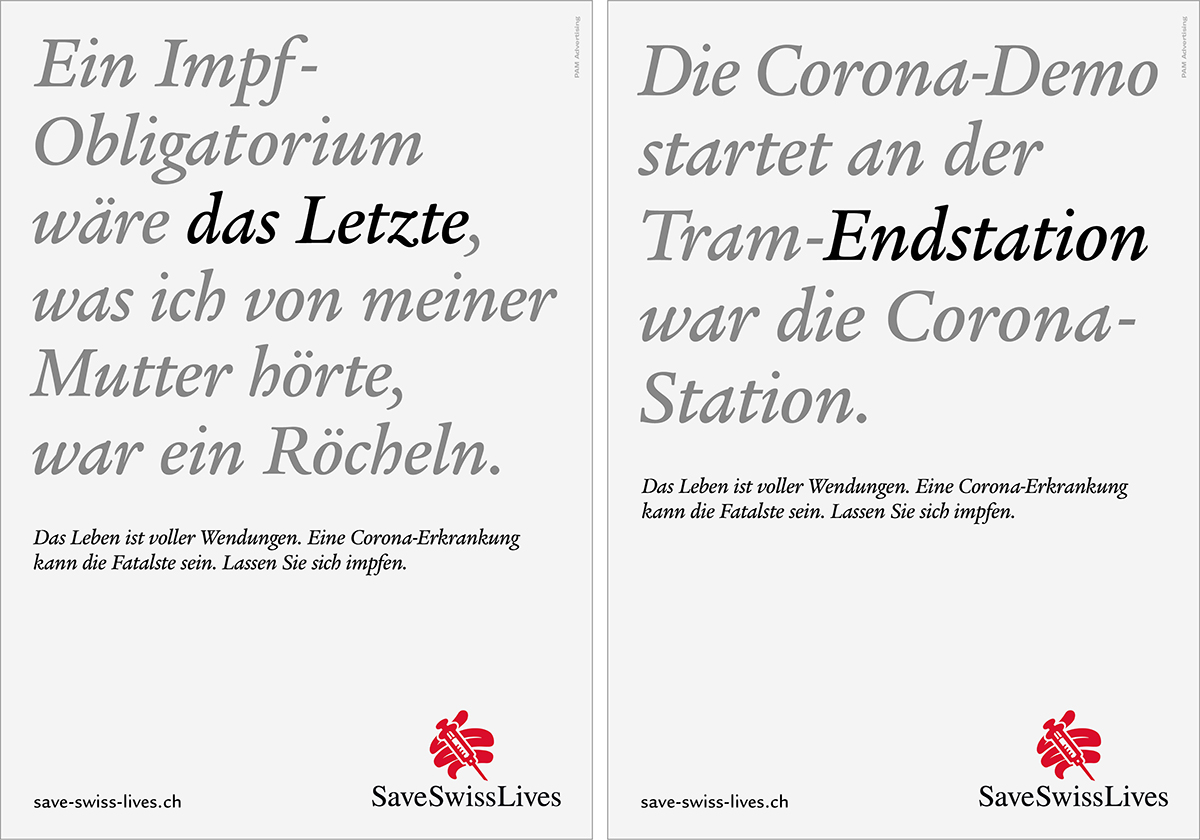
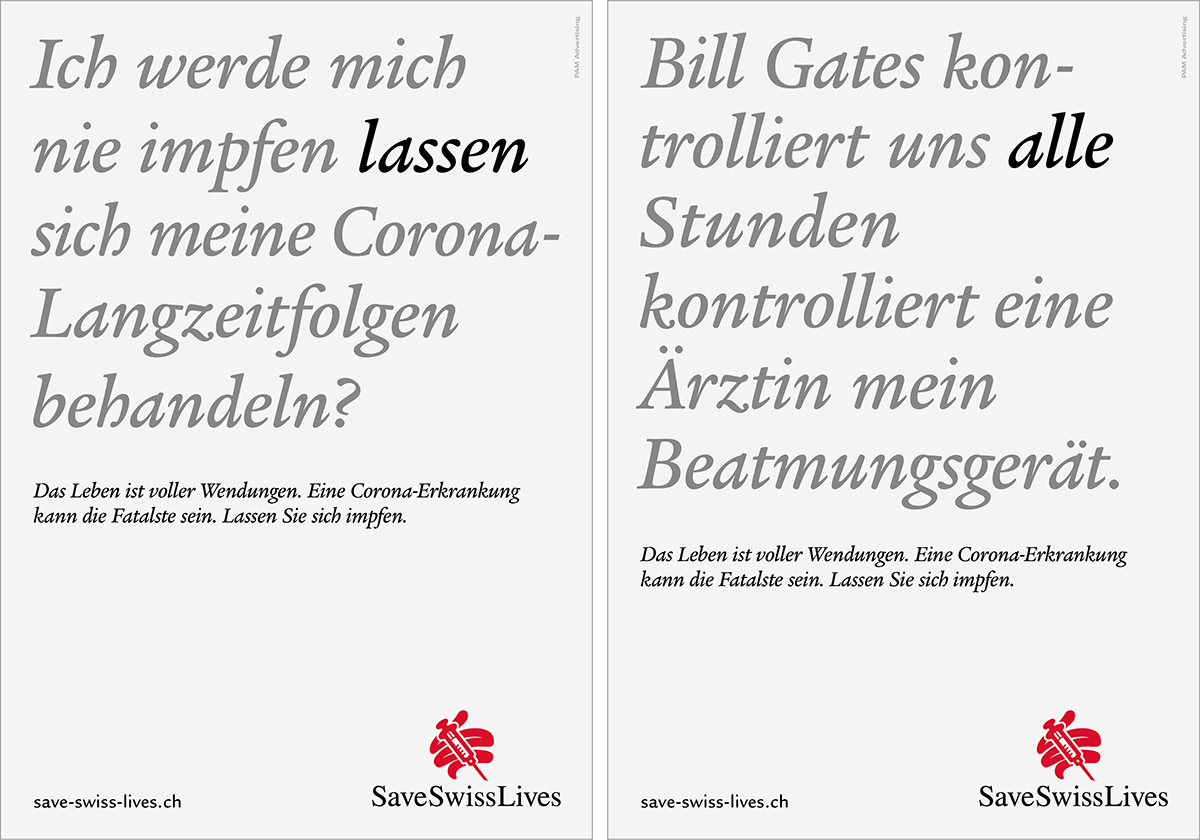
Zurich-based agency PAM Advertising has created a vaccination campaign in the style of Swiss Life's turnaround phrases and launched crowdfunding for the advertising campaign. In an interview with Werbewoche.ch, founders Miro Pfister and Parvez Sheik Fareed explain why such a campaign is needed.
Johannes Hapig and Sarah Willi
-
March 8, 2021
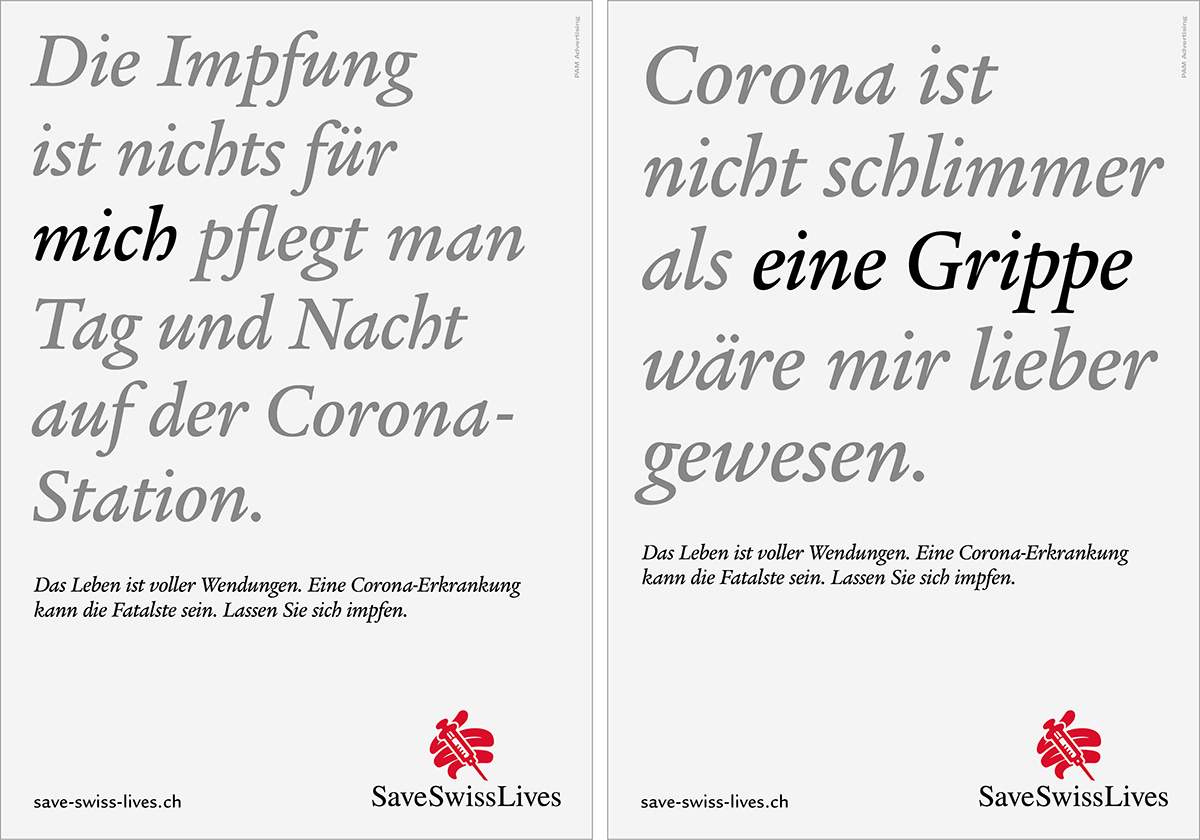
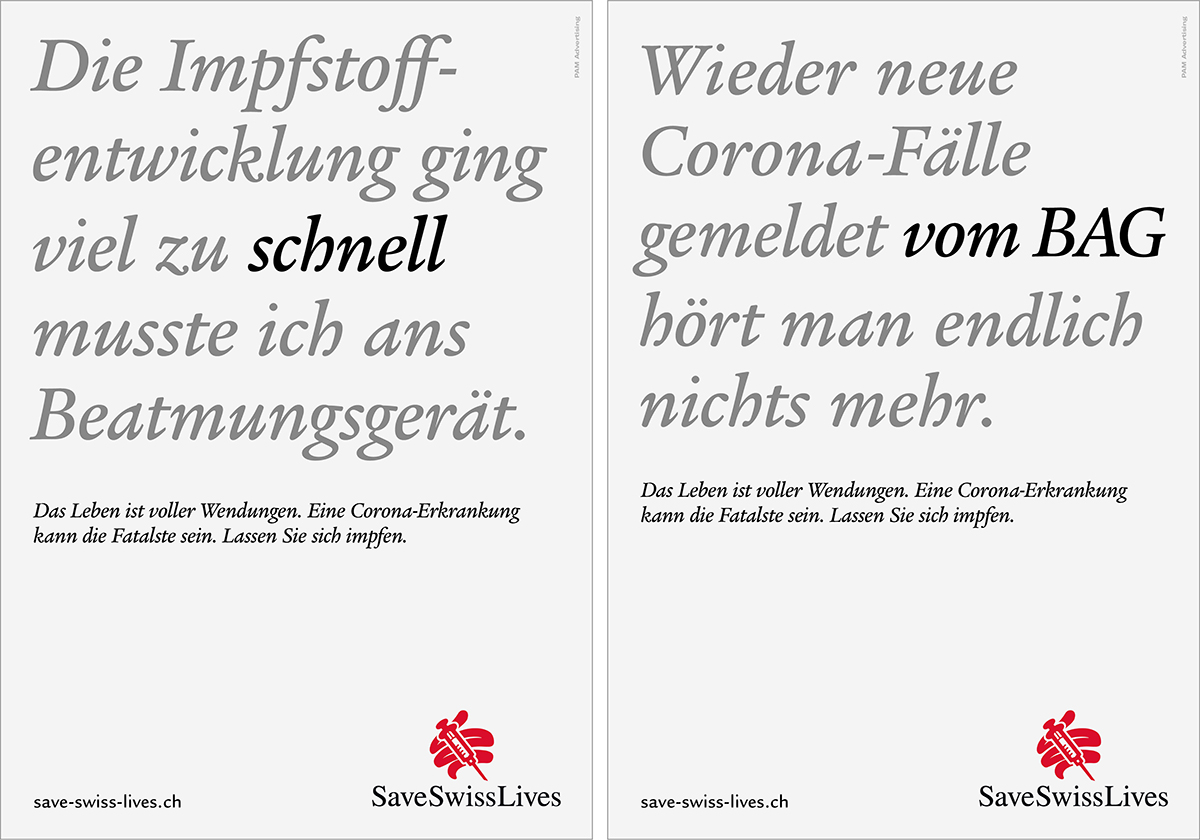
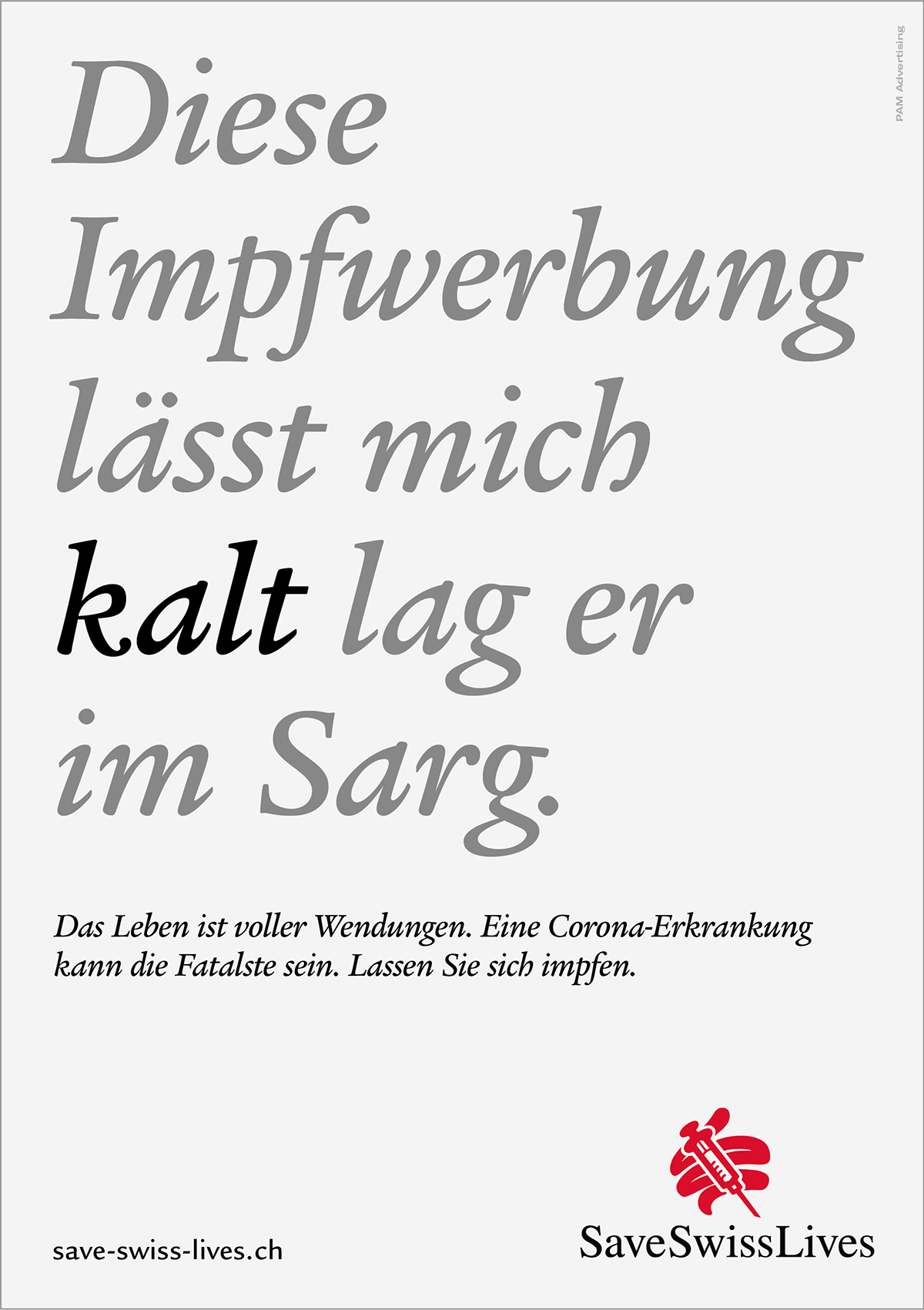
As early as November 2020, PAM toyed with the idea of launching its own vaccination campaign. However, since a sufficient vaccine supply was still very unclear at that time, the agency owners Miro Pfister and Parvez Sheik Fareed waited. In the meantime, the situation looks somewhat better, but prejudices and misinformation still prevail against the Corona vaccination, although the vaccination is considered the most promising and fastest way back to normality. The skeptics and opponents of vaccination are therefore in the focus of the PAM's vaccination campaign launched on Sunday..
Homage to Swiss Life's turnaround campaign
The idea SaveSwissLives was born from the name Swiss Life. The turnaround campaign for Swiss Life provided the inspiration, as a corona disease can also be a turnaround in life. If it is severe, it can even be a bad turn.
The campaign is therefore a mischievous homage to the multiple award-winning turnaround campaign developed at the time by Spillmann/Felser/Leo Burnett, which is still one of the most popular Swiss campaigns today.
"We make no secret of the fact that SaveSwissLives would not even be possible without the original. That's why we deliberately stayed close to the original campaign so that it would be recognizable as such," explains Miro Pfister, co-owner and creative director at PAM Advertising.
Accordingly, various Corona turn phrases and an adapted subline dramatize the vaccination issue. The essential twist is resolved at the end via the campaign logo: SaveSwissLives. On the website save-swiss-lives.ch all subjects can be downloaded.
"We hope people will post and send the subjects on social media. We have more topicality-related subjects in our quiver, which we will publish as soon as the media context is given," says Pfister.
Crowdfunding to enable switching
To take the campaign nationwide, PAM created a Crowdfunding on WeMakeIt started. The goal is 75,000 Swiss francs to realize a broad circuit.
Supporters receive several rewards: Mention in campaign credits, a campaign subject headline featuring the donor's first name, and a designed limited-edition sweater with "I'm Vaccinated" printed on it.
REQUESTED
"Another velvet glove campaign would accomplish nothing"
PAM Advertising launches SaveSwissLives, a crowdfunded Corona vaccination campaign that doesn't mince words. Johannes Hapig asked the founders Miro Pfister and Parvez Sheik Fareed why their campaign is needed.
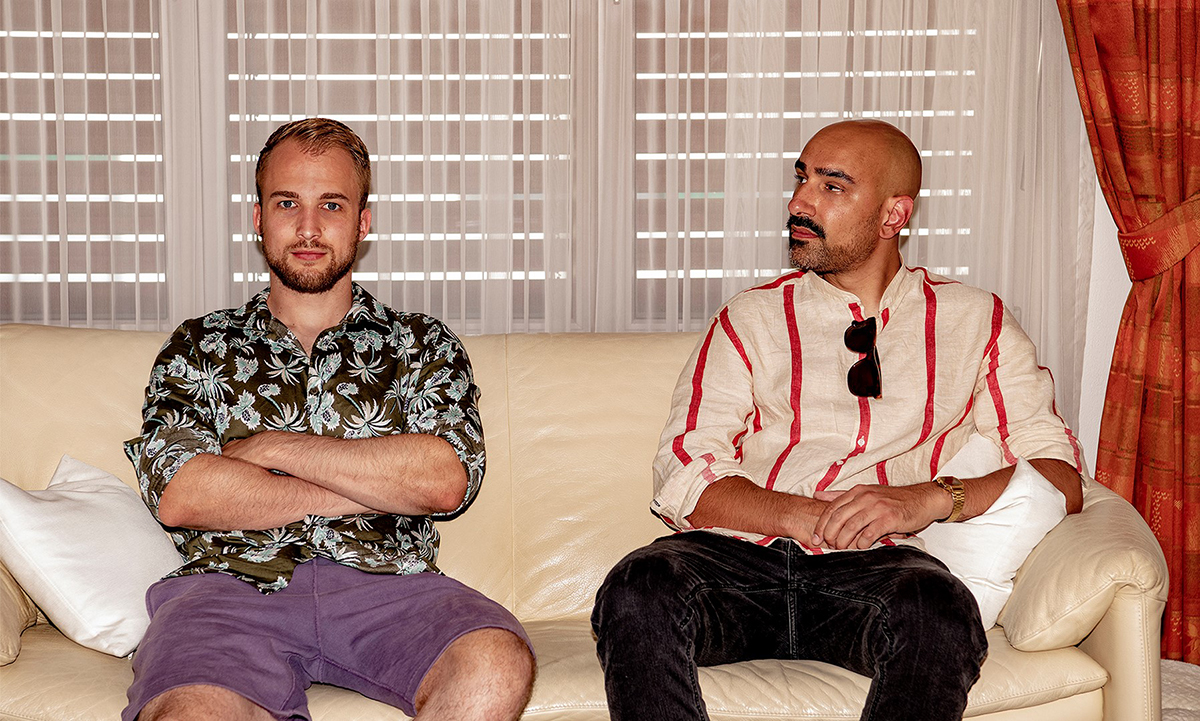
Miro Pfister (left) and Parvez Sheik Fareed of PAM Advertising launch the SaveSwissLives corona vaccination campaign.
Werbewoche.ch:Mr. Sheik Fareed, you would like to finance the launch of a vaccination campaign via crowdfunding. In your opinion, doesn't the current FOPH campaign make people want to take a prick in the upper arm?
Parvez Sheik Fareed: Not really. While the FOPH campaign has massive advertising pressure, which helps visibility, the content lacks rousing persuasiveness. It smacks very much of committee culture at the client to promote internal peace, so that everyone feels picked up and covered. It's probably not an easy job for Rod.
Mr. Pfister, can you tell us a bit more about how you came up with the idea of launching such a campaign?
Miro Pfister: We were already toying with the idea of launching our own Corona vaccination campaign in November. Then the next question was what do we communicate? We found that calling a spade a spade and directly addressing the controversial issues surrounding vaccine skeptics would be most effective. Another velvet glove campaign wouldn't do any good.
Why is the campaign important to you personally?
Pfister: Besides the simple fact that vaccination can save lives, such a campaign also helps the economy, which benefits society as a whole. In our country, too, two or three projects have been stopped, with a temporary drop in demand. And, of course, I also simply wish that life would start again properly.
You took Swiss Life's reversible set campaign as inspiration. Why do the subjects fit so well with your new campaign?
Pfister: As we were poking around for ideas, the Swiss Life logo happened to come to mind. But don't ask me why. And then, with the addition of "Save", we came up with the statement "Save Swiss Lives". And that's what the Corona vaccination is all about. Of course, we then immediately thought of the famous turnaround sentences, which provided us with the slogan. After all, a Corona disease can also be a turning point in one's life, and if it is severe, it can even be a serious one. We make no secret of the fact that SaveSwissLives would not be possible without the original. That's why we have deliberately stayed close to the original, so that it can be recognized as such - a mischievous homage to Spillmann/Felser/Leo Burnett.
Sheik Fareed: By the way, our pension funds are with Swiss Life. If SwissLife would like to support the SaveSwissLives campaign, we would be delighted to receive a financial injection.
With the campaign, you are tackling an issue that is controversially received by parts of society. Are you worried about a possible backlash from the so-called "vaccination skeptics"?
Sheik Fareed: No, not at all. It is simply a reality that these circles sometimes present quite hair-raising things as facts. You can also make that a topic of discussion.
Do you think more agencies should come out of the woodwork when it comes to important issues - and sometimes launch campaigns that are more a matter of the heart than of customer interest?
Sheik Fareed: That's something every agency has to decide for itself. But agencies would certainly be well advised to generally venture out of the woodwork, especially when it comes to customer orders.
Pfister: It's also not a question of customer interests versus matters of the heart, you can easily do both. Personally, I find advertisers a bit strange who prefer to promote only social causes and turn up their noses at commercial communication.
Switzerland Tourism Brings Women to the Top
As part of International Women’s Day, Switzerland Tourism (ST) is launching the “100 % Women” initiative with the goal of connecting women and opening up new opportunities for them to enjoy new experiences. This is particularly true in the areas of outdoor and mountain sports, which are especially important during and after the pandemic.
Editorial
-
March 7, 2021
The 100 % Women Peak Challenge aims to have all-women rope teams climb the 48 highest peaks in the Swiss Alps. The Challenge runs from Monday until September 8, 2021. The interactive landing page Peakchallenge.myswitzerland.com accompanies the action and is to be crowned by the summit selfies of the participants.
ST runs the Challenge together with its partners Swiss Alpine Club SAC, Swiss Mountain Guide Association and the Swiss outdoor brand Mammut. Prominent participants include pop singer Beatrice Egli and the first Saudi Arabian female climber on Mount Everest, Raha Moharrak.
Offers from women for women
Together with the tourism industry, ST presents at MySwitzerland.com/women around 230 offers and events that focus on women and a female view of Switzerland. All of the experiences - which last from a few hours to several days - are led by women to give them and their actions a platform and create role models. Around half of the experiences were newly developed for this campaign. A jury of experts selected the offerings according to defined criteria.
One focus is on outdoor offers, which are all "women-only" and take place in women-only groups. Men are also invited to discover Switzerland with a focus on 100 % Women. For example, on one of more than 40 city or cultural tours that are all about women and their work.
Women's travel booming
Why the focus on women? According to Forbes, around 80 percent of travel decisions will be made by women - no matter who they travel with. Seventy-five percent of tourists booking adventure, cultural or nature trips are women between the ages of 20 and 70. National Geographic identified women-only travel as the top travel trend for 2020, with demand evolving from traditional wellness travel to a broad range of interests. In the outdoor sector in particular, ST sees great potential for attracting women as new guests, and for attracting already enthusiastic outdoor sportswomen, such as hikers, to other outdoor activities such as high-altitude tours or biking.
Women-only offers, led by female mountain guides or female guides, would motivate many women to leave their comfort zone together with like-minded people.
Already in February 2020, ST invited the tourism industry to a workshop to talk about female needs in outdoor sports under the guidance of experts. The results are summarized in a guide for the industry.
AZ Medien generates profit in Corona year 2020
The media group AZ Medien achieved a solid result last year. Turnover amounted to 233 million francs. The bottom line was a profit of 10.1 million francs, as AZ Medien announced on Saturday. The Wanner publishing family also intends to buy back the AZ shares.
Editorial
-
March 7, 2021
The Board of Directors attributes the results primarily to cost-cutting measures, short-time working compensation and emergency media aid from the federal government.
The conclusion of the news portal was pleasing Watson turned out well. It was able to massively increase its advertising income and is in the black for the first time, according to a report by the Switzerland at the weekend continues. Watson has also been present in French-speaking Switzerland since March 1.
In view of the pandemic and the challenging situation, the Board of Directors has decided not to distribute a dividend for the 2020 financial year.
Publishing family wants to buy back shares
At the same time, the Wanner publishing family announced in a press release that it intends to acquire 100 percent of AZ Medien. They will submit a takeover bid to the minority shareholders. The Wanner family currently holds a good 90 percent of AZ Medien. (SDA)
Is there such a thing as the perfect Christmas figure in advertising?
Both Migros and Coop have already used animated Christmas characters. But which character comes out on top in the neuromarketing comparison? A study by Zutt & Partner shows that there isn't necessarily a clear winner.
Editorial
-
March 5, 2021
In December 2020, Zutt & Partner launched a survey on Linkedin. The question was, which of the animated Christmas figures - from Migros or Coop - hit the Christmas emotions better.
In the non-representative Liking survey, the Migros gnome Finn was clearly ahead with 67 votes to 6. Zutt & Partner wanted to get to the bottom of this result scientifically and wants to use the EmoCompass study to show why Migros may have won so clearly on Linkedin and where there is still room for improvement for both providers.
Confirm emotion volume Linkedin survey
Linkedin surveys are not suitable for scientifically studying emotions. However, they can provide initial indications. In the study, similar results actually emerge: If the emotions are surveyed non-verbally and scientifically based, the Migros gnome triggers a significantly higher "emotion volume" than the Coop snow monster Nevi.
The emotion volume shows how much emotion a research object triggers in general. High emotion volumes are often measurable, for example, in the case of strong and well-known car brands or chocolate products, because they appeal to several senses at once, tell stories and have been imprinted in the customer's brain for years.
The latter is known in neuropsychology as the "mere-exposure effect". Mere-exposure refers to the realization that the repeated perception of an initially neutral thing alone results in its more positive evaluation. So it could well be that the Finn "only" triggers more emotion because it has been around longer and is more familiar to the customer's brain.
The Migros Secret Santa triggers significantly more emotions than the Coop Snow Monster. The reason for this could be the so-called "mere exposure effect". (Graphic: Zutt & Partner)
Not only Coop has room for improvement
Strong brands, products, experiences and mascots not only trigger many emotions, but also the right emotions. After all, they hit the desired gut feeling of customers and consumers - the so-called gold standard, which sits deep in the subconscious.
Therefore, the emotional desire - to get the perfect Christmas feeling - was also elicited to calculate the emotional seams and widths to Finn and Nevi, respectively. The EmoMap created in the study shows that although the Migros gnome arouses more emotions than the snow monster, the latter is closer to the perfect Christmas feeling. It must be said that both characters are still far from the perfect Christmas feeling.
The EmoMap, a comparison of different EmoProfiles, depicts which figure comes closest to the perfect Christmas feeling. The closer the pins are to each other, the more similar the emotional feelings are in the subconscious. (Graphic: Zutt & Partner)
This differentiated insight thus corroborates the mere-exposure hypothesis from the first study section - it could well be that after repeated repetition, the snow monster triggers emotionally in a similar way as the gnomes. But how could both Finn and Nevi get closer to the gold standard?
The ideal figure would be a mix of the two
The Migros Santa Claus covers the dimension of power better. The Coop snow monster, on the other hand, better covers the somewhat more important dimension of safety. The perfect figure would therefore be an emotional mix of both.
A closer look at the individual emotion profiles should provide some insight: Neither Coop nor Migros meet all facets of the perfect Christmas feeling. This is primarily composed of the two emotion dimensions security and power, with security playing a slightly stronger role than power.
The dimension of security includes Christmas-related feelings such as being with family, familiarity, or the calming effect of a snowy landscape. Power, on the other hand, includes sparkle, shopping and celebration.
The snow monster from Coop captures the feeling of safety much better and thus has an emotional advantage. The somewhat less decisive dimension of power, on the other hand, is massively better covered by the Migros gnome.
The Migros Santa Claus covers the dimension of power better. The Coop snow monster, on the other hand, better covers the somewhat more important dimension of safety. The perfect figure would therefore be an emotional mix of both. (Graphic: Zutt & Partner)
According to Zutt & Partner, the ideal Christmas figure would be an emotional mix of the two artificial figures. Coop and Migros could therefore learn from each other and adapt the emotional aspects of the other figure.
According to Zutt & Partner, another option would be to design a completely new figure based on the Christmas emotion - this approach is not reserved for Coop or Migros alone. This option is also open to any other retailer such as Lidl or Aldi.
The results of the study are based on a qualitative EmoCompasssurvey conducted in January 2021 by Zutt & Partner, a Zurich-based consultancy specializing in neuromarketing.
The determined mood movements of 50 persons living in the German-speaking part of Switzerland were analyzed. The survey was conducted in online individual interviews - completely non-verbal via neuropsychologically coded patterns. Working with abstract colors and shapes allows for tapping into emotions at a deep individual level of association and almost to the exclusion of cognition (rational thought) and of pure likes and dislikes. For the methodology the findings from neurology like synesthesia, patchwork-like working of the brain as well as fuzzy logic are used.
Detailed results, interpretations, further information on the study and initial approaches to solutions are available to interested parties at a Workshops.
How media professionals in Switzerland are going through the crisis
Journalism in the Age of COVID-19: A survey conducted by the Swiss Media Commission (EMEK) highlights just how challenging the work of journalists has become under COVID-19 conditions.
Editorial
-
March 5, 2021
In qualitative group discussions, 33 media professionals from Switzerland's three major language areas provided a multi-layered insight into how they have perceived and coped with the Corona crisis to date. The EMEK has documented the conversations. In its report, it gives the floor to the journalists and rounds off their statements with its own conclusions.
No criticism, but a sense of community
According to their own assessment, the media act in their role as mediators in the acute crisis period in the sense of the Federal Council and mostly refrain from taking critical positions. The focus is on strengthening the community and overcoming the crisis together. Many emphasize their important function and see their performance in the context of a "public service. This also includes listening to their audience and responding to perceived needs from the population.
In the medium term, however, the media are once again taking on the role of gatekeeper to a greater extent, setting their own priorities and sometimes even questioning the authorities. Many media organizations notice that there is a lack of expertise from a science journalist in their own house.
Organizational challenges
The crisis is forcing media professionals into the home office. For many traditional media companies, this is uncharted territory and is associated with a fundamental rethink in the area of management and work organization - and with a technical innovation push.
Overall, the journalists are satisfied with their performance during the crisis, but they are also self-critical. This is especially true with regard to the question of how they have fulfilled their function of the fourth estate.
Three discussion points
In its conclusions, the EMEK points out three points for discussion.
Service (public) performance versus service public missionAll media have shown a self-imposed extraordinary performance in the context of Corona and have thus accompanied the population through an extraordinary situation. They have thus committed themselves to society and served the public mandate, irrespective of whether they are obliged by a concession under the RTVA to a defined performance mandate.
Lack of science journalism: As a result of a thinning out of specialist editorial departments that has been going on for some time, many media houses lack the relevant expertise. The Corona crisis clearly demonstrated this. Many, especially smaller, media organizations are not only depend on external experts, they also lack the in-house expertise to contextualize and journalistically process this information.
Journalism in the home office - is that possible? To what extent does telecommuting affect journalistic quality? From a purely technical point of view, there's nothing to be said against working from home. However, journalism also thrives on the exchange of ideas in the editorial offices. Consistent telecommuting also possibly favors the tendency to do journalism from the desk and to grasp the world via Google. The on-site experience is missing. Is this desirable? This is a discussion that needs to be had.
New SRF broadcasts: Valais police officers and a farmer drama
This year, SRF is airing two series with which it hopes to build on the huge success of «Wilder» and «Frieden»: «Tschugger» and «Neumatt.».
Editorial
-
March 5, 2021
At a virtual event on -Thursday, Director Nathalie Wappler (pictured) and the SRF management informed the media about current projects at SRF. For eight episodes, "Neumatt" is about the struggle for existence of a family that has to modernize its farm in order not to go under. The son, who now lives in the city as a consultant, returns to the farm in this drama and has to deal with issues such as the current dairy industry.
Tschugger" is about police officers from the Valais. It's a five-part comedy about a would-be cowboy, a village policeman and a federal policewoman who have to investigate together. SRF explicitly wants to attract viewers under 45 with this production.
Talent scouts travel through Switzerland
SRF is also targeting younger viewers with its new talent show "Stadt Land Talent," in which talent scouts travel the country and visit future stage hopefuls at home. They then show off their skills on the SRF stage.
SRF also announced on Thursday what it intends to replace the business show "Eco" with: a weekly business talk show, although there is no name for it yet. The first program will be broadcast on August 16, hosted by "Eco" presenter Reto Lipp.
Explainer videos for business topics
According to SRF, this program will not only feature the usual business representatives, but also voices from the general population. The topics will also be chosen somewhat "closer to the viewer" and will increasingly deal with the professional world and real estate.
Formats for a younger audience are also planned in business reporting in order to rejuvenate the SRF audience. On Instagram, for example, younger viewers are to be introduced to business topics via short explanatory videos. (SDA)
Nicoletta Cimmino leaves SRF
Nicoletta Cimmino, presenter of the radio program "Echo der Zeit," is leaving SRF at the end of May. She wants to strike out on new paths once again and is setting up her own business.
Editorial
-
March 5, 2021
Nicoletta Cimmino is leaving SRF. (Image: Srf.ch)
Cimmino has been working at Radio SRF since 2004. First as TAV producer at SRF 1, then in the newsroom at "Info3," "Heute Morgen," and in Radio SRF's domestic newsroom in Bern. For the last five years she hosted the program "Echo der Zeit". From the industry magazine Swiss journalist:in she was named "Journalist of the Year" in 2019 (Werbewoche.ch reported).
Step into independence
Now Nicoletta Cimmino is leaving SRF at the end of May. She is founding her own company and in the future will work as an author, produce podcasts and moderate events and panel discussions. "Leaving SRF was not easy for me. I will especially miss my dear colleagues in the 'Echo' editorial team. However, at 47 years of age and with a great deal of journalistic experience, the time is right for me to pursue new paths," says Nicoletta Cimmino, explaining her decision.







 In qualitative group discussions, 33 media professionals from Switzerland's three major language areas provided a multi-layered insight into how they have perceived and coped with the Corona crisis to date. The EMEK has documented the conversations. In its report, it gives the floor to the journalists and rounds off their statements with its own conclusions.