KSP wants to push back Swiss Overshoot Day

May 11 is Swiss Overshoot Day - all natural resources in Switzerland have been used up, which should actually last for a whole year. KSP thinks that this absolutely has to be changed and has therefore created a small film to raise awareness.

KSP also realized a social media post for Volkswagen. With the suggestion to switch to the all-electric ID. models and to contribute to postponing the Swiss Overshoot Day to the end of the year again.


Responsible at Amag Import: Melanie Felder (Team Leader Marketing Communication). Responsible at KSP: Alba Rau (art direction), Stephanie Waldvogel (animation, editing), Jelena Germann (graphics), Barbara Sarras (text), Uwe Schlupp, Daniel Krieg (creative direction), Andrea Heller (consulting), Getty Images (videos).

Rod communication and Tally Wejl whistle on expectations

With «Totally me. #fuckexpectations,» the fashion brand Tally Wejl and the Zurich-based agency Rod Kommunikation are launching a rebellious campaign that shows what they think of societal expectations.

Society is full of expectations - especially for young women. And in the past, hardly any other industry has shaped social stereotypes as much as the fashion industry. With its new campaign "Totally me. #fuckexpectations", fashion brand Tally Wejl wants to motivate young women to rebel against these expectations. And not to let anyone tell them what to do, what to say or what to wear.

With the launch of its first major campaign in ten years, Tally Wejl wants to redefine itself. For the fashion brand, the new direction as a Gen-Z brand is a highlight in a very tough Corona year for retailers.

The campaign has been on posters in Zurich and Basel since Tuesday, as well as online in Switzerland, Germany, France, Italy, Austria and Poland.


Responsible at Tally Weijl: Lara Gruering (Director of Brand Management). Conception, creation and realization: Rod Communication. Photographer: Dan Cermak. Lithography: Blue Horizon. Producer: Team Turmoil.

IGEM event on the future of radio and audio advertising

Digital usage of radio and audio content is increasing, generating more inventory for audio advertising. With the planned FM switch-off in January 2023, radio will become a 100% digital medium. What does this mean for audio content re-financing? Will the commercial side follow the audio usage boom? The IGEM event on the future of radio and audio advertising provided the first answers.

The IGEM Radio Audio Advertising event: Aline Rutishauser from Radio FM1 talks to IGEM President Stephan Küng.

Together with the Swiss Private Radio Association (VSP) and IAB Switzerland, the Electronic Media Interest Group (IGEM) organized a focused event on the "Future of Radio Audio Advertising". At the virtual event, speakers from Switzerland and abroad presented the outlook for radio and audio advertising.

For Anja Hänni, Head of Print, Radio and OOH at the agency network Dentsu Switzerland, classic radio campaigns can be reinforced or extended with digital audio spots. But a purely digital audio campaign is no substitute for classic radio advertising, whose broad reach is indispensable. For a successful audio future, Anja Hänni would like to see more targeting options, more information about digital users and clickable audio spots. Anja Hänni welcomes joint initiatives from the radio and audio industry: "Today I'm booking radio stations, tomorrow I won't be interested in which station my spot is broadcast on, but to whom. For that, I need the whole industry and not individual stations."

Iso Rechsteiner, project manager of the Digimig Digital Migration Working Group, presents the latest data from fall 2020 on Swiss radio usage. Digital radio usage is on the rise: 73 percent of radio usage is now done digitally. 41 out of 100 radio minutes listened to happen via DAB+ and 32 minutes via IP - i.e. via computer, tablet or smartphone. Whereas in 2015, 51 out of every 100 minutes of radio listened to were via FM, in the fall of 2020 this figure will only be 27 minutes. In the car, 45 percent of radio usage is still heard via FM. But even in the car, the majority of radio usage (55 percent) is now digital - via DAB+ or IP. As a result, Stephan Küng, President of IGEM and owner of the media agency TWmedia, was cautiously optimistic about the switch to DAB+ in an interview with Radio FM1 presenter Aline Rutishauser.

Florian Wanner, Head of Radio at CH Media, shows that digital distribution via DAB+ or IP is working in Switzerland. For example, the use of national radio stations broadcast exclusively via DAB+ or IP, such as Virgin Rock or Energy Vintage, has increased despite the pandemic. Usage via IP is also on the rise for CH Media's regional radio stations, and especially at news times. "I'm particularly pleased that radio usage via IP is sustainable," says Florian Wanner in this regard. CH Media thus has a larger advertising inventory for audio spots. But Wanner also hints that marketing can still be expanded.

Matthias Kost, Managing Director of Radio Zürisee, then explains what such a marketing strategy might look like in terms of refinancing audio content. Digitalization is making radio advertising international and bringing in competitors from outside the radio industry. For Matthias Kost, journalistic audio content with proximity to the audience therefore forms the backbone in the digital advertising market.

Ralf Brachat, Managing Director of Swiss Radioworld, shows how the radio market in Switzerland has already evolved into an audio market. A broad portfolio of digital radio streams can be booked programmatically and with targeting since one month. In addition, Swiss Radioworld has collected all podcast advertising opportunities in Switzerland and makes it available as a bundled podcast offer.

Thomas Kabke-Sommer, Managing Director of Crossplan Germany, shows how value creation for audio publishers can be increased by bundling audio streams and consistent data management. For Kabke-Sommer, audio advertising must be as good at digital targeting as display or video advertising. With 15 million addressable profiles, Crossplan Germany can provide more than 150 target group segments. And this is being used by the advertising industry: Of the 3,500 regional campaigns Crossplan Germany delivered in 2020, 95 percent had targeting, so they were data-driven.

Overall, the IGEM event shows that the radio market in Switzerland has already evolved into an audio market. It is welcome that various market partners and providers are working together to develop and drive industry solutions. If the advertising market's demand for more targeting options and more information about digital users can be served, the audio market in Switzerland is in for an exciting time.

Living and working after 2020: DACH countries less accepting of new working models

The pandemic has turned the way we live and work upside down. What has it done to people? A recent study by Avaya in cooperation with the market research company Davies Hickman Partner explores this question.

The study provides insights into the acceptance of new collaboration models, the love-hate relationship with the home office, the new fears about the future and the reasons for them. It also takes a look at new consumer behavior and the associated service expectations of consumers. German-speaking countries differ from other countries on a number of points.

Home office and new collaboration models not so popular

The study participants from Switzerland, Austria and Germany are among the most conservative when it comes to embracing the new, hybrid working world 4.0. "Middle Eastern countries stand out as particularly committed technology enthusiasts. They emerge in the study as the most open to new technologies, change and new work. The UK and the US are in the middle of the pack, while the countries in the DACH region - Germany, Austria and Switzerland - are comparatively conservative in their enthusiasm for new forms of work," comments Rania Odermatt, Country Manager/Managing Director Alpine Accounts.

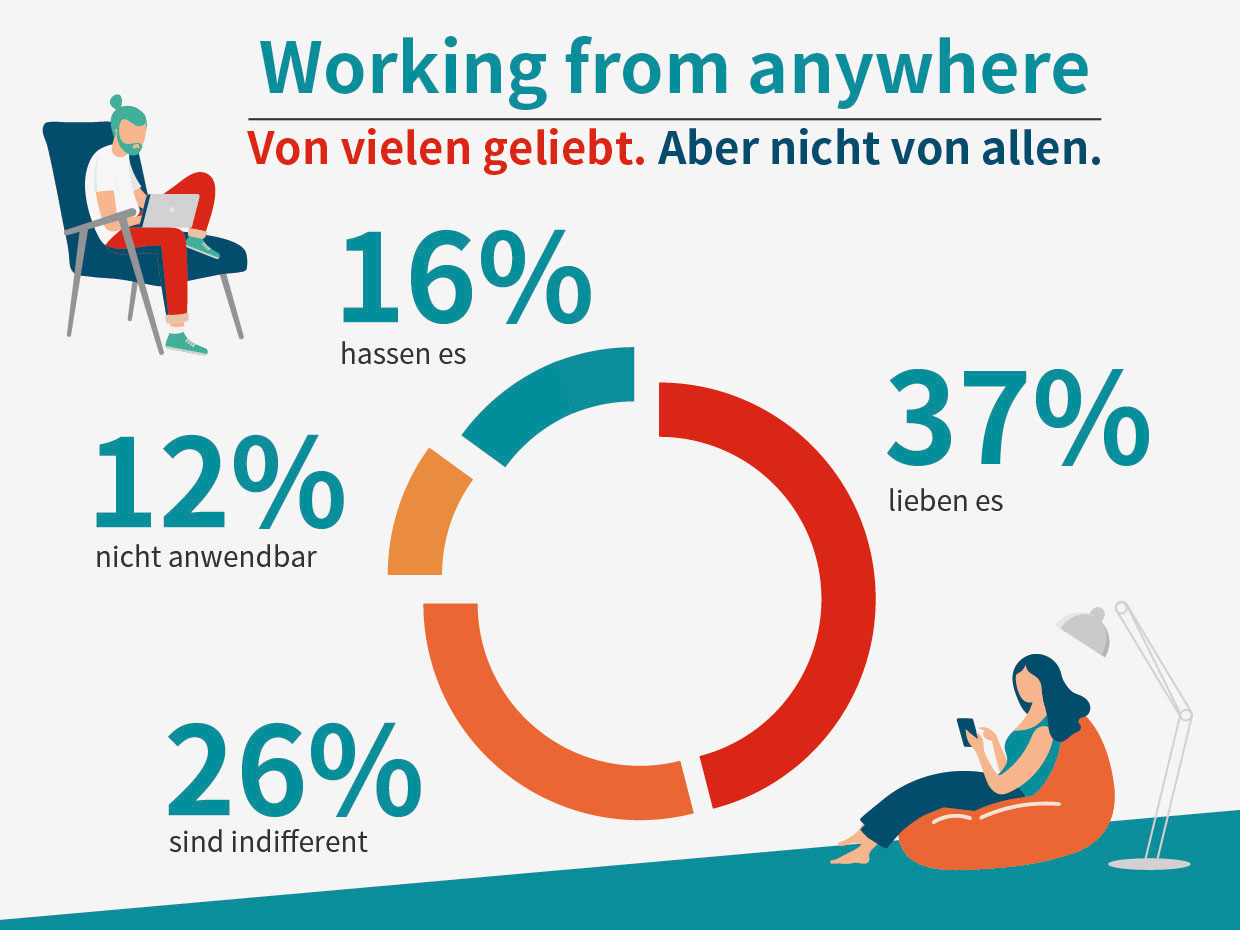
39 percent of Austrian and 43 percent of Swiss employees appreciate the new "work from anywhere" options and want to keep them. Globally, this figure is even higher, at around 46 percent. For 11 percent of respondents from Austria and 8 percent from Switzerland, a home office solution could not be implemented. Globally, this figure is 6 percent; in India, only 2 percent were even unable to implement home office. Two-thirds of respondents feel happier overall if they can (also) work in a home office. In addition, 12 percent of respondents from Austria and 11 percent of participants from Switzerland are skeptical about working from home. Internationally, this figure is 10 percent.
Frustration arises when employers skimp on technologies for efficient communication and collaboration. The loss of productivity due to inadequate technologies is described as a stumbling block by 48 percent of Austrian and 54 percent of Swiss participants. It seems to be a golden moment for digitization.

Employees become workaholics out of fear

The new opportunities for collaboration also have their downsides: Employees are becoming workaholics out of fear of losing their jobs. This has consequences for the psyche, as the global study shows.

41 percent of respondents from Austria and 35 percent from Switzerland said they were unhappier since the outbreak of the pandemic. Globally, this figure is even higher at 43 percent. Direct contact with others is particularly missed. In addition, money worries, fears and risk aversion are putting a strain on peace of mind. 22 percent of the study participants from Austria and 24 percent from Switzerland give priority to work over personal well-being. Globally, this figure is as high as 34 percent.

This is not without consequences: 27 percent of the employees surveyed from Austria and 34 percent from Switzerland describe themselves as workaholics. 36 percent and 32 percent of employees from Austria and Switzerland respectively struggle with their work-life balance. 41 percent of survey participants from Austria and 39 percent from Switzerland feel trapped in their daily routine. 44 percent of respondents from Austria and 46 percent of respondents from Switzerland would like to take it a little easier, but don't dare for fear of losing their jobs due to automation.

Customer expectation diametrically opposed to customer experience 

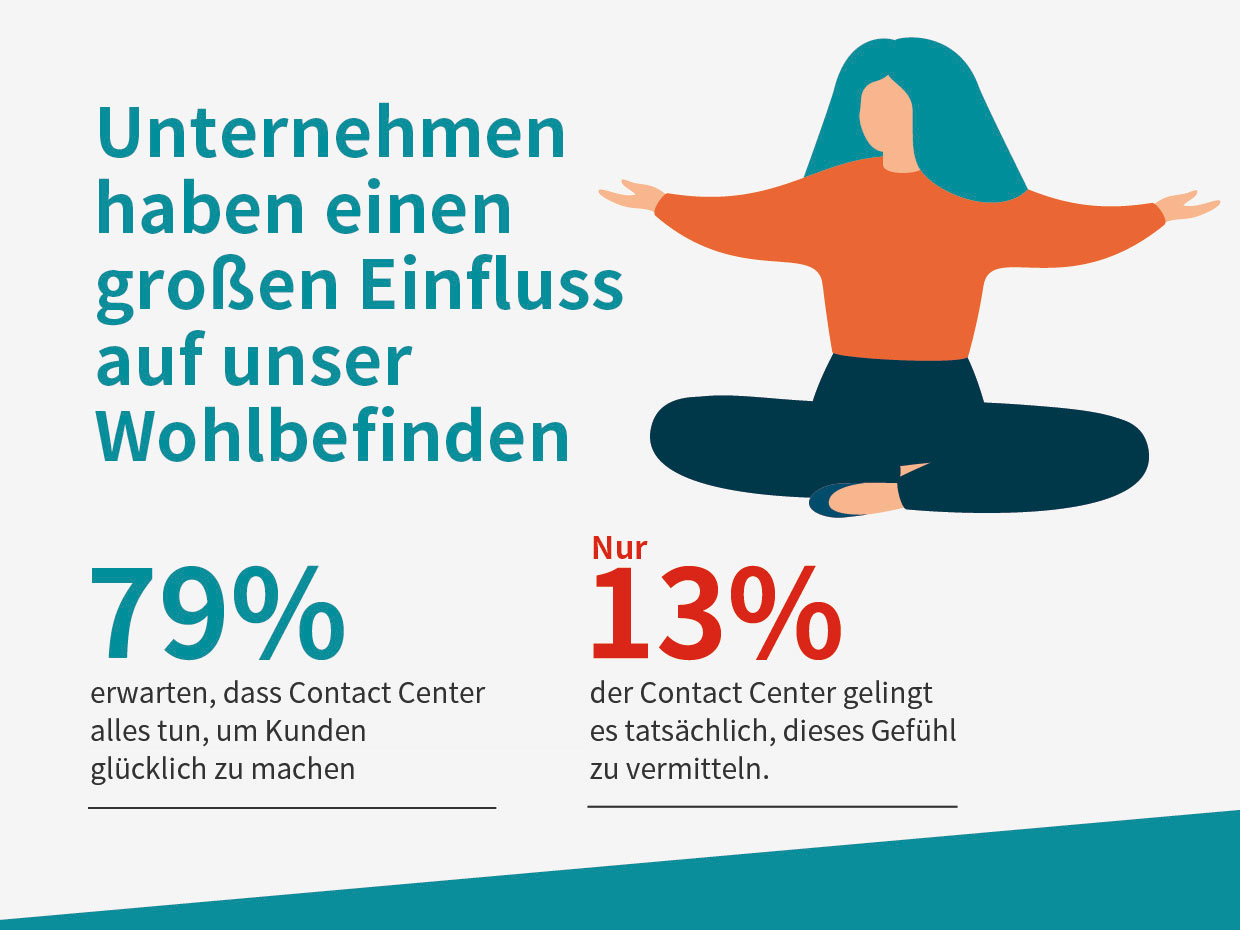
In times of e-commerce and "untouchpoints", the service center is gaining in importance. Due to lockdown, it is replacing personal consulting in many places. The expectations of customers are correspondingly high. So is disillusionment at the moment of truth, as the study makes clear. While 79 percent of customers expect a good customer experience in the contact center, only 13 percent of companies live up to this expectation. 69 percent of customers also think that companies should try to make their customers happy. 5 percent of companies from Austria and 7 percent of companies from Switzerland succeed in doing so.
Consumers in the DACH region are also more conservative about the use of new technologies in customer service: Messenger services such as Whatsapp would currently be used by just under a third (globally: 43 percent), while AI-supported chatbots would be used by only 19 percent of Austrian and 25 percent of Swiss consumers (globally: 34 percent).

After all, 27 percent of the Austrian and 20 percent of the Swiss participants (globally one-third) describe customer service employees as more warm-hearted and empathetic than in the pre-Covid year 2019. A good start - with plenty of room for improvement.


As part of the global study "Life and Work beyond 2020: The Change Makers." has the Market research firm Davies Hickman Partners conducted interviews with 10,000 consumers and employees in Austria, Canada, Egypt, France, Germany, India, Saudi Arabia, Switzerland, the United Arab Emirates, the United Kingdom and the United States. The study was sponsored by Avaya.

Agency at the airport shows the sources of inspiration of APM Technica

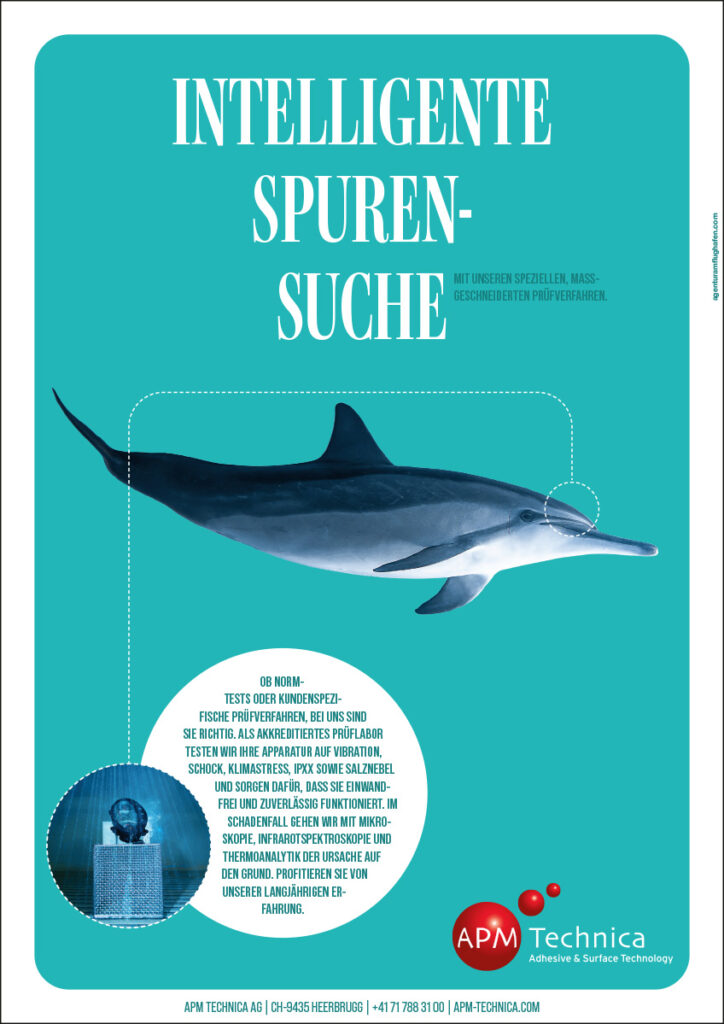
The Altenrhein agency at the airport is showcasing in a poster campaign where APM Technica draws its inspiration from: nature.

APM Technica, which operates worldwide, develops high-tech adhesives and surface coatings for the aerospace industry, the automotive sector, the watchmaking and optoelectronics industries, and many others. For example, Harley Davidson's speedometers are bonded with a special solution from Heerbrugg.

However, the company not only stands for bonding and surface expertise, but also polishes, assembles, soldering, welding, screwing, packaging, testing, inspecting and analyzing in their plants. The more unusual the tasks, the more inspired the solutions proposed by the engineers and process specialists.

They get this inspiration from everywhere. So also from nature. The agency at the airport has taken this up and developed a campaign that shows the inspiration from extraordinary abilities of ingenious creatures in nature.


Responsible for APM Technica: Arthur Philipp (Chairman), Martina Felder (CHRO/CMO and Member of the Executive Board), Julija Milković (Sales/Export & Marketing). Responsible for Agency at the airport: René Eugster (Creative Direction), Dominique Rutishauser (Art Direction), Ketil Eggum (Graphics), Miriam Egli (Consulting/Text), Robert Kadlus (Image Editing).

PHD Switzerland has DOOH campaign analyzed ex-post for the first time by Intervista

Together with Intervista and Adtrac, OMG Switzerland has developed an ex-post standard report for DOOH campaigns on the effective gross and net reach, including target group data. PHD Switzerland was the first agency to have a campaign analyzed in this way.

The report is created by combining the campaign's second-by-second playout data and the very precise movement data in Intervista's Footprints panel using beacon technology. This allows statistically valid statements to be made about the effective gross and net reach of an OOH campaign that has been run in the overall population and within the target group.

"In the Footprints panel with 3,000 participants, stays at Adtrac screens are continuously measured via beacons. Thanks to these measurements, the campaigns can be analyzed in detail and accurately," explains Beat Fischer, member of the Intervista management.

"We want to inform our customers as transparently and reliably as possible about their campaign. This also includes making the offer auditable by external institutes. Intervista's Footprints Panel is predestined for this," adds Ben Wey, Managing Director of Adtrac.


Responsible: Denise Martin (PHD Media), Stefan Beitz (OMG), Beat Fischer (Intervista), Ben Wey (Adtrac).

Family picks up eleven NYX Awards with Watson campaign

For the Watson campaign «Take a Stand, Read Watson,» the Uster-based agency Family won a total of eleven awards for advertising and marketing strategy at the NYX Awards in New York.

As part of the launch of Watson Romandie, Family developed the image campaign for Watson.ch (Werbewoche.ch reported). Now the campaign has received eleven awards.

Seven of the eleven awards are Grands, the main prizes of the NYX Awards. Family takes the Grands in the categories Communication Campaign, Advertising Campaign, Company Branding, Advertising, Snapchat Filter, Brand Strategy Campaign and Video Campaign. In addition, the agency takes four Golds in the categories Business to Consumer, Branding Strategy Campaign, Marketing Effectiveness and again Video Campaign.

Emmanuel Fleig takes over the management of 20 Minuten

Emmanuel Fleig will become the new CEO of 20 Minuten. He will take over on April 1, 2022, succeeding Marcel Kohler, who will step down at that time.

Fleig, 52, is currently managing director of Edita, which publishes the Luxembourg commuter newspaper L'essentiel issues, like 20 minutes announced on Tuesday. As the newspaper 20 minutes had L'essentiel from a monolingual commuter title to a comprehensive media brand with a multilingual news portal and radio.

Fleig brings with him the optimal prerequisites to continue the success story of 20 minutes to continue writing, publisher Pietro Supino is quoted in the release. (SDA)

Office for refreshment broadens the agency management

The Büro für Erfrischung now has a co-CEO structure. Andi Gentsch, a former member of the management team and head of digital marketing at Plan.Net Suisse, is joining current CEO Thomas Grenacher.

The new co-managers of Büro für Erfrischung: Thomas Grenacher (left) and Andi Gentsch.

Grenacher and Gentsch have shared the operational management of the Winterthur agency since May 2021. This co-management takes into account the ever-increasing need for comprehensive consulting expertise and clients' desire for flexibly available contact persons, as the agency writes in a press release.


The shared agency management also reflects the desire of both managing directors for a contemporary, flexible management style. The office in the center of Winterthur now has a core team of ten employees.

As a former member of the management of Plan.Net Suisse, but also through his activities on the client side, Andi Gentsch has many years of experience in supporting clients from various industries.

Büro für Erfrischung from Winterthur - formerly Premiummedia - has served various regional clients in recent years, such as Technorama, FC Winterthur and the Winterthur Music Festival, as well as various national SMEs and cooperatives. Together with Digitalmaterial and Digitalmaterial Computershop, Büro für Erfrischung is a subsidiary of Sehr Gern GmbH.

Schroten makes the numbers come alive for Swiss Life

The Schroten agency makes the new Swiss Life study "Live longer - work longer?" emotionally tangible - with Mattogrosso Films and three real protagonists.

We are getting older and staying fit longer - does that also mean we are working longer and longer? A new study from Swiss Life explores this and other questions surrounding retirement. "Today, retirement from the labor market takes place later than it did 15 years ago. The timing of retirement is often self-determined and chosen according to individual preferences, as various indicators show. Under certain conditions, almost half of those over 55 can imagine working in retirement," says Andreas Christen, author of the study and senior researcher for pensions at Swiss Life Switzerland.

Swiss Life commissioned the young agency Schroten to provide content support for the study content. In short films that are played on social media, three protagonists tell why they are still working in a largely self-determined way after the age of 64 and 65 respectively.

In addition, interviews were produced with the portrayed persons for Swiss Life's "Life Stories" blog. The 69-year-old psychologist Allan Guggenbühl, for example, has his say. Somehow, he just can't help working because it interests him, which is quite typical of his profession - academics are among those who most frequently work longer hours.

Jürg Biber, a 68-year-old passionate winegrower who has not yet found a successor for his farm in Salgesch in the Valais and would actually be happy to go on a trip with his wife, has his say on behalf of the professional group of farmers. And then there is Maria Huber, who at eighty is still just as energetic and self-determined in her work at the Swiss fast food chain Silberkugel as she was forty years ago and still hasn't had enough of the hustle and bustle of the working world - albeit with a reduced workload.

In a short 60 seconds, the video portraits are meant to make viewers think about how they imagine this phase of life itself.


Responsible at Swiss Life: External Communications Team. Responsible for grist: Michèle Roten, Adrian Schräder (Content). Film: Mattogrosso, Benjamin Weiss (camera/direction), Annika Fausch (editing), Ramón Königshausen (color grading), Balint Dobozi (sound mixing), Gabe Noel (music). Photo: Romy Maxime Fuchs.

Dumeni Casaulta also heads regional broadcaster TVO

Dumeni Casaulta will take over as editor-in-chief of TVO, Radio FM1 and FM1Today in St. Gallen on June 1. The 33-year-old thus now also has editorial responsibility for the regional station TVO, as the publishing house CH Media announced on Tuesday.

Casaulta has been responsible for the editorial fortunes of the regional news portal FM1Today for almost five years. Three and a half years ago, he also took over as editorial director of Radio FM1.

Dumeni Casaulta will succeed Thomas Bächle, who has decided to change industries and will therefore be stepping down from TVO, the media company adds. A chief editorial office for all three electronic media is the last step towards trimedial convergence at the St. Gallen location. (SDA)

Blick TV: Rahel Lenz is the new moderator of the "Blick Referendum" campaign

The «Blick Election Campaign» has a new face: Rahel Lenz will now host the Blick TV political program. The 32-year-old has been working as a host and video editor at Blick TV since February 2021.

Rahel Lenz is the new moderator of the "Blick Referendum Campaign" on Blick TV. (Photo: Thomas Meier)

On Wednesday, Lenz will host her first "Blick Vote" on Blick TV. The presenter and video editor takes over from Jonas Projer, who has left the digital channel. "Rahel Lenz has proven herself to be an excellent presenter and editor and has demonstrated her political knowledge," says Stephanie Seliner, team leader moderation at Blick TV. "We are looking forward to the future 'Blick Vote' campaign with her."

Tomorrow's show is about the revised CO2 law. The guests are FDP Council of States member Damian Müller on the pro side and SVP National Council member Christian Imark on the opposing side. Starting at 6 p.m., they will debate in a race against time - each is allowed to speak for exactly seven minutes. Viewers have the final say: They can vote for their favorite on Blick.ch, and the winner receives a free ad in the printed Blick.

"The 'Blick Referendum' is a highly dynamic and innovative format," says Rahel Lenz. "As a moderator, I look forward to controversial, relevant and fair political discussions. With critical and persistent questioning, I want to bring clarity to complex political proposals."

Before Blick TV, Rahel Lenz worked as a presenter, video journalist and producer at the bilingual channel TeleBielingue, and before that she worked at Tele Bärn for five years. She studied at MAZ Lucerne and completed acting studies in the USA. In 2016, she won the Swiss Press Award for a series of reports on a bullying case.

get_footer();