Valencia and Coop: Starting signal for summer fun

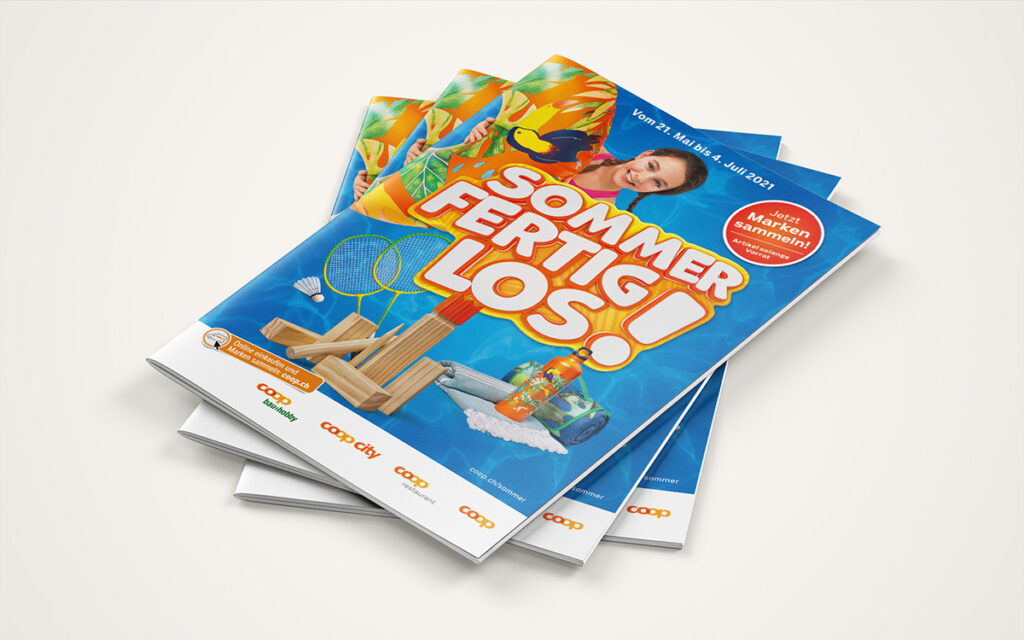
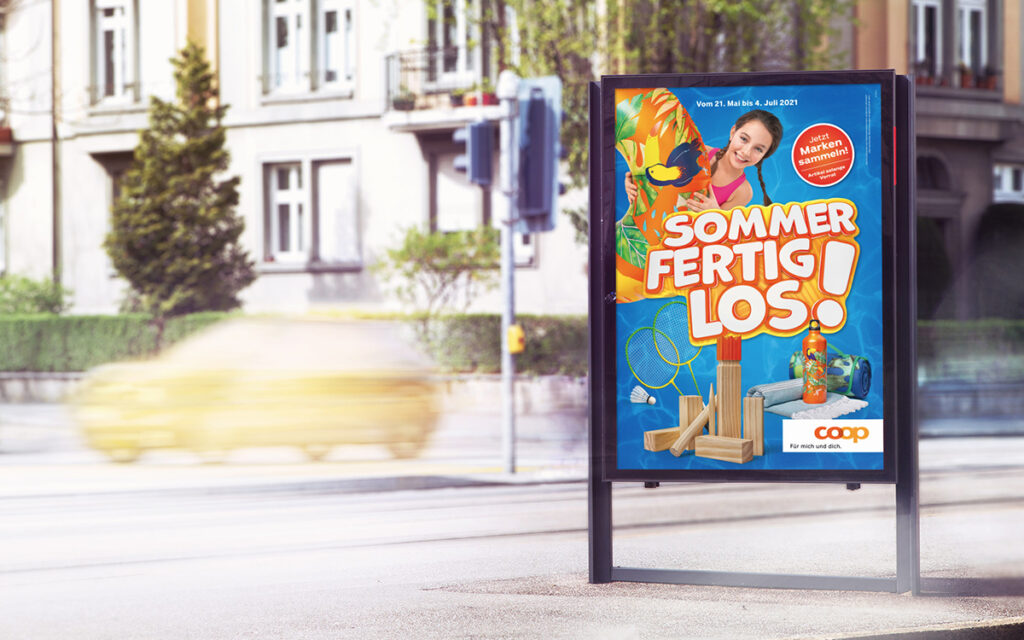
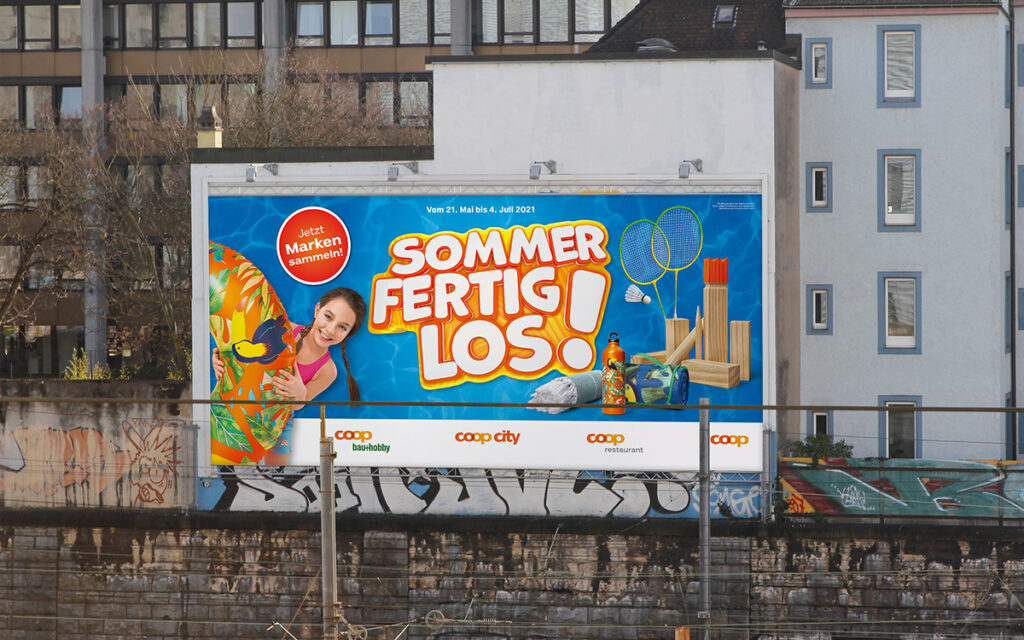
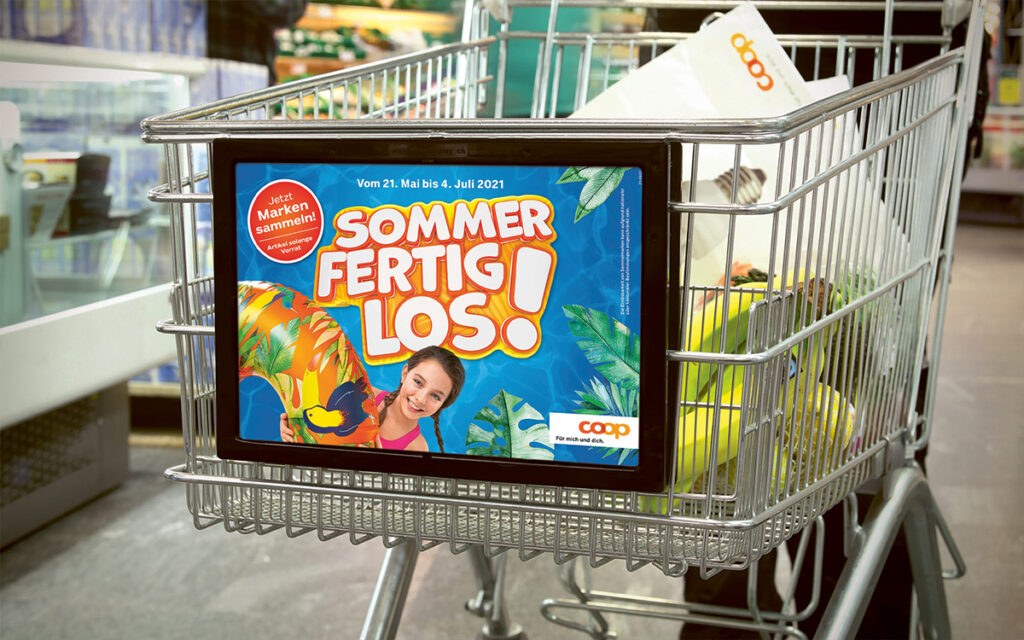
Summer 2021 will not only be exciting and playful, but also colorful: Coop's new collection campaign is all about color. Valencia Kommunikation staged the accompanying campaign accordingly.

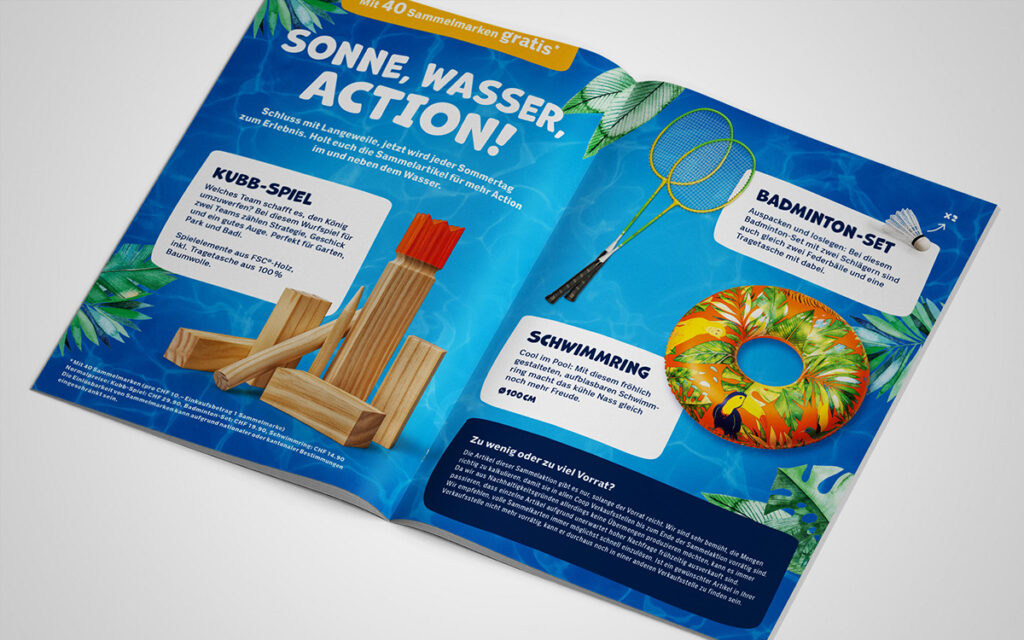
In the current collection campaign of the retailer Coop, there is everything that makes the Swiss vacation in the swimming pool, on the lakeshore or in the park fun: swimming rings, picnic blankets and drinking bottles in Tropical design, Hamam beach towels, badminton sets and even Kubb games are included as collection prizes.

The accompanying campaign by Valencia Kommunikation was designed in a correspondingly summery and colorful way. The promotional name "Summer, get set, go!" is intended to whet the appetite for a direct start to the summer season. The range of advertising measures is diverse and extends from POS and OOH measures to dialog and online in a coordinated mix of digital and print.

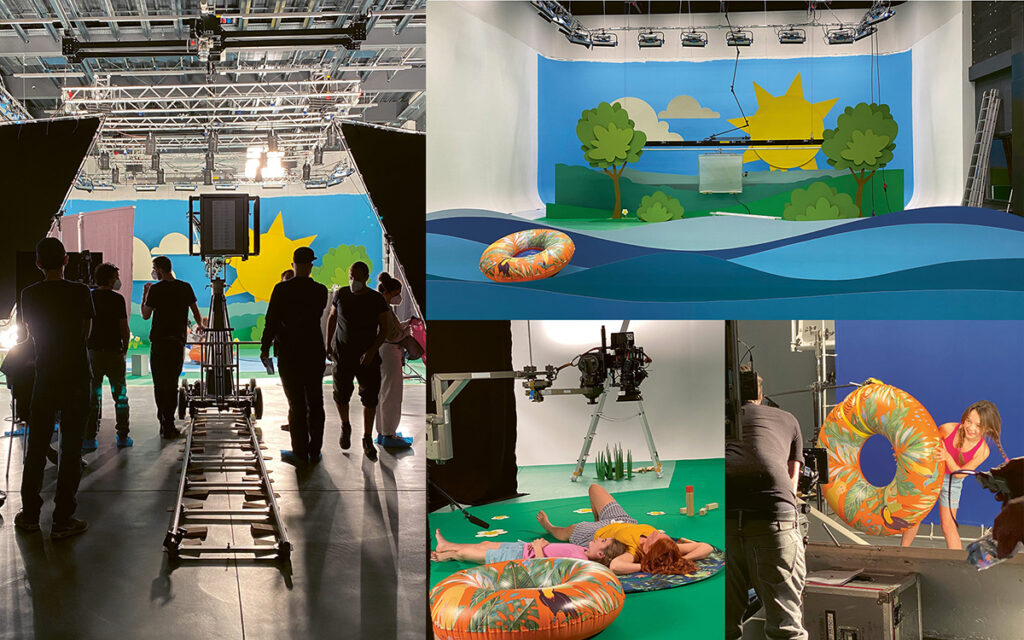
For the moving image, Valencia relied on a special spot idea. "It was important to us that the spot's production and message conform to the current pandemic measures," says creative director Tommy Schilling. So the plan was to realize the spot as a kind of stage production, which would have the models act in a summer setting without actually showing a swimming pool or anything like that. The spot was adapted to various formats for TV and online use. In addition, a tutorial for the Kubb game was filmed during the shoot, which will be used as a separate explainer film.

The "Summer, get set, go!" collection campaign has been running since Friday and will continue until July 4, 2021 at Coop supermarkets and various partner formats.
Responsible at Coop: Vanessa Finzer (Head of Advertising), Simon Bohnenblust (Head of Advertising Promotion/Sales Promotion), Sabine Gnand (Project Manager Advertising Promotion/Sales Promotion), Saara Jeisy (Project Manager Market Development), Joachim von Allmen (Head of POS Retail), Simon Flatt (Head of Media), Karin Rieth (Head of Media Classic), Lukas Schmid (Senior Project Manager Digital Media), Florian Fritz (Head of Social Media & Online Campaigning), Anja Nowak (Project Manager Online Campaigning), Lucas Bieler (Project Manager Online Campaigning), Miriam Barner (Intern Social Media). Responsible at Valencia Communication: Michael Gerber (CEO), Tommy Schilling (Creative Director), Iraklis Hungerberg (Senior Account Director), Janine Kuhn (Junior Consultant) Sebastian Refardt (Senior Copywriter), Michael Wenk (Art Director), Nadine Gschwend (Art Director), Marco Fritz (Polygraf), Niklas Dunke (Polygraf). Responsible at WirzFraefelPaal Productions: Stefan Fraefel (Executive Producer), Nina Wirth (Producer), Adrian Wisard (Director). Responsible at HitMill: Fred Herrmann (Composer, Producer), Roman Camenzind (Executive Producer), Noemi Mathis (Project Management). Responsible at TWmedia: Stephan Küng (Overall Responsibility), Manuela Renner (Media Planning), Pearl Kathriner (Senior TV Planner), Damiano Vitali (Head of TV), Sven Däschner (Head of Online), Madeleine Huber (Media Planner). Responsible concept and products: Boost.

Alcohol advertising spend to grow faster than the market in 2021

According to the «Zenith Business Intelligence – Alcohol: Beer + Spirits» report, advertising spending on alcohol is expected to grow by 5.3 percent this year, outpacing the overall advertising market (4.9 percent). Brands are thus recovering from a much sharper decline in 2020. In 2022 and 2023, alcohol advertising will then grow roughly in line with the overall market, at around 4–5 percent annually.

"In this country, we see a similar picture," explains Maria Brinkmann, Managing Director of Zenith in Switzerland. "Alcohol suppliers will increase their advertising investments by 8.0 percent to CHF 42 million in 2021. In subsequent years, they will increase their budgets by a further 7.1 percent (2022) and 1.5 percent (2023), so that the 2019 level will still be exceeded."

Pandemic shifts brand experience to the digital world

Alcohol brands are often not allowed to directly promote additional consumption. In any case, alcohol consumption is deeply rooted in the culture of the respective country and is not subject to rapid change. Instead, according to Zenith, brands have grown through a process of "premiumization": getting consumers to drink better, rather than more. In this, spirits brands have been more successful than beer brands. Consumption of beer and spirits remained essentially static between 2016 and 2019, according to Euromonitor International. But beer sales grew by three percent per year, while spirits sales grew by seven percent.

Premiumization means persuading consumers to switch to higher-value products by building brand image and experience through high-volume communications. Alcohol brands therefore rely heavily on television and outdoor advertising, spending twice as much on television as the average brand and nearly four times as much on outdoor advertising. Alcohol brands spent 49 percent of their budgets on television last year, compared to 24 percent for the average brand, and 19 percent on out-of-home advertising, compared to 5 percent. However, these tactics have become less effective as audiences shift to digital media, particularly young consumers who are most likely to visit a new bar and try a new drink.

"In Switzerland, the TV share looks somewhat different because of legislation on alcohol advertising," Brinkmann says. "Spirits in particular have strict regulations, and the Swiss advertising windows of the French private stations are subject to French advertising law, which is even stricter than Swiss advertising law. Accordingly, the TV share for alcohol advertising in Switzerland is currently only around 40 percent," Brinkmann elaborates.

More budget for digital

Alcohol brands have been slow to embrace digital advertising in the past, spending less than half their budget on it compared to the average for other brands in 2020. That's changing rapidly now. Restaurant closures meant brands needed a new way to market. Breweries, distilleries, bars and restaurants diversified into direct-to-consumer and takeaway drinks, facilitated by e-commerce and heavily promoted via digital media, especially social media.

Alcohol brands increased their digital media spending from 21 percent of budgets in 2019 to 24 percent in 2020. In an effort to create compelling brand experiences at home rather than at the bar, beverage companies invested in proprietary assets such as brand websites and educational content. Spirits brands that use influencers and retail partners to teach consumers how to mix their own cocktails, for example, were particularly noticeable.

"Spirits brands have overtaken beer brands in terms of sales value by offering more premium experiences and rituals around their product and service," said Ben Lukawski, global chief strategy officer at Zenith. "During the pandemic months' tap ban, brands have worked to bring their premium experiences home to consumers through their own digital content."

Consumers have embraced the available options for buying alcohol online, and alcohol brands now have good distribution networks in place to meet demand. Zenith expects brands to expand their digital advertising to support alcohol e-commerce even after pubs and restaurants have fully reopened. This will result in 9.2 percent annual growth in digital ad spend between 2019 and 2023, until digital advertising accounts for 30 percent of alcohol advertising budgets.

In addition, Zenith forecasts that alcohol brands will reduce their TV spending by 2.4 percent per year through 2023, compared to a 2019 baseline, as traditional TV audiences continue to shrink. Outdoor advertising, on the other hand, will grow 1.1 percent per year, even after accounting for pandemic-related declines in foot and road traffic. The declining reach of television makes the ubiquity of out-of-home even more valuable.

"In Switzerland, nearly 21 percent of alcohol brands' advertising dollars will flow into digital advertising in 2021," says Maria Brinkmann. "That's 9 percent more than in 2019. In 2022 and 2023, investment in online advertising by alcohol brands will continue to rise annually - to 23 percent next year and 25 percent the year after. This will be mainly at the expense of print."

Alcohol advertising recovers by 2023

Alcohol advertising shrank almost twice as fast as the overall advertising market in 2020, by 11.6 percent compared to 6.4 percent of the total market. Brands' finances were hit by declines in consumption volume, average price per drink and profit margins. As bars, pubs and restaurants closed, consumers drank less alcohol and bought the drinks they did consume from stores where they cost less, at a much lower markup. Brands cut back sharply on their marketing to protect their profits. Their combined advertising spend fell from $7.6 billion in 2019

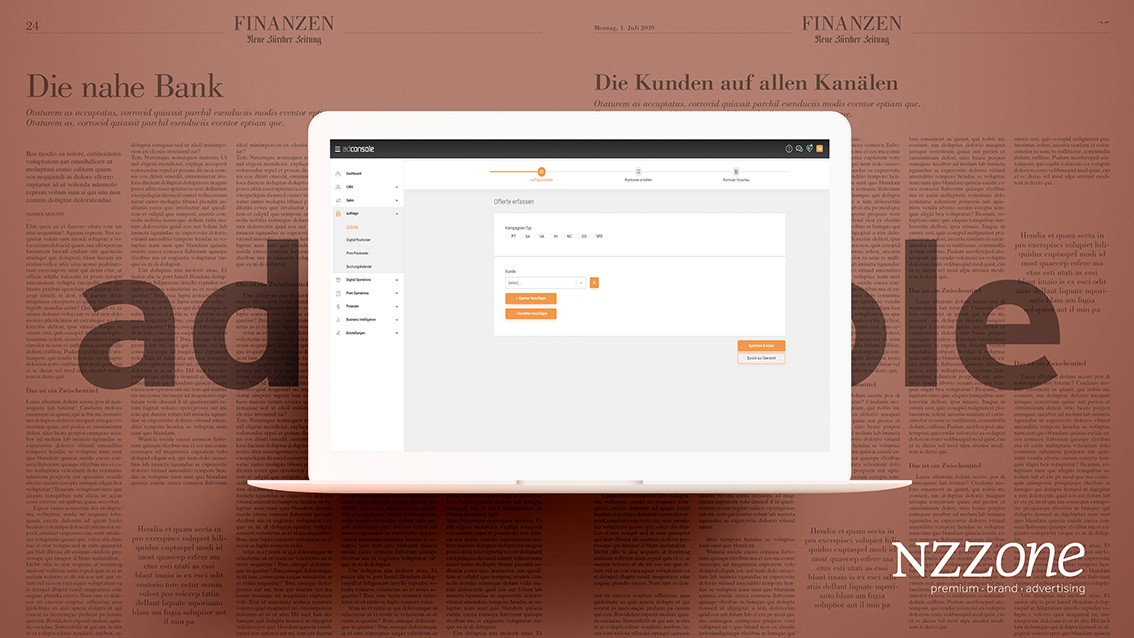
NZZone now relies on Audienzz Adconsole

NZZone, the NZZ’s marketing organization, is now relying on Audienzz’s Adconsole to manage all of its advertising campaigns. The interactive portal was originally designed for the online advertising market and has now been further developed into a multimedia ad management tool for the print advertising market.

"For NZZone, as a marketer of cross-channel offerings, the Adconsole a milestone," explains Adrian Näf, Business Director at NZZone. "We can now handle our processes significantly more efficiently and are much more agile in combining and marketing channels, products and corresponding verticals."

NZZone uses Adconsole to handle sponsorships as well as print and digital advertising. As an all-in-one solution for the management of multimedia advertising orders, the portal is specially tailored to the needs of the advertising market and enables automated, cross-media process handling, according to a statement from the NZZ Media Group. The portal covers all requirements from customer relationship management (CRM) with marketing automation and sales control elements to order processing and invoicing. This allows marketers and publishers to process advertising orders even more efficiently and flexibly.

Adconsole had previously established itself in the digital advertising market. It is currently used by more than a dozen publishers. "With the expansion of Adconsole for the print advertising market, publishers that traditionally offer primarily print products and are currently undergoing a digital transformation can now also benefit from a contemporary ad management tool for handling their advertising bookings," explains Remo Baumeler, CEO of Audienzz.

Science is female: By Heart invites you to a tour at ETH

A new app tour from ETH Zurich takes visitors on a tour of the ETH Hönggerberg campus. The tour focuses on the women who have shaped the university’s history. The team at By Heart has created the striking key visual for the tour.

The story of women at ETH is a long one. By Heart has taken on the task of condensing it and putting it into a clear, simple formula. The team led by art director Julian Scheidegger uses a language reminiscent of the militant tradition of the women's movement. By linking the familiar gender symbolism with the initials of the university, interpreting the symbol with a lot of color and dynamism, and finally putting it on paper in the style of a wild poster, the result was the impression of a spontaneous and also somewhat brash rally graphic that invites everyone to participate.

Because that is what ETH is all about. The new app tour is intended to mobilize people, invite them to visit the ETH Hönggerberg campus and encourage them to download the app. "Science is female" accompanies visitors on their smartphones on an independent tour of the Hönggerberg campus and introduces female pioneers in science: from the first female student to today's female researchers.

Together with those responsible at ETH, the By Heart team has designed a mix of measures around the key visual that is now intended to publicize the new tour offer. This has resulted in posters, display banners, floor stickers, advertisements and digital advertising media, which are being rolled out step by step.


Responsible at ETH: Roland Jaggi (overall project management); Jessica Bormann (project management marketing and communication); Ralph Trossmann(group management Campus Experience). Responsible at By Heart: Fernando Gort (Project Management); Markus Bircher (Strategy); Julian Scheidegger (Art Direction); Nicole Stark (Media Design).

Press Council reprimands Arcinfo for undercutting quote

According to the Press Council, the French-Swiss newspaper Arcinfo «incorrectly attributed quotes» to the former SVP National Council member from Neuchâtel. In doing so, the paper violated its duty to report the truth.

Arcinfo had published a text by a professor from Neuchâtel attacking in particular the two SVP politicians, Roger Köppel and Yvan Perrin. The professor claimed that they had called the Federal Council "dictatorial" and that the risk of death from Covid-19 was "practically zero for people under 65", although only Köppel had made such a statement.

By "falsely" attributing these quotes to Perrin, the newspaper, which is responsible for everything it publishes in its editorial section, failed in its duty to seek the truth, the Press Council wrote in a statement published Friday. Perrin had filed a complaint with the Press Council over the text. (SDA)

SAP CX: "We are on the right track".

Bob Stutz is President of SAP Customer Experience. In an interview with Werbewoche.ch, he discusses the CX innovations his company is working on and how the pandemic is radically changing customer needs.


Werbewoche.ch: Bob Stutz, at this year's, virtual SAP NOW you talked about SAP's customer experience innovations. What are your company's priorities in this area?

We want to move away from standard business models that distinguish between "business-to-business" and "business-to-customer" or, in some cases, "business-to-business-to-customer" - and toward "business-to-everyone. Anyone using SAP technology should be able to contact existing and potential customers very easily at any time, on any channel.


To what extent can SAP CX be part of a company's overall digital transformation strategy? 

SAP CX is in a unique position when it comes to helping customers achieve digital transformation. Our solutions are designed not only to help organizations transition to the cloud, but also to connect the front office with the back office. Whether our customers want to move completely to the cloud or use a hybrid model with front-office cloud solutions and back-office on-premise solutions, SAP CX solutions fit both scenarios very well. By the way: We are, of course, constantly developing our cloud solutions.


How do you think the pandemic has affected CX?

The Covid 19 crisis has forced many companies to shift their business models from in-store to online overnight and has accelerated the transition to cloud-based software. Commerce sites in particular sprang up overnight. Complex software systems with long implementation times were naturally not in demand due to the time pressure; instead, many companies had to get e-commerce sites up and running within a few days and at low cost. And often without their own IT department to provide support.


And how has the pandemic affected your or your team's work?

The CX industry is one of the few industries that was not negatively affected by the crisis. I am very happy to say that this is also true for our team and our strategy. We have been able to continue to pursue our plans and implement our product roadmaps, even though our work environment has changed overnight.


What can customers expect from SAP CX in the near future? What does the future hold?

We have some very exciting projects in the pipeline around customer data, customer engagement and commerce. The acquisition of Emarsys and the launch of our Customer Data platform as well as the new cloud commerce solution designed for "direct-to-consumer" are just some of the innovative offerings. Our customers can also look forward to many many innovations around our core CRM solution, where we are currently working on some very innovative MS Teams integrations. I think we are on a very good path there.


If you missed the virtual SAP NOW, you can find Bob Stutz's presentation - and other, exciting content - at Online at any time. For questions on the topic of SAP, CX and digital transformation, please contact Thomas Ofenloch, Head of CX Customer Advisory SAP Switzerland, is also at your disposal..

HitMill turns Swiss Life employees into "singing stars

Swiss Life, with the support of HitMill, has released the song «Me, myself and you.» 111 employees contributed to the production and brought the song to life with their personal singing videos recorded from their home offices.

At the beginning of March 2021, Swiss Life launched an initiative for its own Swiss Life song. The idea behind it: Express togetherness and solidarity within the Swiss Life Group in the ongoing pandemic situation - and spread positive energy.

In the end, 111 employees from various countries and divisions answered the call and submitted their singing videos. The Swiss Life song "Me, myself and you" and the accompanying video were created from all these voices.

The reggae-style song stands out above all because so many Swiss Life employees contributed to it. The result is a musical collaborative work that captures the extraordinary pandemic situation in a positive way as a contemporary document. The song premiered on Thursday and is available on Youtube, Apple Music and Spotify.


Responsible at Swiss Life: Internal Communications Team. Responsible at HitMill: Georg Schlunegger (Music Producer), Noemi Mathis (Project Manager).

Miele launches new global brand campaign

With «Quality Ahead of Its Time,» Miele is launching a new global brand campaign. The campaign focuses on craftsmanship, performance, and sustainability. Through this campaign, Miele aims to take a stand against the throwaway culture.

"Miele stands for trust - the current campaign shows consumers that with us they have a strong, reliable partner at their side," explains Axel Kniehl, Managing Director of Marketing and Sales at the Miele Group. "During the pandemic, many people have rediscovered the importance of their own home. That's why they're making more conscious purchasing decisions and focusing on values for which Miele is known - and, above all, they want quality that's truly ahead of its time."

In the commercial, examples are used to show that quality at Miele is not a simple advertising promise, but a lived reality. While some car engines are tested for 3,000 hours, Miele tests its products for up to 10,000 hours. Another example is that every washing drum is checked by hand before it leaves the factory, or that Miele keeps spare parts for every product in stock even 15 years after a series has expired.

Miele's commitment to quality is also reflected in the topic of sustainability, which is the focus of the new brand campaign. For example, the company only recently announced its intention to be CO2-neutral across all its sites from 2021.

The campaign was developed by the Hamburg agency Select World. Within the coming year, new themes will gradually be taken up that combine Miele's values and the needs of its customers. The campaign images are by British photographer Dan Tobin Smith - who has already worked with clients including Adidas, Apple and Louis Vuitton. The campaign will be launched in 49 countries. In Switzerland, the campaign will play 360 degrees. The spots can be seen on TV, DOOH and online, among others. In addition to classic OOH formats and ads, Miele Switzerland is using a mega poster on Uraniastrasse in Zurich.

The mega-poster on Uraniastrasse in Zurich. (Photo: Miele)

Teads helps On gain more brand awareness

The campaign of the sports brand On, which was launched in January, achieved a visibility of over 80 percent with the advertising media of Teads. The aim was to increase the brand awareness of the sports manufacturer and to adapt the advertising media accordingly for greater visibility.

Even though the ads were optimized for visibility, they also achieved excellent click-through rates. This is due to the high-quality creatives. A look at the user behavior also shows that the click quality is convincing.

The shoe manufacturer On is already a very established brand. In order to expand further, the company teamed up with the global media platform Teads in 2020. With the help of its InRead formats - Scroller and Flow in sizes Landscape and Square - On played out a large-scale campaign in January via the websites of Teads' premium publishing partners.

Goal: Maximize impressions

The goal of the joint campaign was to increase brand awareness. The campaign was to be optimized to maximize the visible impressions. To achieve this, the teams from On and Teads determined in advance those advertising formats that were most likely to pay off in terms of the campaign goals. After adapting the formats to On's needs, the campaign was rolled out in Switzerland, Germany, the UK and the US.

"We are very satisfied with the performance: Firstly, with the high-quality placements of the Teads ads, but also the impact of the creatives, as well as the click quality," says Ornella Byland, Digital Marketer at On.

Campaign visibility of 80 percent

According to Teads, the campaign has achieved a visibility of over 80 percent. This was achieved, among other things, by the appealing advertising media, which animated users to interact with it and linger. In Switzerland in particular, the company was able to generate convincing click numbers on the ad formats with low bounce rates.

1 year TikTok Ranking Switzerland: Which companies are successful

In April 2020, Mike Schwede launched the first TikTok ranking of Swiss companies. After a year of tracking, the expert took a closer look at the data and used a crawler to analyze the metadata of the 30 most recent videos from both the most successful and the least successful Swiss TikTok brands, drawing insights from the results. Which companies are active? And which ones are actually succeeding?

Within a year, TikTok in Switzerland has grown by more than 30 percent in terms of users. Video viewing activity also increased by a staggering 55 percent. Swiss users spend well over an hour a day on TikTok on average. Successful companies should therefore also grow by at least 30 percent in order to "stay with the people".

Swiss companies have jumped on the bandwagon and successfully

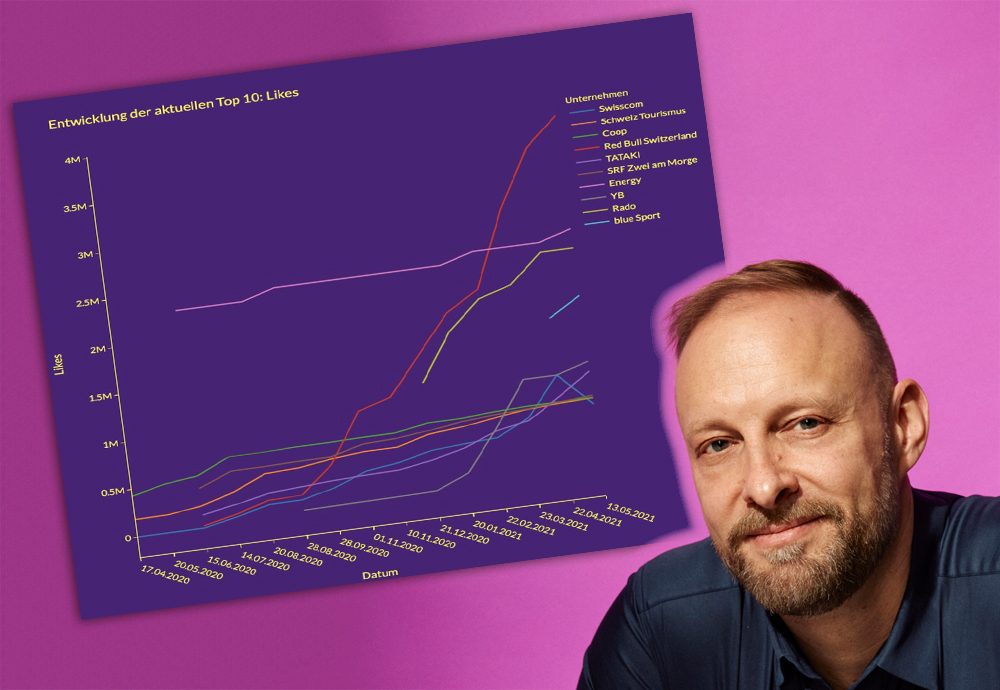
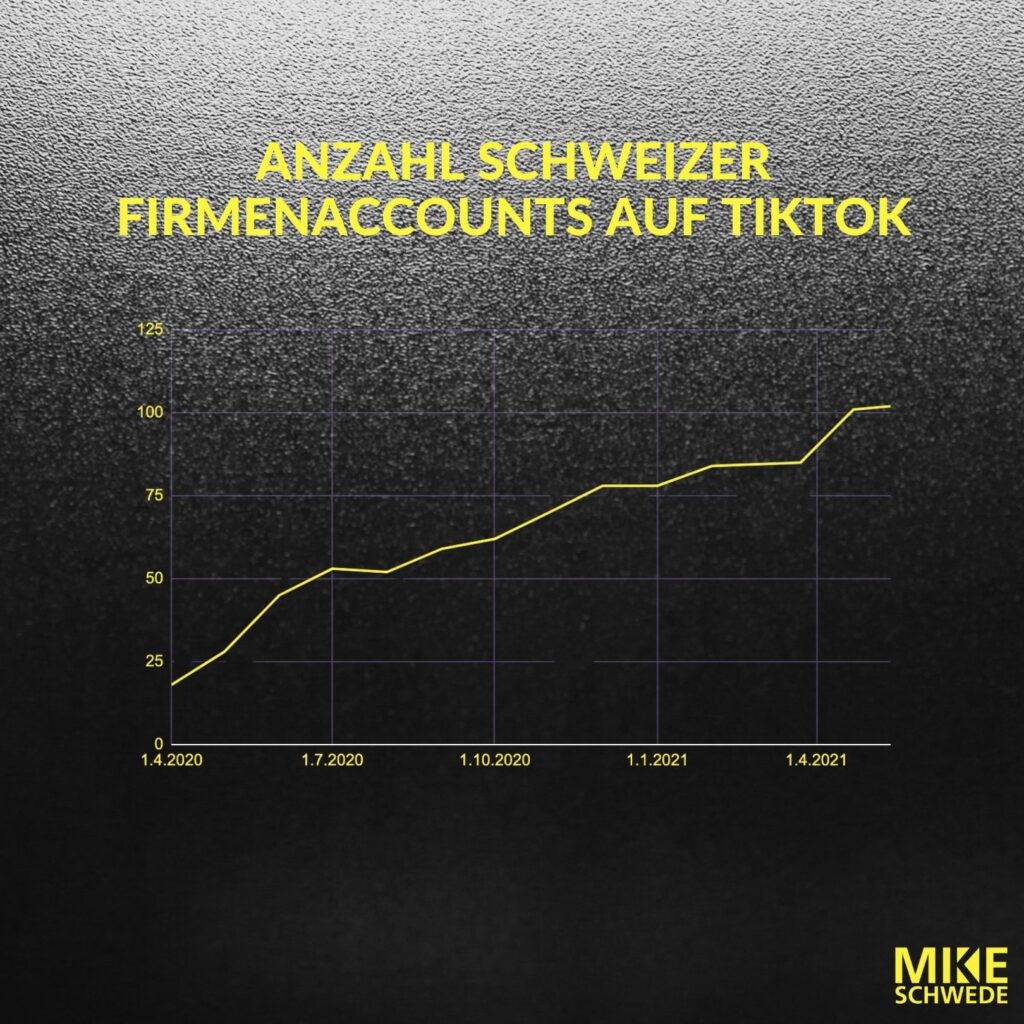
While we had discovered 18 Swiss companies on TikTok in April 2020, there were already more than 100 in May 2021. All of these brands have published more than 4000 TikToks this year and worked their way up from an original 743,000 likes to more than 24 million. Many are now already professionalized: 57 percent of accounts are business accounts - 38 percent are also verified. 41 percent still use private or creator accounts.

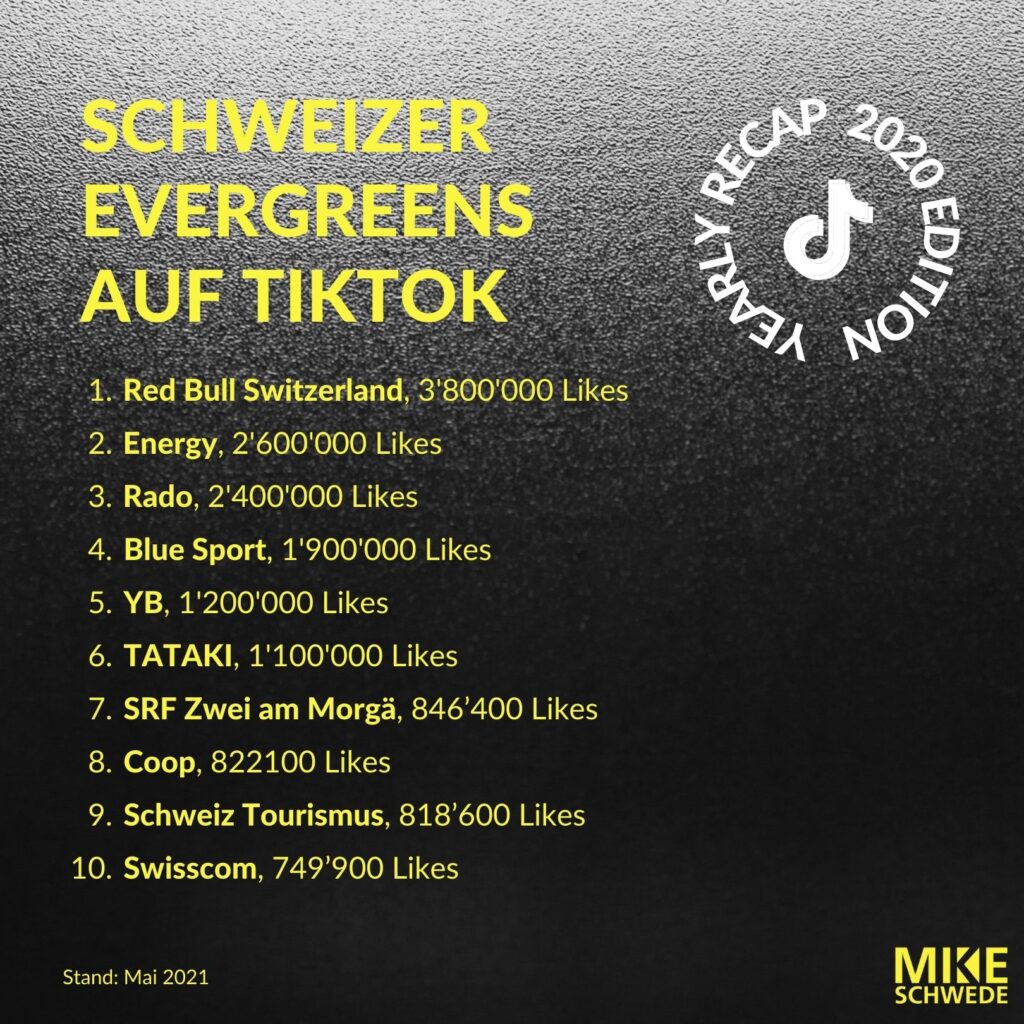
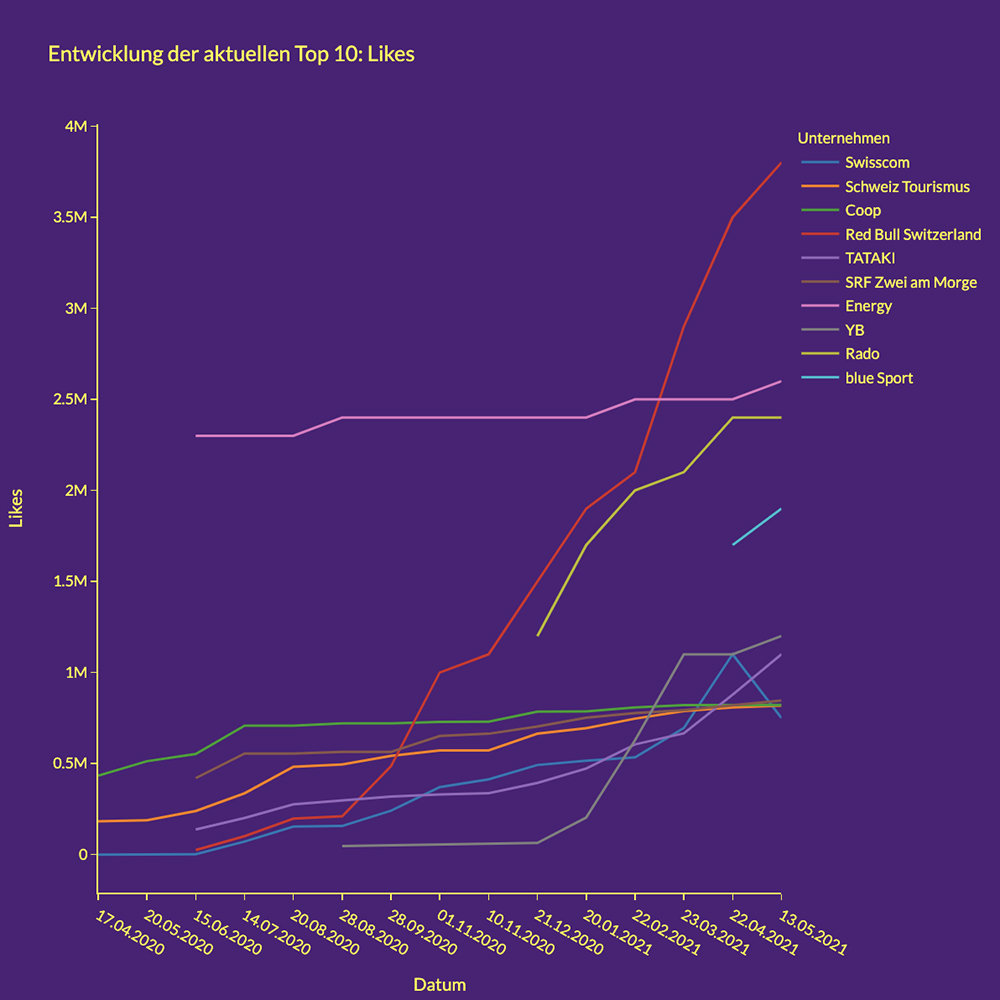
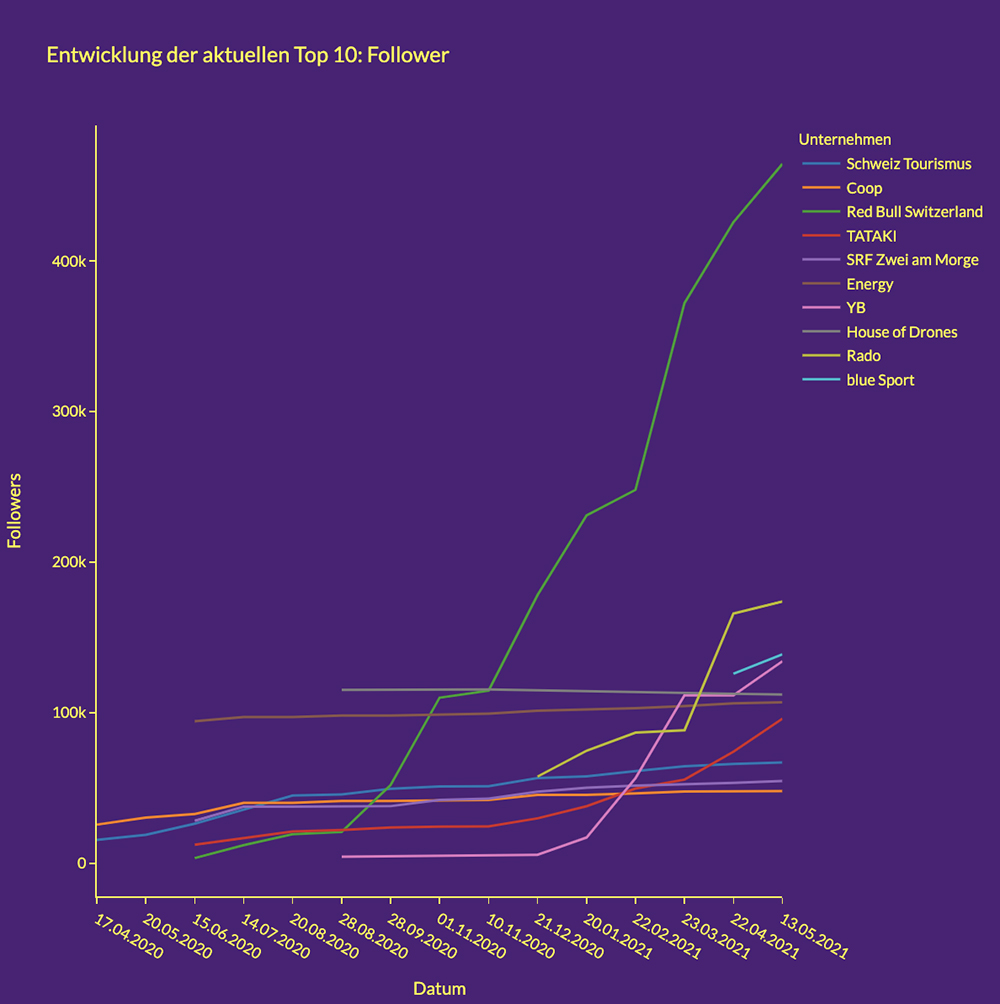
The big Like collectors include Red Bull, the watch brand Rado, and YB. The three brands also scored in terms of follower growth.

The first does not have to be the most successful

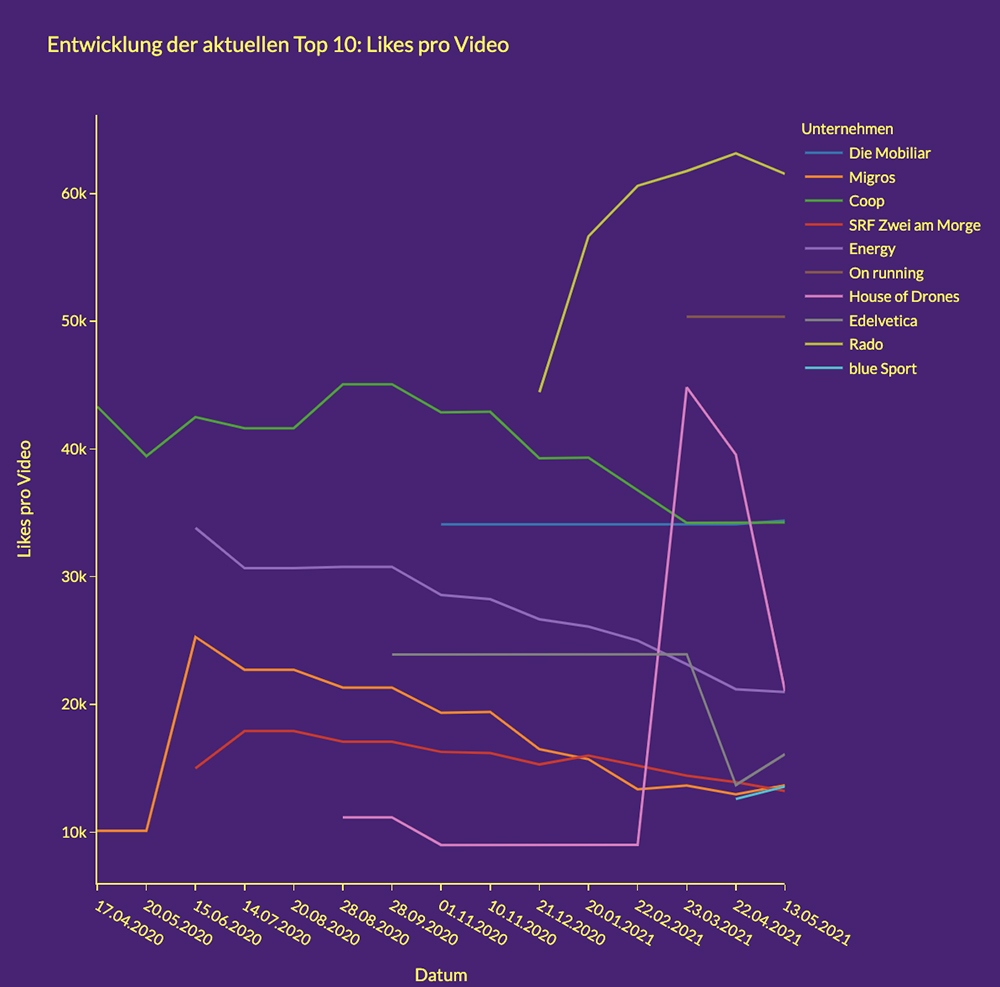
In the ranking, particular attention is paid to the likes per video in order to put individual ricochets into perspective and to rank companies higher that generate exciting content in the long term. What is striking, but not surprising, is that the initial successes are difficult to maintain.

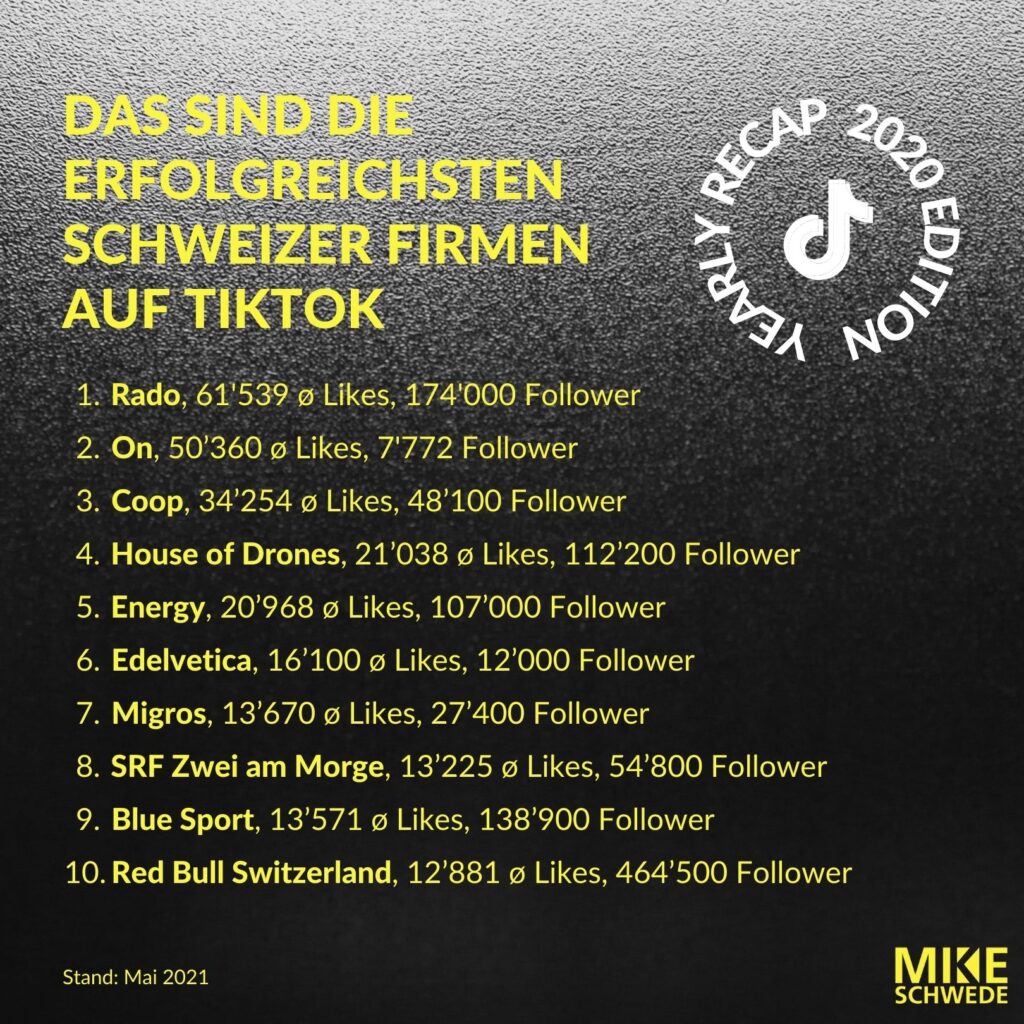
Coop, the winner in the first ranking with around 30,000 followers and 512,800 likes, is still in the top 3 in May 2021 and increased its followers and likes by around 60 percent. Besides Migros and SBB, however, this is the only brand that was able to defend its place in the top 20. All other brands have dropped many dozens of places. So being an early bird can be an advantage, but it's no guarantee of a top spot. SBB, the FOPH and EF Switzerland had the highest relative growth rates in terms of followers and likes - in the 4-digit percentage range. In terms of likes, on the other hand, only two brands lost ground: Lenzerheide and Swatch. The assumption is that a few videos were deleted.

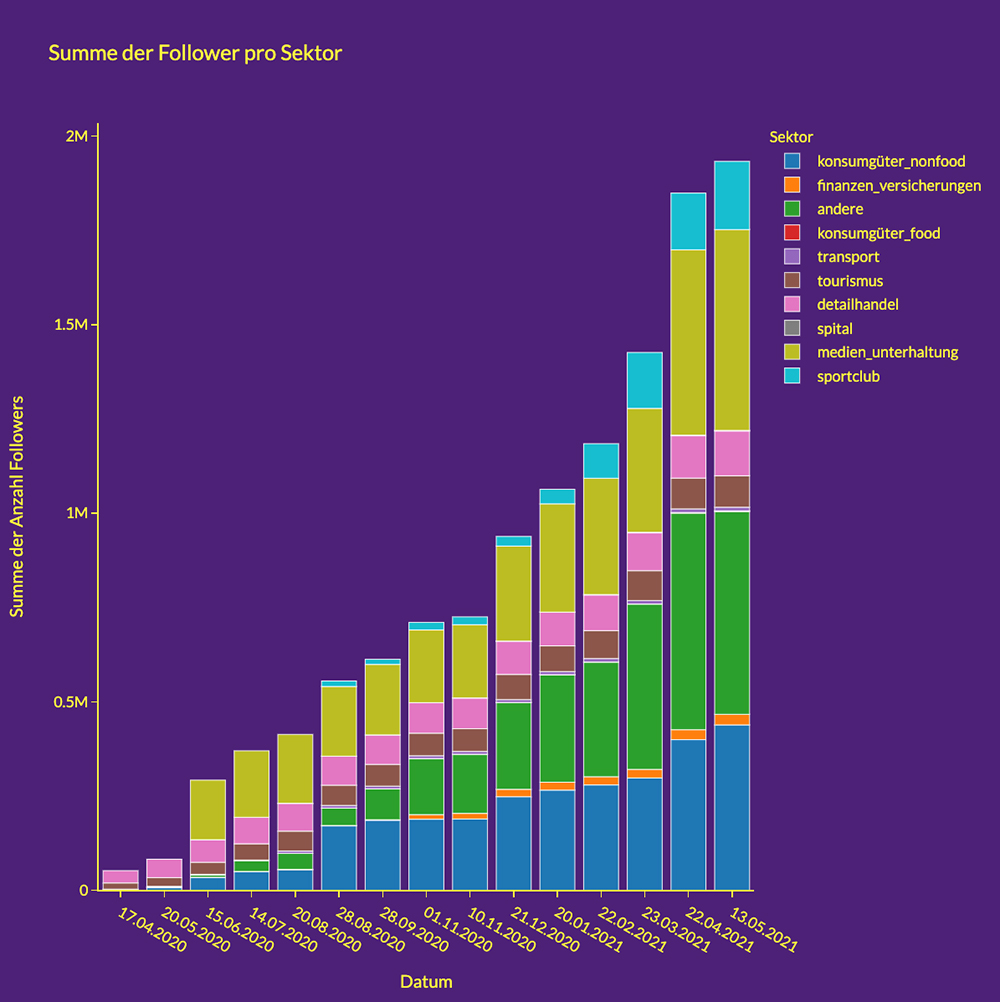
Companies from the consumer goods sector (21.6%), media (19.6%) and tourism (11.8%) are particularly active on TikTok. Media and formats like Tataki, Zwei am Morge, Energy and actually Red Bull collect the most likes and followers. However, consumer products lead the way in terms of top likes per video.

It pays to jump on the TikTok bandwagon early. Now, users are still open to exciting brands. In a year, they'll be more selective.

What influences the range?

The basic principle is well known: TikTok is a viral machine and it is not important how many followers you have in order to achieve great reach and land on the foryou page with users.

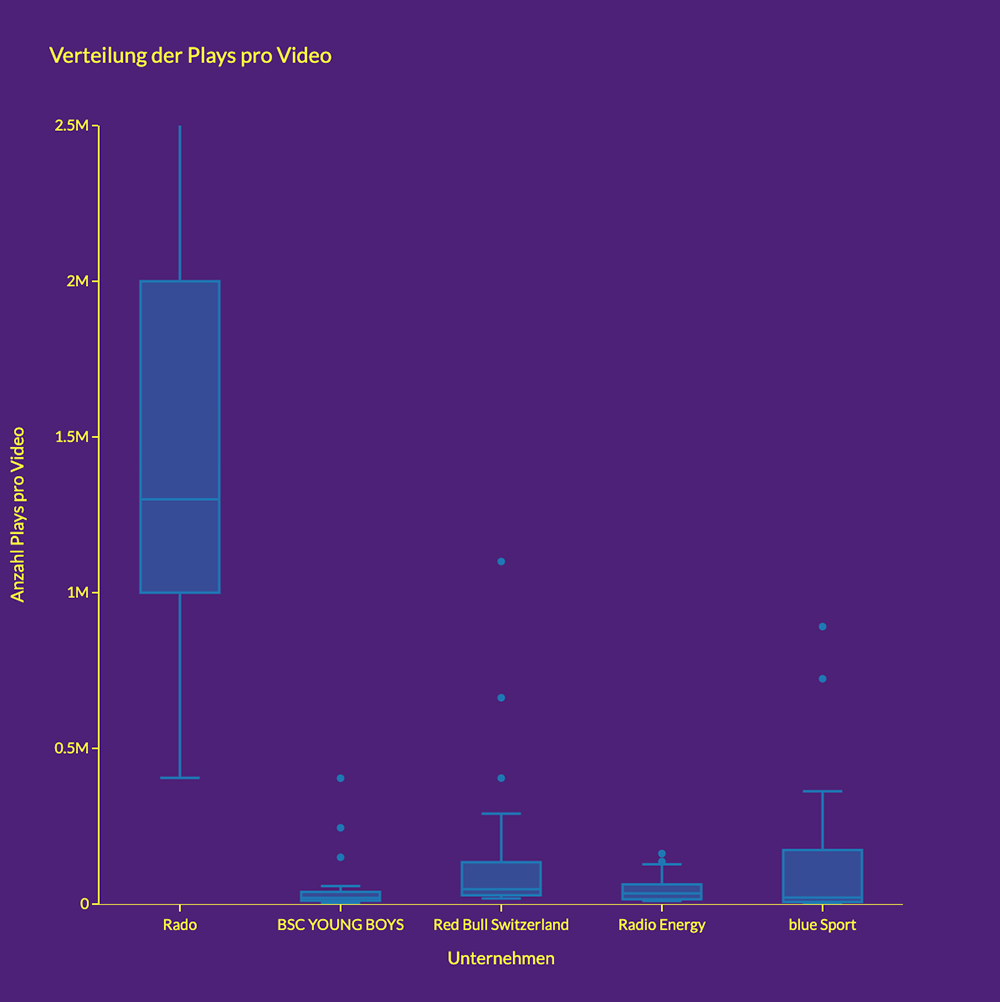
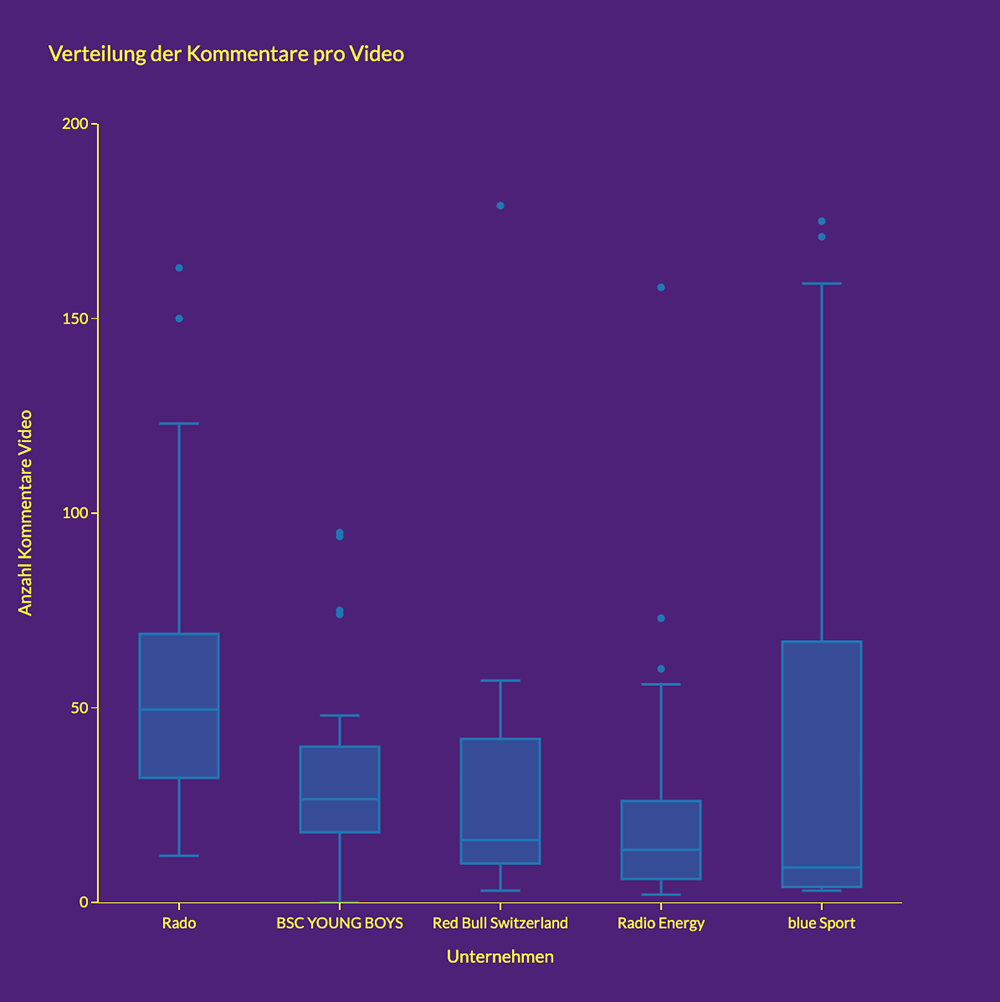
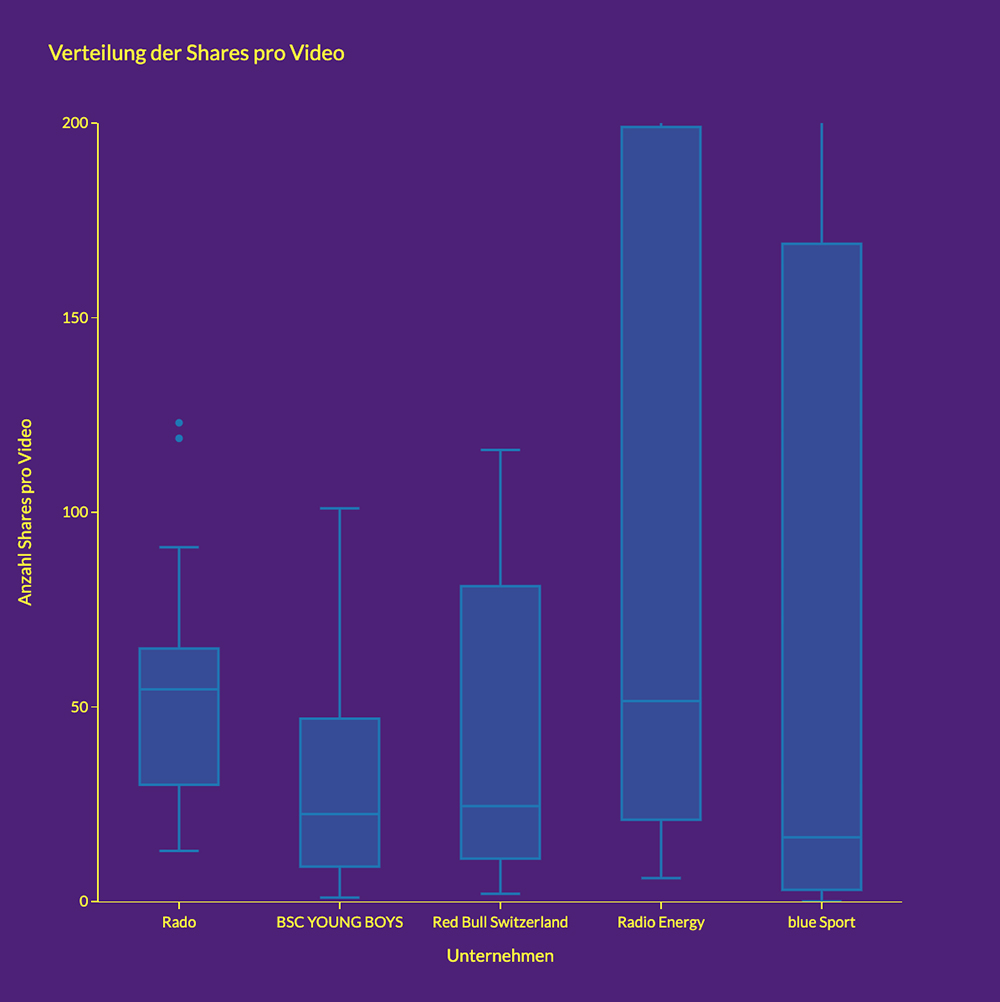
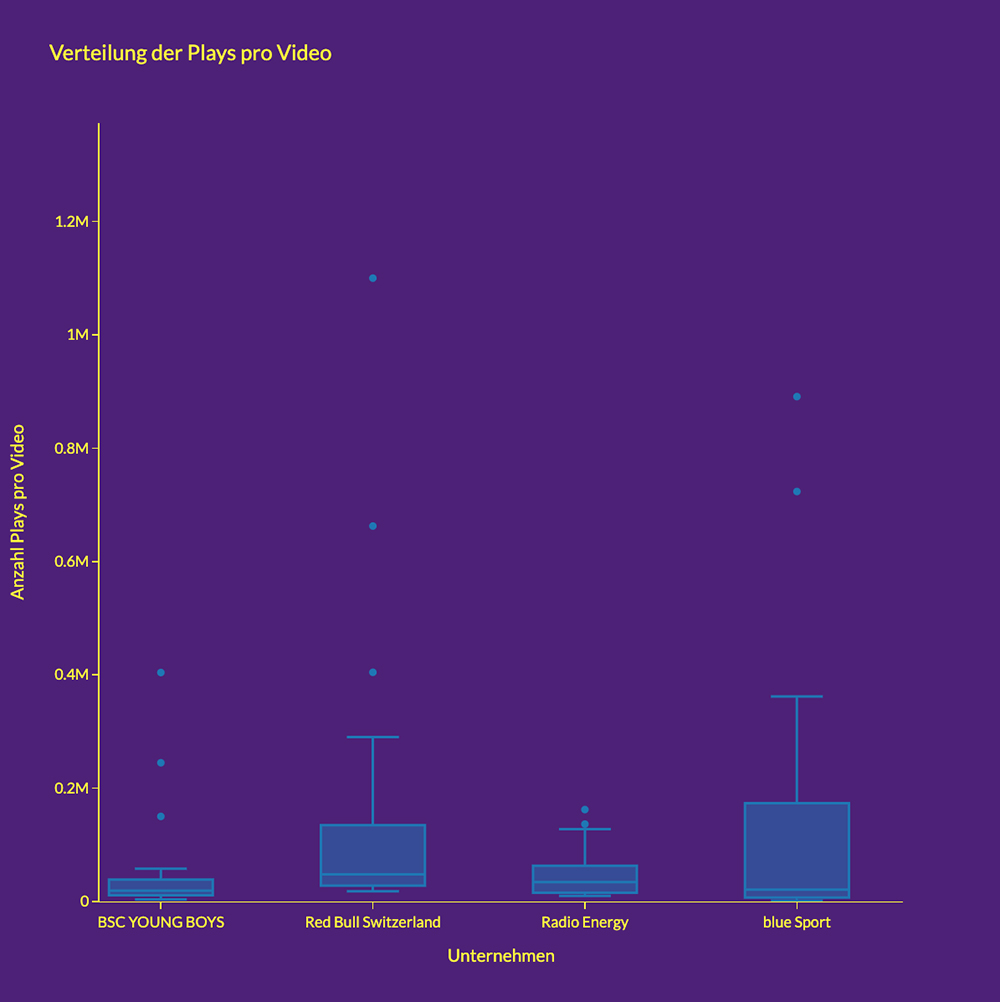
In the graphs you can see: Rado has the lead in views per video - through boosted/paid TikToks. It's a different story when it comes to shares and comments per video. Blue Sports and Radio Energy always manage to produce viral bangers that are shared frequently.

When analyzing the actual videos, five patterns could be identified.

  • Followers are not relevant: Whether top 10, top 20 or midfield: The analyses did not reveal any correlation between the number of followers, views and likes.
  • Activity: The most successful 20 Swiss companies on TikTok have posted four to five times more than the last 20 and have many times more followers (60x) and likes (1100x). Likes per post are also 366x higher. However, if you compare the number of posts of the top 10 and the rest of the top 20, the number of posts there seems to have no influence.
  • Trendy Sounds, that are familiar from private accounts do not necessarily have to be taken up by companies. Good content is enough to generate many views, likes and shares. Top videos often get by without sound (speech, lipsyncs, etc.) or with generic, royalty-free music and simply have good stories.
  • Videos with above average views almost always have an above-average number of comments. Often also an above-average number of 1st likes and 2nd shares. It is known that the average view time is also important for virality, but this cannot be checked from the outside.
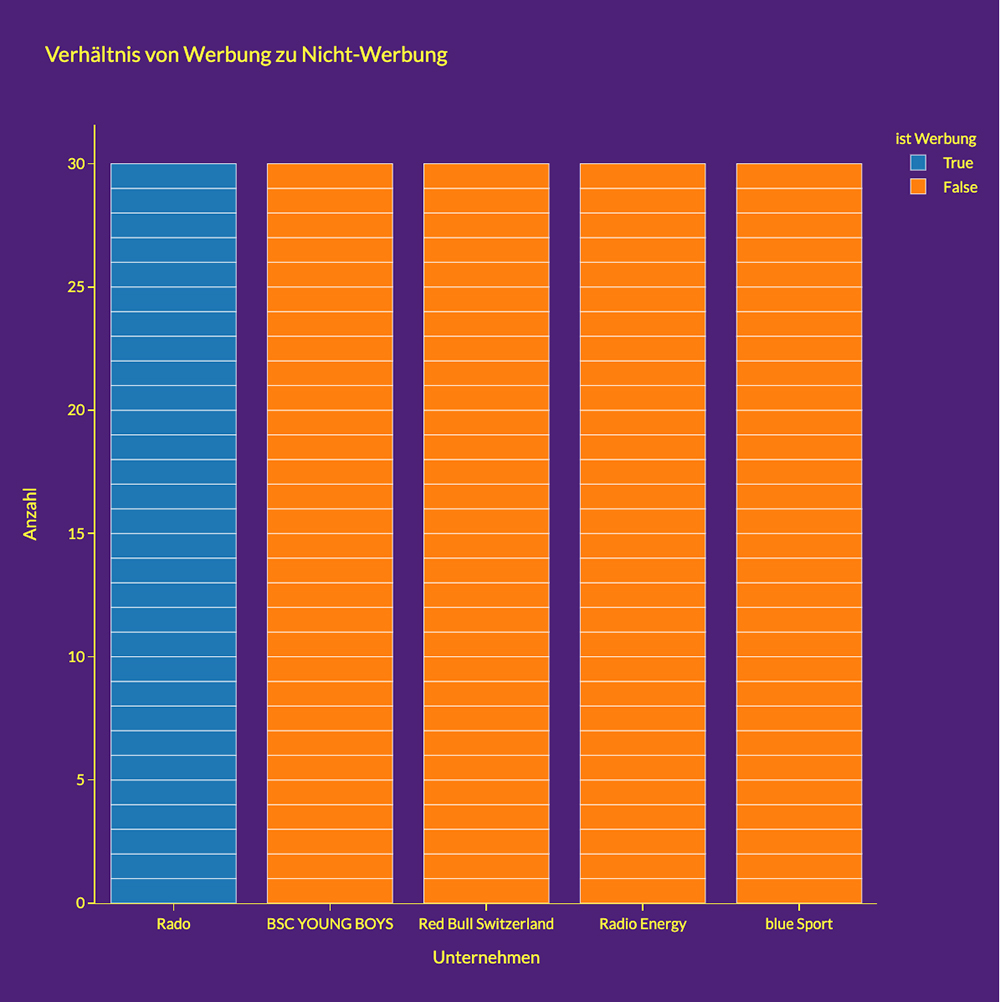
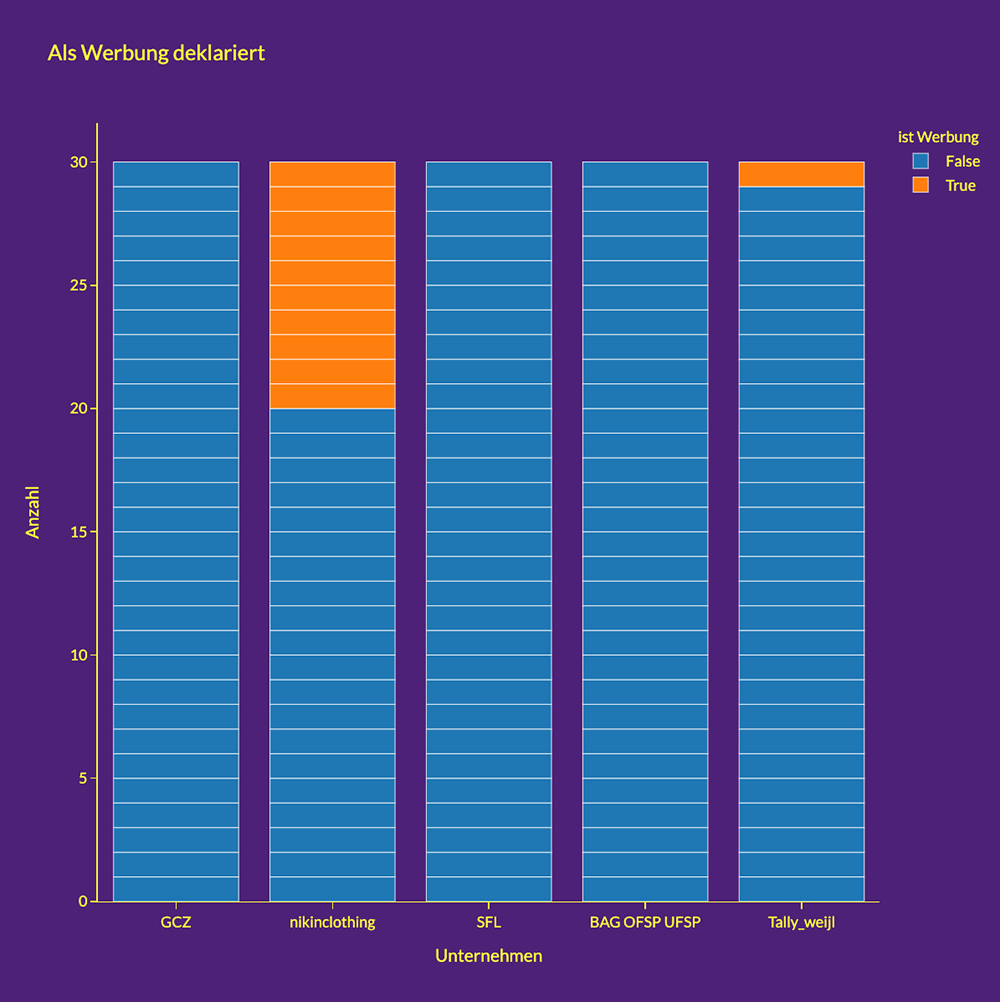
  • The application also has a great influence, especially boosting organic TikToks. As mentioned above, Rado always stands out in the top 10. Here, all of the last 30 analyzed videos have been promoted. Ad boosting also has a positive effect on views, likes, comments and shares for accounts outside the top 10, such as Nikin.
At Rado, all posts are unlocked for boosting.
Nikin also takes advantage of Boosted Ads.

What's next?

TikTok is growing rapidly in terms of users, but now also in terms of companies. The quality of the content is high and very creative. No other platform we know of enables small brands to reach so many people organically and virally and to grow rapidly once they have found the sweet spot in their content strategy.

TikTok is now a fixed component of the digital media mix for our customers and for new customer briefings. This is certainly also because the majority of TikTok users are over 18 and other segments can also be reached that are not active on Instagram, Snapchat or Facebook. We personally appreciate the safe brand environment - no fake news, etc. - and the uncomplicated and direct customer service that TikTok offers in contrast to its competitors.

The price per thousand contacts on TikTok is five to ten times lower than on other social media platforms. Click prices and engagement rates including paid follower growth are also impressive. Prices have remained very stable so far and have not increased noticeably. Campaign performance has also remained impressively high over the year, as long as the content is right. Nevertheless, TikTok preaches itself: Create TikToks not Ads! Are you in?


* Mike Swede is a digital strategist, entrepreneur, speaker and lecturer at various Swiss universities such as BFH, MAZ, ZHAW ML & ZHAW AL and the University of Basel. He is co-founder of Goldbach Interactive (exit), the content marketing software Cooala and Powdience - Data Driven Personas.

In April 2020, Schwede launched the first Swiss TikTok ranking. The current TikTok Ranking Swiss Companies is located respectively on Mike.schwede.ch/tiktokranking and is published regularly on Werbewoche.ch. 

Four gold cubes and an evergreen at the ADC Awards 2021

The digital dice have been rolled: For the second time, the ADC Awards were presented in digital form. Across the 19 categories, 67 entries made it onto the shortlist, and now several clients and their agencies can celebrate winning 34 bronze, 15 silver, and 4 gold cubes, as well as one Evergreen award.

For the generative posters the ADC jury awards Gold in the category Posters to Digitec Galaxus, because this work is an impressive demonstration of the use of data, and the brand promise "Almost everything for almost everyone" is implemented in a completely new and extremely entertaining and witty way.

apg-te

In the new Corona category, Publicis won gold with "Homeschooling" for FC Zurich. The jury said that the work was an exemplary demonstration of how to be there for the target group in times of Corona. How soccer stars help the youngsters with their homework has so much greatness and charm that the kids will probably remain FCZ fans for life.

WePlayDesign's work "Festival Filmar en América Latina 20" was "an absolute eye-catcher", bringing together the themes of film and Latin America in an unseen and brilliantly crafted way on an international level, and therefore also deserved gold, according to the ADC jury, in the Design category.

The final gold cube is awarded to Curaviva, Spitex Schweiz and OdASanté with "The eventful life of Rosemarie" by CR-K in the Art Direction category. According to the ADC jury, this work does justice to the profession of art direction in the very highest form. From the fresh style to the loving way it was made, right down to the last detail, everything was just right.

Digitec Galaxus' "Customer Reviews" was awarded the Evergreen by the ADC jury. This because Galaxus has remained true to its independent and unmistakable line for years and yet continues to surprise in a witty way with new interpretations and variations of the basic campaign idea.

15 silver and 34 bronze cubes for bright ideas

Three silver medals went to the Graubünden brand with "Mission High Dry," implemented by Wirz Communications. The case wins precious metal in the categories Digital, Promotions & Events and PR.

Various other agencies and companies can be pleased about double silver. Digitec Galaxus, for example, is also represented in the silver awards and receives one award each in the Film and Corona categories for its "Warehouse" spot. Heks with the "Donation Campaign" by Wunderman Thompson Switzerland wins silver in the categories Campaigns and Corona. In addition, the work "Stolen Moments" receives a silver award in each of the categories Promotions & Events and Design.

The following clients and agencies can be happy about a silver cube: SO Appenzeller Käse with "Nightmare in Appenzell" by Contexta in the Film category, Swica with "Overmotivated Testimonials" by Wirz Communications in the Film category, Pro Infirmis with "Pro Infirmis" by Jonathan Heyer Photography and Film in the Photo & Illustration category, Turnus Film with "Echo" by Shining Film in the Corona category, Inhalt und Form with their "#Züribrätt" in the Corona category, and also Graubünden Ferien with "Press Conference Steinböcke" by Wirz Communications, also in the Corona category.

Jasmine Jacot-Descombes is "Student of the Year

The jury awards the title "Student of the Year" to Jasmine Jacot from the Zurich University of the Arts ZHdK and SRF for her thesis "Madame Charlotte". According to the jury, this is a reward for her courage in taking such a difficult story as her subject and making it disturbing on the one hand, but also extremely fascinating and emotional on the other.

ADC Awards 2021

Medal table - Olympic ranking
Sender Evergreen Gold Silver Bronze Shortlist
Digitec Galaxus AG 1 1 2 3 1
Publicis Zurich Ltd. 0 1 0 3 2
CR-K 0 1 0 0 1
WePlayDesign 0 1 0 0 0
Wirz Communications AG 0 0 5 0 9
Wunderman Thompson Switzerland AG 0 0 2 1 2
Stolen Moments 0 0 2 1 1
Content and form advertising agency LSA 0 0 1 1 0
Contexta AG 0 0 1 0 0
Jonathan Heyer Photography and Film Ltd. 0 0 1 0 0
Shining Film Inc. 0 0 1 0 0
Call Lanz 0 0 0 12 16
Jung von Matt LIMMAT 0 0 0 3 5
Farner Consulting 0 0 0 1 4
Serviceplan Group Switzerland AG 0 0 0 1 2
Swisscom (Switzerland) Ltd. 0 0 0 1 2
Notch Interactive AG 0 0 0 1 1
Base design 0 0 0 1 0
franz&rené ag 0 0 0 1 0
mjm.cc AG 0 0 0 1 0
Noë Flum photography 0 0 0 1 0
Studio Thom Pfister 0 0 0 1 0
Unic 0 0 0 1 0
Home Zurich 0 0 0 0 5
Kind regards 0 0 0 0 4
Farner Group / Rod 0 0 0 0 2
Chris Burkhard 0 0 0 0 1
Cyrill Matter Photographer 0 0 0 0 1
Federal 0 0 0 0 1
Hinderling Volkart AG 0 0 0 0 1
Maxomedia AG 0 0 0 0 1
Metzger Rottmann Bürge Partner AG 0 0 0 0 1
Scholz & Friends / who's mcqueen picture 0 0 0 0 1
Switzerland tourism 0 0 0 0 1
TBWA Switzerland AG 0 0 0 0 1
Source: ADC Switzerland

This was the Screenforce Day 2021

On Thursday, the Screenforce Day took place for the sixth time. After the corona-related cancellation in 2020, the event was held this year for the first time as a compact video stream. The six speakers provided the more than 500 participants with insights into the Swiss TV landscape.

After last year's Screenforce Day couldn't take place, Screenforce Switzerland held this year's Screenforce Day not on site, but as a video stream. The more than 500 connected participants learned from the six speakers how TV helped brands through the crisis, even in the challenging last year, and gained insights into the future of Swiss TV. German TV presenter Wolfram Kons led the event in his usual relaxed style.

Wolfram Kons led through the Screenforce Day 2021.

TV strong even in uncertain times

The Screenforce Day 2021 kicked off with a presentation by Prof. Dr. Clemens Koob, Chief Scientist Science & Professor at KSH Munich. He presented the current Screenforce study "Safely through the crisis thanks to advertising"The central question is: What role do advertising investments play in uncertain times for brand success? The central question here was: What role do advertising investments play in uncertain times for brand success? It was clear from Koob's explanations that bold advertising investments are the key to brand success, even in difficult times, and that TV plays an important role.

Localsearch CMO Vanessa Marr showed that this is the case in practice with a customer example. She presented why TV - paired with online marketing - is recommended for the new launch of a Swiss online store solution for SMEs and how TV can activate the target group directly for product engagement and purchase.

A look into the future

In another presentation, Dr. Tanja Hackenbruch, CEO of Mediapulse, and Roman Reichelt, Global CMO of Credit Suisse, member of the extended executive board of Credit Suisse Switzerland and member of the SWA board, talked about the media research of the future. Hackenbruch represented the research perspective and Roman Reichelt that of the advertising client. Both emphasized the importance of TV research.

Roger Elsener, Managing Director Entertainment & Member of the CH Media Executive Board, also looked to the future when he spoke about the new Replay Ads in a dialog with Wolfram Kons. The participants learned what exactly Replay Ads are and why new forms of advertising are emerging as a result.

In the final talk on artificial creativity, Dr. Martin Andree, founder of AMP Digital Ventures, spoke about a future in which machines can not only calculate or play chess, but also compose music or write novels - a future in which human creativity is no longer needed.

After this presentation, Wolfram Kons closed the event by pointing out upcoming events: the Expert Forum on June 29, 2021, the Screen-up on September 15, 2021, and the next Screenforce Day on May 24, 2022.

Dr. Tanja Hackenbruch spoke about the media research of the future.

If you missed Screenforce Day 2021, you can watch the event at Screenforce.ch track.

get_footer();