Achim Podak has decided to leave SRF. Since early 2021, he has been responsible for special projects and collaborations in the Culture Department. Prior to that, he headed the «TV and Video» division within the Culture Department for ten years. Achim Podak now plans to pursue new opportunities outside the company.

Podak joined what was then Schweizer Fernsehen in 2005 from ARD, first as editor and later as producer of "Kulturplatz. For the weekly culture magazine, he expanded film coverage and developed the cinema magazine "Box Office," whose editorial team he headed from 2009 to 2011.

After the merger of radio and television, Achim Podak took over overall responsibility for a large number of cultural journalistic editorial departments and formats as divisional director in 2011. In this role, he was involved in the expansion of science reporting at SRF and, like cultural topics, has linked it even more closely to the current affairs reporting of the information department. As project manager, Achim Podak's responsibilities in recent years have included the national theme night "Dataland" and the cultural focus "SRF Menschmaschine.

As part of the "SRF 2024" transformation, management of the existing "TV and Video" department was transferred to Kathrin Ruther and at the same time transferred to the newly created "Society and Knowledge" department. Achim Podak has since been responsible for special projects and cooperations on the staff of the Head of Culture Department. He has now decided to leave SRF at the end of July 2021 and devote himself to new tasks outside the company.

Price indication in advertising also possible on the Internet in future

In the future, prices may also be disclosed digitally in advertisements. To do so, a digital source must be available where consumers can view the required information. The change takes effect on July 1.

The Federal Council is implementing a parliamentary decision by amending the Price Disclosure Ordinance, as it announced on Wednesday. The revision of the ordinance will make things easier for advertisers. According to the current ordinance, the actual prices to be paid must be shown in the advertising itself, if prices are advertised at all.

The amended regulation allows information on the specific characteristics of a product and its price to no longer be provided directly in the advertising medium, i.e. on the poster, in the catalog or in the brochure. It is now permissible to refer to a digital source on which the required information can be seen.

In the eyes of the Federal Council, this does result in a certain loss of transparency. However, consumer protection remains guaranteed. The digital source for the information must therefore be clearly visible or audible. And the source itself must directly indicate the key criteria. This should prevent major abuses, writes the Federal Council. (SDA)

Coop Bau+Hobby and Dreifive barbecue around the world

With an interactive campaign themed «Grill Your Way Around the World,» Coop Bau+Hobby and Weber, in collaboration with the agency Dreifive, are kicking off this year’s grilling season—featuring a click-to-chatbot, international recipes, a contest, and user engagement.

On the microsite created especially for the campaign Grill.bauundhobby.ch users will find numerous recipes from different continents, which can be discovered using an interactive world map. In addition to recipe ideas and tips and tricks on grilling, there is also a competition on the website, and users can acquire grilling knowledge interactively and playfully with a conversational chatbot. The landing page was jointly designed by Dreifive and Yes!devs.

The use of so-called conversational landing pages ensures above all intensive consumption of the content presented and thus also a longer dwell time, according to Dreifive in a statement. Through interaction with individual chat contents and the self-determined consumption of further content strands, the user engages with the brand in a particularly sustainable manner and retains an above-average amount of content in his head. In addition, the application is particularly user-friendly on mobile devices, as individual subpages no longer have to be reloaded or tabs opened and closed again.

The aim of the landing page is to create more awareness for the barbecue products through infotainment and to convey expert knowledge on the subject of barbecuing. The page is advertised cross-medially as part of the overall campaign.


Responsible at Coop: Theres Kummer (Project Manager Marketing Coop Bau+Hobby), Zorica Jurkovic (Head of Advertising Coop Bau+Hobby). Responsible at Dreifive: Cheryl Schlatter (Senior Social Media Consultant), Alessandra Hirt (Trainee Social Media), Marleen Albert (Head of Social Media), Flavia Hagen (Junior Social Media Consultant), Torsten Schallmaier (Senior Copywriter / Concept Designer), Simon Böhm (Digital Designer), Montserrat Urbiola Diaz (Art Director).

Catherine Martin Art Direction awakens anticipation for Knecht Reisen

As part of a rebranding effort, Zurich-based brand designer Catherine Martin created, among other things, the new website for Knecht Reisen.

Due to the Corona pandemic, travel options have been very limited lately. Knecht Reisen used the time to give the website a refresh and sharpen the brand profile as "The specialist for long-distance travel".

For the rebranding of the website, Knecht Reisen commissioned the Zurich-based brand designer Catherine Martin. She designed the new web presence, structured the comprehensive travel offer in a modern and clear way and consistently highlighted the competencies of the destination specialist.

The pictures in connection with the illustrations in the passport stamp look are to wake the anticipation on the soon again possible long-distance journeys. The well-founded accompanying texts are intended to make clear that Knecht Reisen, as a specialist, guarantees real added value compared to other tour operators and Internet providers. Especially in these unpredictable times.


Responsible at Knecht Reisen: Danielle Knecht Lanz and the other members of the BoD, Markus Maushart (Head of Tour Operating) and the other members of the GL, Tanja Röthlisberger, Marc Gooch (Project Management). Responsible at Catherine Martin Art Direction: Catherine Martin (design concept, art direction and brand design). Responsible at WebGarage: Reto Knödlseder (Master Programming).

Google shows dialogue with computer and video communication of the future

Virtually lifelike video conferences and software that can hold a conversation: At its developer conference, Google demonstrated technologies with which the internet giant aims to shape the future.

Google executive Javier Soltero at the Google I/O conference in Mountain View on Tuesday. (Image: Google.com)

At the same time, Google gave a preview of the next version of its dominant smartphone system Android and introduced new privacy features in its services. The latter includes the option to delete the search query history of the past 15 minutes. Furthermore, it will be possible to set up individual folders with password protection in the photo app - for example, for pictures of documents.

The Internet company is hosting the Google I/O conference in an online format this year in light of the Corona pandemic. Unlike many other such events, the presentation was not pre-recorded, but broadcast live on Tuesday from a small stage between buildings at the company's headquarters in California. A few Google employees in masks provided the applause at a safe distance from each other as audience members.

Machine learning

Google placed particular focus on advances in the development of machine learning and artificial intelligence. The "Lamda" software was demonstrated, which can hold a conversation with a human being. The answers are not predetermined, but are generated by the program on the basis of existing information, emphasized Google CEO Sundar Pichai. Google demonstrated two examples of a dialog: The software first took on the role of the planet Pluto and then of a paper airplane. It answered questions such as whether there have already been visitors on the planet or how far the paper airplane has already flown.

Pichai said that the dialog technology is still being researched, but over time it should be incorporated into various products such as the Google Assistant voice assistant. The company wants to make its knowledge of the world as a whole increasingly available via voice. In the future, for example, it will be enough to tell the map service that you would like to take a route with a beautiful view of the mountains to your destination so that a corresponding route is selected.

Revolution for video conferencing

Artificial intelligence is also used in "Project Starline," with which Google wants to revolutionize video conversations. The system uses more than a dozen cameras and sensors to record people and lighting conditions. The images are transmitted to newly developed screens that are supposed to reproduce details particularly realistically.

A journalist from the magazine Wiredwho was able to test the system in advance, confirmed the impression that the person you are talking to is sitting directly opposite you. At the same time, the effect diminishes as soon as you don't look at the display from the right place, she qualified. According to Google, the technology has been in the works for several years - and further years of development are necessary.

Another innovation: Android will get improved privacy settings as well as stronger personalization, also in terms of looks, in the next version, which is expected in the fall.

Computer watches

Meanwhile, Google and Samsung are teaming up in the computer watch business to better compete with the market leader Apple Watch. Samsung will no longer equip its next smartwatches with its in-house operating system Tizen, but will switch to Google's Wear OS platform. At the same time, Wear is to be developed into an overarching system with Tizen elements.

Wear OS is an offshoot of Android for computer watches. Just like Android, it is freely available to manufacturers and was well received by providers of so-called fashion watches like Fossil, among others. However, unlike Android, it has not been able to conquer the market - the Apple Watch has been in the lead since its launch in 2015.

In the coming weeks, the developer conferences of Facebook and Apple will also follow, also in an online format. For the tech giants, the annual events are traditionally an important opportunity to provide an insight into their strategy. Usually, thousands of software developers and journalists come to Silicon Valley for them. In view of the Corona pandemic, the corporations have now had to switch to online events for the second year in a row. (SDA)

Ruf Lanz serves the tick menu for Suva

On behalf of Suva, Ruf Lanz is using an unusual menu to raise awareness about the danger of ticks in early summer.

Every year, tick bites lead to around 10,000 visits to the doctor in Switzerland. The small arachnids lurk on the edges of forests and paths as well as in gardens or swimming pools and can transmit Lyme disease or TBE (meningitis) to humans.

Although one hundred percent protection against tick-borne diseases is not possible, the risk of a tick bite can be greatly reduced with even simple behaviors.

To draw attention to the danger, Ruf Lanz has created an unusual menu for Suva: the "Tick Menu". In the style of a steakhouse menu, it presents the bloodsuckers' favorite foods - warm, well-blooded parts of the body - and provides easy-to-use prevention tips.

The eye-catching motif was designed as a poster for companies insured with Suva. It is also used on a full-page spread in selected print titles.


Responsible at Suva: Gabriela Hübscher (Head of Communications), Christian Stöckli (Product Developer Prevention), Felix Ineichen (Occupational Physician). Responsible at Ruf Lanz: Markus Ruf (Creative Direction), Isabelle Hauser (Art Direction), Armin Arnold (DTP), Miro Poffa (Consulting).

Five retail changes that will outlast Corona

During the pandemic, retailers rapidly accelerated their digital transformation, thereby laying the groundwork for a «new normal.» Many of the changes that have taken place in recent months are not going to simply disappear—Scandit, a provider of mobile computer vision and augmented reality solutions, explains which trends are here to stay.

The retail sector is one of the hardest hit by coronavirus because stores have had to close for long periods and consumers are increasingly using online shopping, click and collect or scan and go. Many retailers quickly adapted to the sales restrictions and changes in customer behavior and massively accelerated their digital transformation.

Changes that would otherwise have taken years took place in just a few weeks and months. As a result, retailers have not only ensured their survival during the pandemic, but also their future, as Scandit believes that these developments and trends will shape the retail sector in the long term.

The high online share remains

The most important change in retail as a result of the pandemic was the shift towards online channels. This includes not only traditional online shopping, which received a massive boost across all demographic groups and which many retailers handled directly from their brick-and-mortar stores - they also often created new offerings such as click and collect. They expanded their stores into fulfillment centers and faced major challenges in order processing and inventory management. With proven technologies such as smartphone scanning, retailers can handle the new picking processes more easily and efficiently, process orders faster, optimize supply chains and keep costs low.

Single-device strategies are becoming the norm

The increased online share of business has changed the tasks of many retail employees, who are taking on additional picking and storage tasks. Employees need to find products quickly, call up stock information in real time and identify and sort orders within seconds - ideally using a single device.

Smartphones have proven to be the ideal solution because they are powerful and intuitive to use. Regardless of whether retailers rely on BYOD (Bring Your Own Device) or COPE (Corporate Owned, Personally Enabled) smartphones: If the devices are permanently assigned to employees, they can meet hygiene requirements better than with barcode scanners that are shared by all colleagues.

Customers want contactless shopping

Despite social distancing and hygiene rules, many consumers are still skeptical about visiting stores. However, with self-scanning and self-checkout, retailers can reduce the number of contacts with people and minimize the time spent in the store. In this way, they protect the health of customers and employees and strengthen trust in local shopping. Customers also appreciate the shopping experience and the time saved at the checkout and therefore want to continue shopping contactless even after the pandemic. As many as 37.9 percent of European retailers have already Scandit study According to the survey, 20.8 percent have already introduced solutions such as Scan and Go, while a further 20.8 percent are in the process of doing so.

Further peaks in demand are likely

The huge surge in demand for online shopping has been a challenge for retailers and has led to new online offerings and new processes. Many retailers are now better prepared for sudden peaks in demand and changes in customers' shopping behavior - this is important as the crisis is not over yet and further peaks in demand are likely. In addition, even after the pandemic, there will still be a rush of customers due to seasonal fluctuations, Christmas sales and special offers.

With digital solutions such as scannable smartphones for employees, retailers are prepared for this and can process significantly larger than usual order volumes. They can bring additional staff on board quickly and easily because temporary and seasonal workers can use their own smartphones, eliminating the need for new equipment purchases and training.

Customers expect digital shopping experiences in-store

The pandemic has changed consumers' expectations and preferences when shopping in-store. They also want quick and easy access to product information, tests and recommendations in-store - just as they do when shopping online. With mobile apps that support barcode scanning and augmented reality, retailers offer them such omnichannel experiences and bring online shopping experiences into the store. For example, customers can use their smartphone to call up product ingredients or care instructions, check the availability of product variants in stock, read reviews from other shoppers or find out about discounts. They can then pay for their purchase via their smartphone or at self-checkout terminals without having to queue at the checkout.

"Corona has permanently changed the retail sector. Online shopping, click and collect or scan and go will not disappear after the pandemic, but will become normal everyday shopping," says Christian Floerkemeier, CTO and co-founder of Scandit. "However, digital solutions not only improve the shopping experience for customers and thus contribute to customer loyalty and higher sales through up- and cross-selling. They also ensure much more efficient processes in retail and make work much easier for employees."

Tamedia honors the most successful articles with the Subscription Awards

For the first time, Tamedia recognized particularly successful articles from its newspaper editorial teams as part of its internal journalism conference, LEAD. The COVID-19 dashboard and the Magglingen minutes received a special award.

On Tuesday, the fourth internal journalism conference LEAD took place - for the first time in a purely virtual setting. Around 160 editorial colleagues from Tamedia and 20 minutes from German- and French-speaking Switzerland accepted the invitation. Among others, the conference was attended by Lotta Edling, Editorial Director at Bonnier News in Sweden, Martin Kotynek, Editor-in-Chief of the Standard, Ben Smith, media columnist for the New York Times or Sandra Cortesi, Director of Youth & Media at Harvard University's Berkman Klein Center. The subscription awards were also presented for the first time at this year's LEAD conference.

In the "Conversion Stars" category, awards were given to the articles from Tamedia news platforms and the Tamedia editorial team that led to the most new subscription registrations. The prizes in the "Subscriber Stars" category went to those stories with the highest usage time. The measurement period was from mid-April 2020 to mid-April 2021, and awards were given, among others, to the article "Berner Studie zu Corona-Massnahmen: Lockdown a week later would have claimed over 6,000 more victims" by Oliver Zihlmann, Christian Brönnimann, Roland Gamp and Sven Cornehls, published on June 27, 2020, and "Millions cachés à Genève: Le banquier romand qui protégeait les secrets de Juan Carlos" by Sylvain Besson and Caroline Zumbach, published on December 20, 2020.

A special prize was awarded to the Corona Dashboard, which shows the latest figures on Covid-19 every day on the Tamedia news platforms and attracted widespread international attention, and the Magglingen Protocols. The research into the abuses at the Magglingen sports center, which appeared in the magazine and Le Matin Dimanche, caused high waves and was the most successful Tamedia article in 2020.

"Reporting on Corona in all its facets was at the center of the work of Tamedia's editorial teams last year, and this is also reflected in the subscription awards," explains Christoph Zimmer, Chief Product Officer at Tamedia. "The list of award-winning articles then reads like a review of this extraordinary year, always accompanied by the latest Corona figures. In addition, we succeeded again and again in convincing readers with other research and with stories from real life. Tamedia honors these outstanding achievements with the Subscription Awards."

The winners per category

"Conversion Stars" 


"Subscriber Stars"

"Special Prize"

  • Corona Dashboard: Marc Brupbacher, Patrick Vögeli, Sebastian Broschinski, Mathias Lutz, Andreas Moor, Duc-Quang Nguyen, Mathieu Rudaz / Tamedia News Platforms

Magglingen Protocols: Christof Gertsch, Mikael Krogerus / The Magazine and Jean-Claude Schertenleib, Christian Despont / Le Matin Dimanche

Thjnk Zurich and Ochsner Sport encourage running

In order to encourage Switzerland to run, Ochsner Sport is making use of the current podcast hype and launching an app with a new running podcast that you can only listen to if you are running yourself. The launch is accompanied by a campaign by Thjnk Zurich.

"Runtime" uses GPS and sensor data to determine whether users are running. The steps are analyzed live, recorded and the speed is determined. In this "running mode", Runtime knows in real time whether the user is running. If you stop, the playback pauses and you are encouraged to continue running. Once you have finished an episode, you can listen to it again at any time in the "Rewind Player".

Viktor Röthlin and Marc Jäggi

Runtime consists of twelve episodes in which marathon European champion Viktor Röthlin and host and runner Marc Jäggi go on a run with the users. Marathon runner Maja Neuenschwander and Olympic triathlon champion Nicola Spirig-Hug are also guests.

The podcast is intended to be fun for running novices as well as experienced runners. For example, in the category "Viktor in your ear" you are coached live by the European champion during the run. The episodes cover a wide range of running topics from correct posture, different running styles and equipment to the big marathon sequence.

Race becomes a game

Since each episode is a run, users get fitter and fitter and therefore the episodes get longer and longer. To further increase motivation, rewards can be unlocked with each completed episode via the "Success Screen", which can be redeemed at Ochsner Sport online or in the store. The completed runs can also be shared with the community directly on social media. If you also complete the twelfth and final "marathon sequence", you will be entered into a draw for the secret main prize.

The Runtime app is now available in the Apple App Store and Google Play store. The application is launched with a sports influencer campaign and can be seen in various online formats. The app is promoted with a performance campaign online, on social media, Spotify and POS measures.


Responsible at Ochsner Sport: Marco Greco (Head of Marketing), Patrizia Fiechter (Team Leader Classic Communication), Viktor Röthlin (Running Expert), Nathalie Brunner (Classic Communication), Jan Cahlik (Online Marketing). Responsible at Thjnk Zurich: Alexander Jaggy, Pablo Schencke (GF Creation), Lukas Amgwerd (Text), Lukas Frischknecht, Leandro Disler (Art Direction), Andrea Bison (GF Consulting), Marie Vuilleumier, Angela Cristofari (Consulting), Calvin Kröhne (Digital Consulting), Gordon Nemitz (GF Strategy). External partners: Ateo: Sebastian Tobler, Xavier Heimgartner (app programming), Infected (film production), Jingle Jungle (sound), Sonicate: Marc Jäggi (podcast moderation and production).

Press Council reprimands Weltwoche for US election coverage

The Press Council has reprimanded Weltwoche in connection with US election coverage. The sentence "Not even Saddam Hussein falsified so brazenly" was not admissible because it presented the alleged election fraud as fact.

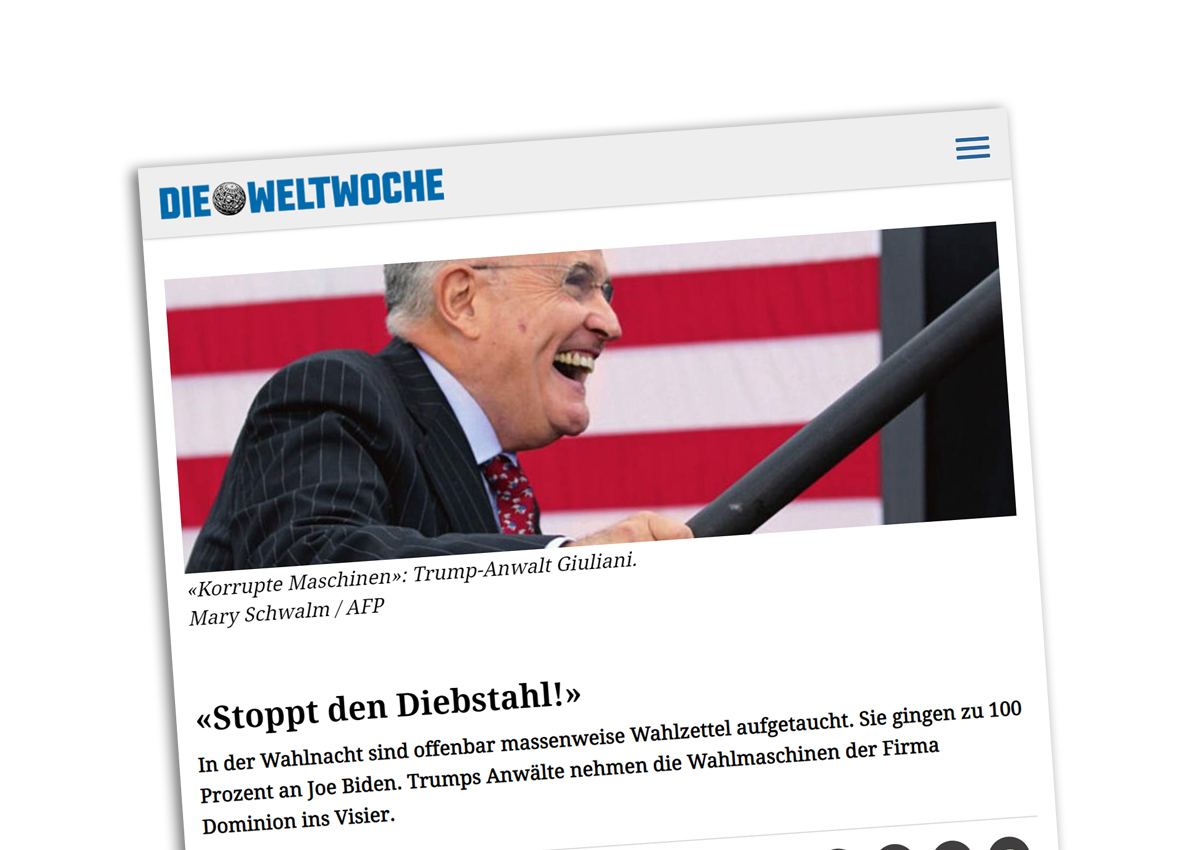
The Press Council reprimands Weltwoche for the article "Stop the theft!" published in November 2020. (Screenshot: Weltwoche.ch)

The Press Council complaint was triggered by a Nov. 19, 2020, article titled "Stop the Theft!" In this article, the lead stated that "apparently masses of ballots had turned up", 100 percent of which had gone to Joe Biden.

A reader contacted the Press Council because the alleged "election falsifications" were false and unconfirmed at the time of publication.

The Weltwoche defended itself with the argument that this was not a statement of fact. After all, the text contained the word "apparently". The readers could therefore easily have recognized that it was a reproduction of allegations that had not been confirmed.

In this respect, the Press Council is of the same opinion as the Weltwoche. The word "apparently" had been used in the lead and in the introductory sentence. However, he is bothered by the sentence "Not even Saddam Hussein falsified so brazenly."

Thus, the allegation of electoral fraud is presented as fact after all, which is not admissible. The Weltwoche had thus violated section 3 (processing of sources) of the "Declaration of the Duties and Rights of Journalists". (SDA)

McOptic: Rebranding and new marketing campaign by CR Basel

Optician McOptic is renewing its brand design and 70 stores in Switzerland. The rebranding follows the acquisition by VisilabGroup in 2019 and is already visible in all stores, on the website and in the marketing campaign realized by CR Basel.

Planning for the rebranding had already begun in the fall of 2020 under the leadership of Sebastien Rossini, the new CEO of the Visilab Group since September 2020. The process was completed in mid-April 2021, with the logo and the different design elements being renewed and implemented in the stores, on the website and for the advertising campaign.

Reference to Switzerland, contemporary positioning

The new logo and corporate design in-house was implemented by McOptic's marketing team. The traditional primary colors of McOptic red and white, which represent the Swiss reference, were retained. The font and logo were adapted to those of the parent company GrandVision. Newly, the McOptic logo includes the so-called "Caring Eye", which stands for GrandVision's brand promise: care, transparency, attention to detail, and high-quality and affordable services.

Switzerland looks through" advertising campaign

The rebranding has been implemented since April 26 and will continue until June 19, 2021, with a marketing campaign under the motto "Switzerland looks through" in all three language regions. The Basel-based agency CR Basel is responsible for implementing the campaign. The campaign is designed to appeal to all age groups and clearly communicate the pricing.

New in-store experience

McOptic's new store design with lots of light and light wood is intended to combine transparency and technology. According to McOptic, digitization is at the heart of the customer experience. With touch tablets and an omnichannel strategy, customers will be able to view the complete range of products both offline and online and try them on using virtual try-ons.

A new, clearer and more direct pricing system has been introduced in the stores, which is now "all-inclusive". The price tag offers an all-inclusive price in each case that includes both corrective lenses and spectacle frames. McOptic has therefore also completely renewed its website. According to the company, this has become all the more important because during the Covid 19 pandemic, customers have shopped online all the more for security reasons. In addition to the existing services, such as the online appointment or the store finder, it is now also possible to view the complete range online and buy glasses in the desired prescription.


Responsible agency: CR Basel. Production: Ramon + Pedro. Media: Mediatonic.

Le Temps takes over online portal Heidi.news

In French-speaking Switzerland, the newspaper Le Temps and the online portal Heidi.news are being brought together under one roof. The company Le Temps is acquiring the news portal for 728,000 francs. The deal is being financed by the Aventinus Foundation.

Both titles will continue to operate independently, according to a statement issued on Tuesday. However, synergies are to be exploited. The editorial, management, marketing and technical departments will be combined. Since the beginning of the year, the two titles have already had a joint editor-in-chief in Madeleine von Holzen and Tibère Adler, as well as a joint director.

The takeover does not come as a surprise. At the beginning of November 2020, the Aventinus Foundation, based in Carouge GE, had given the Zurich media house Ringier Axel Springer Schweiz the newspaper Le Temps was purchased by Aventinus. At the same time, Aventinus also announced its intention to acquire a majority stake in Heidi.news in the medium term.

Le Temps welcomes the commitment of its owner. With the takeover, the Aventinus Foundation demonstrates its will to maintain and further develop a center for quality and innovation in the media sector in French-speaking Switzerland, according to the communiqué. (SDA)

get_footer();