Wunderman Thompson brokers e-mobility for Volkswagen

There is currently a great deal of enthusiasm for alternative forms of mobility. Wunderman Thompson has won the pitch for the activation campaign for Volkswagen’s presence at «The Square,» the New Mobility Hub by Amag at Zurich Airport.

E-Mobility für Volkswagen

With "The Square - New Mobility Hub", Amag Import opened a hotspot for forward-looking mobility at The Circle at Zurich Airport this summer. As part of this opening, Volkswagen Switzerland was given the opportunity in October and November to showcase the current as well as future-oriented innovations from the ID. Family, the e-mobility model series.

In search of the optimal communications partner, Volkswagen called for a pitch. The Wunderman Thompson agency was named the winner.

Emission-free mobility

The activation campaign by Wunderman Thompson is based on Volkswagen's already existing e-mobility strategy "Way to Zero". With the aim of bringing as many visitors as possible to "The Square" during the period from October 25 to November 28, the sustainability credo was personalized and expanded into the event motto: "Your Way to Zero - Your visit marks the start of the path to zero-emission mobility".

The personal approach is intended to convey the feeling of being able to become part of the e-mobility movement in a simple way.

Premieres in Square

In the activation campaign, the agency set itself the goal of presenting a variety of attractive and innovative highlights for the target group. For example, they were to be motivated to visit "The Square" and also take a VIP test drive with an e-mobility specialist.

In addition to info sessions and talks for dealers and their customers, there are two highlights to see in the Square: The E-Concept Car ID. Space Vizzion will be presented, and the ID.5 GTX will also celebrate its Swiss premiere.

Personal involvement as a campaign accelerator

The campaign is communicated to the target group using communication tools such as megaposters, hanging boxes or eBoards and ePanels. Another important campaign component is a social media campaign that works with regional targeting and personally involving headlines.

To generate additional reach, on-site visitors will be asked to personally make a statement about electromobility via a social media post. This campaign extension is to be further strengthened by an incentive via an exciting ID. E-Mobility experience will be further strengthened.


Responsible at Volkswagen: Melanie Felder (Team Leader Marketing Communication), Tanja Schärer (Marketing Communication Manager), Diego Beck (Digital Marketing Manager). Responsible at Wunderman Thompson: Benjamin Franken (Executive Creative Director), Cedric Fuchs (Junior Art Director), David Trüb (Copywriter), Susi Martin (Senior Account Director), Franziska Saxer (Senior Account Director).

Studio Thom Pfister realizes fashion campaign "Reclaim the Streets" for Jelmoli

Under the slogan «Reclaim the Streets,» the campaign for Spotlite’s new concept—the store for the streetwear and sneaker community at Jelmoli—will launch in October. Studio Thom Pfister created the launch campaign.

Studio Thom PfisterAs part of Jelmoli's overall strategy, a comprehensive renovation was implemented, with the Spotlite now located on the 1st floor in an area three times larger. It is intended to be a place where the sneaker community likes to come, meet, linger and experience. The re-opening will take place on November 6, 2021.

The creative central idea of the campaign was visualized through unusual and dynamic movements, as well as through connections of three people, from which new possibilities, dimensions and perspectives emerge. The campaign aims to create awareness. In Zurich itself and beyond, Spotlite is to be further positioned and established as a streetwear destination.


Responsible at Jelmoli: Cécile Moser (Head of Marketing & Communication), Anka Refghi (Editor-in-chief J. Magazine), Carmen Hirzel (Content Lead), Donjeta Selmanaj (Social Media Management). Responsible at Studio Thom Pfister: Thom Pfister (Creative Director, Idea/Concept), Ursula Rytz (Consulting), Daniel Hackiewicz (Art Director), Kim Wüthrich, Juli Martinelli (Graphic Design). Responsible at Stories: Michèle Seligmann (Executive Producer), Flurin Giger (Director, Editor), Heike Schreyer (Production Coordinator), Lara Kuppel (PA Intern), Silvan Giger (DOP, Editor), Elia Grunder (1st AC), Luca Colaci (VTR/DIT/DATA WRANGLER), Raphael Toel (Gaffer), Anabel Rogger (Lighting), Martina Russi (Styling / Style Council), Daniela Koller (Makeup / Hair), Christopher Bautista, Scout Model Agency (Model), Samuel Bietenhader (Model), Nadège Nyakossi Scout Model Agency (Model), Laura Rindlisbacher (Casting Main), Edoardo Moruzzi (Postproduction Supervisor), Luca Colaci (Sound Mix), Yves Roy Vallaster (Colorgrading), Iceage - Vendetta (Music), Studio 1291, Oliver Keller (Location), Christian Witschi (Camera KAMERAWERK), Greg Amgwerd (Light Leuchtturm). Online marketing: Clockwork Digital, Sandro Jungi.

"Ciao Alfi" - An obituary for Alfi Burkard by Thomas Schöb

A great loss for the industry: Advertising executive Alfi Burkard passed away on Thursday at the age of 84. An obituary by Thomas Schöb.

«Ciao Alfi» – Ein Nachruf auf Alfi Burkard von Thomas Schöb
Alfie Burkard, as he cheers Martin Suter on a poster. (Image: zVg.)

Time is the toughest jury in the world. So if you want to be cynically amused, leaf through an ADC yearbook from the eighties. What screams out at you from the massively overestimated zeitgeist - cruel. (Cruel, too, because we won't fare any better one day.) Sometimes, however, one gets stuck with a work: The graphic design is reduced to the maximum, and it is supported by an amazingly logical idea. That would still be good today, damn good even. The eye then sinks to the credits and next to "Art Direction" it usually says "Alfi Burkard". Alfi's work is timelessly good.

When exchanging ideas, Alfi talked about everything except the briefing. About everything except the customer, about everything except the product. Alfi's creative process was mercury. Then suddenly it became tangible, suddenly he was there with his micro-scribbles. Alfi was a lousy draftsman, but once we had deciphered his scribbles, we were amazed at the amazing simplicity of his ideas. No wonder Alfi won awards with his work without a break. The last one, by the way, at the age of 75: Silver at ADC Switzerland for an invitation to his birthday party.

Alfi was hardly to be found at meetings. The call "Wo isch jetz de Alfi wieder!..." accompanied everyone who worked with him. (And also all those who had private dealings with him.) Alfi liked to evade, he evaded the routine, the banal, the unclear. And he eluded the temptation to repeat himself: each of Alfi's ideas was fresh, conceived from scratch, each idea was unique.

As much as Alfi liked to elude, he liked to approach people. He learned from the best, from Helmut Krone and Bill Bernbach at DDB New York. Because he just went to them. He met Milton Glaser and Herb Lubalin because he just went to them. Alfi met John F. Kennedy at a lobster restaurant in Maine. Because he just went to his table.

During his time in Stockholm, Alfi not only worked as an art director at the advertising agency FCB and was not only a member of ADC Sweden. He was also a member of a theater group, meeting Ingmar Bergman and seeing his first performances. Alfi met Olof Palme and the famous developmental psychologist Jean Piaget. Because he just went to see them. - And there was Alfi's encounter with the daughter of General Omar N. Bradley, commander of the U.S. forces in Europe and North Africa during World War II, though encounter is not the most apt of possible terms here.

Martin Suter, then his creative director at GGK Basel, had once told Alfi, "Just look closely at people and the ideas will come." - That's what Alfi did. He could connect with anyone at lightning speed, and he was an extremely careful observer. In Alfi's mind, this created a dynamic network of surprises and inspirations, a kind of Alfinet. Basically, there were no limits to Alfi's thinking. Except for one.

Alfi passed away on the morning of Oct. 21, 2021, at the Golatti Nursing Home in Aarau. Soon Alfi will be with his wife Silv. Of course, there is not just an ordinary tombstone there, but a multi-layered sculpture made of glass, designed by Alfi 22 years ago. And timelessly beautiful.

Where is Alfi again?

FS Parker continues the "Two Creatives One Kitchen" campaign for Siemens

For Siemens studioLine, the Zurich-based agency FS Parker, serving as the lead agency, developed the «Two Creatives One Kitchen» campaign for the second time. This year, industrial design met the art of cooking.

Two Creatives One KitchenIn this year's continuation of "Two Creatives One Kitchen by Siemens studioLine", two creatives meet again and create an emotional symbiosis of design and culinary arts. Sabrina Cipolla, Food Artist & Private Chef, and Alfredo Häberli, Industrial Designer, put carrots at the center of their creativity in their joint project. To make the culinary creations possible, ten new kitchen utensils were designed. The result is three dishes, each of which tells its own story.

This year's "Two Creatives One Kitchen" campaign is a bit more personal than last year's, according to FS Parker. The consumer is closer to the action, he said. The protagonists were captured in their familiar surroundings to illuminate the preparation of the collaboration and the journey.

"In order to appeal to architects and private individuals with a particular affinity for design, we based the creative process strongly on Siemens' values such as innovation and design. However, we didn't just want to show appealing design, but above all to attract attention through storytelling," says Selina Dermon, Key Account Director at FS Parker, describing the strategic thinking behind the campaign.

"The challenge of staging a design kitchen without recreating a conventional cooking situation or producing a classic commercial was particularly interesting," adds Michaela Aerne, Project Manager at FS Parker. Filming took place at the Siemens StudioLine Loft in Berlin. The campaign has been running since mid-October and will be on view until the end of December.


Responsible at BSH: André Franz (Head of Marketing), Susanne Mang (Brand Manager). Responsible at FS Parker: Beni Franz (CD), Toni Pihlaja (AD, Motion Design), Jonas Bürgi (Design), Bettina Schlichter (Design, Text), Maree De Francesco (Photo), Selina Dermon, Michaela Aerne (Project Management), Christoph Schmidt (Consulting). Film: Janic Halioua.

Post chief Roberto Cirillo defends takeovers

Post CEO Roberto Cirillo has defended his company's strategy. He said that in order to ensure basic service without subsidies, the Post relies on additional revenue. He rejected the accusation of distorting competition.

Post-Chef Roberto Cirillo
Roberto Cirillo, Group CEO of Swiss Post, defends the acquisitions made by the Post in recent months.

"We don't want to buy up the whole market," Cirillo stressed Tuesday in an online backgrounder with journalists. But given the change in usage habits, he said, Swiss Post must adapt. This in order to be able to finance the basic service despite declining revenues in the letter market. But it will remain in its core markets, he said.

The background to this are several acquisitions by Swiss Post. In the past few months, for example, the Group acquired the cloud provider Tresorit, the Digital advertising platform provider "Livesystems and the administration aid "Klara". In the latter case in particular, there were accusations in the media that Swiss Post was abusing its dominant position in the market.

Advertising industry protest

There was also criticism of the acquisition of "Livesystems". The company operates advertising screens in train stations, buses and gas stations and other places with a high volume of people. This had nothing to do with Swiss Post's performance mandate, the head of the advertising company APG|SGA, Markus Ehrle, had told Tamedia newspapers in July.

Cirillo explained on Tuesday that the Post has always been active in the distribution of advertising by distributing brochures. The takeover of "Klara" is about the processing of transactions - only that, for example, the bill of a craftsman is no longer tolerated in paper form.

Every takeover is examined in advance to determine whether it complies with competition law, Cirillo stressed. So far, Swiss Post is not aware of any notifications to the Competition Commission (Comco).

According to its own estimates, Swiss Post will invest around CHF 230 million in takeovers this year. In the meantime, the federal parliament is also dealing with the issue: In the fall session, the Council of States passed two openly worded motions calling for stricter rules for takeovers by companies affiliated with the federal government. (SDA)

Media law firm and Mediaplus join forces

Mediakanzlei and Mediaplus are merging in Switzerland. The union of the two agencies is expected to create a creative, data-centric media offering with local expertise under the name Mediaplus Suisse.

Mediakanzlei und Mediaplus spannen zusammen
Matthias Brüll, CEO and Partner Mediaplus International, together with Pam Hügli, CEO and Partner Serviceplan Suisse, Rolf Suter, Managing Partner Mediaplus Suisse, and Pascal Fröhli, Managing Partner Mediaplus Suisse (from left to right).

Mediakanzlei and Mediaplus join forces in Switzerland to combine the best of both worlds: Mediakanzlei's in-depth knowledge of the Swiss media landscape meets Mediaplus' international experience.

Customers at the House of Communication will thus have access to an optimally integrated, data-centric media offering in the future, according to a statement issued on Tuesday.

Further development for media law firm

Since its foundation in 2009, Mediakanzlei has developed into a successful media agency in the Swiss market. "Integrating Mediakanzlei into an agency group that is characterized by entrepreneurial thinking and shares our values is a natural step towards being even more successful in the future," Rolf Suter, founder and previous owner of Mediakanzlei, is quoted as saying in the statement.

Suter will continue to manage the business of the newly formed Mediaplus together with Mediakanzlei partner Pascal Fröhli. Pascal Fröhli will take over operational management, Rolf Suter strategic management. The agency's headquarters will remain in Zurich's Heinrichstrasse.

"Mediaplus Group works strongly data and profile-based, uses the latest technologies and attaches great importance to success tracking. Through the merger, we now have access to innovations, tools, research and the expertise of colleagues throughout Europe," explains Pascal Fröhli.

Enriching collaboration

As a fully integrated part of the Serviceplan Group, the owner-managed Mediaplus Group is represented at 24 locations in 17 countries worldwide. Matthias Brüll, CEO of Mediaplus International, also sees advantages in the merger: "The Swiss market - with its highly fragmented media landscape and special practices in media planning and buying - is very demanding. We are pleased to bring even more local expertise to the House of Communication in Zurich with Mediakanzlei. With Mediakanzlei, clients from other countries get an excellently networked agency to open up the small but very interesting Swiss market for them."

The House of Communication also sees the collaboration as an enrichment. For Pam Hügli, CEO and Partner of Serviceplan Suisse, it is a step towards filling the House of Communication with valuable competencies: "Clients receive an even stronger focus on 360-degree communication. The new colleagues are characterized by innovative ideas, technical know-how and foresight regarding new trends in the media landscape. We will use each other's synergies and share our ideas at an early stage, because a great idea also requires correspondingly creative, target-oriented media planning.

Jung von Matt Limmat: Mobiliar's damage sketch in new dimensions

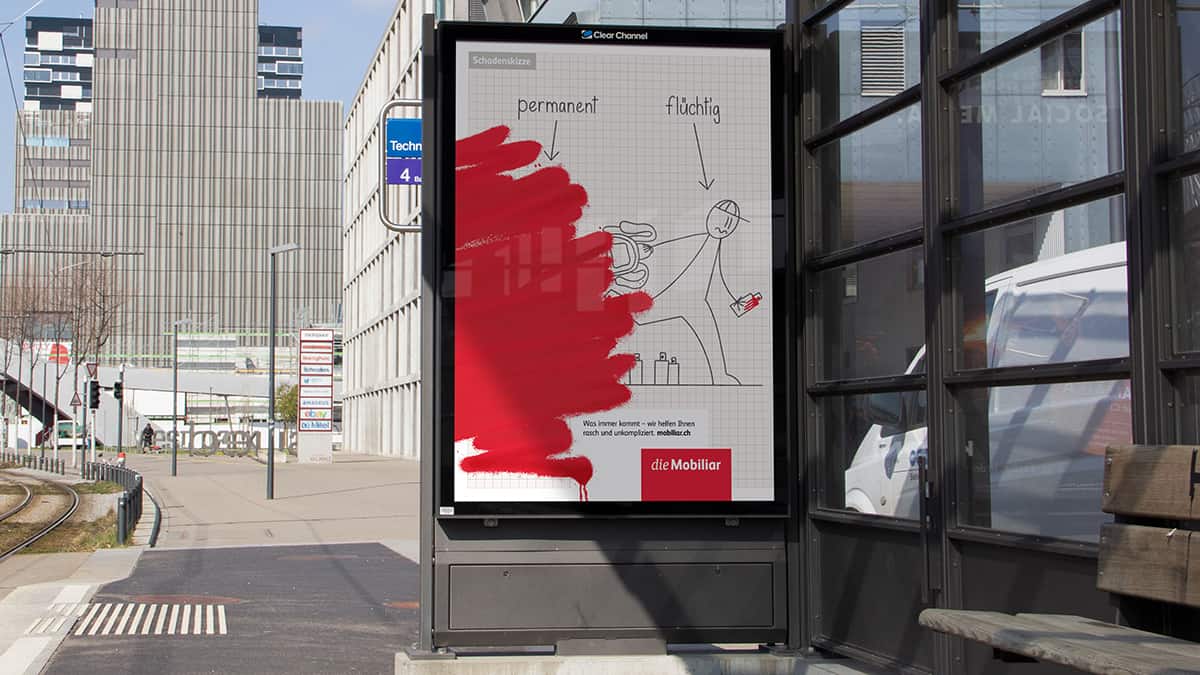
In Mobiliar's current damage sketch campaign, the cult line drawings enter new dimensions. The campaign, developed in collaboration with Jung von Matt Limmat, hogs TV, mobiles and billboards and plays with different levels.

Jung von Matt LimmatMobiliar's famous damage sketches have been mainly what the name implies: sketches, two-dimensional, drawn on squared paper.

In the current campaign of Mobiliar and Jung von Matt Limmat, the damage sketches now play with dimensions and levels and immediately incorporate the medium in which they are played out. The surprising realizations remain true to the classic damage sketch style.

Playful implementation

All the damage sketches in the current campaign always play with the medium in which they are played out. The thief steals the OOH poster, the stick figure and the dog come very close in the TVC, and in the Snapchat lens, mishaps happen directly on the mobile screen. Since Monday, the campaign can be seen nationwide on TV, online, at DOOH and OOH locations, and on social media.


Responsible at the Mobiliar: Hanna Poffet, Nicole Bieri, Silvia Siffert (Marketing Communication Manager), Lorenz Jenni (Head of Brand Leadership & Marketing Communication). Responsible at Jung von Matt Limmat: Luca Schneider, Jan Theus (Art Direction), Melissa Diday (Project Management), Annette Häcki (Executive Creative Director), Cyrill Hauser (Chief Client Officer). Responsible at Jung von Matt Services: Jlona Kopf, Fabrizio Rutishauser, Chiara Killer (media realization). Responsible for Mediaschneider: Anna Perez, Timo Bendel (Senior Consultant), Janine Nussbaumer (Client Service Director). More external partners:inside: Spin Animation (Animatics).

Grip wins Mars Switzerland as a new customer

Grip has secured Mars Switzerland as a new client in the food industry. Since April, the agency has been responsible for Mars’ corporate communications and reputation management and serves as its media relations office in Switzerland.

"Who doesn't know them, brands such as Mars, M&Ms, Ben's Original, Pedigree or Whiskas, for example, which Mars distributes. In addition, Mars is intensively committed to a more sustainable world for both people and animals. We are very pleased to be able to accompany such a traditional family business as Mars in Switzerland on their way to a better future," Patrick Milo, Managing Partner of Grip, was quoted as saying in a statement.

According to the company motto "The world we want tomorrow starts with how we act today", Mars' goal is to take measures every day that create a better world. Thus, among other things, the company is committed to numerous projects and initiatives both internationally and nationally.

New Digitec POV campaign: When customers set the tone

In the current TVCs of the Digitec POV campaign, things are getting musical this time. The honest customer reviews are once again told in a cinematic manner.

A karaoke fan on Bill Murray tracks and two Wes Anderson-style women who are at least enthusiastic about music: With these two new spots, Digitec is ringing in the next round of the current TVC campaign.

Once again, the spots are based on real reviews from the community and provide a humorous insight into the lives of customers from the perspective of the products.

The films have been on TV, in cinemas and on the usual social media channels since Monday.


Responsible at Digitec Galaxus AG: Martin Walthert (Chief Marketing Officer), Flurin Spring (Creative Director), Daniel Kobi (Art Director), Ursina Grimm (Head of Brand Management), Mariya Alipieva (Project Management & Brand Management), Alessandro Thüler (Digital Media Design), Roberto de Bonis (Digital Marketing), Luca Giugliano (Media Planning), Anne Chapuis (French Translation). Responsible at Plan B: Chris Niemeyer (Director), HC Vogel (Producer), Jessica Sonderegger (Producer), Filip Zumbrunn (DoP), Ioannis Sochorakis (Equipment), Christoph Menzi (Edit). Adriel Pfister (Grading), Sound post production: UKO - The Audio Suite.

"Discovery Commerce" in Social Networks: Products Find Customers

People are no longer only inclined to make impulse purchases during haptic city strolls. The trend toward online shopping means that customers are increasingly discovering products spontaneously on the Internet that they haven't specifically searched for, but buy anyway. In his guest article, Peter Potthast explains how online retailers can use discovery commerce to take advantage of this behavior in social networks and win over customers for spontaneous purchases.

Discovery CommerceShopping habits have changed dramatically in the digital age, and the Corona pandemic is accelerating this development. More and more people are now buying products or services online via smartphone, tablet or laptop. According to a study by Adobe Digital Insights, online purchases increased by 32 percent last year alone.

However, it is not only shopping habits that are increasingly changing, but also user behavior. Instead of specifically searching for products, customers are increasingly strolling and browsing online - especially in social networks - and discovering items of interest to them there that they didn't even know they needed or simply wanted to own. With Discovery Commerce, online retailers can take advantage of this behavior: Through targeted discovery, users are made aware of a suitable product or service and encouraged to make a purchase.

How Discovery Commerce works

Unlike e-commerce, where users specifically search for products and services on the Internet, in discovery commerce the products find their way to the people. Shopping by discovery" is originally known from strolling around town, where customers tend to make more impulse purchases, but is now also increasingly migrating to the Internet.

Social networks such as Facebook and Instagram play a central role in this context. 65 percent of Instagram users have already bought a product from the platform at some point, says Kai Herzberger, Group Director Commerce at Facebook. And according to a study by Hootsuite, 52 percent of brands are discovered in the public newsfeed of a social network (as of 2020). Customers who like to spend their time on social media platforms repeatedly discover products or services in the newsfeed that match their own desires and interests.

Someone who is interested in the topic of dog ownership, talks about it in the community, subscribes to corresponding channels and reacts to posts, receives product suggestions for dog leashes, beds or for the BARF nutrition method in the newsfeed. Other customers who see clothing on influencers or other people they follow that matches their own style not only receive information about the price, but can also buy the item of clothing directly in the story or feed post. For online retailers, this presents an opportunity to use discovery commerce to optimize their digital offering and drive new customer acquisition.

Products customers find on social media

In order to use discovery commerce effectively in apps and social media, online retailers must focus on the users or the target group and not on the products in the sense of a customer-first strategy. Instead of displaying an ad with the same images and the same wording to as many people as possible, the aim is to offer a suitable product experience for the respective user at the right time. This means enormous personalization, based primarily on information that users like to share online in social groups and communities.

Machine learning systems provide support here: They grant access to a data basis for understanding which people are most likely to be suitable for one's own products or services. They also ensure that individual advertising with messages, images and videos is played out and displayed automatically. The technical basis is provided by social networks such as Facebook, Instagram and Pinterest, as well as their messengers, which are well attuned to one another and are popular with customers. With them, companies can make individual offers and even anticipate customers' wishes. On Facebook and Instagram, online retailers have the opportunity to highlight products in content and ads, set up their own store, and upload product catalogs where customers can browse and shop.

Discovery Commerce on Facebook

With around three billion active users worldwide, Facebook is the largest social network and offers its own discovery commerce platform that brings together users' demographic and personal data in compliance with data protection laws. The platform is additionally complemented by Instagram, WhatsApp and other messengers.

Online retailers can benefit from the many tools Facebook provides that deliver meaningful data about how customers interact with the company and what is important to them. To do this, Facebook uses machine learning and the application of broad audience strategies. The basic requirement for online retailers is their own Facebook page and an Ads Manager or Business Manager account in order to be able to upload texts and images. In this context, Kai Herzberger recommends that companies give the algorithm as much freedom as possible when targeting and placing ads, as it can react and readjust much more quickly.

For the creative design of the products, there are several tools in Ads Manager and Business Manager that can be used, for example, to make color adjustments. The challenge in discovery commerce is to ensure that the products fit organically into the user's stories, convey authenticity, and avoid reproducing old patterns as much as possible. The goal is not just to sell something to the customer once, but to bind him to the brand in the long term.

Advantages of the new marketing strategy for online retailers

Discovery Commerce offers SMEs the opportunity to better reach and engage with their customers where they like to be and where they regularly spend time. With the right message at the right time, it brings people and brands together and makes the shopping experience much smoother. It combines storytelling and sales in one, with often only a few seconds between the discovery of a product or service (awareness) and the purchase (conversion). In addition, the conversion rate is significantly higher, which Facebook says is 86 percent.

Last but not least, discovery commerce enhances the experience of online shopping and promotes the joy and excitement of discovering a product. An essential factor in this context is personalizability: "Shopping by discovery" benefits from the fact that people are more inclined to shop at brands that offer deals and personalized recommendations, as studies show.

Another plus is the reliable option to analyze the ads over time in the Ads Manager of the social media channels and measure whether the marketing campaigns are actually working successfully or should be adjusted if necessary.


* Peter Potthast is CEO of Löwenstark Online Marketing. The agency develops and manages online marketing campaigns in SEO, SEA, marketplace marketing, affiliate marketing, email marketing and social media for clients in all industries. Potthast has been active in online marketing in the agency and AdTech environment for more than 20 years.

Corona and disinformation: importance of journalism on the rise

During the COVID-19 pandemic, quality media help people make sense of events and curb disinformation. However, the economic situation facing journalism has continued to deteriorate. At the same time, support for media funding remains relatively high in Switzerland.

The Research Center Public and Society Fög of the University of Zurich published its yearbook "Quality of the Media 2021" on Monday. The center has been examining the development of the Swiss media annually since 2010.

According to the report, the topic of disinformation - i.e. intentionally spreading false news - has definitely arrived in Switzerland with the Corona pandemic. This is shown by the results of a representative survey conducted by Fög in Switzerland at the end of 2020.

Almost half of the respondents (49%) consider disinformation to be a "major" to "very major" problem, especially in dealing with social crises. Just under a quarter say they "often" to "very often" encounter false news. The study participants cite social media (62%), alternative media (39%), video portals (36%) or messenger apps (28%) as the main sources of disinformation. Professional journalistic media such as news sites (20%) or television (13%) are less often cited as sources of disinformation. On the contrary, the population uses information from journalistic media (61%) and from the federal government and authorities (68%) to check the content of fake news.

More classification by the media

In the second wave of the pandemic, the media also pay very high attention to the topic of Corona - but less than in the first wave, despite rising case numbers. The coronavirus is also presented explicitly as a threat less frequently (6%) than in the first wave (16%). "A "scaremongering", as the media is often accused of, can thus not be empirically determined", says media expert and Fög director Mark Eisenegger. The proportion of media reports that are very positive towards the authorities remains low (0.3%). Thus, the accusation of uncritical "court reporting" is not confirmed. Figures and statistics are classified more frequently by the media compared to the first wave (21% vs. 12% in the first wave), which is positive.

Limited diversity of experts

Another conclusion of the report is that the diversity of experts in the second wave of the pandemic remains severely limited, however. Thus, voices from medicine, virology, and epidemiology continue to dominate, despite the fact that almost all sectors of society are affected by the pandemic. Female scientists have become more visible (21% vs. 12% in the first wave), but remain significantly underrepresented compared to their male colleagues.

This underrepresentation of women persists in media coverage beyond Corona, as another Fög study on the portrayal of women in Swiss media shows. A limited diversity is also confirmed by an examination of the referendum campaign on the veiling ban of March 7, 2021. The Muslim minority concerned is not very visible on Twitter (13%) and in the media (11%). Instead of letting them have their say, there was more often only general talk about Muslims.

More quality in commuter and tabloid media online

According to the Fög report, media quality remains stable overall, but is changing in individual dimensions. The media provide more information on politics (37%, +5 percentage points year-on-year) and less on soft news such as sports (10%, -1.5 PP) and human interest (30%, -1.3 PP). The share of classified services in the form of background articles did not decline for the first time in six years.

Media types such as public broadcasting and subscription news sites continue to excel in quality. But the commuter and tabloid media online can improve their quality due to the event situation and the stronger focus on politics.

The concentration of content, i.e. the sharing of identical articles in several media, has become more pronounced in German-speaking Switzerland. In 2020, this can be seen in almost all subject areas, but especially in cultural reporting.

Media promotion is strongly accepted

The Corona pandemic has further worsened the economic situation of the media, the report says. For the first time since 2014, revenues from the online advertising market are also declining. Although willingness to pay for online news is growing slightly (17%, +4 PP). However, this is not enough to sustainably finance journalism.

According to Fög, more active media support is not rejected in principle. 37% of respondents are of the opinion that the state should support private media if they get into difficulties; 37% are against, 26% are undecided. In an international comparison, acceptance of direct media support in Switzerland is thus strikingly high.

Good journalism needs resources

The results of the Yearbook show that professional media have become even more important as a result of the pandemic. Media provide orientation, supply the population with reliable information and are also able to check and refute false news. Good journalism, which is supposed to fulfill its democratic functions, needs resources. "It is becoming increasingly apparent that high-quality journalism can only be financed through direct media funding," Eisenegger is convinced. This should also support smaller media providers and startups in particular, which contribute to a diversity of voices and to informing the population. (pd/swi)

No Sleep Agency launches minigame for Dr. Oetker

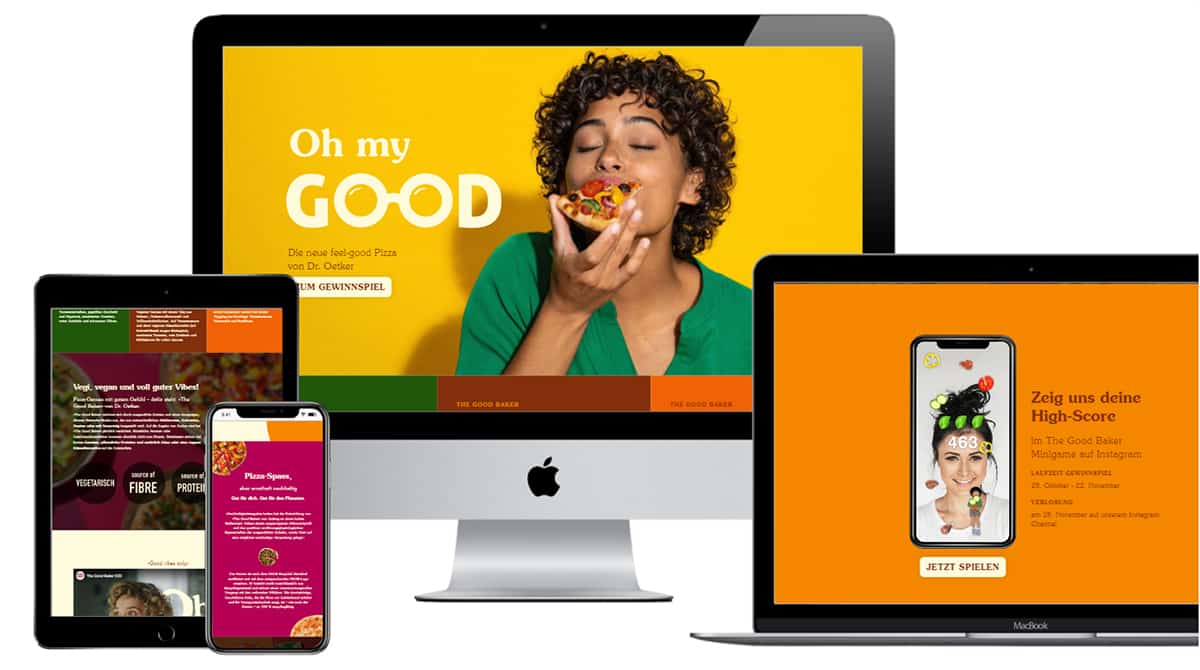
For the launch of the new product series "The Good Baker" by Dr. Oetker, the Zurich agency No Sleep Agency implemented an augmented reality minigame for Instagram.

With "The Good Baker" Dr.Oetker has launched three new pizza varieties. The products have a thin stone-oven base made from different types of flour, grains, seeds or sourdough. No sugar is added to the vegetarian or vegan pizzas. Artificial flavors or flavor enhancers are also not used.

As part of the launch campaign for "The Good Baker," No Sleep Agency created an interactive Augmented reality minigame programmed for Instagram. The players can control the character of the campaign with their heads and must collect the new pizzas, as well as their ingredients. Since the products are vegetarian and vegan, it is necessary to avoid the meat pieces. The filter has been programmed to save the personal high score, so you can always improve.

The minigame is used as part of a sweepstakes and an influencer campaign. In collaboration with Vondach, No Sleep Agency implemented a supporting mobile-first landing page.


Responsible at Dr. Oetker Switzerland: Valentina Mejenina (Media and Communications Manager), Helen Yildirim (Product Manager Pizza), Valery Henle (Managing Director). Responsible at No Sleep Agency: Silvan Obrecht (project management), Ivan Heinzer (consulting). Responsible at Vondach: Nicola Dutoit (Art Director), Eric Léger (Backend Development).

get_footer();