Digicube creates digital home for Innofactory

In the course of launching a new website for Innofactory, Digicube from Buchs was commissioned to develop a comprehensive style guide as well as a new image world for the company.

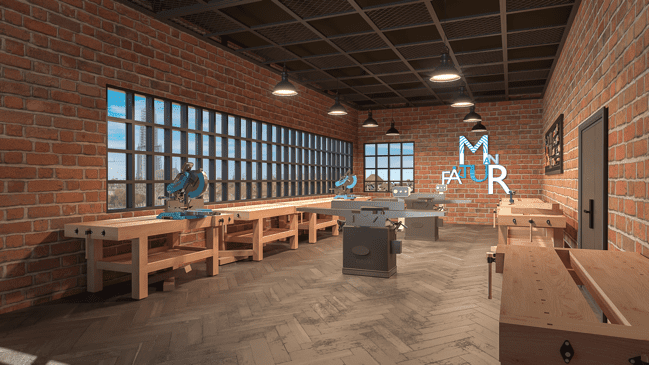
The company Innofactory works mainly for its customers and does not have its "own" office space. Based on this fact, Digicube developed the idea of giving the company a digital home.

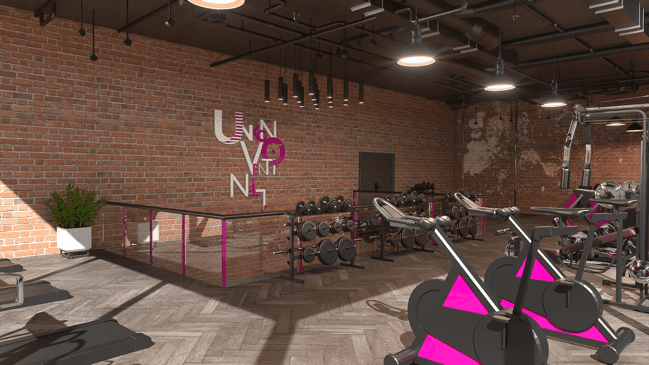
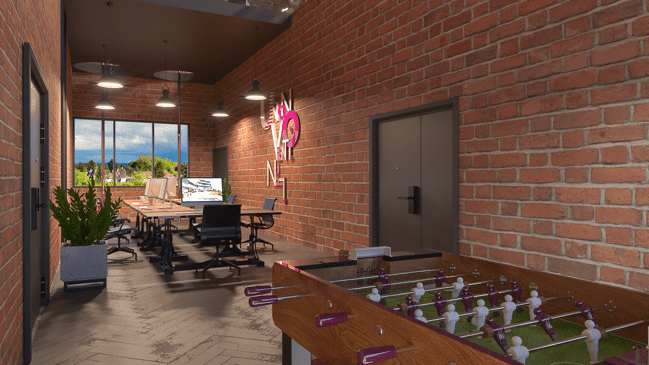
Together with an architect from Paris, a virtual house was designed in the middle of Bern. Innofactory's virtual home is modeled on the company logo.

Each room in the building is meant to represent a dedicated step in Innofactory's mentoring process. On the right side on the lower floor is the market stall - the café where customers with projects and ideas contact Innofactory to find stakeholders who want to work together on that project. Also on the lower floor is the Innofactory Office, where research is conducted and ideas from Innofactory's training center are incorporated directly.

On the left, symbolically represented, is the Inno pipeline. It is meant to reflect the entire process of developing prototypes, checking them and the creation process in the workshop. After successful delivery, the created projects end up in the showroom on the top floor on the right side.

In order to be able to present the Innofactory home in a little more detail, Digicube has created a detailed image for each room as well as a 360-degree image. The house can be viewed in a virtual tour at Innofactory.ch/house be explored. Each individual room is described in detail once again.


Responsible at Innofactory: Ramona Wahlen (Marketing & Business Designer), Mark Chardonnens (CEO). Responsible at Digicube: René Müller (overall responsibility), Alexandra Ging (graphics & design). Production: Ibrahim Ameur Abbassi (Architect).

Noé Robert establishes neurodiverse agency Twofold

As CEO of the Zurich agency Twofold, 29-year-old Noé Robert, together with over 60 employees, is completing a transformation process after one and a half years. Twofold is positioning itself as a neurodiverse agency - and already has several major clients in its portfolio.

Established the neurodiverse agency Twofold: The29-year-old CEO Noé Robert.

"After ten years in the agency business, I was on the verge of leaving the industry," Noé Robert is quoted as saying in a press release. Shortly after his graphic design apprenticeship, he had built up his own branding agency, integrated it into an international agency and continued to support it as a strategy consultant.

But regular 60-hour weeks and internal corporate political battles eventually led him to wonder where the sense of purpose had gone, he says. "I was close to burnout and seriously considering doing something completely different, even though brands and communications had always been my passion," Robert says.

It was during this time that Susan Conza, founder of Asperger - now Twofold - approached Noé Robert. Over the last ten years, she had built up a company for training highly qualified learners with Asperger syndrome. Gradually, small digital projects for Swiss SMEs were added, but the agency was never able to gain a real foothold. Conza's offer to Robert was to turn Asperger into a global agency including training for people with Asperger syndrome.

For Noé Robert, it was an exciting challenge that came at just the right time: "I had no idea what Asperger's meant. But it was an incredible opportunity for me to transform an existing business while doing something really meaningful."

Extensive positioning

So, together with COO Marius Deflorin, the CEO set about building a powerful core team around the newly brought in Creative Director Lukas Rosenmund. "Marius has been a companion and close friend for ten years, Lukas and I got to know and appreciate each other at our last joint employer," says Robert. "The two of them were also about to leave at that time, brought an enormous amount of experience and know-how with them and were thus perfect partners for the upcoming transformation." Within the first three months, two more core team members joined and the repositioning could be started.

As part of a comprehensive positioning process, the Asperger company was renamed Twofold and realigned in the market. Today, the new image and the name Twofold - two is German for "twofold or double", "fold" also denotes a community or herd - unite agency and training company under one roof. The way to the agency with an in-house training part, the Twofold Asperger Academy, was paved.

According to Robert, the topic of autism is one-dimensional and rather negative for many people. He himself had not previously been aware that autism is a spectrum in which there are great differences. "Our professionals with autism add incredible value to our projects and also on a personal level. We see autism as an asset, not a disability."

First major customers already on board

Already during the positioning process, Twofold won the budget of a Big Four company. This was followed by further mandates for brands such as IWC Schaffhausen, UBS, Zumtobel and Rail Systems Engineering. Twofold expanded the team with more than 25 new employees from the areas of strategy, design, technology, text and conception as well as motion design. After two years, Twofold employs over 60 people.

VSM launches survey on trade media usage in Switzerland

The Swiss Media Publishers Association VSM would like to survey the importance of specialist media in the media usage of the Swiss. To this end, the association is launching a wide-ranging survey.

VSM lanciert Umfrage zur Fachmediennutzung in der SchweizThe Publishers Association launched a survey to find out what proportion of the Swiss population's media consumption is accounted for by specialist media and how important they are.

The VSM will be giving away a Microsoft Surface Laptop of the latest generation worth 1,000 Swiss francs to all participants in the survey, which will take about five minutes. The survey closes on Tuesday at 12 noon.

Since you, dear readers, as trade media consumers, are also part of the target audience of this survey, we invite you to participate at join this link.

The latest results of this survey can be found on Q-publications.ch/studies can be retrieved.

Advertising Market Trend: Marked Increase in September

As usual, the advertising month of September was also strong in 2021, closing with a gross advertising volume of CHF 629.2 million. Compared to the previous month, this corresponds to a significant increase of 59.9%, and the advertising market also increased significantly year-on-year to 26.6%. This is shown by Media Focus' Advertising Market Trend.

The biggest trigger for this increase is online advertising pressure - especially search.
The number of ad displays found was declining due to an adjustment by Google. The algorithm was adapted accordingly and the number is now back at a higher level.

Cumulatively over the first three quarters, advertising print stands at 3,735.6 million gross Swiss francs and, compared with 2020, records an increase of 5.6 percent. Compared with 2019, however, advertising print continues to lag behind at -11.3%.

Advertising pressure in the overall market

The development of advertising print as of September 2021 in millions of gross Swiss francs:

publikation img

publikation img

Three industries double their advertising pressure

Overall, the advertising market increased by 26.6 percent in September compared with the previous year. This can be attributed primarily to the significant increase in three sectors. The Fashion & Sports (+105%), Leisure, Hospitality, Tourism (+102.7%) and Events (+96.2%) sectors all increase significantly in September, doubling their advertising pressure year-on-year. Events can boast a quarter of the total YTD advertising print in September alone. This means that the industry's YTD advertising print is now 1.4 percent above the previous year's level.

A look at the YTD comparison also shows a positive picture for tobacco products (+24.5%), cosmetics & personal care (+21.8%) and beverages (+17.9%).

Only five industries reduce in September

Overall, five industries are reducing advertising pressure compared to September 2020. The largest reduction is recorded by the energy industry (-19.2%), followed by initiatives & campaigns (-17.6%), beverages (-14.1%) and tobacco products (-7.1%). As in the previous month, the Telecommunications industry also reduces its advertising pressure slightly (-5.8%).

Despite the positive development of advertising pressure in September, Leisure, Hospitality, Tourism continues to lag behind YTD, showing the third largest reduction year-on-year (-5.5%). The picture is similar for the service industry, which shows a significant increase in September (+69.6%), but the second largest reduction YTD (-6.8%). Only Transportation is even further behind YTD, with a 7.6 percent reduction.

publikation img

Top of the month

Top advertisers and most advertised products and services (excluding assortment, image advertising and collective categories) in September

publikation img

Media Mix for the month of September

publikation img

What does... "EOU" actually mean?

Benno Maggi explains in his column "What does... actually mean?" terms from the marketing and communications field. This time he shares his thoughts on the term "EOB".

Now that the orders are hitting the agencies again everywhere and everything that has been missed and postponed has to be made up for hectically by the end of the year, deadlines are booming again. And with them, the answer to the industry's most popular question at the moment: "Until when is it possible?" The indifferent approach to deadlines that British author Douglas Adams once expressed so beautifully in his book "The Salmon of Doubt: Hitchhiking the Galaxy One Last Time" has long been a thing of the past: "I love deadlines. I love the whooshing noise they make as they go by." Oh, those were the relaxed times.

No more fun

Today, punctuality is a must, and with it the question of "by when" must be answered precisely in our increasingly time-critical business. In the past, a loose "asap" - abbreviation of the English "As soon as possible" - was sufficient. Until recently, "by Wednesday" was precise enough. But today, after a date, it is always "EOB", or written out as "End of business day".

This acronym has its origins - like so many things - in the financial industry. It refers to the end of the business day on a stock exchange, where the use of a loud closing bell ensures that all traders stop transacting at the same time. As we know, in our industry, this chime is not always clear to everyone involved in a project. Some make an early exit, while others have to work late into the night to meet deadlines. After all, EOB is not until 11:59 p.m., and those who want to be even bluffer add an additional "CET" to the back for "Central European Time" instead of approaching the whole thing a bit more objectively and designing the processes in such a way that no (unpaid) overtime and night shifts become necessary.


* Benno Maggi is co-founder and CEO of Partner & Partner. He has been eavesdropping on the industry for over 30 years, discovering words and terms for us that can either be used for small talk, pomposity, excitement, playing Scrabble, or just because.

Volvo Switzerland and Dreifive launch automotive chatbot on Instagram

The Dreifive agency has implemented a conversational commerce chatbot for Instagram in collaboration with its long-standing client Volvo Switzerland and Memacon.

Instagram chatbots have only been around for a few weeks, but they are already offering companies a new and innovative way of addressing customers. Volvo, too, is now relying on this automated and smart form of communication.

Interested customers can use Volvo's Instagram chatbot to receive virtual guidance on the various car models, equipment lines and color options. These components create a fully automated dialog option with infotainment character that can provide additional support in the important phases of the purchase decision, according to Dreifive. Users can also use a deep link to further process their desired model in the configurator or arrange a test drive directly, which provides the opportunity for lead generation and, above all, a modern and interactive exchange with the brand.

Instagram chatbots now respond to keywords that have also been stored in the Volvo chatbot, so that artificial intelligence can be used to respond appropriately to customer inquiries and simplify customer service. In the conception of the chatbot, preparatory interface connections to the CRM system Salesforce via API have already been implemented. In terms of evaluation, comprehensive analyses enable a precise understanding of customer behavior and optimization of the user journey.

"Our incentive for the chatbot was to provide users with an easy and needs-oriented introduction to our Volvo model range and to accompany them in the decision-making process in a modern, open-minded and target group-oriented way," says Giovanni Porcelli, Digital and Social Media Manager at Volvo Switzerland, explaining the communication measures implemented.


Responsible at Volvo Switzerland: Giovanni Porcelli (Digital and Social Media Manager), Katharina Medcher (Junior Digital and Social Media Manager). Responsible at Dreifive: Tiziana Tarzia (Teamlead Social Media), Dylan Hess (Consultant Social Media), Marleen Albert (Head of Social Media). Responsible at Memacon: Moritz Beck (Managing Director/Owner).

More and more companies distribute content via social media

Two-thirds of Swiss companies rely on target-audience-specific content as part of their marketing communications, which they share via social media channels. In addition, more than half of companies now use content marketing, as a ZHAW study shows.

66 percent of companies in Switzerland rely on social media to reach their customers. They use these channels to distribute content created specifically for the target groups and thus draw attention to themselves.
Because they are free or inexpensive to use, among other things, social media are very well suited for content marketing. This aims to reach customers with content that offers them clear added value, such as informative, advisory, or entertaining benefits.

As part of marketing communication, content marketing is generally on the rise: more than half of the companies surveyed - around 57 percent - actively use it. This is the result of the "ZHAW Content Marketing Study 2021". For the study, ZHAW researchers surveyed around 660 Swiss companies from all parts of the country online. The study was carried out by the ZHAW School of Management and Law and conducted by Watson and AZ concept supported.

Facebook most used

"Companies today have recognized the importance of social media, and even a great many small and medium-sized companies are now making extensive use of it," says study author Adrienne Suvada of the Institute of Marketing Management at ZHAW.

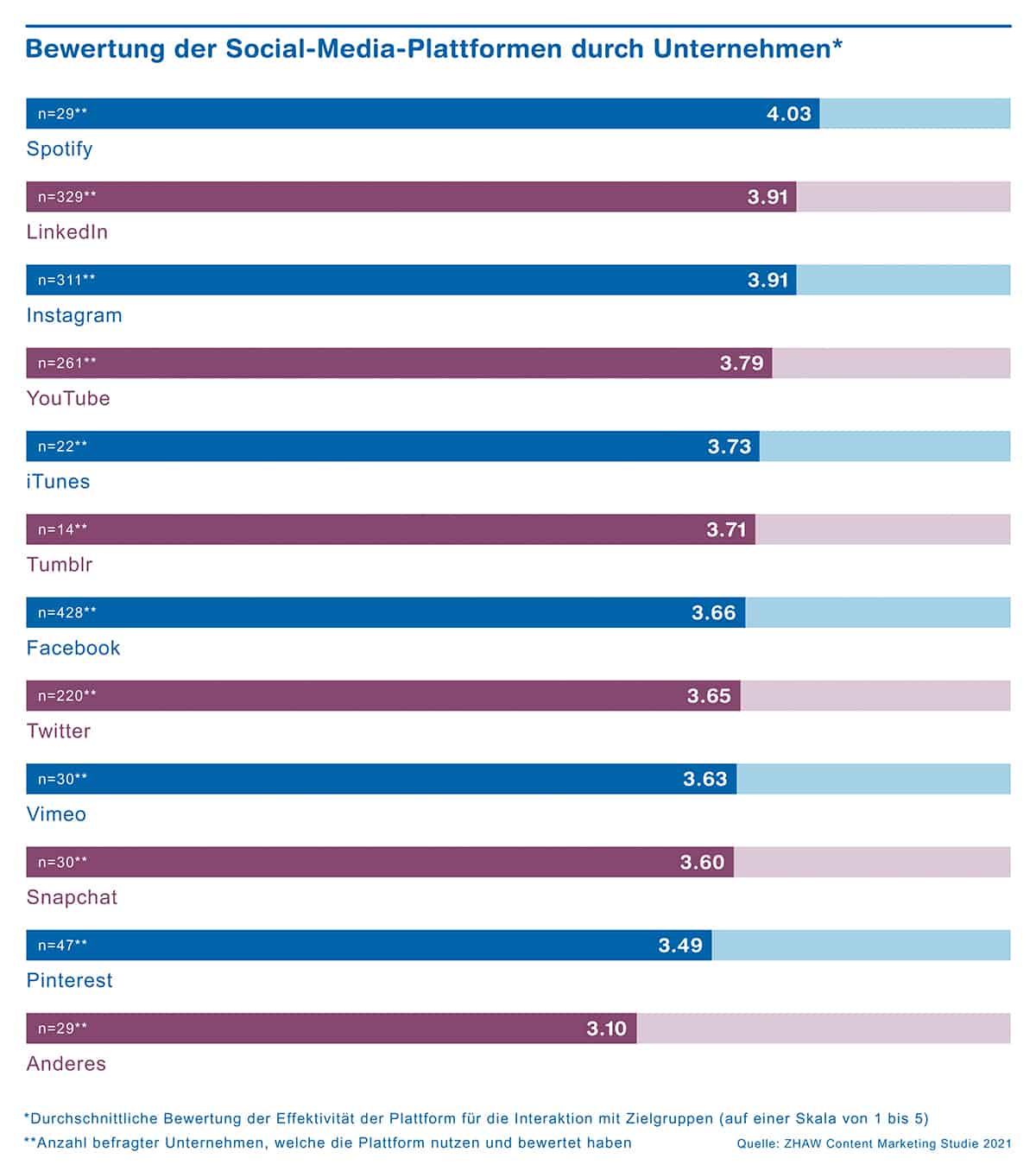
Facebook (69 percent), LinkedIn (53 percent), Instagram (50 percent), YouTube (42 percent) and Twitter (35 percent) are the main platforms used by the companies surveyed. When it comes to companies' assessment of the effectiveness of social media platforms, pretty much all of them score positively, with the niche channel Spotify achieving the best result with a score of 4.03 (out of 5). However, only about four percent of companies use it. Of the larger providers, LinkedIn and Instagram stand out in particular. In addition, Facebook and Twitter are also seen as effective distribution channels.

SMEs catch up

Content marketing in general is used by 58 percent of large companies, and by 48 and 52 percent of medium-sized and small companies respectively. Furthermore, three-fifths of the companies that do not currently use content marketing plan to do so in the future. "While larger companies have been relying on this tool for some time, the trend now seems to have arrived among small and medium-sized companies as well," says study author Adis Merdzanovic of the ZHAW Institute for Marketing Management.

With content marketing, companies pursue a dual objective: on the one hand, they want to retain customers with good and interesting content and thus position themselves on the market; on the other hand, many see it as a further instrument for promoting sales and turnover. On average, companies invest a good 33 percent of their marketing budget in content marketing. This proportion is likely to increase in the future.

Content matters

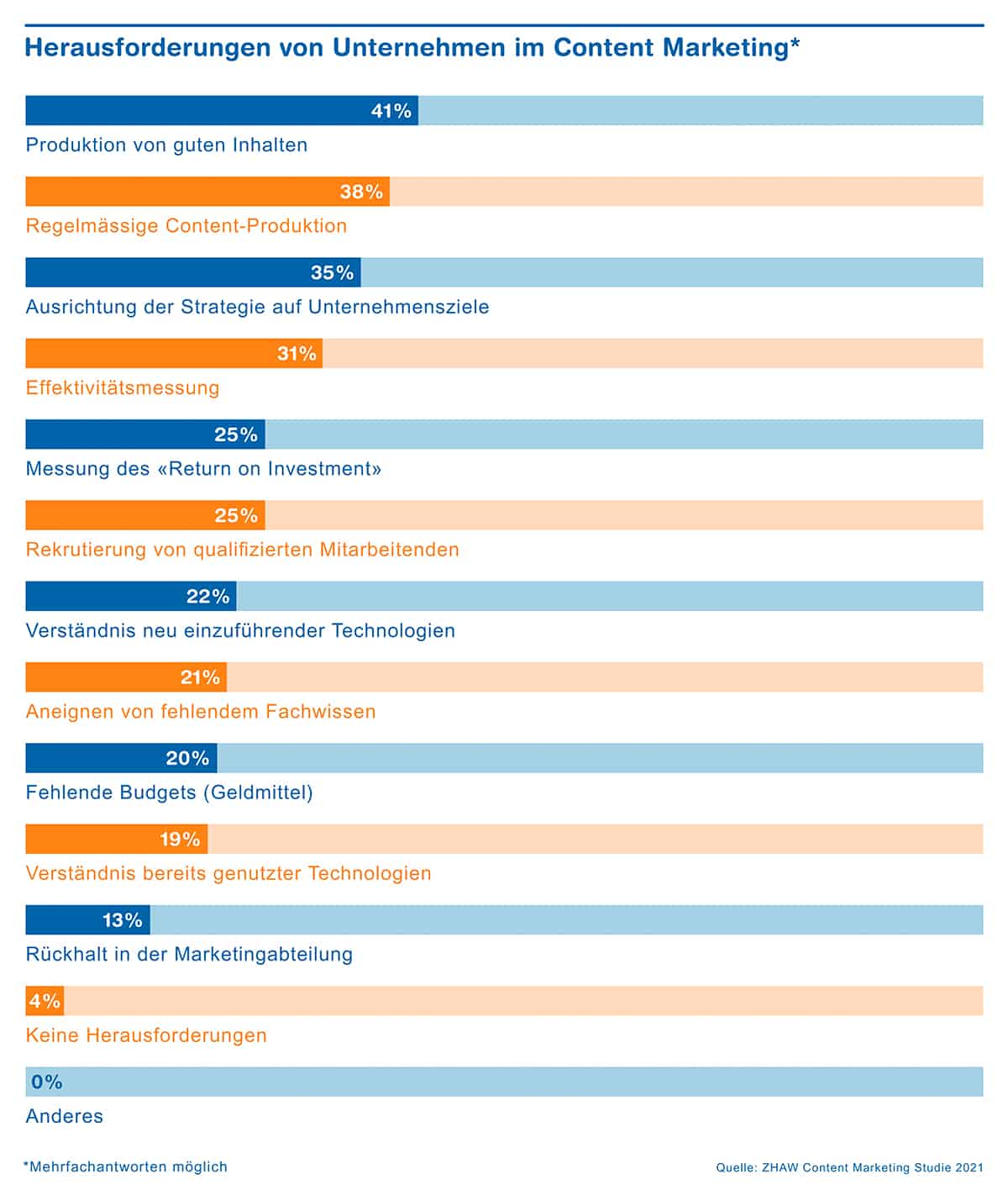
"Digitization and social media have given companies new communication channels. But to use these successfully, content with real added value for the target groups is also required," says Suvada. The study also shows that one of the most important challenges is the regular creation of good quality content. Forty-one percent of companies say they struggle to produce good, engaging content, while 38 percent struggle to provide new content on a regular basis.

In the process, companies draw on many different formats for their content production: from online events to videos and illustrations to podcasts or blogs, they use virtually all content marketing tools, albeit to varying degrees.

How strongly people identify with companies and brands in Switzerland

The «Identity Study Switzerland 2021» by FehrAdvice & Partner shows which companies customers and non-customers identify with the most. Migros tops the rankings. The pandemic and digitalization are playing an increasingly important role in identity formation.

(Source: FehrAdvice & Partner)

For the third time, FehrAdvice & Partners has published the Identity Study in collaboration with the market research institute Innofact, in which the identity values of 169 companies were surveyed. In particular, FehrAdvice & Partners examined the winners and losers of the study as well as the differences in relationship skills in the analog and digital world.

The generally more volatile market environment, faster innovation cycles and open markets mean that many companies and brands are increasingly at risk of being replaced by other products and service providers. Customer identity is therefore an important factor in counteracting this risk. It measures how strongly people identify with a company or brand.

A strong identity leads to greater customer loyalty and more satisfied customers with less price sensitivity, who also act as brand ambassadors. "The global Covid crisis is changing customers' consumer behavior. They are becoming more price-sensitive, more frugal and more active in the digital space than before. This makes a strong customer identity all the more important and an indispensable part of a company's competitive strategy," explains Luca Geisseler, Managing Partner & Executive Behavioral Designer at FehrAdvice & Partners. A strong identity is very difficult to copy and therefore represents a strong differentiating factor.

The identity study shows that Swiss companies and brands such as Migros (1st place), Lindt (2nd place), Ovomaltine (3rd place) and Coop (5th place) have very high identity scores. Die Mobiliar (7th place) and SRrf.ch (9th place) also made it into the top 10, although the digital brands Google (4th place), WhatsApp (6th place), YouTube (8th place) and Wikipedia (10th place) have worked their way into the top group during the pandemic. Raiffeisen and PayPal have high identity scores in the financial sector category, Migros ahead of Coop and Ikea in the retail sector and Die Mobiliar ahead of Axa and Helvetia in the insurance sector.

Digital gap in retail

The study also draws attention to the fact that there are still major differences in customer identity between the analog and digital worlds. This can be seen, for example, in the "digital gap" of brands such as Migros and Coop, which have not been able to transfer their strong analog identity to the digital world.

These results show that there is still great potential for Swiss companies in the digital space to better position themselves in the battle for attention. "We are surprised that the upswing caused by the pandemic failed to materialize for digital grocery retailers. Most analogue brands fail to make the transition to the digital world because human behavior in the digital world is systematically different from that in the analogue world," says Geisseler.

Finally, the results of the study shed light on the difference in identity values between customers and non-customers. "In-depth knowledge of identity drivers and the initiatives derived from them open up the opportunity to increase customer loyalty and turn non-users into customers," explains Geisseler.

The key findings of the study

  • A large number of companies fail to create an identity, neither in the digital nor in the analog world.
  • Even companies that are particularly identity-creating in the analog world only manage to be identity-creating in the digital world to a limited extent.
  • On average, digital companies have less of an identity than analog companies. Nevertheless, they have significantly increased their identity compared to the previous year.
  • The transition from an analog to a digital world is often difficult. It is important to remember that people's behavior in the digital world differs from that of the analog world.

The empirical "Identity Study Switzerland" is compiled annually on the basis of behavioral economics research on identity formation. It examines the question of whether there are differences in the analog and digital world. In addition, the identity values of customers and non-customers are considered separately. The study emphasizes the importance of a sound and precise knowledge of identity drivers in order to develop targeted prototypes that sustainably strengthen the corporate identity.

Eli and Eli design appearance of BernPride 2023

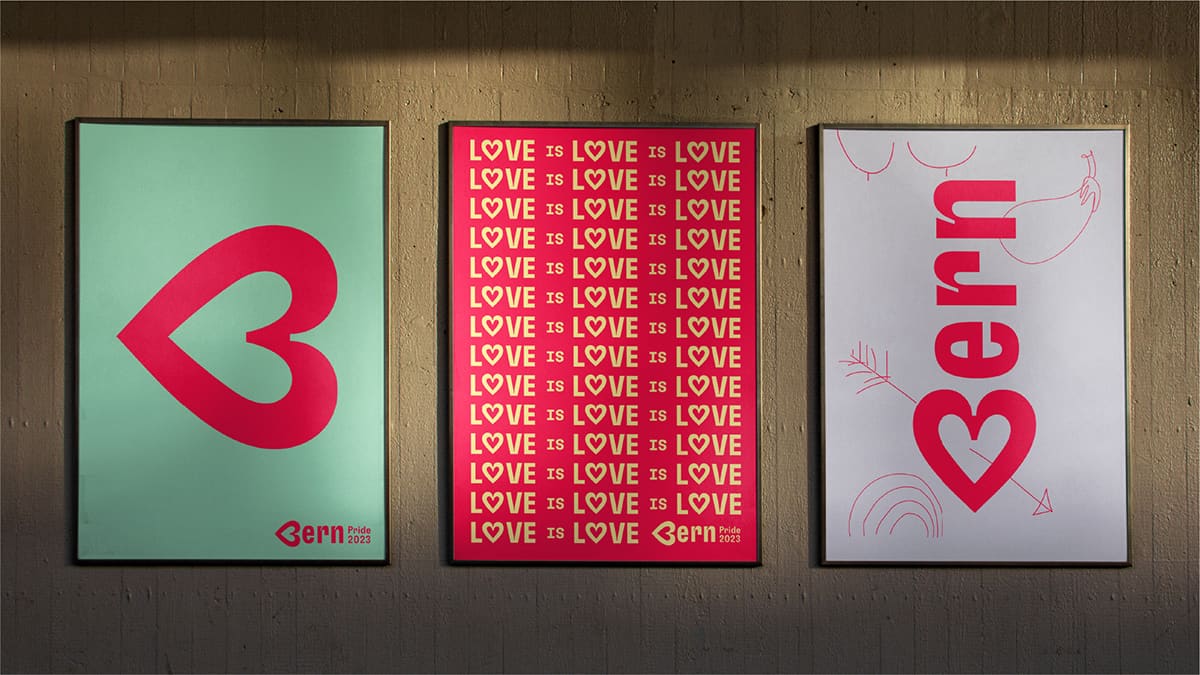
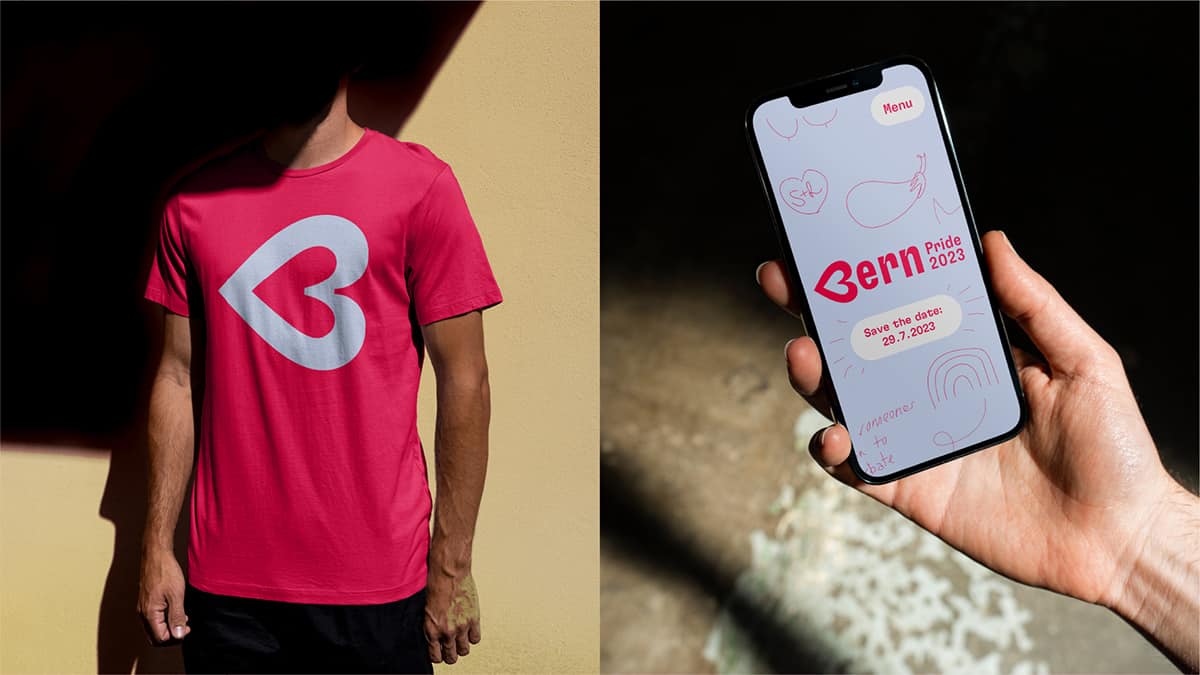
BernPride will take place in the federal capital on July 29, 2023. The two graphic designers Elisabeth Zahler and Eliane Häfliger were able to convince the jury of the LGTBIQ event with their design and create the appearance of the BernPride 2023.

The BernPride will take place on July 29, 2023, and will be the third time the LGBTIQ event has been held in the federal capital, following Pride 2000 and Pride Ouest 2017. The centerpiece of the event is the demonstration parade, held in many countries, which celebrates the political achievements of the LGBTIQ movement and harks back to the 1969 Stonewall riots in New York. At the end of the parade through downtown Bern, political speeches and a cultural program are planned on the Bundesplatz.

For the appearance of BernPride 2023, the LGTBIQ event initiated a logo competition in which 15 graphic designers from Switzerland, Germany and Great Britain participated. The winners were Elisabeth Zahler and Eliane Häfliger - Eliundeli.ch. "Bern proudly shows itself with heart," Häfliger comments on the concept behind the logo. "The logo stands for the openness and inclusion of the movement in Bern," adds Zahler.

Nik Eugster, co-organizer of BernPride, is pleased that the winning design comes from the city of Bern. However, this did not play a role in the choice. "The logo shows Bern with heart," says Eugster. "The design is striking and playful at the same time."

BernPride will take place as part of the LGTBIQ sports event EuroGames Bern 2023. From 26 to 29 July 2023, around 4000 international LGBTIQ athletes will meet in Bern and compete in around 20 sports.

The event is dedicated to diversity and inclusion and is open to all persons regardless of their sexual orientation, gender identity and performance level. BernPride and EuroGames 2023 Bern are organized by a non-profit association.

RTL and Amobee plan joint advertising venture

To strengthen its targeted advertising business on European television, RTL Group plans to set up a joint venture with U.S. advertising specialist Amobee.

The new company, called Techalliance, is to combine the offerings of Amobee and RTL subsidiary Smartclip, RTL announced in Luxembourg on Thursday. If the authorities approve the project, the marketing and service company will launch in the first quarter of 2022.

The Techalliance wants to give European TV broadcasters and streaming services the opportunity to broadcast advertising to viewers in a more targeted way. RTL CEO Thomas Rabe promises high reach and the ability to combine linear TV with digital advertising, according to the announcement.

According to the data, so-called addressable TV advertising is expected to grow to more than 500 million euros in revenue in Germany alone by 2025. RTL Germany wants to claim more than 200 million euros of this, although last year the company was still at less than 15 million euros. (SDA)

Trump announces his own social network "Truth Social"

Former U.S. President Donald Trump plans to launch an alternative social network. Trump announced on Wednesday evening (local time) that the new platform will be called «Truth Social.».

Truth translates as truth. The president-elect said he has the money together to start his own publicly traded media company. With this, Trump is making a new attempt to rejoin the public online conversation.

The network is to be launched for invited guests in November, then nationwide at the beginning of 2022. The goal, he said, is to stand up to the "tyranny" of big tech companies. "We live in a world where the Taliban has a huge presence on Twitter, but your favorite American president has been silenced," Trump shared.

Twitter, as well as Facebook and YouTube, had suspended Trump's accounts in January shortly before the end of his term. The trigger was the storming of the U.S. Capitol by Trump's supporters - and that he expressed sympathy for the attackers. In addition, he continues to claim without any evidence that his victory in the presidential election in November was stolen by fraud. With this, he heated up the mood in the country. Twitter, where Trump had more than 80 million users following him, had been the main communication platform for him until then. The ex-president has been defending himself against the blocking of his account for some time.

New Competition for the "Liberal Media Consortium

The new media company - the Trump Media & Technology Group - was created through a merger with Digital World Acquisition Corp. and plans to go public, Trump further explained. It is intended to be a competitor to the "liberal media consortium" and to stand up to Silicon Valley companies that have used their unilateral power to silence opposition voices in America, he said. Trump announced his intention to publish his first "truth" on Truth Social soon.

Apart from the announcement, not much can be seen of the announced network yet. There is a homepage Truthsocial.com with a link to an iPhone app that can be pre-ordered. Apple's app store lists February 21, 2022 as the launch date.

Own medium after ejection

After Trump's ejection from the most important social media, Trump and his supporters have made several attempts to build a relevant alternative to Twitter & Co. In May, Trump had a blog set up on his website. There, the former president complained primarily about alleged fraud in the 2020 presidential election. After a month, the blog section was closed again. According to a report by the Washington Post Trump was annoyed that his blog had been met mainly with ridicule on the Internet. The site had also attracted few visitors.

Unconfirmed reports have been circulating in Washington for months that Trump wants to set up his own media companies. The rumor that Trump wants to set up an alternative to his former favorite TV station Fox News has also not come true. Not much has happened in terms of establishing a Twitter alternative either. A close Trump adviser, Jason Miller, founded a competing social media platform called Gettr. But Trump has yet to join the platform. (SDA)

Annabelle brings special issue on death

«We're all going to die»: The women's magazine Annabelle has dedicated a special issue to the taboo subject of death—and, through various articles and interviews, shows that death has many facets.

We all die at some point - and many of us try to suppress this very fact. Death seems to be the last taboo in our society. And it is precisely this taboo that Annabelle break with a special edition.

The production of this booklet was fraught with minor hurdles, writes the Annabelle-editor Medienart in a statement. Rarely had tears flowed so often at meetings. Nevertheless, the editorial team stayed on this last chapter of life. "I am convinced that it is the task of us journalists to speak where otherwise there is an awkward silence," writes the editor. Annabelle-Editor-in-Chief Jacqueline Krause-Blouin in her editorial. "Perhaps the most vital thing of all is to make death a part of our lives."

The issue examines the topic of death from different perspectives: While members of the Annabelle-The fashion team has dedicated a section to the mourning color black - showing that the dark only exists in combination with the light.

The famous Nigerian writer and feminist Chimamanda Ngozi Adichie talks to Editor-in-Chief Krause-Blouin about her latest book, in which she deals with the death of her parents. Within a few months, the author lost her father and her mother. One emotion that particularly preoccupied her was the enormous anger she felt: "I was surprised at how angry I was. I still am. I'm so damn angry at death."

Readers learn what death itself feels like from Tom Kummer, who talks to deceased personalities in his very exclusive interviews. While Prince Philip reports having met Neil Armstrong on his way to the afterlife, Ruth Bader Ginsburg philosophizes about justice in the realm of the dead. The short interviews show that death can also be quite entertaining.

The special edition on death appeared on Wednesday.

get_footer();