Atoll goes for color instead of clinical for Männedorf Hospital

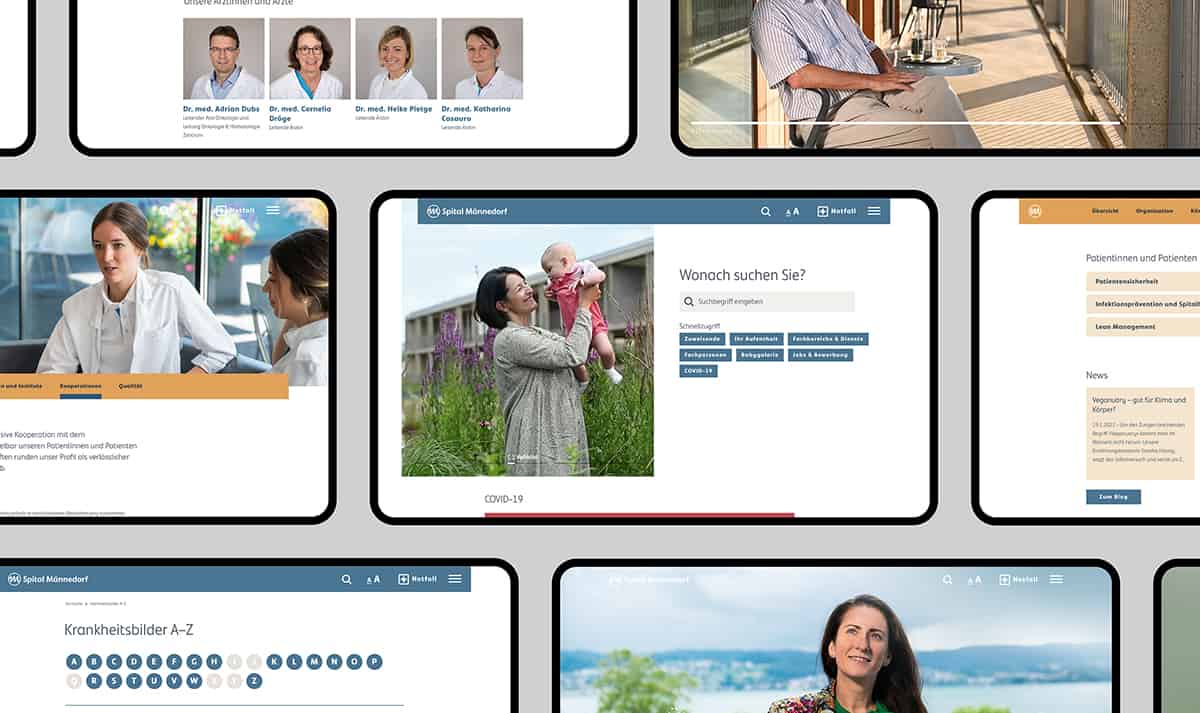
The Zurich agency Atoll has designed the new website for Männedorf Hospital.

Atoll statt klinisch

For around 140 years, Männedorf Hospital has been committed to the health and well-being of the people on the right bank of Lake Zurich. The hospital covers basic medical care but also offers specialized services.

The development from a regional hospital to a networked healthcare partner called for a new website. Atoll was entrusted with the implementation of the new website.

In a deliberate departure from the clinical coldness of typical hospital presentations, the new website is intended to show the human face of cutting-edge medicine - with warmth and empathy.

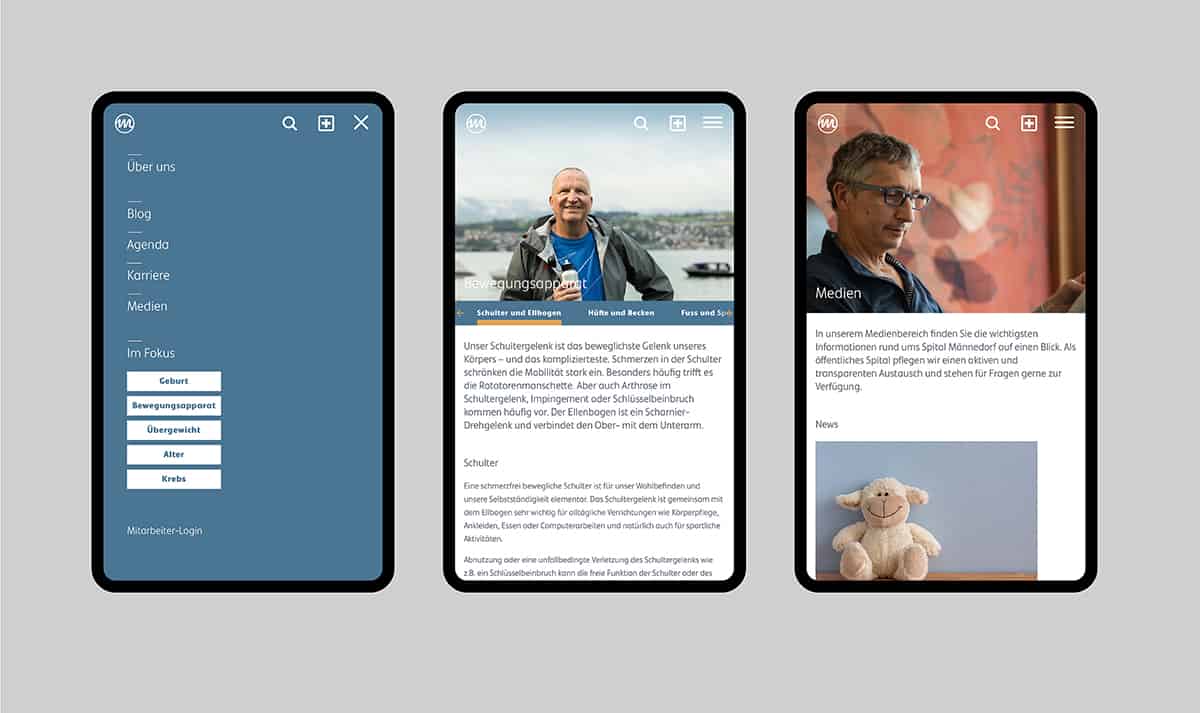
This only made maximum user centricity seem even more compelling. Navigation is no longer a direct reflection of the internal organizational structure with its special clinics, but now follows the behavior of the users. Their main interests lead them to key topics where they experience the most diverse competencies of the hospital as a meaningful unit.

One of the challenges was to create the optimal access points for each use case without compromising the establishment of a logical architecture.


Responsible at Männedorf Hospital: Martina Meyer, Michèle Belviso. Responsible at Atoll (Lead Design, UI/UX): Alexander Kranz-Mars, Axel Eckstein. Responsible at El Patio Studio (Web Development): Vladimir Knobel, Marcos Irureta Goyena. Photography: Désirée Good, Christine Strub, Esther Signer. CI/CD: Designport. Brand Positioning: Crafft.

Thomas Wildberger becomes partner at Prophet

International strategy consultancy Prophet is expanding its presence in Switzerland, hiring former creative director and Publicis CEO Thomas Wildberger.

Prophet Thomas Wildberger

Prophet wants to strengthen its presence in Switzerland and has hired Thomas Wildberger, the longtime creative director and CEO of Publicis Switzerland, to do so. The Zurich native will take over as head of Prophet's Swiss office with immediate effect, according to a statement.

Before Publicis, Wildberger worked for many years in Germany, including at Jung von Matt and Springer & Jacoby in Hamburg, as well as at his own agency Römer Wildberger in Berlin. In 2016, Wildberger was hired by the Advertising Week named "Advertiser of the Year.

"It's the age of transformation. So why not start with myself?" Wildberger is quoted as saying in the release. "I'd like to combine the topic of creativity with the strategic topics of growth and transfromation in my new position."

According to Prophet, Wildberger is to accompany the transformation of international and Swiss companies strategically and also in the implementation, as well as to incorporate creativity into organizational and business development. Brand activation will also continue to play a role for Wildberger. Wildberger and Prophet already know each other from earlier collaborations, when both jointly accompanied the relaunch of Orange and developed the Salt brand.

Founded in 1992 in San Francisco, Prophet is a global consultancy focused on business growth and transformation in the areas of Brand, Marketing, Experience, Innovation and Organization & Culture.


SRF: Daniel Pünter takes a new direction

Daniel Pünter, Head of "DOK and Reportage" at SRF, has decided to seek a new challenge professionally. Since the culture department will be reorganized, his duties will be distributed on an interim basis as of February 1, 2022.

SRF Daniel Pünter
(Image: SRF/Oscar Alessio)

After almost 20 years at SRF, Daniel Pünter is looking for a new professional challenge and is considering options within and outside SRF.

Pünter began his career at Swiss Television in 2001 at "Rundschau" and as a trainer. In 2004, he was responsible for "Glanz & Gloria" as editorial director, in 2008 he took over as editorial director of "Schweiz aktuell," and in 2017 Pünter became head of the "DOK and Reportage" division. 

Reorganization in multimedia teams

The SRF Culture department will be reorganized in the fall of 2022. According to SRF, multimedia teams will now think and plan even more decisively in terms of topics and stories instead of programs and broadcast slots, which will also eliminate the divisional management level.  

With Pünter's decision to reorient himself, therefore, as of February 1, 2022, tasks of the "DOK and Reportage" division management will be assigned on an interim basis to Nathalie Rufer previously Deputy Head of Division and Head of "Series and Reporters. Rufer has been with SRF since 1993 and will help shape the transfer of the division to the new multimedia organization.  

Claudia Badertscher, a reporter at "Kassensturz," will take over journalistic responsibility at the divisional management level for the online reportage format "rec." until the end of June 2022. She has been with "Kassensturz" since 2021, was previously a producer of "10 vor 10" for many years and brings with her extensive knowledge of investigative journalism. She was also part of the operational team for the "SRF 2024" transformation project.

Ilona Stämpfli remains team leader "rec." as before. She has been with "SRF DOK" since 2020 and has successfully gotten the new online reportage format "rec." up and running with a lot of dedication. "rec." will also be on SRF zwei's TV program in 2022.  

Stuiq wins pitch for startup Quitt

The Zurich-based agency Stuiq won the campaigning pitch and will be looking after Quitt with immediate effect. The startup takes care of the administration of private workers.

Stuiq gewinntQuitt's full-digital solution takes care of the bureaucratic processes involved in registration, wages, insurance and much more. This is to ensure that private workers are employed fairly, legally and safely. Stuiq's campaign aims to raise awareness and importance for the service.

"Great people, thoughtful pitch, holistic approach, and experience in marketing SaaS startups - We are excited to have found the perfect partner in Stuiq to help us promote Quitt broadly," said David Christen, Co-Founder and CMO of Quitt.

The national campaign is scheduled to start as early as spring 2022.

Dept realizes new brand experience for Louis Widmer

For the cosmetics and pharmaceutical company Louis Widmer, the agency Dept realized an integral relaunch across various disciplines and thus created the basis for a modern and forward-looking marketing.

Dept Louis WidmerThe agency was commissioned to rebrand the Louis Widmer brand. A complete Website relaunch was also on the program.

The Louis Widmer brand, still family-owned today, stands for in-depth research, highly effective products and a promise of sustainability for people and the environment. These key values of the company should be underlined by the new branding and marketing. The new website is designed to provide users with quality advice in the digital space so they can quickly find the right product for their skin type.

For the implementation of the new appearance, Dept was in intensive exchange with various teams at Louis Widmer. The focus was always on the question of how modernity and tradition can be optimally combined.

The result is a lightweight and streamlined digital experience with a performant website and a high technological standard that follows modern approaches to lead generation and marketing automation; latest CMS and CRM technology, strategically placed call-to-actions and individual country-specific solutions, paired with content on skin and skin care.

Features and functions such as animations and filters should also ensure good accessibility of the website for users of all ages.

Following the holistic approach, Dept implemented everything from rebranding, web concept, design and development to comprehensive analytics and SEO measures independently in this project. The implementation of the CRM also laid the foundation for the marketing automation strategy. In the future, Louis Widmer will be able to better understand its customers and address their offers in a more individual and targeted manner with reduced wastage.

Currently, the agency is working on the next release of the website with even more features and improvements. It also supports Louis Widmer in the further development of digital channels.

Aroma creates Live Experience Guideline for BKW

The energy and infrastructure company BKW acts as an organizer and partner for a variety of events of different sizes, ranging from B2B conferences to B2C trade shows and events. In joint workshops, BKW and Aroma Creative further developed the brand at the touchpoint.

Aroma kreiert BKW

The Live Experience Coach Book developed serves as a strategic basis for doing justice to the event environment and the target group, while at the same time conveying the brand values in an experience-oriented and credible manner.

The guideline is structured according to objectives and experience categories. It provides recommendations on how to design exciting brand presences that will anchor the BKW brand in the minds of visitors. Furthermore, the creation process is defined and spatial design principles are explained. Finally, the modular and scalable furniture catalog is illustrated.

The first implementation was seen at the Alpine Ski World Cup in Adelboden and Wengen. "Thanks to the Coach Book, our brand values can be experienced consistently and the first implementation was a complete success. We are looking forward to the upcoming applications," says Michael Morgenthaler, Head of Live Experience & Campaigns at BKW.


Responsible at BKW: Lukas Aegerter (Project Manager), Michael Morgenthaler (Head of Live Experience & Campaigns), Stefan Oberholzer (Head of Corporate Brand Leadership). Responsible at Aroma: Tobias Zimmermann (Senior Consultant), Philipp Häcki (Art Director), Cristian Valenghi (3D Artist). Responsible at UP. Communications: Patric Schönberg (Brand Strategist).

Museum of Communication conquers Europe with "host" concept

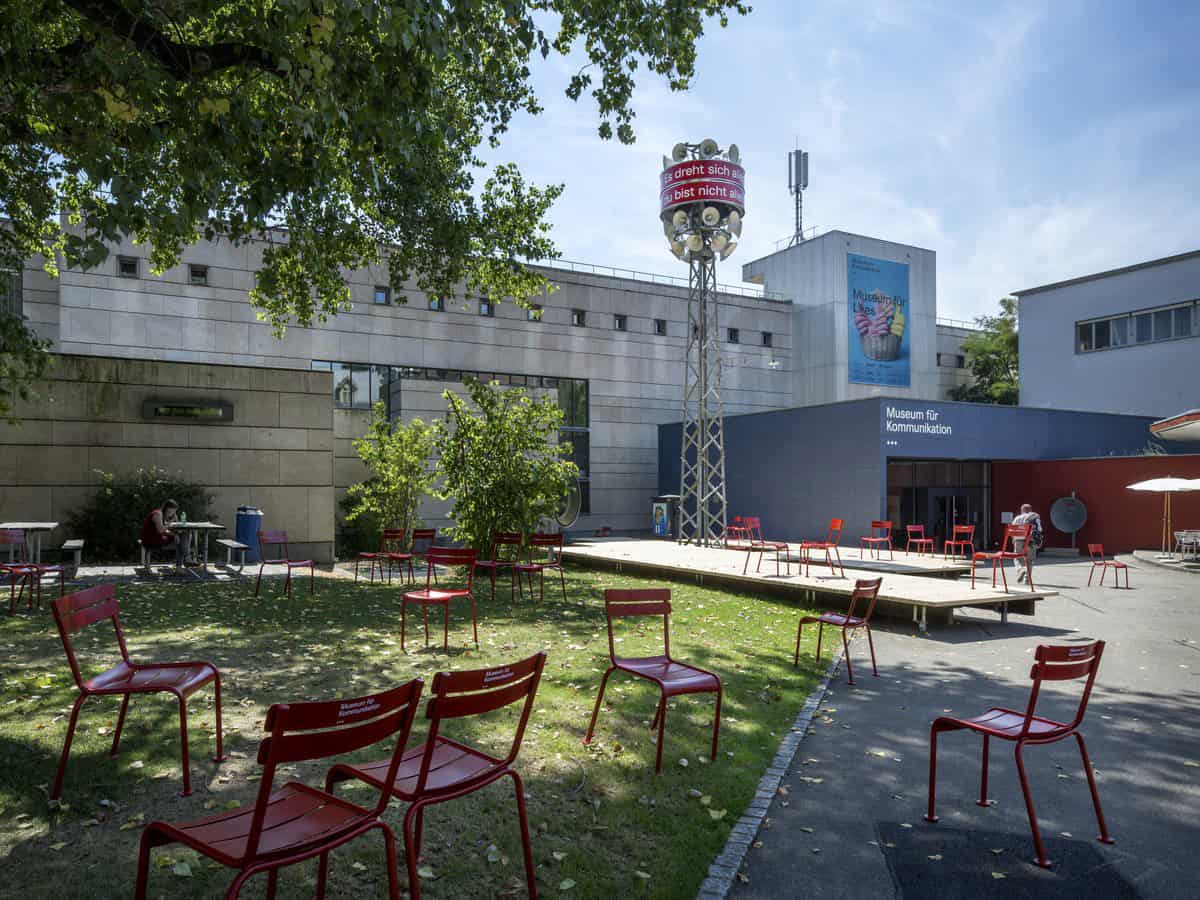
The Museum of Communication in Bern has attracted interest both at home and abroad with its concept of «hosts» instead of attendants, introduced in 2017. According to the museum, numerous museum professionals have undergone training in Bern to adopt this approach.

Museum für Kommunikation
The Museum of Communication in Bern. (Image:: Thijs Wolzak)

Among the museums interested in the concept are the Deutsches Museum in Munich, as well as museums in the Netherlands, Austria and Switzerland, the Museum of Communication announced on Tuesday at its annual media conference.

The "hosts" at the Bern Museum approach visitors individually, hold discussions with them, answer questions and invite participation. This personal touch pleases the guests, says the Bern Museum.

In the meantime, the museum has coined a formula for this. It is based on Einstein's formula - E to the power of three = P times M. What is meant is experience to the power of exchange of experience to the power of knowledge, which equals audience to museum, as was said at the media conference on Tuesday.

More audience again

Last year, more than 80,000 people visited the Bern-based institution, which is a foundation of Swiss Post and Swisscom. That's 35,000 fewer than in the record year 2019, when there was no corona pandemic, but 25,000 more than in 2020, which was marked by the pandemic and its lockdowns.

Without a two-month closure and without restricted admissions in March 2021, the museum would have recorded over 100,000 admissions according to a projection, director Jacqueline Strauss told the media. That, she said, was the institution's goal. Therefore, she is very satisfied with the visitor interest.

The Bern Museum has also enjoyed international success with its own 2018 production "Sounds of Silence": this exhibition will be on display at the "Universience" in Paris in 2023/24.

"Hybrid museum" to be created

The Bern Museum wants to develop into a hybrid institution. Thus, the Museum of Communication wants to achieve that it can be visited analog and digital. As the head of exhibitions and digital museum, Christian Rohner, said, a two-year project phase has been launched for this purpose.

The focus will be on creating a dialog between analog and digital space and vice versa. (SDA)

Silverspot creates the Biotta moment 2.0

Film production company Silverspot was commissioned by Biotta to create a campaign that would fit in with Biotta's existing communications while appealing to new target groups.

Silverspot Filmproduktion

"The question we asked ourselves: how can we highlight new aspects of the product in such a way that a new target group under the age of 30, in particular, feels addressed by it," explains Nicolas Vonlanthen, Creative Director at Silverspot.

The result is a campaign with, on the one hand, a TV commercial that shows special moments in which the specific target group takes center stage. And on the other hand, it also includes a call to action in social media channels to capture your own "personal Biotta moment" on video and share it on social media.

"To increase interactivity in the target group, we have linked a competition to this at the same time," explains Remo Civatti, Managing Director of Silverspot. "Furthermore, polls on social channels will add to the virality." According to Civatti, a large number of videos have already been recorded.

"The great thing is that the campaign has the uniqueness of being self-renewing via social media. Even after the TV spots have all been broadcast," Silverspot CD Vonlanthen continues.

The campaign "The Biotta Moment 2.0" was implemented entirely in-house at Silverspot, from conception to delivery, and has been running nationwide since Monday.

Two new additions to the editorial team of NZZ am Sonntag

At NZZ am Sonntag, there are two new additions to the editorial team. Anja Burri and Gordana Mijuk will be promoted as of April 1. They replace Alain Zucker, who wants to write more again and will move into the background as a writer in July.

NZZ am Sonntag
The editorial team of NZZ am Sonntag as of April 2022: Jonas Projer, Nicole Althaus, Gordana Mijuk, Anja Burri and Thomas Stamm (from left to right). (Image: Joël Hunn)

Anja Burri and Gordana Mijuk, together with Nicole Althaus, who has headed the magazines since 2014, as well as Thomas Stamm, Head of Digital, and Jonas Projer, now form the new Editorial Board of the NZZ on Sundayas the NZZ announced on Tuesday.

The 39-year-old Burri has worked for more than five years for the NZZ on Sunday, first as background editor, then as page editor and, since November 2020, as head of the domestic desk. Prior to that, she was the Federal Parliament editor for the domestic desk of Tages-Anzeiger and The Covenant active. Between 2009 and 2013, she wrote for the news agency SDA in Bern, where she completed a two-year traineeship including a MAZ diploma. She studied sociology, history and media studies at the universities of Basel and Vienna, graduating with a licentiate.

Gordana Mijuk, 48, has been working for the NZZ titles since 2006, initially as an editor in the Zurich department of the daily edition. In 2010, she switched to the NZZ on Sundaywhere she wrote for Hintergrund-Bund and took over as head of the foreign desk in 2017. She began her journalistic career at the Associated Press news agency in Bern and Zurich before moving to the business desk of the Aargauer newspaper switched. She graduated from the University of Zurich in German Studies, Philosophy and History and holds an Executive MBA.

However, the two new deputy editors-in-chief will both continue in their management functions for the foreign and domestic departments. Burri is domestic editor-in-chief, Mijuk foreign editor-in-chief. In addition, Mijuk will take over the role of managing editor from Alain Zucker, who intends to devote more time to writing and research and will therefore move to the background department from July. (SDA/swi)

Philipp Gasser strengthens TrueStory's social media team

The 37-year-old Philipp Gasser joins the Zurich agency TrueStory as Head of Social Media. He comes from PostFinance, where he was responsible as Social Media Manager for three years.

Truestory Philipp Gasser

In order to meet the increased resource requirements in the area of social media, TrueStory has brought Philipp Gasser on board. "We are overjoyed to have gained a proven social media expert in Philipp Gasser, who is also an excellent human fit for our team. With his know-how in the areas of strategy and consulting, we are now even more broadly positioned," says Michel Bognar, Partner at TrueStory.

Before joining TrueStory, the Bern native worked for three years as Senior Social Media Manager at PostFinance. Before that, he worked at Swisscom for six years.

More and more agencies are joining the Gisler protocol

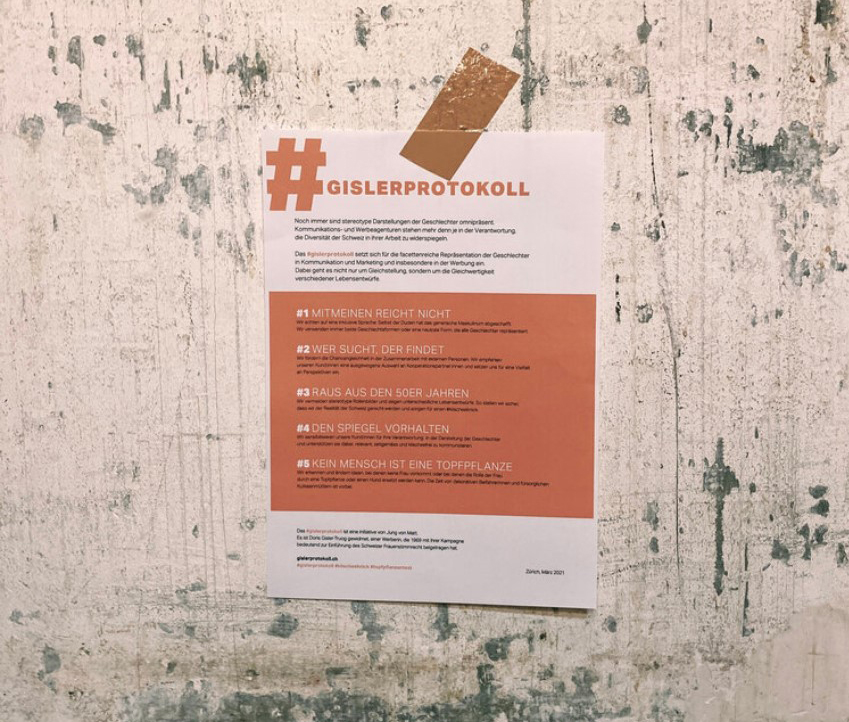
In March 2021, the Gisler Protocol was launched. The cross-agency initiative is committed to the multi-faceted representation of gender in communication, marketing and especially advertising. In the meantime, 19 agencies have already joined the protocol. Werbewoche.ch has launched a survey among the participating agencies.

At the beginning of March 2021, Jung von Matt launched the Gisler Protocol (Werbewoche.ch reported). The protocol is dedicated to the advertiser Doris Gisler Truog, whose campaign for women's suffrage began in 1969. Agencies that subscribe to the protocol thereby make a promise to follow the five principles of the Gisler Protocol.


#1 To mean with is not enough

"We pay attention to inclusive language. Even the Duden has abolished the generic masculine. We always use both genders or a neutral form that represents all genders."

#2 He who seeks, finds

"We promote equal opportunities in cooperation with external persons. We recommend a balanced selection of cooperation partners to our customers and are committed to a diversity of perspectives."

#3 Out of the 50s

"We avoid stereotypical role models and show different lifestyles. In this way, we ensure that we do justice to the reality of Switzerland and provide a # stereotype."

#4 Hold up the mirror

"We make our clients* aware of their responsibility in gender representation and support them in communicating in a relevant, contemporary and stereotype-free way."

#5 No man is a potted plant

"We recognize and change ideas that don't feature a woman or where the role of a woman can be replaced by a potted plant or a dog. The time of decorative co-drivers and caring scenery mothers is over.


In the meantime, Agence Trio, Aroma, Diff. Kommunikation, Feinheit, Flin, Gecko Communication, Kargo Kommunikation, Kingfluencers, Kreisvier Communications, KSP, Liip, Maxomedia, Me Kommunikation, Ogilvy, Open Up, Serviceplan, TBWA and Wunderman Thompson have joined the Swiss Jung-von-Matt agencies.

Advertisingweek.ch wanted to know from the agencies involved why they decided to take this step, and asked them each three questions.
Why do we need initiatives like the Gisler Protocol?

Flin: Added up, we Swiss agencies reach millions of people every day - from our point of view, we therefore also have a social responsibility when it comes to issues such as inclusive gender representation. From our point of view, we could also go one step further. For example, similar initiatives would be desirable for other relevant topics such as climate change (no greenwashing, etc.).

LiipIn a network, we generally have more power than when individuals or individual organizations get involved - but of course both are absolutely necessary. Moreover, communications, advertising and digital agencies in particular have a very strong multiplier effect, which is in the nature of things.

TBWA: On the one hand, initiatives that have broad-based support have more chance of being implemented. At the same time, it is in the interest of all agencies to have their finger on the pulse and stand up for equality and inclusion.

Wunderman Thompson: Together we have more impact. It also makes sense to exchange ideas, inspire each other and learn from each other.

Circle four: Across agencies, the protocol is much less likely to degenerate into a profiling exercise. And together, even big things are much easier to initiate.

Kargo: Our industry has its finger on the pulse of the times and is sometimes even a bit ahead of them. (Good) advertising is always influencing our language, setting new trends or ending old ones - and many a campaign and some of the brands that have risen from it have become an integral part of pop culture. This influence must be handled responsibly. A cross-agency initiative like the Gisler Protocol is a strong sign that agencies want to take this responsibility together and, at best, are also ahead of the curve on these issues.

As an agency, what point of the initiative do you find most important?

Flin: Hold up the mirror. No matter how much we talk among ourselves about equality, inclusion, etc. - it only helps if we talk about it with our customers and point out that images and language are important.

Liip: Hold up the mirror. Not just "doing it better" (à la numbers 1 and 5), but also sensitizing our customers to the issues so that the next time - ideally - they themselves think and work inclusively right from the start - and also carry the attitude forward.

TBWA: We do not have a clear priority, but we think that there is still a lot of educational potential and therefore point 4 - holding up a mirror - is highly relevant. Time and again, role models are used that no longer really correspond to the image of society today and therefore need to be challenged. On the other hand, we also have to be careful not to overdramatize topics, since they sometimes only take place in very small circles of society.

Kingfluencers: "He who seeks, finds" is most relevant for us as an influencer marketing agency. We always look to offer a good mix and diversity in our selection.

Diff. Communication: We feel all points are relevant and would not highlight any one.

Circle Four: Holding up the mirror. Customers and brands have a great deal of power when it comes to creating images of society and their acceptance. If we manage, together with our customers, to use the responsibility inherent in this power in the right way, we can hopefully advance many current concerns more quickly than before.

Me communication: "To agree is not enough". I notice again and again that this opinion is still held - unfortunately also by women. I annoy my environment - sometimes tremendously - because I insist on inclusive language.

Serviceplan: Not the most important, but probably the most common, is "Mitmeinen reicht nicht": Adapting language to mean "everyone" is sometimes stylistically laborious - but it represents a culture, an attitude of the people behind it. We therefore pay attention to gender asterisks and the like, even if we don't always like it visually.

Gecko Communication: The sensitization of the clientele. Because it forces us to be sensitive ourselves. Are we really always stereotype-free when advising our clientele?

Kargo: "No man is a potted plant": no one, but really no one, wants to be equated with a potted plant in terms of their significance within a society.

Fineness: All points are equally important. In our agency, inclusive language has already become embedded in our governance as policy and is a matter of course for us. In our political campaigns, campaigns for NGOs or public institutions, it is relevant for success that we depict the reality of diverse lifestyles and avoid stereotypes.

Which stereotype in advertising annoys you the most?

Flin: Colors. It's blatant how advertising still serves clichés when it comes to color selection. Pink equals female, blue equals male. New, and not gender-related, is green. Everything green is supposed to stand for sustainability. It doesn't matter if it's true or not - the main thing is that the color fits.

Liip: To limit the woman to her external features, to use her as a decorative element - pretty, slim, lovely and often sexy.

TBWA: Ultimately, many role models are still based on the recent past, in which the woman is traditionally portrayed in the housewife model and the man with a tie is shown as the provider of the family. These times are definitely over.

Wunderman Thompson: What sucks is the sum of the individual stereotypes. And everything that makes someone look stupid.

Kingfluencers: The "well-intentioned" one.

Diff. Communication: The representation of the woman who is silent, cares or merely serves as a decorative object.

Circle Four: The sexy woman who, apart from her sexiness, doesn't have much raison d'être.

Me communication: When women are used as a decorative element. When you can immediately tell that men have written copy for the women in advertising. When advertisers celebrate the thigh-slapping mentality, such as the Rohr-Max ads.

Serviceplan: Even if one tries to combine stereotypes with cynicism and humor, they remain stereotypes at the expense of a minority. We would be happy if they were dispensed with entirely in the future. We are disturbed and bored by all kinds of clichés, prejudices and generalizations.

Gecko Communication: Doers here, caring women there. That has nothing to do with the real Switzerland. 

Kargo communication: The two classics: the naive girl and the tough guy. Preferably in combination.

Fineness: The quiet bon vivant and Mister Mansplainer. These stereotypes in particular deprive women of their voice and turn them into passive supporting actors.

What does... "prevalence" actually mean?

In his column «What Does It Actually Mean…?,» Benno Maggi explains terms from the fields of marketing and communications. This time, he explores the concept of «prevalence.».

Benno Maggi

Advertisers like to use words from other industries. In addition to the financial industry, aviation and healthcare are popular sources for this.

Prevalence originates from the latter. It refers to the proportion of a population to which a certain condition applies - be it Covid, influenza, or AIDS sufferers. This rate is calculated by relating it to the total number of people considered; represented as a fraction, percentage or number of cases.

In market research and marketing, the term has been used mostly by statistics nerds in reference to high prevalence of a target group, clicked ads, or sold products. Currently, however, because of the omicron wave - or wall, depending on which statistics you believe - it is appearing more and more frequently in advertising agencies, the media, and communications.

Who else is going to get out of it?

Hand on heart: prevalence was previously incomprehensible to many. And perhaps it still is today. But at a time when everything in marketing has to go viral, no one wants to give themselves away. That's why statements about prevalence in boardrooms or on calls are always met with serious faces or approving nods, without having much idea about it.

Here's an attempt at an explanation: Prevalence means the answer to the question "How many of the group 'Bärli' have blond hair?" - In kindergarten, everyone then wildly shouts any number or name in confusion. Later, in school, the shouting becomes even more confusing, because it is supplemented with statements like "2 out of 11" or "every third", "half", "20%" or cheekily "ich nöd". This jumble of statements is familiar to all dutiful citizens who today try to inform themselves about things like symptoms, isolation or PCR testing.

Agencies with experience in prevention campaigns - and there are quite a few in the country - learned about the term much earlier than anyone else in tender texts or briefing sessions. Therefore, it should be expected that this is also communicated in an understandable way! The Federal Office of Public Health alone spends almost 20 million Swiss francs a year on such campaigns. Covid excluded, there would be another 36 million francs. The good news for confused taxpayers: Even if this figure seems high, the prevalence in relation to the total expenditure to contain the pandemic is low.


* Benno Maggi is co-founder and CEO of Partner & Partner. He has been eavesdropping on the industry for over 30 years, discovering words and terms for us that can either be used for small talk, pomposity, excitement, playing Scrabble, or just because.

get_footer();