Advertising works more effectively over headphones

Advertising consumed via headphones is even more effective, as a marketing expert from UCSDO has determined. The reason for this is said to be content that is perceived as being closer.

"We found that headphones produce a phenomenon called in-head localization, which makes the acoustic content sound as if it is being generated in the head itself," explains On Amir, a marketing expert from the University of California, San Diego. The content would be perceived as closer, both physically and socially. "As a result, listeners perceive the content as warmer, they feel and behave more empathetically toward it, and are more easily persuaded by it."

A question of proper sound reinforcement

The finding is based on five different studies, including both field research and online surveys with more than 4,000 participants. All show that users of headphones felt closeness to the speaker, while other research looked at the medium's effects on empathy and persuasion. For example, one experiment used the Amazon Mechanical Turk platform to find 1,310 adults and play them a clip of a mother and daughter talking about homelessness. There was a speaker group and a headphone group.

Those who listened to the clip via headphones reported feeling more empathy toward the content than the speaker group, and that the mother and daughter seemed more authentic in comparison. In 2022, U.S. radio ad spending is expected to reach $14.8 billion. Revenue from U.S. podcast advertising is estimated to top $2 billion by 2023. "If the goal is to make listeners feel close to the communicator or particularly persuaded by their message, marketing managers need to consider placing their ads or message in a medium that is frequently consumed through headphones, like a podcast," said UCLA researcher Alicea Lieberman. (pte)

Panta Rhei PR strengthens management

The Panta Rhei PR agency is expanding its management team. Marlène Betschart and Andreas M. Viertler join agency owner Reto Wilhelm on the management board.

New in the management of Panta Rhei PR: Marlène Betschart and Andreas M. Viertler - together with owner Reto Wilhelm (from left to right).

Marlène Betschart joins the team from Deutsche Bank Switzerland and Bank Linth as Senior Account Director. She brings a broad radius in corporate communications for the financial, IT and technology industries. Previous professional positions included mandates in education and consumer goods marketing.  

Betschart has held the operational management of the agency together with Reto Wilhelm since March 1, 2022. Andreas M. Viertler has been responsible for IT, finance and administration at Panta Rhei PR since 2005 and has been Chief of Staff since January 2022. "With this step, we have two experienced professionals on board who will provide important impetus for the further development of our agency," says owner and CEO Reto Wilhelm. "I am delighted about the reinforcement, which gives us breathing room for further exciting projects and cooperations."

Friendly greetings lets fly for Franke oven trays

Kitchen, bathroom and catering specialist Franke has launched the surprisingly spacious "Maris" sink. Freundliche Grüsse has developed a spot for it that is intended to dramatize the size of the product in a rather atypical film genre.

More and more people are using their dishwasher for all kitchen utensils, except for the large pots and baking trays that don't fit in the machine. The new Maris sink from Franke does away with the drip tray and thus offers additional space so that kitchen owners can, for example, place entire baking trays directly in the sink and wash them. In this way, the new sink aims to meet the size and design requirements in modern kitchens.

This is also the point of departure for the Freundliche Grüsse commercial. Using a familiar film scene and appropriately dramatic music, the arrival of a large flying object in the kitchen is narrated from the point of view of a boy. A spaceship that turns out to be an oven tray and floats directly into the sink.

"When we thought about the main benefit of the sink - its spacious sink - we decided that we wanted to do something bold and spectacular," explains Gianluca Vigato, Head of Advertising & Communication at Franke Home Solutions. "The creativity of this commercial communicates in a light-hearted and intelligent way, and with a visual and musical reference that everyone is familiar with, how impressive and spectacularly large the Maris Fraganite sink is in any kitchen environment."

The product launch is accompanied by a brochure and various ads that dramatize the spaciousness of the sink.


Responsible at Franke Home Solutions: Gianluca Vigato (Head of Advertising & Communication), Giorgia Longoni (Head of Digital and E-Commerce), Serena Sorana (Head of Trade Marketing), Milly Barba (Digital Project Manager), Fabio Ragusa (Web Specialist), Anna Hennebole (Brand Manager), Michele Moscatelli (Marketing Specialist), Silvia Guse (Social Media Specialist), John Mc Dermott (Communication Specialist). Responsible at Friendly regards: Samuel Textor, Pascal Deville (Creative Direction), Norihito Ida (Art Direction), David Elmiger (Text/Concept), Laura Leuenberger (Design), Marion Schwager, Sarah Winker (Consulting).

DLV encourages fight against dyslexia with Art.I.Schock

Dealing with a reading or spelling disability is worthwhile. DLV encourages young people in particular not to resign with its campaign for the European Day of Speech Therapy on March 6. The professional association was advised and supported by Art.I.Schock.

Difficulties in reading and, respectively, or writing are among the most common developmental disorders. Although the weakness has nothing to do with intelligence, people with dyslexia are underestimated. Nevertheless, it usually affects both the school and professional careers of those affected. The German-speaking Swiss Speech Therapists Association DLV wants to dispel prejudices and encourage young people in particular to learn how to deal with the weakness.

The campaign website is also aimed at them Logopaedics-worth-it.ch for the European Day of Speech Therapy on March 6. The site has been made reader-friendly and accessible. With two playful tests, young people can find out whether they have difficulties reading or writing. In addition, numerous tips and tricks on reading and spelling disorders can also be found. The campaign is supplemented by social media posts.

The campaign was designed and implemented by the Zurich agency Art.I.Schock. The color concept and the lively design using hover effects are intended to appeal specifically to young people. The tips and tricks, however, help at any age to improve the weaknesses and to fully exploit the potential for career and society.


Responsible at the DLV: Edith Lüscher (Executive Director), Cäcilia Matter (Programming). Responsible at Art.I.Schock: Nadine van den Berg (consulting, project management), Yasmin Kim Cilasin (graphics). Responsible at Atelier Mana: Barbara Luchsinger (illustration).

Home office: companies have other plans than employees

One in six would like to stay in a home office permanently, but Swiss companies have other plans. This is the result of a recent survey conducted by New Work among HR managers and professionals in German-speaking Switzerland.

On behalf of New Work, the market and media research institute Forsa surveyed one hundred HR decision-makers in companies and around one thousand professionals in German-speaking Switzerland in spring 2022 on the topic of recruiting and home office.

Every second company plans for the long term with home office

Overall, around half of the companies surveyed (48 percent) plan to enable home office working in the long term. 28 percent state that employees will be able to work up to a quarter of their working hours outside the office even after the end of the pandemic, and for 18 percent, up to half of their working hours can take place in the home office.

Very few go further: only 2 percent plan that more than half of working hours can take place remotely in the long term. Just under half of the HR managers surveyed (48 percent) say there will be no home office option in their company in the long term. This includes companies with offerings that require a physical presence.

One in six would like to work permanently in a home office

With their long-term commitment to home office, many companies are accommodating the wishes of their employees, but not going as far as the professionals would like. Of them, 16 percent would like to be able to work completely at home in the future, another 16 percent up to three quarters and 22 percent up to half of their working time. 6 percent would be satisfied if they could work up to a quarter of their time outside the office in the long term. 34 percent say that home office is not possible in their job.

There is thus a gap between the willingness of Swiss companies to offer home office on a long-term basis and the wishes of working people. Companies that restrict home office options too much or do not offer them at all run the risk of diminishing their attractiveness as an employer. If companies are aiming for a high presence rate, the office environment should be designed in such a way that working on site also provides clearly recognizable added value for employees.

Home office does not necessarily bring more flexible working hours

From the perspective of HR managers, working life has changed in the wake of the pandemic, particularly in terms of communication within the company (65 percent), the way people work together (63 percent), and new work concepts such as home office and remote work (63 percent). However, new work concepts do not necessarily mean more flexible working hours: Only 34 percent say that Corona has led to a freer arrangement of working hours in their company. And less than half (42 percent) say that the pandemic has had a noticeable impact on the management style in their company.

More difficult recruiting and more changes since Corona

Recruiting employees has become more challenging since Corona, according to more than a third of the HR managers surveyed (37 percent). Only 2 percent say that recruiting new employees is easier for them today than before the pandemic. According to the respondents, the frequency of staff changes has also tended to increase. 20 percent report more staff changes since the start of the pandemic, while only 10 percent note a decrease.

Corporate culture is the top topic in job interviews

Asked which topics currently come up particularly strongly in job interviews, 77 percent of HR managers mention corporate culture. Other key topics in job interviews are job security (75 percent), salary (73 percent), work-life balance (73 percent), as well as good leadership (68 percent) and personal fulfillment of meaning in the job (66 percent). The figures illustrate the need of Swiss job seekers to find out what makes a company tick and whether they see their own values reflected in it.


On behalf of New Work, the market and media research institute Forsa surveyed 100 HR decision-makers in companies with 50 or more employees in German-speaking Switzerland in January 2022 by means of computer-assisted telephone interviews and 1,009 employed persons aged 18 and over by means of an online panel. The survey participants were selected by means of systematic random selection (HR decision-makers) or representative random selection (employed persons).

HWZ: New course director for CAS Brand Leadership

The CAS Brand Leadership HWZ course is now being designed and implemented by Pam Hügli and Benjamin Gilgen. The development work of Peter Felser and Max Meister will thus be made even more relevant with new concepts and methods and will be continued in a future-oriented manner.

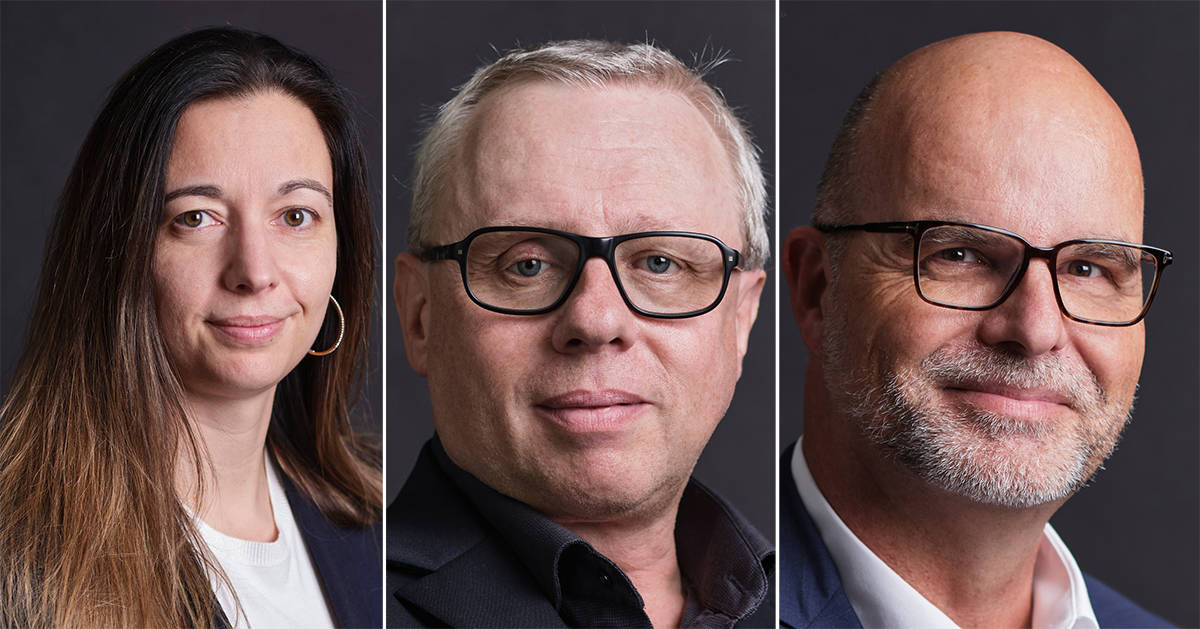
Peter Felser (left) hands over the management of the CAS Brand Leadership HWZ to Pam Hügli (center) and Benjamin Gilgen. (Image: zVg.)

The importance of the brand as a means of corporate management has increased continuously in recent years, writes the Hochschule für Wirtschaft Zürich HWZ in a statement. At the same time, the need to differentiate and increase relevance for a variety of stakeholders is also constantly rising.

Today's and tomorrow's demands on those responsible for marketing and the brand are specifically addressed in the new concept of the CAS Brand Leadership HWZ and explained both scientifically and with national and international practical examples.

Hügli and Gilgen take over management of study program

After six courses, Peter Felser and Max Meister pass on the management of the course to two brand experts, Pam Hügli and Benjamin Gilgen, who deal with brand leadership topics on a daily basis and ensure both scientific and practical relevance. Both are well-known lecturers and continuously shape modern brand leadership in practice.

Pam Hügli runs the House of Communication in Zurich and is CEO of the agency Serviceplan Suisse. She is one of the first graduates of the course and a guest lecturer at the HWZ. For Pam Hügli, it is particularly important to combine theory and practice: "We will bring together leading brands, but also exciting SMEs with the students. The course will be interactive and practically relevant so that graduates can quickly add value in practice," says Hügli.

Benjamin Gilgen heads marketing and communications at the pharmaceutical company Tigen. Before that, he was a partner at Prophet and managing director of MetaDesign. "With Brand Leadership, we give students the tools they need to successfully position products and companies in the market and win market share," explains Gilgen. "In doing so, we combine analysis, strategy and creation to develop outstanding customer experiences. "Benjamin Gilgen is also a guest lecturer at the HWZ.

Peter Felser and Max Meister are delighted with the future course leaders. "Pam and Benjamin ideally embody the Brand Leadership philosophy. They combine classic brand leadership methods with the latest national and international trends. They will make the CAS even more attractive," Peter Felser is convinced. He will remain with the HWZ as a lecturer and teach within the CAS Brand Leadership HWZ on his favorite topic, "Brand Mission". In addition, Felser oversees the alumni network of "Brand Leaders," which represents an important aspect of networking and continuous professional development.

The CAS Brand Leadership HWZ is now also credited as part of the MAS Marketing Excellence HWZ. The course is aimed at marketing managers from large companies as well as SMEs and start-ups and can be easily combined with a full-time job.

TX Group sells remaining Moneypark shares to Helvetia

The TX Publishing Group is completely divesting itself of the mortgage broker Moneypark. It is selling its remaining stake to Helvetia. Meanwhile, Moneypark founder and CEO Stefan Heitmann is stepping back and will hand over the top job to Martin Tschopp of Helvetia in May.

After TX Group had already sold part of its Moneypark stake to Helvetia in 2016, the remaining shares will now also go to the insurer, according to a statement on Wednesday.

It is not known how large the package is. The parties have agreed not to disclose details of the sale. Helvetia was already the largest shareholder of Moneypark, which was founded in 2012. TX Group had joined in 2014 with a minority stake.

Fintech Moneypark has developed "excellently" in recent years and has advanced to become the market leader in this sector with an annual mortgage volume of clearly more than CHF 3 billion, TX Group writes further. Now is a good time for the sale of the remaining stake. At the same time, TX manager Jens Schleuniger is leaving the board of directors of Moneypark.

CEO change in May

There will also be a change in the operational management of Moneypark. Founder and CEO Stefan Heitmann will hand over his office to the current chairman of the board Martin Tschopp in May, writes Helvetia. After ten years at the helm of Moneypark, the time has come to hand over the reins, Heitmann said. However, he will remain a shareholder and part of the board of directors.

Moneypark is in an "excellent" position and the aim is to further expand its good market position, Tschopp is quoted as saying in the press release. He has been a member of the board of directors since 2019 and has also worked at Helvetia since 2017. In addition to Moneypark, he also heads the Helvetia Venture Fund, the online insurance Smile and the customer and market management of Helvetia Switzerland. (SDA)

Four new columnists for NZZaS and NZZ Magazin

The NZZ am Sonntag and the digital NZZ Magazin are expanding their roster of columnists: Starting Sunday, Gerhard Schwarz and René Scheu will be discussing economic and philosophical topics. Stage poet Patti Basler will be contributing digitally and, starting in April, via podcast. Economics professor Monika Bütler will return to the NZZ am Sonntag as a columnist in June, while Katja Gentinetta is stepping down as a columnist to focus on her other activities.

NZZaS und NZZ Magazin
Gerhard Schwarz, René Scheu, Patti Basler and Monika Bütler are new columnists for the NZZ am Sonntag and the digital NZZ Magazine. (Pictures: zVg.)

Starting Sunday, Gerhard Schwarz and René Scheu will discuss each month a new aspect of free living in the NZZ on Sunday discuss. They use the messenger service Signal for this purpose. Gerhard Schwarz is now president of the Progress Foundation and a freelance journalist. Until 2016, the economist was director of Avenir Suisse, and before that he was responsible for the business section of the New Zurich Newspaper. René Scheu was editor of the Swiss monthbefore the philosopher took over as head of the NZZ feuilleton. Today, he is managing director of the Institute for Economic Policy IWP at the University of Lucerne.

New to the editorial team is author, stage poet and satirist Patti Basler, who since February has been a regular contributor to the NZZ on Sunday writes. From April, it will also be available in the new NZZ Magazine to be heard. Patti Basler was awarded the Salzburger Stier for Switzerland in 2019

Bütler returns to NZZaS

As of June 2022, the columnist Monika Bütler will also return to the NZZ on Sunday back. Bütler, who is one of the ten most influential economists in Switzerland, has written for Sonntagstitel in the past. Among other things, the economics professor headed the Swiss Institute for Empirical Economic Research at the University of St. Gallen and is vice president of the Gebert Rüf Foundation.

Gentinetta goes

Political philosopher Katja Gentinetta, on the other hand, has decided to give up her column work at the NZZ on Sunday and to concentrate on her activities as a university lecturer and board member as well as her own publications.

Delivery of newspapers is part of basic service according to publishers

The delivery of subscription newspapers should remain part of the Swiss Post’s core mission in the future. This is the view of the Swiss Media Publishers Association. On Friday, the association responded critically to proposals from an expert commission regarding postal reform starting in 2030.

Zustellung von Zeitungen gehört laut Verlegern zur GrundversorgungIn a statement, the association expressed concern that the expert commission no longer wants newspaper delivery to be part of Swiss Post's basic service mandate in the future. The daily delivery of print media is of democratic importance and must be maintained at all costs. Many people depend on information from the print media every day.
Today, Swiss Post must deliver subscribers' daily or weekly newspapers to their homes by 12:30 p.m. at the latest, six days a week. In 2020, 964 million copies were delivered by Swiss Post. This is mainly in rural areas, where there is no early delivery by third-party providers. Publishers and the Post estimate that even after 2030, more than 600 million newspaper copies would still be transported each year.

Despite declining circulation of subscribed newspapers, the assumption that delivery of printed newspapers would no longer meet a need in the future was wrong, the publishers wrote. The share of printed circulation for most daily and weekly newspapers is still significantly higher than the share of digitally distributed copies. (SDA)

Court prohibits store in the Lower Village digital advertising display

A store in Zurich's Niederdorf neighborhood must remove its digital advertising display from its storefront window. This was decided by the Building Appeals Court. The 28-inch tablets were deemed to be too bright and in violation of aesthetic regulations.

Niederdorf digitalen Werbeaushang
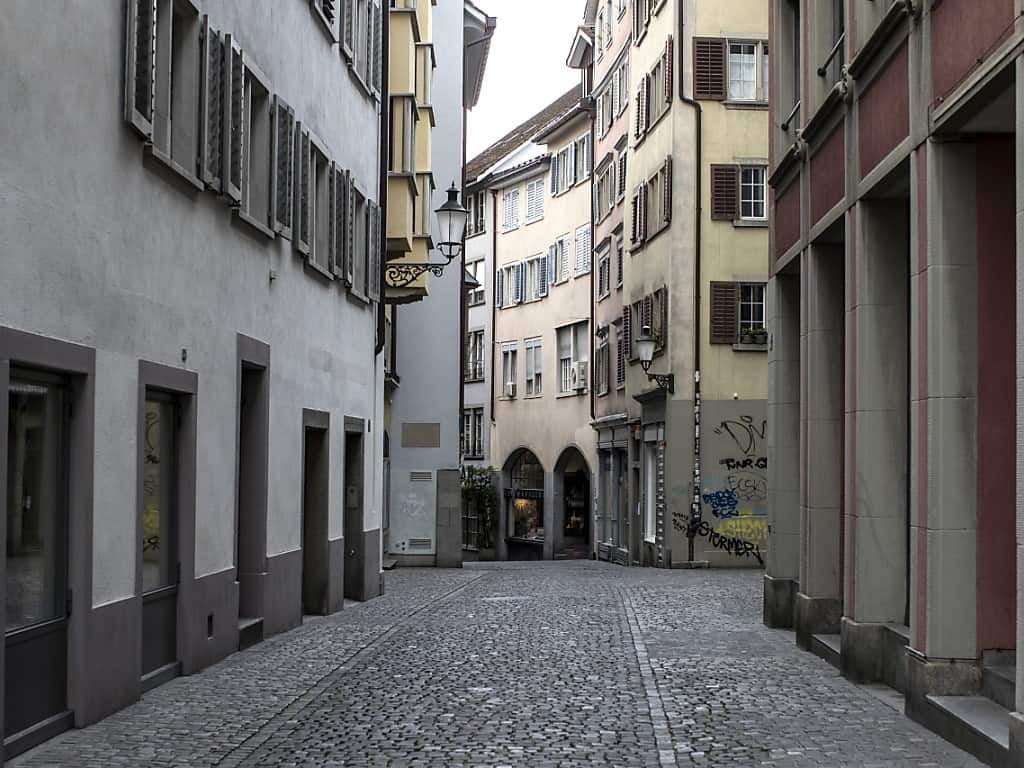
Strict rules apply in the alleys of Zurich's Niederdorf: A digital menu display in a showcase is not allowed. (Archive photo: Keystone/Alexandra Wey)

For the store owner, the digital notice in the display case is a welcome advertising opportunity: there, he can not only draw attention to his own offers, but also display advertisements from other stores. In the city of Zurich, however, such digital displays are prohibited in historic alleys.

After the city of Zurich, the Baurekursgericht now also comes to the conclusion that a ban is appropriate, as can be seen from the ruling. With their cold glowing light, the monitors are "quite capable of impairing or even disturbing the medieval character of the protected buildings".

The tablets in the display case were "disturbing and alien" in this sensitive environment in terms of monument preservation. The city of Zurich had made the right decision when it classified the advertising monitors as "not eligible for approval". However, the display cases themselves are legal.

Ten days time for disassembly

However, the ruling is not yet final. The store operator can still appeal. As soon as it is legally binding, he has ten days to dismantle his tablets.

This is not the first time that the Zurich authorities have dealt with tablet advertising. In other cases, too, they have ordered traders to remove their digital notices, for example in the case of a restaurateur with a digital menu card. He, too, has his restaurant in a historically valuable building in Niederdorf. (SDA)

Monami expands to Berlin

Monami goes international. Following the example of the successful offices in Zurich and Chur, the agency crosses the border and establishes a headquarters in Berlin.

Monami
After Zurich and Chur, Monami is now opening a location in Berlin Kreuzberg.

In Switzerland, Monami originally made a name for itself as a social media agency. It now generates creative content as an integrated content agency for clients such as Coop, Seat, McDonald's and Switzerland Tourism. The team of around 30 people manages digital campaigns and, according to its own information, manages many of the most successful Swiss Tiktok channels, develops multi-year content strategies and is currently also fiddling around with Metaverse appearances. In addition, Monami recently ventured successfully into the event space with the first Swiss MTV Unplugged (Werbewoche.ch reported).

Berlin becomes the third Monami location

Now the company is about to take another founding step: Monami is crossing the border and entering the German market. The new "Monami Content GmbH" is based in Berlin's Kreuzberg district, in a store near Maybachufer. According to the agency, two to three employees will be working there from March to ensure a successful start. Among others, art director Max Mottas from Glück Berlin is joining Monami - and the office is expandable, the agency adds.

In addition to the Swiss vegan brand "The Green Mountain," which wants to conquer the German market with Monami, the portfolio already includes two customers from Germany before the launch: Fintech startup Muffin and online tool Inckd. which aims to digitize the global tattoo market. According to Monami, more brands are expected to join in the coming months.

Agency sees potential in Germany

The whole thing came about after several months of evaluation and many discussions with German agencies and companies, during which the Monami-GL noticed that "even in the supposedly more digital Germany, people only boil with water and there is still a lot of room for optimization".

"Functioning TikTok channels in particular, but also gamification pieces for Instagram, for example, are still far too rare among major brands. Yet a company can be playful and attractive and at the same time offer substantial content and a high visual quality. We have proven that in Switzerland," says David Cappellini, founder and owner of the agency. "In addition, various Swiss employees are already looking forward to working from the Berlin office in between. Will be good!"

Bank We shipped medicine against too high fees

Bank Wir and Amnis have been offering the SME platform "FX Trading" since May 2020. In an in-house designed campaign, company and finance managers of SMEs are personally administered a "medicine" to save costs - including an instruction leaflet on opportunities and positive side effects.

Bank WirThe "FX Trading" platform, which Bank Wir offers in partnership with fintech Amnis Treasury Services, is designed to enable SMEs to settle foreign exchange transactions easily, quickly and cheaply.

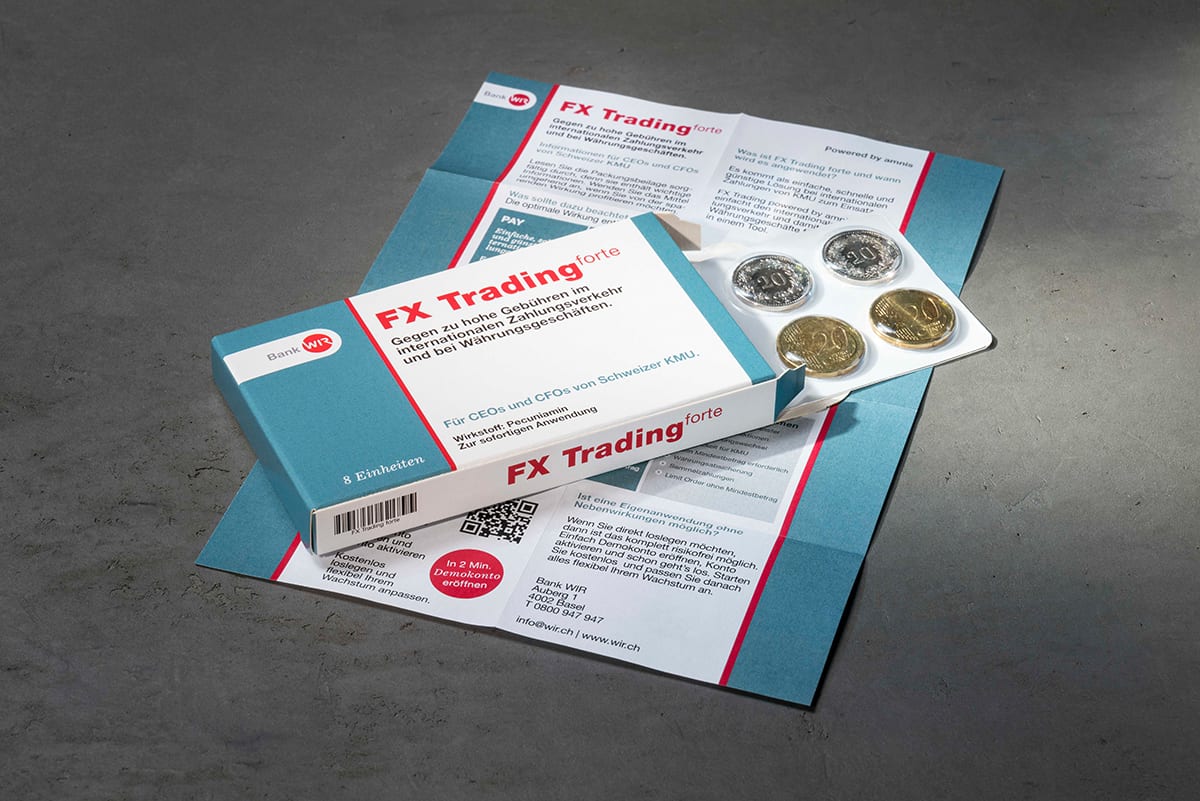
In order to promote this offer, the bank sent a mailing to the company and financial managers of Swiss SMEs, each containing a pack of "FX Trading forte". According to the imprint, it contains "pecuniamine" in the form of Swiss francs and euros in coins. "We were looking for an amazing idea that wouldn't just be put away carelessly," says Jonas Kiefer, Head of Marketing at Bank Wir, looking back on the initial situation for the campaign developed internally by the bank.

The blister packs "against excessive fees in international payment transactions and currency transactions" were produced by Wir partner Blipack. The drug design was followed through from A to Z: The eight units are recommended "for immediate use" - and in the package insert, SME managers learn everything about "opportunities and positive effects" from the cooperative bank. In the process, the topic of foreign exchange transactions is to be communicated in an easily understandable way and at eye level.

The physical mailing of the campaign, which was conceived in-house, is accompanied by social media ads, a special Landing page, content with customer testimonials in SME magazine Wirinfo and on the blog as well as in the "O-Ton" podcast of Bank Wir.


Responsible at Bank We: Claudio Gisler (Head of Marketing & Products), Matthias Pfeifer (Head of Private & Corporate Clients), Reto Brotschi (Head of Marketing), Jonas Kiefer (Head of Marketing & Text/Concept), Volker Strohm (Head of Corporate Communication), Patrick Besenfelder (Head of Product Management), Pascale Erdin (Business Manager), Eliane Meyer (Art Director), Peter Bellakovics (Campaign Manager & Text/Concept), Denise Siemens (Digital Marketing Manager), Detlef Winkelmann (Data Manager), Patrizia Herde (Corporate Communication/Public Relations), Daniel Flury (Corporate Communication/Chief Editor Customer Magazine). Responsible Mailing: Blipack. Campaign: Milos May (Hunter Film), Arne Völker (Hutter Consult).

get_footer();