Radio Zürisee remains in Rapperswil hands

Radio Zürisee has a new owner: As of January 1, 2023, the private radio station is owned by Fabian Villiger Management GmbH, based in Rapperswil. The station will thus remain independent and rooted in the region.

Radio Zürisee has been sold. As of January 1, 2023, the private station will belong to Fabian Villiger Management GmbH in Rapperswil. (Archive photo: Keystone/Alessandro Della Bella)

After the majority shareholders of the parent company Zürichsee Medien AG announced at the end of September that it would withdraw from the media business and focus on their properties, they now presented the new owner at the end of October.

The takeover of Radio Zürisee fits perfectly into Fabian Villiger's field of activity, the responsible persons wrote in a statement on Thursday. The entrepreneur runs an event agency and serves as vice president of Rapperswil Zürichsee Tourism.

"The fusion of radio and event in combination with a strong region is a perfect match for me," Villiger was quoted as saying in the statement. The operational management of the private broadcaster will remain in the hands of CEO Matthias Kost and program director Tony Immer.

Radio Zürisee was founded in 1983 by Buchdruckerei Stäfa. This gave rise to Zürichsee Medien AG in 1988. In 1992, the station moved its studios to Rapperswil. Radio Zürisee employs 37 people. (SDA)

Jung von Matt Limmat reminisces for Ifolor

It's the "Weisch no" moments that we remember best - and that we capture in photographs. Ifolor and Jung von Matt Limmat know this, too, and are therefore staging these moments in a pre-Christmas activation campaign.

"Do you know where your daughter dressed up as a toilet?" This is the question posed by Ifolor's current campaign. How could anyone forget! Not least because the uniquely bizarre moment was, of course, captured photographically. Such photos are the gateway to your own unforgettable "Weisch no" moments.

This repeatedly asked question "Weisch no?" is the central idea of the current activation campaign of Ifolor and Jung von Matt Limmat and is implemented in a wide variety of media formats.

The question is the introduction to moments that we still talk about years later. Be it the daughter who doesn't dress up as a princess, animal or superhero, but as a toilet. Or the girlfriend who had a gothic phase one summer. And of course - thanks to Ifolor - there is photographic evidence of everything.

Standstill with an element of surprise

At the heart of the campaign are two TV spots, which are also played online in adapted form. The observer wanders through a setting with frozen protagonists and sees every little detail until he finally arrives at the star of the "Weisch no" moment and the actual photo. Where the surprise and thus the uniqueness of the memory is dissolved.

The activation campaign has been running since mid-October with two commercials in German- and French-speaking Switzerland. On social media channels such as YouTube, Instagram, Facebook and owned media such as newsletters and website, the campaign will start at the beginning of November. From mid-November onwards, the campaign will get more and more Christmassy.


Responsible at Ifolor: Hannes Schwarz (CEO), Sonia Custodero Rodriguez (Head of Marketing & Communication), Jasmin Kagerbauer (Marketing Manager). Responsible at Jung von Matt Limmat: Dominique Magnusson, Jacqueline Rufener (Creative Direction), Sophia Kramer (Text), Ayleen Friedrich, (Graphic Design), Marianne Sauter, Sara Hirt (Consulting), Luitgard Hagl (Executive Creative Director), Cyrill Hauser (Managing Partner). Responsible at Jung von Matt Play: Natascha Imfeld (Senior Agency Producing). Responsible at Analog/Digital: Grajper (Director), Patryk Kin (DOP), Alicija Lesiak (Photography), Barbara Dudek (Production).

APG|SGA markets new mega-poster on Zurich's Paradeplatz - Edelweiss is first customer

At Paradeplatz, one of the most expensive locations in the middle of the city of Zurich, there is now a megaposter measuring over 176 square meters. The advertising space is being marketed by APG|SGA, with Edelweiss Air being the first customer.

Currently, the "Savoy Hotel Baur en Ville" on Paradeplatz is undergoing a comprehensive renovation. After reopening in mid-2024, the luxury hotel will be operated by the Mandarin Oriental Hotel Group. To enhance the building installation, Credit Suisse Group - as the hotel's main shareholder - opted for APG|SGA's outdoor advertising solution following a competitive selection process. The OOH media provider was granted the exclusive rights to install and market a temporary MegaPoster measuring 21 by 8.4 meters.

This location is characterized by strong frequency, intensive viewing and high-quality environment. As an important global financial center, the Paradeplatz is extremely well known for business travelers and at the same time has a great attraction for leisure guests. The impact is remarkable and, according to APG|SGA, offers contact opportunities of over 348,000 passers-by per week.

New campaign bookings will be possible from spring 2023, as Edelweiss Air has already secured the first six months. "The Paradeplatz is not only the hub of the Swiss financial world, but also an important hub for commuter traffic in the city of Zurich," says Yves Maclean, Head of Brand Management & Marketing Communications at Edelweiss Air. "This is where we reach an attractive target group, and in the coming months, when the weather turns drearier again, we will inspire them with an attention-grabbing megaposter for vacations to the world's most beautiful destinations."

The MegaPoster at Paradeplatz expands the existing range of large formats in Zurich, which include the temporary spaces at the corner of Bahnhofstrasse and Pestalozzianlage and the permanent spaces at Oerlikon station, Pfingstweid multi-storey parking lot, Zurich main station or Hardbrücke.

Swiss Life and Schroten show people who go their own way in a self-determined way

With three emotional portraits, the Schroten agency is making the Swiss Life purpose tangible online. The content is played out on the «Life Stories» blog and on social media channels.

Anyone who has ever seen Miro Waldvogel play golf will not soon forget it. The 22-year-old hits the balls across the fairway and onto the green with only his left hand and backhand - so precisely and elegantly, as if it were the most normal thing in the world. And for him it is. Just as disciplined as working toward his goal - the 2028 Paralympics in Los Angeles. "It doesn't matter what impairment you have. If you work hard for it, you can achieve anything," emphasizes the Ustermer. Self-determination is the highest good for him.

Waldvogel is one of three protagonists in the content series Schroten created for the Swiss Life blog "Life Stories" and the company's social media channels this year. In addition to Waldvogel, the storytellers also portrayed lawyer and farmer Anne Challandes, who is committed to helping rural women lead self-determined and financially confident lives, and most recently fragrance creator Andreas Wilhelm, an entrepreneur and rebel who is passionate about putting olfactory habits to the test.

The three portraits consist of an in-depth online interview, a one-minute film, and a palette of cutdowns, images, listicals, and text overlays that fan out the stories across all channels.


Responsible at Swiss Life: External Communications Team Swiss Life Switzerland. Responsible for grist: Adrian Schräder (overall responsibility), Michèle Roten, Nicola Brusa (text & concept), Leonie Moeri (consulting). Film production: Mattogrosso GmbH, Marc Bachmann, Benjamin Weiss (camera), Annika Fausch (editing), Hannes Rüttimann (color grading), Studio Dobozi (sound mixing). Photo: Lukas Mäder (Challandes, Wilhelm), Maurice Haas (Waldvogel).

Pop realizes cinematic redesign for the International Short Film Festival Winterthur

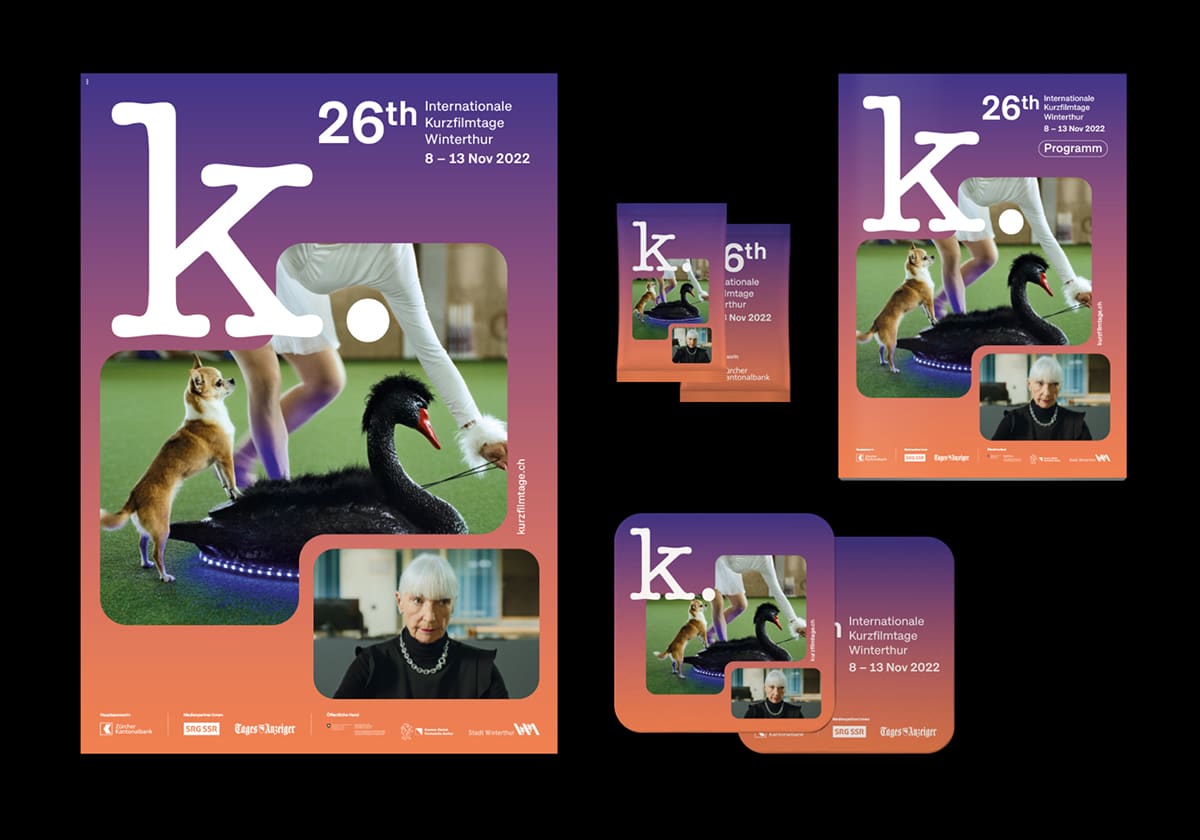
The Winterthur International Short Film Festival will take place from November 8 to 13. For the festival’s 26th edition, the brand underwent a comprehensive redesign, and a public campaign is showcasing the shortest short film. The new lead agency, Pop, is responsible for the concept and execution.

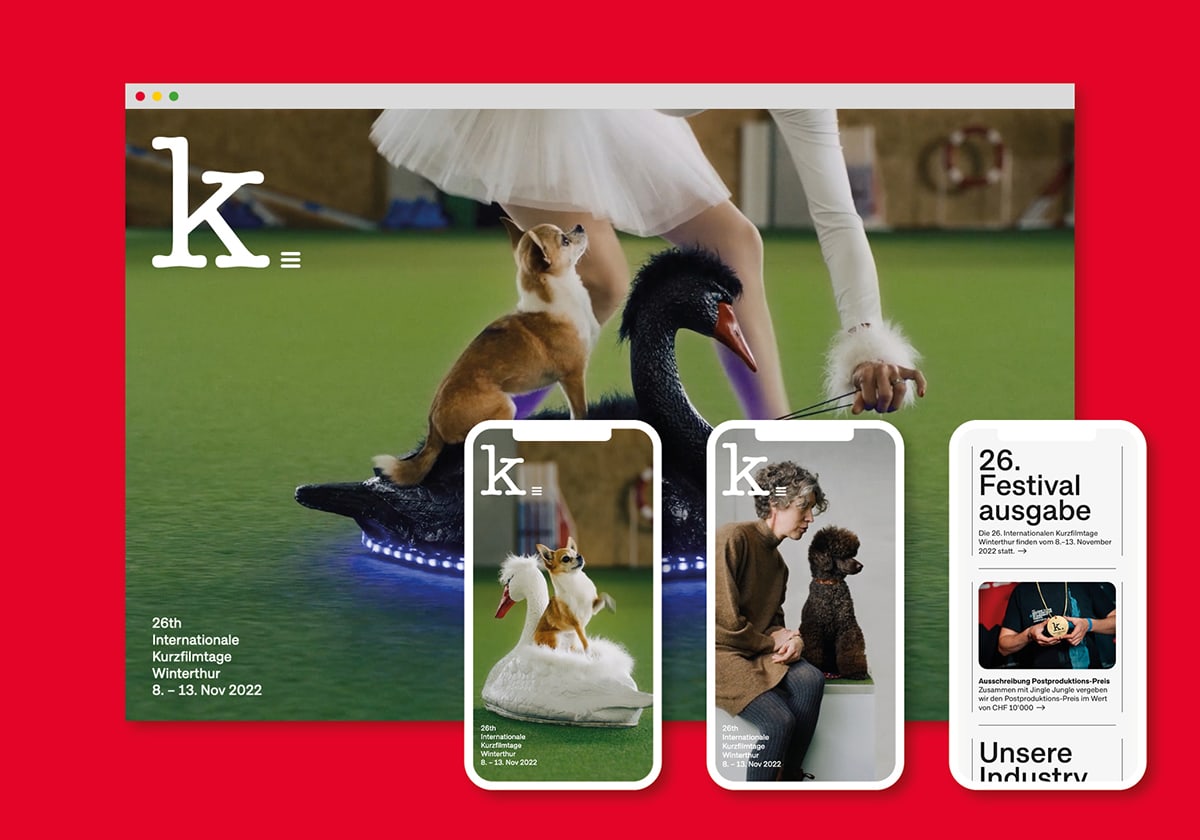
The short film festival welcomes its visitors this year on a new festival site and presents itself in a brand new dress: Branding, website and communication were designed by Pop Creative Services. The agency was able to prevail in a pitch against two competitors.

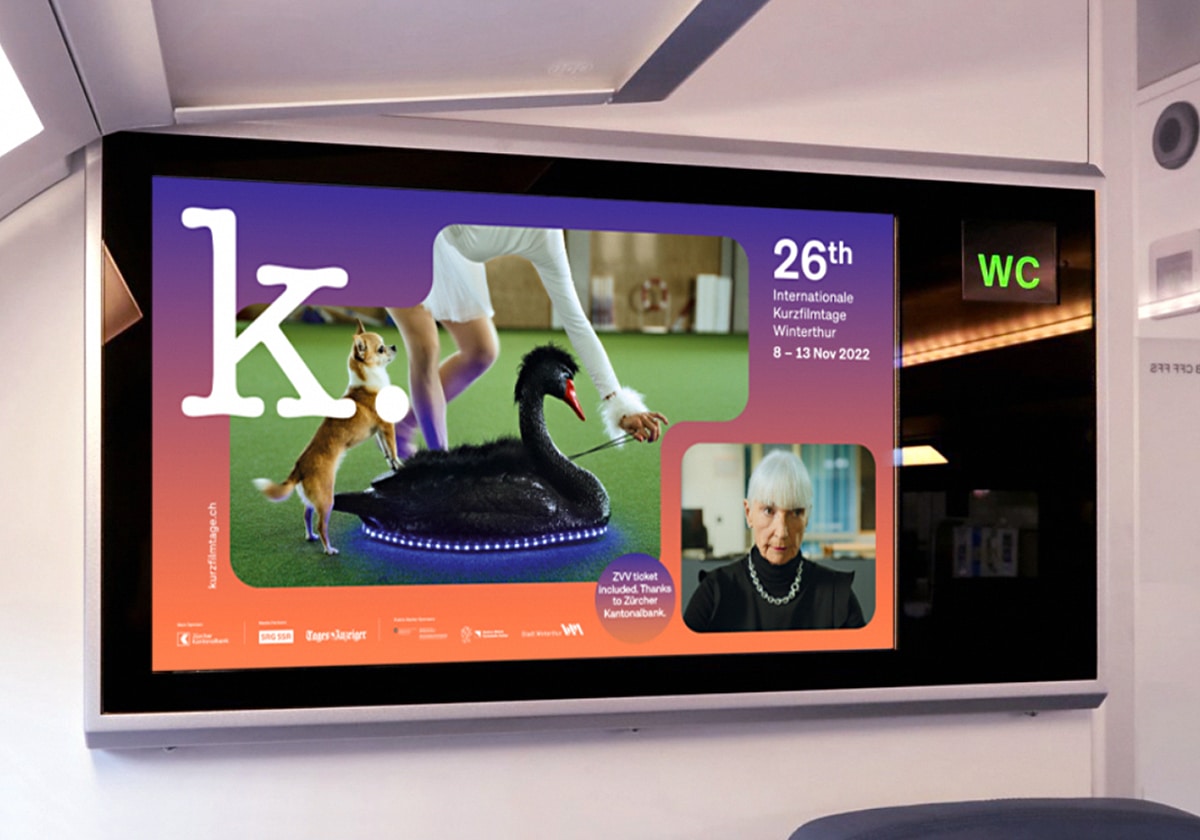
Short films don't shorten, they condense. The audience campaign takes this insight to the extreme and shows the shortest short film in the world: two images. The story in between is told by the viewers themselves. The campaign integrates the festival trailer by filmmaker Lasse Linder in a light-footed way and creates a coherent appearance at all touchpoints.

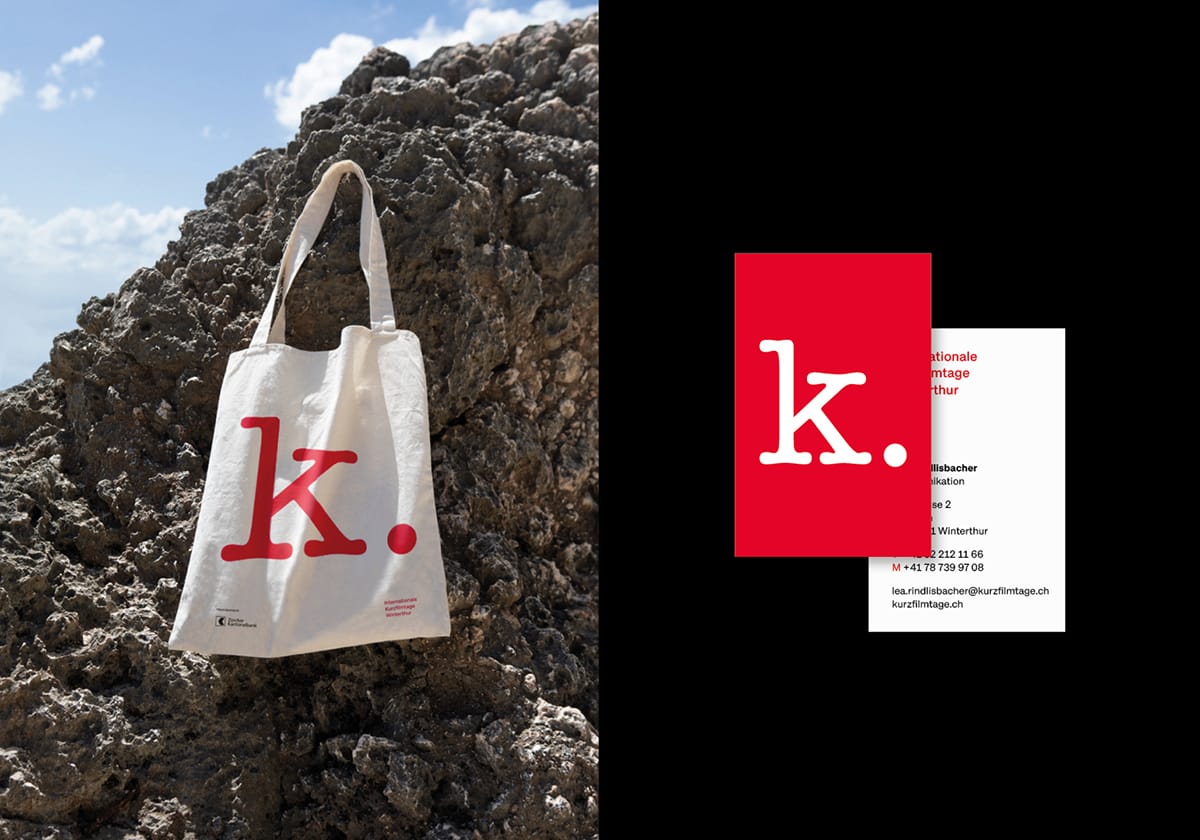
Clarity and accessibility also play the main roles in the corporate design. The concise brand element "K." is further accentuated by the reduced look, and the website has become a communication hub: Through database-based digitization of documents and processes, the Short Film Festival Winterthur can now significantly reduce its ecological footprint.

The campaign can be seen on posters, DOOH, ads, in cinemas and online, as well as at the festival itself.


Responsible at the International Short Film Festival Winterthur: Lea Rindlisbacher, Marlene Buchser (communication), Stefan Dobler (commercial management), John Canciani (artistic management), Rudolf Gehring (project coordination).Responsible at Pop Creative Services (strategy, concept and creation)Roli Hofer, Michi Benz. Programming website/database: Taylan T. Baslangic, Waldbach Media Baslangic, Andrew Blackwell, Ballet Mécanique. Festival trailerLasse Linder (Director), Robin Angst (DoP), Daniel Loepfe (Editor), Philipp Ritler (Producer).

KSP chooses the most direct route to customers for the mail

KSP designed and produced the current awareness campaign "The most direct way to customers" for the two self-service tools PostCard Creator and Flyer Service of Swiss Post.

Whether addressed mailings to existing customers or unaddressed to potential new customers, the most direct route is always through the mailbox. This message is conveyed by the key visuals with customers whose personal environment takes place in the mailbox itself.

With Swiss Post's flyer service, you can reach your target group reliably and conveniently with an advertising flyer. You upload the designed flyer online, Swiss Post takes care of printing and distribution - when and where you want. The distribution area in Switzerland in which Swiss Post distributes the flyer can be determined by the customer. As unaddressed advertising, the flyers are delivered together with the daily mail to recipients without a "Stop advertising" sticker.

Even an addressed postcard mailing can be done online in a few steps with PostCard Creator. You create the design online - the post office takes care of printing and mailing.

The campaign can be seen on online and social media banners and on the Swiss Post website. This will be supplemented by publicity reports.


Responsible at Swiss Post, Logistics Services: Karina Chodorowska (Marketing Advertising Manager), Michelle Schneider (Marketing Advertising Project Manager). Responsible at KSP:      Julian Riegel (Text), Alba Rau, Céline Goldschmid (Art Direction), Stephanie Waldvogel (Animation), Uwe Schlupp (Creative Direction), Aline Herzog (Consulting), Manuela Pasanen, Bianca Jäger (DTP), Ansichtsache (Image Editing), Daniel Krieg (Strategy and Gesmat Responsibility).

Lindt "golden rabbit" again before German court

For 70 years, the Swiss chocolate manufacturer Lindt has been selling its «Gold Bunnies» at Easter—including in Germany. Did a competitor unlawfully package its bunnies in identical gold foil? The Munich Higher Regional Court must rule on this matter once again.

Even more popular among Germans than chocolate Santa Clauses and Santa Clauses are Easter bunnies: More than 130 million chocolate bunnies were sold in Germany this year, according to the German Confectionery Industry Association.

The market leader is the Swiss company Lindt&Sprüngli, which has been offering its Easter bunny dressed in gold foil in Germany since 1952 - and is fighting for species protection in court. On the instructions of the Federal Court of Justice, the Munich Higher Regional Court is hearing the case again on Thursday at 2 pm.

The 29th Civil Senate must examine whether a competitor sued by Lindt - Allgäuer Confiserie Heilemann, which belongs to the Thuringian company Viba Sweets - has infringed the trademark rights of the "Lindt Gold Bunny". Specifically, the case concerns the gold tone of the two foils used and the possible likelihood of confusion. The BGH has already ruled that the gold tone used by Lindt enjoys trademark protection - contrary to a previous ruling.

Lindt claims damages

Heilemann also marketed a sitting chocolate bunny in a gold-colored foil during the 2018 Easter season. The traditional Swiss company is demanding that the competitor stop selling its gold bunny and provide information about its business with it with a view to damages.

The Munich Regional Court had ruled in favor of Lindt in 2019: The gold hue of the chocolate bunny had become a color trademark through long use and intensive advertising. In 2020, however, the Higher Regional Court dismissed the claim as unfounded. Unlike "Nivea Blue," "Telekom Magenta" or "Milka Purple," the gold hue did not unmistakably belong to Lindt. The chocolate manufacturer also had other colored products in its range.

In contrast, the BGH ruled in the last instance that the color of the "Goldhase" was so well known that it enjoyed trademark protection. The color is associated with the Swiss chocolatier by 70 percent of consumers. It had established itself on the market as a trademark through its long and intensive use and had "acquired a reputation in the trade.

The fact that Lindt does not use the gold for all its products and that the "Gold Bunny" has other characteristic features, such as the red collar with bells, is irrelevant. The Karlsruhe judges thus referred the case back to the Munich Higher Regional Court for a new hearing and decision.

Lindt says it now produces around 150 million "Gold Bunnies" a year in more than 50 countries. Lindt has been defending itself against overly similar competitor products for years. The golden chocolate bunnies of the Franconian chocolate producer Riegelein were allowed to remain after two BGH rulings. Four weeks ago, the Swiss Federal Court in Lausanne ruled that discounter Lidl could no longer sell its Gold Bunnies in Switzerland because of the risk of confusion with Lindt's Gold Bunnies. (SDA)

Swisscom gives in to fiber optic dispute and changes rollout method

Swisscom has backed down in its fiber-optic dispute with the Weko: The company will now once again build mostly direct lines from the telephone exchange to individual households, rather than a single line serving multiple households.

Naturally, this will be more expensive because more lines will have to be laid and more roads torn up. Swisscom is therefore trimming its expansion targets: It now wants to achieve coverage of only 50 to 55 percent of the population by the end of 2025. The annual budget for fiber-optic investments of 500 to 600 million Swiss francs remains unchanged.

The "blue giant" actually had the goal of doubling the number of fiber-optic connections from one-third of households and businesses to around 60 percent by the end of 2025. This would be 1.5 million more fiber-optic connections than today. Coverage of 70 to 80 percent is then to be achieved by 2030.

400,000 connections blocked

However, the Federal Competition Commission Weko had stopped the fiber optic rollout because it considers Swisscom's modified network architecture with only one feed line from the telephone exchange to the street shaft to be anti-competitive. The Weko is insisting on a four-fiber rollout.

Swisscom's appeals against the Weko's precautionary measures have so far been unsuccessful. The main proceedings are still ongoing. A formal decision is not expected before the first quarter of 2023, the group said.

The Weko veto has now blocked almost 400,000 fiber-optic connections that Swisscom has built in the meantime but is not allowed to put into operation. And 70,000 more connections would be added every quarter. The fiber-optic partnership with Salt has been on ice for months. This means massive revenue losses.

Now the pressure on the industry leader has become too great: "Business can no longer wait," the Group wrote in the analyst presentation. In order for customers to be able to use the fast fiber-optic connections, Swisscom has decided to build new connections largely in the point-to-point architecture in the network expansion, it said.

And the nearly 400,000 connections that have been blocked so far will be partially converted to the model with direct lines from the connection center to the household. Swisscom explained that talks are underway with Salt to adapt the partnership to the new circumstances, without giving details.

Solid operating business

Swisscom's operating performance was solid: Revenue fell slightly by 1.4 percent to CHF 8.2 billion in the first nine months. The slight decline was due to the weak euro, which depressed the results of the Italian broadband subsidiary Fastweb in Swiss francs. Operating profit before depreciation and amortization (EBITDA) fell by 3.6 percent to CHF 3.3 billion.

Net profit, however, dipped by 21 percent to CHF 1.2 billion due to special effects. In the previous year, revaluations from a Fastweb fiber-optic cooperation and the sale of a stake in Belgium had resulted in a one-time gain of CHF 207 million. In addition, there were one-time effects in tax expense.

On the other hand, Swisscom booked a fine of almost CHF 72 million from the Weko this year. Without these special effects, net profit would have increased by 2.5 percent, Swisscom wrote.

Sales target lowered due to euro weakness

In view of the weakness of the euro, Swisscom is now lowering its annual revenue targets slightly to CHF 11.1 billion. Previously, Switzerland's largest telecommunications group had targeted sales of 11.1 to 11.2 billion.

By contrast, the other targets for the full year 2022 remain unchanged. EBITDA is expected to reach around CHF 4.4 billion and capital expenditure around CHF 2.3 billion. If the targets are met, shareholders will also receive an unchanged dividend of CHF 22 for the current year. (SDA)

Publicis creates agency "Publicis inspire" for Baloise

Baloise and Publicis Groupe intensify their cooperation in the context of the new brand strategy and the group-wide rebranding: The dedicated agency "Publicis inspire" is to lead the new Baloise brand into the future.

For the first time in the history of the Baloise Group, all employees, all countries, and all companies - Basler Versicherungen, Baloise Bank SoBa, Baloise Asset Management, Bâloise Assurances, Basilese Assicurazioni, and Baloise Insurance - are operating under a single umbrella and the Baloise brand.

MetaDesign, the branding agency of Publicis Groupe, developed the brand strategy and brand identity. The new brand is intended to bring Baloise employees even closer together, create synergies between business units and markets, and reduce complexity for customers.

All under one roof with Publicis inspire

In order to sustainably implement the promise of the joint brand, Baloise has opted for an international power-of-one agency model. According to Publicis, a surprising big idea and the efficient agency set-up convinced Baloise during the agency evaluation: The result is the new agency "Publicis inspire".

Publicis inspire consists of selected experts from the disciplines of branding, communication, digital and production of the Publicis Groupe - namely from MetaDesign, Publicis Zurich, Saatchi & Saatchi Munich, Notch and Prodigious. Coordinated by a central Publicis inspire contact, the agency bundles all expertise and is focused on Baloise's needs.

"We were looking for a strong and challenging partner and found it in Publicis inspire," Daniel Zangger (pictured left), Head of Branding for the Baloise Group, is quoted as saying in the release. "Together, we look forward to continuing to bring the new Baloise brand to life with inspiring communications."

Alexander Haldemann, CEO of Publicis Groupe Switzerland, adds: "The fact that Baloise is forming an interdisciplinary agency together with us shows the will to make a difference. The holistic development of a brand gives us the opportunity to use all our strengths for the benefit of our customers. And that's exactly what we call 'The Power of One'".

Gfm Marketing Award 2022 goes to Victorinox

Gfm awarded the 2022 Marketing Prize on Tuesday evening. The winner of this year's award is Victorinox. CMO Veronika Elsener accepted the award at Kaufleuten in Zurich. Véronique Stephan is a new member of the Gfm board.

Foto: Tai (Jannick) Tongmool
Photo: Tai (Jannick) Tongmool

This year's winner Victorinox convinced the Gfm jury with its outstanding branding and products - but also with its long-term focus on the well-being of its employees. Even during the Corona crisis, when sales plummeted by more than 30 percent, the Elsener family refrained from layoffs and instead used the time for process improvements and innovations.

With the "Annual Award of the Foundation for Marketing in Corporate Management", Gfm annually honors a company that distinguishes itself through outstanding marketing achievements. For the Gfm marketing prize, successful entrepreneurial results are evaluated, which can be attributed to a high degree to innovative marketing strategies and effective measures.

"The Victorinox company expanded internationally more than 70 years ago and has thus carried a piece of 'Swissness' out into the world for many decades, with the pocket knife, with watches, luggage, knives and fragrances," said Stefan Michel, president of the Foundation Board, about the winner of the 2022 Marketing Award.

Véronique Stephan new on the Gfm Board of Directors

The members of Gfm were welcomed by President Dominique von Matt at Kaufleuten in Zurich. After the annual report on the past business year, the last item on the agenda was a vote by those present on the members of the board. Véronique Stephan, Head of Market Passenger Traffic and Member of the Executive Board at Swiss Federal Railways SBB, was newly elected to the Board.

The following members of the Board of Directors were re-elected for a term of three years:

  • Reto Dahinden, CEO Swica Health Organization
  • Rolf Fallegger, Member of the Group Management Lindt & Sprüngli
  • Sunnie J. Groeneveld, CEO Inspire 925
  • Martin Schneider, CEO Swiss Txt
  • Quido Stillhard, Head of Digital Products Schindler Management
  • Dominique von Matt, President of Gfm

    Foto: Tai (Jannick) Tongmool
    Photo: Tai (Jannick) Tongmool

Is Confidential Computing the Future of Personalized Advertising?

Third-party cookies are being banned, data protection laws are being tightened, and advertising platforms are facing major challenges. The solution to this advertising dilemma lies in data clean rooms, says Maximilian Groth of Decentriq.

Reconciling data privacy and personalized marketing is an exceedingly big challenge that affects advertisers and individuals at the same time. Either data protection is in the way for advertising companies to present their services and products to the relevant target group, or private individuals complain about loss of control of their personal data.

This dilemma not only affects Swiss companies and the Swiss population, but is rather a global problem. And the hankering for a good solution is becoming increasingly urgent. Stricter data protection guidelines place enormous restrictions on companies in their advertising activities, which can have a massive impact depending on the companies' products and offerings. For example, with Apple's restrictive data protection as of 2021, Meta's revenue has plummeted by several million.

At the same time, various surveys reveal the increasing insecurity of end users. A study by the German Society for Online Research DGOF shows that three quarters of Germans feel they have less control over their personal data than they did ten years ago.

The end of personalized advertising?

Three developments underlie the challenges of personalized advertising. First, privacy is assigned a greatly increased relevance. For this reason, data-related laws as well as regulations such as the DSGVO or the California Consumer Privacy Act (CCPA) are currently being massively tightened. Companies, for example from the healthcare or banking sectors, have their hands tied when it comes to using their data externally. This affects the sensitive data of banks, doctors and health insurance companies. In addition, third-party cookies will be abolished by 2024. Google is thus meeting the needs of private individuals - and at the same time turning the advertising market for companies on its head. The advertising industry is dependent on new technologies for personalized and at the same time privacy-compliant advertising.

At the same time, new companies are entering the advertising platform market. For example, Apple has already banned cookies for iPhone users in 2021, thus stealing a large part of the clientele from existing advertising platforms. The company is currently reported to be in the Financial Times work to grow their own ad business and follow in the footsteps of Meta, Amazon and Google.

Recently, opinions have been divided on the side of private individuals. While some see personalized advertising as added value, others feel it is a nuisance. But regardless of whether they appreciate it or not, what unites private individuals to a large extent is a lack of data awareness - an awareness of when and where personal data is passed on. Among other things, this also stems from a lack of transparency on communication platforms.

According to a report by Bakom from 2021, there is a great lack of transparency on communication platforms with regard to data handling. The platforms hardly provide any information about how user data is collected and why certain ads are displayed to specific users. The lack of information about the data situation is not only problematic for research and politics, but also for private users: Without sufficient information about data collection and data use, no education can take place in this area.

Regardless of which party you belong to, personalized advertising is becoming increasingly difficult and requires new approaches that function in compliance with data protection laws.

Confidential computing solves the problem

What can combine the best of data protection and advertising is "Confidential Computing", i.e. the creation of an isolated environment in which data can be processed protected from unauthorized access or manipulation. So-called data clean rooms run on a cloud computing platform and allow advertisers to synchronize and gain insights from their encrypted first-party data with also encrypted first-party data from third parties. This is intended to allow companies to serve ads targeted to clusters of people despite the lack of third-party data. Since this data synchronization is done in the data clean rooms, no party can decrypt the data at any time, which is compliant even with particularly strict data protection regulations and does not affect the privacy of private individuals in any way.

The data of the users or the target group does not have to be given out of hand for this purpose and no party - not even technology providers or cloud services - have access to the raw data. Advertising can be targeted at aggregated target group segments and not at individuals, as is the case with first party data. However, online campaigns can still be implemented in a targeted manner and, at the same time, in compliance with data protection laws and optimized on an ongoing basis.

Data Clean Rooms as the center of a first-party data strategy

Goldbach, for example, uses this technology together with several partners. Data clean rooms enable advertisers to define target groups based on existing information, such as e-mail addresses, and to match them with the corresponding data pools of the marketers using data onboarding. Marketers can thus activate these target groups on their inventories independently of third-party cookies, across devices, and in compliance with data protection laws. Furthermore, applications such as lookalike modeling or exclusion targeting can be implemented in this way.

Goldbach's case shows that the combination of advanced analytics, supported by privacy-friendly technologies like Data Clean Rooms, can be a central pillar of a future-proof first-party data strategy in the media sector. As Jochen Witte, CTO of Goldbach, puts it, "It's a win-win situation for companies and user privacy."


* Maximilian Groth is co-founder and CEO of Decentriq. The enterprise SaaS platform provides secure and compliant data clean rooms and specifically targets the advertising dilemma. With DCR, companies can match encrypted data and draw conclusions that matter to business while maintaining data privacy.

Publicis Zurich and Meta launch "Creative Impact" session

On November 23, 2022, the first edition of «Creative Impact» will take place at Stadelhoferstrasse 25 in Zurich. At this event organized by Publicis Zurich and Meta, experts from all relevant fields of modern social media communication will discuss insights for social media campaigns and creativity that makes a strong impact.

The "Creative Impact" is a social media inspiration from Publicis Zurich and Meta, according to a joint release on Tuesday. In inspirational sessions and panel discussions, participants will learn about the factors that make up a successful social media campaign and the key role creativity plays. The following speakers from the two companies will be taking part:

  • Christine Florence Hansjosten, Creative Director, Publicis Zurich
  • Dominik Lämmler, Agency Partner, Meta in Zurich
  • Evelin Wachter, Managing Director, Publicis Media in Zurich
  • Matthias Koller, CEO, Publicis Zurich
  • Peer Wörpel, Creative Agency Partner, Meta in Hamburg
Speaking at the Creative Impact session: Matthias Koller, Evelin Wachter, Peer Wörpel, Dominik Lämmler and Christine Hansjosten (from left to right).


Creative Impact Award

At "Creative Impact," participants also have the chance to win the first "Creative Impact Award" from Publicis Zurich with their social media briefing. The award is intended to give their next social media campaign the greatest possible impact: The winners will receive services for the conception and media placement of their social media briefing on Instagram and Facebook - sponsored and supported by Publicis Zurich and Meta.

Interested parties can register now for the "Creative Impact" at Stadelhoferstrasse 25 in Zurich. The number of participants is limited.

get_footer();