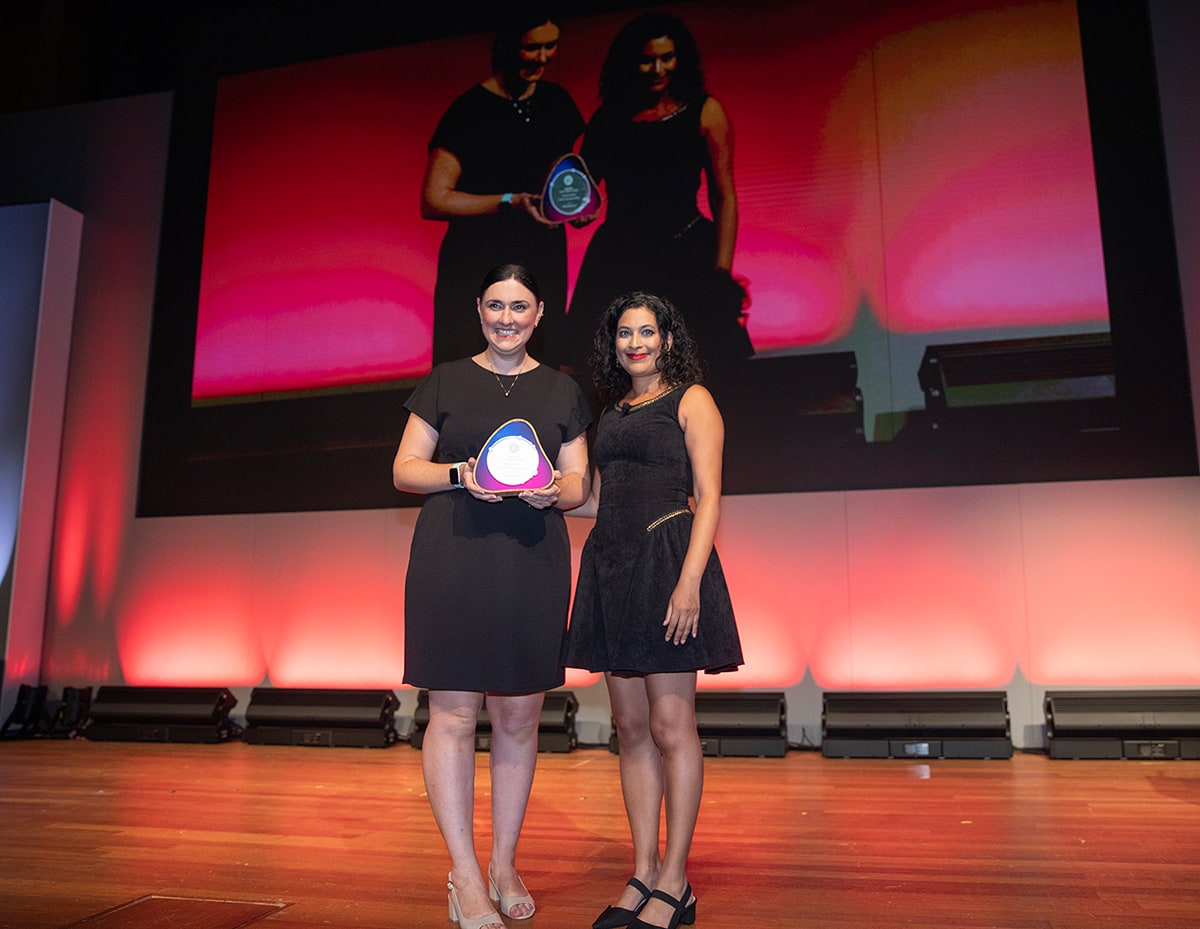
IBC "Social Impact Award" goes to SWI Swissinfo.ch

SWI Swissinfo.ch has been honored with the Social Impact Award by the International Broadcasting Convention (IBC) for its data-driven promotion of inclusive language in a multilingual digital newsroom.

Presenter Nadira Tudor (right) hands over the IBC Award to Jo Fahy (left), Head of Distribution and Formats. (Image: IBC)

Since 2022, the ten-language international SRG SSR service SWI Swissinfo.ch has consistently dispensed with the use of the generic masculine.

The use of inclusive language is evaluated periodically; all published texts and photos are also evaluated with the aim of achieving gender balance. SWI Swissinfo.ch is guided by the BBC's "50:50 Equality Project," which was launched in 2017.

For this commitment, the International Broadcasting Convention IBC has now presented SWI Swissinfo.ch with the Social Impact Award in the Diversity and Inclusion category.

The handover took place on Sunday in Amsterdam, during the 56th edition of the media, entertainment and technology industry trade show.

"Reporting on Switzerland is not feasible at all without diversity".

"This one is a recognition of the years of hard work we've put into this project," says Jo Fahy, Head of Multimedia at SWI Swissinfo.ch. "It's a project that has demanded quite a bit of change from our multilingual and multicultural teams."

Director Larissa M. Bieler sees the use and promotion of inclusive language as a task for all media, with media with public sponsorship playing a key role: "As an international media house, we share responsibility for how the media take diversity into account in their language or not. Our job is to report on society as a whole, and in the case of Switzerland, this is not even feasible without diversity."

Counteracting underrepresentation

The idea behind this is that diversity in media content and in language has an impact on society, on patterns of thought and behavior. Inclusive language therefore means more than just "gendering.

Without an awareness of inclusion, population groups are made invisible, underrepresented, or distorted. The consequences can be stereotyping, racism, and discrimination.

Globally, women are still heavily underrepresented in media contributions. The gender ratio of men to women is 80 to 20 percent. For Switzerland, an average representation of women of 23 percent was measured (Fög/IKMZ, 2021), with the ratio varying by topic and media title. (pd/swi)

Erdmannpeisker turns building technicians into sun tamers

Like almost all skilled trades, building technicians also suffer from a shortage of apprentices. For this reason, the Swiss-Liechtenstein Building Services Association Suissetec, together with Erdmannpeisker, is launching a new film for young people, calling for the first and most important step in making contact: The trial apprenticeship.

The film takes up the highly topical subject of solar energy, which is the focus topic for Suissetec this year. Whereas in the first film building technicians were presented as competent partners and as the professionals for solar installations, the newcomer film takes up the topic for young people in a surprising and target group-specific way: As in the popular anime, in which the main characters can tame water, fire or air, here the building technician becomes a sunbender, because anyone who can install solar systems on the roof and thus bring the sun into the house is a real sunbender.

The online spot, conceived by Erdmannpeisker, combines real images and illustrations in a surprising way and in quick cuts. In the film, sympathetic young building technicians call for Top-apprenticeships.ch and to take part in a trial apprenticeship in the industry. The approach to the young people should be witty and yet authentic and approachable.

The campaign focuses on young people of career choice age and is broadcast online and on social media. Parents, the most important influencers when it comes to choosing a career, are also addressed as a secondary target group.


Responsible at Suissetec: Christian Brogli (Head of Marketing and Communication Suissetec), Helena Montag (Project Manager Marketing and Communication Suissetec), Mirjam Viviani (Project Manager Marketing and Communication Suissetec). Responsible at Erdmannpeisker: Gabriel Peisker (Creative Direction), Selina Helbling (Consulting), Jenny Ziörjen (Art Direction), Laura Fässler (Implementation Advertising Media), Markenfilm Schweiz, Stefan Künzler (Direction), Florian Studer (Producer), Cyril Gfeller (Motion Design), Capucine Matti (Illustration), Nono Photography (Photos), Mediaschneider Bern (Media Planning).

Department of Noise strengthens Smile's digital relevance

The insurance company Smile positions itself as a digital lifestyle brand. This includes a 100% online customer journey and skillful lifestyle marketing. By introducing a distinctive sound identity, the brand now aims to further expand its relevance in the digital space.

(Pictures: zVg.)

The digital business model of Smile Versicherungen is gradually being scaled in other European markets. In line with the business model, Smile successfully positioned itself as a digital lifestyle brand. This was achieved, among other things, through the consistent and cross-channel implementation of influencer marketing. To this end, the first activities were implemented in the metaverse at the beginning of the year.

"Staying relevant in the digital space is an ongoing process," says Joséphine Chamoulaud, Head Marketing, Brand & Digital Experience at Smile. "Our new sound identity will help us in this task in the long term by solidifying our brand feeling across channels."

Fabienne Braunschweiler, Brand & Communication Manager Europe at Smile, adds: "The ambition in developing our brand sound was to highlight our expertise as an experienced online insurance company through consistent reduction, while at the same time further strengthening our positioning as a digital lifestyle brand. By snappily integrating the brand name into the audio logo, we additionally found a convincing answer to the second-screen phenomenon."

The new brand sound, as well as Smile's audio logo, can be heard in the ongoing fall campaign, across all multimedia channels.


Responsible at Smile: Fabienne Braunschweiler (Brand & Communication Manager Europe), Joséphine Chamoulaud (Head Marketing, Brand & Digital Experience), Ivana Gonzalez (Lead New Business), Jonathan Barreiro (Lead Business Development), Stefano de Filippis (Head Front Office After Sales). Responsible at Department of Noise: Florian Goetze, Ph!L!pp Schweidler (Strategy, Creative Direction & Production), Yves Gerber (Creative Producer).

Christina Neuhaus becomes Jury President of the Zurich Journalism Award

The Board of Trustees of the Zurich Journalism Prize has elected Christina Neuhaus as the new jury president. The domestic head of the NZZ thus succeeds Hannes Britschgi, who is now chairing the foundation board after nine years as president of the expert jury.

(Image: zVg.)

Since 2020, Christina Neuhaus has headed the domestic editorial department of the NZZ. Previously she led the Folio and was available for the NZZ and NZZ on Sunday active. Before joining the NZZ in 2001, she wrote as an editor for various local and regional newspapers around Lake Zurich. From December 2020 to September 2023, Neuhaus sat on the seven-member expert jury of the Zurich Journalism Prize.

At the same meeting, the Foundation Board elected Sermîn Faki as a new member. Faki has been since 2017 View-Policy Chief. She has been reporting from the Federal Parliament since 2011, among other things for the Südostschweiz and the Central Switzerland on Sunday.

The next Zurich Journalism Award ceremony will take place on May 15, 2024. Since 1981, the prize has been awarded by a jury of experts to media professionals in Switzerland. Prizes are awarded for complete works as well as works from print and online media. Each of the main prizes is endowed with 10,000 Swiss francs, while the Newcomer Prize, created in 2018, is endowed with 5,000 Swiss francs. The sponsors of the foundation are the four media houses CH Media, NZZ, Ringier and Tamedia. In addition, renowned companies and institutions support the event.

Evoq implements brand refresh for Alao

Alao has established itself in the Swiss market as a broker and the go-to digital platform for attractive mobile and internet plans. The agency Evoq has been commissioned to demonstrate the value of Alao to B2B customers while simultaneously driving growth among price-sensitive B2C customers.

Getting the best value for money on mobile and Internet subscriptions is essential these days. Finding the best deal can sometimes be tedious, time-consuming and frustrating. Alao's basic idea has always been simplicity. But as the company's success grows, so does the complexity of its branding. Being inexpensive without looking cheap. Conveying competence and still remaining simple, these were the requirements for Evoq. Together with Alao, the agency developed a new brand positioning, sharpened the associated advertising messages and updated the brand design system for consistent branding.

New positioning sets the tone

Alao's vision is to leave behind the dubious image of the telecommunications industry by offering surprising and exceptional services, thus becoming a trusted player in the market. The positioning is to build a strong emotional bond with each stakeholder, and to stand the offer as a "Love Place" for telecommunications.

The renewed positioning is also the brief for the design refresh. The new look is designed to bridge the gap between loud, cheap online retailers and the trustworthiness of established telecom brands, conveying ease of use across predominantly digital touchpoints. The "smile element" in the logo taps into the emotional customer experience. The redefined use of existing design elements and brand colors is intended to guarantee recognition for the B2C customer base and convey a sense of reliability and competence to the increasingly important B2B customer base.

Activate the brand

How the brand feels, looks and sounds to the different target groups is conveyed by the brand design guidelines and a customized "messaging toolbox". For B2C customers, the message board is formulated with service and sales in mind. B2B customers receive their own messages tailored to them. However, both target groups are addressed in line with the positioning. The toolbox is thus intended to provide inspiration for current and future communication and marketing activities and thus help to communicate more qualitatively and, above all, more effectively in a rapidly changing market.


Customer: Alao. Mandate management and concept: Adrian Schaffner. Project management and text: Siljan Laerdal. Creative Direction: Markus Wohlhüter. Design: Marc Hahn.

Symbiosis of organic and paid social media posts

In an era dominated by social media, organic reach is rapidly declining, and creating engaging content is becoming increasingly challenging. How can companies ensure that their content is seen and appreciated by combining organic and paid posts?

We look back to 2010: Facebook is giving companies in our regions the freedom to create their own company pages. This step triggered unprecedented euphoria among companies of all sizes. In numerous company rooms, one could hear exclamations such as, "Now we also need a Facebook page," or "Company XY is already represented on Facebook, we absolutely have to follow suit!" It seemed as if everyone wanted to take advantage of this social network opportunity, and so everyone from local bakeries and butchers to craft businesses now have a Facebook page. Pages that were initially filled with a flood of content.

But reality set in: Far from being a no-brainer, effectively maintaining social media presences requires a lot of effort. And it's anything but free, because the need to create authentic and relevant content is an investment in both time and money. Especially as expectations of posts have changed dramatically. In 2011, the focus was still on a simple text post with a link, but now short video clips are expected - a format whose creation effort should not be underestimated. And so the initial enthusiasm for managing the Facebook page quickly evaporated.

This trend can also be seen with the launch of other social media platforms, such as Instagram in 2012 or TikTok in 2019. And let's not be fooled: This pattern will repeat itself in future social media platform launches. That's why Thomas Besmer, Head of Consulting & Growth at Hutter Consult AG, to the Webstage Masters on November 9, 2023, will talk in his keynote about how good content can be used in the future to tap into new target groups and thus improve results.


WebStage Masters is the largest social media marketing conference in Switzerland, which will take place for the sixth time on November 8 and 9. For the first time, the conference will be held in the breathtaking mountain setting of Engelberg - the village can be reached from all major cities in less than two hours! Do you also want to be there? Then secure your ticket now at
www.webstage-masters.ch/tickets


Even more than a decade after Facebook's debut, numerous companies are still navigating the vastness of the social media landscape quite disoriented. They cling to metrics like engagement rates or subscriber numbers and try to define and increase them as a goal. But the bitter truth is that these metrics have little to no impact on a company's business objectives. Who in a company can say exactly how much revenue a single subscriber generates per year? The answer is obvious: virtually no one.

There is also the challenge of organic reach. In 2011, a company post still reached around 80% of its subscribers. Today, this value has been reduced to just 5 to 15%. Which means that out of 1,000 subscribers, barely more than 100 get to see the post. If a company wants to reach a broader target group, it would have to advertise the post. But under these conditions, wouldn't it make more sense to publish a paid post right from the start that is directly geared towards business goals such as traffic generation, leads, conversions or sales?

Before we turn to how organic posts can support paid advertising efforts, we need to understand why both formats are important.

Organic posts are the backbone of an authentic social media presence and offer companies the opportunity to build an honest, authentic and sustainable relationship with their target audience. They allow for flexible and responsive communication and can thus create a closer bond with the target group.

Paid advertising campaigns, on the other hand, are powerful catalysts that offer measurable results and reach. They enable brands to target specific audiences and ensure that messages are seen. At the same time, they are excellent for achieving specific business objectives such as lead generation, revenue growth or brand awareness quickly and in a targeted manner.

When combined, these two formats create a balanced and dynamic ecosystem that maximizes reach through paid advertising while maintaining brand integrity and increasing engagement through organic posts.

Now the essential question arises: How can these two formats be optimally linked to create a holistic social media ecosystem? To answer this question, it is first crucial to answer three fundamental questions about organic posts

Three questions that each organic contribution must answer

Before publishing an organic post, there are three essential questions to address:

  • Who do I want to address?
    The target group analysis is indispensable. How is the target audience defined? What are their specific needs, likes and dislikes? A blanket answer such as "Our subscribers" is not enough, because even within this circle, diverse and differentiated interests exist.
  • What do I want to communicate?
    Every post must have a clear goal or unambiguous message. Whether it's explaining an innovative product, sharing expertise, or reinforcing brand identity, clarity and consistency are key.
  • What action do I expect the recipients to take?
    Whether you want to encourage the recipient of the post to click on a link, purchase a product, or interact by sharing or commenting, a well thought-out call-to-action (CTA) is key.

Once these three questions have been answered, nothing stands in the way of publishing the organic contribution. A post that is addressed according to the specifications from the answers formed from them will undoubtedly be classified as relevant for the target group. And relevance is the key to successful delivery by the algorithm. By the way: Of course, these considerations apply equally to paid posts to ensure maximum effectiveness and reach.

Cross-pollinate paid posts with organic posts

So how can organic posts fully unleash the potential of paid posts? The answer varies by platform, with Instagram and Facebook leading the way. Meta's advertising solutions for these platforms set standards and often find imitators in other social networks. One key to success here is the so-called "Interaction Custom Audiences," which are based on user behavior. These audiences group together users who have performed certain actions on the platform, such as video views or interactions with posts. Since these activities take place directly on the platforms, they are unaffected by tracking restrictions such as Cookie Consent or Apple Tracking Transparency. As a result, nearly 100% of the interactions can be used for targeting.

Let's take some real-world examples to illustrate this:

  • A tourism organization meticulously maintains its Instagram account and posts stunning images from the region on a daily basis. By creating a custom audience of people who have interacted with the posts in the last 365 days, it can target ads for regional offerings without cluttering its Instagram account with promotional content.
  • A financial institution offers weekly financial tips for young adults in the form of videos or reels. By using Interaction Custom Audiences, it can identify people who show great interest in these tips and attract them for a consultation by means of advertising.
  • An online store offers a kind of shopping advice via Instagram messages. All people who have interacted via this medium in the last few days can be included in a Custom Audience and targeted, i.e. addressed again.

These examples illustrate very well how organic content and activities on the platforms can be used specifically for advertising measures. If companies use their organic content strategically, for example to entertain, inspire, or increase brand awareness, they can not only complement this effect, but increase it exponentially through targeted audience building and advertising measures.

So here's a final tip: Those who define clear goals for their posts or their social media channels create the basis for targeted Custom Audiences and thus for effective paid advertising measures. This not only enables the achievement of soft metrics such as engagement and subscriber numbers, but also paves the way for the realization of concrete business objectives such as new customer acquisition, increased sales and lead generation. The possibilities and thus the resulting potential are manifold.


*The article was written in collaboration with the WebStage Masters created. 

New ancillary copyright divides media and parties

During the consultation process, the major publishing houses welcomed the proposal that large internet companies should pay for the distribution of media content in the future. Small media outlets, however, feared that the «neighboring rights» provision could prove counterproductive.

(Image: Schweizermedien.ch)

For example, when Internet platforms such as Google display short excerpts from newspaper articles, known as "snippets," they do not have to pay publishers for this. The Swiss Media Association VSM expressly welcomed the fact that the Federal Council now wants to change this with the so-called ancillary copyright in the consultation process that ended on Friday.

The platforms benefit greatly from the publishers, wrote the VSM. This is because, for example, thanks to the media content, the Internet giants can collect data about the interests of Internet users, which enables them to place targeted advertising.

However, the smaller, independent media, which have joined together in the Association Media with a Future VMZ, expressed doubts about the new law during the consultation process. It posed considerable risks for small publishers and prevented the debate on the necessary reforms of media promotion and platform regulation.

Parties are divided

There is also disagreement among the parties. The FDP supports the draft, which the party describes as "balanced and pragmatic. It offers a "Swiss" approach that supports the country's media diversity and does not neglect the small publishers.

The SVP rejects the bill, even though it sounds "promising" at first glance. Its main complaint is that the new copyright law only applies to the media, while blogs and online encyclopedias, for example, cannot benefit from it. In addition, the principle of compulsory remuneration collides with freedom of contract.

The center welcomes the fact that the system proposed by the Federal Council is based on incentives. In contrast to the European model, which subjects the use of journalistic content to an authorization system, the Swiss way introduces a "right to remuneration.

Despite sympathies, the Green Liberals reject the draft before it is clear in which direction media funding should go. This would have to be redefined after the people rejected a comprehensive package for press funding in February 2022.

The Greens are campaigning for the introduction of a performance protection right. The remuneration would benefit small media in particular, which they believe do not have the opportunity to negotiate with the Internet giants on an equal footing.

Internet industry against new copyright law

Swico, the trade association for the ICT and Internet industry, firmly rejects the draft. Journalistic content is already sufficiently protected today. Moreover, media companies already have the option of preventing the display of snippets.

Google did not provide a statement when asked by Keystone-SDA. (SDA/swi)

Studio Thom Pfister creates new visuality for the umbrella brand Zweifel

Studio Thom Pfister was commissioned by Zweifel to develop a new visual identity for the umbrella brand, which is being used for the first time in the image campaign. The result is the modular «Design System Z.».

The aim of the project was to further develop the visuals and unify the appearance of the umbrella brand. The application was also to be modular and thus work for all formats, and come across as dynamic and fresh, while retaining the defined brand elements. Products and headlines continue to be the focus, while Expert:innen, logo and claim serve recognition purposes.

From these defined goals, Studio Thom Pfister has developed the guiding idea "More Z for the future". The "Z" as a design system serves as a "new stage" for all product levels and means of communication. It is intended to provide stringent, timeless visibility. The Zweifel logo with claim becomes another striking element on an orange surface and can be used with or without Snacks-Expert:innen. In order to underline the diversity of Zweifel products, new background images, colors, the use of fonts and also disruptive elements were defined. The "Design System Z" as a result is modular, "responsive" and easy to use.


Responsible in case of doubt: Gina Chiellino (Campaign Manager), Pia Gaube (Media & Project Manager), Philip Honegger (Head of Marketing & Communication), Serge Doutaz (Head of Marketing & Sales). Responsible at Studio Thom Pfister: Thom Pfister (Creative Director, Idea/Concept), Roland Zenger (Art Director), Daniel Hackiewicz (Graphic Design & Web Development), Ursula Rytz (Consulting).

Refinery creates new image for Lenz & Staehelin

The Zurich-based agency Raffinerie has developed a new brand identity for Lenz & Staehelin. The new logo visually represents what the firm has always been: «The world’s Swiss law firm.».

The law firm Lenz & Staehelin has completely revamped its website. "Our design no longer reflected our self-image as a company," says Heini Rüdisühli, partner in charge, explaining the motivation for the project. "We wanted to put more emphasis on our innovative strength and the values of the law firm."

The Zurich agency Raffinerie was entrusted with the conception and implementation of the new appearance. The lynchpin of the designers' considerations was the logo - and with it the challenge of making it suitable and unmistakable for digital implementations. "We decided to officially use the already well-established abbreviation 'L&S' for the first time," says the agency. On the one hand, the new logo symbolizes the unity of the firm with its offices in Geneva, Lausanne and Zurich; on the other hand, it also graphically implements the unchanged slogan "The world's Swiss law firm." The circle in the new logo represents the globe, the squares stand for the Swiss coat of arms.

Inspired by Sophie Taeuber-Arp

The goal was a modern interpretation of the Swiss graphic tradition. For this, the agency was inspired by the works of artist Sophie Taeuber-Arp, an important pioneer of concrete art. Raffinerie developed a flexible graphic system from the basic shapes square and circle. This gave the various internal competence centers their own animated sub-branding.

The new house typeface is called "Circular" and comes from the Lineto typefoundry in Zurich. "Circular subtly picks up on the geometric design language and at the same time has a very human feel," says Raffinerie, explaining the choice.

Renunciation of models

The imagery was created in close collaboration with fashion photographer Markus Pritzi. For once, he did not have professional models in front of the camera, but the Lenz & Staehelin team. "Our colleagues are the foundation of our firm," says Rüdisühli. "Only with them could we convey the authenticity we were aiming for and a touch of humor."

Colorful website

Also the Website has been almost completely redesigned, both visually and in terms of content and tonality. The main colors blue, turquoise and orange stand for different sections and are intended to facilitate orientation. Vertical "scrollytelling" is intended to encourage users to discover the diverse content - for example, the newly designed "Insights" and "Stories" sections. The "Careers" section also offers interesting content and a simplified application process, as Tino Gaberthüel, Partner and Head of HR in Zurich, explains: "Our new website is designed to further strengthen Lenz & Staehelin's appeal to the best students and employees."


Responsible at Lenz & Staehelin: Heini Rüdisühli, Benoît Merkt, Thierry Calame, Fedor Poskriakov (National Management Committee), Nina Isabel Koch (Project Manager National MarCom Team), Corina Schnyder, Natascha Kühne, Lara Schönmann, Jasmine Gay, Coralie Balfroid, Iman Yazli (National MarCom Team). Responsible at refinery: Adrian Goeppel, Christian Haas, Claire Hulla, Daria Lötscher, Lukas Fust, Mattia Dellamora, Meret Fischli, Michèle Gutmann, Pascal Arnet, Reto Ehrbar, Sarah Dietrich, Simon Meier. Other partners: Snowflake (website), Ink! (text), Markus Pritzi (imagery), Sandro Diener, Anoush Abrar (portraits).

More production power for TBWA\Zurich with ViDo

The startup ViDo Switzerland complements TBWA\Zürich's offerings in the areas of video and print production, lithography, and 3D modeling.

The seven-member team of ViDo Switzerland. (Image: zVg.)

According to the announcement, the agency TBWA\Zurich is pleased to unite all central competencies under one roof and thus ensure the best quality and fast implementations. For the digital productions in the HTML5 area, the agency has been working successfully with its German colleagues from Eg+ for several years. Accordingly, all services can be offered integrated.

Already working ViDo for many TBWA\Zurich customers, including Coop, Mercedes, McDonalds, Davos Klosters and Emmi.

In the field of video, motion design for all possible formats and channels is offered, as well as more extensive video productions, such as those already produced for Emmi, Davos Klosters or Credit Suisse were implemented.

"We can solve smaller productions quickly, efficiently and cost-effectively in-house. For medium-sized productions, we work with our network of production partners and casting agencies," explains Karl Hofmann, Traffic Manager at ViDo Switzerland .

In addition, the production unit offers print production, image processing and 3D modeling.

Enigma expands management team

To drive future growth, the Enigma agency is expanding its leadership team with three long-time employees: Frédéric Doms, Charlotte Paris, and Franck Pineau.

The extended management of Enigma: Franck Pineau, Martin Künzi, Olivier Kennedy, Frédéric Doms, Antonia Sturzeis, Nadine Nassif and Charlotte Paris (from left to right). (Image: zVg.)

Creative Director Frédéric Doms, Head of Digital Charlotte Paris and Head of Sales Franck Pineau are new members of Enigma's management team. They complement the current management team consisting of CEO Olivier Kennedy, CXO Martin Künzi, Nadine Nassif, Head of Human Talent & Admin, and Antonia Sturzeis, Head of Client Success.

This strategic move is aimed at supporting the company's significant growth in recent years and laying the foundation for further expansion, according to a statement from the agency. This is particularly with regard to the German-speaking Swiss market. Thomas Kendlinger, former Head of Operations, and Emilie Laussausie, Head of Client Success, have left the agency.

Frédéric Doms is a seasoned advertising professional with 25 years of industry experience, including 10 years at Saatchi & Saatchi Switzerland. He has already been with Enigma for more than three years.

Charlotte Paris has a wealth of expertise gained in advertising and network agencies. Over the course of more than three years, she had played a crucial role as Head of Media Trading at Enigma.

Franck Pineau has been with Enigma for over a year and is committed to unlocking the full potential of teams and projects.

With the expanded management team, the agency wants to be able to deliver even better and more creative results for its clients.

Kind regards and City of Zurich: Pleasurable for the climate

More plant-based foods, less food waste: Through a campaign by Freundliche Grüsse, the City of Zurich is encouraging residents to explore climate-friendly eating habits.

Your tomatoes look old? Throw them in the frying pan! With a wink of the eye, Zurich diners are given simple tips on plant-based nutrition and avoiding food waste. At the same time, attention is drawn to the "Climate à la carte" campaign: under this motto, around 100 Zurich restaurants offer climate-friendly menus for a month.

Because what ends up on our plates has a major impact on the environment and climate. A significant proportion of CO2 emissions is caused by nutrition and food waste. The good thing is that we can influence this positively. This is where the "Climate à la carte" campaign comes into play at various levels: more specifically, when cooking for ourselves and when eating out.

Good vibes instead of finger pointing

The poster and online campaign is designed to directly motivate Zurich residents to question their own eating habits. Climate-friendly nutrition is addressed with a touch of humor. In addition, options for action are shown that everyone can easily implement. For example, making croutons out of bread that "makes you hard.

In the "Facts and Hacks" video format, Lisa, the city's sustainable food expert, answers questions from Zürcher:innen. In addition to a contest, there are simple tips and an overview of food-save initiatives to avoid food waste at home in your own kitchen.

Around 100 catering establishments with climate menus

The Climate à la carte" campaign is already taking place for the second time. Until the end of September, around 100 Zurich restaurants will be offering climate-friendly menus as part of the campaign. Gülsha Adilji and Anina Mutter go to two of the participating restaurants: In the video format "Mit de Reste is Resti," they have female chefs conjure up a gourmet menu from leftovers.

Other local Influencer:innen test the climate menus and thus make a restaurant visit during "Climate à la carte" palatable to their community.

"Climate à la carte" can also be found at Zurich's biggest food events: At Food Zürich, at Soil to Soul and at Food Save Day.


Responsible at Environmental and Health Protection Zurich: Daniela Diener (overall responsibility), Selina Galliker, Florence Ritter (campaign management), Lisa Halter (specialist responsibility for nutrition). Responsible at Friendly regards: Fabian Biedermann, Samuel Textor, Pascal Deville (overall responsibility), Laura Leuenberger (art direction), Julian Riegel (text), Käthy Känzig, Eva Brun (consulting), Mario Noser (social media), Clips: Damien Inderbitzin (Executive Producer), Photography: Visualeyes International, Nathalie Furrer (Producer), Marie-Christine Gerber (Photographer), Filipa Fernandes (Styling), Lithography: Matter of opinion.

get_footer();