Digitec Galaxus answers product questions with AI

The online retailer Digitec Galaxus has integrated artificial intelligence (AI) into its community process to answer product-related questions more quickly. Questions that the AI cannot answer are forwarded to the community as usual.

The Galaxus AI answers product-related questions. (Image: Galaxus)

The Galaxus teams Rivendell and Nightingale have integrated artificial intelligence into the community process. The aim is to answer product-related questions more quickly, writes Digitec Galaxus in a press release. The AI first checks whether it can answer the questions and then provides an answer directly. If customers are satisfied with the answer, it will be visible to everyone in the community.

The new feature is only suitable for questions that can be answered immediately from the data. The AI scans the store data from Galaxus, but also takes information from other sources and indicates this in the respective answer.

Above all, the AI can answer product-specific questions such as "What cable connection does this cell phone have?" or "From what age can children play with it?". The AI should also be able to answer questions about the scope of delivery. However, the AI cannot answer human experiences with the product or questions about prices.

This is not the first AI function that Digitec Galaxus has used in its online store. In spring, for example, the online retailer introduced an AI-generated overview of product reviews. Other Swiss online retailers are also experimenting with the technology. Brack.ch, for example, introduced an AI-based chatbot in the fall of 2023.


This article first appeared in Netzwoche.

Refluenced strengthens VR after successful expansion

Now that «Refluenced» has successfully established itself throughout the DACH region, the platform is expanding its board of directors with the addition of Thomas Brändle and Sacha Moser.

Sacha Moser (left) and Thomas Brändle (right) are new members of the Refluenced Board of Directors. The platform was founded by Jonas Holzer (2nd from left) and Quirin Hasler. (Image: zVg.)

"Refluenced" connects nano- and micro-influencers with brands and products using advanced technology and artificial intelligence (AI). According to the company, the platform has been able to grow rapidly throughout the DACH region. Following its successful market entry in Germany and Austria and a successfully completed financing round, the company is now appointing two new members to its Board of Directors.

Serial entrepreneur and founder of Run Accounts, Thomas Brändle, is joining Refluenced's Board of Directors and will also become its Chairman. His "understanding of the technology industry coupled with his financial expertise" will be a "valuable asset for the further development of Refluenced", the platform writes in a press release.

Sacha Moser is also a new member of the Board of Directors. The founder and CEO of Foundry will contribute his many years of experience in brand building and digital transformation to the platform.

With the recent financing round, Refluenced can now further expand its platform and extend its offering for companies, agencies and brands. According to the company, it recently launched the world's first platform for TikTok campaigns with nano- and micro-influencers.

Axel Springer Group plans split-up

The international media group Axel Springer is set to become a family-run media company once again and plans to spin off its businesses. The media division will be owned and managed by Friede Springer and Mathias Döpfner and separated from the classifieds business, which includes job and real estate portals. According to the company, the plans are subject to regulatory approval, and the transaction is expected to take place in the second quarter of 2025.

Springer CEO Mathias Döpfner (archive image: Axel Springer media library)

"The new structure is intended to optimally position all business divisions for future growth potential and success in their respective markets," said the Group, which has around 18,000 employees. The move also marks a change in a strategic partnership entered into years ago with the major US financial investor KKR: the classifieds businesses will become independent companies with a new shareholder structure - US financial investor Kohlberg Kravis Roberts (KKR) and the Canadian pension fund CPP Investments will become majority shareholders.

Vice Chairwoman of the Supervisory Board and publisher's widow Friede Springer said: "It was the clear vision of Mathias Döpfner and myself that Axel Springer would one day be a family business again. It fills me with great joy that this vision is now becoming reality."

CEO Döpfner, who like Springer also holds a large stake in the media company, says: "Before we started the partnership with KKR five years ago, Friede Springer and I had an idea of what the company could ideally look like in a few years' time. That is now probably coming true." The future structure provides the "very best conditions" for a good future for journalism.

This is what the structure looks like

The deal will be as follows: The media businesses with the brands Image, Business Insider, Politico, WorldMorning Brew" and other areas such as the online comparison portal "Idealo" will remain with Axel Springer. Almost 98 percent of the company is controlled by 61-year-old Döpfner and 82-year-old Friede Springer.

"Axel Sven Springer, a grandson of the company founder, will retain the remaining shares - a smaller part of his previous minority stake. This means that for the first time since the IPO in 1985, Axel Springer will be a family-owned company, fully in private hands," the Group said.

The part that is then separated includes companies such as the Stepstone Group (job exchange), Aviv with real estate portals and "Finanzen.net". KKR and CCP Investments will then be majority shareholders in the independent joint venture company - Axel Springer is to become a co-minority shareholder and there is to be an economic participation by Axel Springer's grandchildren.

The exact participation has not yet been determined. It also remains to be seen what the separate part will be called in future or whether there will be several units. (SDA/swi)

Riklin brothers file complaint against NZZ

Performance artists Patrik and Frank Riklin from St. Gallen have filed a complaint with the Press Council against the Neue Zürcher Zeitung. The NZZ had used a photo of their latest performance art piece in Schaffhausen in an article about Russia.

NZZ Sonntag

On September 2, the NZZ a text with the title "Russian disinformation shows: Switzerland has long been at war". The article was illustrated with a photo of the latest art project by brothers Frank and Patrik Riklin, in which they sawed up yellow benches in Schaffhausen.

The picture of the sawed-up bench was taken by a photographer from the Keystone-SDA news agency. The image was freely available to media customers in the database. As the Riklin brothers write in their complaint to the Press Council, which was also reported on Thursday by the Schaffhausen News reported, the NZZ but the recording is used without any context.

"Nothing to do with war"

What is to be seen in the picture is not stated. The word "symbolic image" is also missing. As a result, her art campaign is associated with Russian disinformation, which has caused considerable confusion in her environment and on social media.

There have been people who have called them "war artists". "Our action has nothing whatsoever to do with war, on the contrary," the brothers said when asked.

In their opinion, the NZZ against the Code of Journalism. It states the following on the subject of "illustrations": symbolic images that do not refer directly to the text must be labeled as such.

Keystone-SDA's picture of the Schaffhausen art project made it all the way to Russia, to a relevant propaganda channel. "RT DE", the German-language program of the Russian state broadcaster RT, ran the headline: "Switzerland absurd: Because art project degenerated, it was of course Russian propaganda".

The Riklin brothers will probably have to wait a year for the Press Council's decision. (SDA/swi)

Readers take a critical view of artificial intelligence in the media

The Swiss public is very skeptical about the use of artificial intelligence (AI) in journalism, according to a new study. Not even one in four people surveyed would read articles generated entirely by AI.

The approval rating looks slightly better for texts that were created "with the support" of AI, i.e. when AI helps with translations, research or data analysis. As many as 53.6 percent would be willing to read such texts, as shown by a study of the Research Center for the Public Sphere and Society Fög at the University of Zurich. The study was published on Thursday.

It is important to most respondents that the responsibility for content still lies with humans. "Many people probably think of text robots. They find this idea off-putting," study director Daniel Vogler is quoted as saying in a press release.

Little willingness to pay for AI texts

The study also shows that Swiss people do not have a great deal of trust in media companies when it comes to AI: Only 21.2 percent believe that the media they use the most handle it responsibly.

There is also some catching up to do in terms of declaration. Only 12.1 percent of respondents believe that the media provide sufficient information about how they use AI and which guidelines they follow.

AI also has a negative impact on readers' willingness to pay: Only 6.2 percent of respondents would pay for texts generated entirely by AI. And even for texts written with AI support, only one in four is willing to put their money where their mouth is. The highest willingness to pay is still for AI-free content.

1287 people took part in the representative online survey. (SDA/swi)

Ingo shows how 100 francs can change a life for Postfinance

With its «Smart» banking packages, Postfinance offers students and adults personal accounts, savings accounts, cards, e-finance—and 100 francs in startup capital. Ingo Zürich is using this sum as a springboard for a campaign.

Sure, it's easy to spend 100 francs - on a date, for example. Or a few records. Or a cookbook. But the question is not how quickly the 100 francs are gone - but what these investments can become. Ingo's campaign aims to show that these 100 francs of starting credit can change a life.

What happens if you invest 100 francs in something that is important to you? Like quick thought experiments, the three commercials in the campaign explore this question - and find scenarios for Postfinance's potential target groups.

This is how a young woman from the "students" target group launches her DJ career with her bank package: In 15 seconds, the spot zips through the beginnings of her career, from practicing in the basement to her set at a popular day rave.

Even adults who are already in the middle of life still have everything ahead of them. The commercial for the "adults" target group makes this clear: a man in his prime discovers his love of cooking thanks to the 100 francs starting credit with a cookbook. After his first attempts, he soon creates increasingly elaborate menus and attracts more and more friends and relatives to his table - until he is finally shown on the opening night of his own restaurant.

The third story aims to appeal to everyone with the universal theme of "love". For her first date, a young woman buys herself a bouquet of flowers and then invites her date out for a drink. Her efforts visibly ignite the spark and in the end we see a love for life in its infancy.

The stories are intended to illustrate in a simple but emotional way what such a smart banking package can achieve: with the 100 francs starting credit, it can be the beginning of something big and accompany customers on their journey even after this first step.

The campaign can be seen digitally, DOOH and as print OOH.


Responsible at Postfinance: Melissa Pham, Darija Dananic (Marketing Manager Everyday Banking). Responsible at Ingo Zürich: Marika Magnuszewska, Johannes Jordan, Kathrina Seiler, Kim Prinzing, Curdin Montalta, Felicia Aeppli, Samuel Wicki (creation), Kira Verlaus, Franziska Saxer (consulting) Galina Helbling (strategy). Responsible at Webrepublic: Torill Sigg (Campaign Manager Social Media Marketing), Sina Eggenberger (Consultant Performance Marketing), Philipp Hentrich (Senior Campaign Manager Programmatic Advertising), Janine Zimmerli (Account Associate). Responsible at Havas Media: Claudia Gantenbein (Account Manager), Lena Rüdisüli (Account Manager), Timo Bendel (Senior Account Director). Responsible at Boutiq Films: Chantal Gugger (Executive Producer), Sandro Jäger (Director), Pascal Hein (Camera), Paula Patocka (Photography), Jan Klemsche (Edit), Delfina Mayer (Color Grading), Polaire Audio (Sound Design), DubDub (Voice Recording / Audio Postproduction).

Normal creates new web experience for the art planet

The Normal agency created a branding concept and a website for Kunstplanet, an organization that promotes the arts.

The Kunstplanet association provides artists with a studio and an apartment on Visper Planetenweg as a retreat for concentrated work and exhibitions.

In close cooperation with the KiloKilo agency, Normal has developed a new website which forms the hub of the Kunstplanet. It provides information about the idea and goals of the Kunstplanet, generates donations and links to the so-called planetary art - the Insta channels of the Kunstplanet, where events and exhibitions are published.

The visual implementation of the website is characterized by a stylized planet made up of hundreds of stars. The stars stand for the stars of the Kunstverein: the artists who make the art planet visible and tangible with their work.

In digital space, the star planet serves as an interactive navigation tool. When the location of the artificial planet is called up, for example, the stars form a realistic topographical map. Similarly, the star planet functions as a logo for business cards, sponsor dossiers and letterheads.

At the studio, the Spacebox draws the attention of passers-by to the art planet. With spherically illuminated headlines on the subject of artistic existence in our galaxy.

To publicize the association, T-shirts were produced with a motif by illustrator Maurus Zehnder, who freely interpreted the "Art Planet" theme.


Responsible at Kunstplaneten: Dr. Martin Kaspar (overall responsibility), Vincent Coppey, Roger Guntern, Pascal Minger (Executive Board), Rachel Camina (Media and Communications). Responsible for Normal: Sven Loskill (Digital Director), Martin Arnold (Text/CD), Maurus Zehnder (Illustration). Responsible at KiloKilo: Lukas Zgraggen (Motion & Interaction), Dominik Sigrist (UI/UX Design).

Swiss media and entertainment industry growing more slowly

The Swiss media and entertainment industry is growing at a slow pace. Overall, revenue in 2023 rose by 1.7 percent to 21.4 billion francs. The previous year, the increase had been 3.6 percent. According to experts, growth is likely to slow further in the future.

(Graphic: Pwc.ch)

By 2028, the market for (entertainment) media, which includes internet offerings, music and radio, newspapers and magazines, online media, television, video games and virtual reality, will only see average annual growth of 1.1%. This is the conclusion reached by PwC in its latest Swiss Entertainment & Media Outlook" survey.

On the one hand, the experts blame inflation and the higher cost of living for this slowdown. On the other hand, the so-called "post-Covid effect" is diminishing.

However, the pessimistic forecast does not apply equally to all sub-segments of the industry. Cinema, for example, has recovered from the coronavirus pandemic and grew by a good quarter in 2023. In addition, the high level of streaming has boosted sales of video, music and radio.

On the other hand, newspapers, books and consumer magazines were among the biggest losers. Linear television is also likely to experience a decline.

According to the report, virtual reality (VR) and artificial intelligence (AI) achieved the strongest growth in 2023 with an increase of 36.4% to CHF 161 million. The authors also forecast a significant increase in the coming years. Bogdan Sutter, Director Strategy and Digital Change Expert at PwC Switzerland, is quoted in the press release as saying that turnover will almost double by 2028. (SDA/swi)

Jeff Zürich: A little "Dolce Vita" for Flaschenpost.ch

The latest campaign by Jeff Zürich for Flaschenpost.ch shows what happens when Italian joie de vivre meets Swiss reliability.

The agency implemented the campaign as part of the cooperation between Flaschenpost.ch and the Italian Trade Agency. This involves Flaschenpost.ch adding 50 new Italian winegrowers to the 150 already on offer. "We show you the best Italians for more 'Dolce Vita' in your home. Hand-picked from the largest online selection of Made in Italy wines," co-CEO and co-founder Dominic Blaesi is quoted as saying on the website. The wines on offer are also marked with the "Dolce Vita" label. The label is intended to stand for particularly enjoyable drinking and the highest quality - a true "Made in Italy" experience.

Jeff Zürich developed the creative idea, while Nova Impact took care of the planning and booking of the poster campaign. The campaign is being played out in two flights and can be seen on the left and right banks of Lake Zurich plus at selected S-Bahn stations in the city of Zurich.


Responsible at Flaschenpost: Dominic Blaesi (Co-CEO and Co-Founder); Lea Vogler (Product Manager); Imke Sundermeyer (Category Manager). Responsible at Jeff Zurich: Mischa Müller (Art Direction); Peter Day, Stephan Gimmi (Creation); Peter Broder (Project Management). Responsible at Nova Impact: Marcel Bieri, Larissa Mörgeli (Senior Media Consultants).

Interplay of data and emotions at the "Direct! By Post Advertising 2024"

On Wednesday afternoon, more than 350 invited marketing and advertising experts accepted Post Advertising’s invitation to the Kaufleuten in Zurich. The «Direct! by Post Advertising» conference provided valuable insights into the future of the advertising industry. m&k was on site and conducted video interviews.

(Image: Post Advertising)

The newly designed specialist conference took place in a contemporary afternoon format and in a fresh location, the Kaufleuten Zurich. The program of "Direct! by Post Advertising" included a journey through current trends and forward-looking topics in the advertising industry.

m&k editor Beat Hürlimann was able to talk to the speakers of the exciting afternoon following their respective presentations. These included representatives from Post Advertising, an advertiser of the year and a member of the Oscar Academy.

In his presentation, computer graphics pioneer Prof. Dr. Markus Gross showed how artificial intelligence is revolutionizing storytelling and advertising. And emotion researcher Cornelia Krebs addressed the question of how companies can reach the hearts of their target groups through passionate advertising. Together with Andrea Bison, Co-CEO of Thjnk Zurich and "Advertiser of the Year" 2024, and Raphael Bratschi, Head of Product Management and Business Development at Post Advertising, she discussed in the panel discussion how brands can be developed into authentic "soul brands".

(Image: Post Advertising)

Ingo Barlovic, a child and youth researcher, then opened up a fascinating perspective: he explained how Generation Alpha, the future target group, actually ticks. He emphasized their sensitivity to authenticity and made a powerful plea for credible advertising.

Other personalities on stage included Nicolas Hugentobler, Head of Live Marketing at Rivella, Christoph Keiser, Co-Head of Fundraising and Marketing at Caritas, Esther Cahn, VP Strategy & Customer Growth at Exactag and Adriano Beti, CEO of Livesystems.

Speakers and panelists presented inspiring theses and illuminating insights. Statements such as: "In the coming years, the digital overlay of the real world will take hold - with a dual economy and numerous personalized services.", "Present your brands with rough edges. Be bold: Show who you really are.", "Your target group asks itself: Who are you really? And who will I become with you?", "Generation Alpha - born between 2010 and 2024 - finds itself caught between the old world and the digitalized world, with the old world still very much present.", provided plenty to talk about.

Erdmannpeisker gives B&G Switzerland a new lease of life

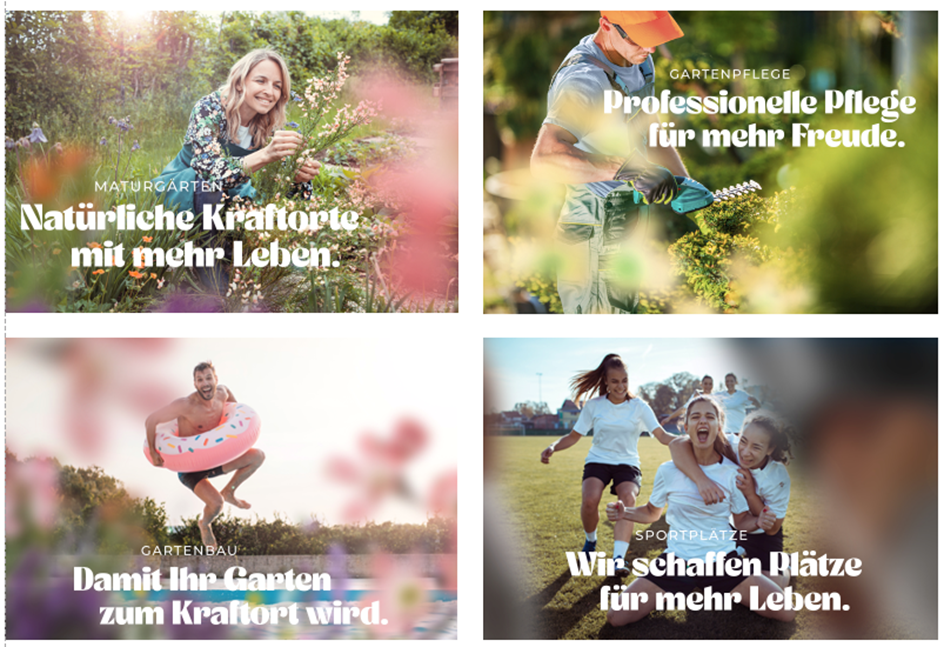
B&G Schweiz, a holding company active in the gardening and landscaping sector, has a new brand identity. The Biel-based agency Erdmannpeisker was responsible for its implementation.

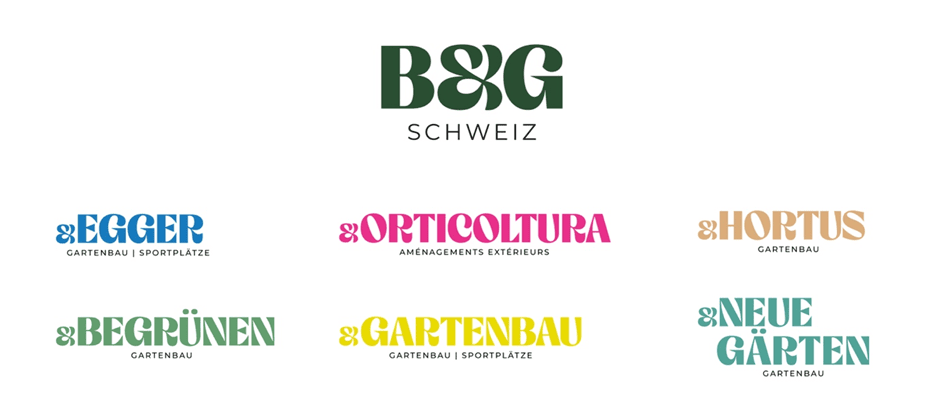
B&G Switzerland currently has ten successful and well-established local members. The holding company aims to grow by two to three additional members each year in order to become the leading gardening and landscaping company in Switzerland.

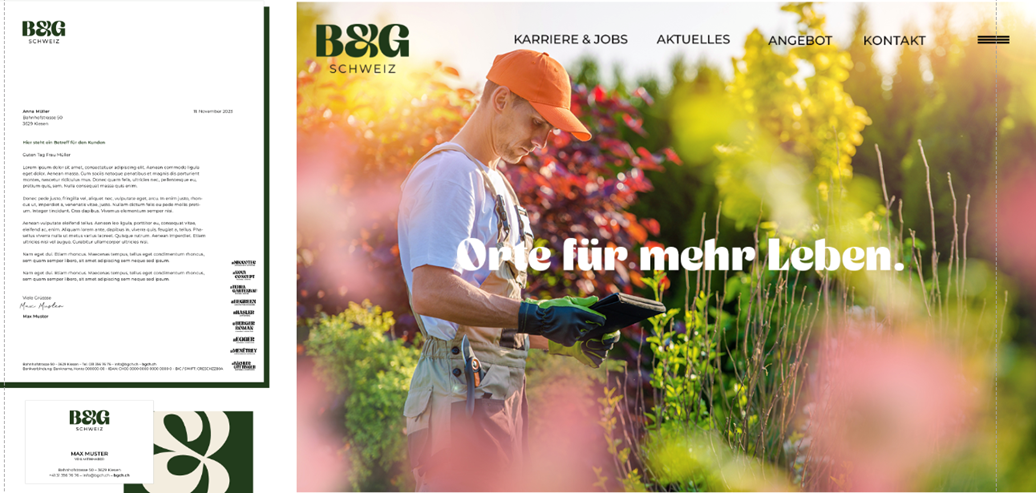
After winning a pitch, Erdmannpeisker created a completely new image for the holding company and its members. This comprises various measures - from positioning, claim, logo, corporate design to communication and website - and is being implemented step by step for all members.

In order to maintain the local roots of the members, it was decided for the logo system that they would keep their name and their corporate color, but all receive a uniform logo. The group will have a common figurative mark and font. The "ampersand" is reminiscent of a flower and is placed in front of the word marks of the respective members to make the group affiliation clear in terms of content.


Responsible at B&G Switzerland: Ramon Stucki, Lorenz Geissbühler. Responsible at Erdmannpeisker: Gabriel Peisker (Creative Director), Sybille Erdmann (Consulting), Jenny Ziörjen (Art Direction), Crosswalk (Positioning).

Maxomedia and Republica launch the SCB chatbot "Mutz"

The Bern-based agencies Maxomedia and Republica have teamed up for a project with SC Bern and jointly launched «Mutz.» The chatbot is designed to set new standards in digital fan interaction.

"Mutz" complements SCB's digital offering and is intended to provide fans with real added value on the SCB website and in the SCB app. The AI-based chatbot answers questions, performs complex calculations and always provides up-to-date information and statistics.

Maxomedia laid the foundation for "Mutz" by further developing its previous chatbot "Max" and giving it the ability to calculate. The special thing about "Mutz" is above all its "advanced prompt engineering, which, in combination with a specially developed knowledge base and access to current web data, enables precise and informative interaction", the agencies write in a press release. "We wanted to offer fans something truly innovative that understands and responds to their needs," Maxomedia CEO Simon Muster is quoted as saying. "With 'Mutz', we have successfully realized this vision."

SCB lead agency Republica contributed its many years of expertise in fan communication and information management relating to match attendance to the concept, ensuring that Mutz can draw on a comprehensive database. Republica CEO Bala Trachsel explains: "With 'Mutz', our website and the SCB app have gained another relevant feature that allows us to make fan knowledge and information accessible in a simple and low-threshold way."

For SC Bern, the launch of "Mutz" represents another important step in terms of digitalization, the statement continues. Among other things, the chatbot provides seasonal data, acts as a comprehensive knowledge hub and navigation aid and uses complex calculations for SCB statistics.

The chatbot is now live on Scb.ch and in the SCB app and was presented to the public for the first time at an SCB fan event. The fans were able to playfully test the chatbot, for which Maxomedia created a special game in which the fans could interact with "Mutz" through voice input and output. The game can be can be tried out online.

get_footer();