Six trends that will shake up six industries

New Trends Future Bussiness Growing Concept
Grocery: Smart tools offer more relevant and connected offers Marco Cerqui, co-founder and managing director of Bring(www.getbring.com) The digital transformation in food retailing will increase in speed, both for online and offline purchases. Personalized prices, more flexible delivery and pick-up concepts, or virtual shopping are just some of the drivers - and not only of the large grocery chains. In the future, the customer should receive offers with the highest relevance and will thus spend less time on one of the most regular of all everyday activities. The right tools for this will increasingly link up, for example recipes with shopping lists and online orders, and thus enable the customer to have a new and everyday-optimizing shopping experience.Banks and insurance companies: The big financial service providers will catch up onlineJens Rode, digital expert and CEO of Tellja (www.tellja.de) Accelerated information channels and changing consumer habits are creating a number of new opportunities for long-established service providers, especially in the insurance and banking industries. To avoid continuing to be an easy target for nimble fintech startups, industry giants will look more to young emerging competitors in 2017. As CDOs, digital thought leaders will make their way into established companies and increasingly focus on smart innovations such as consumer communities. There, users will be able to inform themselves independently about insurance, recommend the best offers to each other, and conclude insurance solutions directly. The transparent and user-friendly processing of contract conclusions will be a key issue in the digitization of large companies.SMEs: Digital transformation becomes more concrete thanks to e-commerceSinan Arslan, Marketing and Communication at Neofonie(www.neofonie.de)For many, digital transformation sounds abstract and not very tangible. Consultants are called upon to be more concrete - entirely in the interests of customers, especially when addressing small and medium-sized enterprises. Digital agencies must provide answers to the question of how customers can be inspired with the help of "digital" and how processes can be innovated. E-commerce offers concrete starting points for this. Several trends can be observed here: Individual commerce, B2B commerce and emotional commerce. This means that target groups and the individuality of customers are moving into the focus of the digital transformation process.Service providers: online assessments are used more proactively and aggregatedRemo Fyda, CEO of ProvenExpert.com (www.provenexpert.com)The topic of customer reviews is no longer just important for the e-commerce sector, but is also becoming indispensable for services in all industries. Nine out of ten consumers today gather information on the Internet before buying a product or booking a service - and the experiences of previous customers are immensely important in making the right decisions. More and more companies and service providers are recognizing the added value of proactive review marketing and are increasingly relying on all-in-one solutions with which customer reviews can be obtained, evaluated and even bundled from a wide variety of review platforms.Publishers: Usability in digital reading is the most important goalPhilipp Graf Montgelas, CEO and Managing Director Readly (https://de.readly.com)Whether newsfeed on Facebook, books on the Kindle, magazines with Readly or via the apps of daily newspapers - reading has long been done digitally everywhere. What is important is a user-friendly presentation, optimized for the respective device, from smartphone to laptop. In 2017, publishers will therefore increasingly focus on improving usability. As in the film and music industry, there is no shortage of good content, because a good story remains a good story, whether digital or print.Marketing and communication: Virtual reality brings brand storytelling to lifeMiriam Rupp, CEO of Mashup Communications GmbH (www.mashup-communications.de)With the enthusiasm for good brand stories, the possibilities in the mobile age are also growing. Virtual reality, in particular, holds exciting potential for brands as a storytelling tool. Customers become heroes who can experience brand stories close enough to touch in the middle of the action. To successfully accompany target groups on their virtual hero's journey, companies should learn to create 360-degree worlds for their customers.Mashup Communications is a PR and storytelling agency that supports companies in various fields such as fashion, health, travel, finance and digital marketing.

The graduated marketing and sales managers 2016

die-diplomierten-marketing-und-verkaufsleiter-2016-jahrgangsbeste-bei-den-marketingleitern-silvio-graf-mit-stefan-schuerpf-praesident-der-pruefungskommission-mk-marketing-kommunikation
Silvio Graf (right), the best marketing manager of the year, with Stefan Schürpf, President of the Examination Committee.Last Saturday, November 26, at the Victoria-Jungfrau Hotel in Interlaken, 57 ladies and gentlemen received their diplomas as federally certified marketing managers and 143 as federally certified sales managers. The average grade for the marketing managers was 4.3 and for the sales managers 4.1.The celebrationTV personality Kurt Aeschbacher led the ceremony at the Victoria Jungfrau with aplomb and humor. The president of the examination board, Markus Hinder, addressed the successful graduates with a quotation from John F. Kennedy: "He has a head start in life who tackles where others are still talking. This was intended as an appeal that true hard work will take you far and that you should also be quiet for once.The best list marketing manager Top achievements were made by: Silvio Graf, who was honored with the "Swiss Marketing Sales Award" as the best of all graduates. The best graduates in the individual subjects were: Yanick Riesen and Roger Thalmann (Leadership and Organization); Markus Waldvogel (Strategic Marketing); Roger Kleiner (Operational Marketing); Roland Liem (Corporate Accounting); Antonio Della Badia (Market Research & Information Management); Roland Liem (Marketing: Fundamentals and Strategy); Marcel Kolb (Strategic Management); Jolanda Setz (Law) and Silvio Graf (VWL).The best list sales managerTop performances were achieved by: Barbara Rohrer and Thomas Roth, who were both honored with the "Swiss Marketing Sales Award" as the best of all graduates. The best graduates in the individual subjects were: Paolo Russo (Leadership and Organization); Michael Enderli (Marketing and Instruments); Thomas Roth (Corporate Accounting); Michael Gloor (Sales Information and Sales Controlling); Adrian Dickenmann (Sales Planning); Thomas Roth (Marketing: Fundamentals and Strategy); Barbara Rohner (Sales Management); Daniel Franzen (Law) and Timon Sollberger (VWL).The best of the year Barbara Rohrer (outside left) and Thomas Roth with examiner Ibi Bertschi.
die-diplomierten-marketing-und-verkaufsleiter-2016-barbara-rohrer-und-thomas-roth-mit-pruefungsleiterin-ibi-bertschi-mk-marketing-kommunikation

Change by design

change-by-design-buchtipp-mk-marketing-kommunikation
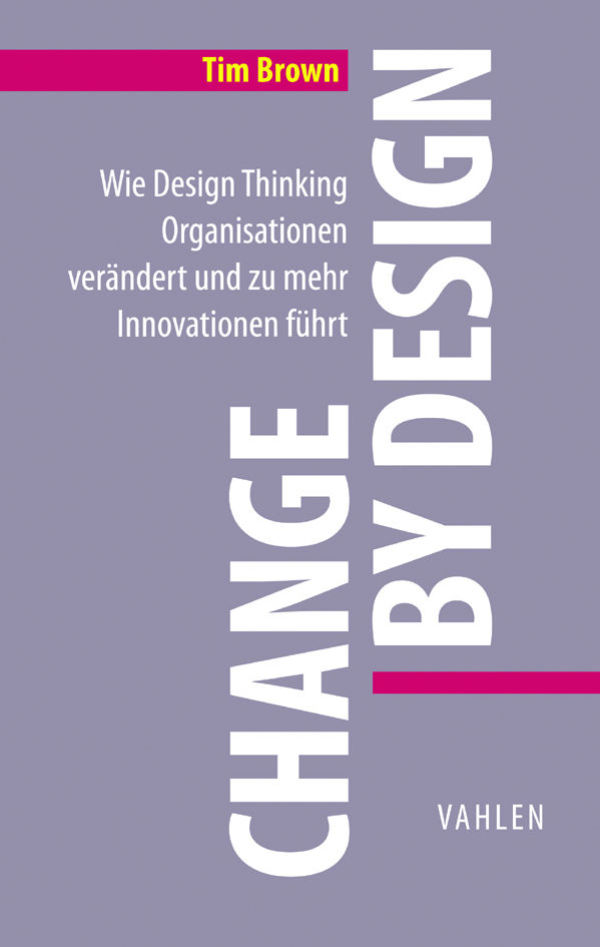
Not everyone is a born designer. However, the principles and thought structures behind good design can be adopted by anyone. Tim Brown, CEO of the design agency Ideo, which was involved in the development of the iPhone among other things, describes how "design thinking" works using specific examples of his work. As the term suggests, this approach goes far beyond the actual design of things - according to Brown, it can bring about profound changes in personal lives, in companies and even in global contexts. Brown makes an engaging and compelling call not to stifle creativity and to harness the potential of participation and teamwork. "We are all smarter than any one of us," is Ideo's credo. getAbstract recommends the book not primarily to designers - who will already be familiar with Brown's thoughts - but to all product managers and executives who are responsible for development and innovation in their company.getAbstract rating: 8Implementability: 7Innovation level: 8Style: 8Publisher: Vahlen VerlagPublication year: 2016Pages: 196ISBN: 9783800652587

Where is mobile marketing heading? Your opinion is needed!

Wohin geht die Reise im Mobile Marketing? Ihre Meinung ist gefragt!
What will 2017 bring in mobile marketing? Take a look into the crystal ball!Smartphones and tablets have usurped digital supremacy. Two years ago, the frequency of use of mobile devices worldwide surpassed that of desktop computers for the first time. According to international surveys, the first thing one in two people do when they wake up is reach for their smartphone. This means that more than 3.5 billion people are also potential recipients of all kinds of digital messages. It is therefore only logical that mobile will also overtake the stationary internet in terms of global advertising expenditure in 2017 and will probably quickly overtake it.how will mobile marketing develop in 2017? And which technologies will have a decisive influence on it? Your opinion is needed! Take part now in our Survey (duration approx. five minutes). The best comments will be published in the next issue of MK and online: https://de.surveymonkey.com/r/XC6BWPV

The "I" in the Spotlight: Micheline Calmy-Rey and Günther Jauch on DirectDay

das-ich-im-scheinwerferlicht-micheline-calmy-rey-und-guenther-jauch-am-directday-mk-marketing-kommunikation
Günther Jauch in conversation with Stephan KlapprothDo you have to be a narcissist to achieve attention? What is the price of a life in the public eye? Why do many companies rely on celebrity brand ambassadors? These questions were the focus of this year's DirectDay on November 22 in the Kursaal Bern. Among other things, they were discussed in two panel discussions with Roger Schawinski and Bernhard Russi, as well as with Prof. Dr. Lucia Malär, lecturer in brand management, advertiser Geri Aebi and Nicolas Schibler, COO Marketing and Sales at McOptic.The approximately 1,000 participants at the event listened with rapt attention to former Federal Councillor Micheline Calmy-Rey's presentation on self-marketing in politics and how to give your country a face. Another highlight of the day was the appearance of surprise guest Günther Jauch, who answered moderator Stephan Klapproth's questions with a great deal of mischievous humor.Time for encountersDirectDay is Swiss Post's largest business customer event and offers guests the opportunity to cultivate their network and acquire knowledge on dialog marketing, communication and management topics.Impressions at www.post.ch/directday.

These are the most popular data for online targeting

Das sind die beliebtesten Daten für Online-Targeting
Online targeting often uses interest and purchase intent data.The online trend study by profile data marketer Q Division interviewed 106 German advertising experts. The participants were asked about their current and future plans to use profile data, i.e., anonymized data records that make it possible to play an advertising medium to specific target groups or individuals. While 94 percent of respondents still used sociodemographic data in 2016, only 74 percent intend to take it into account for their planning and test campaigns in the next 12 months. Targeting on statistical twins, i.e. users who are similar in terms of demographics and online behavior, was 83 percent in 2016; in 2017, only 68 percent still plan to use the data.Gerald Banze, Managing Director of Q Division, welcomes this development of new targeting approaches: "The same socio-demographic data has always determined advertising for 140 years. Online, too, they are used by a large proportion of advertisers and media planners, despite more precise targeting filters on the market. It is therefore all the more pleasing that we are now seeing the first signs of a move away from the old familiar target group models. At the same time, advertisers are more frequently using minute-by-minute insights that enable individualized yet mass targeting."Ranking: These are the types of data media buyers plan to use in the next 12 monthsInterest data: 79 percentOwn data: 76 percentBuying interest data: 74 percentDemographic/socio-demographic data: 74 percentStatistical twins (prospecting): 68 percentGeo data: 60 percentAccording to the Trend Study, the most important source of data is the company's own: 83 percent of all media managers play out advertising primarily on first-party data profiles. Eight out of ten respondents buy data from other providers. According to their own information, a full 25 percent do not use second-party data that they have previously determined via website visits or campaigns.Trust before price: How media buyers choose their data supplierWhen selecting their data provider, price is only the fourth most important purchasing criterion (77 percent). Instead, the decisive factors for almost every respondent are the data source (94 percent), data currency (96 percent) and trust in the data provider (97 percent). This quality-before-price mindset is based on the German data market's experience with inferior data offerings, especially at the beginning.If we take a look at the data sources preferred by media managers, data marketers seem to be the ones most likely to meet these requirements. Three quarters of respondents buy the data for their campaigns from them. Buying directly from the portal operator or from public data marketplaces is not as popular, with 57 percent booking there in each case. Media agencies are also discovering the field of data marketing for themselves. Almost half of the respondents buy data from them.

Digital Marketing Summit for SMEs

digital-marketing-summit-fuer-kmu-nicolas-buerer-digitalswitzerland-ewa-ming-suisse-emex-und-hans-akeret-eulachhallen-ag-mk-marketing-kommunikation
Nicolas Bürer, Digitalswitzerland, Ewa Ming, Suisse Emex and Hans Akeret, Eulachhallen AG."What really works" - this is the motto of Suisse Emex 2017. Ewa Ming, Managing Director of Emex Management AG, presented the program of the trade fair, which takes place on 29 & 30 August at Messe Zürich, to over 100 partners and guests in the Eulach-Eventhalle.Knowledge platform & learning workshopFor the first time, the "Digital Marketing Summit for SMEs" will be held in parallel with Suisse Emex 2017. The congress will be positioned as a separate event. However, the synergies with the Event & Marketing trade fair and the partner trade fair Top-Soft will be used and the congress will take place in Hall 7 of Messe Zürich, in the Conference Center in the Holiday Inn hotel opposite and in conference rooms in the Hallenstadion next to the trade fair. The congress is primarily aimed at managers of SMEs. This new knowledge platform with a learning workshop is designed to enable them to acquire practical know-how. The target is 750 congress participants.Hub for digital & technologyThe new specialist congress is supported by Digitalswitzerland, the new initiative that was launched a year ago as Digital Zurich. It is supported by major companies and aims to establish Switzerland as a leading hub in the fields of digital & technology. Nicolas Bürer, Managing Director of Digitalswitzerland, presents the initiative at the Suisse Emex kick-off event.Versatile hallsThe Eulachhallen were also presented. They were presented by the Chairman of the Board of Directors of Eulachhallen AG, Hans Akeret. The halls can be used in a variety of ways, not only for sporting events, but also for trade fairs and events. The guests at the kick-off event were able to see this for themselves.

Six tips for optimal live video delivery

Sechs Tipps zur optimalen Auslieferung von Live-Videos
Live streams are increasingly in demand.Despite advances in video streaming technology, delivering high-quality live video is still a challenge for providers. In Akamai's experience, the key to success is to ensure the best possible video quality at all stages of the workflow, whether broadcasting global or local events, and interest in online video - whether live streaming or video on demand - continues to grow. This year's major international sporting events in particular attracted significantly more viewers to the screen than on-demand videos. Firstly, viewers expect live videos to be presented in television quality and secondly, they expect the broadcast to offer the interaction and personalization options they are accustomed to on the Internet. These high expectations are putting TV broadcasters, OTT specialists and telecommunications companies under increasing pressure. Akamai Technologies uses six best practices to illustrate how providers can ensure high quality.1. start planning at an early stage.In order to provide high-quality live online videos, providers have to plan the quality long before the first byte is transmitted. This applies to both major sporting and musical events. Planning covers four areas: firstly, an estimate of the potential number of viewers; secondly, consideration of the devices used by viewers; thirdly, a calculation of peak times; fourthly, the development of a plan for the reliability of all components during delivery.2. use fast capture technologies.Quality starts with the capture. Providers should ensure that the capture points of the live stream are as close as possible to the encoders. To ensure an optimal viewer experience, video streams should be dynamically and automatically assigned to capture points. A CDN should support any media format. This reduces operational complexity and the risk of errors. Hybrid HTTP/UDP (User Datagram Protocol) capture combines the reliability and stability of TCP with the higher bit rates of UDP and enables fast capture.3. implement security measures for the transmission.The delivery of online videos also repeatedly attracts hackers who can tap into live streams; targets include pay-per-view events, for example. For some time now, movie and music piracy has shifted from file sharing and downloads to video streams. As the protection of video streams is of great importance, providers should use SSL encryption on the "first mile" so that hackers cannot access the content. In addition, the appropriate DRM technology should be used for the devices to which the content is delivered, for example FairPlay Streaming for iOS devices.4. technically secure cooperation with advertising partners.Another challenge is posed by video streams, some of which consist of advertising messages from third parties. This can lead to further complexities and new sources of error at the transfer points. By integrating advertising clips on the server side and combining them in the streaming workflow as services of the CDN provider, TV broadcasters, for example, have the opportunity to deliver revenue-relevant and high-quality advertising to a large number of viewers.5. support adaptive bit rates.A CDN should be able to support streaming with adaptive bit rates (ABR) to ensure the highest quality playback in fixed and mobile networks and at different connection speeds. In addition, the CDN should be able to handle a wide range of streaming formats: HTTP Live Streaming (HLS) for iOS devices; HTTP Dynamic Streaming (HDS) for devices running an Adobe AIR runtime; Microsoft Smooth Streaming (MSS) for devices running Microsoft Silverlight; and Dynamic Adaptive Streaming over HTTP (MPEG-DASH).6. measure transmission quality during a live event.In order to ensure consistently high quality, providers of live video should measure and evaluate the entire workflow, from planning, capture and feed through to transcoding and delivery to the devices. By analyzing data directly, buffer times or problems with bitrate quality, for example, can be identified and rectified very quickly. In addition, providers receive important information for planning future major sporting or musical events.

20 Minuten and 20 Minutes with one million Facebook fans

20-minuten-und-20-minutes-mit-einer-million-facebook-fans-mk-marketing-kommunikation
The 20 Minuten brand has broken the million barrier on Facebook.20 Minuten and 20 Minutes have been active on Facebook since 2009. Every day, the social media teams publish up to 20 posts in the form of news, viral videos and other moving images as well as surveys. 20 Minuten's everyday editorial work would be unthinkable without the reader community, which makes a significant contribution to the great success of the commuter medium. The social media channels enable the editorial team to be closer to the users, enter into dialog with them and receive their feedback. The presence on Facebook is therefore the perfect complement to the 20 Minutes app, which is the heart of the community. 20 Minutes and 20 Minutes are also present on Instagram and Twitter, with 20 Minutes also active on Snapchat. Both titles reach a total of around 1.4 million users via social media. 20 Minuten is giving away one million flight seconds via Facebook in collaboration with Edelweiss to thank the one million Facebook fans. As part of the campaign, 20 Minuten participants will be given their own platform.

Companies discover videos for the intranet

Unternehmen entdecken Videos für das Intranet
More and more companies are using videos for internal communication.Around 500 experts from companies in various industries took part in Kaltura's international online survey in September 2016. In its third "Status Report on Video in the Enterprise", Kaltura regularly examines the development of video use in companies of all sizes. "Our latest report on video in the enterprise shows that a turning point has been reached," says Ron Yekutiel, Chairman and CEO of Kaltura. "The fact that almost 60 percent of companies use video in their intranets and 42 percent have integrated video functionality into social business platforms is a clear signal!"Since 2015, the importance of video for internal use in the areas of communication and education in corporate networks has increased significantly. 90 percent of participants described the ability to access videos internally "on demand" as "essential" or "very important". 80 percent are also in favor of the possibility of mobile use. As the regular use of videos in the workplace becomes the norm, it is increasingly important for companies to find appropriate platforms and service providers. A central video management solution is important to 47% of participants, while 43% believe that embedding video functionality in company content management solutions is even essential.When asked about in-house webcasts - videos streamed over the intranet - almost three quarters (73%) of respondents said that their company produces more than five in-house webcasts per year, with almost a third producing an astonishing fifty or more webcasts and offering them online. "Any company that has resisted implementing a company-wide video strategy is in danger of being left behind," adds Ron Yekutiel. "On the other hand, companies that use video will continue to gain a competitive edge in communication and education thanks to the benefits of video. "The "Status Report Videos in Companies" is aimed at IT directors, heads of commercial and IT departments and video project managers who want to design or improve a video strategy, but also at providers of company software who want to integrate video functionalities into existing company solutions.Here the complete status report can be requested.

Campaign Briefing in Programmatic Marketing

kampagnen-briefing-im-programmatic-marketing-mk-marketing-kommunikation
A clear briefing is also important in programmatic marketing in order to achieve good results.Programmatic marketing is no different to any other communication tool. In order to achieve the best results and get the most out of the budget invested, it is important to determine all relevant information in a structured briefing. This is the basis for communicating with a programmatic agency.Instructions for a good programmatic briefingOf course, a good campaign strategy must first be developed that makes it possible to achieve the set goals in the first place. This in turn requires that a campaign - and this applies to programmatic campaigns just as it does to all other media - is designed for the user, appeals to them and is able to engage them. Even programmatic marketing cannot work its magic if this foundation is not right or does not exist at all. In this article, I would like to provide advertising clients with tips and suggestions as well as concrete instructions for a good programmatic briefing.Using the special features and advantages of programmaticOne of the major advantages of programmatic marketing over traditional online media planning with individual placements is that the entire customer journey can be tracked for each individual user. This means that it can be analyzed, interpreted and optimized across the entire display campaign. In the case of programmatic campaigns, this allows high-quality diagnoses to be made that come very close to market research. Setting a frequency capping (number of individual contacts per user - also advertising pressure or OTS) across the entire campaign and adjusting it to the individual user is no problem. In order to benefit from these and other advantages of programmatic marketing, these and other peculiarities must be taken into account in the briefing.Programmatic campaign briefing structureI have divided the programmatic campaign briefing into seven aspects. Of course, you can structure and define this differently according to your own taste or adapt it to your own specific circumstances.1. Addresses & people2. Campaign info3. Budget4. Advertising media/banners5. Analysis & Reporting6. Formalities for creating offers7. Open list for further aspects and criteriaThis briefing also exists as a Online form and is on the media BROS. Website available. In the following, I would like to discuss the most important briefing criteria and their interrelationships.The purpose of the programmatic campaign and the specific campaign goals are probably the most important aspects and information for the programmatic marketing agency.This is probably one of the most important points of the programmatic briefing and is directly related to the analysis, reporting and the definition and implementation of conversion tracking. This aspect defines who the programmatic campaign is aimed at (target group/segments/personas), for what purpose and with what expectations. A precise description of the user offers, any CTA call-to-action and specific landing pages give the programmatic agency clear indications of the means and tactics to be used to achieve the objectives.Advertising material/bannerThis aspect looks at the most important props of a programmatic campaign, the advertising media formats. Must haves and nice to haves.Analysis & ReportingThe analysis, reporting, definition and implementation of conversion tracking are directly related to the goals, expectations and purpose of the programmatic campaign. I recommend always visualizing the conversion process and mapping the conversion tracking to it. From experience, this is the best method to discuss with all participants involved on the same basis and to create a common understanding. In most cases, several people and often several companies are involved in such campaigns. The following is a list of the parties involved, as they occur at media BROS. practically every campaign:- Advertising client: PM Product Manager or Online Manager- Advertising client: Head of Communications and/or Head of Marketing- Advertising client: Webmaster, IT- Media agency: Consultant- Advertising or web agency: Consultant- Advertising or web agency: Programmer- Programmatic marketing agency: ConsultantSo at least six to seven people or interfaces are involved, which have to be coordinated at intersections such as the implementation of conversion reporting. The foundation for this is mutual and shared understanding. In times of email and telephone as well as fewer 1:1 meetings due to increasingly decentralized working methods, visualization is an indispensable aid to getting a grip on complexity and communication.
kampagnen-briefing-im-programmatic-marketing-conversion-prozess-ab-landingpage-media-bros-mk-marketing-kommunikation
media BROS. Example visualization of modular conversion process
kampagnen-briefing-im-programmatic-marketing-conversion-prozess-programmatic-kampagne-media-bros-mk-marketing-kommunikation
media BROS. Example of modular conversion tracking

What is pogo sticking?

was-ist-pogo-sticking-mk-marketing-kommunikation
Pogo sticking can mean more than hopping around on a jump stick.Pogo sticking describes the activity of a user when he clicks on a search engine result and immediately switches back to the search engine. The user therefore only stays on the homepage for a moment. The reason for this can be that the clicked homepage does not meet the requirements of the search or offers too little information content. This behavior results in a low ranking of a homepage. Websites with high information content have a lower pogo stick rate on average.Source: http://www.onlinemarketing-zentrum.ch
get_footer();