Advertising forecast: social media and video on the rise

Social media advertising will therefore grow from 16% of total internet advertising in 2016 to 20% in 2019. With annual growth rates of 20 percent, social media advertising will be only 1 percent behind newspaper advertising in 2019 (50.2 billion US$ for social media compared to 50.7 billion US$ for newspapers). In 2020, social media will already be the undisputed leader.social media platforms have benefited from the rapid acceptance of mobile technologies and their integration into our everyday lives. For many users, social media is now not only the hub of their social lives, it is also their most important source of information. Social media advertising blends seamlessly with news feeds and is therefore much more effective than the annoying ads that are displayed on mobile devices.Online video overtakes radioWith annual growth rates of 18%, advertising investments in online video are growing almost as fast as those in social media and will total 35.4 billion US$ worldwide in 2019, just above advertising expenditure for radio advertising (35.0 billion US$). Online video advertising is benefiting from the increasing use of mobile devices as well as mobile access to fast data connections and improved handset displays. More and more brands are using online video to complement TV advertising, but very few see online video as a complete replacement for TV advertising. Even in 2019, online video advertising will account for less than a fifth (18%) of television advertising.Growth driver for Switzerland too"Unfortunately, we don't have exact figures for the Swiss market, but we can see from the development of our daily business that online video and social media are growing very strongly," says Beat Krebs, CEO of ZenithOptimedia Switzerland, assessing the situation here. "We are increasingly using online video to complement TV with young and mobile target groups, and our social media capacities have been growing continuously for years, so we are also expecting a strong increase in investment in these areas in Switzerland," explains Krebs.Further continuous growth in advertising expenditure in 2017 despite political risks and four-year comparisonFor 2017, the forecast predicts a global increase in advertising expenditure of 4.4%, the same level of growth as in 2016. This is a very strong performance, as the unexpected outcome of the Brexit vote in the UK and the presidential election in the US have increased political uncertainty and the risk of trade restrictions. The year 2017 also stands in difficult comparison with 2016, which benefited considerably in terms of advertising expenditure from the major events that take place every four years (elections in the USA, the Summer Olympics and the European Football Championships), and the forecast predicts that global advertising investments will continue to rise steadily after 2017, with growth of 4.4% for 2018 and 4.1% for 2019. Global advertising investment has grown at a remarkably stable rate of between four and five percent annually since 2010, either on a par with or just below global GDP growth. Before the financial crisis, the advertising market over-reflected the economic situation, i.e. advertising spending grew faster in economic boom times and shrank faster in times of recession, resulting in very different annual growth rates. Recently, however, the global advertising market appears to have entered a more stable growth phase. "We also expect growth in Switzerland in the coming years. We estimate growth of 2.0% for 2017, 2.2% for 2018 and 2.2% for 2019," says Beat Krebs, describing expectations for the coming years.

#ThisHappened: The Twitter Year in Review 2016

Global top 3 tweets with the most retweetsHillary Clinton may have lost the battle for the US presidency in 2016, but her compassionate appeal for women's rights on Twitter won her a lot of sympathy. The former First Lady's tweet is ranked third in the global top 3 tweets with the most retweets. The tweet with the most retweets in 2016 was posted by the Spanish YouTube star elrubius with a fan campaign. He even had to admit defeat to Harry Styles from One Direction.These are the top global trends discussed on Twitter in 20161. Rio20162. Election20163. PokemonGo4. Euro20165. Oscars6. Brexit7. Blacklivesmatter8. Trump9. RIP10. GameofThronesThe most moving hashtags of the year on TwitterMany events moved the Twitter community in 2016. In a grand gesture, the residents of Munich offered their home as a shelter under #OffeneTür after the first shots were fired in a shooting rampage in a shopping center in the city. Twitter users also showed great commitment after the events on New Year's Eve in Cologne: countless users called for more prevention against sexual assault under #ausnahlos. Under the hashtag #CuteSolidarity, German Twitter users showed solidarity with children with a migration background by tweeting photos of children and thus sending a signal against Pegida's xenophobia.TwitterOnly: Something like this only exists on TwitterFrom the sweetest to the most hilarious - many stories can only be found on Twitter! One worried father launched an appeal to find a special cup that is no longer manufactured. Because his autistic son would only drink from it. The response was huge: under #CupForBen, the whole of Twitter went on the search. And then there was the grandson who tweeted a photo of his grandparents, who have been married for 52 years and have only ever left the house in their partner look. How Twitter can change lives was also demonstrated by an English couple who met on Twitter and have since married.Top trends worldwide in news and politics1st Election20162. Brexit3. Blacklivesmatter4. LoveisLove5. PrayforOrlando6. AltonSterling7. InternationalWomenDay8. PanamaPapers9. PrayforNice10. TurkeyThe world's most popular challenges on Twitter1. mannequin challenge2. Sogonechallenge3. Runningmanchallenge4. Huhchallenge5. TrustfallchallengeGlobal top trending TV shows1. gameofthrones (Game of Thrones)2. thewalkingdead (The Walking Dead)3. greysanatomy (Grey's Anatomy)4. descendantsofthesun (Descendants of the Sun)5. masterchefbr (Masterchef Brasil)6. oitnb (Orange is the New Black)7. strangerthings (Stranger Things)8. empire (Empire)9. thevoice (The Voice)10. bbb16 (Big Brother Brasil)Global top films of the year on Twitter1. starwars (Star Wars)2. suicidesquad (Suicide Squad)3. deadpool (Deadpool)4. harrypotter (Harry Potter)5. batmanvsuperman (Batman v Superman)

The 20 most important principles of brand management

Anyone who has been doing brand management on the side will be disabused in this book. The reader learns that brands are intangible and monetary assets and why. And to ensure that they are treated as they deserve to be, there is also an overview of the most important and current methods and concepts of brand management. This is less innovative than informative, but this does not detract from the book, which can be used wonderfully as a reference work and source of ideas. Countless examples ensure that even complicated issues are easy to understand. Illustrations and information boxes do the rest. What's more, the book is written in a lively and flowing style. If you only need to read about one topic in more detail, such as revitalizing sagging brands, you will quickly find what you are looking for thanks to the tight structure and short paragraphs.getAbstract recommends this book above all to marketing managers and advertisers.getAbstract rating: 7Feasibility: 7   Degree of innovation: 5Style: 8Publisher: Springer GablerYear of publication: 2015Pages: 200ISBN: 9783658063856

Salt relies on Snapchat advertising

The campaign is about an online Christmas deal from Salt: Plus Swiss at half price for just CHF 29 instead of CHF 59 per month. The 10-second video created for this purpose was compiled using video content shot by creative young talents with smartphones, and for 24 hours on Saturday, December 3, Snapchatters also had the opportunity to use a unique "filter" provided by Salt especially for this occasion to shoot a short clip or take a selfie with built-in real-time effects and facial recognition function.https://youtu.be/P5pxFYh9UA8

How digital marketing will develop in 2017

Digital business expert Arithnea explains which developments will shape digital marketing in 2017:1. digital marketing is becoming more mobile worldwide. Smartphone use has already become widespread in the western world. Now the Asian market has followed suit in explosive fashion, and mobile use is also becoming increasingly widespread in developing and emerging countries. Companies in the export nation of Germany in particular must react to this and optimize their digital marketing measures for mobile worldwide.2. advertising opportunities for messaging apps arise.Users are communicating more and more frequently via messaging apps, above all WhatsApp, of course. Until now, there have been no suitable advertising options for these channels. This is likely to change in 2017 - largely driven by the takeover of WhatsApp by Facebook.3 AI is finding its way into the customer approach.Artificial intelligence (AI) is already being used to some extent in customer service and by search engines. For example, a New York hotel operates an autonomous information robot for its guests based on IBM Watson; Google uses AI to correctly resolve semantic queries. In 2017, it will also be increasingly used in digital marketing in order to save resources and respond to large volumes of inquiries in a targeted manner.4. marketing clouds continue to spread.In 2017, companies will increasingly use complete suites from the cloud for their digital marketing, such as those offered by Adobe, Salesforce and SAP Hybris. One reason for this is the consolidation on the provider market, which has led to special solutions increasingly being integrated into such complete systems. On the other hand, companies benefit from reduced complexity and simpler operation thanks to the suites.5. predictive analytics enable more automation.Based on the complete suites, companies will be able to collect and evaluate customer data more easily on a standardized platform in future. This will enable them to use predictive analytics to anticipate future interests and automatically display appropriate digital advertising at the right time.6 After "Mobile First" comes cross-device optimization.Most companies have now successfully implemented their "mobile first" strategies. Now they are starting to optimize their content for the other channels as well. This ensures that their customers' company, brand and service experiences are identical across all devices and that they experience a consistent customer journey.7 Content marketing must be measurable.While in the past the motto was usually to distribute as much content as possible on digital channels regardless of the costs, content marketing is becoming increasingly professionalized. In future, companies will determine the ROI and try to find a sensible balance between content quantity, publication frequency and topicality.8 Lifecycle marketing is also gaining ground in B2B. The digital advertising environment is becoming ever more competitive, making digital advertising increasingly expensive. For this reason, B2B companies will also adopt a lifecycle marketing approach, as has been common practice in online retail for some time. They will no longer only consider the costs of acquiring a new customer in their cost analyses, but will determine which costs and revenues arise over the entire lifecycle of a customer - and use these findings to determine their investments in new customer acquisition. "2017 promises to be an exciting year," says Christian Weckopp, Head of Digital Marketing at Arithnea, "New channels and new technologies will change digital marketing. However, companies must also optimize the management of marketing. The increasingly competitive environment means that they need to put their measures to the test and calculate them more precisely and comprehensively."

When packaging becomes a cult brand

Mr. Meyer, how long has Tetra Pak been in existence in Switzerland? In 2007, we celebrated half a century of Tetra Pak Switzerland: it all started in the 1950s with the commissioning of the first packaging machine in a dairy in Lausanne. Especially in the early years, Switzerland served as a reference due to the clear structure of the dairy market and a high presence of Tetra Pak products. Today, our packaging can be found everywhere: Tetra Pak has established itself as a leader in the beverage packaging market.What is the strength of the Tetra Pak brand? In 1950, our company registered the first word mark "Tetra Pak" in Sweden. It has become synonymous with a type of packaging that protects both the packaged food, consumers and the environment. Today, Tetra Pak is an ingredient brand, i.e. a vertical form of brand cooperation. The brand always appears at the POS together with customers. The Tetra Pak packaging, which is popular with consumers, increases the brand strength of the end product brand, i.e. the content.Tetra Pak has invested a lot of time, effort and money to build such a strong brand. Therefore, it is a long-term and strategic tool and our most valuable asset.What do you have to do to maintain the 'cult' of a brand?In the 1990s, Tetra Pak made the well-known TV commercials with the slogan 'Simply clever'. In the meantime, word has long since spread that Tetra Pak is a clever solution. Today's consumers take it for granted that packaging is easy to handle. Their requirements also focus on the highest possible quality of the contents and the conservation of natural resources. But it is not only consumer behavior and demands that have changed. Tetra Pak has also evolved.In what way?Even if Tetra Pak is not the typical brand, it has gained enormous recognition, is consciously perceived as a market leader, is respected as a partner by customers and suppliers, and is accepted by end consumers as a sympathetic and ecological brand.While the Tetra Pak packaging brand is often better known than its contents. In the meantime, however, the filling industry associates us with everything needed to process, package and distribute liquid food.How do you achieve this?Our slogan 'We protect what is good' not only relates to the packaged content, but also to consumers, packaging companies and the environment. Consumers have learned over the years that Tetra Pak stands for practical, ecological and recyclable packaging. Today, we position ourselves primarily in the B2B sector. We supply our customers with filling equipment and materials that make it possible to package even more ecologically while maintaining the same level of safety, reducing losses in production Our packaging has always consisted of a large proportion of renewable raw materials, and in addition we can now produce the closures as well as entire packages such as the Tetra Rex bio-based from renewable raw materials. We also support our customers in their production processes to avoid waste, conserve resources, and ensure maximum efficiency through innovation.Our strong and broad product portfolio and clear overall focus on customer benefits provide a good platform for the future and help to continue to position the Tetra Pak brand as an iconic brand.Among consumers in particular, Tetra Pak is synonymous with beverage cartons and gives its name to an entire category. What does that mean for the brands that use your packaging? For the consumer, beverage containers are low-interest products. They often have only a functional significance. However, packaging is an important part of the marketing mix. This is because, together with the bottled contents, it forms a unit that triggers the consumer's purchase or not. The higher the value of each component, the more likely the unit will be purchased. Packaging cannot turn a nameless product into a brand - but as a brand, packaging can increase the value of the product on offer.What does this mean for Tetra Pak? In addition to practical, ecological and other aspects, the emotional dimension is increasingly playing an important role. In order to survive in the competitive environment, for example, the packaging material must be perceived as being of high quality and the packaging as being likeable. This perception is the result of communicative measures and the consumer's personal experience with the packaging material. The more positive the perception, the more trust the consumer places in the packaging material. In the long term, a brand can thus develop from a low-interest product. Tetra Pak has recognized the importance of this emotional, trust-building component and invested in strengthening its brand from the outset.What is the focus of Tetra Pak's brand work?Our visual appearance is the same all over the world. The trademark and brand name are closely linked. They are an important tool for making the Tetra Pak brand and its products known, as they symbolically represent statements such as quality, experience and reliability to customers and end consumers. Both the brand mark and all products such as packaging, machines and equipment are registered trademarks worldwide and legally protected by Tetra Pak. Our companies adhere to branding guidelines worldwide. These ensure that Tetra Pak enjoys a high level of recognition both in our customer segments and among end consumers. Wherever possible, the brand is presented in conjunction with the motto "Protect what's good". This allows global brand positioning across the entire value chain and supports a consistent brand image----------------Additional information about Tetra PakThe founder of Tetra Pak, Dr. Ruben Rausing, a Swedish entrepreneur, wanted to revolutionize milk distribution with a packaging system that saves more than it costs and developed packaging in the shape of a tetrahedron (or pyramid). The principle was based on the idea of forming coated paper from a roll into a tube, filling it and sealing it below the liquid level. This was done in a continuous process, as the packages were formed, filled and sealed in the same machine. Based on this system, AB Tetra Pak was founded in 1951 in Lund, Sweden. This first packaging also gave the company its name: tetra (= four) pak (= packaging).The first tetrahedron-shaped packaging was launched in 1952. It has been supplemented to date by numerous new systems such as the brick-shaped Tetra Brik, the prism-shaped Tetra Prisma, the gable-top Tetra Rex and the Tetra Top packaging. The development of the different types of packaging materials and sizes was first necessary due to the variety of liquid food products. However, there were also the advantages of new packaging units during transport to the retailer. Brick-like packaging was easier to stack, the loading space of vehicles could be used more optimally and thus transport costs could be reduced. Retailers were also able to make better use of shelf space and additional storage space was reduced. In addition, some new forms of packaging were also necessary to differentiate customer brandsThe development of aseptic systems in the 1960s meant that refrigeration of the products could be eliminated and the demands for achieving long shelf life in a way that was gentle on the product increased. The supply of process and packaging equipment was necessary to enable customers to make better use of raw materials and to ensure that products were handled more gently. The customer also required a packaging system that used as little material and energy as possible in its production and distribution. Based on its previous experience, Tetra Pak was able to optimally meet the most important customer requirements for maintaining product quality, minimizing waste and reducing distribution costs through novel systems. The first packaging system for aseptic filling of aseptic milk was introduced in Switzerland in 1961.Through the acquisition of the market leader in plant engineering for the food industry, the Alfa Laval Group, Tetra Pak became the world's only provider of complete solutions in 1991, starting with the design and installation of processing equipment, through the entire packaging systems, to comprehensive technical service.See also:Tetra Pak in a nutshell: http://www.tetrapak.com/chde/about/tetra-pak-in-briefHistory: http://www.tetrapak.com/chde/about/historyFacts & Figures: http://www.tetrapak.com/chde/about/facts-figures

Sobu customer event: "Internationalization"

Due to the upcoming international scaling of Sobu, the event focused on the following topics:sobu goes internationalSobu plans to expand its business idea worldwide in Q1 2017 and has taken the opportunity to demonstrate the new features of the new sobu 3.0 platform and the benefits of a global presence through an international marketplace for online stores.International logisticsAnother key issue in e-commerce in connection with an international marketplace is logistics. At the event, PostLogistics demonstrated the various solutions for international logistics.Product staging in e-commerceThe entire e-commerce market is experiencing an incredible boom. There are various ways to stand out from the competition. One important point is product presentation. This is where the customer's shopping experience begins. Empiricom (a member of the otto group) gave an exciting and informative presentation on how this can be optimally solved.Act multilingualInternationality automatically raises the issue of multilingualism. Which languages need to be covered and how can the quality of the content be ensured? These and other questions were answered by Eurotext's presentation, and it is clear that the topic of international trade and the "borderless shopping experience" will become even more important. At this point, it is important that the entire Swiss e-commerce sector prepares itself strategically so as not to fall behind.

Digital logistics, supply chain and customer management

Technology in the hands"The tightrope walk to Digital Logistics is getting bigger." - Patrick Köpfli, Managing Director Prologist AGYour industry is undergoing major changes. How do you manage the balancing act with digital logistics so that you are equipped for the requirements of e-commerce, for example?Patrick Köpfli: Balancing act and change - that's right. Retail is in a state of upheaval. New, intelligent technologies are fundamentally changing customers' everyday lives, their needs, the way they shop and their expectations, and the opportunities for interaction and service. We and also our customers are in the process of change. The market is dynamic, at the mercy of a wide variety of factors and constantly in flux, which also triggers continuously increasing competitive pressure. This affects all types of logistics, value chains and integration possibilities at customers. In order to be able to serve specific task areas - or even business models - from a logistics perspective, we need some kind of basic understanding of the various supply chains.What does "understanding the supply chain" mean for you and for your customers?The most optimal supply chain is defined by maximizing process efficiency, perceived customer satisfaction and maximizing capital commitment. And: The more topics emerge as a result of the change, the greater the tightrope walk to digital logistics, to an effective supply chain. To get the focus right, we need to look at what the different value chains look like - ours and our customers'. We want to learn more about their processes as well as their customers and suppliers: What do they look like today? What character do they have? What framework conditions are they subject to? How should the chains of services be structured for the future and what do possible steps towards this look like? The better we understand both the big picture and the many small pictures, the more we have the possibilities to integrate, shorten and optimize with our logistics services.So from logistics specialist to management consultant?Not necessarily. We simply want and need to understand what additional benefits we could offer customers with our integrative logistics processes. We need to understand the strategic goals of the company and the specific needs. From this, we want to derive our optimal supply chain and offer those responsible a customized solution. With this process, we are already on the path to the best solution, and thus have a stable basis for setting up specific business configurations on a selective basis - i.e. for trade of various kinds, for example. This also includes seamless e-business processes.What are your very current challenges on the part of your clientele?From a sales perspective, some changes are imposing themselves. Cross-channel has just been anticipated, and already omni-channel commerce is just around the corner. In the process, the sales channel is moving into the background and customers expect data consistency - across all topics and channels. This, of course, has a huge impact on our integration capabilities. After all, omni-channel commerce demands complete data integrity, collaboration capabilities as well as the coordination of information, goods and value flows. Along this chain, we are confronted with these challenges everywhere in customer processes and can integrate to a greater or lesser extent. Some of our customers are affected by "smart" and "e" and require selectively relevant services from IT and logistics. These include IT and telecoms, but also retail companies and industry in various forms, such as Swiss Air Lines, IBM, Base Logistics and SMEs. Some others are in the middle of the transfer to digital logistics and demand well-rounded integrative processes.What are the specific logistics requirements for e-business?The motto is "Smart". Logistics will also change via smart and e-commerce, i.e., with the changes brought about by consumers and the economy. But let's ideally start from the end customer and his shopping behavior: To see why, for example, the smartphone is changing commerce, we need to understand the Internet usage of the Swiss population per se. We know that around 90 percent use the Internet today. Purchasing is becoming increasingly important, and so is obtaining information about offers, quality and prices of products.And how does this change logistics in concrete terms?Logistics is given new tasks with e-commerce. They can also arise here because logistics has to carry out new processes that were previously only carried out by stores (returns of goods, sales, end-of-season returns). I will mention a few topics that must not be forgotten in connection with logistics:Adapt logistics processes to the respective e-commerce business case or create new onesCreate overall device, input and output management (with interfaces to customer systems)Budget initial and follow-up expenses for operation and maintenanceCreate multidevice-capable delivery documents and data structuresPlanning the space available in the warehouse after consultation with purchasing and the online areaReview personnel planning, adapt and, if necessary, reorganize (24 x 7, all year)Draw up contracts in line with the new ecosystem (overall supply chain, all service providers)Organize return logistics (customer, logistics warehouse, manufacturer)And what does the future hold for logistics?The future is already partly a reality today. New e-commerce and future store concepts are being developed, and have even already been implemented. Many companies are increasingly focusing on expanding their online stores, digital marketing strategies are at the top of their agenda - and yet they are losing touch with their customers. Because they are already one step ahead of them. Companies need to rethink in order not to be overrun by the current developments in their customers' shopping behavior. If you see the logistics of the future as a center, as a central platform, all conceivable devices are lined up on the outside: from smartphones to stores, mobile, print, feeders, call centers, all home devices, video games, refrigerators, restaurant storage rooms. Likewise, all systems such as ERP, warehouse, customer management and third-party companies are seamlessly integrated.You can go one step further, then we are at the recently presented initiative "Industrial Data Space" from Fraunhofer IML with a logistical assistance system that simulates a production flow. Or via the "Coaster", a tablet for controlling logistical processes, there the human interacts with a "ProductionPad" to plan and control a fictitious production. The demonstrator shows how humans will be integrated into the manufacturing of the future and thus become part of Industry 4.0. Or the "3D World" tool lets an employee monitor and control a virtual global supply chain using tracking and tracing technologies. Or - relatively simply - virtual reality goggles provide insight into the view of a warehouse worker. This is how change via technologies will continue to keep us on our toes.proLogist  http://www.prologist.ch/

46 new PR specialists with a federal certificate

At the professional examination for PR specialists, 46 candidates were awarded the federal certificate. Of these, 20 are from German-speaking Switzerland and 26 from French-speaking Switzerland. The success rate is 85.2 percent, and at last week's graduation ceremony in Thun, examination director Barbara Forster presented the newly qualified PR specialists with their federal certificates. In keeping with tradition, the best students each year were honored: Mike Cortese achieved the highest grade of 5.3. Kataline Masur Aebischer achieved 5.1 and Maria-Fernanda Guerrrero-Ferrada graduated with 5.0. The quality of this protected title is guaranteed by the State Secretariat for Education, Research and Innovation (SERI). With their degree, the new PR specialists have the necessary theoretical knowledge and practical skills to professionally plan and implement PR measures in companies, agencies and organizations.

The payment preferences of millennials

Die-Payment-Vorlieben-der-Millennials-mk-marketing-und-kommunikation-1
With their preference for the latest technology, millennials have different habits and expectations when it comes to payments and traditional banking compared to previous generations. Now that Generation Y is about to enter their prime spending years, the pressure on banks and financial services to understand millennials' preferences is increasing.The more digital, the more sophisticatedGrowing up in a digital and connected world, millennials expect a seamless and frictionless payment experience, with a focus on speed, convenience and security. Today's market is meeting these needs with the introduction of ever more innovative payment methods and financial services. According to Juniper Research mobile contactless payments are expected to break the 100 billion euro mark by 2018, with Apple Pay leading the way. That is approx.  three quarters of US contactless payments. But Apple is not the only tech giant trying to attract millennials via fintech. This year saw the launch of Facebook's Messenger payments, Amazon has been offering loans to its SME clients (small and medium-sized enterprises) with Amazon Lending since 2012 and Google Wallet has been involved since 2011. In fact, a number of services have been established that allow money to be lent, shared and invested in a completely new way. For example Square Cash Send money quickly and easily. With SplitWise invoices and other expenses can be documented and tracked. In the event of problems with loan repayments CommonBond a platform for refinancing and companies such as SigFig, Wealthfront and WiseBanyan offer users financial advice for wealth management. However, with the emergence of all the alternative financial services, the question arises as to how banks stand for millennials?The bench on the launch pad?Of course, millennials also have a traditional bank account, but their loyalty to their bank is dwindling: more than 46 percent state that they are unsure whether they will stay with their bank in the next six months. According to the Cassandra Report as outdated and unable to meet the needs of their generation. This notion is also confirmed by a report by First Datawhich revealed that 71 percent would rather go to the dentist than a bank and that 33 percent are convinced that they will no longer need a bank in five years' time.Collaboration as the key to successBanks are therefore facing a new challenge and need to start thinking about innovative strategies for this increasingly demanding generation in the age of GAFA (Google, Apple, Facebook, Amazon), Square and Bitcoin. One way to polish the image of banks and successfully address the needs of millennials is to collaborate with fintechs. Side by side, banks and fintechs can give GAFA a run for its money, which - given its enormous market reach - is likely to expand further into financial services. The key to success with millennials is the customer experience: full integration, usability across multiple channels and a high level of security are crucial. Finely selected strategic partnerships between traditional banks and fintechs could result in further innovation by leveraging the respective strengths of all parties. Banks would offer fintechs their large customer base, expertise in financial regulation and a robust global infrastructure, while fintechs could help banks to build more innovative, faster and cheaper services that make them an even more important part of everyday life. Recent examples show that many banks are open to these ideas. Among others JP Morgan and The Bank of England with fintechs, whether individually or through incubators - collaboration is the key to appealing to this tech-savvy generation.

TV awards 2017: The devil is in the detail

The table "Price development 2016/2017" shows the changes in the planned CPPs (CPP = cost per GRP) for selected channels in prime time (7 p.m. to 11 p.m.). The planned CPPs for the first half of 2017 are compared with the corresponding figures from the previous year. The evaluations are based on the pricing target groups of the channels in question and the channels marketed by Admeira Broadcast do not increase the planned CPPs for the first half of 2017. Depending on the broadcaster and time zone, they are even being reduced.Goldbach Media, on the other hand, is increasing the planned CPPs in prime time by 4 to 8% for the broadcasters under review, with the exception of RTL. Outside prime time, the picture is somewhat different: RTL, Kabel1 and Sat1 reduce the planned CPP slightly here, M6 even significantly. As many advertising clients allocate the largest share of their budgets to prime time, the price increase will nevertheless be clearly noticeable for these channels.
tv-preise-2017-der-teufel-steckt-im-detail-2-mk-marketing-und-kommunikation
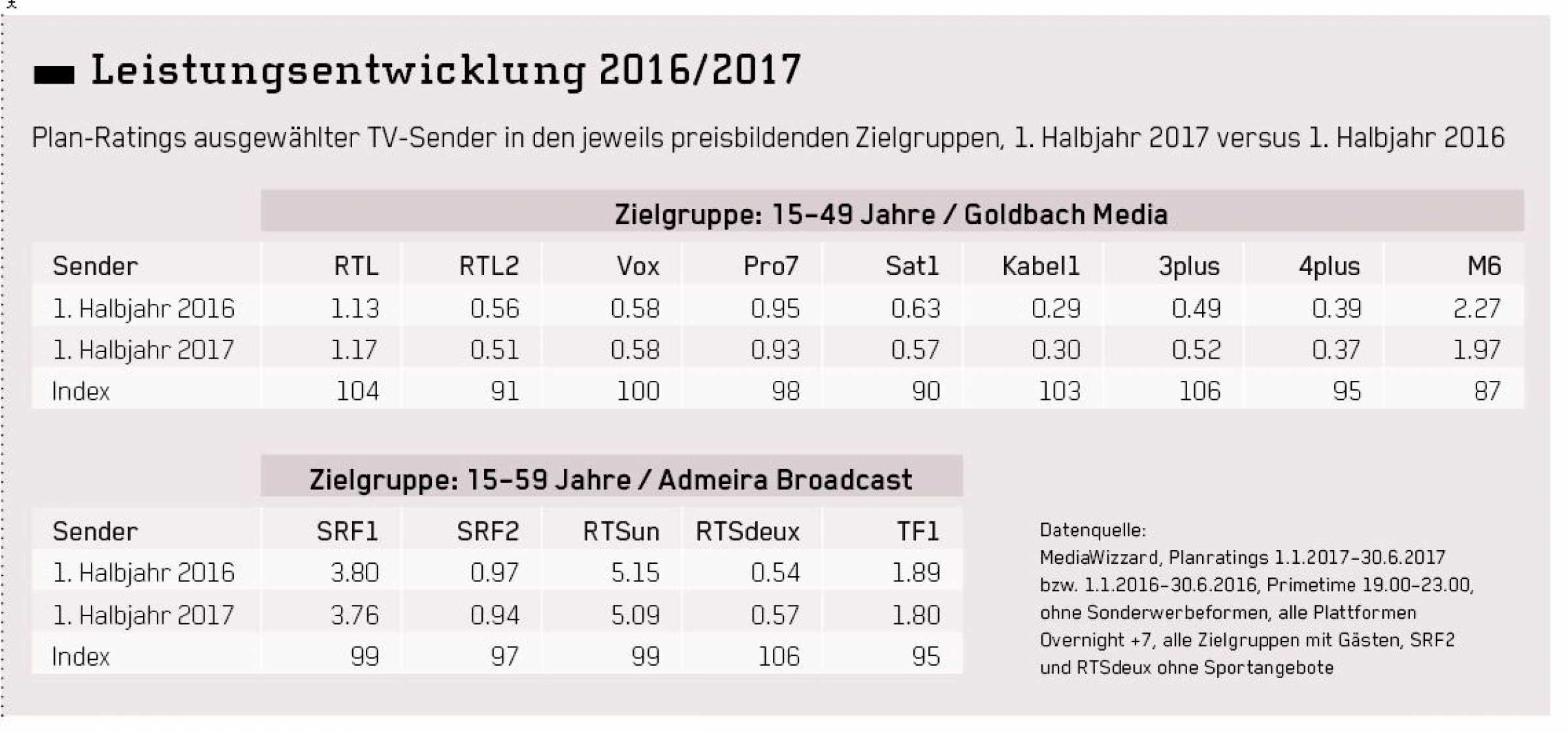
Price-performance ratio is not the only decisive factorHowever, a realistic assessment of the prices published by marketers is not only based on the price-performance ratio, but also takes into account their performance forecasts in the price-setting target groups. The table "Performance development 2016/2017" compares the average advertising block reach (ratings) forecast for the first half of 2017 in prime time with the previous year's forecast values, and no general trend can be discerned. It is striking that some broadcasters have significantly reduced their forecast compared to the previous year or have only made increases in the single-digit percentage range.
tv-preise-2017-der-teufel-steckt-im-detail-3-mk-marketing-und-kommunikation
Performance forecasts not always realisticSo everything is fine? Unfortunately not. This is because the changes only partially take current developments into account. For example, SRF1 was below the forecast in prime time every month in the first half of 2016, in some cases significantly. We would have expected a reduction in the forecast for 2017 here, as the deviations did not only relate to months with major sporting events, in which SRF2 can generally make gains at the expense of SRF1. In our opinion, Sat1, 3plus and 4plus should also reduce their forecasts more sharply, as some of the channels missed their forecasts for the first half of 2016 by a considerable margin.Effective inflation is higher for some broadcastersThe effective inflation is therefore likely to be higher for some channels than would be expected based purely on a comparison of the planned CPPs. The forecast appears to be more realistic for RTL, Vox and M6, for example, as they reflect developments in the first half of 2016 well.Hidden price increases in the offer for 2017Hidden price increases also play a role in the assessment of the offer for the coming year. Next year, these will particularly affect the stations of the 3plus Group and the SRG stations. The 3plus Group is changing the so-called "spot length index" for 2017. The 100 index will now only apply to commercial lengths of 30 seconds or more; previously it applied to commercial lengths of 26 seconds or more. As a result, spots with a length of 26 to 29 seconds will be five percent more expensive in the coming year. The price indices will also be changed for shorter spots.Admeira no longer gives a performance guarantee on FreespaceThe SRG broadcasters recently announced that in future the performance guarantee will only be granted on the paid volume, but not on freespace bookings. As the SRG broadcasters grant a 100% performance guarantee for some target groups, this change is particularly significant. Admeira Broadcast says that this move is in line with the TV market and its competitor Goldbach Media, but it means it is saying goodbye to an important unique selling point. Are these the new prospects for Admeira?

20 Minuten launches two new mobile apps

With "Flame", 20 Minuten's largest reader-reporter community in Switzerland is getting its own app. With "Flame", users can rate the 3,500 reader-reporter pictures that are sent to the editorial team every week with a simple swipe gesture to the left or right. On the other hand, users can upload their own pictures via "Flame", categorize them and have them rated by the community. 20 Minuten is launching a mobile game for the first time with "PaperGirl". The retro-designed game of skill takes place in the cities of Bern, Geneva, Lucerne and Zurich, which have to be unlocked one after the other. As "PaperGirl", the user is on the move in 16 city levels and has the task of distributing newspapers into the 20-minute boxes under challenging circumstances. "Flame" and "PaperGirl" are linked to the 20 Minuten news app. This means that all points earned via the two apps through interactions - such as upvotes or photo uploads in "Flame" and points collected by distributing newspapers in "PaperGirl" - can be credited in the PersonalView of the 20 Minuten app.The two new mobile apps are only available for iOS in an initial phase. The Android apps and the launch in French-speaking Switzerland will follow at a later date.
get_footer();