Almost a quarter of a million visitors at last Muba

The 103rd and final edition of Muba came to a close on Sunday in Basel. Nearly a quarter of a million visitors attended the final edition of the oldest public trade fair.

deriere-muba

"This is a great result for the Dernière and we are overwhelmed that so many people said goodbye to Muba," Sabrina Oberländer, head of communications at Muba, said, according to the release.

At the closing ceremony, among other things, the Muba guest book was officially presented to the Basel Historical Museum, before a toast to 103 years of history was made at the closing party.

The Swiss Sample Fair was launched in the spring of 1917 as a national exhibition. In the meantime, with the many shopping centers and online shopping, Muba had "fallen out of time", Ulrich Vischer, Chairman of the Board of Directors of the MCH Group, had said at the opening of the Dernière on 8 February.

The MCH Group, which has run into difficulties due to fundamental changes in the exhibition and event industry, decided last year to discontinue Muba and the public exhibitions Züspa in Zurich and Comptoir in Lausanne. Muba had been suffering from a decline in the number of visitors for years. In 2018, around 124,000 visitors had still been counted. (SDA)

Rita Meyer becomes National Sales Manager at Swiss Regiomedia

Rita Meyer will take over as head of national sales for Swiss Regiomedia titles on March 1, 2019.

rita-meyer

Swiss Regiomedia has twelve locations in German-speaking Switzerland with a total of 25 titles. In addition to the regional sales teams, Rita Meyer will be responsible for supporting national advertising clients and agencies. She will be based at Swiss Regiomedia's Zurich office.

Rita Meyer is moving to Swiss Regiomedia from the City of Zurich, where she was Head of Administration and a member of the management team of two municipal care centers in 2018, where she was responsible for ensuring all financial processes and marketing, among other things. Until the end of 2017, she was a member of the management team at Radio 24 as Head of Sales, before which she was Managing Director at Tilllate.com (20 Minuten) until 2014. From 2000 to 2011, she worked for Belcom (Radio 24, Tele 24, TeleZüri) and Radio 1, among others.

Rita Meyer has a degree as a sales coordinator with a federal certificate and is a federally certified sales manager.

Portfolio Swiss Regiomedia: Aarauer Nachrichten, Bodensee Nachrichten, Frauenfelder Nachrichten, Gossauer Nachrichten, Herisauer Nachrichten, Kreuzlinger Nachrichten, Lenzburger Nachrichten, Luzerner Rundschau, Neue Oberaargauer Zeitung, Neue Oltner Zeitung, Oberthurgauer Nachrichten, Rheintaler Bote, See und Gaster Zeitung, St. Galler Nachrichten, Toggenburger Zeitung, Unterland Zeitung, Untersee Nachrichten, Weinfelder Nachrichten, Wiler Nachrichten, Winterthurer Zeitung, Zofinger Nachrichten, Zuger Woche, Tagblatt der Stadt Zürich, Rümlanger, Furttaler

The majority of winter sports enthusiasts support the dynamic pricing model

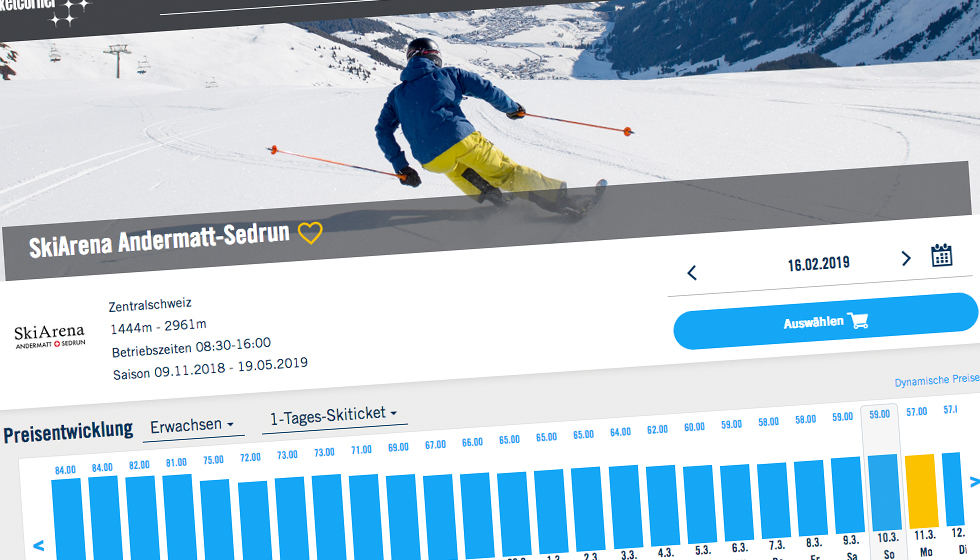
For the first time, Swiss winter sports enthusiasts were surveyed about «dynamic pricing» for ski passes. Fifty-seven percent of those surveyed view the new pricing model positively.

sedrun-ticketcorner

The expressed approval reflects the sales figures of the current winter season, writes Ticketcorner. Ski resorts with dynamic prices have been able to significantly increase their sales.

On behalf of Ticketcorner, the market research institute Demoscope conducted a population-representative multi-topic survey (omnibus) among around 1,000 people from all over Switzerland and from all walks of life. The active winter sports enthusiasts were asked for their opinion on various aspects of ski ticketing, including the new "Dynamic Pricing" pricing model, which was first introduced by Ticketcorner and the SkiArena Andermatt-Sedrun in 2017 and has since been followed by various other ski resorts.

Winter sports enthusiasts recognize the advantages of dynamic pricing

Public opinion on dynamic pricing for ski tickets tends to be positive. Although only recently introduced in the mountain railroad industry, 57 percent of winter sports enthusiasts surveyed are already in favor of the new pricing model.

When asked about the individual aspects of "dynamic pricing," the majority of survey participants expressed approval. For example, the fact that you have to pay less for a ski ticket on bad weather days is - unsurprisingly - well received by 61 percent - only 15 percent are against it. The survey also gave positive marks to discounts on working days and for advance bookings. Pascal Zürcher, CMO of Ticketcorner: "Consumers understand and welcome the various advantages of dynamic pricing. For the mountain railroads, this is a great opportunity to get more winter sports enthusiasts back on the slopes."

What consumers say about the disadvantages - namely noticeably higher prices on fair-weather days booked at short notice - is not clear from the results communicated, or is still being evaluated by Ticketcorner.

Rising revenues in ski resorts with dynamic prices

The dynamic prices are already said to be having a beneficial effect on ski resort revenues, writes Ticketcorner. In the current winter season, the company has sold 50 percent more tickets on its ski platform than at the same time a year ago. For the ski resorts SkiArena Andermatt-Sedrun, Airolo and Brigels, which rely on dynamic prices, two and a half times more tickets were sold.

"The online share of ski tickets sold has increased significantly in the ski resorts with dynamic pricing," says Pascal Zürcher. "Based on the survey and the good sales figures, it is to be expected that in the future the majority of Swiss ski resorts will rely on dynamic pricing and that the purchasing behavior of winter sports enthusiasts will change. For example, we are already noticing an increase in advance booking time because early bookers are benefiting from dynamic pricing."

Whether the overall revenues of the ski resorts could also be increased and not only the online share increased, however, remains open and to be seen.

New insights for ski resorts and mountain railroads

The results of the population survey show, among other things, that individual population groups have an above-average positive attitude toward the dynamic prices. "Young people, people with low household incomes or, in general, the population of western Switzerland see the cheaper rates as an opportunity to go skiing more often," explains Pascal Zürcher. The purchasing behavior of winter sports enthusiasts and existing consumer reservations about "dynamic pricing," such as concerns about rising prices, were also recorded as part of the study and are now being evaluated by Ticketcorner for the ski resorts. (hae/pd)

Winning new customers: content and form gets AutoSense going

The young startup AutoSense is now part of Inhalt und Form's client portfolio.

AutoSens_InhaltundForm

The Zurich agency is now responsible for the brand positioning as well as the marketing communication of AutoSense. The young startup, a subsidiary of Swisscom and the AMAG Group, aims to make the lives of car drivers more relaxed: With an adapter, the car is connected to a sophisticated app that helps drivers with a variety of functions, valuable information and services.

The agency is pleased to be able to support the startup with efficient ideas that will get the clever vehicle assistant off to a promising start and make it known to a wider audience. The first works are to be seen already in spring 2019.


Swiss Press Council rejects a complaint against ArcInfo.ch

Is a journalist required to use all the information provided by a source? And if not, does he violate his duty to seek the truth? No, says the Swiss Press Council.

arcinfo

It therefore rejects the complaint of the collective H+H against "ArcInfo.ch". In this collective, citizens have joined forces to ensure the implementation of the referendum of February 12, 2017 in favor of the model of two acute hospitals in the canton of Neuchâtel.

The Press Council also considers it unproblematic not to return to the substance of the case in every article, but to deal with only one aspect, such as the satisfaction survey of hospital staff conducted by the same collective. Putting the representativeness of the survey into perspective is just as much a part of journalistic work as giving all the groups involved a chance to have their say.

Moreover, the fact that the article was written by a journalist who had not been very familiar with the case until then violates freedom of information nor the independence or dignity of the profession. The Swiss Press Council therefore rejects the complaint of the member of the collective H+H on all the points complained of.

Facebook faces a billion-dollar fine in the U.S.

Social media giant Facebook is facing a potential fine of several billion dollars in the USA. The US consumer protection authority, the Federal Trade Commission, wants to prosecute the company for its permissive use of customer data.

facebook-gericht

"Since the Cambridge Analytica scandal, Facebook's image has been tarnished, as can be seen from its share price. Facebook must now change its strategies. Privacy is becoming an increasingly decisive factor in the acceptance of social media," explains Markus Hübner, social media expert and CEO of Brandflow, in an interview with the Pressetext news agency.

Hübner points out that the media landscape has changed since the rise of Facebook. "Data protection used to be less of an issue in the public eye, but now you can see the extent of data usage on social media. This has caused a rethink, customers are thinking twice about where they log in. I hope that Facebook will give in on this issue. Mark Zuckerberg has repeatedly reassured his shareholders with PR messages, but the announcements are still rarely put into practice. Hopefully the ruling will be the catalyst for a different line."

Changes right down to the DNA

Facebook is currently still negotiating with the authorities. Hübner acknowledges the possibility that the company will pay the fine, but he does not necessarily see this as a positive thing: "Unfortunately, it may be that Facebook can simply afford these fines. The share price has already recovered considerably. There have been a few scandals at Facebook in recent years, but unfortunately they disappear after a few weeks. I believe Facebook will pay the fine. It remains to be seen whether Facebook will change the way it handles customer data as a result, but I'm skeptical. A profound change would be needed here, not only at a technical level, but also in the company's DNA. This is the only way Facebook can repair its image." (pte)

Watson is happy about a traffic record in January

With 1.95 million unique clients and over 14 million visits, the Watson news portal took a significant step forward in growth in January.

This emerges from the publication of the figures from NET-Metrix-Audit January 2019. Compared to the previous year's figures, this means an increase of 30 percent (unique clients) and 28 percent (visits). For Watson, these are the highest values measured to date. Michael Wanner, Managing Director of Watson, expressed his satisfaction in a statement on Thursday: "For us, the record figures are the latest confirmation that the Watson program hits a nerve journalistically and appeals to a constantly growing audience."

Whether Watson will also strike a chord in Germany remains to be seen. In November last year, Editor-in-Chief Gesa Mayr left the portal together with her deputy Anne Kathrin Gerstlauer just seven months after its launch. The editorial team has since been led by Arne Henkes. In January 2019, Watson.de will reach IVW around 10 million visits - i.e. significantly fewer than the Swiss "original" even in absolute terms. (hae)


Successful advertising in six seconds: How to create efficient short commercials

Research shows how shorter commercials influence emotional connections and how brands make the most of six-second commercial videos on mobile devices.

https://youtu.be/06Kj6tMkO30

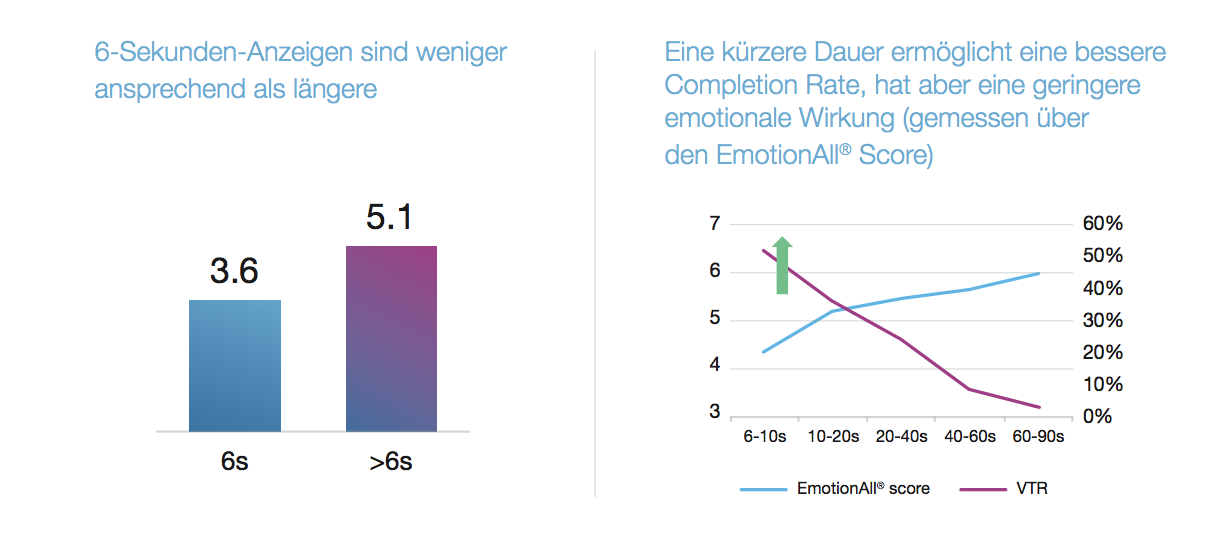
Teads, The Global Media Platform, in collaboration with Realeyes, analyzed 166 six-second creatives to find out how these video contents are received by consumers. As part of this global research initiative, subjects were presented with advertising material from 75 brands using facial expression recognition software. The emotional reactions recorded in this way were used to classify the commercial on the ten-point EmotionAll scale. While six-second commercials achieve a view-through rate (VTR) of 55 percent on mobile devices, they only achieve an EmotionAll score of 3.6, while longer advertising videos (30 seconds) achieve a score of 5.1.

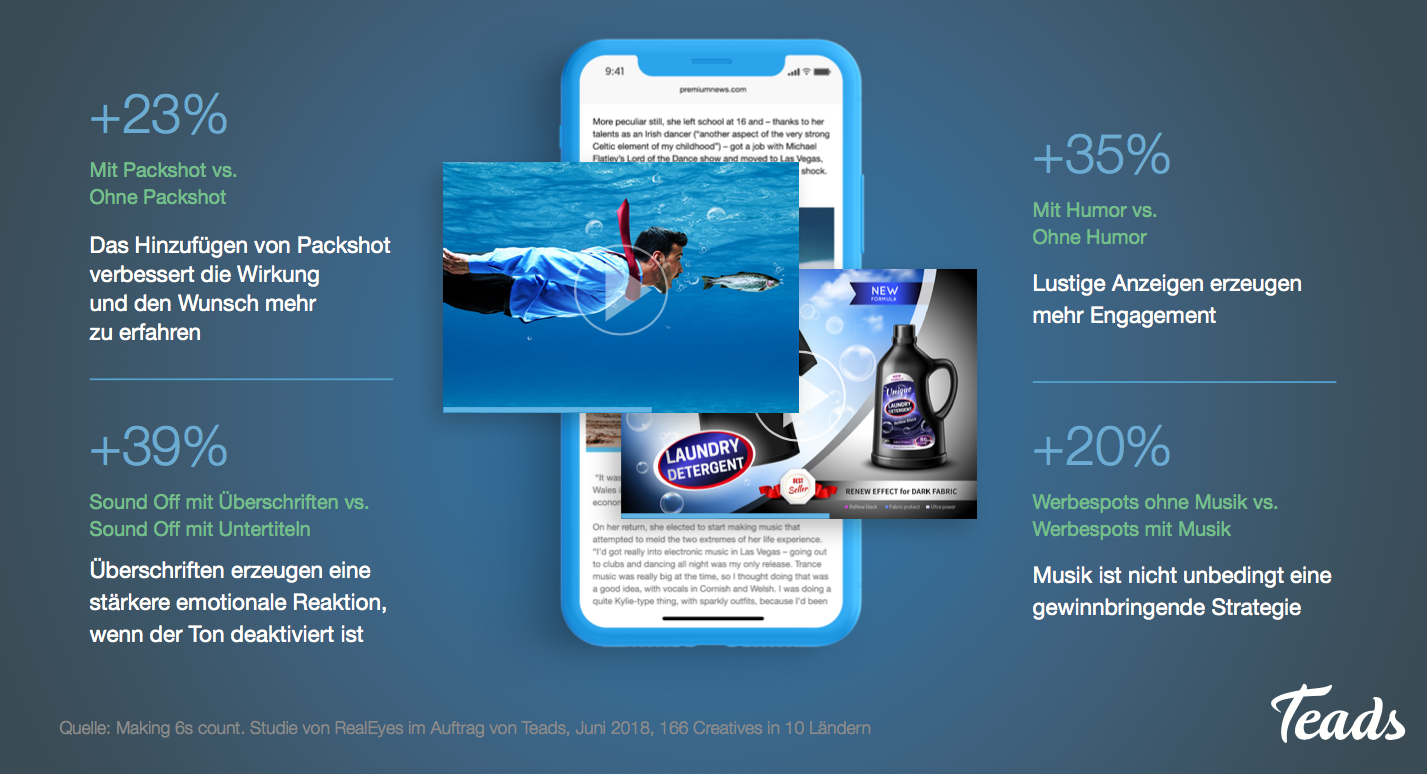
Realeyes' research shows that the emotional impact of commercials is linked to increased sales in 75 percent of cases. Advertising videos with a length of six seconds often fail to tell a story in this short time, which is a key factor in building an emotional connection. Those spots on mobile devices that managed to do this achieved a significantly better score of 4.1 (compared to 3.1 for spots that did not build a story).

Sorin Patilinet, Director of Center of Expertise for Marketing Communications at Mars, made it into the top 3 commercials with two creations. According to him, the six-second format is a major challenge for advertising marketers, but one that needs to be overcome: "Mars, working with our agencies, has learned over the last 50 years how advertising can be used to grow a brand - but in a TV world with long content. This is no longer enough today. The explosion of short-form content with the advent of mobile devices and the resulting reduction in consumer attention spans has fundamentally changed the rules of the game. We have to learn to tell the story of brands in short formats and prepare for even shorter formats in the near future."

Spending on video advertising on mobile devices rose by 145% to USD 4.2 billion in 2018. As a result, it has never been more important for these advertising media to be effective for brands.


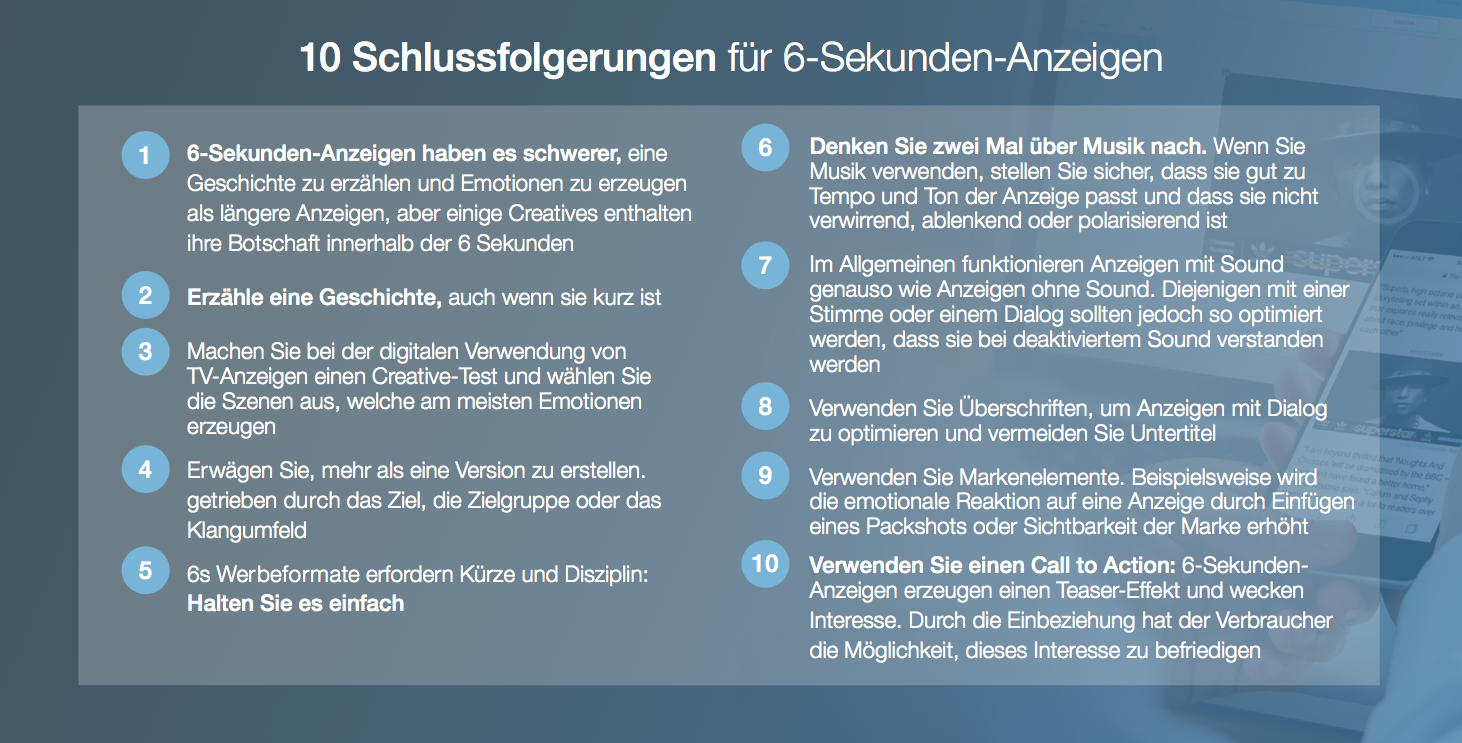
The following findings of the study are key:

  • Compared to longer formats, six-second promotional videos are difficult to tell a story and stimulate emotions - although some works succeed in doing so.
  • Repurposed TV commercials should consist of the most effective scenes from the TV commercial, which are determined during pre-testing. If the story is too complex or the joke needs a lot of lead-in, the commercial should not be shortened or should be edited using an appropriate ad format so as not to confuse the viewer.
  • Calls to action are essential - Only 16% of the videos tested used calls to action. However, these are an important tool when time is short.

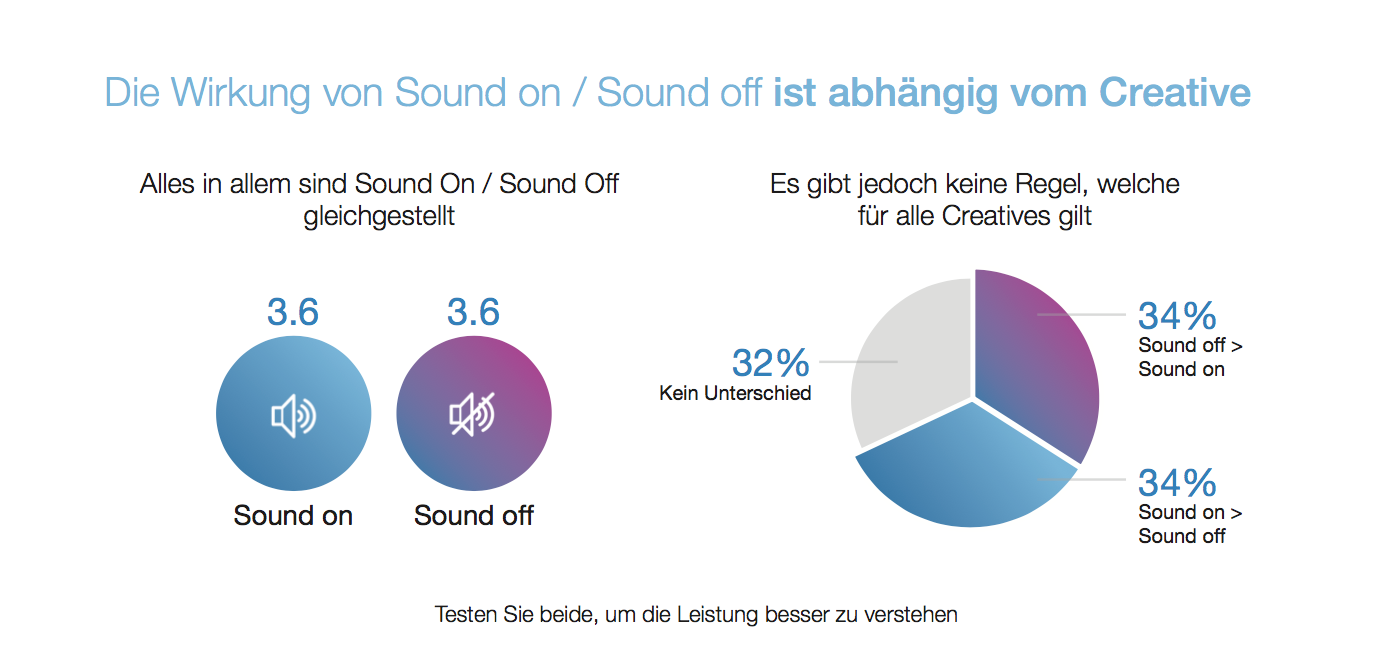
Caroline Hugonenc, Global VP Research and Insights at Teads, says: "Now that we predominantly use mobile devices, 30-second TV spots are no longer enough to present an engaging ad video on the small screen - marketers know this too. However, as the research shows, it is not enough to simply shorten the spots if the emotional component is lost. With Teads Creative Lab, we want to help brands and advertisers measure the performance of their ads and provide them with technology to adapt them to the small screen."


ansprechend
teads
sound
Schlussfolgerungen

Programmatic Barometer: Take part in the survey

Gamned! examines what makes Switzerland tick in terms of advertising. Are you an advertiser? Take part in the survey—the results of the study will be published exclusively in Switzerland on Werbewoche.ch.

The survey is about getting to the heart of Switzerland programmatically. It is the first survey of its kind and will be conducted annually in the future. In French-speaking Switzerland, the data will be collected and published in collaboration with Cominmag.ch. The results of the study should be available towards the end of March 2019 and will then be published on Werbewoche.ch.

The survey is addressed to all Advertiser and lasts approx. five minutes.

Click here for the survey


Susanne Schlatter succeeds Managing Director Christian Rufener at Mediaschneider

Starting in March, Susanne Schlatter will join Mediaschneider from OMD Switzerland, where she will serve as Managing Director. She will replace Christian Rufener, who is moving to Swisscom in April.

Susanne_Schlatter_Bild-t

Schlatter most recently worked as Director Strategy at OMD Switzerland and looks back on a long career as Client Service Director in various agencies. She replaces Christian Rufener, Managing Director, who has decided to leave Mediaschneider Zurich after eight years. He will take on a new challenge at Mediaschneider client Swisscom in the Digital Business division. Rufener will remain with Mediaschneider until his departure in April and will train his successor, according to a statement.

After the end of the print edition, Le Matin achieves record figures digitally

Le Matin's all-digital offering has been well received by its readership. In January, the digital publication reached 1.4 million unique visitors, the highest number in its history. 

lematin-ch

Last January, Le Matin recorded the highest number of visitors since its founding, with 1.4 million unique clients. According to the latest figures from NET-Metrix, the increase in the number of visitors to lematin.ch in January was 28.6 percent. The latest figures prove that the title is also highly appreciated by the readership as a purely digital offering, Tamedia wrote in a statement on Thursday.

"This record is a great reward for the performance we achieved with our dedicated team. Our thanks go to the entire editorial team, which has worked tirelessly for this joint success," says a delighted Laurent Siebenmann, Editor-in-Chief of Le Matin. "Furthermore, it is an expression of the successful cooperation between the editorial teams of Le Matin and 20 minutes. In January, our stories were also successfully published on 20minutes.ch for the first time."
 
In-house productions published by Le Matin in recent weeks have not only been adopted by the media in western Switzerland, but also in France, for example by Le Parisien, the Huffington Post, France 2, LCI, BFMTV and by Thierry Ardisson in his program "Les Terriens du Samedi" on C8, a statement added.

Children communicate more and more with cell phones instead of with parents

Children spend twice as much time on their smartphones as they do talking to their parents. This is the conclusion of a recent survey by the British company CensusWide, which was commissioned by the audio streaming service provider Roxi.

In total, children spend around three hours and 18 minutes a day on their personal devices. Conversations with parents only take up one hour and 43 minutes.

Another result of the British study is that 54% of parents surveyed are concerned about the use of smartphones, tablets and the like. Two thirds would also like to spend more time with their family. However, there is a contradiction here: two out of five study participants admit to having equipped their adolescents with a smartphone for employment reasons.

In terms of usage time, London is an absolute frontrunner: here, children spend four hours and 42 minutes a day using gadgets. South East England and Wales are the opposite with two hours and 36 minutes. Dame Sally Davies, Chief Medical Officer for England, recommends removing smartphones from the sleeping and eating areas of adolescents. She also advocates limits, for example after two hours of use.

Respecting boundaries is important

Another important point is for parents to be responsible and set an example with regard to internet use. For example, photos of children should never be published on social networks without their consent. Experts also warn of the addictive potential of social media platforms, which should be curbed. "However, time spent online can also have a positive effect in terms of developing certain skills and gaining information," comments Dame Sally Davies on the positive aspects of smartphone use. (pte)

kind-smartphone
get_footer();