"Hello Kitty" cat to promote UN sustainability goals

The world-famous "Hello Kitty" cat is to promote the United Nations' Sustainable Development Goals in the future. The cat figure is to draw attention to the goals with videos on YouTube, the UN announced in New York on Tuesday.

hello-kitty-781142_1280

"'Hello Kitty' with her many fans joins our global efforts to educate young people everywhere about the Sustainable Development Goals and why they should get involved to achieve them," a UN spokeswoman added. "Hello Kitty" is a cartoon character invented in Japan in the 1970s.

The Sustainable Development Goals are considered the global resolutions of the United Nations and its member states. They include ensuring that no one should ever again live in poverty or suffer from hunger, improving access to education and health, eliminating discrimination against women, and combating climate change. The 17 goals are to be achieved by 2030. (SDA)

Parliamentary elections 2019: Does Switzerland risk flying digital blind?

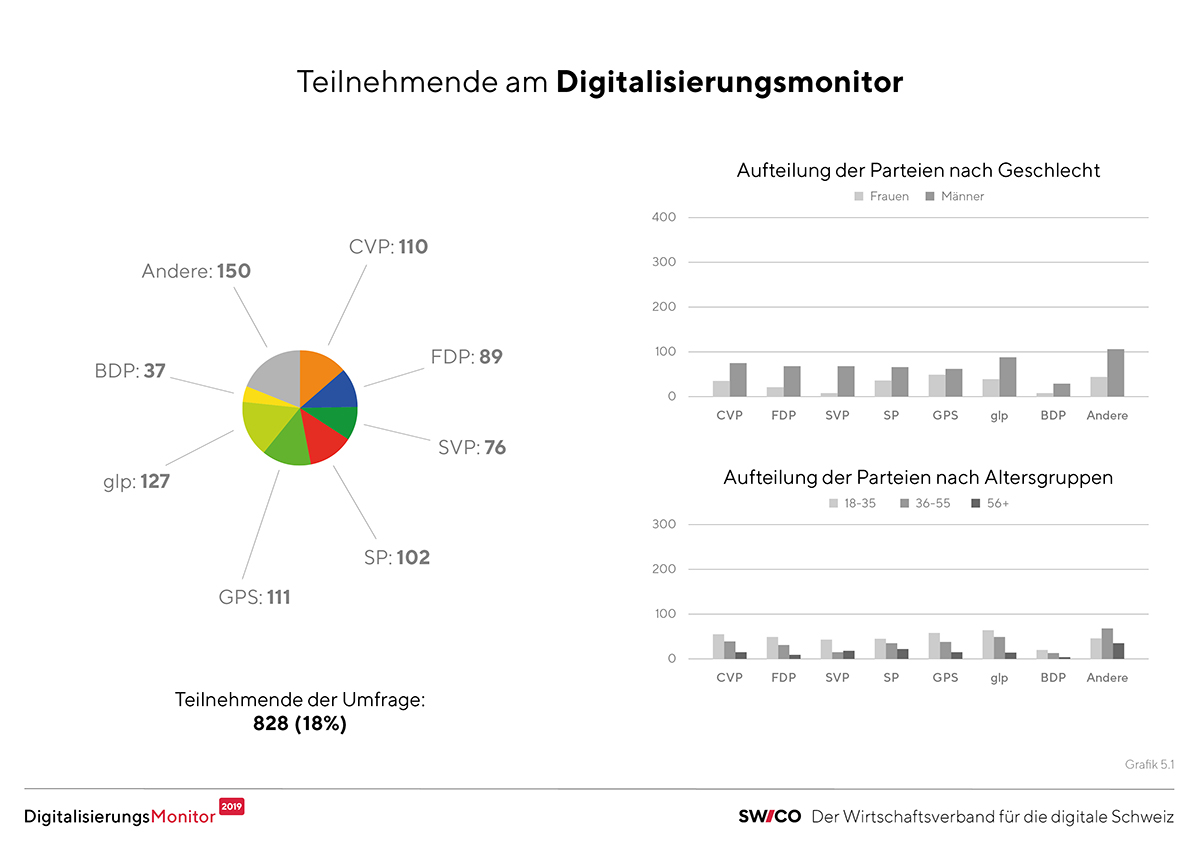
Only 18 percent of the candidates for the 2019 federal elections took the time to answer the questions in the Digitalization Monitor and thus make their positions transparent. Still, those who participated in the survey see more opportunities than risks.

2019-SWICO-MM-2409-GRAFIKEN-de17

The topic of digitization still plays a subordinate role for many politicians: Although 3571 have created their Smartvote profile, only 18 percent of all candidates (828 out of a total of 4596) for a National Council mandate have completed the additional surveys on digitization topics on Smartvote. The digitization monitor was launched by Swico in collaboration with the Bern University of Applied Sciences (BFH) and the universities of Zurich and Geneva.

For Swico President Andreas Knöpfli, the numbers speak for themselves: "Digitalization has still not arrived in Bern. Of the 4,600 or so candidates who want to go to Bern, only a fraction have dealt with this development, which is fundamentally changing our society right now." Knöpfli sees a corresponding need for action: "The new parliament absolutely has to use the new legislative period and prioritize digital topics more strongly in the political agenda. 


How digitally savvy are politicians?

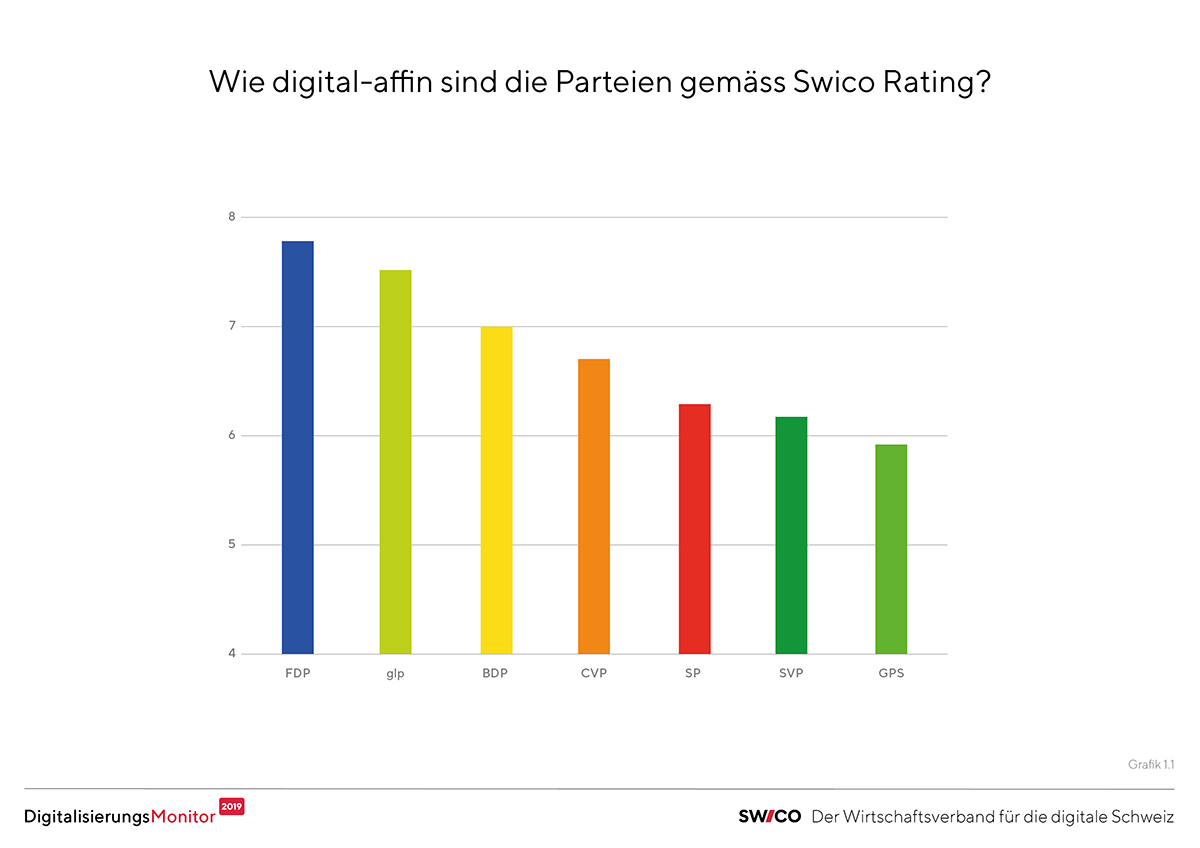
Basically, all parties see opportunities rather than risks and assess the effects positively. Women tend to be more skeptical than men. Among the major parties, the most positive views are held by the FDP with 81 percent and the GLP with 75 percent. The highest proportion of skeptics is among the Greens, at 14 percent. 

2019-SWICO-MM-2409-GRAFIKEN-de2

Greater digital affinity among the newcomers

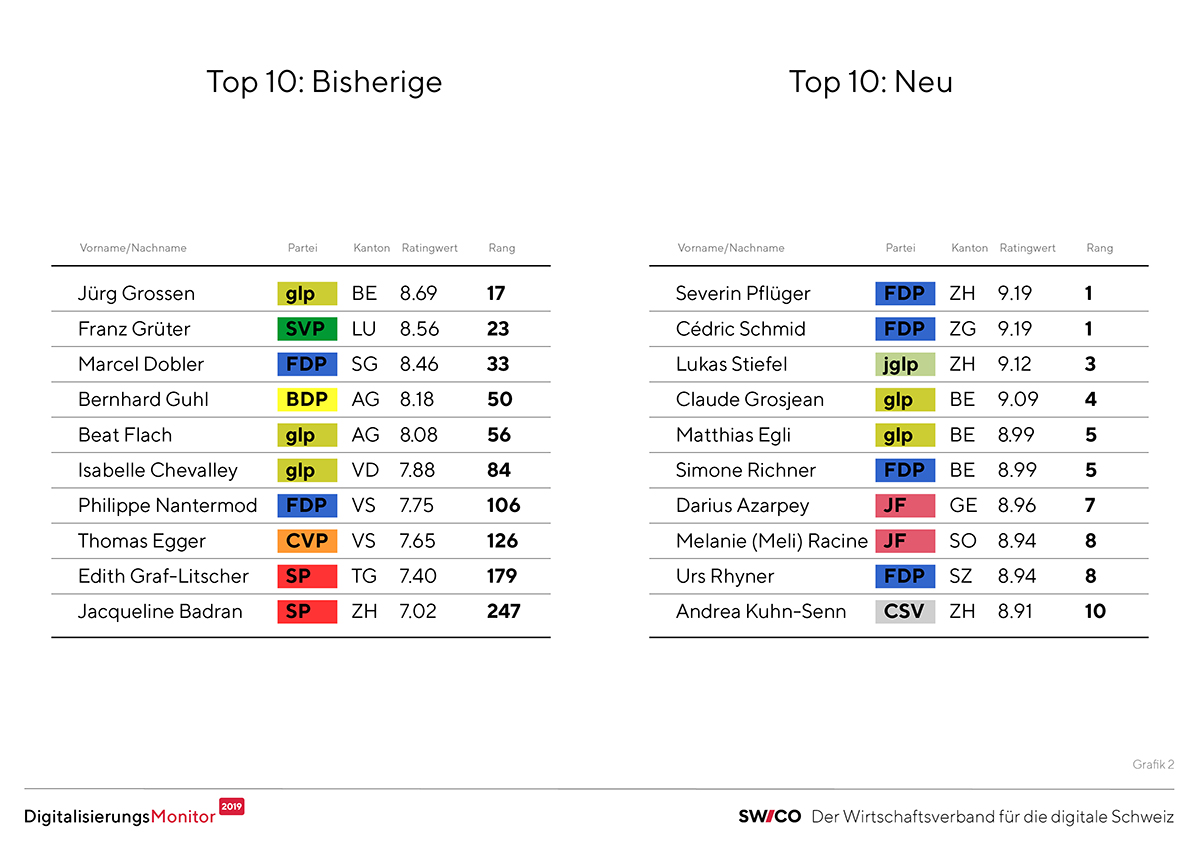
A look at the newcomers at least shows a glimmer of hope: overall, they appear to be more digitally affine and more engaged with digital issues than the National Council members running again. 

2019-SWICO-MM-2409-GRAFIKEN-de4

Digitization as an opportunity

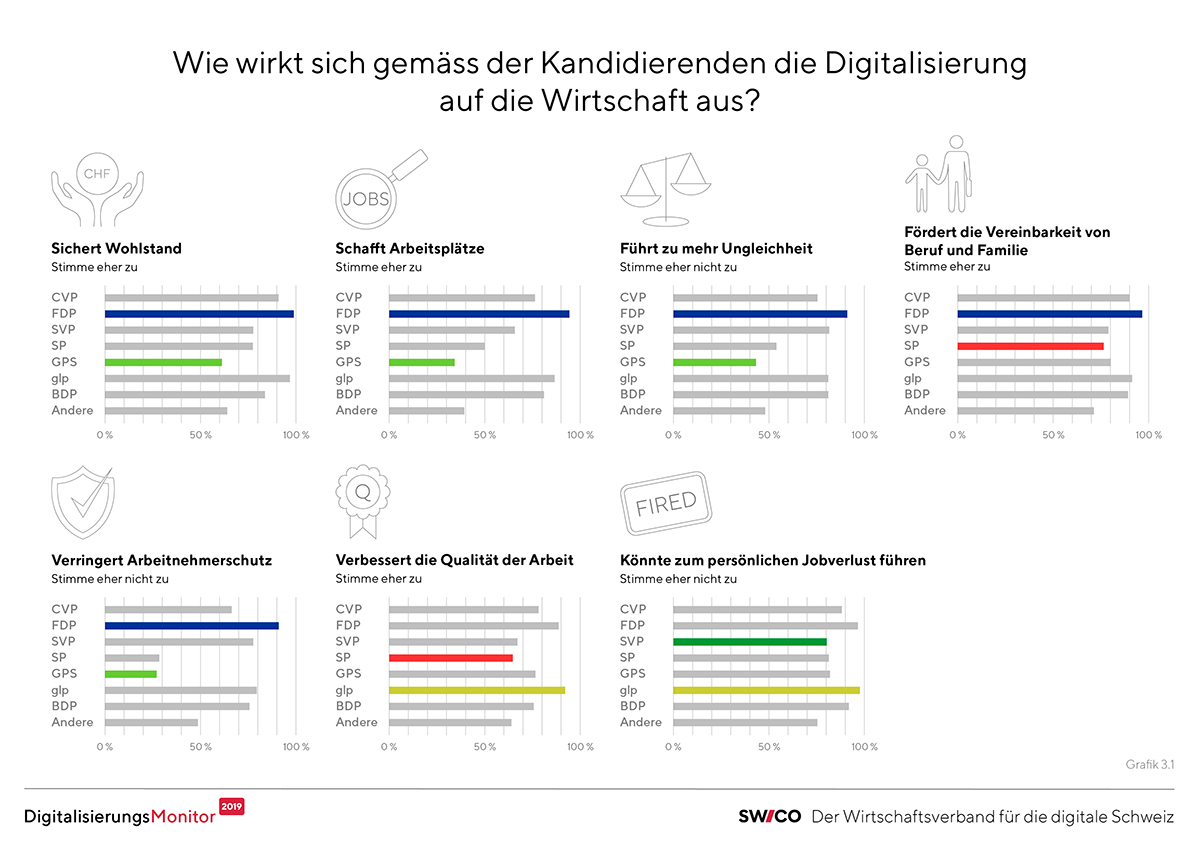
Majorities in all parties agree with the statements that digitization secures prosperity, that it promotes the compatibility of family and career, and that the quality of work is increasing. The parties also almost unanimously support the statement that digitization facilitates access to knowledge and education.


Impact on the economy

The FDP candidates have the most positive view of the effects of digitization on economic life across all statements, while the Greens are the most skeptical. The statements regarding the creation of jobs and the reduction of employee protection are judged controversially.

2019-SWICO-MM-2409-GRAFIKEN-de5

FDP and GLP want more speed in digitization

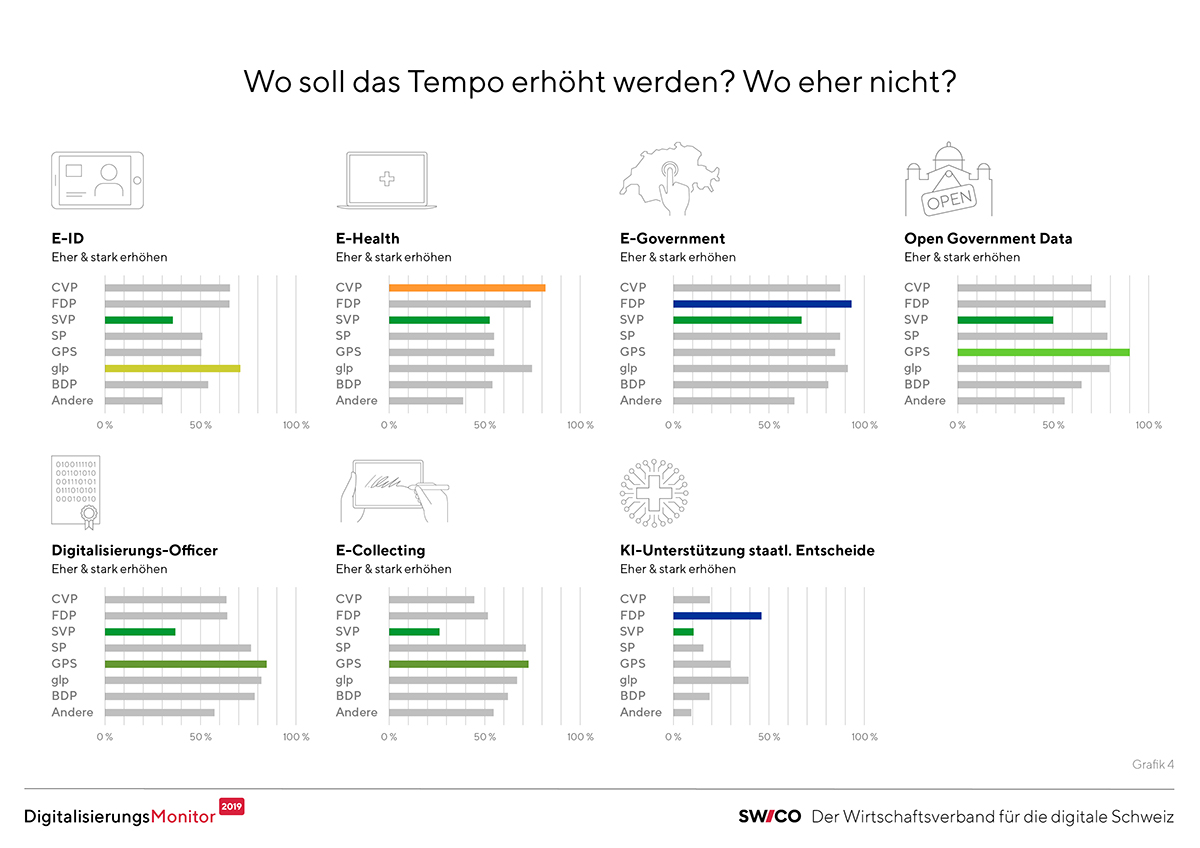
While the parties assess individual topics very differently, the following can be seen consistently across all areas: The candidates of the GLP and the FDP want to move forward the fastest. The SVP candidates are clearly more reserved, and they are least likely to want to increase the pace.

2019-SWICO-MM-2409-GRAFIKEN-de6

Disagreement on measures

Opinions differ on the measures to be taken. The majority of the candidates think that (far) too little is being done in elementary schools in terms of ICT skills. With the exception of the SVP, all parties are in favor of retraining measures as a reaction to the changes; the unconditional basic income, on the other hand, is only supported by the SP and the Greens.

The taxation of (AI-supported) hardware and software (robot tax) is clearly welcomed by SP and Greens; clearly rejected by FDP and SVP; CVP, glp and BDP are split here. SP, Greens, CVP and BDP would like to see stronger regulation of online intermediary businesses such as Airbnb or Uber; FDP and GLP are opposed, with young people clearly less in favor of regulation.


And the women?

The gender distribution shows a similar picture as in the economy: women are underrepresented. In the Smartvote survey, 2139 men and 1442 women responded (78 percent of candidates each). The questions in the Digitization Monitor were answered by 21 percent of men, but only 13 percent of women.

Women also tend to be more skeptical than men, with the exception of e-voting. "Women need to be made more aware of digitization," says Swico President Andreas Knöpfli in response. "We need to push the proportion of women in STEM subjects and specifically challenge and promote women in all areas."

2019-SWICO-MM-2409-GRAFIKEN-de7

In the run-up to the federal elections on October 20, 2019, Swico has launched the "Digitization Monitor 2019" in collaboration with the online voting tool "Smartvote", the Bern University of Applied Sciences BFH, the University of Zurich and the University of Geneva.

In addition to four questions on digitization in the standard Smartvote questionnaire, candidates had the opportunity to express their positions on various dimensions of digitization in an additional survey and thus make their position transparent to the public.

Judith Bellaiche, Managing Director of Swico, is running for the National Council. She has deliberately chosen not to participate in order to avoid any conflicts of interest.

Wirz accompanies Swiss market entry of international hotel chain CitizenM

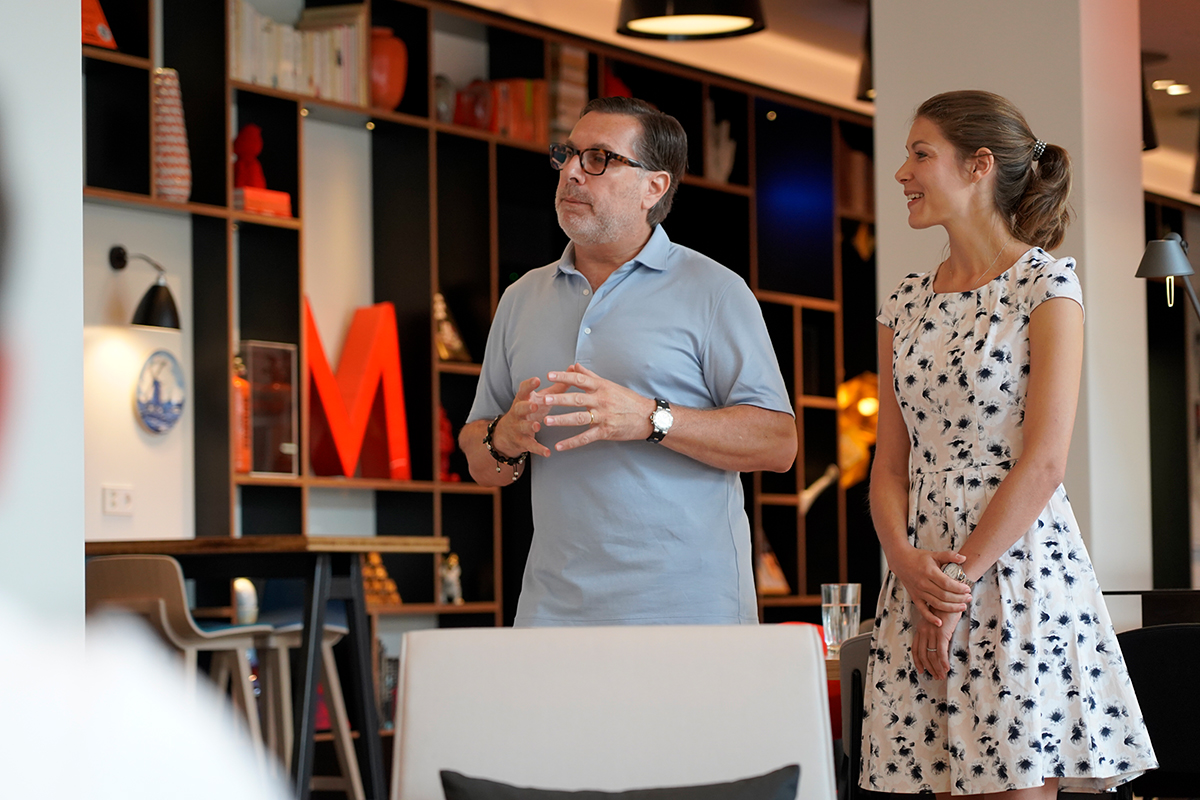
The Wirz agency is supporting the international hotel chain CitizenM with PR and media relations in connection with its openings in Zurich and Geneva.

CitizenM_Livingroom2

The Dutch hotel chain with 18 hotels in metropolises such as New York, London, Paris, Shanghai or Kuala Lumpur has shaken up the international hotel industry in the last ten years and has become a popular alternative for business travelers from all over the world.

The company relies on the services of Wirz Storyline to accompany its entry into the Swiss market and to develop activation ideas. The agency's content department acts as the official Swiss media office and is responsible for all PR matters.

The opening of the hotel at Talacker 42 in Zurich at the beginning of August received media attention. A total of 36 media reports were realized in the run-up to, during and after the hotel opening. In the coming year, various activation measures are planned in Zurich and on the occasion of the hotel opening in Geneva, in addition to continuing the media work.

CitizenM_CMO_MichaelLevie_MD_TamaraDias

Vivian Mohr leaves CH Media and joins Comparis Group

Vivian Mohr, Head of Integration CH Media and member of the Executive Board, is leaving the company at the end of the year at his own request. He will become COO and later CFOO of the Comparis Group. A successor solution for the Integration division is being planned.

F12.-t

Vivian Mohr has headed the Integration division as a member of the Executive Board since CH Media was founded on October 1, 2018. As Head of Integration, he was responsible for one of the largest mergers in the media industry in recent years. The development and implementation of the "Kolumbus" integration programme - with the aim of realizing high synergy potential and positioning CH Media for the future - forms the core of the strategic decision to merge the two regional media companies AZ Medien and NZZ Regionalmedien to form CH Media.  

Vivian Mohr joined the company from the NZZ Media Group when CH Media was founded in 2018. Previously, in his role as Head of Strategy and M&A at the NZZ Media Group, he played a leading role in the conception, negotiation and founding of CH Media.
 
Vivian Mohr is leaving CH Media at the end of 2019 to initially take on the role of COO at the Comparis Group. He will then assume the role of CFOO of the Group during the second quarter of 2020. A successor solution for the Integration division is being planned. 

Axel Wüstmann, CEO CH Media, regrets the departure in a press release: "Vivian Mohr was not only responsible for the decisive area for the integration of the joint venture CH Media, he also co-founded it. With his knowledge, his commitment to CH Media and not least thanks to his integrating personality, he has made a significant contribution to the successful development in the still young history of CH Media. He leaves behind a very well-positioned division that is already making a significant contribution to our financial results and will enable us to continue the program successfully."


Comet burns calories for Visana

Komet's latest campaign for the Bern-based health insurer Visana shows just how easy it is to do something for your health and earn points at the same time.

Visana - Herbstkampagne 2019 - Einkaufswagen (KOMET) 0-6 screenshot

Exercise is healthy. That's why Visana is launching "myPoints," a new digital bonus program designed to motivate policyholders to be more physically active. What's really new about it is that you don't even have to be particularly sporty to collect points that are worth money with myPoints - everyday movements are enough. 
 

This attitude is also reflected in Komet's launch campaign. Whether TV short spots, social video ads, or print, they all show familiar life situations in which more or less voluntary exercise becomes a sporting activity or - as on the posters with the brand-typical bow word - is even equated with it. Collecting points with myPoints is just that simple.

The cross-media campaign is completed by a "Fitness light" blog and a landing page.

Visana_Herbstkampagne_F12_d_Bankdruecken

Responsible at Visana: Hedwig Gerards (Head of Marketing); Michael Wüthrich (Head of Marketing Communications); Simon Achermann (Head of Online Marketing); Esther Trüssel (Marketing Specialist); Franziska Lehmann (Marketing Specialist). Responsible at Komet: Jeff Gerber (Creative Direction); Claudio Parente (Art Direction); Daniel Müller (Text); Andrea Zaugg (Graphics/DTP); Corinne Hert (Head of Consulting); Christine Gerber (Consulting). Film production: Boutiq Films; Annina Zimmermann (producer); Benjamin Weiss (director). Media agency: The whole Media (OOH); Attackera (Online).

Agency at the airport ensures seamless memories for the Synapsis Foundation

The number of people living with dementia is rising rapidly, yet research in this area is progressing slowly. The agency at the airport, in collaboration with the Synapsis Foundation, has launched a direct-mail campaign to change this.

IMG_5955

More than 150,000 men and women now suffer from dementia. Every year, 29,500 new people are affected. According to the "Alzheimer Switzerland 2019" factsheet researchers expect up to 300,000 patients in Switzerland by 2040, not least because research into this disease today is roughly on a par with cancer research 20 years ago.

The Synapsis Foundation - Alzheimer Research Switzerland AFS is committed to changing this. It supports non-commercial, young, talented researchers at universities and other institutions in Switzerland. To finance this, the Synapsis Foundation relies on donations.

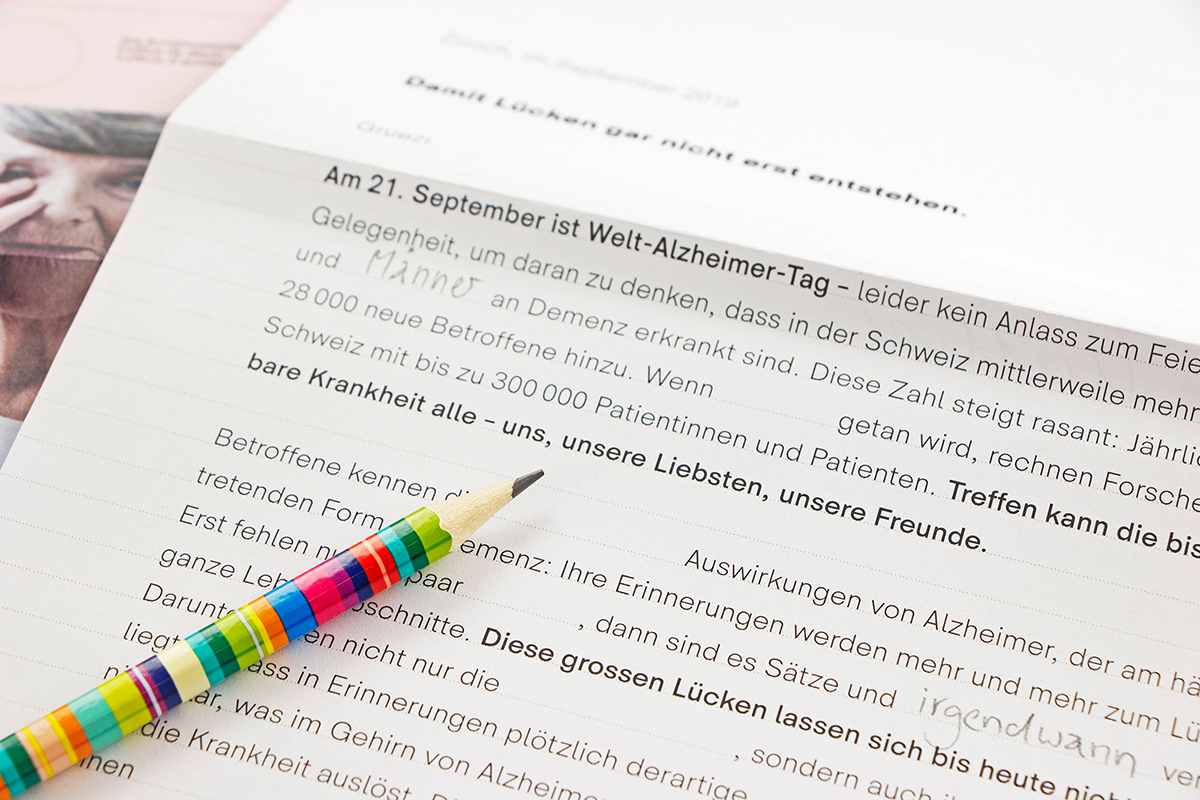
Following last year's internationally award-winning fundraising campaign, the agency was able to further develop last year's fundraising campaign on the occasion of World Alzheimer's Day on September 21, 2019. The new mailing dramatizes the progression of the disease through gaps in the text that make the letter extremely difficult to read. To make sense of it all, a pencil for dipping in and completing the cloze text and a payment slip for making an immediate donation were integrated into the direct mail.

The mailing called on around 1 million Swiss households to donate so that no memory gaps occur in the first place and effective therapies against this "widespread disease" can be developed as soon as possible.

IMG_5941

Responsible at Synapsis Foundation - Alzheimer Research Switzerland AFSFranco Rogantini (Managing Director); Esther Roth (Public Fundraising); 
Marc-André Pradervand (Head of Fundraising). Responsible at agency at the airportRené Eugster (overall responsibility); Dominique Rutishauser (creative and art direction); Tilman Mäder (graphics); Miriam Egli (consulting/text); Julia Lüchinger (coordination).
 

When dog and sloth promote UBS Digital Banking

The Publicis agency has once again created two spots that illustrate the advantages of UBS mobile banking in a striking way.

UBS Spot Hund 0-3 screenshot

For around two years, UBS has been underlining its status as the leading bank for digital banking and has already dramatized in several films how practical its digital products are in everyday life. Now, two more spots are being added to the highly successful series.

The first wave focuses on the simple login process with the UBS Access app. The login process is so simple that the protagonist can literally log in "with his left hand" while he is busy with his dog.

In the second wave, the phlegmatic main character makes it clear that you don't have to do anything at all to pay your bills with UBS eBill - without losing control.

The films developed by Publicis are used in the target group-relevant online environment and are flanked by social media ads, display banners and DOOH.

Responsible at UBS: Daniel Fischer (Head of Marketing Region Switzerland), Sonja Kingsley-Curry (Head of Marketing Key Initiatives & Creative Assets), Anne-Martine Beck (Project Manager Marketing Key Initiatives), Julius Wiedemann (Digital Marketing Specialist), Marc Délèze (Digital Products Distribution). Responsible at Publicis: Peter Brönnimann, Jan Kempter (CD), Andrea Klainguti (Art Direction), Urs Hirschi (Managing Director), Stephanie Galfano (Consulting), Carol Maag (Prodigious), Thomas Wildberger (CEO). Responsible for production: Markus Hürsch (director), Markenfilm Schweiz (film production), Florian Studer (producer).

Content and form gives Sensai a facelift

The Zurich agency Inhalt und Form supports the luxury cosmetics manufacturer Sensai with the launch of its new brand identity and new care products.

Silky_Bronze_1

In addition to the new face, Sensai has expanded its range with the "Absolute Silk" facial care and launched three new care products. For their market launch, Inhalt und Form designed and implemented an international social media campaign.

In addition to various images, three films were produced and are currently active in six different countries, reaching potential customers and raising awareness. 

Responsible at SensaiShinsaku Ichida (Marketing Manager); Nina Weise (Communications). Responsible for content and form: Dominik Stibal (CEO); Karin Estermann (Executive Creative Director); David Hugentobler (Text); Mato Bilic (Animation); Gianin Walter (Graphics); Eveline Mathis (Project Management); Bodo Nuber (Content Manager). Movies: Nadia Rosasco (production, Rosas & Co. Films); Paulus Bruegmann (direction); Valentin Bärlocher (camera); Kathrin Schmoll (editing); Nora Fehr (set construction); Philipp Kreusen (make up); Emilie Fischer (styling). PhotosPascal Weber (photography); Victoria Steiner (styling).

Good winter boosts sports market in first half-year

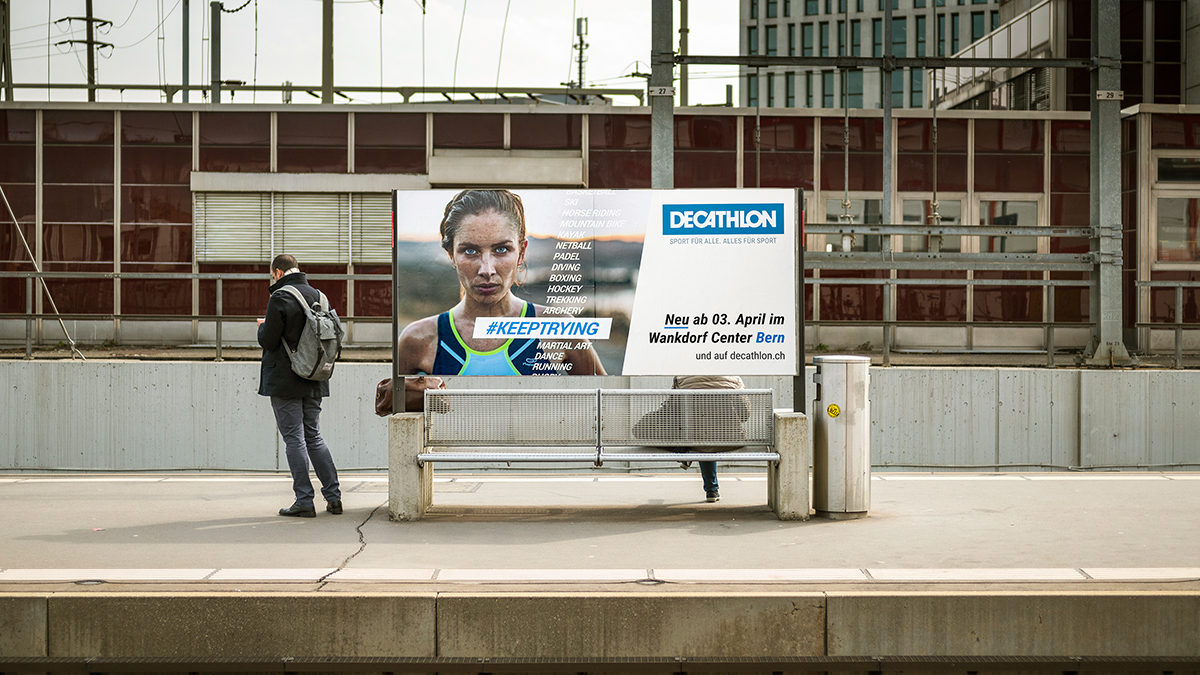
The Swiss sports market posted a slight increase of +1.5% in the first half of 2019 and is on a steady growth trajectory. Winter sports contributed significantly to the strong results in the first quarter of 2019—compared to the weak same period last year.

F12_street-decatholon

Very good weather conditions and a moderate Swiss franc exchange rate attracted locals and tourists to the mountains. All submarkets, from hard goods and footwear to textiles, benefited. Summer all-season sports, on the other hand, performed below the previous year's level. Sales from the World Cup, in particular, failed to materialize and had a sustained negative impact on textile sales. 

Apparel sales (-3 percent) remain challenging. In addition to Football, sales of Swimwear also declined - due to the somewhat delayed start to the summer. The fitness and running segments were also weaker, although outdoor was able to increase slightly. 

Sports footwear, which is heavily influenced by online retailing, remains a constant and weighty sales driver with a share of just under 30 percent of the sports market. 
Online retail continues to record strong growth: In the first half of 2019, sales increased by around 25 percent. The share of stationary trade is declining. 

A big boom (not included in the above sports analysis) is e-bikes. Kurt Meister, GfK expert in the sports sector, ventures a look into the future: "Sales, especially e-mountain bikes, are very much in demand. If the trend continues like this, by the end of this year or next year at the latest, every second bike sold in Switzerland will be an e-bike." 
 

Outlook 2019: Winter remains decisive

For the first time, the Swiss population has exceeded the 8.5 million mark. Among the Swiss population, sports as well as sports lifestyle go hand in hand and topics such as wellness, health and fitness remain as popular as ever. It is therefore to be expected that online sales in these segments will continue to rise. The current somewhat low exchange rate of the Swiss franc against the euro could fuel the issue of "foreign purchases" again somewhat, but could also keep tourists away from Switzerland as a winter sports destination. However, winter sports will once again tip the scales. The start to the winter of 2018/9 was below expectations in terms of sales and could be topped in the coming season. All in all, these are good conditions for the sports market to close the year in the black.


After Google algorithm update: Implement commerce content offers Guideline-compliant

Commerce-content partnerships have become one of the most important digital revenue streams for many media companies. Experts from Global Savings Group explain how publishers can implement their commerce-content partnerships in accordance with Google’s guidelines.

Gerhard_Trautmann_CEO_GlobalSavingsGroup_1258

Gerhard Trautmann, Managing Director Global Savings Group.


Commerce-content partnerships help to continue financing high-quality journalistic offerings in the digital age. At the end of August, numerous commerce content offers from media companies worldwide, such as coupon and product comparison offers, recorded a decline in visibility in Google's search results, in some cases significantly.

The Google algorithm update, whose roll-out was observed from 22.8.- 6.9.2019, correlated in time with a message of the search engine company distributed via Twitter. In it, Google clarified that content collaborations are basically covered by their guidelines and thus allowed. "That includes commerce content offers," says Gerhard Trautmann, managing director of the Global Savings Group. "But it's important to Google that when implementing these collaborations, the partners work closely together and the media companies monitor the published content."


Google does not punish commerce-content partnership model

After the update that has now been rolled out and the changes that can be observed, it is clear that Google is not punishing the commerce-content partnership model as such. Rather, the search engine giant specified its guidelines in this area and has adjusted the algorithm to better recognize their implementation. This creates a plus in clarity. Market participants who rely on a partnership model now understand better where they stand: Google expects media houses and commerce experts - even more than before - to enter into genuine collaborations that are coherent in terms of content and committed to creating independent, high-quality content.

Partnerships that implement these specifications very well have in part gained visibility in the August update, while others have lost it, sometimes significantly. This is true at least for the established partnerships that have been around for a while. "However, we also noticed during the analysis that some very young partnerships have lost visibility, even though they work according to the described quality approach. We assume that these will develop positively again over time," explains Trautmann.


Five learnings from the update

What does this mean in concrete terms for commerce content models? And what lessons can be learned from the analysis of traffic changes in recent weeks?

  • Cooperation is what counts: Commerce content offerings located on subdomains or subfolders of media partners should not operate outside the control of the news portals. The editorial teams or commerce content teams should be involved in the commerce content offerings at all times and have final responsibility for their publication.
  • It is advantageous if the media partners are directly involved in the creation of the content. In fact, Google is now taking pains to determine whether content has been created completely independently of the actual domain host, i.e. the media house. The search giant wants to be able to recognize at any time that the content of a commerce content offer was created in close cooperation between all parties involved. Close collaboration, interlocking, and an exchange of activities and content created within partnerships and the shopping-relevant content published elsewhere by a media house will become increasingly important. 
  • The decision of a media company to cooperate with a commerce content partner should always be of a strategic nature, and all decision-makers should be behind it. All parties involved must clearly commit to producing high-quality and shopping-relevant content and distributing it transparently via their own portals. The content should represent added value for the media brand's readership and should therefore also be appropriately linked and linkable to other content.
  • For each partnership, there should be a recognizable connection between the purpose of the commerce content offering, its content, the target audience, and the content of the main page.
  • An absolute no-go is and remains domain leasing. In contrast to real commerce-content partnerships, some domain owners also pursue the strategy of leasing their well-ranking subpages. In this case, the tenant populates the pages with content that has nothing in common with the domain owner or his other offerings. The domain owner himself does not actively participate in the creation of the commerce content offer. The point of this variant is not to expand an offer with complementary content, but merely to benefit from the good search engine ranking of the main domain.

"Our experience shows us that the points are best implemented with mixed or closely meshed teams of both partners working together on content production and distribution," says Gerhard Trautmann. "Basically, the better the commerce content offers are adapted to the target group of the main site and their needs, the more successful they will be."

* Global Savings Group is a commerce content platform and operates more than 100 digital commerce content offerings in partnership with publishers worldwide. With GSG's support, publishers offer inspiration, recommendations, and special deals and coupons to their users, generating additional digital revenue.

Facebook plans to double number of employees in Zurich

The U.S. internet company Facebook plans to significantly expand its office in Zurich and more than double the number of employees there from the current 80, said Tino Krause, Facebook's new head of DACH, in an interview with the German newspaper Handelsblatt.

facebook-zürich

The Facebook employees in Zurich currently work primarily in the area of augmented reality and virtual reality, said Krause. "In future, more than twice as many people will work there, including in sales," he announced. The US company has had a branch in Zurich since 2016. At the time, it took over the small ETH spin-off "Zurich Eye".


Efforts for data protection

With the expansion in Zurich, the importance of German-speaking countries is also increasing, Krause said in an interview. "The German-speaking region is a crucial market for Facebook, not least because the topic of data protection is very much driven from here." He was convinced that the focus in Germany would have a major influence on product development in the USA. "My ambition is clearly for our region to be a pioneer when it comes to data protection."

In terms of data security, Facebook is currently changing "radically", the Facebook manager assured. This year, 3.7 billion dollars will be invested in security and 30,000 people are working on security issues. Employees are also aware of this: "Everyone knows that Facebook needs to become more secure."

The US consumer protection authority FTC, which fined Facebook 5 billion dollars in the summer, has promised the company to examine the platform and the "millions and millions of lines of programming code" even more closely for vulnerabilities. This will also have an impact on individual employees. "Everyone will have to sign an internal document pledging to protect the data and privacy of our users - in everything they do and develop."


AI against hate comments

Krause was also open to regulation in connection with "political advertising" and "hate speech". However, Facebook also has something to show for it. "In the first quarter of 2019 alone, we deleted 160,000 hate comments in Germany, for example."

70 percent of them now discover Facebook with the help of new technologies such as machine learning, computer vision and artificial intelligence. "We no longer wait for someone to point out inadmissible content, we find it ourselves." In addition, the research center Correctiv and the news agency dpa work as "external fact checkers" for Facebook, preventing the spread of false reports.

Following the attack in Christchurch, which the assassin transmitted via Facebook, the company is also cooperating with law enforcement authorities in the USA and the UK to train its artificial intelligence. In addition, the rules for the Facebook Live function have been tightened. But Facebook is "not omnipotent". "When people with criminal energy want to spread content, it's a constant race that we face." (SDA)

Tamedia: New Head of Portfolio Management Ventures in the Technology & Investments division

Jens Schleuniger will assume the position of Head of Portfolio Management Ventures effective October 1, 2019. In this role, he will provide strategic support for Tamedia’s portfolio companies and evaluate new investments. The 39-year-old will report directly to Samuel Hügli, Head of Technology & Investments.

header_Jens_Schleuniger

Jens Schleuniger has experience in private equity, start-up investments and portfolio management as well as in company formation and development. He was most recently Senior Investment Advisor and member of the Investment Committee of Silk Invest, a private equity fund in London. As co-founder and Managing Director of Für-Gründer.de, he built the largest portal for start-ups in the German-speaking world and developed a leading software-as-a-service solution for digital business and financial planning. 
 
Samuel Hügli, Member of the Management Board and Head of Technology & Investments at Tamedia: "We want to further expand our portfolio in the areas of fintech, software-as-a-service and other high-growth fields. As a former entrepreneur and managing director, Jens Schleuniger is very familiar with the operational challenges of our investments and will provide us with significant support as a proven expert in business development and investments. I am very much looking forward to working with him."
 
Jens Schleuniger is taking over from Lorenz Lüchinger, who left the company in May. Nicola Claglüna has held the position on an interim basis since May.

get_footer();