The Swiss media are becoming increasingly poor at contextualizing events. According to the 2013 yearbook *Quality of the Swiss Media*, reporting is often fragmented and fails to provide background information. Researchers see this as further evidence of the media crisis.
Editorial
-
September 25, 2013
The yearbook gives a particularly poor report card to free newspapers and the online offerings of the tabloid media. According to the yearbook, these are the least likely to categorize events and the amount of soft news is above average. Tabloid newspapers, on the other hand, fared better.
Quality stocks lose ground
Overall, the quality of the Swiss media has continued to erode over the past eleven years. High-quality media titles have noticeably lost circulation and usage, while low-quality offerings have increased massively. This trend has been particularly pronounced in the media in French-speaking Switzerland. In terms of news quality, public radio is at the top, followed by national subscription newspapers such as the Neue Zürcher Zeitung, Le Temps and Tages-Anzeiger. Online portals, on the other hand, did not make it into the hit list of titles with the highest quality. They rank in the midfield or further down.
Softnews on the rise
The relevance of news has also decreased: Soft news became slightly more prominent in 2012 compared to the previous year. One explanation may be that the past year was characterized by prominent sporting events such as the Olympics, according to the yearbook. The researchers are concerned about the development of information media in the press, radio and TV. This is not the first time that they have experienced a decline in usage, according to the main finding of the study. Compared to the previous year, advertising revenue from the information press alone fell by CHF 183 million in 2012. However, the information media are an "indispensable element of democracy", the researchers state. In their view, however, it will not be possible to safeguard the existing offering in the future under current conditions.
Myths disproved
Publishers and editors-in-chief, whom the researchers accuse of being immune to criticism, were not spared either. However, the "myth of the best newspaper landscape of all time" is fatal in the long term. The researchers' appeal: the media guild must strengthen standards in journalism again. The 2013 yearbook "Qualität der Medien Schweiz Suisse Svizzera" was written by the Public Sphere and Society Research Unit (Fög) at the University of Zurich. The study was financed by the Foundation for the Public Sphere and Society. (SDA)
Under this link a detailed summary of the study can be downloaded.
Here you can find the official press release of the Fög.
Image: Keystone
New three-man editorial team for Le Courrier
The French-speaking Swiss daily newspaper Le Courrier is getting a new management trio. The Nouvelle Association du Courrier General Assembly unanimously elected Christiane Pasteur, Dominique Hartmann and Philippe Bach as the new editors-in-chief on Tuesday.
Editorial
-
September 25, 2013
This was announced by the newspaper on Wednesday. The model of a three-person editorial board was introduced following the departure of several editors-in-chief who had given up their posts due to work overload. The two editors-in-chief and the editor-in-chief are on an equal footing and assume full responsibility for the newspaper, but remain active in their respective departments. (SDA)
Numéro 10: Campaign for Romandie Combi
Romandie Combi is launching a new campaign with Numéro 10 from Bern, which includes not only print ads but also a new corporate identity.
Editorial
-
September 24, 2013
Romandie Combi stands for the six newspapers - Le Nouvelliste, La Liberté, L'Express, Le Quotidien Jurassien and Le Journal du Jura - that have joined forces to form Romandie Combi (ROC). According to the press release, all six newspapers are well anchored in their region and can rely on a loyal and broad readership in the five cantons of French-speaking Switzerland. Together, they have a subscription share of over 90 percent and thus a stable reader market.
The new communication campaign underlines the new corporate and identity of ROC. The new logo combines the flexibility of a changing world, flexible pricing - TLP under 50 francs with the Week-End offer - and adapts to the conditions of the modern world.
Patrick Fehlmann has been appointed the new head of communications at HWZ. He is a member of the extended school administration.
Editorial
-
September 24, 2013
In addition to a degree in business administration, Patrick Fehlmann has a master's degree in corporate communication management. Most recently, the 44-year-old worked as Deputy Head of Communications at Postbus Switzerland in Bern. Previously, he held management positions at Swisscom, the Swiss Athletics Association and In4U. As a sideline, Patrick Fehlmann runs a travel company specializing in China.
Teletext Art Prize 2013 for Kathrin Günter
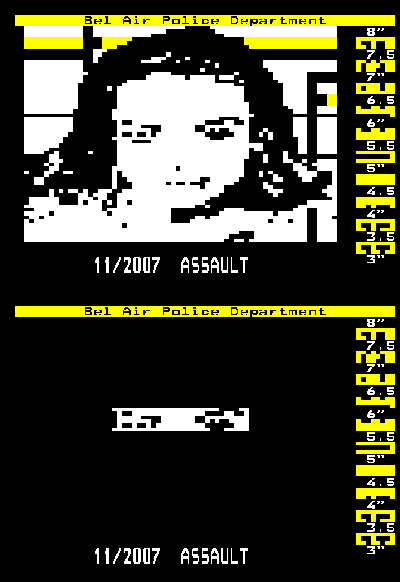
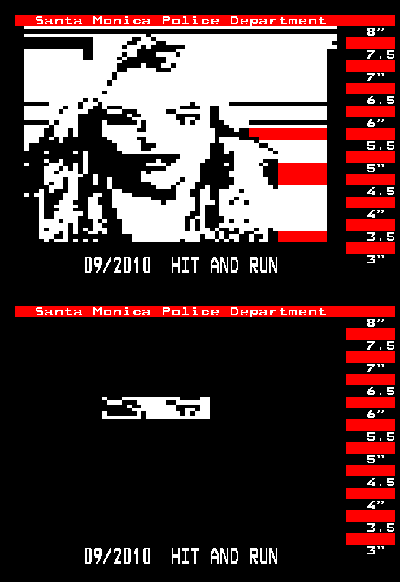
The 2013 Teletext Art Prize has been awarded to Berlin-based artist Kathrin Günter. She is being honored for her series «Lindsay Lohan’s Mug Shot Cabinet.» The work features mug shots of Lindsay Lohan that have been adapted and altered for Teletext.
Editorial
-
September 24, 2013
According to the jury, the series was convincing both conceptually and through the innovative implementation of the theme in teletext imagery and its current relevance. The artist not only reverses traditional role and gender clichés, but also adds a further level of meaning through the use of the (teletext) technology of "blinking". In this second view of the series, only Lohan's eyes can be seen, which is reminiscent of veiled women.
As part of the International Teletext Art Festival, works by 16 artists were shown at Teletext until September 15. According to the press release, the works range from word-text collages to pixel comics. The works were broadcast on ORF Teletext as well as on ARD Text and Swiss Teletext. The festival was organized by the Finnish artists' cooperative FixC from Helsinki.
In addition to Kathrin Günter, the jury also honored the work of Austrian artist Daniel Egg, Raquel Meyers (Spain) and Dragan Espenschied (Germany).
Formeldrei: Collect letters with Parisienne
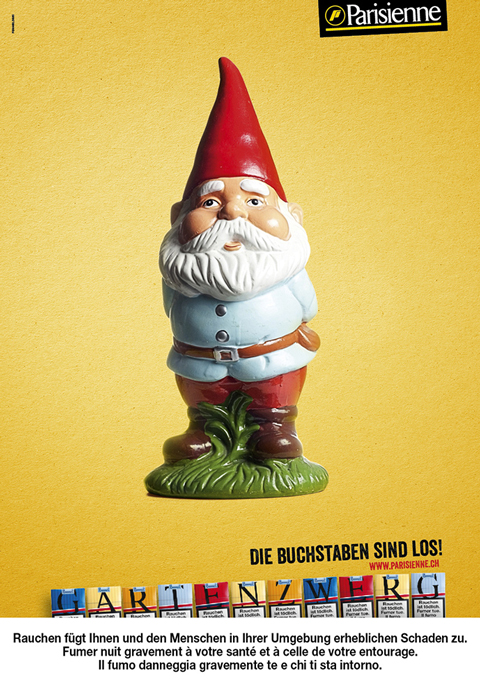
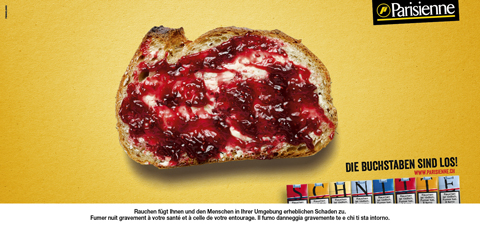
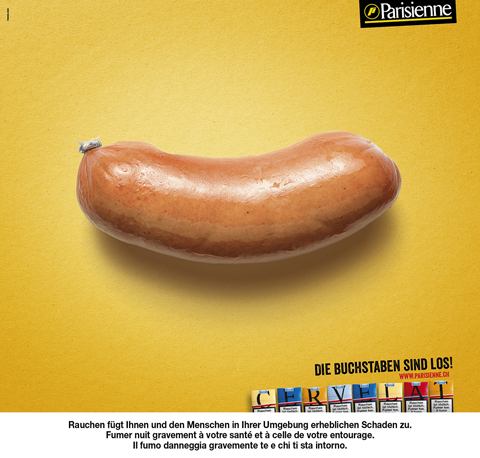
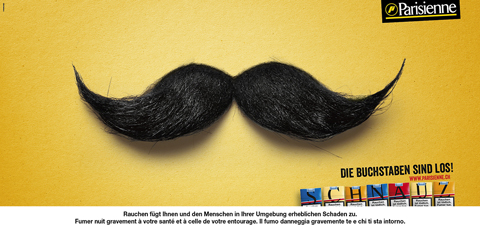
In the fall of 2013, Formeldrei is promoting the classic Parisienne colors through a national ABC contest. Packages turn into words.
Editorial
-
September 24, 2013
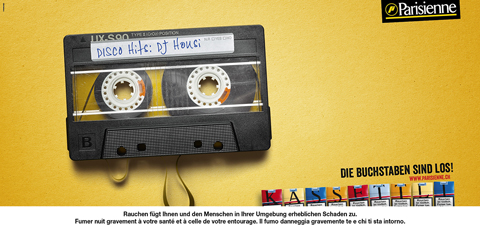
From the beginning of September to mid-November, all box and soft packs of Jaune, Orange, Bleue, Rouge and Ciel will have a large letter on the front on the shelf. According to the press release, this not only looks good, but you can also do something with these letter packs: Create your own word and, if you wish, take part in the competition with it. There can be as many words Uploaded become as you want. The only condition: The word should fit Parisienne and be in one of the national languages. There are two prizes of one million centimes in cash and over 1,500 other surprises in yellow and black.
Responsible at British American Tobacco (Switzerland): Robert Goossens, Brand Group Manager Parisienne & VFM. Responsible at Formeldrei: Moritz Adler (graphics/concept), Christian Wüthrich (text/concept), Marco Mesot (consulting/concept), Jeanine Hochuli (consulting). Programming online Station, Zurich.
The Kassettli subject is big also on our Facebook page to see.
One Marketing: Wish free for education
The Pestalozzi Children's Foundation and celebrities collect wishes for children. The campaign was created by the One Marketing agency.
Editorial
-
September 24, 2013
Children have a right to a good education. The Pestalozzi Children's Foundation has been dedicated to this principle for over 30 years. With its current campaign, the organization is drawing attention to the fact that millions of children still have no access to schooling. Swiss celebrities are leading the way and calling for more education for children worldwide. A first day of school for all!
In mid-September, most households in the German-speaking part of Switzerland received mail from the Pestalozzi Children's Village: In the form of an exercise book, the relevance of education and the work approach of the non-profit organization are presented in a coherent way. In addition to informing and generating donations, the campaign has another goal: recipients are encouraged to actively express their solidarity for disadvantaged children. On the back of the booklet, recipients are invited to make a wish online for more access to education worldwide.
The microsite specially designed for the campaign First-school-day.ch is the actual heart of the continuing communication. Visitors to the one-pager can declare their support for the right to education with small acts. And the countdown is on: Until November 20, 2013, Children's Rights Day, the Pestalozzi Children's Foundation is collecting wishes. In addition to the online gallery, the colored wish cards will be printed out at the Pestalozzi Children's Village and collected in the local "Wish Room." The blog and a campaign newsletter inform about the progress of the wish collection. On Children's Rights Day at the end of November, all wishes are passed on to political decision-makers with the unmistakable message: the Swiss population has not forgotten disadvantaged children and is committed to ensuring that the right to education does not exist only on paper.
The campaign uses a colorful mix of advertising media that lead to the microsite both offline and online. In advertisements, well-known faces call on people to do the same and write a wish for children online. In public transport, spots flicker across the screens and show in a sympathetic way how former first-graders - not least thanks to good education - were given the chance to develop their talents and today pursue their dream job. "With the SMS donation option, passengers can donate a solidarity franc directly from their seat. The thank-you text message to the smartphone includes the link to the campaign page and reaches passengers just at a time when they already have their mobile device in hand and have time to explore the microsite," explains Yong-Jong Lee, Online/Digital Consultant at One Marketing Services. Furthermore, banners, ads on Facebook and Google as well as spots on online TV ensure good visitor numbers to the campaign site. Thanks to the responsive design, the site is just as easy to navigate on a smartphone as it is on a tablet or desktop computer.
Well-known Swiss personalities were recruited as ambassadors for the campaign. On the microsite, they tell their own school stories - for example, you can find out what difficult task Beni Thurnheer had to master on his first day at school, or what punishment primary school pupil and now crime scene detective Stefan Gubser had to reckon with after a prank. The reigning Miss Switzerland, Dominique Rinderknecht, and TV presenter and trained primary school teacher Claudia Lässer also have vivid memories of their school days. With their wishes, they draw attention to the worldwide grievances in education. Beni Thurnheer, who as a member of the foundation's board of directors is very familiar with the organization's fields of activity, wishes the schoolchildren above all good teachers who have been trained to meet local needs, "because simply sitting out school is no use to anyone."
Education enables opportunities in life - with memories of their own school days and wishes for today's schoolchildren, the campaign ambassadors convey in a way that is as simple as it is catchy how important a solid school education is for their future lives.
Responsible at Pestalozzi Children's Foundation: Remo Schläpfer, Thomas Witte. Responsible at One Marketing Services BSW: Balz Farner, Yong-Jong Lee, Ruth Wagner.
Karin Müller, managing director and editor-in-chief of Radio 24, has decided to leave the station at the end of October 2013 to pursue a new career path.
Editorial
-
September 24, 2013
Karin Müller has successfully led the station for five and a half years, according to a statement. Among other things, she introduced the newsroom and a new quality assurance system. In April of this year, Radio 24 moved to its new, modern location in the Löwenbräu. This laid the foundation for a new era.
Succession planning is underway. On an interim basis, Irene Frei as Managing Director and Markus Gilli in his function as member of the Board of Directors of Radio 24 are responsible for the radio.
In Flagranti: Donations for the Cerebral Foundation
The Cerebral Foundation, which supports people with cerebral palsy and their families, relies on donations. That is why In Flagranti is once again organizing a fundraising campaign this year.
Editorial
-
September 24, 2013
The existing subject in an adapted media mix serves as the basis. For the first time, the public is presented with twonew radio spots to draw attention to the foundation's concerns. Posters, a TV spot, direct mailings and advertisements will be used to promote the campaign.
Responsible at Stiftung Cerebral: Michael Harr, Managing Director; Ursula Diethelm, Head of Individual Assistance. Responsible for strategy, conception and realization: In Flagranti, Lyss.
The Media Use Index 2013 study shows, among other things: Switzerland leads the world in smartphone density and mobile Internet use. This is fundamentally changing the entire media landscape.
Editorial
-
September 24, 2013
Media Use Index 2013: The study Media Use Index of the Y&R Group examines the media usage and information behavior of the Swiss population every year. In 2013, it was conducted for the fifth time. For the study, 2,000 people aged between 14 and 69 from German- and French-speaking Switzerland are surveyed online. The sample is representative.
Media usage: Mobile Internet usage rises to 74 percent, traditional media channels stagnate
The use of most media channels is stagnating. TV consumption is still at a high level, Internet via computer has become established among 86 percent of the Swiss, and free newspapers are constantly consumed by two-thirds of the Swiss. Radio, on the other hand, is losing ground in terms of usage, and daily newspapers are also being read less and less - at least as print editions.
As new media channels, the Internet via smartphone and tablet are experiencing a meteoric rise: 70 percent of the Swiss go online via smartphone in 2013 and 31 percent use their tablet for the Internet. Overall, 74 percent of the resident population thus already access the Internet via a mobile device. It is also worth noting that mobile Internet use is equally widespread among both sexes.
The mobile Internet is now firmly integrated into the everyday lives of the Swiss: 76 percent of smartphone owners use the Internet on a daily basis, and 69 percent of tablet owners do so - in each case, a third spend more than 1 hour a day online. Already 42 percent of digital natives say they are online more often with their smartphone than with a computer. This is also reflected in the importance of media. For the youngest generation, 4 of the top 5 are exclusively digital media channels.
If you compare media usage with advertisers' media spending, there is still a big discrepancy in Switzerland. According to bsw, just 2 percent of budgets flowed into mobile advertising in 2013, while only 15 percent is still invested in online advertising.
Mobile devices: 70 percent of the Swiss own a smartphone, 47 percent have a tablet in the household
In 2013, 70 percent of the Swiss already own a smartphone, and 31 percent personally own a tablet. Slightly more than a quarter of the Swiss (27 percent) already have both - a clear indication of prosperity. Broken down by generation, 79 percent of digital natives own a smartphone, 73 percent of digital immigrants do, and 52 percent of silver surfers already have one.
The tablet once again made significant gains last year. It is most popular among digital immigrants: penetration in this group is a high 37 percent. However, it has gained the most in the Silver Surfers group, with growth of 44 percent: today, a quarter of Silver Surfers own a tablet. Exactly the same number own a tablet among digital natives. For the youngest, however, the tablet is still a major investment. However, with new models becoming increasingly affordable, significant growth is also expected among them in the next 1 to 2 years. Overall, almost every second household now has a tablet (47 percent) - that's world class.
Operating systems: Switzerland is no longer an Apple country
Android draws level with iOS. This ends Apple's dominance in Switzerland, and the two operating systems now share the market equally. Looking at the global development, this trend is likely to continue and Android will soon gain the upper hand in Switzerland as well. The BrandAssetTM Valuator study by Y&R Group Switzerland provides a further indicator of this: among the younger generation, the previous cult brand Apple is clearly losing relevance and appreciation. With the gradual expiry of the 2-year contracts, a further push in the direction of Android is therefore to be expected.
Mobile activities: communicate, inform, entertain and socialize
The most frequent daily activities performed with the smartphone are writing messages, making phone calls, reading and writing e-mails, chatting and visiting social networks. The indexed comparison of the generations according to disproportionate use is particularly interesting: Digital natives use their smartphone primarily for entertainment, digital immigrants more frequently for information and organization, and silver surfers regard their smartphone more as a tool.
Viewed by dominant activities per device type, the smartphone proves to be primarily a communication tool, while the PC is a work tool. The tablet is a kind of compromise between the two: It is a complementary device that is primarily used for entertainment on the sofa and thus represents a luxury.
Mobile apps: The Swiss love apps and use them intensively. WhatsApp, Facebook and 20 Minuten are top
When it comes to the Swiss' favorite apps, the popularity of 20 Minuten among Swiss mobile brands stands out alongside the dominant chat and social apps WhatsApp and Facebook. This brand ranks among the top 5 most popular apps among both smartphone and tablet users.
Social media activities: Still in vogue thanks to high smartphone penetration and simple apps
Social media continues to be a big topic: Overall, 75 percent of respondents visit social networks, and 69 percent actively participate. Every day, a third of the Swiss (34 percent) visit social media sites via their smartphone, 32 percent via PC and 20 percent via tablet. The Facebook app alone is used by 60 percent of respondents. Here, too, digital natives are more active than average in liking, sharing, following and posting.
The most important social media brands for the Swiss are YouTube (39 percent), ahead of Facebook (35 percent) and Google+ (20 percent). This is followed by the travel platform TripAdvisor (11 percent), the career portals Xing (8 percent) and LinkedIn (6 percent). The much-cited social media brands Twitter (6 percent) and Pinterest (3 percent) are still considered really important by few Swiss.
Crossmedia: Media brands are increasingly consumed on mobile - above all 20 Minuten
Digitization is being joined by mobilization: daily newspapers and free newspapers are being consumed less and less in print, but more and more frequently on mobile devices such as smartphones and/or tablets. Mobile access to 20 Minuten has increased so dramatically in the last two years that mobile readership has already overtaken online readership and is converging with print readership, which continues to decline. A similar development, albeit less pronounced, is emerging at Blick, while NZZ is stagnating or losing ground in all channels.
Parallel media use: TV is increasingly becoming a sideshow
An exciting development is emerging in parallel media use: While the TV is on, people are surfing on their tablets or smartphones on the sofa at the same time. Among digital natives, 50 percent are already surfing the web on their mobile devices while watching TV. Women are much more active here than men. Television is increasingly becoming a sideline activity and a sound wallpaper in the background. Cross-media campaigns that encourage viewers to interact via the second screen during (live) broadcasts are therefore making more and more sense.
eCommerce: Online shopping is growing steadily, across all sectors
Most Swiss people shop online at least occasionally: 88 percent by PC, 67 percent by tablet, 55 percent by smartphone. People are increasingly researching online and then buying directly online, especially for books and music. People research online but buy offline primarily for items with a higher level of involvement, such as watches, computers and consumer electronics. In the case of services, the willingness to buy online is usually even higher, especially for photo services, tickets and vacations, and increasingly also for financial services and insurance.
The most popular online stores (as in 2012) include Ricardo, SBB and Ticketcorner, but international online brands such as Amazon and Zalando are also very popular in Switzerland. Among digital natives, Zalando, Exlibris and Google Play are particularly in demand, LeShop, Digitec and Amazon are popular among digital immigrants, and silver surfers prefer to shop online at SBB, Swiss and Nespresso.
Top 10 online stores (purchased in the last 12 months)
SSF: New broadcasts and live sports
The SSF sports channel has announced its upcoming programming lineup: In addition to continuing its successful in-house productions, the channel is launching several new formats. Live broadcasts will also continue to be part of the lineup.
Editorial
-
September 24, 2013
New additions to SSF's programming include the show "Knockouts," which every Saturday night reviews the most exciting fights in boxing history with the most spectacular knockouts by legends such as Mike Tyson, Lennox Lewis or the Klitschko brothers. In addition, viewers can look forward to the Red Bull Cliffdiving Series cliff jumps, the breakdance reality documentary "Breakin' Reality" and various individual magazines and sports documentaries, according to a statement.
New episodes of successful formats
In the popular football talk "Twelve - the football bar"Mämä Sykora, presenter, walking football encyclopedia and editor-in-chief of the football magazine of the same name, will discuss the world's most beautiful pastime with his guests every Wednesday. Afterwards, the program "Futbol Mundial" presents soccer stories from all over the world. The program "Inside Grand Prix" will remain on the air, offering commentary, analysis and interviews before each race weekend to take a look behind the scenes of the Formula One circus.
Live coverage continues to be a central component of SSF's programming structure. The first event here will be the start of the Volleyball Champions League with VBC Volero Zürich on October 24. "The continuation and relaunch of the aforementioned programs and the live coverage of Swiss sporting events form the basis for establishing SSF as a versatile and attractive platform for sport in Switzerland" explains program director Philip Michel. "But we have to go one step further here and are working at full speed to further expand SSF's programming. I don't want to give too much away yet, but on the one hand we are working on new sports programs, and on the other hand we will present new formats this fall that will give a face to the "Scene" program area."
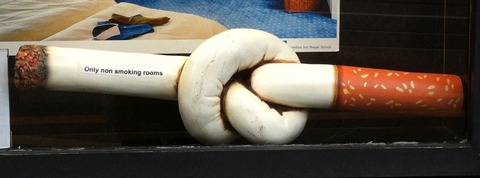
Last but not least: Only non smoking rooms
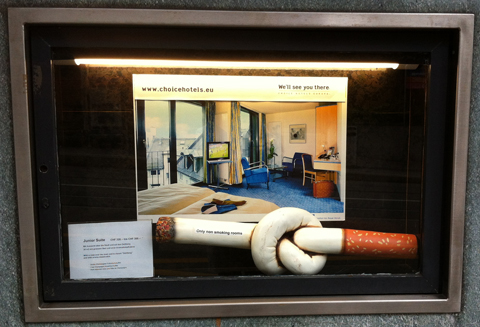
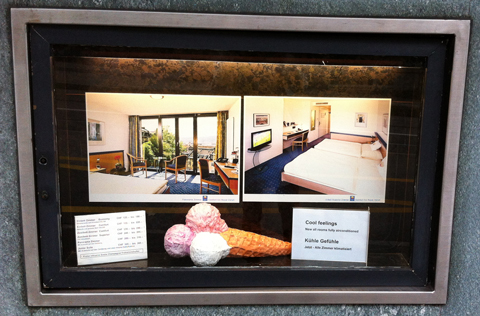
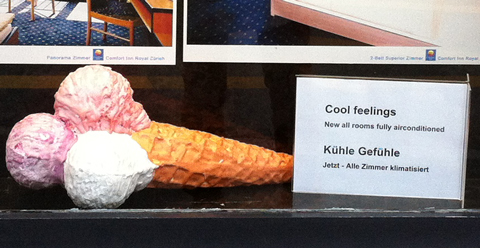
The Comfort Hotel Royal in Zurich does not offer smoking rooms, but it does feature a charming window display and a cool atmosphere thanks to the air conditioning.
Editorial
-
September 24, 2013
Smokers do not have an easy time in today's society. In addition to the omnipresent health risks, it was recently announced that the Federal Council wants to raise the price of a packet to a perceived 150 francs in the near future. And for good reason: as smoking has lost its credibility and coolness among young people, valuable AHV francs are at risk of being lost in the coming years.
Advertisers are using all available means to combat the extinction of this endangered species of smoker. The Formeldrei agency, for example, has organized a fun nicotine scrabble for Parisienne: Letters are printed on the packets, which are combined to form words (Werbewoche.ch reported). If you smoke a lot, you have a clear advantage here for once: lots of packets make lots of letters make lots of words make lots of chances of winning! For the word "Benzypren", for example, you only need nine packets, and only five for "Pudel".
Nevertheless, smokers are increasingly being pushed to the margins of society. After editorial offices, cinemas, airplanes, trains and restaurants, hotels are now also in danger of becoming a fume-free zone. On a voluntary basis, of course - a smoking ban defined by federal law is limited to the generally accessible areas of hotels. Operators can still let guests smoke in their rooms to their heart's content. If they wanted to.
The Comfort Hotel Royal in Zurich definitely doesn't want to. Or not allowed to - the Comfort Inn chain belongs to the American Choice Hotels International Holding. To mark the occasion, one of the showcases on Leonhardstrasse has been lovingly loaded with an oversized cigarette. At first glance, you might not necessarily associate the XXL tar monster with fresh, spring-scented hotel rooms, but rather with the smell of stale ashtrays.
But the button in the cigarette makes it clear on closer inspection: there's no smoking in this house, friends! And by the next display case at the latest, it becomes clear that an unerring decorative hand was at work here. An oversized ice cream communicates: All rooms are air-conditioned, dear non-smokers. Cool feelings for everyone - that's how shop windows should be!