Havas Worldwide Zurich reads between the lines

Under the slogan «Read what’s only between the lines elsewhere,» Havas Worldwide Zurich has developed a campaign for the magazine Schweizer Monat.

Tabloid-style headlines represent the views of the social mainstream, which are often repeated without much thought, according to a press release. The fine print inserted between them represents an alternative perspective on the topic at hand. For example, the mini-text sheds light on the dark side of the casting culture, questions the digital lifestyle, or warns against security at any cost.

Responsible at Swiss Month: René Scheu (Publisher and Editor-in-Chief); Urs Arnold (Head of Marketing & Sales). Responsible at Havas Worldwide Zurich: Frank Bodin (Overall Responsibility), Axel Eckstein (ECD), Laurie Morard, Claude Schweizer (Graphic Design), Sven Rufer (Copywriting), Maria Ebnöther (Consulting).

Anzg-sm-'alle-Sujets'-230x300ra_Seite_1
Anzg-sm-'alle-Sujets'-230x300ra_Seite_2
Anzg-sm-'alle-Sujets'-230x300ra_Seite_3
Anzg-sm-'alle-Sujets'-230x300ra_Seite_4


«To me, this journalist is a stalker.»

In the Sonntagszeitung, Frank A. Meyer discusses critical journalists, his role at Ringier, «suitcase commandos» in media companies, Andrea Bleicher, and Kurt Imhof.

In the interview, Meyer calls a journalist from the *NZZ am Sonntag* a «stalker» because the journalist always writes about him in «such a malicious and obsessive» way, even though he has never met him. That must be love, he says, because love can turn into its opposite.

Meyer does not deny his influence over Ringier («Those who have influence don’t talk about it»), and given his many years as editorial director at the media company, this is understandable. He regularly discusses journalism with Marc Walder and Michael Ringier—«both of whom are great people to talk to.» Of course, «personnel issues» also come up in the Editorial Committee. According to Meyer, every publishing house should have such a committee, consisting of the publisher, the head of the publishing house, and journalists. All without the hated «suitcase-toting commandos,» «young men hatched at the University of St. Gallen and honed in consulting firms» who think they have to overhaul a company even though they’ve never accomplished «anything concrete» in their lives. Journalists need to reflect on their own profession; with an editorial staff, one could even discuss cost-cutting, since it is generally made up of intelligent people.

Meyer argues that we need to move away from the constant debate about the future of print media. Instead, we should reflect on the craft of journalism. It is a craft of thought—but he observes that young journalists are Googling instead of thinking. Readers have the right to gain some insight from an article. «Describing foam crowns» is not the job of journalists—their responsibility is to cover the broader trends.

The decision to dismiss Andrea Bleicher may have been driven by the intention to «convey the incredible power of the gaze in a less superficial way,» even though he himself has nothing against entertainment. The relevance of the The Editorial Staff's Uprising Meyer compares this to the question of why Schawinski has a beard. «Zurich stories» in which he doesn’t want to get involved.

Meyer has words of praise for Ringier CEO Marc Walder. Under his leadership, there are no cost-cutting measures in the newsrooms; in fact, investments are even being made at *Blick*. Thanks to new revenue streams (entertainment, digital), Ringier aims to become editorially independent and strong, delivering «substance» rather than “content for people.” If you strip the newspapers of their substance, you shouldn’t be surprised if no one wants to pay for them.

Meyer accuses sociologist Kurt Imhof of trying to attract attention with pessimism. «Such findings always imply that »I, the professor,« know the solution to the problems.» He says the «scientific farce» is all well and good, but journalists don’t need media studies. Compared to the party newspapers of the past, we’ve come a long way today, even if “Google journalism” does indeed pose a problem. (hae/SoZ)
 

"Donate a Plate" Enters Its Second Round

Last but not least: How not to farm

WWF produced a clip as part of an international campaign against bycatch in fisheries. It had to be withdrawn because it was too bold or too authentic.

The animated film shows various real-life methods of catching wild fish - not in the water, but on land. The aim is to make people aware of how absurd it would be to plow up an entire field with animals during the harvest.

wwf1_0
wwf2_0

The clip is humorous and has a clear message:

wwf3_0
wwf4_0

The clip not only sensitizes, but also promotes the Marine Stewardship Council label and MSC-certified fish. This creates different needs and requirements for the clip.

The clip has now disappeared from YouTube and Vimeo. MSC called on WWF to remove it from the web: it shows a false and negative image of fishing. And it fails to recognize the commitment of many fisheries that strive for sustainable fishing. It is not entirely clear why they should feel attacked. (sis)

You can still find the video at following link.

Start of a time series

OVERVIEW MACH Basic 2013-2 marks the start of a new time series in print media usage research. For once, therefore, the focus in this issue is not on the changes, but on the new starting position itself. Nevertheless, the changes, some of which are massive, should also be mentioned.

Now it's here, the completely redesigned third-generation MACH Basic. As the MTJ has already reported several times (most recently in issue 2013-1 on pages 5-7), the results of the new MACH Basic are closer to reality than the previous ones. The most important innovations can be seen in the corresponding box.

MASSIVE CHANGES

Differences between the results of MACH Basic 2012-2 and the current edition cannot be clearly interpreted. This is because it remains open what proportion of the changes are due to methodological reasons and what proportion are due to actual changes in usage in the market. However, it can be assumed that very high deviations are strongly influenced by the methodological changes. The new sampling method certainly has a decisive influence here. According to WEMF head of research Harald Amschler, it has become apparent that the people not reached so far (i.e., those without a registered fixed network connection) are exhibiting deviating usage behavior. These are predominantly men and young people. Their usage was previously simulated, so to speak, by weighting them accordingly. This gave the interviews with people from this target group a disproportionate weighting. With the new sampling, however, the actual behavior of boys and men is now included. The results are therefore much closer to reality. However, this has the consequence that there are high percentage deviations for a large number of titles, ranging from -45 to +79 percent, and in very few cases can be justified by an actual change in usage behavior. The fact that in the new MACH all respondents had both the title logo and the answer categories in front of them certainly also has a significant influence on the results. Harald Amschler suspects that this meant that the queries about frequency of use in particular were answered more precisely. This influence is significantly greater for titles that are not published daily.

The table section of the printed report volume has been completely redesigned. In addition to a change to landscape format, a different presentation method is particularly noteworthy. The information on gender and age, as well as the results by economic area, can now be read separately by language area on the same page. The values in the basic population are consistently arranged by canton across the whole of Switzerland for the titles of the daily, weekly and Sunday press, while those of the general-interest and special-interest press are arranged by language area. This means that for all titles and combinations used in more than one language area, the values for the language regions concerned and for Switzerland as a whole can be read on the same line.

NEW NATIONAL OFFERS

Thanks to this method of presentation, national offerings can be identified and presented much more easily. The chart opposite shows those that achieve at least five percent reach in at least two language regions. This applies to no less than six offerings, which are listed in the chart in the order of their national reach. Apart from the KombiNation SwissWomen from Ringier with Swiss Illustrated, Glückspost, L'Illustré and TV8 and the NZZ Business Combi from NZZ and Le Temps these offerings are represented in all three language regions. The third-placed KombiNation SwissFamily from Ringier with SonntagsBlick, Swiss Illustrated, L'Illustré, L'Hebdo, TV8 and Il Caffè della Domenica achieved the second-highest reach in French-speaking Switzerland. In the case of the leading offer, Kombinazione, with all three Migros weeklies, the relatively strong difference between the three language areas is striking. In the two charts showing the reach hunters, the titles are also ranked on the basis of their reach in the basic population. Only offerings that reach at least 30 percent of the basic population in the language area are listed. In contrast to before, the titles of Migros and Coop are now at the top in both major language areas, in French-speaking Switzerland thanks to massively higher reach than in the old MACH Basic. In addition to the two titles of the major distributors, in both language regions 20 minutes as a publication also distributed free of charge. If these publications and the combinations are omitted, the picture in the chart "Top titles paid for" emerges. It is striking that the three titles in French-speaking Switzerland are all on the podium. In addition, only the following publications have a reach of more than 20 percent K-Tip and the Observerwhich just reaches the limit value.

Overall over all of the MTJ In Switzerland, 45.5 percent of contacts are generated free of charge (see chart "Free of charge shares by title groups and language regions"). For the general-interest and special-interest press, the free share is almost exactly 50 percent, for the daily press 37.8 percent and for the Sunday press, which is only distributed free of charge in southern Switzerland, only 5.3 percent. In southern Switzerland, paid contacts are also only generated by the daily press; for the other three title groups, the free share is 100 percent. In western and German-speaking Switzerland, the total share is between 40 and 50 percent.

Ueli Custer

Graphics and overview (PDF)

Advertising and the Röstigraben

In French-speaking Switzerland, Migros presents itself with different ideas for its advertising and communication than in German-speaking Switzerland. The bilingual Bernese agency Numéro 10 presents three new works.

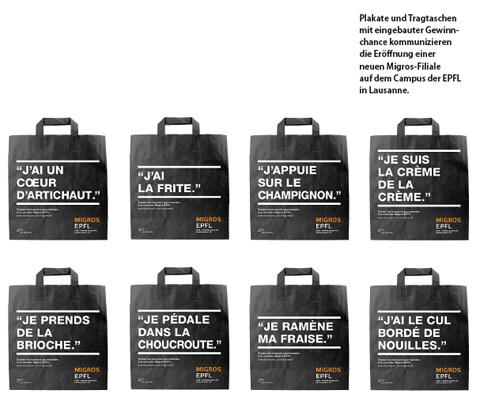
On the other side of the Röstigraben, it's not just life that is sometimes a bit more relaxed. Advertising for Migros, for example, is not bound by the same basic principles as in German-speaking Switzerland. It is allowed to take a few "typically French" liberties. The Bernese agency Numéro 10 is responsible for three different shopping temples or "centers," and new works by Gilles Aebi and his bilingual creative team will be on display for all three in the coming weeks. All campaigns build according to the speciality of the agency on "sync big" - the "new method for synchronized communication ", to which around the red thread with Transmedia Storytelling classical measures with dynamic and digital communication are connected. The campaigns were designed completely independently and individually for the three centers in Bulle, Marin-Epagnier in the canton of Neuchâtel and on the campus of the EPFL technical university in Lausanne.

Gruyère Centre Bulle

In Bulle, which belongs to the Migros cooperative Neuchâtel-Fribourg, 20 retail stores have been attracting customers for 30 years. Migros is focusing on children in the campaign that has just been launched. The Numéro 10 campaign builds on three "legends" that are strongly anchored in the region and very popular with children. The giant Gargantua, the court jester Chalamala and the witch Catillon are once again brought to life with 3-D drawings that are intended to generate a similar attraction among the target audience as currently popular films in the style of "Ice Age". The characters advertise on posters for a fairy tale performance. This play of 45 minutes in total can be seen at the Centre on different days in three acts of 15 minutes each. "An ideal time for a break after family shopping," Gilles Aebi says. And the trick works, of course, that kids will want to come back to the Centre for all the sequels. There, they are also presented with 68 tickets. Unlike the "Mania" collectibles in German-speaking Switzerland, however, the distribution of these cards is not tied to a purchase. They are distributed at around 15 events following a pre-announcement in the press. At these events, the children can then swap cards and take part in a tournament while their parents are out shopping.

Marin Centre Canton Neuchâtel

The Marin shopping center was one of the first of its kind in Switzerland. Numéro 10 has already provided communications support for the four-year renovation period leading up to the reopening in November 2011. Now the agency is promoting the shopping center, which is also architecturally excellent, with a series of happenings. In each case, "the best" or the most unusual from a particular field are or were being sought. For the competition "Who shows the most original shoes", more than a hundred people came to the center on a Saturday with self-made "fantasy shoes". Showing them off, of course, attracted an even bigger crowd. A performance by 80 brave people in pajamas also drew crowds to the Marin Centre.

Migros EPFL Lausanne

The new Migros on the campus of the EPFL Technical University and very close to the university was opened only on September 19 of this year. The aim here is to appeal to a primarily young audience. "These students like to communicate via social media more than average," Gilles Aebi knows. In his Numéro 10 campaign, Facebook therefore plays a correspondingly strong role. To this end, the look with the design of the advertising materials has also been made "younger" than in other Migros measures. The agency works with black shopping bags. 50 different models have been produced, each with different inscriptions. The puns each take up well-known proverbs about food. During the opening phase, the students found a snack offered by Migros in the bags, which were distributed free of charge. A pun was specially promoted on Facebook for each bag. Those who could show a bag with the corresponding slogan were given generous shopping vouchers. And to ensure that the campaign has a lasting effect, the black bags were produced in particularly good quality - so that the students don't throw them away, but continue to advertise their Migros every day.

Andreas Panzeri

Unbenannt-3_5
Unbenannt-4_13
 

Pecking order unchanged

Neither the new survey method nor titles reported for the first time or no longer have changed the ranking of publishers in the individual markets. But of course the gaps are no longer the same.

Tamedia, the major distributors Migros and Coop, and Ringier together achieve 50.6 percent of all contacts of those titles covered by the MTJ (see box "Basic information" on page 2). The other half of the reader market goes to Axel Springer and NZZ (5.2% each), Konsumenteninfo (4.9%) and AZ Medien (3.4%). The remaining 30.7 percent is distributed among a large number of titles from smaller publishers (see chart "Market Shares Whole Switzerland"). In the old MACH Basic, Tamedia, Ringier and the two major distributors still held less than half of the market. Contributing factors were Ringier's new Landliebe, which was reported for the first time, on the one hand, and gains by commuter newspapers due to better accessibility to young people, as well as significantly higher reach of the two major distributor titles in French-speaking Switzerland, on the other. Thanks primarily to 20 Minuten, the free share of all Tamedia titles is 52.7 percent. It is second highest at the NZZ Group with 30.2 percent, while Ringier has 19.9 percent. It cannot be calculated for AZ Medien, as it does not have its free titles surveyed by MACH Basic, with the exception of Stadtanzeiger Olten.

NZZ and Springer on a par

In German-speaking Switzerland, Tamedia, Ringier and the two major distributors account for not quite 50 percent. As the chart "Market Shares German Switzerland" shows, three of the four medium-sized publishers play a greater role here, as they are heavily or entirely active in this language area. Here, too, the NZZ Group and Axel Springer are virtually on a par. However, the fact that the German publishing giant no longer reported its two program titles TVvier and TV2 also contributed to this. In addition, the number of readers of Beobachter Natur was significantly lower than before. The same can be said for NZZ Folio. In French-speaking Switzerland, the titles of the big players reported in MACH Basic generate as much as 59.1 percent of all contacts. Tamedia is clearly ahead with 28.8 percent. At 6.3 percent, Konsumenteninfo has a clearly higher value here than in German-speaking Switzerland.

NZZ will become stronger

If we focus on the daily and Sunday press market, the picture becomes much more extreme. Tamedia, Ringier and the NZZ Group hold more than 80 percent of the market in Switzerland as a whole and in German-speaking Switzerland. Tamedia is the dominant player, especially in French-speaking Switzerland, where it holds more than three-quarters of all contacts. With regard to the market share of AZ Medien, it should be noted that the readership of the total edition (i.e. including the regional edition of Graubünden) was used here for Schweiz am Sonntag, since the title is only reported in this way. Its market share of 9.9 percent is therefore also due to a small extent to the former Südostschweiz am Sonntag. The NZZ Group will certainly increase its market share in a year's time, because figures for Ostschweiz am Sonntag will be reported for the first time then at the latest. In addition, the St. Galler Tagblatt and Neue Luzerner Zeitung have been strengthened by the takeover of parts of the Südostschweiz Group. The Landbote, which now - subject to approval by the Competition Commission - belongs entirely to Tamedia, will not have a significant impact on the ratios in view of only 60,000 contacts.

Ueli Custer

Unbenannt-7_13
Unbenannt-7b
Unbenannt-7c
Unbenannt-7d
Unbenannt-7e
Unbenannt-7f

Prix Italia: SRG SSR co-productions honored

At the 65th Prix Italia, Stéphanie Argerich’s «Bloody Daughter» was named Best TV Documentary in the «Music and Art» category. Markus Imhoof’s «More than Honey» was nominated for the «Expo 2015» Special Prize.

continents participated in eight different categories.

As in 2012 and 2011, SRG won one of the main prizes this year. The jury of the TV documentary section "Music and Art" awarded the first prize to "Bloody Daughter" by Stéphanie Argerich, who in her intimate family portrait explores the relationship
between a mother - star pianist Martha Argerich - and her three daughters. The award is proof of the quality and international format of SRG's co-productions, the media company wrote in a statement Thursday.

A second SRG documentary co-production has attracted the attention of the international jury of the Prix Italia 2013: It nominated "More than Honey," a film by Markus Imhoof about the death of bee colonies, as one of the three best films for the
Special Award "Expo 2015 - Feeding the Planet, Energy for Life". This prize is awarded for television productions that deal with the topics of nutrition, the food industry and its impact on the environment, health and our lives in general.
 

To the point: Perfect timing

After Ueli Maurer—our Federal President, a passionate reader of Grass’s works, and a self-proclaimed non-media consumer—briefly reverted to his role as a confrontational party leader at the Swiss Media Congress and made sweeping criticisms of the media’s quality and the topics it covers, he was booed by some of the attendees. Was this justified?

Criticism is good, but if you only condemn what doesn't correspond to your own view of the world, it gets a bit dull. From the booing, you can think what you want, but who gives out, must also be able to take. This was not the case! The otherwise not so squeamish Maurer complained that he had never been booed like that in 35 years. Lucky for him - but he doesn't know that, because he doesn't read the media - was also the fact that the majority of readers' comments on the various articles about the media scolding were positive. The fact is, many readers have something to criticize about today's media.

The annual quality discussion was launched. Then, on Tuesday of this week, the Media Club under the title "Ueli Maurer's media scolding". Roger de Weck, Director General of SRG, Norbert Neininger, Publisher and Editor-in-Chief of Schaffhauser Nachrichten, Kurt Imhof, Professor of Journalism and Sociology at the University of Zurich, Patrik Müller, Editor-in-Chief of Schweiz am Sonntag, and Iwan Rickenbacher, Chairman of Tamedia, took part in the discussion. I found the discussion interesting, with a few exceptions. Not even Karin Frei's lousy moderation, which, as in the first media club, didn't exactly shine (she missed the right pass, abruptly ended the discussion and moved on to the next one, lost the thread, didn't follow up, and wagged her finger in an annoying way), could prevent that. Remarkable the sentence of de Weck: "If the customers fall away, all other industries say, the product must become better. Except the media ..." Has something. On page 6 there is a selection of tweets about the broadcast.

Then, on Wednesday, the presentation of the fourth edition of the yearbook "Quality of the Media". At the same time as the press release from the publishers, there was also a press release from the Association of Swiss Media, which prophylactically demonized the yearbook in advance. And quite by chance there was an article in BaZ online with the title "If Kurt Imhof were a newspaper, it would be called Blick". That can't be it. One can be divided about the methodology and about Imhof's definition of the term quality. You can like it or dislike it, but we cannot avoid a discussion about the quality of our media. This discussion must be conducted without prejudice or blinkers.

Pierre C. Meier, Editor-in-Chief
[email protected]
 

Paris windows

What ideas do the French private broadcasters M6 and W9 have for attracting viewers in French-speaking Switzerland during commercial breaks?

A group of employees from marketer Goldbach Media traveled to Paris for a day in early September, along with other interested parties. At the "Club de L'Etoile" cinema, the Swiss had a French version of the "screen up" presented to them, featuring the upcoming highlights of private stations M6 and W9.

M6, also known as Métropole Télévision, is a French private broadcaster 48.56 percent owned by RTL Group. M6 is France's second-largest private broadcaster after TF1. W9 is a sister company with an identical shareholding. Launched in May 2005, the channel W9 has no profound meaning as a name. It is simply the graphic mirror image of M6. In its early days in 1998, the channel was still called M6 Music. Accordingly, the programming today still consists mainly of music shows, TV series and sports broadcasts. Jacqueline Sasse, Sales Director TV at Goldbach, describes W9 as a "shooting star in France". The channel is No. 1 on the TNT platform, the main cable network in France, ahead of the big TF1. "The channel is a unique success story in France as well as in the French-speaking part of Switzerland and has become a relevant channel within a very short time, despite great competition in both markets. " W9's advertising window has been added to Goldbach's portfolio in French-speaking Switzerland ten years after the launch of the M6 advertising window in summer 2012. With shows like "The Simpsons," "Lie to me," but also the French version of "young, wild and sexy" under the title "Bienvenue chez le Ch'tis," W9 is suitable as an advertising platform especially for a younger and cheekier target group.

Cult, but less trashy

The show "Séduis-moi si tu peux" was also particularly well received at the presentation in Paris. Genuinely progressive in attitude, here men who consider themselves attractive have to pass in front of a jury of 24 women. The bachelorettes show themselves emancipated and merciless in their search for the man of their dreams. The lavish show is produced by Fremantlemedia. Also on W9 is soccer from the UEFA Europa League and world-class tennis. Among the series, "Spartacus" is already very successful in its third season. On M6, a format with the still provisional working title "Ice" caught the eye at the Paris novelty show. Comparable in concept to the "Battle of the Choirs" on Swiss television, here four teams compete for the best performance in the ice dance category. The young talents are coached by multiple Olympic and world championship stars Philippe Candeloro, Surya Bonaly, Sarah Abitpol and Gwendal Peizrat. For the various episodes of the show, M6 has had two ice halls built, one for training, a second for TV recording. The most modern equipment for light shows, projections on the ice surface and other effects was installed here, he said. The show is produced by M6 in its own direction. Docu-soaps like "Le meilleur Patissier," where the best baking talents are sought across the country, are presented with French charm.

la meilleure Boulangerie de France" follows a similar recipe. Among the series, the Golden Globes and Emmy-winning episodes of "Touch" with Kiefer Sutherland stand out. And if you want to brush up on your French once again, both M6 and W9 offer a range of high-quality movies to enjoy away from Paris in the comfort of your own sofa.

Andreas Panzeri


The advertising windows of the French private stations are marketed in French-speaking Switzerland by Goldbach Media. In an interview, Jacqueline Sasse, Sales Director TV, is very satisfied with the response.
 
WW: How important is M6 compared to other stations in French-speaking Switzerland?
Jacqueline Sasse: M6's development is very satisfactory. The top-rated shows are "Top Chef" and "L'amour est dans le pré. This is the French version of "Bauer ledig sucht," but shot with visibly greater effort. The "Scènes de ménages" are also doing very well. These are short sketches from everyday life together. Only a few people in German-speaking Switzerland are familiar with these formats from French stations. In French-speaking Switzerland, however, the shows have a real following. Sunday evening's "doku/intello" is also very popular and can hold its own against TSR's magazines. M6 positions itself in the advertising-relevant target group 15-49 and HHF 20-49 over 24 hours and in prime time even ahead of TF1 and is accordingly the market leader within the private stations. In the 15-29, 15-39, 15-39 male and 15-39 female target groups, M6 is even the No. 1 station in French-speaking Switzerland over 24 hours.
 
How satisfied is Goldbach as a marketer with the window bookings?
We are very satisfied. M6 and the new advertising environment launched last year on W9 are well booked. M6 has been consistently delivering top performance for years and is highly regarded by advertisers in Switzerland as an innovative and reliable programming environment.
 
How do you experience the response to the new W9 window launched last year in Switzerland?
W9 is particularly popular in French-speaking Switzerland. The young station enjoys a great media response thanks to press articles from France as well as references and reviews in the Swiss media. W9 is also very present in French-speaking Switzerland on social media such as Facebook and Twitter. The music station is making a name for itself thanks to new, innovative shows and magazines, which are being well received by young people.
 
Which station is for which audience?
M6 positions itself as a family station. The HHF target groups are reached thanks to numerous and varied in-house productions, for example "La France a un incroyable talent," "Scènes de ménages," "un dîner presque parfait," "100% Mag" and feature films, which are on air in the afternoon. Not only the young and dynamic women are addressed by means of crime series, cooking shows, magazines and beauty shows, but also the male target groups thanks to "Capital", "Zone interdite", the car show "Turbo" and many blockbusters. In addition to great innovation, M6's programming is also of high quality.
 
W9 is for the youth?
Yes, W9, M6's sister station, is particularly suitable for younger target groups. W9 has been very successful in implementing new concepts in France that appeal mainly to young and trendy people, i.e. 15-39 year-olds. Popular shows include "The Crazy Cht'is" and "Marseillais. These continue to make headlines and fascinate young adults with pithy but also funny sayings. The station also broadcasts exciting in-house formats such as "Relooking Extreme " and "Séduis-moi si tu peux," which also appeal to the advertising-relevant ZG HHF 20-49 and 15-49.

pan

Advertising impact: TV commercials are not only effective on TV

Today, consumers watch TV on devices other than their televisions. But what is the actual impact of TV commercials on these various devices? A recent study led by Australia’s Murdoch University provides valuable insights.

The television in the living room is still an important media fixture - but it has lost its TV monopoly. Consumers today also use PCs, laptops, tablets and smartphones to watch TV. It is therefore interesting to see how TV commercials work on such alternative devices. With the help of experiments in which a total of around 1000 Australian consumers took part, the effect of TV commercials on televisions, PCs and cell phones has now been compared. As part of the experiments, the study participants - who were assigned to different groups - were shown around 30-minute TV programs including commercial breaks. Depending on the group to which they belonged, either a conventional TV set, a PC or a cell phone was used to watch TV. The impact of the TV commercials was then recorded in a survey. Four parameters were measured: Advertising recall and liking, attitudes towards the advertised brands and willingness to buy. The interesting result: TV commercials have a high impact - regardless of the device on which they are viewed. The study showed no statistically significant differences in impact between the devices.

Consumers in the TV group were able to recall 39% of the commercials without support. In the cell phone group, unaided advertising recall was also 39%. In the PC group, even slightly higher recall values were achieved at 46%, but the deviation is not statistically significant. TV commercials also achieved comparable likability ratings on all devices: on a 7-point scale with 7 as the best value, TV commercials on TV were given an average rating of 4.8. The spots received the same likability rating when viewed on a cell phone (4.8), while the likability ratings on a PC (4.7) were only slightly lower. A similar picture emerges with regard to consumer attitudes towards the advertised brands and willingness to buy. Consumers consistently showed a positive attitude towards the advertised brands, regardless of whether the TV advertising was viewed on a TV set, PC or cell phone (4.9 on a 7-point scale with a top score of 7 in each case). In the TV group, the willingness to buy the advertised products was 32%. In the cell phone group (28 %) and the PC group (27 %), the willingness to buy was slightly lower at first glance - however, the difference proved to be statistically insignificant. TV commercials are therefore not only effective on traditional televisions, but also on alternative end devices such as PCs or smartphones - and comparably well.

In everyday life, it is also often the case that consumers see the same commercial several times - possibly on different devices. From the perspective of advertising companies, it is of interest in this respect whether the combination and order of the devices on which a TV commercial is viewed affect the impact of the commercial. The study shows that this is not the case: in terms of advertising impact, it makes no significant difference whether a commercial is viewed first on a TV set and then again on a cell phone, first on a cell phone and then on a TV set, first on a PC and then again on a TV set or first on a cell phone and then again on a PC. All device combinations are similarly effective.

Clemens Koob

Unbenannt-10_7
 

The organizer

As managing director of the text agency Etextera, Ruth Hardegger-Wickli supports women in balancing job and family. That requires coordination skills.

Unbenannt-11_7

Coordination and organization are in Ruth Hardegger-Wickli's blood. For years, the business economist managed communications projects in the railroad business. At SBB, she was communications manager and deputy editor-in-chief of Sbb.ch, after which she moved to BLS as multimedia project manager. At the same time, Ruth Hardegger-Wickli managed the "Project Family" together with her husband. Three times a week, she had to make sure that the external childcare worked. She delivered the offspring early in the morning, was in the office during the day, and returned to her role as mother in the evening. As long as all the cogs meshed, the system worked. As soon as one of them broke down, for example if a child became ill, the machinery came to a standstill. It was during this time that Ruth's husband Sascha Hardegger came up with the idea of founding his own company. An agency that helps women balance work and family by allowing them to flexibly schedule their work and work from home. While Ruth Hardegger- Wickli was still working for BLS, the communications professional began to set up the company in his spare time. He developed the company's image and drummed up interest among companies. Things really took off in 2010, when Ruth Hardegger- Wickli's temporary contract with BLS expired and she took over the management of Etextera. Hiring female copywriters was still the easiest part of building the business. "We receive weekly requests from women who want to write for us."

The customers, on the other hand, had to be worked harder. Small companies often lack the money to have their texts written externally, or they are less aware of what a bad text can do. As a result, Etextera's customer base today includes mainly large and medium-sized companies, such as Allianz Suisse, Wago Contact, the canton of Basel-Landschaft, Local.ch and the Migros Club School." The latter commissioned Etextera to rewrite the texts for its new website. "A totally cool assignment," enthuses Hardegger-Wickli. When writing the texts, the agency not only had to match the style of the Klubschule, but also do justice to the character of the respective course offerings. Everything was included, from language or IT training to dance lessons and cooking courses. Search engine optimization was an additional criterion.

While Hardegger-Wickli still diligently picked up the keys herself during the start-up phase, the CAS PR editor now leaves this to her "ladies". "They write much more efficiently than I do. Hardegger-Wickli's strength clearly lies in the organizational area. As managing director, she is the interface between the clients and the freelancers. From her home office in Schmitten in the canton of Fribourg, she coordinates inquiries, selects the right copywriters and takes over project management. She also organizes the placement of presenters as well as text and social media training for clients.

Hardegger-Wickli is the figurehead of Etextera - and the agency's guarantor of quality. "No text goes out for us without me proofreading it," says the managing director. She checks whether a text is written to the point, whether the message comes across as intended by the company, and whether the text is suitably formulated for the target group: in one case, whether the text intended for specialists does justice to the terminology, in the other, whether the "technical jargon" has been translated in such a way that it is also understandable for the layperson.

Loose fluffy

Hardegger-Wickli presents herself in a light-hearted manner. On the website, she not only presents herself in a business outfit, but also in a leisure outfit - or rather in a sports outfit. We're not a prim and proper agency," she says. I don't go to client meetings in deux pièce."

However, her relaxed attitude should not obscure the fact that Hardegger-Wickli's work is strictly structured and thoroughly organized. "With Ruth Hardegger-Wickli, you have a reliable partner at your side," says Franziska Rodel, executive assistant at the software manufacturer Diartis, for example. "She maintains an overview at all times - no matter how chaotic things get." Hardegger-Wickli tries to help her clients move forward. If something seems suboptimal to her, she intervenes. Her clients appreciate this. "Ruth Hardegger-Wickli gives clear feedback and makes suggestions for improvement - even without being asked " says Manfred Lehmann, Marketing Manager at the technology company Wago Contact. "I see my function as an advisory one." And with this approach, Etextera has gone from a text-only assignment to a larger project several times. The software company Diartis, for example, only wanted its product sheets and customer magazine revised. In the end - with the help of a second agency - a new overall appearance was realized. A festive magazine of a regional bank, which was actually only to be edited, was finally completely revised. "Anything else would have been a waste of money."

Yes, can women write?

The fact that whoever hires Etextera is in women's hands interests some very much, others not at all. "For us, the flexibility and speed of the agency was decisive. Whether it was a woman or a man in the background was secondary," says Lehmann. For other companies, the door opens for Etextera precisely because of the agency's philosophy. "Basically, Etextera's idea of supporting women meets with goodwill from many clients," explains Ruth Hardegger-Wickli. "Companies can indirectly promote women through us, that's clear. In the end, however, it's only performance that counts." The agency manager knows exactly in which cases she can use her model for marketing purposes - and when she prefers to focus on other arguments. Hardegger-Wickli's most important selling point is never the advancement of women. Rather, she emphasizes the advantages for clients that result from the size and diversity of the text agency. With over 20 female editors and copywriters, Etextera brings together expertise from a wide range of fields. The large network also makes it possible to execute orders in the shortest possible time.

As appealing as Etextera's philosophy is to some, in some cases the "women's bonus" turns into the opposite. "Yes, can the women also do something or do they just look good?" Hardegger-Wickli is well aware of the clichés. She is not impressed by them. "As a woman, you experience that kind of thing everywhere." Ruth Hardegger-Wickli is often asked whether fathers are welcome at Etextera. In each case, she says elegantly, "We want to remain true to our philosophy." For the time being, the only man on board will be her husband Sascha Hardegger, the "token man". Nor are there any plans to open another office in Bern or Zurich in addition to the headquarters in Schmitten. "We came to the conclusion that a second location is not necessary at the moment." Ruth Hardegger-Wickli communicates with customers and employees primarily by mail and telephone. "And otherwise, I'm quickly in Bern or Zurich by train. Or in Landquart." Hardegger-Wickli remains true to the home office model. After the regular jobs, the managing director enjoys the freedom she has gained. Being able to organize her working hours more flexibly, drive her children to training sessions or help them with their homework means a lot to her. The managing director is happy to accept the fact that one or the other evening off is lost for this.

Hardegger-Wickli brings the necessary discipline to the home office with ease. She also demands the same from her female employees. "I don't care when the women write their texts. They just have to deliver on time. " As strict as the managing director shows herself to be on the one hand, she can be just as understanding on the other. If her ladies are in a difficult situation privately, Hardegger- Wickli always has an open ear. "My female employees know that they can also talk to me about children or family. "She can empathize with what it means when a child is sick - or there is a bottleneck in care. Then, once again, her organizational skills are in demand.

Isabel Imper
 

get_footer();