Advertising becomes art

The National Museum in Zurich is showing the exhibition "Good to Print. Art and Advertising at Wolfensberger". The objects come from the holdings of the J. E. Wolfensberger print shop. Curator Felix Graf explains the background to this donation.  

Unbenannt-2_14

WW: How did the exhibition "Good to Print: Art and Advertising" come about?

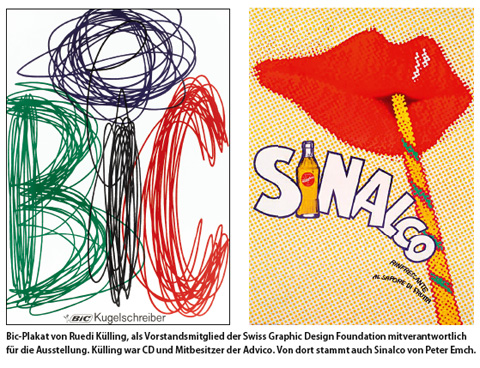
Felix Graf: The exhibition was triggered by a donation from the Wolfensberger family to the Swiss National Museum. The donation was arranged for us by the Swiss Graphic Design Foundation. One of the Foundation's board members is Ruedi Külling, the former CD and co-owner of Advico. As a designer, he created, for example, Cementit, the famous poster for Bic ballpoint pens as well as the Sinalco campaign and much more. In his era, Ruedi Külling did a lot of printing in the offset print shop at Wolfensberger. A family relationship and friendship developed from this. Külling even appeared in Wolfsberg as "Samichlaus" for the little wolves Benni and Thomi. The two great-grandchildren of the company founder and current managing directors of the print shops in Zurich and Birmensdorf only found out about this during the interview that I did with them and Ruedi Külling for the publication accompanying the exhibition. Well, with all these "divisions of inheritance" in the Wolfensberger family - there have been many children over the generations - original graphics and pictures have always ended up in other hands. Finally, the family also sold their Wolfsberg in order to be able to continue the print shops at a more suitable location with the new capital. When Benni and Thomi Wolfensberger realized that fewer and fewer of the documents from the print shop's history remained, the two had an idea: It would be good if a suitable institution could take over the valuable stock.
 
How big is this Wolfensberger collection?
This stock is still relatively large, about 400 sheets of every kind, advertising leaflets, posters, brochures, books, archival documents, contracts, quite great historical photographs. For example, a photo of the lithographer Oscar Haag, who is transferring Hodler's Tell onto the stone. Wolfensberger wanted to use it to make the Landi poster in 1938. But the jury refused, and so Alois Carigiet finally designed the Landi poster. But it was also printed by Wolfensberger. The photo with the side-inverted Tell on the stone, for example, was not yet known to Hodler researchers. And there is much more material in this quality in the donation.
 
What have you taken on for the exhibition?
I once inventoried everything and consulted with Ruedi Külling. He then had the idea of making an exhibition out of it. And because I'm a curator of prints and very interested in the history of media, I was of course immediately interested. Then I was also able to get our director Andreas Spillmann excited about the project. A print shop with a history dating back over 100 years that is still in business today - that has to be worth an exhibition for us.
 
According to which concept do you exhibit?
A first idea sketch was developed together with the Swiss Graphic Design Foundation. Its president, Christian Jaquet, board member Ruedi Külling and I roughly drafted the concept, then I took over. I'm not only a curator of prints, but also a cultural historian. Political history and media history interest me, as well as the history of mentalities and, of course, art history. We have built up the exhibition from this perspective, and so the artist Otto Dix, who exhibited and printed at the Wolfsberg, has also been given great weight - and General Wille is also present with a photograph. We are the historical museum of Switzerland and less specialized than others. We go the whole hog, so to speak. The concept is thus a journey through time, through worlds of images from advertising and art, most of which were printed on the lithographic high-speed press built in 1905 at the J. E. Wolfensberger graphic institute. Historically, we also pass the moment when lithography was replaced by offset printing.
 
How did you incorporate all the anecdotes?
That comes into play during the tours. You can't write all that on blackboards. But we have produced an accompanying publication in the form of essays. Where we have really broken new ground and can present our own research results, we want to publish them in the Christmas number of the Zeitschrift für Schweizerische Archäologie und Kunstgeschichte, our in-house journal. And on the day of the finissage, I would very much like to put the entire exhibition integrally on the web, as the first electronic exhibition of the National Museum. But of course not parallel to the exhibition, but after the exhibition. So that it can be viewed from all over the world. We have never done that before. I'm excited about this idea because it would allow us to expand the theme. If we get new objects, we can add to the exhibition on the web. We can also make a link to our electronic object catalog. That would be something between an electronic exhibition catalog and a partial inventory catalog, so it would actually be a new genre of museum publication.
 
There is the ZB, the poster collection of the Museum of Decorative Arts and the posters in the National Museum. How are the competencies distributed?
There is no distribution of roles at all. The Museum für Gestaltung has a poster collection and collects posters. There are around 300,000 posters in the collection. We have about 400 posters in world format in the collection, which we are now expanding together with the Swiss Graphic Design Foundation to perhaps 1,200. For us, it is an expository collection. So we don't aim for completeness, for example by graphic artist, product or decade, but with a view to our exhibitions.
 
What criteria does the National Museum use to collect posters?
Our collecting serves to supplement our three-dimensional holdings. It is important that we can show any advertising and a poster for objects that we exhibit. Swiss commercial art of the 20th century enjoys an international reputation, which is part of our cultural heritage. I mean: We must have about two good tourism posters for each decade. And we want to show the original, the contemporary witness that breathes the spirit of the time that has penetrated the paper. A criterion is also the threshold product. When something important is produced in series for the first time: the first buckled ski boot Henke, the first sunscreen Hamol, the first cheap Bic ballpoint pen, the first cell phone or snowboard - we collect such things from everyday life, consumption, industrial society, leisure society. And if there are printed advertising materials, including posters, then of course we take them as a supplement.
 
When does a commercial graphic become art?
I would say: The moment a good advertising print is suitable as wall decoration, when it is hung up, when the change of function takes place and works. That can't be programmed. It just happens. And then the advertising graphic is most likely also good art. One example is the Landi picture by Hans Erni. It is 100 meters long and 4 meters high and shows Switzerland as the vacation destination of the nations on more than 140 panels. We were able to take over the object from a shed years ago. This mural is art, self-portrayal of Switzerland and political advertising in the sense of self-strengthening in 1939. Our Hodler frescoes are of course also political advertising. Then we have oil paintings by great artists in the exhibition by Otto Dix, by Adolf Dietrich, Cuno Amiet. They didn't actually do commercial art, but they created posters for their exhibitions. The artists themselves then transferred these to the stone at Wolfensberger. These "advertising posters" are numbered and signed and have a commercial value.
 
Interview: Andreas Panzeri

Unbenannt-3_8
Unbenannt-4_16

From lithography to offset

Background information on the just opened exhibition "Good to Print. Art and Advertising at Wolfensberger" at the Zurich National Museum.
 
The exhibition "Good to Print" at the National Museum reflects a journey through time in the worlds of images from advertising and art. All exhibits shown for the first time in such complexity were printed at J. E. Wolfensberger. In 1902, the company was founded by Johann Edwin Wolfensberger (1873-1944) in Zurich. The patron set new standards in the graphic arts industry and gave modern Swiss art a fresh platform. In 1911, the trained lithographer moved into an imposing Art Nouveau building at Bederstrasse 109 in Zurich, where he combined business and residential premises, a print shop, lithographic studio and art gallery under one roof. Swiss and foreign artists, including Ferdinand Hodler, Cuno Amiet and Oskar Kokoschka, designed the posters for their exhibitions in the Wolfsberg directly on the stone themselves. Otto Baumberger, Emil Cardinaux and Burkhard Mangold and other pioneers of Swiss commercial art are among the first collaborators. In 1956, Wolfensberger begins offset printing. In 1985, part of the production is relocated to a newly purchased building in Birmensdorf. This second location is successively expanded until finally in 2006 the company is completely relocated to Birmensdorf. Here the company today offers all services of the "black art" up to digital printing. Only lithography finds a new domicile on Eglistrasse in Zurich West. Today, this craft is still cultivated by the Wolfensberger family business. Their lithographic print shop enjoys an excellent reputation among the only 30 suppliers still active worldwide today. The cultivation of this tradition is led by Thomi Wolfensberger. Benni Wolfensberger is responsible for the offset printing plant in Birmensdorf. The two brothers are great-grandchildren of the company founder.

 
Everything that has rank and name

The twelve-color printing with the litho stones and state prints serves as the most important exhibit in the exhibition at the National Museum. During the era of lithographic printing at Wolfensberger, which lasted until the 1950s, the company had around 30 employees. These included graphic artists, hand lithographers, proof printers, press masters, and numerous auxiliary printers and stone grinders. The boundary between reproduction graphics and artists' lithography was fluid in the "Wolfsberg" during the first decades. The "Kunstsalon" housed in the same building on Bederstrasse is considered the first private Swiss gallery for modern art. Until the 1920s, twelve exhibitions were held here each year - with their own posters and brochures. The company's first sales catalog, printed in 1927, offered both artist lithographs and art reproductions. Unique documentation and photos of this can also be found in the "Good to Print" exhibition. Later, famous artists such as Otto Dix, Hans Sturzenegger and Cuno Amiet portrayed their gallery owner. Advertising on their own behalf was considered the company's most important "business card.
 
Andreas Panzeri.

To the point: and they do exist

I'm referring to innovations in the media industry. There have been quite a few in recent months and weeks—some still just ideas, some in the planning stages, and some already implemented. Not only abroad, but also in Switzerland.

Amazon CEO Jeff Bezos has bought the Washington Post. David Pogue, the New York Times' sometimes controversial tech journalist, is joining Yahoo to launch a tech news offering. E-Bay founder Pierre Omidyar is planning a $250 million joint venture with Guardian investigative journalist Glenn Greenwald. In early 2011, online giant AOL bought the Huffington Post from founder and editor-in-chief Arianna Huffington for about $315 million. Huffington, a former author of biographies who unsuccessfully dabbled in politics and eventually founded the Huffington Post with a partner in 2006. Now AOL has launched a German edition together with Tomorrow Focus, a Burda subsidiary. After all, this is already the sixth foreign edition.

Hansi Voigt, the former editor-in-chief of 20min.ch, is quietly working on his online news project Watson, which notably also includes AZ publisher Peter Wanner. Ringier is thinking aloud about a Buzzfeed-like product based on the Blick am Abend. There are similar considerations at Springer Germany. And finally, Jean-Claude Biver, the gifted communicator and watch manager, can imagine buying Le Temps.

Are there any similarities? There are two. What is astonishing - or perhaps not so astonishing - is that the majority of the investors are from outside the industry. And they are all known as lateral thinkers; in many cases they have built up something that did not exist before. And they are looking for journalistic partners who are also not just ordinary journalists.

At this year's Media Congress, Eran Davidson, ex-CEO of the venture capital company Hasso Plattner Ventures, spoke about the "Clash of Innovation Cultures" between the USA and Switzerland. One example: "You have a great idea and want to share it with an engineer: The response in the US: Let's do it today. In Switzerland: It can't be done." Perfection is the goal in Switzerland in the US Perfection means Inefficiency. He also gave advice on how to successfully stifle any innovation: An established company that buys a startup should immediately integrate it into the existing organization and keep it on a short leash. Why is all this coming back to me right now? Guess.

Pierre C. Meier, Editor-in-Chief [email protected]
 

Three gears up for Simpel

Kreienbühl und Vogler was commissioned with the repositioning, redesign and communication for the Simpel bicycle brand.

For over ten years, the Zurich-based bicycle brand Simpel has been supplying low-maintenance bicycles all over the world via direct online sales. Simpel has also been the official supplier of the new Swiss military bicycle since 2013.

Simpel commissioned Kreienbühl und Vogler to develop a claim and redesign the entire brand identity. In the process, the logo was streamlined by dispensing with the ".ch" in both the name and the logo with immediate effect. This will free the brand from the dot-com stink of the 2000s, according to the press release issued on Thursday. And made even simpler.

The developed claim "Bikes you need" positions the bicycle brand as a supplier of reliable bicycles that people ride a lot every day: to work, to the shops or to chauffeur children around. Kreienbühl und Vogler also developed the first communication measures. These included e-banners and an advertising motif for the new Swiss military bike, the

Responsible at Simpel: Philip Douglas (Managing Director and owner), Joachim Schneebeli (Finance and owner). Responsible at Kreienbühl and Vogler: Reto Vogler, Oli Kreienbühl, Marco Donada, Fabian Schiltknecht.

1.simpel.logo_
1.simpel.bild_

Der Motz vom Butz: Reasons why there is bad advertising; Chapter 3

From his almost 50 years of advertising experience, Theophil Butz has attempted to describe the reasons for the emergence of bad advertising in several theories. Third and final part.

Theory G: One of the most suitable advertising deterioration methods is to change the advertising campaign. I have often heard myself that after two years, the client demands a new advertising campaign. "We've all seen enough of that," he said. He worked on his campaign every day. It even adorned his office walls. It was clear that he had seen enough. However, the target audience only had contact with the 10 million advertising budget for a few seconds about ten times over two years. In addition, the consumer has seen up to 1000 advertising messages every day. So of course it is important to be present continuously for 20 or 30 years with advertising that gets under the skin and into the memory. Those who grew up in my generation can certainly still remember the HB cigarette TV commercials: "Why go up in the air right away, just reach for HB and everything will go by itself." Or "The scent of the big, wide world by Peter Styvesant". Not forgetting "Marlboro Country", the "purple cow" and the "Lovely milk cow". All advertising messages that have been preached to us for 30 years and more. And with great success. That's why they're still stuck in our minds today. So stop zapping.

Theory H: Anyone can invent, design and write advertising. The computer age has given this nonsense an extreme boost. When it comes to typography, hardly anyone today has any idea what spationing, weft, indentation, small caps, white space, slurs or dashes mean. Even trained graphic designers or polygraphers disregard every rule of the art. As a result, most advertising looks like shit. Not to mention e-newsletters and flyers. Some of what is then written is getting closer and closer to SMS jargon. An advertising idea is not only an idea when it is realized, but only when the addressee recognizes it as an advertising idea. A lot of advertising does not contain an idea because it is not recognized. Jekami is one of the reasons for bad advertising.

With this three-part column (Chapter 1, Chapter 2) tried to find out what the reasons could be for throwing so much advertising money out of the window. One of the reasons I haven't mentioned here is the money saved on creation and realization. It's true: What costs little is usually worth little. Why does nobody make 75-page ads for the 75th anniversary (BMW) anymore? Why doesn't anyone make 1700 unique ads for a bitters anymore? Why doesn't anyone do good advertising with the same agency for 25 years (Swissair)? Unfortunately, our father Paul Gredinger, who influenced, promoted and supported these and many other quirky and original advertising ideas, has just died. Sadly, another good friend from the days of creative advertising passed away shortly afterwards. Farewell Gebi Schregenberger. In memory of you, there is no stand-up of the week today.

Unbenannt-5_18
The puzzle of why advertising is not getting better, but rather significantly worse compared to the past. The solution is not as simple as scribbled here.

Theophil Butzgraphic designer, advertising agency owner, inspirer and, for more than two and a half years, also a mocker for Werbewoche readers. Please send any relevant information to theophil(at)undbutz.ch.

jetzt-Abonnent-werden_6


Stable air for city dwellers

With more than 160 videos online so far, the Farmers' Association is running a successful image campaign through BuureTV.

There are good reasons to highlight BuureTV.ch as an example of a video image campaign on the web: The official Web TV channel of the Swiss Farmers' Union (SBC) is already in its fifth year of operation and won a Gold Award in the Web TV Information category at the World Media Festival in Hamburg this May. Matthias Singer is responsible for the project in the Communications division at the SBC. When asked about the episode that is his personal favorite, he names the feature about professional musician Michel Biedermann, who plays clarinet in the Bern Symphony Orchestra. "I like this feature so much because Michel Biedermann is not only a musician, but also a farmer. And I find this interplay fascinating. Not least because you can feel how much Michel Biedermann loves his job as a farmer." As further episodes, he highlights:

- The best: "The article about the wandering shepherd, because it is emotional, humorous, thoughtful, but just as serious: if - for all the romance - no local lamb is eaten, soon there will be no more wandering shepherds."

- The most viewed: "This is clearly the post about the 1st August brunch."

- The underrated: "One film that clearly deserved more attention is the feature on poppy oil farmer David Brugger. A young farmer who has found a livelihood with a new old farm."

- The most elaborate: "That was probably the episode about the Marti family's whey bath on the Berglialp high above Glarus. The film team had to carry the camera equipment steeply up the mountain for almost two hours for this film. The result was a great film about a mountain farming family that very successfully discovered a niche and cultivates it with great attention to detail."

As an umbrella organization, SBC has structured its communication in the form of a pyramid: At the top, under the responsibility of the respective brand owners, are individual products, such as Emmi or Caffe latte, below which are product groups such as fruit, vegetables, milk etc. And at the very bottom, quasi as a basis, SBC has been running a comprehensive image campaign for Swiss agriculture since 1998 under the claim "Gut, gibt's die Schweizer Bauern" ("Well, there are Swiss farmers"). In addition to classic media advertising with posters and TV commercials, the campaign includes numerous other measures aimed at improving the image of agriculture. Buuretv. ch is one of these measures and was first launched in 2007 as a pilot project in the canton of Aargau and then in 2008 for the whole of German-speaking Switzerland to reach a young, urban target audience. "We are noticing an increasing alienation between the farming and non-farming population and are therefore trying to bring some 'barn air' into urban living rooms with the online videos," says Singer, explaining the target group strategy.

YouTube disappointed

The videos can be seen in a separate channel on Internettv. ch, which can be accessed via Buuretv.ch, they are incorporated on various websites, such as Bauernverband.ch or Landwirtschaft.ch, and also used in social media, especially on Facebook. In addition, they are also used at trade fairs and farm festivals of the respective farmers and are made available free of charge to local TV stations such as TeleNapf or ZüriPlus. The greatest reach is achieved via the company's own websites and Facebook. Between 400,000 and 500,000 videos are viewed each year, which is one of the highest reach figures of all SBC communication measures in terms of budget. Viewing time averages 2:45 minutes, which means that full-length episodes averaging between 2:30 minutes and 4 minutes are usually watched. Distribution via YouTube is not a priority for Singer. During the pilot phase, the video channel was promoted relatively heavily on YouTube, but it soon became clear that the intended target group could be reached much better with its own, well-embedded channel. Today, the farmers' association distributes "sporadically some videos" via a YouTube channel. But YouTube is far too little target group-oriented, internationally there are huge scatters and the access figures are "surprisingly low" compared to the BuureTV channel, reports Singer and at the same time admits that perhaps after the last attempt in 2010 "the experiment would have to be done again".

For the production of the videos as well as for hosting and streaming, Singer has worked with the company Ipmedia in Zurich from the very beginning. Today, the production processes with Ipmedia are well established, and Singer still spends one to two hours a week on BuureTV. SBC is primarily responsible for finding topics and making arrangements with the farmers involved. In the beginning, a short storyboard was written for each shoot, but now the video journalists know the concerns of the farmers' association "very well and decide for themselves on location how the topics are to be staged," boasts Singer. Before filming, he says, the central message is determined and then implemented on location. "The VJs have a lot of freedom there, and the actual storytelling often happens during the shoot. Because it was noticed that with a script, "there was often no room for good, spontaneous ideas. In the beginning, they always wanted to pack too much information into the videos, Singer reports on further insights. "But the VJs very soon convinced us that the videos had to be short, that one story per film was more than enough."

Expansion into a national project

Asked about future plans for BuureTV, Singer says that in the future they want to remain true to the approach of showing agriculture in all its breadth and always putting people at the center. And for some time now, they have had in mind expanding into western Switzerland and, in the medium term, developing BuureTV into a national project. Singer knows that the videos would have to be made by Romands, and regrets that Ipmedia does not employ any French VJs. Meanwhile, BuureTV has already found imitators in his own family: The vegetable producers operate an independent communication and have become active with Gemüsetv.ch after seeing BuureTV. When it makes sense thematically, videos are exchanged in order to mutually benefit from the additional distribution.

Christoph J. Walther

Unbenannt-11_9
 

TV remains the number one opinion-forming medium

The media play a prominent role when it comes to forming opinions about current events. But how relevant are the various media formats in the process of shaping consumers' opinions?

The media entertain people. But they also serve as a source of information for inquisitive citizens when it comes to current political, economic or cultural events and contexts. The "Media Diversity Monitor" conducted by the Bavarian Regulatory Authority for New Media (BLM) and TNS Infratest regularly examines the importance of individual media genres in the opinion-forming process in our northern neighbor. In the current study, over 3,000 German consumers were surveyed. In addition, the regular reach studies of the various media genres conducted in the media market were included in the analysis.

The study confirms once again that television is still the most frequently used medium. 85% of consumers had watched television on the day before the survey. At least 65% listened to the radio, which puts them in second place. This is followed by the Internet (57%), daily newspapers (48%) and magazines (20%). Compared to 2009, TV usage (-1 percentage point) and radio usage (+1 percentage point) have remained virtually unchanged. The reach of print media has fallen significantly: Daily newspapers have lost 6 percentage points, magazines 4 percentage points. Internet usage, on the other hand, increased by 6 percentage points, as expected.

TV is not only generally the medium with the highest reach, but is also ahead in terms of informative media use. 60% of Germans use television to find out about national and international current affairs in politics, business and culture. 50 percent of consumers use the radio for this purpose, 37 percent daily newspapers and 8 percent magazines. Only one in four people use the Internet to find out about current affairs. This means that only 43% of online users use the Internet to find out about current affairs. By comparison, the proportion of informative use of TV is 71% of total use. So what about the importance of the media as a source of information? Here too, TV is in the lead. For 40 percent of respondents, TV is the most important information medium, followed by daily newspapers (25%), the Internet (22%), radio (10%) and magazines (3%).

The age comparison shows that TV is the most important information medium for around half (48 %) of consumers in the 50+ generation. In second place in this age group are daily newspapers (33%). Among 30 to 49-year-olds, TV is also clearly in first place (37%), ahead of the Internet (27%). Television is also a key source of information for 14 to 29-year-olds (26%), even if it is behind the Internet (49%). The information on informational use and importance can be used to determine the so-called "potential opinion-forming weight" for each medium.

Accordingly, TV remains the most important medium for information and opinion-forming (weight: 37%). The importance of television is therefore roughly twice as high as that of the internet (18%). Daily newspapers (23%) and radio (19%) also still carry more weight than the web. Also interesting: the share of individual providers in opinion formation. Accordingly, the public media ARD and ZDF have the greatest "opinion power" with a combined share of 30 percent of the opinion market. In comparison, Bertelsmann with the RTL Group (13%) and ProSiebenSat1 (8%) have less influence on opinion formation.

Clemens Koob

publisuisse_0

Key Facts

- TV is the most frequently used medium (85% use on the previous day), ahead of radio (65%) and the Internet (57%).
- TV is also top in terms of informative use (60%). This is followed by radio (50%), daily newspapers (37%) and the internet (25%).
- For 40% of consumers, TV is the most important information medium (daily newspapers 25%, Internet 22%).
- The "potential opinion-forming weight" (formed from information on use and importance) of TV is 37%.
- The other media contribute less to opinion formation (daily newspapers 23%, radio 19%, web 18%).
 

Advertising and the Röstigraben

In French-speaking Switzerland, Migros presents itself with different ideas for its advertising and communication than in German-speaking Switzerland. The bilingual Bernese agency Numéro 10 presents three new works.

On the other side of the Röstigraben, it's not just life that is sometimes a bit more relaxed. Advertising for Migros, for example, is not bound by the same basic principles as in German-speaking Switzerland. It is allowed to take a few "typically French" liberties. The Bernese agency Numéro 10 is responsible for three different shopping temples or "centers," and new works by Gilles Aebi and his bilingual creative team will be on display for all three in the coming weeks. All campaigns build according to the speciality of the agency on "sync big" - the "new method for synchronized communication ", to which around the red thread with Transmedia Storytelling classical measures with dynamic and digital communication are connected. The campaigns were designed completely independently and individually for the three centers in Bulle, Marin-Epagnier in the canton of Neuchâtel and on the campus of the EPFL technical university in Lausanne.

Gruyère Centre Bulle

In Bulle, which belongs to the Migros cooperative Neuchâtel-Fribourg, 20 retail stores have been attracting customers for 30 years. Migros is focusing on children in the campaign that has just been launched. The Numéro 10 campaign builds on three "legends" that are strongly anchored in the region and very popular with children. The giant Gargantua, the court jester Chalamala and the witch Catillon are once again brought to life with 3-D drawings that are intended to generate a similar attraction among the target audience as currently popular films in the style of "Ice Age". The characters advertise on posters for a fairy tale performance. This play of 45 minutes in total can be seen at the Centre on different days in three acts of 15 minutes each. "An ideal time for a break after family shopping," Gilles Aebi says. And the trick works, of course, that kids will want to come back to the Centre for all the sequels. There, they are also presented with 68 tickets. Unlike the "Mania" collectibles in German-speaking Switzerland, however, the distribution of these cards is not tied to a purchase. They are distributed at around 15 events following a pre-announcement in the press. At these events, the children can then swap cards and take part in a tournament while their parents are out shopping.

Marin Centre Canton Neuchâtel

The Marin shopping center was one of the first of its kind in Switzerland. Numéro 10 has already provided communications support for the four-year renovation period leading up to the reopening in November 2011. Now the agency is promoting the shopping center, which is also architecturally excellent, with a series of happenings. In each case, "the best" or the most unusual from a particular field are or were being sought. For the competition "Who shows the most original shoes", more than a hundred people came to the center on a Saturday with self-made "fantasy shoes". Showing them off, of course, attracted an even bigger crowd. A performance by 80 brave people in pajamas also drew crowds to the Marin Centre.

Migros EPFL Lausanne

The new Migros on the campus of the EPFL Technical University and very close to the university was opened only on September 19 of this year. The aim here is to appeal to a primarily young audience. "These students like to communicate via social media more than average," Gilles Aebi knows. In his Numéro 10 campaign, Facebook therefore plays a correspondingly strong role. To this end, the look with the design of the advertising materials has also been made "younger" than in other Migros measures. The agency works with black shopping bags. 50 different models have been produced, each with different inscriptions. The puns each take up well-known proverbs about food. During the opening phase, the students found a snack offered by Migros in the bags, which were distributed free of charge. A pun was specially promoted on Facebook for each bag. Those who could show a bag with the corresponding slogan were given generous shopping vouchers. And to ensure that the campaign has a lasting effect, the black bags were produced in particularly good quality - so that the students don't throw them away, but continue to advertise their Migros every day.

Andreas Panzeri

Pictures to the article to see in the PDF file

Unbenannt-9_14
At the Marin Centre, there are regular happenings along the lines of casting shows.


A phantom is on the loose

Categories

Uncategorized

Attack is the best defense

Swisscom merged various marketing and communication activities at the beginning of 2013. Tim Alexander took over as Head of Marketing Communications on September 1.

Unbenannt-15_6

The market leader Swisscom wants to make better use of synergies and the brand image is to be unified. Marketing and brand communication play a key role in this. In line with this strategy, the corresponding tasks were combined under one Head of Marketing for the first time at the beginning of 2013. Jürg Pauli has assumed this new overall responsibility. Tim Alexander was appointed Head of Marketing Communications in Berne on September 1. In addition to marketing communications for business and private customers, his responsibilities also include public relations and online communications.

Tim Alexander can look back on many years of experience in the telecom industry. He introduced the claim "Erleben was verbindet" ("Experience what connects") for Deutsche Telekom and won the Digital Brand Champion Award from Wirtschaftswoche in 2012 with the O2 brand. The current Head of Marketing Communications at Swisscom entered the world of advertising on a tip from his father. He worked in marketing himself and said, "Before you go to university, you should take a look at the industry. " So Tim Alexander started with an apprenticeship as an advertising salesman at Grey in Düsseldorf. "Because it was great," curiosity has turned into vocation and Alexander has been able to develop himself from the ground up. Even as a junior consultant, however, Tim Alexander also realized, "If I want to change things to my liking, I'll have to add a degree on top of that."

He decided on Pforzheim. The university there is considered a leader in Germany for the subject of marketing and communication. "Keeping an eye on the fundamentals of business administration and trying things out in practice" then became a recipe for success during the course of his studies that Alexander was to pick up again and again throughout his career. In addition to an internship at Springer & Jacoby in Hamburg, he was also able to expand his experience during a stay abroad at Merck in Thailand.

Founding an agency while still a student

Alexander financed his studies himself as a young entrepreneur. Together with his roommates, he founded the advertising agency "Werbeliebe". There, the students developed professional creations for small and medium-sized companies at the kitchen table. The "practice agency" later became a permanent institution at Pforzheim University, and Tim Alexander still serves on the supervisory board. He regularly follows what new ideas today's students are also developing in his "love of advertising" and thinks: "This is probably the most sustainable thing I have created so far. In any case, I am very proud of my youthful sin. "

Among the students who are now 15 years younger, Alexander, who now also works as a lecturer at technical colleges in Düsseldorf and Munich, can still detect the same curiosity "as we had back then. But the possibilities of technology have become so much different and more versatile today. "Today, much more is possible. For example, people tweet in parallel while developing. In a blog, interested parties can follow the development of a project. Professors and even we as alumni can give feedback through these channels. This means we can all work together in real time, share our experiences, and learn from each other," says Alexander, making the connection to his new job: "That's also the world in which Swisscom operates." To ensure that the promotion of young talent doesn't remain just theory, Alexander has repeatedly tried to help young talents from the "advertising love" get a start in larger companies in his subsequent stations. "Giving something back" is his motivation.

Experience on both sides of the front

In the course of his own career, a change between the agency and the client side stands out several times. Alexander, however, doesn't want to comment on this as a "change of front." "At the end of the day, the two spheres of activity belong together. We are all in the service industry - we serve brands. And you can only help brands succeed if you understand both sides properly." On the customer side, Alexander's first job was with Daimler for four years, where he worked on the launch of the Smart car. This phase also saw his first contacts with the Swiss agency scene. At that time, the Smart budget was handled by Weber, Hodel, Schmid. Later by Springer & Jacoby. At Daimler, Alexander learned "how a large corporation works and how to really push issues." The great thing about this client site
was also for him: "You are really responsible.

There are no excuses. You say yes or no." On the agency side, he says, the variety of tasks is interesting. "Understanding brands in depth and always finding answers to new questions, that's always been a lot of fun for me. " After his stint at Smart, Tim Alexander was brought back to Grey once again in 2005. At his old teacher, he now managed the budget of O2, among other things, as a professional. For this mobile brand from the Telefónica group, he managed the account. With success, because soon Saatchi & Saatchi asked him if he would like to do the same for Deutsche Telekom. "The change interested me: doing the advertising for Telekom on a European level was a new challenge."

Growing specialization

Finally, O2 was able to win him back once again at a higher hierarchical level. Tim Alexander became Head of Branding and then Vice President Brand Management at Telefónica Germany in 2008. "I was always kindly passed around ", he smiles about his increasingly concentrated experience in the telecommunications industry. The references he has accumulated have now also made him interesting for Swisscom. "A company that I have followed closely and admired from Germany for some time. It's fair to say that we at O2 have even copied a few ideas for marketing from Swisscom." As a specialist who has grown into the marketing of telecommunications in parallel with its growing importance, Tim Alexander now sees the highly diversified market in the consolidation phase. After eight years in this almost boiling-over industry, he knows the rules both from the provider side and on the advertising front. "With this background, I can contribute something to the further development of Swisscom. It's a challenge I'm very happy to take on. On top of that, I have the honor of representing a part of Switzerland with Swisscom."

The strategy of the market leader

Tim Alexander had very intensive discussions with his current boss Jürg Pauli before he joined Swisscom and realized that Swisscom must not only react, but act. "That means: as the market leader, we are actually in a defensive position. But here's the unique thing: defense is not the issue at Swisscom; we attack because that's the best defense." Swisscom also saw early on that it made sense to invest in the network, he said. "That's why Swisscom is in an excellent position. If you do the network comparison, for example, you can see: The money was invested in the right place for the future. The brand promises its customers: You can rely on it. It works!" To this end, he says, Swisscom offers all products from a single source. This is an advantage that marketing will have to "use and leverage" even more in the future. He was also attracted to Berne by the corporate culture. In the course of his industry contacts, Tim Alexander has been able to ascertain: "Swisscom not only puts the customer at the center, but also the employees. They are given space and there is a culture that is second to none. The trust in the brand is very high."

Understanding the levers of success

Since taking up his post in September 2013, the new Head of Marketing Communications has naturally also familiarized himself "very thoroughly" with the agencies. "The agencies Swisscom works with are all doing a good job, because the brand is in a good position. We don't have the problem of repositioning the brand and frantically turning the store upside down. It's about understanding the levers of success even better and then using them in a targeted way. Beyond that, we want to identify the things that we might still be missing. Then we can get that little bit better again. " One way to do that? "Activating customers even more and further sharpening the brand. That's the task at hand. I'm not going to twirl around. Brand is not a short haul, it's a long haul. It's our responsibility to make sure that the right marketing activities come to fruition. I feel a certain humility towards the brand. Swisscom is solid and big. We have enough time to analyze the situation carefully and then do the right thing. That's the approach we agreed on when I signed on."

Germany and modern Switzerland
The fact that the Swisscom advertising lead has now found its home in Berlin has also caused a stir in the industry in Germany, Alexander confirms. He can "better understand" the excitement from Bern today. On the other hand, "Heimat is simply one of the best agencies of our time" and delivers incredibly good work, for example for Hornbach and for the Volksbanken, Raiffeisenbanken. "Using that for us is a smart idea. I'm not responsible for that, but I'm very happy to live with it." Smoothing the waters, Alexander wants to specify that all productions as well as PR and online "are made in Switzerland ". But for new ideas, it sometimes helps to "have a fresh head." Specifically, inspiration and dynamism are two of the things Tim Alexander wants to dramatize more in marketing communications in the future. "That's certainly a task we want to take on, because the Swisscom brand embodies modern Switzerland."

Andreas Panzeri

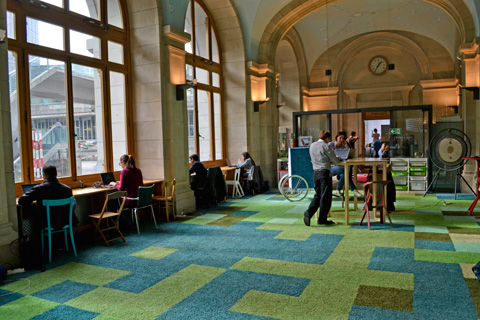
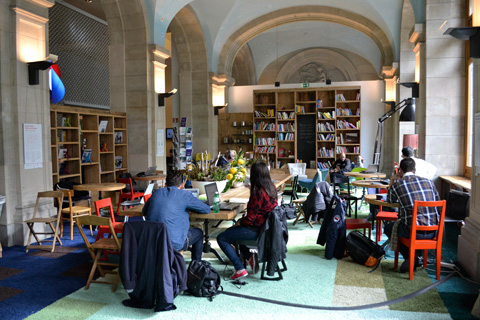
The interview with Tim Alexander took place at Swisscom's "Brain Gym" at the Bollwerk in Bern. In this center for creativity, there is also a living room (photo above), whose furnishings are based on the living space of potential customers.

_DSC0049
_DSC0053
_DSC0055
_DSC0057
_DSC0061


"Best of Swiss Apps": Shortlist announced

Following an extensive first round of evaluation, the shortlist of this year's contestants has been finalized and can be viewed on the website.

The first tendering and judging process for the new "Best of Swiss Apps Awards" has been successfully completed. For five days, 41 jury members sat together in Zurich and evaluated all 130 submitted projects. The result is the Shortlistwhich this year includes a total of 69 projects that can seriously hope to win an award. Best of Swiss Apps congratulates all the projects that have made it onto the shortlist.

Project Client Contractor
After Party
bfu - Swiss Council for Accident Prevention AND Federal Office of Public Health, "I talk about alcohol" campaign Gestalt Kommunikation GmbH | Gbanga Millform AG
Budget alert
Editions Plus Sàrl Mediancer Sàrl
Alpine Flower Finder - Discover the wildflowers of the Alps
Renata Caviglia, webgestalten.ch n3xd software studios AG
appolino Plus & Minus
Teaching materials publisher St. Gallen LerNetz AG
appolino Writing
Teaching materials publisher St. Gallen LerNetz AG
Excursion destinations in Switzerland
Private project Private project
AutoScout24
Scout24 Switzerland AG Xmedia AG
az Aargauer Zeitung Mobile
AZ Newspapers AG Goldbach Mobile
BLINQ
BLINQ Three-pole
Bring! shopping list
Bring. Bring! by Publisheria
chocogreets
mySwissChocolate AG Boxalino AG
ComeOn!
Apps with love GmbH Apps with love GmbH
Comparis Real Estate Windows Store App
comparis.ch AG Zühlke Engineering AG
Coop Grill
Coop Cooperative bitforge AG
Coop Hello Family App
Coop Cooperative include7 AG | Obvious
Datasport Events
DATASPORT AG Experience Guys GmbH
Departures Switzerland
Tactile Software GmbH Tactile Software GmbH
Die Schlaumäuse - In the land of language
Microsoft Switzerland GmbH HELLIWOOD media & education in fjs e.V.
easyPush - Executive MBA App
Zurich University Futurecom
ExLibris Mobile Shopping App (iOS)
Ex Libris AG Youngculture AG | Carpathia Consulting GmbH
gleis7 Entertrainment
SBB CFF FFS Moca AG
Bern Grand Prix
approppo approppo
HockeyInfo
Ahrina GmbH Ahrina GmbH
home.ch
home.ch home.ch
HSG Focus
University of St.Gallen (HSG) Dachcom.ch AG
Insights Orthopedics
Medical Insights AG finebrain AG | Canoo Engineering AG
iRoom
Raumgleiter GmbH atfront ag
Kaba Docs
Kaba AG webgearing ag
KPT Smileball
KPT/CPT Insurance webguerillas AG
LeShop.ch iPad Edition
LeShop SA LeShop SA
Lindt2b
Lindt & Sprüngli Middle East Netcetera AG
LiquidSketch
None None
M8! - Mind Map
WeyDo WeyDo
MeteoSwiss
MeteoSwiss Ubique Engineering Ltd.
Mila
Mila AG Mila AG
MINIMANIA Run your own Migros branch
Federation of Migros Cooperatives PRfact AG
MobileDataReporting (MDR)
Martha Software GmbH Martha Software GmbH
MobileSG - Sankt Gallen Mobile
City of St.Gallen anthracite ag
myENIGMA
Qnective Qnective
Night shifts
Zurich University of the Arts Zurich University of the Arts
NZZ.ch for iPhone
Neue Zürcher Zeitung AG Cellular GmbH
Ocean Science
Monterey Bay Aquarium Research Institute Ringier Studios AG
OKO
independent independante/privé
OutdoorMaps
Nexplore AG Nexplore AG
Partners Group iPad Information Platform
Partners Group mp technology
Photo Service
Ifolor AG Zühlke
PipeFiction
Goldfish Software GmbH Goldfish Software GmbH
PipeFiction (Windows 8)
Goldfish Software GmbH Goldfish Software GmbH
Ricola Farmer
Ricola AG YooApplications AG
SBB Mobile
SBB AG, E-Business SBB AG, E-Business
Sennheiser LSP-500 PRO App
Sennheiser NOSE Design AG
SIWÄ
Private Private
SmartID Pay
Institute Icare Institute Icare
Star flight 2
Coop Cooperative bitforge AG
Swisscom TV App
Swisscom (Switzerland) Ltd. youngculture AG | monostream GmbH
Tooxme
Tooxme Tooxme
UBS Financial Health Check
UBS AG Namics AG
UBS Mobile Banking App 3.0
UBS AG Namics AG | AdNovum Informatik AG
Uepaa!
Uepaa AG Uepaa AG
Weather bucks
Lenzerheide Tourism Jung von Matt/Limmat
WWF Guide
WWF Switzerland getunik ag
XBMC Remote
no company. Private project no company. Private project
Zurich Zoo
Zurich Zoo Futurecom
Zwap.TV
Filmwords AG Filmwords AG
"Cargo Game"
Nationale Suisse SCHMAUDERROHR

Follow the departure in real time

The new partnership between Microsoft and Red Bull Rampage breathes new life into freestyle mountain biking on Internet Explorer 11.

In an announcement Wednesday, Microsoft announced its new partnership with Red Bull to showcase Red Bull's freeride mountain bike downhill competition, Rampage, on Internet Explorer 11, an event that just premiered Oct. 11-13, 2013, in the southern Utah desert.

The event was broadcast live throughout the weekend, allowing viewers to vote directly for the winner. With the updated website the highlights of Rampage can be conveyed even more impressively, Microsoft says. The site presents a 3D map of the downhill course, rider biographies, videos of the descents and a behind-the-scenes look at the event. In particular, it uses Web GL to take advantage of a new capability for creating 3D content.

To create a geographically accurate, three-dimensional model of the Rampage terrain, the developers collected 3D geospatial data about the location of the course and its surroundings from the area around Gooseberry Mesa. As a further step, small GPS devices were attached to the mountain bikes to record their exact position during the descent. Finally, the developers used the time stamp of the GPS data and matched it with the exact GPS data from the riders' video footage.

The combination of these three data sources creates a whole new kind of physical awareness of athletics presented at Rampage, Microsoft's announcement said. This should inspire Web developers around the world to rediscover the possibilities of the Web.

1.redbullrampage
 

Felix Partner nominated for German Design Award

The book «Swiss Housing Projects by Felix Partner» was named the 2013 winner in the Communication category at the Iconic Awards on June 27 and is therefore eligible for the German Design Award.

The Iconic Awards honor visionary architecture, innovative products and sustainable communication from all areas of architecture and the construction and real estate industry. The competition thus draws attention to the interplay between individual trades. The focus is on the holistic presentation of products in architecture.

With this award, the architecture and design firm Felix Partner has also qualified to take part in the German Design Award and is a nominee for 2014. The German Design Award recognizes products and projects in product and communication design. The initiator and organizer of both awards is the German Design Council.

About the book

Felix Partner is the brainchild of Peter Felix, architect, and Rahel M. Felix, designer and marketing communications planner. Using built and unbuilt projects from recent years, the book aims to explain the approach that architecture and design should deal with the entire value chain of a construction project. This ranges from real estate valuation and project development to project financing, planning and execution, including marketing and furnishing. The Zurich-based architecture and design firm covers all these areas. "Swiss Housing Projects" uses thirteen selected projects to showcase the work of Felix Partner. The various aspects are explored with contributions from Kenneth Frampton, Thomas Held and Ulrike Gölker Zeugin. Portraits with residents and clients provide additional personal insights.

1.architektur


get_footer();