

A phantom is on the loose


Migros has managed to pull off a brilliant move these days - one that I, as a passionate Migrosist and anticoopian, can applaud uncritically and painlessly: Migros is giving our children "Minis", i.e. Migros products in miniature format, and mommy and daddy in the same breath another little piece of childhood. At the moment, everyone who has children considers themselves lucky. For once, not because of the children, but because at the Migros checkout, in response to the cashier's question "Do you collect miniiiiiiiis? "with a hearty "Yes, of course!" at the checkout. Everyone else invents nieces, nephews or grandchildren in order to enjoy the tiny Gruyère, toilet paper packages and ice cream sticks for the Kauflädeli. It doesn't matter whether they tear open the little orange sachets themselves as soon as they turn the next street corner and enjoy the mini products. "So häääääärzig," even graying gentlemen can be heard exclaiming.
The minis are also a hit with the actual target group. Since the campaign started, all I have to do is tell our two-year-old, "Come on, let's go get Minis." And he immediately follows me willingly to the store. Only when my tour from the entrance to the checkout takes too long does he start to whine: "Mamaaa? Mini? Hmmmm?" And as soon as we get to the checkout, he snatches the sachets out of the cashier's hand and immediately has to tear them all open. Every time I ask myself: Which Mini actually catches which one?
Passion en miniature
And me? On the one hand, I'm very enthusiastic, but on the other hand, I have a good grip on myself. It's only with the minis that I'm overcome by a peculiar greed. First, I want to open the sachets that my son shreds myself and let the little tubes and sachets disappear into my handbag. Secondly, I always wait to see whether the person in front of me or the person behind me will get more minis than I do. And third, I always choose the cash register where we pay so that there's a chance the person in front or behind me will ask me, "Would you like mini minis?" If my wish comes true, a wave of warm happiness flows through me.
Even my hubby, otherwise above any short-lived enthusiasm for Chrüsimüsi, is blown away. Every Friday, he lurks to see if we've left him a few sachets that he can open himself. Usually that's not the case, so he makes a pilgrimage to our well-kept collection box and calls out "cool" or "so läääss". We both can hardly wait until the Kauflädeli time of our Bürschchen begins. Finally we can play again!
Wrapped around the finger with charm
Unfortunately, the promotion is almost over. Our home-and-home Migros had already posted the warning last week: "There are no more Minis in this store." And indeed, on our last shopping trip, the big disappointment followed at the end: Minis are out. What a pointless purchase! Luckily, we have a dear neighbor who saved our weekend: she had posted ahead of us and snagged some of the last minis - and hung them on our doorstep. It was like a birthday where you get the gift you were hoping for at the very end. But I don't yet know how I'm going to inspire our offspring to go weekend shopping in the future. Maybe I'll promise him, "If you're nice, I'll buy a few minis for you at the auction afterwards. Because in the meantime, it's not just Migros that runs a swap meet for duplicate Minis; you can also buy and swap Minis everywhere else on the Internet. But of course they were the nicest as gifts.
More than one million tablets
Media tablets are currently the growth product in home electronics. Sales in Switzerland have more than doubled every year for the past two years. In the current year, more than one million devices will be sold. A media tablet is already in use in every third household.
Smaller screens in demand
The sharp drop in average prices, which was made possible not least by the trend toward smaller screens, contributed to the high penetration. While virtually all tablets were larger than eight inches last year, the new segment of six to eight inch screens accounted for 40 percent of sales in the first half of the year. The new "phablets" are now to close the last gap between smartphones and tablets.
The boom continues
Media tablets are a strategic focus for all major home electronics manufacturers and prices will continue to drop. Apple's dominance has been broken in the meantime and the competitors around Android and Microsoft are also betting on tablets.
Prodir is an international manufacturer of promotional writing instruments with seven European subsidiaries and a sales office in Moscow. The writing instruments are manufactured exclusively in Switzerland and are said to stand out for their quality and design.


Unfortunately for the rest of the world, it is extremely problematic, if not almost impossible, to pronounce the brand name correctly. But who, if not the citizens of the mighty People's Republic of China, should be able to identify with a word like Volkswagen? The Wolfsburg-based manufacturer needed a project that was not only accessible to everyone, but also understandable: the German car manufacturer developed an online crowd-sourcing platform called the People's Car Project (PCP). On the social media platform they created, www.zaoche. cn (meaning "to build a car"), anyone could put together their own virtual dream car as they wished.
On the one hand, this project helped Volkswagen to understand the preferences, needs and requirements of Chinese customers and, on the other, to maintain a secure position in the market. The desire of the Chinese for individual automobile design seemed to be great, as the People's Car Project exceeded all expectations. After just eleven months, the website had 33 million visitors. And that's not all: over 119,000 different concept ideas were submitted.
But which of these innovations are feasible and which are useless? The proposals submitted were first and foremost evaluated by the community and then by a number of experts. Three of the vehicle and technology concepts designed by users on an online platform and further developed by Volkswagen were presented at "Auto China 2012" in Beijing. How can we imagine a virtual self-built car? One thing is clear: if the Chinese have their way, wheels are superfluous. This is demonstrated by the so-called "hover car", a floating two-seater that could travel emission-free over electromagnetic road networks. This futuristic vehicle, which is more reminiscent of a vehicle from a science fiction film, not only caught my eye, but also attracted the greatest attention from the public and experts.
People's Car Project, is it all just a pipe dream or serious ideas for the mobility of tomorrow? It remains to be seen how high the chances are of a "hover car" floating through our cities in the future. The fact is that Volkswagen's aim of giving its brand an innovative and emotional touch with this project has undoubtedly been achieved. In addition, the project, which was originally only planned to run for one year, has been extended indefinitely thanks to its great success.
Manuel P. Nappo, Director of Studies CAS Social Media, Management HWZ University of Applied Sciences in Business Administration Zurich. www.fh-hwz.ch/smm
Farewell Gebi
On October 15, 2013, Gebi Schregenberger bid farewell to this world. He went as he had lived, with great dignity. I was able to accompany him with my family. Thanks to him, Gisler & Gisler had become a legendary advertising agency: at times the largest and always one of the best. Everything that came out of our company had to satisfy Gebi's incorruptible eye - and so these campaigns still stand up to any criticism today. More than that - they are still a feast for the eyes.
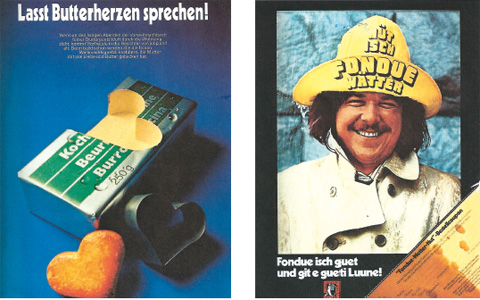
Gebi selected his employees with a sure hand and forged them into a close-knit team in his inimitable way. Many of them would have had what it takes to be an AD or creative director at another agency - but they remained loyal to G&G and, above all, to Gebi. To encourage them, he often took a step back himself. He was proud to be part of "Gislerei", which would not have existed in this form without him. This pride was transferred to his entire studio.
He joined the agency in 1954, when it was still called "Kaspar Gisler, Reklameberatung", but already bore the later famous Gisler logo. He helped shape the entire, often turbulent development into a full-service agency with around 100 employees. After Kaspar Gisler's death, he supported me in my then still almost exotic role as the first female agency boss. He enjoyed the many trips associated with the expansion of our international relationships and the recognition he received from leading American and European agencies.
When I retired from the agency business, it was obvious to me that he should become my successor. I almost had to persuade him - he hesitated, and he was right. Torn away from his actual job, which he was doing so masterfully, he lost his footing. He agreed to a merger that was incompatible with the culture of Gisler& Gisler, which had grown over decades, and meant the end of this charismatic agency.
Our friendship also survived this test. To his and my great delight, we not only met in private and at the "Gisler-Höck", which still takes place regularly, but were also able to toast the good times we had together at the big nostalgia party with 180 alumni.
Doris Gisler Truog
The client requested a media plan for its online campaign that took into account Xbox Live, online TV, mobile devices, etc. in addition to the major platforms. For the campaign with two subjects in three languages, we received a production plan for 140 advertising media from the media agency, of which only 40 complied with the IAB standards. The remaining 100 advertising materials were subject to individual specifications, some of which had to be searched for on the publishers' websites or were not easily accessible. As publishers cannot agree on standards for special formats such as Xbox Live, YouTube mastheads, in-read & keyword videos and siteboard videos, they result in additional work and costs:
- The specifications for special formats are only partially available in writing. They must be requested directly from the publishers.
- Mobile advertising in particular leads to advertising media inflation, as the advertising media vary depending on the screen resolution, screen orientation and bandwidth.
- The individual advertising media cannot be derived from a standard dimension; instead, each advertising medium must be laid out individually.
- The publishers have not yet agreed on file formats (FLV, MOV, SWF, etc.), which in turn increases the production effort The client must take into account that a text or image change during production leads to manual adjustments to all advertising media.
- Each advertising medium is analyzed and approved individually. It can happen that a single video format is not accepted by a publisher because it is too loud.
- If the client wants to measure the performance of the campaign with a 3rd party tool, each placement must be provided with a tracking code that must be correctly inserted and tested. In order to further establish online advertising on different mobile devices, publishers are called upon to think not only about their own technology, but also about the requirements of advertisers. Creative media plans and cost-efficient implementations are only possible with a further expansion of standards.
Sandra Marques
The launch of Radio Blue Sky is accompanied by a poster and advertising campaign. The new station's logo takes center stage and is staged using a light installation. The various cloud elements were created in real life as part of the production and later photographed. In this way, not only the songs of the Bee Gees, Rod Stewart and Prince are to remain in people's minds, but also the visual appearance of the new station, according to the press release on Tuesday.
In addition to the greatest hits of the 70s and 80s, Blue Sky also provides the latest news and weather forecasts. The station can be received practically everywhere on DAB+, cable, satellite and the internet.
Responsible at Music First Network: Franziska Hartmann, Paola Scaglione. Responsible at Contexta: Nadine Borter (overall responsibility), Jan Ehrenreich (creative direction), Ulysse Schnegg (art buying, FFF), Sandro Heierli (graphics), Raphael Gammenthaler (text), Giuseppe Luciano (advisory group management), Michèle Borter, Delia Zeiter (consulting). Production: Graphic-in. Photo: Caspar Martig, Sam Konrad.

With the large advertising banners, Google is breaking a promise it made eight years ago. "There will be no banner ads on the Google search results page. There will be no crazy, flashing, graphic things on the Google page that fly around and pop up. Never," promised Google manager Marissa Mayer, who is now head of competitor Yahoo. However, anyone searching for the airline Southwest Airlines in the USA on Wednesday, for example, was shown a huge photo of one of the airline's planes, including links to booking, check-in and customer service.
The simplicity of the Google site - in addition to the quality of the search results - had contributed to Google's success. Until now, text-only advertisements have been presented alongside the search results, with paid search results above the list of results. However, the prices for traditional Internet advertising on computers - and therefore Google's earning potential - have fallen recently. The reason for this is the boom in mobile devices such as smartphones and tablets, for which advertising has to be redesigned.
(SDA)
For these two reasons, I really liked Christoph Plate's article in the NZZ am Sonntag: It was plain language, German and clear, above all German. The title: "Nichts wie weg". Plate had worked in the newspaper's foreign policy editorial department for ten years, and "gladly". But as soon as he returned to his native Swabia after a successful escape and became deputy editor-in-chief of the Schwäbische Zeitung, the accusations came. The second German without complexes after Steinbrück.
Remarkably, even the SVP had long spared the Germans during its 25 years of hegemony - even though they are at the heart of its ideology and its image of Switzerland, which goes back to the World War. As if it were a taboo. After the triumph of the minaret initiative, the SVP relied on anti-German sentiment and used it to campaign in Zurich. The "German felt" at universities and in hospitals was attacked, "Berlin conditions" had to be avoided. Two or three years ago, the German professors fought back with an ad in the NZZ. Now they are going home. Even before it addressed the turnaround in German immigration, the NZZ had already published a dossier on the state of relations in Germany on Sunday to coincide with the elections and proclaimed: Normalization prevails. The exodus of Germans is already being lamented and the NZZ am Sonntag asked its former editor for a statement. Plate was now able to get rid of everything he hadn't said before in his own newspaper. The Swiss as Bünzli&Blocher drove him out of Zurich. Narrow-mindedness, anti-Semitism and anti-German clichés characterize us. He accuses an entire nation of a lack of controversy and self-irony.
And many of the reactions have confirmed all of this. But also the other way around: pure misjudgment, Mr. Plate! The neighbors' pity, "where our children would have made friends" (the next generation as a beacon of hope), was pure irony, which overtaxed Teutonic self-irony. In fact, the compassionate neighbors were genuinely and honestly pleased in advance about the departure of the foreign nest-polluter in spe.
Jürg Altwegg is correspondent of the Frankfurter Allgemeine Zeitung in Geneva.
Steven Neubauer, 37, has many years of experience in management consulting, especially for media companies. A native of Germany, he studied business administration at the University of Bayreuth and received his doctorate in innovation management from the University of Aachen in 2008. He joined McKinsey & Company in 2003, first in Berlin and later in Zurich.
You see many curious, enthusiastic, and even bewildered faces, because the variety of digital channels, possibilities, optimizations, business models, and technical solutions is so overwhelming that not everyone can cope with the barrage of opportunities—let alone find clear direction. But you can look for commonalities—that is, buzzwords that you come across at many vendors’ booths or that appear in many synopses of the countless presentations and seminars.
From this, we can already deduce the season’s trending colors. This year, at the very top of the wish lists of clients and agencies are «moving images» and «social media.» We saw this here and there last year, but this year it’s almost everywhere. This is largely because static images are increasingly met with skepticism in digital channels—and passive consumers are, too. The display business for marketers is crumbling. So, please, dear images—and consumers—get moving and get involved! As a cinema marketer, even in the digital age, you feel you’re in the very best of company. We’ve always had that down pat—admittedly, for over 100 years now. What’s new for us is that today we can also integrate ourselves into the chain of fully digital channels, and that speed, agility, and transparency in performance have increased significantly—allowing us to compete quite comfortably with online media. Key point: Actual attendance figures from the box office per campaign—up-to-date and fully generated, no panels, no calculations—real numbers.
We were also pleased to see a third keyword at dmexco: «local.» If you combine these keywords—for which there’s the somewhat clunky and not-entirely-new acronym «SoLoMo»—you get an idea of how these three factors interact: I’m on the go («Mo») and, of course, digitally connected via my smartphone; I’m reachable («So»); my friends know where I am and what I’m up to; and this location is also known («Lo»), as is the context at this location. These are, of course, idyllic conditions when you imagine that, armed with all this knowledge, brands and services can now engage in dialogue with me. Even the NSA would turn green with envy.
If this is the triple win for current and future communication, then we’re thrilled and right at the forefront. The best moving images (in every possible dimension), a fully engaged and involved audience, socially interacting in the moment, and reachable locally. Who could have imagined that online media, of all things, could set such high and effective standards for us die-hard movie lovers? And we have absolutely no problem with data protection either. After all, everyone sits in the movie theater of their own free will, enjoys the sense of community in the auditorium and the interesting content on the big screen, and pays a fair price for it. With a little luck, we might even get to know the people sitting next to us. That’s real life. With these trendy colors, I’m definitely on board. And by the way: Next year, I’m heading back to Cologne in September. You hardly ever get this much good news otherwise.
By Florian Weischer, Managing Director WerbeWeischer