Heart and soul for craftsmanship

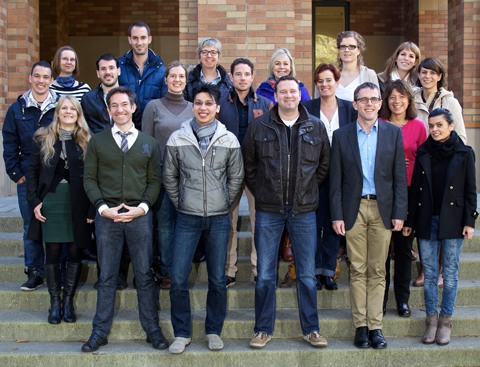
To mark its 20th fiscal year, By Heart Kommunikation has expanded its management team and staff. Othmar Küng and the production specialists from Pixeldisko have joined the creative workshop.

byheart_online
Markus Bircher, Othmar Küng, Hans Siegwart. Photo: Gian Marco Castelberg.

When Markus Bircher and Hans Siegwart sat at the table with Othmar Küng for the first time, the owners of By Heart had a good feeling. The agency was teaming up with the production specialists at Pixeldisko for a client project. "My impression was that, for once, this was not an aloof agency that wanted to realize itself, but was responsive to the other party," says Hans Siegwart. He was not wrong, as it turned out.

For five years, the brand management and design agency regularly cooperated with the Multimedia Factory. For Emmi Caffè Latte, for example, By Heart renewed the entire brand presence, Pixeldisko subsequently transported the brand ideas into the digital world.

For a few weeks now, By Heart and the Pixeldisko team have been going their separate ways. Othmar Küng, founder of Pixeldisko, came on board as Managing Director and member of the Board of Directors. "Like us, Othmar is a doer," Siegwart says, explaining what the three managing directors have in common. "One who approaches brands with a seriousness and care."

As of now, around 16 employees are working for By Heart. Othmar Küng has taken over the interface function as Supervising Head and will accompany the entire process from strategy and conception to implementation. Hans Siegwart leads the creation as CD, Markus Bircher is responsible for the service part as Managing Head & Copy - for strategy, brand consulting and text.

Brand specialists and producers

By Heart's strength originally lay clearly in the area of brand management and brand creation. However, in order to offer customers everything from a single source, external specialists were often brought in. This worked out quite well thanks to close partnerships. But the ambition to cover a larger area of value creation grew steadily at the agency. "If you create the core of a brand, you shouldn't leave the realization out of your hands," says Siegwart.

By Heart is convinced that the fascination of a brand cannot be theorized. It arises in the implementation. "Whether a brand works is not decided on the strategy paper, but on the individual word, on an image, on the way I talk to the target group in the social community," says strategist Bircher.

To follow and determine every single step is therefore the claim of By Heart. They are the craftsmen who still stand in the workshop themselves and work on the implementation. Creative director Siegwart, for example, likes to look over the shoulders of the crew during the shoot, and strategist Bircher still writes the texts himself. "We want to prevent our thinking from suddenly getting lost at one point."

This attention to detail is visible, for example, in the poster sujets for the fashion company Burger with sexy posing couples, in the image campaign "Das Bild der Frau" for the women's magazine Annabelle, in which prominent Swiss women had themselves photographed without makeup. Or at Paul Kehl. By Heart completely developed the PKZ Group's own brand, built it up together with the PKZ design team and positioned it as "fashion for the active, sporty man".

"As a brand, it's essential to speak the same language across all platforms," Bircher explains. As soon as you cede individual areas, you relinquish control to a certain extent. It was therefore nothing other than a "logical consequence" for the owners to integrate the production area into their own agency sooner or later.

Continuity in the creative workshop

There have already been several opportunities for mergers and cooperation. However, it has not really worked out so far.

The only possible partner was someone who shared their fascination for craftsmanship and their demands. Both were the case with the founder of Pixeldisko. With Othmar Küng, another craftsman joins By Heart. One who has internalized the "office mentality" and is just as attentive to detail as Bircher and Siegwart. "If you believe that nuances ultimately make a brand shine, it would be negligent not to control the various disciplines and process steps yourself," says Küng, who learned the design trade from scratch in a print shop.

In fact, the agency By Heart and Pixeldisko have become the company By Heart. However, Pixeldisko will continue as a brand. Clients who specifically demand expertise in creative productions and implementation in print and digital - which is what Pixeldisko has made a name for itself with over the past eight years - will be served directly on request. "Just as there is Armani and Emporio Armani," says Siegwart, "we have By Heart and Pixeldisko." So it says on the business card, "By Heart & Pixeldisko."
 

Giving up the By Heart brand was not up for discussion. Siegwart and Bircher, who launched By Heart with partners in 1994, wanted to continue the agency in the same spirit. "The agency was successful and there was no reason to do everything differently," Bircher says. "Rather, we wanted to make sure we could continue to bring our strength in brand management and brand creation and be best equipped to meet today's demands," Siegwart says. To some extent, this also meant rejuvenating the agency - with a generation that has grown up with digital media.


Down to the last detail
 

By Heart wants to hold on to its manageable size. "Small but mighty," as the agency is described by clients. To be only as big as it can continue to accompany processes from A to Z. "The customer has us not only at the beginning, but also at the second and third meeting," says Bircher. "And he knows: We're doing it." From the first question (What makes the brand? What does it stand for? How can it assert and develop itself in the market?) - until the poster is on the wall, the commercial is "on air," the website is online.
 

"You can compare our work to haute couture," Siegwart says. "There, the fashion designer changes the seams with his own hand shortly before the fashion show until the dress fits perfectly." In the same way, he says, brands need accompaniment and fascination until the very end.
 

"We receive the best possible support in the areas of branding, conception and strategy, as well as in all the creative implementations," explains Simone Schäfer, Head of Communications at PKZ BurgerKehl & Co. "I can recommend the agency to any client who values personal consulting and wants a lot of heart and soul in their daily work."
 

By Heart returns the compliment: "Our work is only possible because our clients are serious about their brand and don't just want to go for a fun flash in the pan," Siegwart says. "PKZ, Navyboot, Beldona ... Our clients have a strong brand understanding themselves," says Bircher. The same is true of the Pixeldisko agency, which will in future complement By Heart's brand portfolio with clients such as Canon, Warner Bros. and Twentieth Century Fox.
 

At the moment, a chocolate brand is being honed in the creative workshop. For Camille Bloch, By Heart is breathing new life into the traditional Ragusa brand and making it accessible to a young audience (here it goes to the article). "A dream customer," Bircher says. "Camille Bloch looks at every hazelnut in the Ragusa," says Siegwart. "And we on every stroke, every word and every nuance of color," adds Küng.

Isabel Imper

article2_4_large
For the magazine Annabelle By Heart had the internationally renowned photographer Paola Kudacki portray women - without makeup

article2_2_large
The stylish classic: subjects for the fashion company Burger

pkz
The PKZ Group's own brand Paul Kehl was completely built up by By Heart


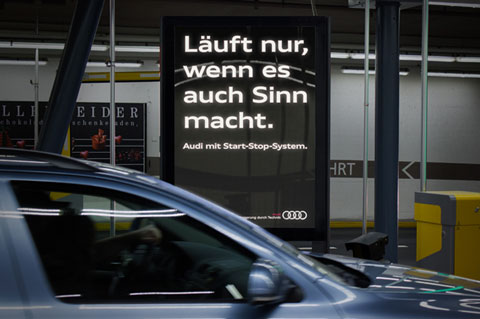
Exxtra: Audi billboard only lights up when it makes sense

The Audi Start-Stop system helps to reduce fuel consumption and CO2 emissions by switching off the engine when stationary. Exxtra is now bringing this technology to life for Audi in an interactive poster campaign.

The Start-Stop system was integrated by Exxtra into illuminated billboards - placed in places where you have to stop. With the help of a sensor, the poster only lights up when a car stops. If the car continues to drive, the backlit poster switches off again, demonstrating the effect of Audi's energy-saving Start-Stop system.

Responsible at Audi: Erich Hunold (Head of Marketing Audi), Barbara Wernli (Head of Advertising Audi). Responsible at Exxtra: Dominik Oberwiler, Martin Stulz (CD), Sandro Tissi (AD), Patrick Bucher (text), Nora Bertoli (graphics), Susan Baumgartner (consulting); with the technical support of APG/SGA.

1.startstop.1
1.startstop.2

Blick is looking for the eighth Federal Councillor

Blick is looking for the eighth Federal Councilor - a person who will work for the Swiss people for 45 days from August to September 2014. He or she will be assisted by a team of advisors and Blick journalists.

Switzerland is facing turbulent times - especially after the vote on the mass immigration initiative. With the search for the eighth Federal Councilor, Blick is now breaking new ground to launch the discussion about the future of Switzerland, according to a statement on Monday.

"We are offering someone the unique opportunity, with the support of Blick, to move Switzerland for 45 days, to provide food for thought, to ask questions and to find solutions for a better Switzerland - and thus to work directly for the people," explains Blick editor-in-chief René Lüchinger. The eighth Federal Council will receive its assignments directly from the people, according to the press release.

From next Saturday, March 1, 2014, any person resident in Switzerland who has reached the age of 18 may register on the website TheEightFederalCouncil.ch apply. The best applicants, a maximum of 200 people, will be invited to a personal casting in Zurich on April 5 and 6, 2014. In a 15-minute interview, the aim is to convince the Blick jury of his or her personality, ideas and doer qualities. From May 11 to 24, the public will choose the eighth Federal Councilor from the nine best candidates in the casting. The eighth Federal Councillor will not only have his own office, a team of advisors and an official car, but also the salary of a real Federal Councillor: 50,000 Swiss francs.

Switzerland can follow the search for the eighth Federal Councilor on the various channels of the Blick Group. "We will closely accompany the selection procedure as well as the term of office with our products and let the audience have a say," says Florian Fels, CEO Publishing at Ringier.

//www.youtube.com/watch?v=qdTszjoQago

How to Make the Leap Across the Border

This year, Lucerne University of Applied Sciences and Arts is offering the CAS in «International Marketing and Communication» for the third time. We’ll explain what the program is all about—and share how participants in last year’s CAS experienced the course.

tab-skyline

A Swiss food manufacturer wants to make its products appealing to U.S. consumers; a pharmaceutical company wants to supply the Chinese market with medicines; and an industrial company wants to carry out a construction project in India. For some, the small domestic market is driving the search for new sales opportunities. Others hope to benefit from economic growth in emerging economies.

The scenarios and motivations behind local companies expanding beyond Switzerland vary. However, crossing the border is always a challenge: choosing the right market, deciding on the form of market entry (should I work with a trading partner, establish a joint venture, or set up my own subsidiary?),, the right strategies for market development, the selection of distribution partners, legal factors (e.g., environmental regulations, tax burden), and communication.

Anyone who plunges into an international venture unprepared reduces their chances of success. Some companies are not sufficiently aware of the consequences of expansion, says Anja Janoschka, a professor at the Institute for Communication and Marketing (IKM) at the Lucerne University of Applied Sciences and Arts (HSLU). Since 2012, the university has offered the annual CAS program in «International Marketing and Communication,» equipping marketing and communications professionals, salespeople, and executives for their international endeavors.

The Program: Over the course of 16 class days in Switzerland and a one-week study abroad program, participants gain the knowledge needed to develop international marketing and communication strategies. They will learn about market entry strategies for key Swiss export markets, examine various distribution channels and cultural differences, and explore the requirements and implementation options of the marketing mix in an international context.

Do you have sufficient human and financial resources? Are your own employees motivated to work abroad? Can you absorb a failure without jeopardizing the company in its home market? Such questions are often given too little attention, says Janoschka, who heads the CAS. Cultural differences are also frequently underestimated. Unpleasant surprises can arise not only in areas such as work practices, resources, or staff. In China, it’s quite common for entire teams to switch to another employer, as Janoschka explains.

There are additional hurdles at the communication level. On the one hand, there are translation errors or literal translations that are interpreted differently in a different cultural context. On the other hand, depending on the market, the visual elements must also be adapted. This is particularly true for Arab countries, where there are strict regulations governing how women may be depicted in advertising.

Global, local, or glocal?

A key concern for many companies as they expand: finding the right balance between global and local thinking. «A global strategy makes sense above all for consumer goods that appeal to homogeneous target groups and show little or no cultural variation,» explains Janoschka. Perfumes, for example, or high-tech products like computers and chips—products that are identical worldwide or differ only marginally.

A hybrid approach, known as “glocal,” is also possible. For example, a global brand promise that is culturally adapted in communications. According to Janoschka, razor blades or ice cream are well-suited for global or glocal advertising. For example, a global approach when grouping similar markets, but adapted to different consumer behaviors and needs.

The cost savings achieved through a global strategy are often substantial, though this comes at the cost of not reaching the entire target audience. «It’s not uncommon for perfume manufacturers to advertise worldwide using a French slogan—without expecting it to be understood,» says Janoschka. Rather, the aim is to evoke certain associations with France, the perfume’s country of origin, through the language. Anglicisms, on the other hand, are frequently used to suggest scale and modernity. However, caution is advised when targeting specific audiences. «Older consumers, in particular, sometimes react negatively to Anglicisms.»

However, a local strategy is important for products with regional roots or sociocultural characteristics, such as food and luxury goods. As an example, Janoschka cites the chocolate manufacturer Lindt, which has adapted its product line to the tastes of American consumers for the North American market.

lucerne1

Theory and Practice

«We have two goals,» explains Janoschka. «On the one hand, to impart knowledge that participants can put into practice right away. On the other hand, we want them to have at least once engaged with the key theories and approaches.»

The CAS program isn’t limited to the lecture halls, either. In addition to a field trip to Schindler, a manufacturer of elevators and escalators, the CAS participants visited the headquarters of the Starbucks coffee chain and the Boeing aircraft manufacturing facilities—where the new Dreamliner is built—during their study week in Seattle.

At the partner university in Seattle, the focus was once again on theory and practice. In addition to lectures, a panel discussion with industry professionals explored the use of social media in marketing communications. And when it came to developing market strategies for Swiss companies in the U.S. market: For example, one group developed a scenario for the Swiss Nail Academy, a beauty school, outlining how it could gain a foothold in the U.S. Another group considered how to expand marketing efforts for Hocoma, a manufacturer of therapeutic devices already well-known in the U.S.

The CAS instructors also bring this blend of practical experience and theory to the program. They are professionals with academic backgrounds—or academics who have gained practical expertise through professional experience or consulting engagements. This year’s course featured, among others, a marketing director from an international consumer goods company, a B2B expert from a technology firm, a communications manager from a foreign trade organization, and a strategist from an international advertising agency.

«There’s no getting around the trial-and-error method when companies expand into foreign markets,» says Janoschka. «However, decisions in international marketing shouldn’t be made solely on a gut feeling.»

Isabel Imper

IN BRIEF

The CAS in «International Marketing and Communication» is designed for professionals working in international marketing, communication, or sales, and covers both the B2B and B2C sectors. The focus is on the four operational marketing tools, the 4 Ps: Product (product design), Price (pricing policy), Place (distribution), and Promotion (communication). A class typically consists of around 15 participants (maximum of 24 students). The CAS can be enrolled in individually or as part of the MAS in Communication Management. Cost: 11,500 Swiss francs (plus travel and accommodation expenses for the study week).

For information and registration for the fall semester of 2014, visit: bit.ly/1mqtrZR. You can find the participants' blog posts at: Blog.hslu.ch/internationalmarketing.


Iced Tea Launch from Tee Gschwendner

Partner & Partner begleitet die internationale Lancierung der neuen Ice Tea-Linie von Tee Gschwender vom Packaging Design bis zur kommunikativen Unterstützung am POS.

The eight new Iced Tea sorts of tea Gschwendner stand out by their naturalness, it is called in a communication from Monday: as genuine tea infusion, without artificial sweeteners and in bio quality the aroma is to 100 per cent natural. Communicatively just as on this USP one sets as also the scientific illustration style the contents materials naturally-fresh to represent is.

The German tea retailer Tee Gschwendner is, among others, a strong supplier in the Arabic market. According to the agency, the culturally different requirements and the six-language texts in German, English, French, Spanish, Arabic and Russian proved to be a particular challenge in the package design.

The new Iced Tea flavors Mango-Passion Fruit, Mate, Ginger-Orange, Mint, Grapefruit-Apple, Black Cherry, Wild Berry and Elderflower will be available from mid-February in the web store or directly in Tee Gschwendner stores in Germany, Austria and the Middle East.

Responsible at Tee Gschwendner: Birgit Rohn (Overall Responsibility/ Head of Marketing), Christiane Mandt (Marketing). Responsible at Partner & Partner: Peter Elser (CD), Bettina Baumann (AD/Graphics). Illustration: Alain Blank, Blankvisual.

1.icetea.1
1.icetea.2

Folk music stations Tell and Heimatklang merge

The two folk music radio stations Tell and Heimatklang are merging. From March 1, 2014, they will share the new name Radio Tell - Heimatklang der Schweiz.

The station can be received on Radio Heimatklang's existing satellite frequency and cable channels, as detailed in a press release issued by the two stations on Monday. The folk music radio station can also continue to be received via the Internet.

The new radio station is on a sound financial footing, the initiators announced. This is ensured by the supporting association Heimatklang, the regional churches and Migros as patrons or sponsors. Radio Tell - Heimatklang der Schweiz will not only broadcast mainstream folk music, but also lesser-known titles.

Radio Tell used to be called Buureradio and first went on air in 2005. The first editor-in-chief was SVP National Councillor Toni Brunner. At the beginning of 2012, Migros had to support the station financially. Since then, the station has been called Radio Tell. Radio Heimatklang, based in Langnau im Emmental, emerged two years ago from the local radio station neo 2, which had been discontinued. The neo 2 support association and the founding association for a Swiss folk radio station then continued to run the station as a folk music station.
 

Last but not least: Bearer of good news

Mean, but clever: Jung von Matt/Neckar turned DHL's competitors into walking billboards.

The agency has achieved a masterpiece in guerrilla marketing and is causing a stir worldwide. Whether the parcel service is really faster and better than all of its competitors remains to be seen. But one thing is certain: in terms of advertising, the yellow and red giant is at least one step ahead of the competition after this campaign. Parcels were prepared with thermal foil in such a way that the prominently printed message "DHL is faster." was not visible at first. The cooled, black shipments were picked up and loaded by UPS and other logistics companies. As temperatures rose, the bulky freight took on color and lettering - forwarded by the unsuspecting curriers of the competition. Of course, the question arises as to whether the "victims" should not have noticed the huge lettering at the latest when unloading. But, as always, it's the idea that counts - and that is undoubtedly convincing. (hae)

dhl-01
dhl-02
dhl-03

//www.youtube.com/watch?v=dAdlKx98rAw

Regional TV stations demand more money

At a meeting marking its 20th anniversary, the Telesuisse association of regional television stations called for a larger share of license fee revenue for its members. The stations consider the current share of four percent to be too low.

Telesuisse announced on Saturday evening that the current share of fees for regional broadcasters is clearly not sufficient to allow broadcasters to adapt to rapid technological change and to further develop their content and technology. In the upcoming revision of the law, Telesuisse is demanding a share of the funds in the range of four to six percent. This means that SRG SSR, which receives almost all of the remainder, will continue to be favored, the communiqué continued. The Federal Council is proposing a range of three to five percent to latu Telesuisse. Association members met in Gstaad BE for the Extraordinary General Assembly to mark the anniversary. Chairman of the Board André Moesch was re-elected. Filippo Lombardi, the new head of the CVP parliamentary group, resigned from the Board. (SDA)

Apple: Questionable security vulnerability

Apple has warned of a serious security vulnerability in its mobile devices, such as the iPhone and iPad, as well as its Mac computers. Hackers could gain access to email and other encrypted communications.

It has therefore provided security updates for the iOS operating system, which runs on iPhones, iPod touches and iPads. Most devices are updated automatically. The company admitted that the security vulnerability also exists in the current version of the Mac OSX operating system, which is used on Apple laptops and desktop computers. The company announced that it would provide an update for these devices "very soon". If attackers have access to the same network as the user - for example by using an unprotected WLAN connection in a restaurant - they could intercept or even modify the communication between the user and protected websites. A hacker could, for example, intercept emails or bank details, warned cryptography professor Matthew Green from Johns Hopkins University. "It's just as bad as you would imagine". The company did not say when or how Apple found out about the problem. (SDA)

apple-update
update-8-stunden
Coveted update: If you want to protect yourself, you need patience.

Google: First Big Tent in Switzerland

On Wednesday, February 19, Google held its first "Big Tent" event in Switzerland. At the Folium Sihlcity, prominent figures from the worlds of politics and business gathered to discuss the significance and role of the Internet for Switzerland’s export-oriented economy.

Big Tent is a series of events organized by Google at which representatives from a wide range of sectors come together to discuss the impact of the internet on the economy and society, as detailed in a press release. Eric Scheidegger, Director of Economic Policy at SECO, opened the conference with a keynote speech. He emphasized the importance of the Internet for Switzerland: "The Internet permeates all areas of life and the economy and is of enormous importance for the Swiss economy." In the second keynote speech, Daniel Küng, CEO of Switzerland Global Enterprise, spoke about the importance of a digital business strategy for the success of every company. According to the export expert, SMEs that utilized the advantages of the internet worldwide would earn twice as much and create twice as many jobs.

A video link from National Councillor Ruedi Noser, entrepreneur and President of ICTswitzerland, who described the Internet as our lifeblood, was followed by a panel discussion with moderator Reto Lipp. He was able to welcome Robin Barraclough (Executive VP Global Categories & Marketing and member of the Executive Board at Emmi), Julia Graf (independent Internet entrepreneur), Helmar Hipp (CEO ifolor) and Monika Walser (former CEO Freitag lab AG and Partner Waega Group) as participants. They discussed the advantages of a successful export economy based on the Internet, which is essential in all sectors.

The official part of the event concluded with a discussion between Reto Lipp and Vint Cerf, Chief Internet Evangelist at Google and one of the founding fathers of the Internet. Afterwards, at the packed Folium Sihlcity, attendees were able to discuss their own views on the potential of the Internet as a 21st century trade route and its impact on the Swiss export economy over an aperitif.

Unbenannt-4_25
Unbenannt-3_17
Unbenannt-5_27
Unbenannt-6_26
Images: Google

Sales: novels before children's books

Books are becoming more expensive, yet more are being sold. Almost 40 percent of books sold in Switzerland are novels.

After five consecutive years of falling sales, in some cases sharply, the book trade saw a turnaround in 2013: Compared to the previous year, sales of printed books increased by 1.7 percent (Werbewoche.ch reported). The average price of a book has risen from CHF 20 to CHF 21.15, as reported by the newspapers Zentralschweiz am Sonntag and Ostschweiz am Sonntag. Nevertheless, Dani Landolf, Managing Director of the Swiss Booksellers and Publishers Association, assumes "that more books have actually been sold". The figures were compiled by market researchers from Media Control/GfK on behalf of the association.

Consumers in German-speaking Switzerland bought a total of over 20 million books. Novels lead the hit parade of the most frequently purchased books (down from 39.3 to 37.2 percent). Children's and youth books are in second place (from 18.7 to 19.1 percent). Guidebooks are in third place with 15.5 percent. On average, a fiction book costs 18 francs (hardcover and paperback) and a children's book 15.20 francs. (OaS)

PKZ: New campaign for spring/summer '14

An eye for style and quality combined with a keen sense of trends: that is the foundation of the Swiss company PKZ’s current Spring/Summer 2014 campaign. The concept was developed by the Austrian agency UCM Corporate Communication.

The PKZ Group, with PKZ Men, PKZ Women, Blue Dog and Paul Kehl one of the leading and most competent fashion companies in Switzerland, focused on value, finesse and chic, according to a statement. Toni Garrn and Jon Kortajarena, two top international icons of the fashion model scene presented the new F/S collection highlights in a radically reduced studio ambience.

Star cast

Spanish top model Jon Kortajarena embodies the masculine part of the campaign. As a charismatic, elegant and likeable guy, he is the perfect casting and forms the ideal counterpart to Toni Garrn. The German supermodel not only graces catwalks worldwide, but also the covers of international high-fashion magazines such as Elle, Numéro and Vogue. She scores with her natural charisma and her unmistakable charm. As photographer, the Spanish-Dutch fashion specialist Marcel Gonzalez-Ortiz ensured the perfect realization.

The concept includes 28 key visuals that can be seen on campaign posters, advertisements, magazine and newspaper inserts, and at the POS. In parallel, different videos were produced for TV spots, for use at the POS and for the website.

PKZ-WOMEN
PKZ-COUPLE
PKZ-MEN

Responsible at PKZ Burger Kehl & Co: Olivier Burger (owner), Simone Schäfer (communications manager). Responsible at UCM Corporate Communication: Nicolaus Zott (CEO/CD), Lisa Werger (AD), Jana Kürbiss (Key Account/Text). Photos: Marcel Gonzalez-Ortiz. Video Production: Miquel Gonzalez. Litho: UCM/Hiltl. Media: Thomas Rüttimann, Zip Media.
 

get_footer();