To the point: Thank you

Newsrooms can be viewed as organized social systems. This was the view expressed by Manfred Rühl, the German social scientist, in a book published in 1969.

Isabel Imper, a psychology student with a minor in journalism, began working in such an organized social system in September 2008. As part-time online editor of Werbewoche, she and her two colleagues were responsible for ensuring that the website was constantly fed with new reports. Her tasks were varied. She had to make inquiries by phone, follow up by e-mail, request picture material, do research and request new picture material because the one she had received was not printable. In addition, she had to keep up with what was going on in the industry and have a feel for what might be interesting. She had to write, struggle with image editing, and try to outsmart the content management system. She organized the messages on the daily newsletter page and at the same time had to put off impatient people who were missing their oh-so-urgent press release. To angry ones, she charmingly made it clear that her news item, "Groundbreaking news for the advertising industry," would be of interest to Werbewoche readers. She did all this dutifully, accurately and carefully. She was linguistically very gifted, interested, open to everything new and she wanted to make a career in journalism.

After Friederike Heinrich went on maternity leave, her position had to be filled. Isabel was one of the candidates. I trusted her with the new job, even though she had no actual journalistic training. She also had the confidence to take the step from part-time online editor to full-time print editor. I thought that was good. After a short break, during which she graduated as a lic. phil., she started as a full-time editor in December 2011. At the same time, she took courses at the Maz to deepen her knowledge and learn new things. She quickly found her feet in her new job.

She came up with new ideas and was interested in trying out new journalistic forms. She had a good graphic eye and she soon learned to take photographs as well. There, too, she wanted to know more, she continued her education and was never satisfied with the first picture she saw. As carefully as she formulated her texts, titles, leads and captions, she discussed the design of her articles with the graphic designer. In addition, she still found time to provide impulses to the online editorial team.

After just over five years, Isabel Imper is now leaving Werbewoche. We will miss her dedicated and charming manner. Fortunately, we are not losing her to another editorial team, because that would have been a bit upsetting. She will be joining Accelerom, a research and consulting company. I wish her all the best.

And who knows? Maybe she'll be drawn back to journalism at some point.

Pierre C. Meier, Editor in Chief
[email protected]

90 years ago the cars were more beautiful - even the poster

The example of the Autosalon posters shows the steady deterioration of advertising graphics. by Theophil Butz

This is about posters for events like automobile salons. I have deliberately chosen the word "advertising graphics". Because the term advertising would be too sophisticated in connection with the posters for the automobile salon. Almost without exception, the posters for this gigantic auto show have no charisma. They all assume a graphic-driven presentation. The idea is also always missing. Making a car wheel out of the letter "O" is just not an idea.

If you then read what was written about the winning poster, which was created on the occasion of a competition of the Geneva School of Art and Design, you get dizzy. Quote from the website: "To stimulate the viewer's imagination with as few elements as possible. For this reason, he limited himself to playing with the text. This reads as multi-layered: on the one hand, it suggests the silhouette of a limousine and suggests mountains - a homage to the Swiss landscape. On the other hand, the geometric letters lead from the edge of the picture to the center, which in turn is reminiscent of the construction of roadways. Just as if 'all roads led to the automobile salon'. The poster is in cheerful colors, emphasizing the buoyancy and dynamism of the event."

It is always amazing what the writing faction is able to interpret into this school work. If you look at the last 20 posters for this event, you are almost without exception disappointed. Somehow the organizer and client do not have a challenging brief ready. On the contrary, there seems to be a lot of caution involved. Proof of this is also the fact that a student competition was held for 2014 and the choice certainly fell on one of the most well-behaved solutions.

My theory: A big event like the Autosalon doesn't really need advertising. So, since a lot of money is already invested in posters, advertisements and banners, one could advertise a little more boldly, wittily and conspicuously. There are some pleasing examples, such as the advertising for the Knie Circus, the Montreux or Willisau Jazz Festival, the Locarno Film Festival, the Zooh posters in Zurich, as well as the poster for the first Batman film and the posters for the Zurich Opera House. Posters that spontaneously come to mind. In the same class of illness as the Autosalon, there are the Art Basel ads, the musical Wahri Liebi and the Olma poster.

There is an endless amount in this category, but unfortunately also an endless amount of bad, amateurishly designed advertising. Just as the example of the car show showed a slow decline in design quality over the last 90 years, exactly the same phenomenon is taking place across the entire volume of advertising. In my opinion, both the client and the creative side lack the courage to come up with the most attentive, novel and amazing solution. Look again at the 90-year-old Autosalon poster and let yourself be positively inspired.

My opener was - like every 1st Monday of the month - the funk, soul and jazz concert with Ernst Who and Robi What at the Kaufleuten Lounge.

salon
The 90-year-old Salon poster clearly wins the creative prize for me. The fact that advertising in general is getting worse can be seen not only in these examples.

Theophil Butz, graphic designer, advertising agency owner, inspirer and, for the last three years, mothballs for Werbewoche readers. Please send any relevant information to [email protected].
 

Trend towards paid privacy

Data protection expert Hanspeter Thür is convinced that privacy is increasingly becoming a privilege. «Only those who are willing to pay for it will be able to protect it,» he said in an interview with the NZZ on Thursday.

Google, Facebook, Whatsapp and co. are free, but "in return, the providers use the user data." And not entirely voluntarily. The disclosure of data often happens gradually, explains Thür. For example, if you buy a product and, after updating the operating system, it can only be synchronized with your own computer via the data cloud - i.e. the provider's server. "This is actually a defect in the product, but try returning your device with this justification." In fact, it is not voluntary - especially because all providers operate in this direction.

Wine lover or alcoholic?

The trend is clearly moving in the direction of comprehensive data collection. This becomes problematic when future behavior is predicted from the amount of data. "If an algorithm recognizes you as a wine lover, you might not care. But what if it identifies you as an alcoholic?" On the one hand, Thür is calling for consumers to become more aware. And also from politicians, because a clear legal framework is needed. Despite global providers, there is room for maneuver for nation states, the Federal Data Protection Commissioner is convinced.

Privacy made to measure

For example, politicians could demand that all services offered in Switzerland must meet certain conditions. For example, the possibility for users to restrict or even prohibit the collection and transfer of data. "We are talking about privacy by design here. Nobody is forced to use this option." Thür also calls for certain standards for the approval of products and stricter sanctions. He criticizes the fact that violating the Data Protection Act is now considered a trivial offence and no fines can be imposed. (SDA)

Image: Keystone
 

Print offers the best conditions for advertising impact

Advertising in print media is perceived as more informative, more credible and much less disruptive than in all other media types. This creates particularly good conditions for advertising impact.

The findings come from WEMF's latest MACH consumer study (see box). In addition to purchasing and consumer behavior, it also provides information on the frequency with which advertising is viewed by media and how informative, credible or annoying advertising in the individual media types is rated. The study base of over 9400 interviews also allows detailed analyses.

The results show that advertising in print media is viewed particularly positively. This is probably not least due to the fact that advertising in newspapers and magazines is perceived as an integral part of the product. Advertisements belong to the product like the Amen belongs to the church. The positive approval applies to all assessment criteria surveyed. 48.2 percent of respondents described advertising in newspapers as informative. The figure for magazines was 42 percent. Both figures are above average. At 23.3 percent, the information content of television advertising was rated less than half as high. Billboard advertising is rated as informative with 29.6 percent and radio advertising with 26 percent. However, the MACH study also clearly shows that the credibility of advertising tends to be viewed critically. This applies to all types of media, but particularly to electronic media and the Internet. Only 12.9% of the population consider TV advertising to be credible. Newspapers and magazines fare much better, or at least less badly, with 25 percent and 21.8 percent respectively. Advertisements placed in newspapers are rated twice as credible as TV commercials.

The clearest differentiation can be seen in the assessment of advertising acceptance. For 62.1% of the population, TV advertising is perceived as annoying. The figure for radio advertising is still high at 55.1 percent. Advertisements in newspapers and magazines have by far the highest level of acceptance, followed by billboard advertising. Only one in 6 people consider advertising in newspapers to be annoying.

Another indicator that shows how the conditions for advertising impact are presented is the chance of attention by media type. Without contact with the advertising message, there is no impact. Newspapers are in first place in terms of both the widest advertising audience and the frequency of exposure (at least once a week) with 86.8% and 53.6% respectively, followed by television and advertising in magazines.

Otto Meier

wemf_3

MACH Consumer: Largest consumer media study in Switzerland 
MACH Consumer by WEMF, AG für Werbemedienforschung, is the largest continuous consumer study in Switzerland. It provides information on 20 different areas of consumption and shows the purchasing and consumer behavior of the population in German-speaking Switzerland, French-speaking Switzerland and Ticino. It includes specific information on over 500 brands. The consumption data is combined with the media usage behavior of the print media from MACH Basic. 


Targets in no man's land

«How much does an AdWords campaign cost?» «We’re building a new website, and after that we want 25 percent more visitors.» Statements like these come up time and time again.

It is still common practice to conduct online marketing without real targets. This is why companies are more or less consciously missing out on using online marketing profitably.

What is going wrong? The client does not link the budget allocation to measurable targets, such as the maximum investment in a sales transaction or a newsletter subscription. The main reason for this is that they do not know how much the profitable acquisition of a new customer, fan or visitor may cost or how much can be earned from a customer during their lifetime. If there are no corresponding specifications, the effect of a campaign or the performance of the agency or the online marketing manager cannot be measured and the online marketing budget is wasted without gaining important empirical values for campaign management.

If the company does not control its campaign via the costs per order or lead, hardly anyone will question and rethink the user guidance and the order process on the landing page. It can happen that a campaign refers enough visitors to the landing page, but they abandon their visit without converting because they are not guided enough through the interaction process. This is another way in which an investment in online marketing can go down the drain.

Ultimately, a large part of the online marketing budget flows into AdWords. Here, too, you need to do your homework beforehand. In particular, it is important to analyze the competitive environment. The stronger this is, the more influence brand awareness and brand perception have on click behavior. If competitors have sufficient financial resources for a broad, continuous AdWords presence and for high-reach image advertising, companies with modest budgets are at a disadvantage, as their visibility and therefore also their brand awareness are limited. As consumers prefer familiar brands, these will receive the clicks.

In order not to go under alongside strong competitors, companies with a limited budget have no choice but to develop a sophisticated AdWords strategy and reduce the trust deficit through level-appropriate, creative communication.

Imre Sinka
 

New dress

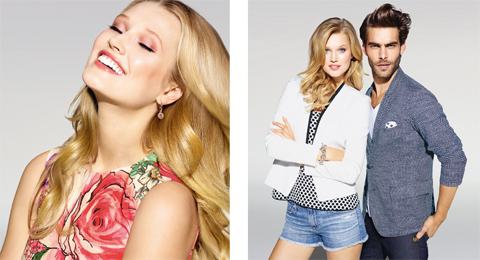
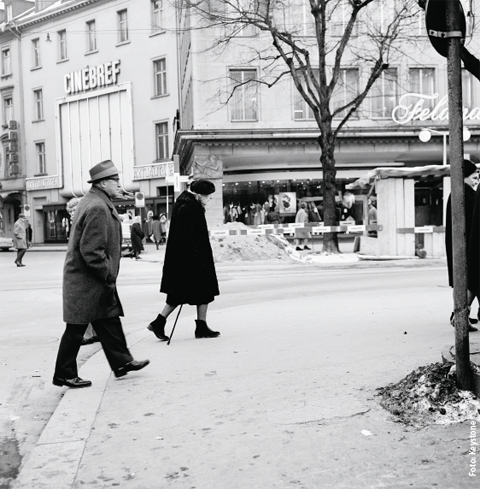
On March 6, 2014, the PKZ Group opened its flagship store, PKZ women, on Zurich’s Bahnhofstrasse. At the same time, the former Feldpausch stores at 12 locations were rebranded as PKZ women. This marked the end of a traditional brand, but also saw a new brand successfully integrated into a strong umbrella brand.

burger

WW: The fact that the name Feldpausch is disappearing is a step towards simplifying the structure: What are the advantages of this simplification? 
Olivier Burger: There are various reasons why we want to focus the brand. We have worked with six brands so far. PKZ, Feldpausch, Blue Dog, Burger, Paul Kehl and TheLook.com. That was definitely too many brands for a company that does almost 200 million in sales. We had to promote them individually, profile them individually. In addition, we have realized in recent years that the target groups tend to merge. Today, we serve gray-haired men who wear Laundry jeans and young people who go to work in an Armani smock. With female customers, we've seen our Blue Dog grow closer to PKZ. That's why all the larger PKZ men & women stores already have a Blue Dog department under the same roof. 

In Zurich's Shop-Ville, however, your Blue Dog is still to remain independent, one hears? 
Yes, that's still the only store at the moment. We must always think from the consumer. His wishes are behind the concentration of PKZ men & women. Customer behavior has changed. The new concept will give us more opportunities in the future to bring men and women together under one roof. We have already had a store in Zug for many years where we combine PKZ, Feldpausch and Blue Dog under one roof. In the new concept, it's now simply called PKZ men & women. We are also extending this to various shopping centers. It already works in Marins, in the Glattzentrum and also in Shoppyland. This integration also offers more opportunities for expansion because we can cover larger areas. 

And what happens to Paul Kehl? 
Paul Kehl remains, of course. This is a brand we relaunched five years ago, named after the founder of PKZ, Paul Kehl. For this label we have our own design team for men and now newly for women. The newly created Paul Kehl women's collection has just moved into our three Paul Kehl stand-alone stores, as well as all PKZ men-&- women stores. After all, there are various companies that carry several brands in their portfolio. For a while, it was fashionable to keep creating new brands. Now, more concentration is the order of the day again. 

Feldpausch is a great traditional brand. Was it easy to dissolve it? 
This was not an easy decision. We have discussed the issue three times in the course of history. We considered it when we took over 17 years ago, then five years after the takeover. And we considered it most of all when we implemented the omni-channel strategy. Omni-channel means a seamless and unified brand experience, which is what we strive for today. Still, it was a difficult decision for us. Feldpausch is an anchored name that has been around since 1927. By comparison, the name PKZ was registered by Paul Kehl in 1891, 133 years ago. However, other considerations were more decisive for us. We realized that the online sector is becoming stronger and that it is a great advantage if we appear online and offline, i.e. in the omni-channel with the same name. That is a very important factor. In the future, everything will run via PKZ.ch.

Will the online store TheLook.com also be renamed?
Exactly. But it's easier online. I can enter Feldpausch, TheLook or PKZ and in any case end up at the PKZ website. It's not like in the stores, where I have to go from one department to another. The developments in online were a very important reason for this name change. We are convinced that in the next five to ten years the market will grow from today's 7 percent of total supply to 20 percent. Online trade will become a very decisive mainstay. Of course, it makes sense to have as uniform and strong a name as possible. But the question was: give up Feldpausch as a name. Was that difficult for us? It was difficult for us. That's why we also wanted to ask our customers. We conducted around 1,500 interviews with regular customers and others. We wanted to know what they thought of Feldpausch suddenly being called PKZ women. The reactions were 95 percent in favor of our decision. The customers said they had known for a long time that these companies belonged together. Our communication was already very similar beforehand, in terms of advertising and our magazine. Secondly, the customers said: "As long as the product range still appeals to me and I can still find my favorite saleswoman, it doesn't matter what's written on the top of the door.

So you don't see any risk?
Changing a retail brand is probably a lot less difficult than changing a brand. There are various examples. Manor used to be called Vilan in Zurich, Rheinbrücke in Basel, Nordmann in Lucerne and Innovazione in Ticino. So x others have already done that. WE used to be called Hey. An interesting observation can be made here. In the last two weeks we have adapted our logos on the houses. The customers who know us come to the store in exactly the same way. But there are a lot of new ones who pass by the store and say, "Wow, PKZ now has a women's store. I have to go in there! "So all of a sudden, completely new female customers come in. The old customers stay and new ones come in. In our survey of regular and non-customers, we also received confirmation that the values embodied by Feldpausch and PKZ are very similar. People know: we are a Swiss company, they know the good quality and we offer a wide range of brands as well as good service. With both companies, the profile was quite similar.

There used to be a saying: PKZ means "Dad can pay. Does such an image bother you?
As far as I know, this originates from the 1930s and is in the vernacular. Somehow the phrase still applies in families today, when young people make their wishes for new clothes in the spring. We are rather happy about the saying. But it is clear that PKZ has been dusted off in the last 20 years. We now have an average age of PKZ customers of 42. That's an interesting average. Among modern men, and now women, we are considered a household brand. Admittedly, the name PKZ can be debated. The advertising industry certainly knows even more resonant names ...

Fashion labels are also subject to a trend.
This is also something that can be debated. Our lettering certainly looks elegant. It's true that PKZ sounds a bit choppy. But that's no different with the big and successful fashion companies. Take H&M, C&A in Germany, P&C ... But I also like our lettering. A brand is something really exciting. Something that is charged with values. That's the crucial thing that people have in mind when they hear PKZ. And that's what has held us back the most over the last 17 years from changing the name Feldpausch. The decisive argument then in each case was in the company management: No, PKZ is clearly "Number One in Mind" for menswear. And PKZ is not Number One in Switzerland for fashion in general. That's why we stayed with Feldpausch. But with the changes currently underway in the market, where men's and women's fashion are coming closer together and online and offline are inspiring each other: Now the market is ripe for the move. What's more, why did we make the move now? It has to do with the fact that we have completely remodeled our flagship in Zurich, the previous Feldpausch store. We have invested a sum in the double-digit millions and can now present the most beautiful and the largest women's fashion store in Switzerland. With the opening of our flagship store PKZ women on March 6 on Bahnhofstrasse in Zurich, it was only natural for me to communicate the strategy of our new orientation around it. At the same time, we opened two new stores in Switzerland's largest shopping center, Glattzentrum, also PKZ men & women.

In Switzerland, you are considered the "fashion czar" for men. When will you also be the king of women?
I find fashion czar massively exaggerated. Our goal is to make the people of Switzerland look good. That's the motive and we've been doing that for men and women for a long time. The proportion of men's fashion in our store is about 55 percent and that for ladies is 45. That may very well even out soon.

As the responsible CEO, you have increased sales from 50 to 200 million Swiss francs in the last few years. What is your concept for success?
When I joined the company in 1984, we had 17 stores. Since then, we have continuously increased our presence. We have grown organically in part, taking over individual additional stores in Lucerne or Biel. The most important steps were the acquisition of Esco, a menswear chain, and later the takeover of Feldpausch, which opened the door to women's fashion in 1997. This was part of a clear strategy.

How do you see online developing in relation to stores?
Fashion consumption in Switzerland has been the same for years. Average prices are even tending to go down. I therefore believe that brick-and-mortar retail - if it's lucky - will stagnate at most. The growth is coming from online. Last year, we saw growth of around 35 percent in this area. That will continue. You can often see this kind of development in advance in other countries. In America, where four of our five children live, this market is growing massively. When I visit my children, I come to a house where young couples live. There's a doorman at the entrance. He has already set up a room for storing the boxes. In the evening, the boys come home and find their online deliveries at the gatekeeper's place: Food, shoes, Pampers and, of course, clothes. They take the packages into their homes, try on the new things - and the next day, the unsuitable items are deposited with the doorman again until the next courier from DHL comes by. This is now standard practice in the USA. In England, the online fashion market already accounts for 20 percent of sales. And that will happen here, too.

Which advertising agencies do you plan to move into this future with?
For the communication of the new PKZ men & women offers, we have now worked with the publishing house UCM in Salzburg. They designed our catalogs. But the Zurich agency By Heart will still be involved in certain projects.

Interview: Andreas Panzeri

burger3
burger2
The renovation on Zurich's Bahnhofstrasse is more than a mere facelift. Feldpausch was founded by Willy Feldpausch in 1927. In 1997, the stores were taken over by the PKZ Group. Now the Feldpausch name is to disappear from the Swiss fashion scene. The change of name from Feldpausch to PKZ women marks the beginning of a new era for the PKZ Group after 133 years. The company has invested over 12 million Swiss francs in the new flagship store at Bahnhofstrasse 88. The result is the largest women's fashion store in Switzerland with 3000 square meters of retail space. Part of the shop window,
which is otherwise used as advertising space, will make way for a video installation by Julian Opie after this Advertising Week goes to press.

//www.youtube.com/watch?v=d_C9OVVOA7A


Ogilvy reveals the secret of Baer Camembert

In a new TV commercial, Ogilvy & Mather Zurich reveals why Baer's Camembert is so creamy.

It has been around almost as long as the cheese dairy, founded in 1922 in Küssnacht by Edwin Baer, it was the first Camembert produced in Switzerland and it is one of the most popular soft cheeses on Swiss tables. So much for what was already known about Baer's Camembert. But what was a secret for many until today, is the origin of the special creaminess of the Küsssnachter soft cheese.

In the new TV spot for Baer Camembert, Ogilvy & Mather Zurich unravels this mystery, with a coherent story told in a historical setting that harks back to the early days of Baer Camembert.

The spot is also accompanied by a redesign of the packaging. The previous master cheesemaker who adorned the logo was replaced by a more authentic, quintessentially Swiss cheesemaker. While at the time of the original logo's creation, the focus was on the French soft cheese world, today - as market research clearly showed - it is precisely the differentiation from all the imported French soft cheeses that is the real challenge. Both the new design and the new TV spot therefore focus on a quaint, traditional Swissness.

//www.youtube.com/watch?v=qnqmp8PjcNc

Responsible at Baer or Lactalis Suisse SA: Mathilde Petit (Marketing Manager Switzerland and Austria); Adelheid Jäggi (Brand Manager). Responsible at Ogilvy & Mather: Gaby Zimmerli (overall responsibility); Thomas Bolliger (CD); Priska Meyer (art); Markus Sidler (text); Samuel Hug (consulting); Chocolate Films (production); Marcel Langenegger (direction).

Mediapulse Group strengthens leadership

Urs Zeier will assume the position of Chairman of the Executive Board of the Mediapulse Group on March 10, 2014, under a fixed-term appointment.

In this way, Mediapulse's Board of Directors intends to strengthen the company's operational management and relieve incumbent Director Manuel Dähler, also a member of the new Executive Board, so that he can concentrate on his universally recognized strengths in the areas of research and technology in the coming months, according to a statement. The operational management of the company will now be the responsibility of a two-member executive board chaired by Mr. Zeier. The focus of Manuel Dähler's activities will continue to be on the areas of research & technology; that of Urs Zeier on the commercial and market-related matters of the company. The scope of Mr. Zeier's mandate meets the requirements in terms of management support and strategy development.

Urs Zeier, born in 1952, has a broad range of experience in the media industry, in which he has held various management positions - including as Chairman of the Board of Directors of Wemf. In 2001, he set up his own business as Zeier Consultants, specializing in media management, communications, coaching and interim management.
 

Leo Burnett: Fan campaign for Swiss Life

Leo Burnett is launching the «Mir sind d'Nati» fan campaign for its client Swiss Life, which turns everyone into a star.

Who doesn't remember, in the past on the playground when playing football: "I am de Chapuisat! - Or "I'm Shaqiri" - "No, Shaqiri, I'm Shaqiri already! In short, everyone wants to be like the great role models and belong to the national team.

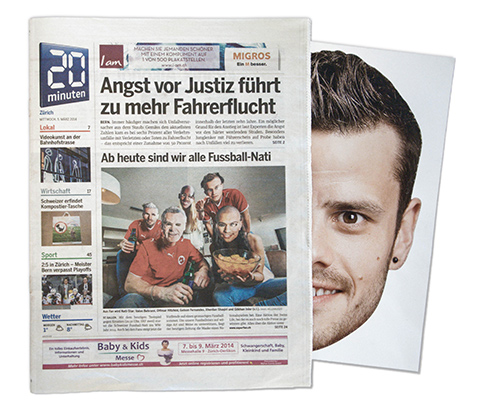
Swiss Life - sponsor of the Swiss Football Association since 2004 - is now making this dream come true with its "Mir sind d'Nati" campaign: To kick off the campaign, masks with the likenesses of Nati players will be distributed, turning every fan into a big star. On the microsite Superfan.ch you can also upload your own picture and become part of the Nati. There are many attractive prizes to be won, including meet & greets with the Nati stars, signed red Swiss Life sofas and Nati jerseys with your own name.

The Swiss Life football fan campaign "Mir sind d'Nati" takes place in cooperation with 20 Minuten and is played offline and online.

IMG_5629
FaecherKoepfe
IMG_5617

Responsible at Swiss Life: Elke Guhl (Head of Marketing Switzerland), François Foucault (Head of Events & Sponsoring), Gülin Sengül (Events & Sponsoring). Responsible at Leo Burnett Switzerland: Reto Clement (AD), Simon Smit, Mark Stahel (text), Peter Brönnimann (ECD), Daniel Strickler (production), Dominik Mätzener (consulting), Rolf Zimmermann (overall responsibility). Responsible for the online implementation at Red Works: Björn Schneider, Sandra Pellny, Estefan Justo, Karl Badde.
 

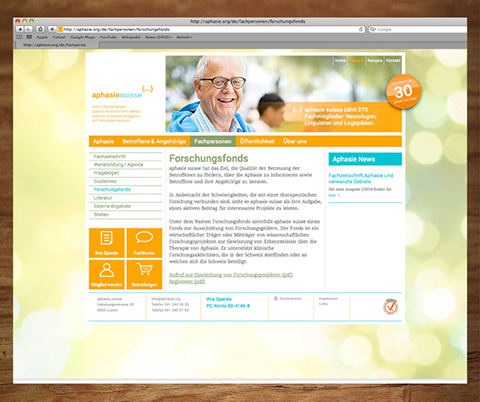
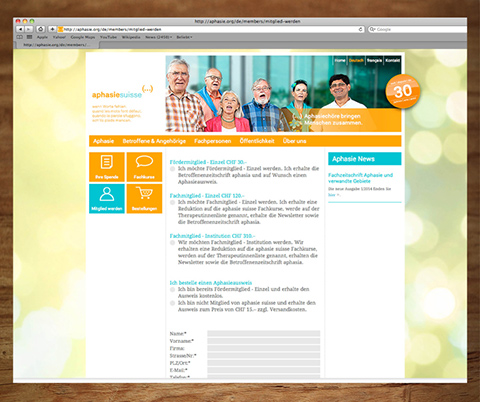
Mint: Campaign for people with speech loss

People with aphasia can barely speak, have trouble understanding others, and also face significant difficulties with reading and writing. Thanks to Aphasie Suisse and Minz, however, they are now at least being recognized by the outside world.

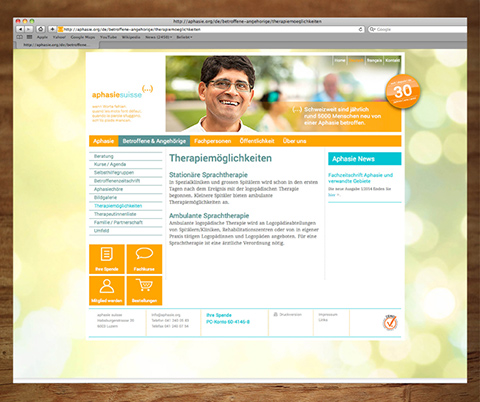
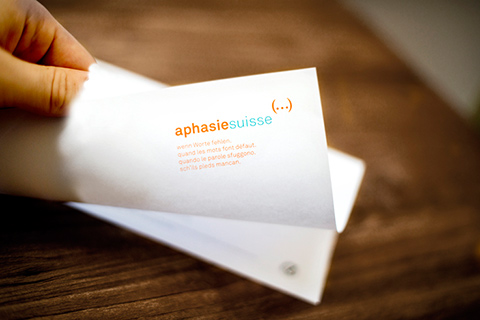
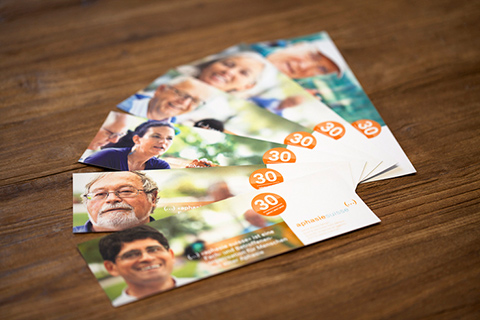
The campaign includes a new corporate design, which will be rolled out in the form of regular member and trade magazines, flyers and brochures, information sheets and a new Website makes the concerns of Aphasie Suisse known.

Also noteworthy, according to the statement, is the close cooperation of the advertising people with the aphasic people. Content was developed and layouts discussed in workshops tailored to their needs. Those affected also made themselves personally available for the photo shoots by the agency. In this way, an authentic and practical campaign could be realized.

aphasie-minz-1
aphasie-minz-2
aphasie-minz-3
aphasie-minz-4
aphasie-minz-5
aphasie-minz-6

Responsible at Minz: Susann Blum; Sylvie Rapold, Claudia Zosso (web design).


Last but not least: Gone with the wind

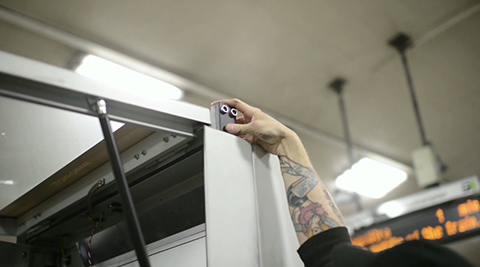
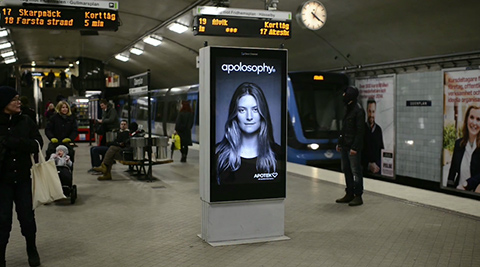
This ad in the Stockholm subway reacts to passing trains—and is wowing the world.

The case film "Blowing in the Wind" by Akestam Holst, Stockholm has quickly become a hit with millions of clicks. To promote a new line of hair products from Apotek Hjärtat, the agency equipped the digital ad with wind sensors. When the subway pulls into the station, the hair of the lady shown swirls around. That's how beautifully airy, light and voluminous the hair becomes when it is cared for with the Apolosophy line. At least that's what the advertisement would have you believe - a message that in this case is readily and attentively received. The film was viewed almost two million times in just a few days on the portal Vimeo clicked on. Advertising that interacts with the environment is well received by the public. In November 2013, British Airways, for example, already wowed the world with a corresponding Advertising space at Piccadilly Circus amazed: a child reacted to real airplanes flying by. The potential of such eye-catchers seems great and far from exhausted, dear advertisers. (hae)

//vimeo.com/87648696

Bildschirmfoto-2014-03-05-um-17.12.35
Bildschirmfoto-2014-03-05-um-17.12.50
Bildschirmfoto-2014-03-05-um-17.13.04
get_footer();