Ogilvy: Proving greatness for Ford at the Motor Show
Ogilvy & Mather designed a giant poster for the entrance area for the premiere of the new Ford Mustang at the Geneva Motor Show.
Editorial
-
March 7, 2014
The latest pony from Ford's successful stud for generations has been designed for the European market again for the first time and will also be available in Switzerland from 2015, according to a statement. The 162-square-meter poster is designed to showcase the youngest descendant of a legendary model series in a way that cannot be overlooked and, via the headline, literally and figuratively invites people to take the liberty and get to know the new Ford Mustang. The measure is accompanied by advertisements in magazines in and around the Geneva Motor Show.
Responsible at Ford Motor Company Switzerland: David Frey (Director Marketing), Marcello Varallo (Marketing Communications Manager). Responsible at Ogilvy & Mather: Thomas Bolliger (CD); Priska Meyer (AD); Marcel Elsener (text); Marcel Kohler (production); Sascha Isenschmid (graphics/DTP), Jonathan Schipper, Michela Girola (consulting)
"Tagesschau": Moderation swap with "Telegiornale
On March 20, SRF and RSI will swap presenters and editorial teams for their news programs «Tagesschau» and «Telegiornale.».
Editorial
-
March 6, 2014
For the main edition of the "Tagesschau" on Thursday, March 20, 2014, everything is a little different - on purpose: On this evening, a team from RSI will take over the production and moderation of the main news at Leutschenbach. At the same time, a team from Schweizer Radio und Fernsehen SRF is at work in Lugano, where it is in charge of its sister program "Telegiornale.
"Tagesschau" anchor Maureen Bailo will host "Telegiornale" in Italian this evening on RSI LA 1. She will be supported by a ten-strong team from the "Tagesschau" editorial team, which contributes the features for the program and is also responsible for the live broadcast. In addition, the Federal Parliament correspondents Hanspeter Trütsch, Gion-Duri Vincenz and Fritz Reimann will report in Italian from the Federal Parliament.
In turn, the main edition of the "Tagesschau" on SRF 1 at 7:30 p.m. is presented in German by "Telegiornale" presenter Alessia Caldelari. She is also accompanied by a team from her regular editorial department, which is responsible for the news and the schedule. Urs Leuthard, editorial director of Tagesschau: "A year ago, we carried out such an exchange for the first time with our French-speaking Swiss colleagues from Radio Télévision Suisse - and it was very successful. Such an exchange makes it possible to see Switzerland, as we experience it every day in the "Tagesschau", through different glasses for once. At the same time, the TV audience experiences the news in Ticino from the perspective of us German-speaking Swiss. Ultimately, we can make a small contribution to understanding between the language regions.
Advertising impact: TV commercials create emotional connection with brands
Consumers use a wide variety of media. It is therefore crucial for companies to understand how advertising works across different media and how to coordinate them most effectively.
Editorial
-
March 6, 2014
A new study from the U.S., conducted by the TV station Fox in cooperation with market researchers from Innerscope and the University of Michigan, provides indications of this. Using a neuroscientific approach, it shows that TV advertising achieves a particularly high level of attention in an intermedia comparison, is strongly emotionally activated, and is superior in creating and strengthening emotional connections to brands. Optimal cross-media coordination can increase the impact of TV advertising even further.
The study examined the effect of TV and online advertising using an experimental setting. 251 consumers between the ages of 18 and 49 who regularly watch TV and use the web were divided into different groups. One online-only group was shown only online advertising in the form of rich media display banners while using various websites, while a TV-only group was shown only TV commercials - embedded in a TV series from the Fox program. A third group was first shown TV spots and then rich media display banners of the same brands on general interest websites (brand only Synergy ). A fourth group was also presented with TV and online advertising from the same brands, but here the TV program and websites were coordinated in terms of content - i.e. the online advertising was integrated into websites with content related to the TV series shown (Brand & Program Synergy ). Subsequently, the test persons in all groups were shown a series of brand and product images relating to the brands advertised. The special twist of the study is that the unconscious media and advertising effects were recorded using eye-tracking and biometric methods. Both during television viewing and surfing and during final viewing of the brand images, the subjects' heart and breathing rates, skin resistance and physical movements were measured to determine their emotional activation. Eye tracking provided indications of attention. The result: TV advertising achieved significantly higher attention than online advertising (index TV only 1675 vs. online only 100). If TV and online are combined, attention to advertising increases further (Brand only Synergy: 1755) - but the increase is not statistically significant compared to TV only. Attention is highest when TV and online contexts fit (Brand & Program Synergy: 1888).
The biometrics show that TV advertising also activates consumers significantly more emotionally than online advertising (index 223 vs. 100). The general combination of TV and online advertising increases the emotion level achieved by the advertising by another 13 index points (Brand only Synergy: 236). The highest emotional activation is achieved when the environment of TV and online advertising also meshes in terms of content (Brand & Program Synergy: 253). The combination of TV and online thus offers synergies, but the decisive attention and emotion lever comes from TV advertising. Finally, biometric measurements during the presentation of brand images following media use make it clear that TV advertising is also particularly good at creating emotional connections to brands that go beyond the moment. This "brand resonance" is higher by a factor of 2.5 for TV advertising compared to online advertising.
Clemens Koob
"Fashion Run" jury: Rigozzi, Rossi and Valentino
Three weeks before the premiere of the new show «Fashion Run – The Shopping Duel,» Tele Züri, Tele M1, and Tele Bärn have announced the members of the judging panel: Christa Rigozzi, Luisa Rossi, and Valentino.
Editorial
-
March 6, 2014
Starting on March 27, they will choose a new fashion icon every Thursday evening at 8:15 p.m. for eight weeks. In their function, the three fashion and style experts judge the fashionable being or not being of the candidates. In the new styling documentary, the contestants have three hours to dress according to a given theme and have their hair and makeup done professionally, with a shared budget of 1,000 Swiss francs. The winner gets to keep the entire outfit.
As the most successful Miss Switzerland of all time, a sought-after presenter and the face of numerous advertising campaigns, Christa Rigozzi from Ticino knows how to put herself in the best light and entertain charmingly like no other, according to the press release. Luisa Rossi is probably the best-known styling and lifestyle consultant in Switzerland. She has acquired her fashion expertise through her many years as a model and as a hair and makeup styling agent. Valentino, the only man in the group, is synonymous with a well-groomed appearance and is successful beyond the country's borders with his company Mondo Valentino. Mondo Valentino has been styling for over 30 years at the biggest catwalks, the most famous models and for the most important labels.
Christa Rigozzi: "Fashion is important to me in every area. But it doesn't necessarily have to do with luxury, but rather with individual style, originality and one's own personality. You can achieve a lot with very little. True to the motto: less is more!"
Luisa Rossi: "For years I've been enthusiastically running after fashion, so I'm even more excited to see the choices and combinations of the women who will now run for me!"
Valentino: "As a Fashion Run judge, I won't mince words!"
The House Agency stages living office furniture
The House Agency has launched an integrated campaign for «eQ,» a product line from the long-established Swiss furniture manufacturer Embru.
Editorial
-
March 6, 2014
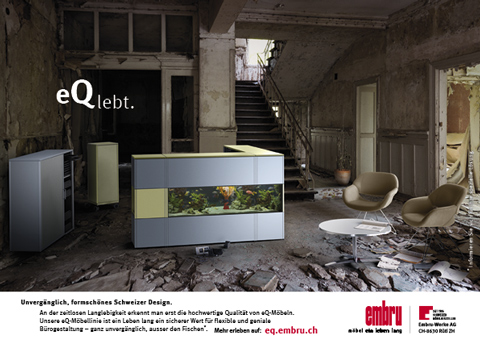
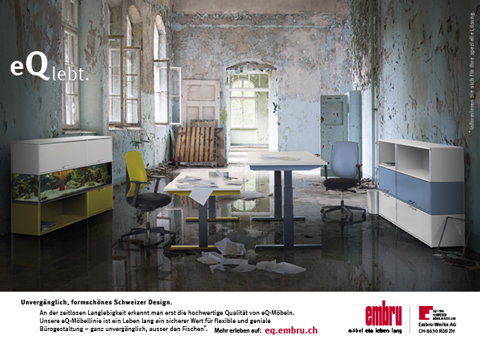
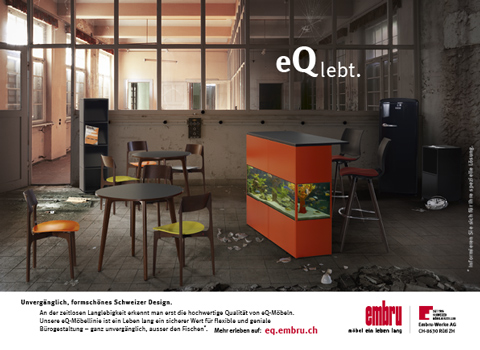
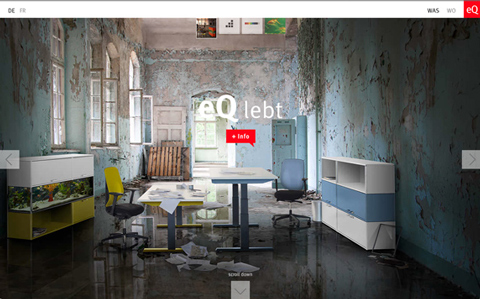
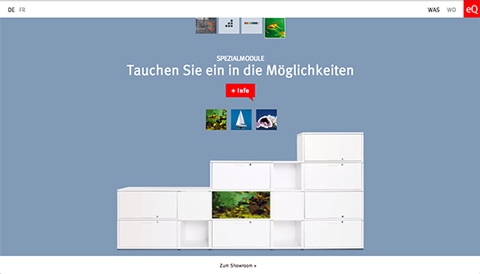
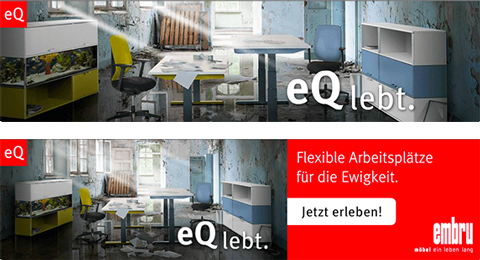
The focus is on the new microsite Eq.embru.chwhich also uses a new visual world to create awareness and showcase the product benefits. True to the claim "eQ lives", the Zurich agency dramatizes the robustness, modularity and design possibilities of the steel furniture.
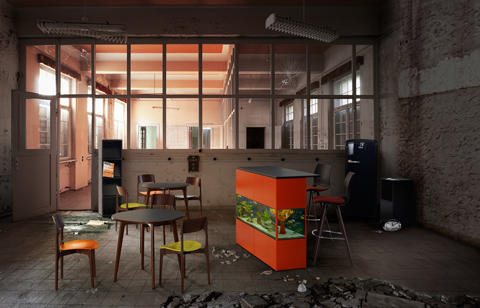
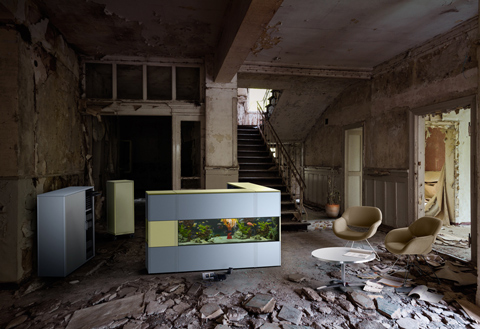
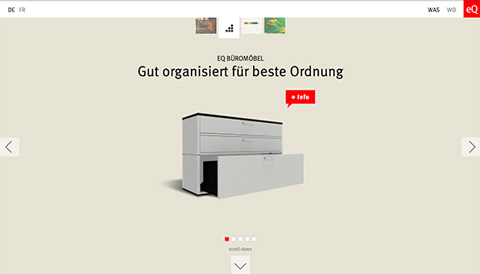
The imagery shows abandoned commercial spaces that have been gnawed away by the ravages of time. In the center: eQ office furniture. They have survived all challenges, outlasted the years and still look like they did on the first day. These visuals pave the way for the mobile-compatible microsite. A simple and clear user navigation gives the user the opportunity to obtain more information about the product horizontally via a click or scroll function and to move to the next area vertically.
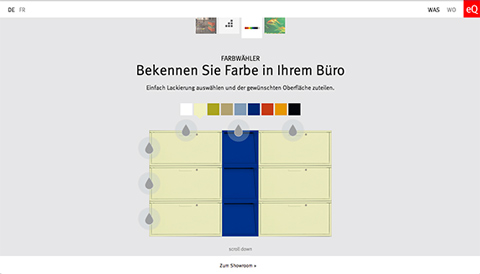
One of the highlights of the German and French-language eQ microsite is the color selector, which gives interested parties the opportunity to try out different color combinations - nine colors are available online, which can be assigned to individual module surfaces as desired. Another surprising feature awaits users in the special modules section. Here, videos illustrate that eQ office furniture is not only practical and beautiful, but also inspiring. From a glass display case for crystals or models to a real aquarium, various special modules can be integrated. The new eQ microsite also features a showroom with impressions, an extensive list of dealers and a contact section to suit every region.
The media deployment is aimed at a frequency-optimized in-depth strategy for the trustees, lawyers and personal assistants segment. eq.embru.ch is advertised in the digital channels via display using regional/commercial and functional targeting, newsletters and social media. In the analog channels, the focus is on a print campaign and print mailings to activate the target group segments. Other communication tools such as search engine marketing, the moving mega poster on the Embru trucks and corresponding specialist PR round off the campaign.
Responsible at Embru-Werke: Matthias Schubiger (Communication), Marcel Stocker (Head of Office). Responsible at The House Agency: Andreas Jorgella (Concept & Consulting), Peter Trüb (CD), Claudio Lier (Strategic Concept), Stephan Suter (Media), David Roth (Text & Concept), Fritz Kreis, Michael Booz (Art Direction), Manuel Griestock (Graphics), Jasmin Kaltenegger (Production).
On a new path with a new team
«Back to the Poster»: Ivan Schultheiss has been working at Clear Channel as the new Sales Director and a member of the executive board since the end of January.
Editorial
-
March 6, 2014
There was a lot of guesswork when Ivan Schultheiss left Mediaschneider at the end of March 2013 and wanted to "reorient himself professionally". The former APG Managing Director was a member of the management team at Switzerland's largest independent media agency for just two years. During this time, as Head of Business Development, Ivan Schultheiss "made valuable contributions to the strategic development of the company and did much to acquire new clients", as Urs Schneider thanked the departing manager a year ago. Then things went quiet for the departing employee. The surprise was all the greater at the end of January when Clear Channel was able to introduce Ivan Schultheiss as the new Sales Director and successor to Beat Sulzer. In this role, he also acts as a member of the Executive Board. But how has the thoroughbred manager been able to keep quiet for almost a year in the meantime?
Ivan Schultheiss's smile is pleasantly wise: "Among other things, I walked the Way of St. James. It was wonderful to be able to collect myself and have time for myself for once. I was tempted to discover new things. I wanted to clear my head, be open to everything and I didn't have the stress of deciding on a new job."
That's why, while it may be "a rather surprising turn of events" for some, for Ivan Schultheiss it was a mature and well-considered choice to move to competitor Clear Channel with almost eight years at APG under his belt. "APG is the market leader. We at Clear Channel are the 'hunters'. That's an exciting position. Together, we want to further expand the share of out-of-home advertising in the overall advertising pie. So it's mainly about inter-media competition and less about intra-media competition. As partners, we can go a long way there."
Flashback
In January 2009, Ivan Schultheiss became Managing Director of APG, replacing Christian Kauter at the helm of the Affichage Group company with the highest turnover. This was part of the internationalization of the Group's business activities. Schultheiss had previously worked as sales manager at APG since 2004, during which time he "significantly advanced customer orientation", as Werbewoche wrote at the time. Before joining APG, the federally certified advertising manager held various management positions, such as advertising manager at Weltwoche. There he played a key role in the successful relaunch of the magazine until 2003. At Publipresse, in the general management of Publicitas, he worked on a project basis and presented the first "media atlas" for Switzerland on a CD-ROM. "That was revolutionary at the time."
Ivan Schultheiss has also gained experience on the agency side. He worked as a consultant at the advertising agency Sulzer, Suter. Even before that, he started out on the client side at Dipl. Ing. Fust in the 1990s. "That was before Media Markt entered the Swiss market," says Schultheiss, recalling the beginning of this exciting phase, in which the triumphant advance of electronic gadgets began and has since turned the media world upside down with a constant stream of new devices.
Outlook
At Mediaschneider, where all these developments had to be taken into account, Ivan Schultheiss was able to experience an "extremely positive time". It was also valuable because of the insight he gained into a 360-degree view at the media agency, having previously worked mainly with advertisements and posters.
Schultheiss is now keen to create added value for his customers with the new opportunities offered in outdoor advertising by combining posters with their digital extensions. As Sales Director, he wants to "offer customers tailor-made and effective advertising solutions so that they can maximize their advertising impact".
Just one month after Schultheiss joined the company, Clear Channel also appointed Claudia Cattaneo as a new branch manager for the Ticino region. At the beginning of March, Thomas Estermann, former publishing director at Das Magazin, also joined the poster company as Senior Key Account Manager for the support of key customers.
With the new team, Ivan Schultheiss wants to continue the success story of Clear Channel Switzerland and be successful on the market with a focus on benefits. "We are an innovative company that has always been very responsive to customer needs. We are very fast and flexible in developing customized out-of-home solutions. We also need to acquire new poster spaces and will therefore be actively bidding in the tenders."
Ivan Schultheiss is "back to the poster" because he is a poster fan and believes "that out-of-home advertising can further expand its position in the Swiss advertising market". The out-of-home sector is under less pressure from other media than other traditional media. In addition, Switzerland is a poster country par excellence and will continue to develop with the opportunities offered by the digital sector. "Out-of-home advertising will change, but I'm sure that stickers will be around for a long time to come. "
Andreas Panzeri
Frank Bodin chooses the best TV spot of the month
Each month, a member of the ADC selects their five favorites from all the new TV commercials at Publisuisse. Frank Bodin, president of the ADC, kicks things off.
Editorial
-
March 6, 2014
Of the five new entries nominated, the spot with the most audience votes will be the monthly winner. At the next ADC awards ceremony, all monthly winners will compete for the coveted audience award.
From all new additions from February in Publispot, Publisuisse's spot database, Bodin has selected his five favorite spots. And which of the five nominated TV commercials do you like best? Help your favorite to win the month. You can now vote for the nominated spots for two weeks. The voting runs on Spotofthemonth.ch.
The next ADC award ceremony will take place at the beginning of 2015. A new audience award will be presented. All 12 monthly winners automatically take part in the audience vote for the best TV spot. Publispot is publisuisse's spot database with all SRG SSR TV spots since 1993.
Cheeky tone in the chocolate market
Camille Bloch is launching a new chocolate called Ragusa Blond. Young, feminine, and bold—that’s the new caramel world co-developed by By Heart. What does this mean for the traditional Ragusa brand? And how will the brand family evolve from here?
Editorial
-
March 6, 2014
Ragusa - the chocolate launched over 70 years ago with its rectangular shape and whole hazelnuts is a classic in Swiss chocolate history. Externally, the cult product has been updated again and again over the years - with adjustments to the design and new packaging units. Ragusa, on the other hand, has remained true to its original positioning over the years: an outdoor product that is a pleasure to have on hand on school trips, while hiking, or on the ski slopes.
In 2008 came the first turning point. The Ragusa family was completed with a dark variant "for the gourmets". Less sweet, with 60% cocoa content. Ragusa Noir now accounts for around 30 percent of Ragusa products sold. Now the brand has grown for the second time. This time, the company from the Bernese Jura wants to attract a younger, female audience to the traditional brand with a new Ragusa alternative. Why wasn't a new brand launched for this purpose? "Ragusa enjoys a high profile in Switzerland. We wanted to build on the strength of this brand," says Regula Gerber, communications manager at Camille Bloch. "At the same time, the aim was to rejuvenate Ragusa as a brand. After all, even a traditional brand has to reinvent itself again and again to stay current."
It would have been obvious to develop a white chocolate after launching the dark variant. However, Camille Bloch felt that this was too narrow - especially since white chocolate is heavily used in the children's segment. Instead, the company wanted to break out of the brown-white-black chocolate world. CEO Daniel Bloch finally came up with the brilliant idea during a trip to the Canadian province of Quebec, which is said to be home to the world's biggest chocolate fans. Enthusiastic about a chocolate speciality with caramel that went by the name of Blond, he traveled back to Switzerland. Soon the whole company was enthusiastic about the idea, and the innovation team set about developing its own product. The result was a Ragusa with Blond couverture, caramel-flavored praliné filling and, like the original, whole hazelnuts.
Ragusa rocks
The blonde chocolate was born - and the name Blond was set. What was still missing was the right appearance. At this point, the communications agency By Heart came into play, which had already helped shape various brands from Camille Bloch in recent years. By Heart was commissioned to define the positioning for the golden blonde Ragusa and thus further develop the existing brand world. "The challenge was to implement the DNA of Ragusa in a new and young way, without losing its authenticity and naturalness," explains Creative Director Hans Siegwart of By Heart. The nutty, pithy character of Ragusa was to be preserved. But while the original had more of a traditional, masculine feel, the blonde Ragusa was meant to come across as younger, more feminine and cheeky. "Ragusa is a chocolate with rough edges," Siegwart says. "Not a praline stick." Camille Bloch covers this division with the Torino brand.
By Heart turned the blonde into an "unabashedly blonde". The agency found the corresponding attitude to life in rock. Sassy and rebellious. "I'm blonde - and I don't care what you think," Siegwart said. The rock theme was cast in a 360° angle. The thrust for the campaign lends the song "Dynamite Blond" developed with the Swiss band ZiBBZ.
True to the motto "Ragusa rocks", the new Ragusa feeling is spread on a snow tour in various ski resorts. Right next to the slopes, ZiBBZ will be rocking on stage, the new Ragusa will be available for tasting, and anyone who wants to can pose as a rock star in front of the Tilllate.com camera. The new TV spot is also a real show-stopper, with brand ambassador Lara Gut head-banging to the wild sound of the rock band. "Lara Gut is predestined as brand ambassador for the blonde feeling, " says Siegwart. "Lara doesn't let anyone tell her what to do. She knows what she wants."
In terms of visual appearance, Ragusa Blond fits seamlessly into the existing brand world - but with one important difference. Whereas Camille Bloch was previously represented relatively prominently alongside the Ragusa brand logo, the sender now recedes into the background. This is entirely in line with the current change in brand strategy. Whereas in previous years greater emphasis had been placed on the umbrella brand Camille Bloch, under which chocolate bars are also produced, the company is now once again relying entirely on the appeal of its two most important brands: Ragusa and Torino. (This will become even more apparent in the coming months).
And how is Ragusa Blond to develop within the brand family? "We are very confident that the new brand will establish itself in the same way as Ragusa Noir and that we will gain additional market share," says Gerber. "Ragusa Blond is very different in taste and appearance from Classique and Noir, and is distinctive enough to appeal to a new audience. " That one irritates existing consumers with the rejuvenation, the unabashed Ragusa, she therefore does not believe. "Our tradition-conscious customers will still find the Ragusa Classique in the stores."
Isabel Imper
On course for growth
Camille Bloch was able to increase its chocolate production by a good seven percent last year compared to the previous year. The chocolate manufacturer from the Bernese Jura was able to make gains primarily in its home market. A considerable proportion of this growth is attributable to a new sales channel: For the past year, Camille Bloch's products have been listed at Migros throughout Switzerland. But Camille Bloch is also present abroad. One fifth of its production is already sold outside Switzerland. In its export strategy, Camille Bloch relies mainly on neighboring countries - Germany, France, Austria, Italy. In addition, there are Scandinavia, the USA and Canada. China, for example, is not currently a priority as an expansion market.
Migros on a beauty mission
With its newly revamped «I am» skincare line and a wave of compliments, Migros aims to make Switzerland more beautiful. We’ve already featured the Y&R Group’s campaign on Werbewoche.ch. Now Jürg Spring, Head of Brand and Label Management at the Migros Cooperative Federation, explains the background.
Editorial
-
March 6, 2014
WW: In its new "I am" campaign, Migros encourages people to please others with a compliment (Werbewoche.ch reported). Jürg Spring, when was the last time you paid someone a compliment?
Jürg Spring: That was the case two days ago when I came out of a restaurant and met an acquaintance. I spontaneously told her she looked dazzling, which immediately put a smile on her face.
So the campaign has already worked for you. Exactly, that's the goal. We don't just want to provide entertaining advertising or talk about products, we want to move people to action. It's so easy to make someone more beautiful with a compliment. The campaign calls on people to do the same. To this end, we are currently putting on www.i-am.ch 550 poster sites available and ask users to publicly compliment other people.
What is the most captivating thing about the campaign? Quite simply the idea behind it. Giving compliments springs from the core of the brand: "Beauty needs care" and that means not only the body, but also the soul. Added to this is the implementation of the idea in the TV commercial. The protagonists of the film are real passers-by, people with emotions. This makes the spot authentic and fits in with "I am" and the core message "I am beautiful, just as I am".
Many cosmetic brands advertise authenticity and naturalness (e.g. Dove - a brand for true beauty). How does "I am" distinguish itself from this? In this respect, positioning is not that far removed from it. However, the differentiation takes place at the content level. The brand essence is the self-confident attitude from within. "I am beautiful the way I am" is combined in the campaign with the compliment from the outside "You are beautiful the way you are". This clearly differentiates us from the competition.
Migros is currently doing a lot of advertising for its own brands. How does the "I am" campaign fit in? The "I am" products are of course also part of the ongoing "From us. From here." campaign, because they also come from Migros' own industry. They are produced by "us" in Switzerland true to the motto "What's close to our hearts, we make ourselves". Behind "I am" is the Mibelle Group, Migros' own industrial operation
For what reasons does Migros carry a private label like "I am"? With our own brands, we quite generally differentiate ourselves from our competitors. "I am" is an innovative brand that constantly surprises with new products. With this brand, we address women and men who have a demand for quality at a good price. Since we develop these products ourselves, we can respond even better and specifically to the needs of our customers.
Do mainly price-conscious customers buy "I am"? They are consumers who pay attention to a good price-performance ratio. "I am" is not a cheap line, but a high-quality, comprehensive skin care line at a fair price. It is aimed at customers for whom both the product and the price are important.
"I am" was created in 2008, when various care brand lines were combined under the new umbrella brand. How has the brand developed since then? Very good. According to the Brand Asset Valuator (brand and consumer study by Young & Rubicam), "I am" has become a power brand. It can compete with competitors in terms of brand vitality and brand strength. However, there has been a certain discrepancy between the product or the experience on the shelf and the advertising.
In what way? In communication, "I am" was very conspicuous, loud and self-centered. The "I am what I am" song by Gloria Gaynor from the TV commercial is probably still in the ears of many today. This brand promise did not match the experience one had when holding the product in one's hand. The logo was unobtrusive, not very self-confident, and in some cases poorly legible. With the relaunch at the product level, we made significant changes to the design and the logo. With the new campaign, we are now closing this discrepancy and creating a consistent brand experience.
Have the "I am" shares in the cosmetics range increased? Yes, "I am" is a brand that has grown strongly. We attribute this to the high brand awareness, but also to the constant expansion of the range. In addition to individual new products, for example, entire product ranges have been added, such as "I am Professional," a high-quality hair care line, or "I am Natural," the product line based on natural ingredients.
In the cosmetics and care sector, new products are coming onto the market on a treadmill. How much pressure are you under to follow suit? I wouldn't call this pressure, but rather an incentive. We follow what's new on the market and check whether the innovations fit with "I am". "I am Natural" or "I am Professional" are such examples. These are two fast-growing segments in the cosmetics sector that can be well managed under the "I am" brand.
What plans do you have for "I am" in the coming months? In addition to the current classic campaign, customers can use the Website enter into a dialog with us. They can apply for test packages or receive simple application tips for the "I am" products via tutorial videos. From March 31, the most beautiful compliments, which can now be submitted online and voted on, will then be displayed at 550 billboard locations throughout Switzerland.
And in the store: Are compliments handed out at the checkout? That would be the desired effect to the end. It is important that compliments always come honestly from within, otherwise they do not appear authentic. However, initial positive reactions from employees make me confident that we can bring about a change in attitude with the campaign and trigger a small or even larger wave of compliments.
Interview: Isabel Imper
Last but not least: What if
A "Second a Day" video of a special kind leaves London at war and the viewer lost in thought.
Editorial
-
March 6, 2014
The agency Don't Panic has achieved what years of media coverage have failed to do: it makes the war in remote Syria at least somewhat comprehensible by bringing it to our own (or English) doorstep. The basis for this is a "Second a Day" video of the kind that can be found by the thousands on YouTube. A short moment is filmed every day, the short sequences are cut together into a video at the end, and a longer period of time - usually a year - is thus summarized in a few minutes (example: 2012 per day one second).
The Save the Children commercial begins with the carefree life of an English girl, whose perfect life is shattered in the course of time by the outbreak of war. The convincingly realized film made it to the most popular English media in the last two days and is now - thanks to blogs and social media - conquering the rest of the world. "It's easy to forget that Syria was a middle income country where children enjoyed the benefits of education, healthcare and the other basic rights our children take for granted - not to mention Facebook accounts, video games and youth culture," said Jack Lundie of Save the Children. Message received. (hae)
Over the past few months, UBS has been steadily expanding its digital solutions. The ultimate goal: to become Switzerland’s leading multichannel bank. What does this mean? UBS executives provided an insight into this for *Werbewoche*.
Editorial
-
March 6, 2014
I n 2000, UBS was the market leader in Switzerland with half a million e-banking customers. In the mobile sector, the big bank set new standards. Even then, UBS customers could place stock market orders on the move via WAP. But it was not a success, and mobile banking was discontinued in 2006 (source: Schweizer Bank). The next big thing was a long time coming. Until recently, UBS's web presence was more like an electronic catalog than an interactive platform, and Postfinance was the leader in mobile banking.
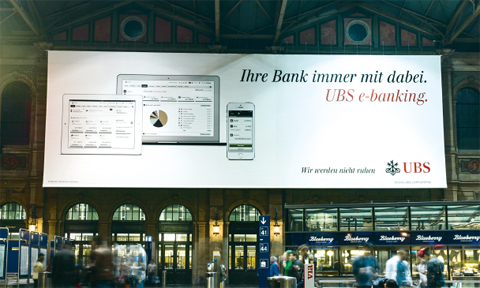
Now UBS is getting back in touch. Since last fall, the big bank has been gradually revamping its online offering. In addition to new websites, various solutions for e-banking and mobile banking have been launched. The mobile area with the core element mobile banking app is being pushed strongly, but the strategy goes far beyond the mobile channel. UBS's goal: to become the "leading multi-channel bank in Switzerland." Specifically, the bank is working on three focal points, as Andreas Kubli, Head of Multichannel Management & Digitization, explains.
1. the digital service is expanded
In the future, simple services will be comprehensively available electronically - via online or mobile banking. Instead of asking the customer advisor about savings potential at the bank branch, the new e-banking system will allow users to create a budget plan and set savings targets using the personal financial assistant. And via mobile banking, you can keep an eye on your budget wherever you are.
2. website and online marketing
A second focus concerns the website. Ubs. com is being expanded in the direction of an e-commerce site, a site where products can be experienced and ordered directly. In addition, the entire keyboard of online marketing is played. Online campaigns, email marketing, social media, web analytics, search engine marketing, etc. While online campaigns have been an appendage to the traditional campaign, they are now becoming a main component. "We want to be constantly present at the point of interest," explains Daniel Hünebeck. The former managing director of the agency Adisfaction Switzerland has been driving online marketing at the bank as Head Client Dialogue Management since the fall. If a customer searches the Internet for information on buying a house, he is offered mortgage topics - regardless of whether a campaign is currently running or not.
3. all channels are linked
The third hobbyhorse is linking online and offline. For example, if a customer fills out a form online, she shouldn't have to enter the same information again the next time she visits the branch. That sounds banal. However, the transition from one channel to another is more challenging than one might think, as Kubli says. The technical prerequisite is that the data is not stored in separate silos (e.g., one for e-banking, one for the branch offices), but that you can more or less draw from one data bucket. That was not the case in the past.
The callback function also provides an example of the dovetailing of channels. Whereas customers previously had to search for a phone number to contact a customer and then wait in the loop until a customer advisor became available, there is now a "call me back" option. Enter a phone number - and within a few minutes, you'll get a call back. Kubli presses call back in his app. "Let's see how long it takes." (In five minutes, the phone will ring and Kubli will comment, "It's busy this afternoon, so it's a good thing we didn't have to wait by the phone, but could continue talking in a relaxed manner.")
UBS - soon to be a pure digital bank?
The digital service is being continuously expanded. Once the first advisory service has been digitized with the personal financial assistant, other areas will soon follow. Kubli doesn't want to reveal too much, but he does say: "In principle, all simple advisory services can be implemented digitally. Instead of the information reaching the customer via the advisor, the data is made directly available to the bank customer via an application.
Last but not least, digital services offer great savings potential. After all, the online financial assistant incurs lower costs than the bank employee in the branch, which makes offering such services economically feasible. Will the customer advisor soon be superfluous? Kubli answers in the negative. "It's not about saving the advisor, it's about offering customers a choice." If the branch is closed on Sunday, bank customers can access information digitally. In addition, he said, a distinction must be made between different services. In the future, Kubli estimates that simple processes such as making payments, reporting complaints or changes of address will be handled exclusively digitally. The situation is different for mortgages, investments or pension plans. "I'm thinking here, for example, of a 60-year-old who is faced with the choice of whether or not to cash out his pension fund. For such important decisions, customers will probably prefer to get personal advice in the future," says Kubli. "That's why multichannel banking. "
How do you convince customers?
Kubli and his team have many ideas for new services. However, whether and when the new services are launched depends not only on (financial) resources, but also on customers. After all, they have to want to use the new services. In the case of mobile banking, the conditions are not bad at all. Mobile Internet usage in Switzerland has risen at an above-average rate over the last two years, with 39% currently online while on the move (IPMZ, World Internet Project Switzerland 2013). The only problem is that Swiss bank customers have so far relied mainly on online banking.
"Customer acceptance of the new mobile services is very high," says Kubli. The mobile segment has almost doubled in the last year. At the moment, it is growing significantly more than 1% per week. In the third quarter of 2013, about 145,000 UBS clients used mobile banking, and by the following quarter 4, that number had risen to 160,000, representing slightly more than 10% of UBS's main clients, Kubli calculates (UBS has 2.5 million clients in total, but that includes those who have only a rental deposit account, for example). Kubli considers 10% a success, but at the same time says that a comparison with other countries shows that much more could be done.
A lot is also being invested in bringing the new services closer to clients. In an initial wave last year, UBS drew attention to the new services on the bank's own channels and on social media platforms. Since February 2014, it has also been present with TV commercials, print ads and an online campaign. UBS relies heavily on moving images to provide information, as Julia Stefanides explains, who as Strategy & Business Development Director is responsible for marketing all digital channels. On the microsite Ubs.com/banking short info films explain the digital solutions to customers. For e-banking, the bank has also created tutorials that explain the individual functionalities in detail. Hünebeck is satisfied with the videos, saying that the dropout rate is very low. And internally, the videos are just as well received, adds Kubli. In October 2013, an info video was sent to the 22,000 employees in Switzerland. It was downloaded 17,000 times. "Even if you assume that one or the other watched the video several times, the figures are very pleasing, " says Kubli. "With a PDF brochure, we probably wouldn't have come close to that number."
What are the benefits and risks of mobile banking?
In terms of communications, the bank faces two challenges in particular. The first is to convince customers of the benefits of the new services. Many bank customers are still skeptical about whether they even need the new tools, explains Hünebeck. Why do I need a mobile app when I can do my finances at home on my computer? At the beginning, everyone said, "I don't need a smartphone because I only need my cell phone to make calls. Once you have a smartphone, you don't want to give it up," says Hünebeck. "I think we'll see the same thing with mobile banking. Once customers experience the convenience aspect, the use of mobile services will certainly increase."
The second construction site is the security aspect. Here, too, UBS needs to do some convincing. Security concerns are already one of the main reasons why customers decide not to use e-banking. In addition to phishing attacks (spying on access data), the loss of the device or infected apps are further risks in the mobile area. For the mobile banking app, UBS therefore relies on a two-stage model. If, for example, only the account balance is to be called up, it is sufficient to log in using a password. The information is anonymized to such an extent that any hacker who gains access will not obtain any valuable data. A code is only required for the second security level, which provides the same access as e-banking and allows payments to be made. As with e-banking, the bank customer accesses this code via a card reader or a credit card-sized hard token (a hardware component for identification and authentication). This is an advantage over systems where the code is sent via SMS, Kubli said. "Once the app is infected, the SMS is not far away. With our technical solution, e- and mobile banking are equally secure."
(Image: The new UBS Hard Token)
However, Kubli is aware of one thing: The security measures do not guarantee that the customer's need for security is thereby fulfilled. "The need for explanation is enormous," says Kubli. "But it's probably a matter of time: we've been discussing online banking for 15 years, and mobile banking for just a few months."
What happens to the data?
For bank customers, the new solutions open up new conveniences and additional information. For example, the personal finance assistant shows how much money one spends on housing, how much on traffic and transportation, on communications and media. In addition to the current account balance, planned income and expected expenses are also displayed.
At the same time, it becomes obvious how much data the bank collects about its customers. Regular media reports about IT breakdowns and data leaks don't exactly inspire confidence (PwC, Bank Coop, St. Galler Kantonalbank, NSA affair ...). What does Kubli say about concerns about data protection? "Banks know a great deal about their customers - this is already the case today." The decisive factor, he says, is that the bank agrees with the customer what it will do with the data. It is conceivable, for example, that customers will be able to release their data for certain purposes in the future. Someone who is interested in savings offers would then receive special offers, for example. However, any change to the existing practice would be made transparent and would not take place without the customers' consent.
When UBS puts out feelers in other business areas, companies from outside the industry become active in the financial sector. Not only Google, Apple or the eBay subsidiary PayPal. Telecom providers such as Sunrise and Swisscom are also currently testing cashless payments. "From my point of view, banks have to be on their guard that they don't lose valuable shares in payment transactions and thus a large and important part of customer relationships to possibly completely new competitors (from the non-banking sector)," writes Andreas Dietrich, professor at the Institute for Financial Services Zug (IFZ) at the Lucerne University of Applied Sciences and Arts, for example, in a blog post.
"Kubli is also convinced that "the value chain will become more fragmented. In this regard, he locates UBS's strength over competitors from outside the industry in two areas. "One advantage is trust. Various studies show: If you ask people who they are willing to trust with their finances, banks and bank-related companies such as credit card companies are in the top ranks" (e.g., unpublished study by Mastercard). Kubli considers the existing infrastructure as well as the large research department and the IT platform to be another advantage. Competitors would have to build all this up first. 300 offices in Switzerland, UBS is present in 50 countries worldwide.
How does the information reach the customers?
And what does Andreas Kubli see as the biggest challenge posed by digitization for UBS? "First, that we can't start on the greenfield. UBS is a huge tanker with 2.5 million clients on board. It works well, to be sure. But: if you want to change course, you have to pull a lot of levers." The second challenge, he said, is communicating the new services. "When I ask around in my environment, I realize again and again: even there, newly launched services are partly unknown." This shows that you have to communicate in a much more segmented way in order to reach the customer at the right time with the right message.
In any case, bank customers can look forward to further developments in banking. Various financial service providers are currently upgrading digitally - or have announced this. Last but not least, digital competence is a way for banks to differentiate themselves from competitors in a market with virtually identical products.
Isabel Imper
Agencies:
Namics Supported UBS with e-banking, mobile banking app and partial overhaul of Ubs.com
Hinderling Volkart realized the microsite and the first communication wave
Alpha 245 is responsible for the TV spot and the ongoing communication wave
On our own behalf: Isabel Imper leaves Werbewoche
After five years at *Werbewoche*, our editor Isabel Imper is moving into research and consulting.
Editorial
-
March 6, 2014
Isabel Imper has spent the last two and a half years writing mainly for the print edition, before that she worked as an online editor for the website and the Werbewoche newsletter. Before joining Werbewoche, the psychology graduate worked for a Zurich regional newspaper and most recently for a marketing and communications agency. She will soon be joining Accelerom, a consulting and research company specializing in market development, brand management, innovation and transformation as well as investment management.
Werbewoche very much regrets this departure and wishes Isabel Imper all the best in her new job.