The hunger for digital devices continues unabated

The change in media use goes hand in hand with rapid technological development and the rapid spread of new digital devices. And consumers' hunger for innovation is far from satisfied.

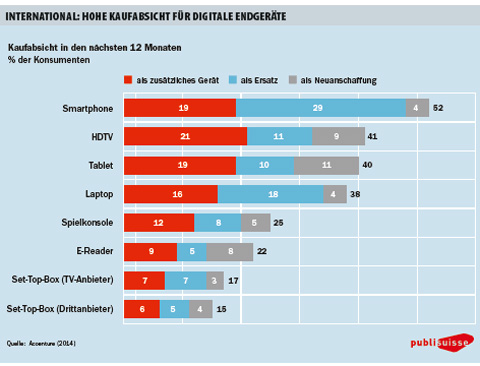
Smartphones, HDTVs and tablets are still on people's shopping lists. In addition, wearables such as smartwatches and smartglasses will continue to change everyday media life, as the latest "Digital Consumer Tech Survey 2014" by management consultants Accenture shows. The international study surveyed 6,000 consumers from Australia, Canada, India, South Africa, the UK and the USA. First of all, it is clear that many consumers are already well equipped with digital devices. Almost 75% of respondents own a laptop, 69% a smartphone, 57% an HDTV, 37% a tablet and 37% a games console. Over a quarter of consumers even own a set consisting of a smartphone, laptop and tablet.

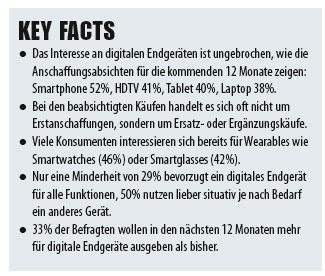
And interest in digital devices is unbroken. 52% of respondents plan to buy a smartphone in the next 12 months. 29% want to replace their old smartphone, 19% intend to buy a smartphone in addition to their current device and 4% intend to buy a smartphone for the first time. The intention to buy tablets is also high: 40% of those surveyed plan to buy a tablet in the next 12 months - 10% of these are replacements, 19% want to buy another tablet and 11% plan to buy a tablet for the first time. There is great interest in phablets, i.e. devices that combine the advantages of smartphones and tablets: half of the planned smartphone purchases (51%) are phablets.

HDTV is also still very popular: 41% of respondents plan to buy an HDTV set. For 9% of consumers, this will be their first such set, 11% plan to replace their current HDTV and 21% will then own at least two HD televisions. Consumers will also increase their digital equipment with new laptops (38% plan to buy), games consoles (25%), e-readers (22%) and set-top boxes (17%), among other things.

The next innovations are also in the starting blocks: Wearables. Smart devices worn on the body are arousing great interest among consumers. 46% are interested in smartwatches, 42% in smartglasses. The appeal of these devices is presumably also due to the fact that they facilitate permanent monitoring of personal data (54% are interested in monitoring their own health, for example) and support permanent connectivity with the environment (53% want to control and monitor their home, for example). What about the functions that different end devices perform? This shows that consumers are using more and more devices in a multifunctional way. For example, 51% of respondents use TV apps on mobile devices or plan to use them in the next 12 months. On the other hand, half of those surveyed prefer to use different devices depending on what they want to do. Ultimately, only 29% of consumers prefer an all-in-one solution. The fact that the hunger for digital devices remains immense is also reflected in consumers' willingness to pay: 33% of respondents intend to spend more on digital devices in the next 12 months than they have done so far.

Clemens Koob

Unbenannt-15_10
Unbenannt-15b
 

We are a newspaper

Libération, France’s most iconic newspaper, is fighting for its survival—and against its own owners. It is supported by intellectuals and cultural figures. By Jürg Altwegg

There are plenty of good restaurants in Paris," Umberto Eco scoffed. He, too, reached into the keys to express his solidarity with the French Libération: "But good newspapers are rare. Libération is the example of a brave and free press; it would be sad if anything changed."

The brilliant Italian semiologist and author of the bestseller "The Name of the Rose" did not formulate the comparison with a restaurant from a hollow gut. In fact, Bruno Ledoux, who is the owner together with Edouard de Rothschild, wants to oust the editorial staff from the editorial building in Paris. Ledoux is its owner, and the newspaper rents from him. That's how he got his shares. He wants to open a cultural and fashion center under the brand name Liberation, with a restaurant, bar and TV studio. Ledoux talks about the "Café de Flore of the 21st century," alluding to the famous bistro where Jean-Paul Sartre wrote his books after the war.

Sartre was one of the co-founders of Libération, which celebrated its fortieth birthday last year. The hard core consisted of Maoists, with whom Sartre sympathized after May 68. In Germany, the revolt led to terrorism; in France, the insurgents tried to change society with a newspaper. Everyone got the same pay. The editor-in-chief didn't have much more to say than the proofreaders and the cleaning lady. Advertising did not exist, it was introduced by stealth. And it was handled in an original way: individual issues were sold to a single customer. Once the newspaper appeared perfumed. Another time, it was commissioned by a fashion company and made of fabric. No other newspaper has shaped and intelligently described the development of French society as much as Libération.

Several times it was on the verge of ruin. It had to cease publication for months. Shareholders who were not allowed to decide anything were brought on board. It was a counter-revolution when Edouard de Rothschild took over the reins of the anti-capitalists - who had already lost a lot of the long march. He is no longer in the mood - and his new co-owner Ledoux lacks the money. The accumulated debts amount to six million euros. In 2013, after two balanced years, there was a deficit of one million. Ledoux has imposed a radical savings program and tried - in vain for the time being - to reduce the low wages by ten percent.

The staff saw the plan for a cultural center with galleries and stores designed by Philipp Starck as a declaration of war. It published Ledoux's description of the project. Apparently, the broker tried to extract the Libé brand - on the pretext of depositing it as a bank guarantee for new loans. This would have allowed him to declare the newspaper bankrupt and carry out his plan without print. The managing director who prevented this had to go. Every day, the editorial team reports on its fight for survival and against the owner on several pages: "We are a newspaper" is the heading.

Last weekend there was an "open house Saturday". The turnout was tremendous. Readers are more critical than those of other newspapers and more left-wing than the editorial staff. Circulation has dropped to less than 100,000. France's intellectuals and cultural figures write and sign for the endangered paper. Europe is also looking to Paris: "Without Libération, France would be more petty," says Denis Macshane, a former British minister for Europe. He recalls Voltaire, Victor Hugo, Zola, Camus and Sartre, whose importance he explains with the imperative to "think differently. The newspaper remains committed to him, staging an impressive staging of topicality every day: with its own weighting and competent commentaries.

Libération is more than a newspaper; its struggle makes people aware of the importance of the press for the public.   

Jürg Altwegg is correspondent of the Frankfurter Allgemeine Zeitung in Geneva. 

Unstoppable advertising for Range Rover Evoque

To promote the new 9-speed automatic transmission and other features of the new model, Ogilvy is launching a national campaign for Jaguar Land Rover.

With the Range Rover Evoque, Land Rover presents the first SUV to feature a 9-speed automatic transmission. In addition, a variety of practical assistance systems are available in the new Range Rover Evoque to make driving easier, according to a statement on Thursday.

To publicize the new 9-speed automatic transmission as well as the other features, Jaguar Land Rover deployed a national campaign. Ogilvy was responsible for a TV commercial, print ads and various online activities such as banners, newsletters and a Landing page with explanation of the new assistance systems responsible.

Responsible at Jaguar Land Rover: Stephan Vögeli (Managing Director), Karin Held (Director Marketing, PR & Sponsoring), Sladjana Mitrovic (Communications Manager). Responsible at Ogilvy: Jonathan Schipper (overall responsibility), Claudia Sigg, Daniel Suter (consulting), Thomas Bolliger (CD), Stephanie van Ophuisen (AD), Marcel Elsener, Markus Sidler (text), Filippo Salmina (DTP).

1.landroverevoque
 

//www.youtube.com/watch?v=XtHE49uuRIo

Element P: Corporate film for Glanzmann

For the second year in a row, a Worldstar Packaging Award went to a Glanzmann packaging design. To mark this achievement, Element P produced the corporate film «Cocon,» which premiered Wednesday evening at the Kino Royal in Aarberg with staff and guests in attendance.

The film "Cocon" pays tribute to the dedication of Glanzmann employees with the story of a young packaging technologist, according to a press release issued by the agency on Wednesday. At the end of her training at Glanzmann, the young woman develops a packaging solution of superlatives and asks in the film: "What are we packaging? This one unique product that Glanzmann only delivers once a year. You could call the product, um, Glanzmann."

The protagonist in the film challenges the entire workforce in her search for the perfect packaging: from the pattern makers to the master finishers to the specialists on the punching and folding machines. However, the film not only tells of the uncompromisingly hard-working workforce, but also of the family loyalty of the small Swiss company Glanzmann, according to the press release.
 

The next stage

Koch Kommunikation is a somewhat unique combination of a creative, owner-managed full-service agency in Frauenfeld. The first BSW agency in the canton of Thurgau is not only pleasantly down-to-earth but also cutting-edge in the digital realm. In fact, of its 18 employees, nearly half are deeply involved in the future-oriented online market.

Unbenannt-11_17
The management team: Jean-Marc Demeulemeester, Philipp Koch, Michael Koch.

There are just under 50 advertising agencies in the canton of Thurgau. Only one of them has so far also been accepted into the BSW Leading Swiss Agencies association. Koch Kommunikation in Frauenfeld, founded in 1969, has set its sights on great things.
 
"We used to be a blue-collar agency. Clients came with an idea, and we implemented something beautiful. The clients were satisfied with it. With the end customers, our ideas generated the desired success," says Philipp Koch, describing the concept of the old days. "A few years ago, however, the feeling set in: We have to go one step further." Today, Koch Kommunikation "questions more and also looks in other directions." The new strategy is called: "more creative solutions - from the concept to the entire implementation".
 
This process was initiated in April 2012 with a strategy workshop. There, the two brothers Philipp and Michael Koch, as owners, and the Creative Director Jean-Marc Demeulemeester, who had joined the company the year before, realized that Koch Kommunikation was pretty much "fifty fifty" in the areas of classic advertising and digital communications, both in terms of personnel and orders. It's a mix that remains rare in today's agency scene. "In addition to classic advertisers, we employ our own developers who develop websites, apps, social media and other online campaigns," explains Michael Koch. A head start that Koch Kommunikation therefore wants to make even better use of in the future. Accordingly, the new direction was defined: "creative, active, interactive." Koch Kommunikation employs 18 people. Most of them work at the headquarters in Frauenfeld. Some of them are also deployed in Brüttisellen for individual assignments. The agency operates a branch office there. This came about when Koch Kommunikation was able to take over some of the services from the digital sector from its former IT partner UMB. As one of the leading IT service providers in Switzerland, UMB had previously purchased web design services from Koch Kommunikation. When the company in Brüttisellen wanted to sell its web business, Koch Kommunikation was able to take over these customers. These include, for example, the ice hockey club ZSC Lions and the soccer club GC.
 
These references also opened the door to a pitch for the Swiss Football League a year ago, for which Koch Kommunikation was now allowed to implement the entire Internet presence. Various interfaces and a responsive site ensure that live data, match reports, statistical data, etc. are available to the user. Cross-media tasks are one of the core competencies, for which more and more customers come to Frauenfeld who previously sought their fortune in the advertising stronghold of Zurich. On the other hand, it is somewhat more difficult to lure the necessary creative people away from Seefeld to Thurgau. "But the advertising location of Eastern Switzerland is becoming more and more interesting," says Philipp Koch with conviction. Last but not least, this region is also home to numerous companies that sell their products throughout Switzerland. And thus also carry their advertising "made in Thurgau" out into the country. Not only Frifag Märwil, the third largest poultry producer in the country, for which Koch Kommunikation has been in charge of advertising for over 20 years.
 
In Thurgau, the apple does not fall far from the tree in advertising either
Philipp Koch already "worked" in advertising as a child in his parents' house. Father Hans-Peter had set up his agency at home in the early days. So Philipp's first jobs were wrapping mailings. As a teenager, an apprenticeship at Publicitas in Winterthur followed. "That was my big opportunity. The apprenticeship finally awakened my passion for marketing and media." Philipp Koch went on to train as an advertising assistant at Sawi. Then he joined the family business in 1990.
 
The agency was founded in 1969 by the father as a one-man company with only one client. When this client fell away, the advertising agency suddenly found itself without work. But challenges provoke growth - and so Koch Kommunikation quickly blossomed again in new strength and soon with six employees. Since then, things have gone steadily upwards, "but within the framework of healthy growth". During this phase, an external job offer was also tempting for Philipp later on. He could have worked for six months with an agency owner friend in New York. "But because my father constantly gave me more responsibility, I couldn't simply leave for six months in the midst of the booming development in Frauenfeld," is the only thing that Philipp finds a bit of a shame in retrospect. Otherwise, he feels "completely fulfilled" to have now driven the second-generation family business forward to become a flourishing SME. Brother Michael Koch also started out packing envelopes for his father when he was young. Then followed an apprenticeship at the publishing and printing house of the Thurgauer Zeitung. Here, Michael was also introduced to the world of media planning. Later, he also joined his father's up-and-coming agency for a short time. After two years, however, the big city of Zurich lured him. Together with a colleague, he opened his own office on Limmatquai. "We did the marketing and communications for the entire Pierre Hairstylist chain of stores," Michael recalls of his wild years. But because his office partner ticked a bit differently and his father urgently needed reinforcements at the same time, the expatriate returned to Frauenfeld.
 
 
New responsibilities and sporting challenges
 
"I had to grab my chance." Added to this was the responsibility when his father died unexpectedly in 2003 and the two brothers had to take over the family business completely. Michael, who has since specialized more and more in the area of the Internet and also trained in programming, is now Head of Management and as a "digital expert" is primarily responsible for customers such as the Swiss Football League, ZSC Lions and GC in the online division. Philipp, whose business card reads Head of Consulting, is more concerned with classic projects. "However, the distribution of roles can be creatively adjusted." Even more consistently responsible for creation has been Jean- Marc Demeulemeester for three years. With the experienced creative director, the Koch brothers wanted to usher in a new era in the history of the largest advertising agency in Thurgau. The goal is creative quality. That means: Together with Jean-Marc Demeulemeester, they want to really take off again as a CD. Jean-Marc Demeulemeester discovered his "primal love for advertising" while still at school and began an apprenticeship as a graphic designer at the age of 16. In the subsequent merry-go-round through renowned agencies, the communications professional and designer won numerous awards, including a Bronze Lion in Cannes. In the course of his career, Jean-Marc Demeulemeester developed from Junior Art Director at Advico Young & Rubicam to AD at Publicis.
 
Further stations were Metzger Lehner Worldwide Partners, J. Walter Thompson and then Lang Gysi Knoll, today Neue Lgk. Here Demeulemeester worked for four years as creative director. The advertising with the creatively peeled potatoes for Swiss farmers, which is still present today with ever new menu suggestions, dates from this time. The concept "We don't let ourselves be hindered" for Pro Infirmis also got its start with Jean-Marc Demeulemeester.
 
In 2006, CD set up his own business with his wife Caroline Demeulemeester. In Winterthur, the two wanted to be "a kind of boutique" where advertisers could provide very personal service to their clients. These included Swiss Post. However, the structures of the mini-agency were a bit too small for the national player. So in January 2008, Jean-Marc Demeulemeester moved his newly acquired Swiss Post contract under the umbrella of GGK in Zurich. He then worked at Hermann Strittmatter's agency for three years as creative director, until he set up his own business again in 2011 as a creative consultant, only to join the Koch brothers in Frauenfeld in April 2011 as a supplier of ideas. As with Neue Lgk, the task of taking an agency to a new dimension attracted him to Koch Kommunikation. "Building something new is much more exciting than sitting in the feathered nest of an international network agency, " says Demeulemeester, describing his drive. And what he succeeded in doing at the new Lgk, leading the agency to a national size, is now also his goal with his new partners Philipp and Michael Koch. "At Koch Kommunikation, I was also interested in the fifty-fifty concept with an equal weighting of digital and classic. And all within the framework of a manageable entity. Now we just need to ignite one more stage."
 
Andreas Panzeri

Unbenannt-12_18
Unbenannt-13b
Unbenannt-14dd

Cardinal extends contract with Gurtenfestival

Cardinal will remain the main sponsor of the Gurtenfestival in Bern for another five years. Representatives from both parties signed the contract extension in Rheinfelden.

The Cardinal brand has been associated with the Gurtenfestival since 2010 and has now decided to continue its involvement until 2019 due to the successful collaboration. The sponsorship package includes the appearance of the Cardinal Factory as well as exclusive delivery, advertising and serving rights. In addition to Cardinal, the local Gurten beer will also be served exclusively in the tent stage, according to the company's press release on Thursday.

The Cardinal brand has been involved in the music and festival sector for many years and sponsors music events throughout Switzerland.

1.cardinalgurten_0

Arena presenter wants to reorient herself professionally

After 20 years with Swiss Radio and Television (SRF), Sonja Hasler will step down as host of «Arena» at the end of May 2014. She has decided to take some time off and explore new career opportunities.

Sonja Hasler has been working for Swiss radio and television since 1994. She began her career at Schweizer Radio DRS as a sports reporter, and from 1997 she worked as a radio news editor. From 2001 to 2005, Sonja Hasler was in charge of the "Tagesgespräch" program on Swiss Radio DRS.

Sonja Hasler moved to Swiss television in 2006, where she hosted "Rundschau" for seven years. From spring 2009, Sonja Hasler was the first woman to also act as a discussion leader for "Arena" and "Arena vor Ort", before concentrating entirely on her work on the political discussion show from mid-2013. During her time in television, she conducted interviews and hosted the Elephant Roundtable during the parliamentary elections, the Federal Council elections and the voting studio.

After so many years at the pulse of national events, Sonja Hasler is in the mood for something new, she is quoted as saying in Thursday's press release. Whether this will be inside or outside SRF remains to be seen. Editorial director Marianne Gilgen regrets her departure. Hasler was not impressed by political bigwigs and struck the right tone with her interviewees - from the Federal Council to mountain farmers.

Urs Wiedmer will host all editions of "Arena" until the summer break. As the media company has already announced, Jonas Projer will take over as presenter of the program from the end of August (Werbewoche.ch reported). Urs Wiedmer moves to the editorial office of the Federal Parliament.
 

To the point: more courage

Like any journalist, I regularly exchange ideas with many different people. Once in a personal conversation or on the phone, but then also via e-mail, Facebook and Twitter.

As different as the communication channels are, so different are the interlocutors. They can be veteran journalists, editors-in-chief, creative directors, agency owners and CEOs, publishing managers, PR or communications directors, but also young creatives, young journalists, online nerds or Internet entrepreneurs.

The topics are logically always similar: function of the media, quality of the media, development of the advertising market, online media, future of communication, etc. Lately, it has also always been rather explosive topics from politics, business and society. That probably says a lot, too.

What always strikes me is that the age of the people rarely correlates with the different answers. I know, my dear know-it-alls, that this has long been known from psychography and countless target group typologies. But there is a huge difference between seeing colored diagrams or data clouds on a PowerPoint chart and hearing the whole thing one-to-one and perhaps also noticing non-verbally what makes the other person tick.

If you want to divide the answers, attitudes and opinions quite simply into two groups, then there are the preservationists who want to shield, defend and guard everything. Every idea, every new approach is nipped in the bud. They don't see any opportunities, but concentrate on possible risks. They don't look beyond the end of their nose, because it's all about their own industry. We dream of glorious past times and secretly hope that they will return.

The second group are the curious. These question the tried and true, they seek new paths (knowing that one may fail), they see new opportunities - albeit often overly optimistic ones - and they are curious. They are interested in other industries, new ways of thinking. They try to imagine new markets and new consumer and reader needs.

What I've noticed lately is that the group of preservationists and doubters is growing more and more. The curious are viewed with suspicion and secretly catalogued as potential troublemakers and dangerous fantasists.

A little more courage, dear media and communications industry! Hesitation and procrastination will get you nowhere.

Pierre C. Meier, Editor-in-Chief
[email protected]
 

Last but not least: a moody cloud

Instead of a little dog, this grandma takes the white cloud named «Freddy» for a walk. 

The creative team at DDB Chicago came up with the whimsical idea of having grandma walk around the neighborhood with a fluffy cloud instead of a pampered lapdog. The agency used the cloud to shoot a series of commercials for Skittles, the fruity, colorful chewy sweets.

The cloud is as moody as a spoiled poodle and can let off quite a storm if it is stroked in the wrong places. When the cloud is in a good mood, it rains colorful Skittles. In return, she is forgiven everything. (sis)
 

//www.youtube.com/watch?v=JCAA81eIK4g

//www.youtube.com/watch?v=UOQ_tKZNq6k

//www.youtube.com/watch?v=iELg1xRL9Io

Clever accompaniment: the event app

In the future, there will be an ever greater merging of real and virtual platforms. To cope with this trend, Rufener has developed its own event app. CEO Jennifer Somm explains its purpose.

Unbenannt-6_27
Power App at the Power Lunch: Nicole Simmen (moderator), Simon Hofmann (Strategy & Development Sponsoring, Swisscom), Jennifer Somm (Rufener), Dirk Scherble (SAP Switzerland), Pascal Kreder (Reflection Marketing) discuss interactive communication tools in the event and sponsoring environment.

WW: Are event apps as technical gadgets a fad or actually a success factor for an event?
Jennifer Somm: The possibilities for communication and interaction have changed drastically in recent years. Live communication must also respond to these new forms, understand them and implement them. An event app is exactly in tune with the spirit of the times: people want to help shape, share, criticize or recommend. Through the app, the real experience merges with the virtual one. This offers information, interaction, but also networking and fun. Event apps are therefore not only a success factor, but also the logical consequence of adapting to the interests of today's society.
 
What can an app contribute to a successful event: before/during/after?
An event app accompanies the entire communication process. Contact can be established with the target group long before the event, which can be continued during and after the event. The event app extends the period of time in which the participants engage with the company/brand. The relationship is thus deepened and strengthened.
 
What added value is generated? What do the visitors get out of it?
An event app activates the visitor in a playful way. They receive compact, up-to-date information, can network with other participants and, depending on their interests, delve deeper into certain content. And they don't need flyers and brochures or an information stand to do this: the only device they need is their smartphone in their pants pocket or handbag.
 
How does the organizer benefit? What does the app offer the sponsor? By addressing target groups digitally, it is possible to create a far greater reach. For example, participants of an event do not necessarily have to be on site to be part of the action. By linking to social media and their "sharing" functions (liking, sharing, commenting), reach can be further increased. If attendees are active and engaged, this is a key and decisive success factor for live communication: it means that attendees engage and engage with the brand and its messages, share their thoughts and inputs, and spend time with it. This time and the reach mentioned earlier are two more essential points to offer sponsors an attractive and lucrative platform. The event app is an ideal tool for this.
 
How important is post-processing and what can it bring?
An event app allows events to be evaluated better and more accurately for the first time. The post-processing shows how individual contents of the event were evaluated, what met with interest and where there is still potential for improvement.
 
Is there already a standardized version? And what does the use of an event app look like at the event itself?
At Rufener, we work with Dreipol to offer an event app that has a standardized structure but can be completely customized to the brand/event in terms of look and feel. This enables us to offer our customers an attractive price/performance ratio. In order to guarantee the two relevant parameters - speed and topicality - we are always on site with specialists who post content, news and results of surveys and votes in "real time".
 
For whom does such an app make sense?
An event app makes sense above all if it can also offer real added value. This also means that event organizers must consciously plan time and resources to prepare exciting and stimulating content that precisely matches the brand and the communication strategy. Of course, we are happy to support and accompany our customers in this process.
 
At what event size does an event app make sense?
Whether the use of an event app makes sense or not does not primarily depend on the size of the event. The decisive factors are the event format, the target group of the event, and the content that can be made available. Certain formats are just perfect for an app: for example, conferences, workshops, but also award ceremonies and product launches benefit from an interactive accompaniment to the event. It is also important that the guests at the event have an affinity for digital communication tools, i.e. that they are not afraid of new communication channels, but rather enjoy using them in a playful way. And last but not least: Content is key! If the event app is an empty shell, it will certainly not have the desired effect.
 
Your final tip for organizers?
Be bold as a company, offer exciting, profound and entertaining all in one, encourage your target audience to share and give feedback and create a real dialogue
 
Interview: Andreas Panzeri  

Unbenannt-7_25
 

Location marketing for the Zurzibiet

Megura launched a branding campaign for the Zurzi region in the northern part of the canton of Aargau.

There are too many good reasons to make the Zurzibiet a place to live and work to be able to communicate them all at once, according to a press release issued on Thursday. The campaign is therefore concentrating on attracting the necessary attention: By means of "people like you and me" who live and work in the Zurzibiet. They are portrayed in their work outfit and at the same time in their leisure look via a mirror. In this way, the agency gets to the heart of the issue of "living and working in the Zurzibiet".

The campaign aims to strengthen the sense of community among locals as well as arouse the curiosity of potential newcomers. It consists of posters, advertisements, transport advertising, postcards and the website Advantage-zurzibiet.ch together.

Responsible at Wirtschaftsforum Zurzibiet: Peter Andres (Managing Director). Responsible at Megura: René Utiger (project management), Seraina Hoffmann (consulting), Mariana Haerri (concept & design), Emil Enzler (online), Thomas Wirth (concept & text), Dominik Golob (photography).

1.zurzibiet.1
1.zurzibiet.2

Telephone advertising remains permissible for health insurers

Telemarketing by health insurers will not be banned for the time being. On Wednesday, the Council of States rejected a motion from the National Council by a vote of 24 to 12, with one abstention. The motion is thus off the table.

In its decision, the small chamber followed the recommendation of its preliminary committee. A ban would be disproportionate and incompatible with economic freedom, said Urs Schwaller (CVP/FR) on behalf of the committee. It was not clear why a ban should be imposed on a single sector. Telephone advertising also existed for the media, cosmetics and wine. In addition, citizens could protect themselves from such advertising calls with an asterisk in the telephone directory.

Self-regulation failed

National Councillor Jacques-André Maire (SP/NE) justified his motion in the large chamber by stating that previous attempts to restrict telephone advertising for health insurance had not been successful. The health insurance association Santésuisse had reached an agreement with its members to solve the problem through self-regulation. However, it is clear that telephone advertising has not decreased since then.

Hans Stöckli (BE/SP) pointed out in the Council of States that Santésuisse had recently lifted the self-regulation anyway - under pressure from the Competition Commission (COMCO), which had complained that there was no legal basis for it. Santésuisse therefore also had an interest in a Yes to the motion. Stöckli found the comparison with the wine trade inadmissible, as the wine trade is not compulsory, unlike health insurance. This would justify a ban on health insurance.

Regulation in the Supervision Act

Alex Kuprecht (SVP/SZ) disagreed. He admitted that he was also annoyed by such calls, which he received despite the asterisk entry. However, he rejected the motion. A legal basis for self-regulation should be created by other means. Health Minister Alain Berset also asked the Council to focus on the Health Insurance Supervision Act, which is controversial in the Councils, instead of the motion. (SDA)
 

get_footer();