Last but not least: Affenzahn

We've received a funny TV commercial from Austria featuring monkeys! We won't need to be asked twice.

Whatever happens, Wiener Städtische Versicherung is always there for its customers. The Viennese agency Demner, Merlicek & Bergmann communicates this in a new TV commercial. We're familiar with the concept of bizarre insurance claims from Mobiliar - but we've never had the pleasure of monkeys before. And you just have to love monkeys - especially when they take the wheel themselves. Incidentally, the macaques performing were treated with animal care, the message accompanying the commercial assures us. And to ensure that the two-legged friends didn't crash into the first highway pillar they came across, the car was driven on a disused highway by stuntmen who were among the monkeys. Reassuring... (hae)

//www.youtube.com/watch?v=ODh2-dNcn5M

Wiener-Staedtische_KFZ-DMB

The key to a successful automotive campaign

Rocket Fuel, a German provider of digital advertising solutions, analyzed more than 7,500 digital auto ads and summarized the key findings in a study.

Rocket Fuel has identified the most important factors that lead to success in automotive campaigns. To this end, the company analyzed the results of over 7,500 digital automotive ads that were traded via its platform between September and November 2013. The overview reveals the following results:

- Black cars are "in" and are associated with luxury
- Special offers lead to fewer clicks and fewer conversions
- Safety first: 134 percent higher click rate
- Awards increase clicks by 90 percent
- 116 percent more conversions when ads are individually and interactively customizable
- Ads with a white or black background achieve fewer clicks but more conversions
- 72 percent more conversions for car images without people

Pictures of the vehicle are more effective than photos of people

Although the prevailing opinion is that ads with faces are the most effective, the study by Rocket Fuel shows that this is not the case for automotive campaigns. A campaign is more successful when images of the vehicle are shown; human faces only contribute to success when they appear together with the car. In this case, the conversion rate increases by 72 percent.

Price is more important than special offers

According to the study, the most effective ads are those that quote the original price without any special offers. Overall, ads that show special offers tend to achieve a lower click-through and conversion rate in a campaign. Those that do not mention either the normal price or a special offer tend to focus on the car itself rather than containing large amounts of text. In terms of information content, safety (+134 percent CTR), reliability (+92 percent) and awards (+90 percent) are the most effective tools. Advertising claims that refer to such awards achieve the highest and most similar click-through and conversion rates.

Individual design increases effectiveness

When a campaign allows users to create or configure their own vehicle, including choosing extras and adjusting the price accordingly, ads attract much more attention from consumers and achieve 116 percent more conversions than the industry average. The most popular campaigns are those that allow users to change the color of the car. In such campaigns, users are often directed to the manufacturer's website. Other popular call-to-actions used by advertisers are: "View details", "Find your model", "Compare", "View offers", "Find a dealer", "Learn more", "Click here" and "Buy now" (sorted by effectiveness).

Black cars are "in"

The colors that bring the highest conversion rate are black and the option to choose the color individually. Black cars are associated with luxury and are aimed at an older generation. The greatest appeal in campaigns is interactivity, where consumers can customize the color. When analyzing the predominant colors and the background colors used, there are clear differences in terms of performance. Ads with white or black backgrounds achieve fewer clicks but more conversions, with a rate of 10 to 20 percent compared to the industry average.

Based on the results of its study, Rocket Fuel has compiled a list of the five most effective practices for automotive advertising campaigns:

1. price is more important than special offers
2. select a black or white background
3. the car is important, not the driver
4. mention reliability and proven track record
5. let users design their own model

You can view the results of the study here download.
 

Prime further develops IT Dreamjobs campaign

The IT Dream Jobs campaign, launched in September 2013, is the IT industry’s first joint advertising campaign. The Prime agency expanded it in collaboration with the client and in consultation with the target audience.

According to the press release, the aim of the campaign is to make the public aware of the diversity of computer science professions and to attract more young people to study computer science. After all, those who study computer science are shaping the future, have the best career prospects, a lot of contact with other people and can work in practically any industry: a real dream job. Switzerland urgently needs young people for professions in information and communication technology.

As the most important target group, young people have a central role to play in this campaign, Prime owner Basil Hangarter is convinced: "A modern and successful brand can only be managed and further developed in constant dialog with the target group." That's why young people were involved in the development of the campaign from the very beginning: from the campaign idea, brand identity and corporate design to tonality, visual language and the messages. In the technical implementation of the website, the blog posts on the website and the sponsor rap, young adults are even directly involved in the campaign.

TRAUMICT_00790-04F
TRAUMICT_00790-04_F
TRAUMICT_00790-0
TRAUMICT_00790-04_Plakate_F

Responsible at It-Dreamjobs.ch: Annette Kielholz (Project Manager). Responsible at Prime: Basil Hangarter (Creative Direction), Sylvie Saxer (Consulting), Marcello Koch/Sven Christinger (Art Direction), Erwin Lötscher (DTP).

New Swiss website landed safely with Supertext

Swiss has chosen the Swiss language service provider Supertext for its new website.

Supertext put nearly 50,000 words on 120 pages to paper for Swiss, according to a statement. For topics ranging from baggage regulations to product texts, it was important to develop a style that suited Swiss before the launch. To this end, the airline's team issued a number of writing assignments; Supertext successfully tackled them. As a result, all texts were drafted within several months by the selected copywriter and checked by a proofreader. In this way, Supertext ensures a consistent style with a recognition effect: "The new Swiss.com Language stands out noticeably from other airline sites thanks to Supertext. Supertext understood very quickly what we wanted to achieve and adapted the language to the online and mobile world," says Janos Heé, Head of E-Commerce at Swiss.

As with any good web text, the following also applies at Swiss: The content should inspire existing and future customers - and must be found on Google and Co. for this purpose. Therefore, a keyword and a desired keyword density were defined for each page by Swiss' in-house SEO specialist and used in the text by Supertext in a reader- and search engine-friendly way.

On the subject: New appearance for Swiss.com

screenshot-SWISS-698x584

Switzerland Tourism appoints new Market Manager Canada

Switzerland Tourism has appointed Evelyn Lafone as its new Market Manager for Canada. She succeeds Mirko Capodanno, who will assume the role of District Manager for the Western U.S. in June 2014.

Evelyn Lafone will start in her new role on August 15, 2014, and from then on will be responsible for the entire marketing of Switzerland Tourism in the Canadian market, including the central states of the USA. Lafone started with Switzerland Tourism in London in 1989 and held various positions there. Most recently, she was country manager United Kingdom and Ireland from 2005 to the end of 2009. At the beginning of 2010, she moved to the then newly opened Sydney office, where she was the main manager for the Australia market. In her new role, Lafone succeeds Mirko Capodanno, who in turn will start as District Manager Western USA, based in Los Angeles, on June 1, 2014.

Sunday newspaper changes layout

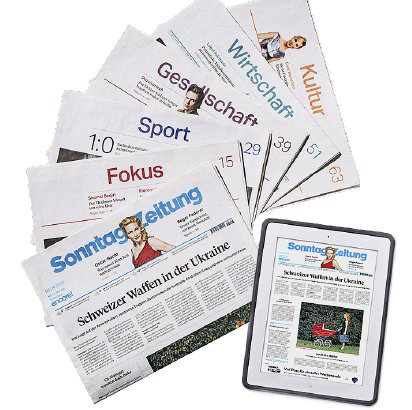
On Sunday, the Sonntagszeitung was published for the last time in its usual layout. In addition to design changes, future issues will feature a new masthead.

As the Sonntagszeitung announces in its current issue, print and digital readers can expect various innovations starting next week. The new website has been prepared "intensively and with a lot of passion" for months, the article says. The layout will be calmer, clearer and offer space for longer, well-researched texts and well-founded analyses. The most striking change, apart from the design elements, will be the newly conceived "Society" bundle, which takes up current debates and includes the previous "Knowledge" in addition to Style and Culinary. The Online presence of the Sunday newspaper has also been completely redesigned and is now accessible for all systems, both on smartphones and tablets. (hae)

sonntagszeitung-neu
 

Leo Burnett: Taking a breath for Sihlcity

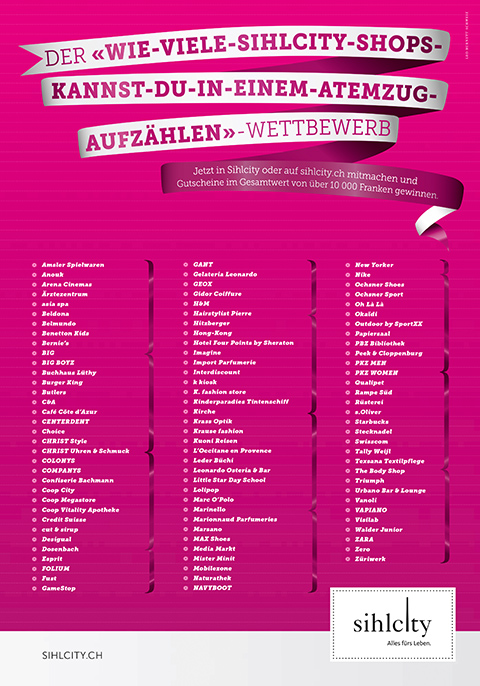
Shoppers at Sihlcity have a huge selection of stores to choose from. Leo Burnett Switzerland has once again brought this to life in its advertising.

With a simple and multimedia promotion: the "How-many-Sihlcity-Shops-can-you-enumerate-in-a-breath-competition". The more stores you could count in one breath, the higher the prize. Participants were able to prove their lungs at the POS, online via webcam and with numerous promotion teams in the city. The competition, which was announced on TV, radio, POS posters and advertisements, was extremely successful, with over 600 participants at the POS alone. The winner was a young man who, thanks to his ingenious breathing technique, managed to reach an incredible 129 stores.

//www.youtube.com/watch?v=FRVnZ3uyBJQ

Sihlc_Atemzug_Plakat_F200_d-1
Subject large

Responsible at Sihlcity: Jörg Engeler (Center Manager), Mara Bonorand, Vanessa Welti (Marketing and Communications). Responsible at LBS: Johannes Raggio (ECD), Pablo Schencke, Barbara Hartmann, Anna Leudolph, Lukas Tauss, Inken Rohweder, Markus Rottmann (Creation), Isabelle Meier, Nadine Stüssi (Consulting), Suzana Kovacevic (Art Buying), Update (Website).


Media Diversity Holding: All or Nothing

According to Schweiz am Sonntag, Publigroupe has offered to sell its 25 percent stake in the St. Galler Tagblatt and the Neue Luzern Zeitung to Medienvielfalt-Holding. However, Blocher and Tettamanti showed little interest.

Schweiz am Sonntag relies on the independent statements of two "reliable sources". St. Galler Tagblatt and Neue Luzerner Zeitung belong to Freie Presse Holding, which in turn is controlled by the NZZ Group (75 percent) and Publigroupe (25 percent). Publigroupe wants to get rid of the shares and is said to be hoping for 50 million francs from the sale. According to the sources, Publigroupe actively approached Blocher's Medienvielfalt Holding through an intermediary and "under the utmost secrecy". Direct contact was deliberately avoided. It had been assumed that Blocher would pay "a proud sum" for influence in rural, middle-class areas.

Contrary to these assumptions, however, interest failed to materialize, because even with a 25 percent stake, the NZZ Group would still call the shots. If the opportunity arose to acquire the major share of the cake, Blocher and Tettamanti would probably not be asked twice. NZZ communications chief Bettina Schibli, however, denied to Schweiz am Sonntag a suggestion voiced by Schweizer Journalist magazine that a medium-term purchase was a realistic scenario. NZZ is aware of Publigroupe's intentions to sell, she said. Industry insiders assume that the NZZ Group will acquire the remaining 25 percent with a right of first refusal. (SaS/hae)

Image: Keystone
 

Maxomedia revamps the website for Stop Piracy

Maxomedia has given the website of Stop Piracy, the Swiss platform against counterfeiting and piracy, a comprehensive redesign. It now meets the latest standards in terms of design, usability and functionality.

Almost everything with a good name is counterfeited and copied: Clothing, watches, software, music, films, medicines and even food. To provide even better information about the dirty world of counterfeiters and pirates, Maxomedia has now completely revamped the Stop Piracy website.

According to the press release, great importance was attached to usability. All answers to the key questions on the topic of piracy can now be found more quickly and easily in four languages (d, e, f, i). The text has been reduced to the bare essentials and an emotional visual language has been chosen. Striking icons and the corporate color red make complex content quickly understandable and clear. Existing campaign sites of the association such as Haende-weg.ch or Dirty-past.ch have been sensibly integrated and linked.

The Website was also implemented in "Responsive Design" and optimized for use on desktops, tablets and smartphones.

screenshot-stoppiracy
stoppiracy-slider-2

Trade association: No to alcohol advertising ban

The Zurich Canton Trade Association (KGV) has announced its positions on the referendums to be held on May 18: Unsurprisingly, it is voting “No” on the ban on alcohol advertising in sports.

The ban on alcohol advertising at sporting events called for by the initiators contradicts economic and commercial freedom and unnecessarily restricts small beverage producers and breweries in particular, the trade association said in a press release. It would also jeopardize the staging of sporting events, as these are often dependent on sponsors from the beverage sector, not only because of the specific financial support, but also because of the provision of infrastructure (bars, cooling facilities, tents). In addition, the trade association is of the opinion that society is already regulated by sufficient laws and bans.

The initiative against alcohol advertising at sporting events was launched in April 2013 (Werbewoche.ch reported) and was launched by the Zurich Cantonal Association of the Blue Cross in August 2012 (Werbewoche.ch reported). (pd/hae)

Basler Tageswoche with a new look

The print edition of *Tageswoche* was published for the first time on Friday with a new layout. The format has been reduced in size, and a new section of the paper features updated articles from the daily online coverage. The goal is to bring digital and print channels closer together.

The smaller format not only helps to save paper, but also has advantages in production, writes print manager Remo Leupin in the editorial of the weekly paper published in Basel. On closing Thursdays, the Tageswoche thus gains a few hours before going to press. Even in the smaller format, the issue published on Friday comprises 48 pages in a single bound. However, there is no stitching, the paper is somewhat thinner and the design appears less airy. Images continue to be used to great effect.

Bundle print and online

The new layout concept does away with a fixed sequence of sections. In the future, this will vary depending on the mix of topics and relevance. A new feature is the "People and Stories of the Week" section with online articles from the previous days. The articles are updated and accompanied by reader reactions from the online edition. According to Leupin, readers will also play a greater role online thanks to a new debate format that replaces the previous one. The print edition no longer includes the culture agenda, as the online version is more comprehensive. Instead, there is now a comic strip. The new concept should help to merge online and print even more, Tageswoche had announced in advance. Thanks to a newly created team of producers, who prepare both newspaper and print contributions, the editorial forces can be better bundled.

Pending proceedings

In February, the Tageswoche hit the headlines because of falsified circulation figures. The local television station Telebasel reported that the Tageswoche was delivering just under half of its 2013 certified circulation of 26'358 copies free of charge to Basel and Zurich airports. This circulation trick prompted the Basel public prosecutor's office to open a police investigation on suspicion of fraud. These proceedings are still pending, as was learned on Friday upon request. In the meantime, Tageswoche has provided transparency on its current circulation. As of March 7, the total circulation amounted to 24'735 copies. Of these, 9765 go to subscribers and 350 to newsstand sales. A further 12'420 copies go to households in Basel and the surrounding area for promotional purposes. 1800 copies are also distributed at Basel-Mulhouse airport. And finally, there are 400 voucher copies.

Digital reach

The relatively high number of promotional copies serves to increase awareness and is nothing out of the ordinary for a new launch, according to the Tageswoche editorial blog. As a hybrid medium, it is not only the print circulation that is important, but also the reach of the digital channels. The mobile pages of Tageswoche were used by 164'000 unique clients (devices) in February, according to research institute Net-Metrix. The site recorded 630'000 unique visits and two million page impressions. On its iOS app, Tageswoche also records 2000 unique visitors per day. The figure is 8,500 per month (SDA).

Swiss Media Prize: The nominations

The 2014 Media Award ceremony will take place on April 25 at the Stadttheater Bern. The nominees have been announced.

On the same evening, journalist François Gross from French-speaking Switzerland will be honored with the Reinhard von Graffenried Lifetime Achievement Award for his life's work. With the Swiss Prize for Local Journalism Print, Online, Radio and TV, the Fondation Reinhardt von Graffenried honors media professionals who have made a special achievement in the fields of local journalism and press photography in Switzerland in 2013. The following media professionals from the three language regions have been nominated for the 2014 Swiss Media Prize:

Print - Mario Fuchs, Sophie Roselli, Samuel Tanner

Jury president Peter Rothenbühler

"In the asylum", by Mario Fuchs, published on 30.3.2013 in the St. Galler Tagblatt

Série de cinq articles sur le drame d'Adéline, by Sophie Roselli, published from 9.10.2013 in La Tribune de Genève

"Chaos phase on the A13", by Samuel Tanner, published on 10.11.2013 in Ostschweiz am Sonntag

Online - Marcel Gyr, Florian Ratz, Alexandra Wohlgensinger

Jury president Peter Hogenkamp

"50 years of Seegfrörni", by Marcel Gyr, published on 25.1.2013 on NZZ Online 

"Rotblaulive - The season of FC Basel", by Florian Raz, published on 22.8.2013 on Tageswoche Online

Piz Bernina ascent series, by Alexandra Wohlgensinger, published from May 2013 on Engadinerpost.ch

Radio - Wilma Rall, Maurine Mercier, Curdin Vincenz

Jury president Patrick Nussbaum

"All will be well in ZuReich - 20 years of Wohlgroth clearance", by Wilma Rall, Dendung Stadtfilter broadcast on 25.11.2013, on Radio RaBE and Radio Lora

"Dans la peau des mécanos. Quand c'est trop, c'est trop !", by Maurine Mercier, broadcast on 24.8.2013, RTS La Première - Quinze Minutes

"Who owns the lakeshore?", by Curdin Vincenz, broadcast on 29.4.2013, Radio SRF1 - Rendez-vous am Mittag

TV - Simone Herrmann, Sophie Hostettler, Cecilla Mendoza

Jury president Mario Cortesi

"School class sends balloon into space", by Simone Herrmann, broadcast on 27.5.2013, TV SRF 1 - Schweiz aktuell

"The Jura conflict" - series in the run-up to the vote, by Sophie Hostettler, broadcast from 24.11.2013, TV Telebärn News

"Les nouvelles tendances de marketing politique", by Cecilla Mendoza, broadcast on 20.9.2013, TV RTS 1 - Couleurs locales

The nominated entries can be found at this link available.

Reinhardt von Graffenried Lifetime Achievement Award

Born in Lausanne in 1931, François Gross found his way into journalism at the beginning of the 1950s. He first worked as an editorial secretary at the newspaper La Gazette de Lausanne with Pierre Béguin, then became the French correspondent in Paris for four years before being appointed editor-in-chief of Téléjournal Romand, which was broadcast from Zurich at the time. Between 1970 and 1990, he shaped the Fribourg daily newspaper La Liberté with his direct and independent style as editor-in-chief. He then took over Radio Schweiz International in Bern, became president of the association Reporters sans frontières and taught at the Institute of Journalism at the University of Fribourg. The 83-year-old thoroughbred journalist lives in Fribourg and still writes regular columns for the online portal Sept.info.

get_footer();