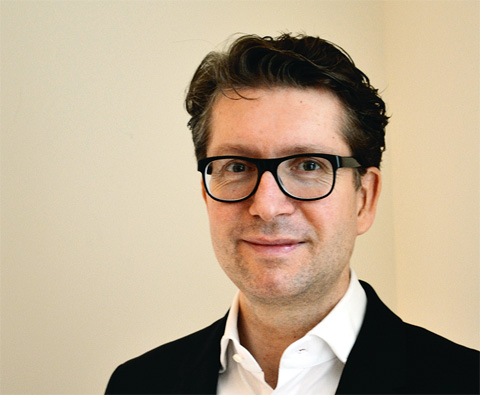
Roland Bernhard studied business administration in Zurich and the USA and graduated with an MBA. Commenting on his approach with Vivaldi, he says: "We don't see the brand as a design issue, but as a business issue. The brand should be something that creates value for the business."
WW: What is the background or purpose of the Always-On Consumer Study? Roland Bernhard: The study is being published at a time when Always-On Consumers (AOCs) make up almost half of the total US population - and the trend is rising! In other words: very soon we will be able to count a large proportion of consumers among the 'AOCs'. It is therefore this 'tipping point' that gives the issue such urgency. If you want to know what will make the majority of consumers tick in the future, you need to understand the 'AOC'.
Is this the first time this study has been written? When did the industry start talking about the "always-on consumer"?
The marketing world has been looking at the always-on consumer with growing interest for some time now. This phenomenon was originally coined by Forrester, among others, two years ago. The current study by Vivaldi Partners now examines the strategic implications for the future relationship between brands and consumers in detail for the first time.
How exactly are these consumers defined?
The always-on consumer is constantly online, several times a day via multiple devices in different places. These consumers differ from "classic" consumers less in terms of demographic factors and more in terms of their greatly changed purchasing and consumer behavior.
What is specific to the consumer behavior of these consumers?
Our study shows that the always-on consumer is much more selective when it comes to brands and their communication/advertising. Attention is primarily attracted by offers with substantial added value that reach them at the right moment and in the right context. However, according to our findings, there are different patterns of behavior. This means that always-on is not the same as always-on.
What do you consider to be a really new finding from this study?
The always-on consumer is much more independent, focused and determined in their purchasing decisions than we are used to. They no longer necessarily follow the principle of the classic purchase funnel from the age of mass media. Marketing managers must therefore be able to accompany consumers on their personal purchase decision path and intervene at the right moment, in the right place and in the right context. To do this, they need to build up completely new skills in their marketing organization - according to our findings, primarily along the cornerstones of big data, location-based technology and mobile platforms. This represents an enormous challenge for marketing managers. Against this backdrop, we also speak of "digital Darwinism". Those who are not able to adapt to this change will become irrelevant to consumers and will therefore be pushed aside.
What are the other key findings of the study?
In order to meet the demands of the always-on consumer, the entire value chain must be specifically geared towards this new type of consumer. This goes far beyond the traditional understanding of marketing or communication. Tailor-made offers are needed that do justice to the consumer behavior of AOCs and can be translated into corresponding products and services. Streaming services, shared mobility, mobile payment, etc. - new formats are already emerging in many sectors that go hand in hand with the changing consumer behavior of AOCs.
Why do always-on consumers deal with brands differently than traditional consumers?
The main reason is that they can no longer be bombarded with one-sided advertising messages around the clock via mass media. Consumers in the USA already spend more time on their smartphones than in front of the TV, and in China even twice as much time. On this new "first screen", consumers are in control - of what content they want to see and what they want to share with their friends; what recommendations they follow from their friends and what recommendations they make themselves. But consumers don't just use their smartphones and tablets to get information, they also use them directly for mobile shopping. The gap between information intake, purchase and, in some cases, distribution is shrinking. Completely new mechanisms are needed to achieve relevance in this process.
Did the study also reveal any surprises?
We have been dealing with changing consumer behavior in the dawning digital age for several years now. Nevertheless, it is astonishing how strongly these new consumers are no longer characterized by the so-called digital natives or millennials, but represent a rapidly growing group. This is precisely the reason why it is so important to take a very targeted and strategic look at your own business model now and transform it in a customer-oriented way.
With this study, your company is predicting the end of traditional market research: Isn't that a bit tongue in cheek?
You could say that until now, marketers have relied on traditional market research to learn about consumers. We assume that learning and acting will merge into a mutual exchange in the future. Traditional market research can no longer achieve this. Instead of measuring consumers' attitudes towards a brand, in future marketers will need methods that enable them to track the entire consumer journey right up to the point of purchase in real time - at the "point of action" and across all channels.
The study also calls for brand experiences instead of advertising: do you think advertising agencies are ready for such a step?
I think the question is not so much whether advertising agencies are ready, but rather whether they can achieve this. Advertising agencies have their strength in the broad dissemination of brand messages and in changing the image and attitudes of consumers towards brands on a broad front. However, other means are required to motivate the AOC to make a purchase. As a rule, the company will have to offer much more contextually relevant messages, products and services via a large number of contact points and thus be able to react in real time to the situational circumstances of consumers. The brand experiences created in this way go far beyond pure communication and have a direct sales impact. The strategic focus is shifting towards creating digital infrastructures and tools that enable managers to do just that. Nestlé is a good example of this. The company set up its own "Digital Acceleration Team", which uses digital tools around the clock to stay in constant contact with consumers. The success of such measures can be tracked in real time and enables marketing managers to continuously take on a steering role.
The study was conducted in the USA. Do the findings also apply to Europe and Switzerland in particular?
Yes, the study was conducted in the USA and there is no doubt that consumers in the home of Google, Apple & Co are already more "digitalized". In our opinion, however, it is only a matter of time before this trend manifests itself even more clearly here in Switzerland.
The Vivaldi Partners Group is behind the study: What is the elevator pitch for this company?
With our customer-centric consulting approach, we specialize in growth - be it through positioning and managing the brand experience, outside-in based development of innovations or through the development of digital marketing strategies.
You represent Vivaldi Partners in Switzerland: How big is your consultancy firm and what projects are you involved in?
We are a global boutique management consultancy with our head office in New York and a strong presence in German-speaking countries. Our global team of around 100 employees works for multinational clients from all industries. In Zurich, we have six consultants plus a back office. Our goal is to grow to around 10 consultants. For all projects, however, we have the opportunity for an international exchange with our network. We have a pool of people throughout Europe and, if required, also in the USA, depending on the topic and sector. Many of our clients also have an international presence. We can mirror this accordingly. Our clients in Switzerland include UBS, Rivella, Swarovski, Lego, Lonza, SIX, etc.
What are your goals with Vivaldi in Switzerland?
We want to become the first choice for clients in Switzerland who want to achieve profitable growth through customer-centric development of their brand, offering and business model.
Interview: Andreas Panzeri
Vivaldi Partners identifies five key segments that are relevant to address from a marketing perspective:
Social Bumblebees (22% of AOCs) spend a lot of time online, especially on social networks, often make spontaneous purchases online, often on the move
Mindful Explorers (27%) like to remain inconspicuous, protect their privacy and shop online for various reasons - but always after thorough research and consideration
Deal Hunters (13%) are to a certain extent the bargain hunters among the AOCs - price/performance is what counts for them
Focused Problem Solvers (18%) go online for comparatively short and targeted periods, largely ignore online advertising and usually remain loyal to their existing brands
Ad Blockers (20%) shop online very selectively and completely ignore advertising and branded content
The study in PDF format