Cavegnwerbrung is committed to art

Cavegnwerbung designed the website for the painter Lucrezia Brendel.

For the painter and artist Lucrezia Brendel, the painter's palette becomes the image, the agency said in a statement. A concise image idea, which is to put artistic craftsmanship and personal creativity of the painter in the foreground. The basic colors and the artist's name are used to create the paintings, which can be viewed on the website of the same name.

For the logo, Markus Cavegn twisted the name off to the side and slightly distorted the font to visually open up the space of creativity. Curiosity was aroused about the artist's website with a mailing that was printed directly on a brush and sent without packaging. The personal, artistic touch was also implemented with it.

This teaser was followed by postcards to launch the website. These postcards were designed as painter's palettes made of paper. What the logo hints at was thus formally rounded off.


Maz certifies communication professionals

13 students with communication professions in companies and institutions successfully complete the CAS Professional Media Relations. At the same time, 16 communication and management professionals successfully completed the CAS Rhetoric and Moderation.

The two courses "Professional Media Relations" under the direction of Elmar zur Bonsen and "Rhetoric and Moderation" under the direction of Oliver Schroeder are a partner offering of the MAZ and the HWZ Hochschule für Wirtschaft Zürich and an elective module of the MAS Business Communications of the HWZ.

CAS Professional Media Relations

The graduates completed the CAS (Certificate of Advanced Studies) "Professional Media Relations" at the MAZ at the end of February. In the course of study, they learned and trained technical and strategic media and communications knowledge at the Swiss School of Journalism. Experienced lecturers from companies, agencies and associations taught them in a practical way how an efficient media office must be structured and networked, how successful issue management works or how to score points even in crisis situations. Thanks to intensive coaching, the CAS graduates also improved and refined their writing and presentation skills.

Certificates received:

maz
Mario Bislin, Political Community Bad Ragaz; Nicole Drechsler, MAZ - The Swiss School of Journalism; Patrick Dubach, Unia Northwestern Switzerland; Anna Faoro, Federal Department of Finance FDF; Barbara Felix, Alternative Bank Switzerland; Florence Horisberger; Celine Kohlprath, Federal Office for Migration; Isabel Rutschmann, Swiss Red Cross; Urban Schwegler, Catholic Church City of Lucerne; Roland Siegenthaler, Burson Marsteller; Manuela Staub, Swisscom AG; Madeleine Wälti, Synedra Switzerland; Robert Witte, Psychiatrie Baselland.

CAS Rhetoric and Moderation

In the 6-month, part-time course, participants intensively improved their own performance skills using a wide range of rhetorical tools. Throughout the course, participants received individual coaching in breathing and vocal techniques. The participants trained the art of convincing appearance and argumentation in speeches and negotiations. They professionalized various presentation techniques as well as the art of storytelling. In the second part of the CAS course, participants deepened their skills and knowledge in moderating meetings and panel discussions as well as in leading difficult conversations. A two-day media training course concluded the total of 11 modules of 2 course days each.

Certificates received:

maz2
Thomas Armendinger, Post CH; Werner Augsburger, Swiss Volley; Andrea Brändli, Schule Dietikon; Gabi Buchwalder, Migros Genossenschaftsbund; Dietmar Eglseder, suissetec; Melanie Fussen, BCP Business Consulting Partner AG; Stefan Grösser, Berner Fachhochschule Wirtschaft; Sandra Isler, Lungenliga Luzern-Zug; Anne Koch, Greenpeace Switzerland; Christian Meier, Würth Finance International B.V.; Nicole Payllier, Courts of the Canton of Aargau; Martina Ulmann, Allgemeine Baugenossenschaft Zürich; Reinhard Venetz, Seniorenzentrum Naters; Regina Waldis, Lucerne Tourism; Jürg Widmer, Verkehrsbetriebe Zürich VBZ.
 

VSM: Markus Somm to become new member

Markus Somm is set to join the executive board of the Swiss Media Association (VSM). The publisher and editor-in-chief of the *Basler Zeitung* is set to replace Filippo Leutenegger.

Leutenegger was elected to the Zurich City Council last February. This was announced by the Swiss Media Association VSM on Thursday. The Executive Committee unanimously approved the election proposal for the Annual General Meeting on September 11 in Interlaken, it added. Leutenegger will also be bid farewell at the general meeting.

The Presidium of Schweizer Medien currently consists of:

- Hanspeter Lebrument, Chairman, Publisher Somedia
- Pietro Supino, Vice Chairman of Swiss Media, Chairman of the Board of Directors of Tamedia
- Gilbert A. Bühler Director Freiburger Nachrichten
- Veit Dengler, CEO, NZZ Media Group
- Norbert Neininger, Publisher and Editor-in-Chief Meier + Cie.
- Christof Nietlispach, Publisher of Freiämter Regional Newspapers
- Marc Walder, CEO Ringier
- Peter Wanner, Chairman of the Board and Publisher AZ Medien
 

Branded Storytelling

Shortcuts has produced three clever commercials for SRF 2 Kultur. The commercials highlight a new positioning for the early-evening programming on this long-established cultural broadcaster. The commercials are typical of the Shortcuts trio.

A cab ride is over, and the music on the car radio is also fading out. The young people in the back seat are thrilled by the awesome sound. And they scoff at classical music. But then the big stunner: "The new eve, on Radio SRF 2 Kultur," the presenter's voice enlightens the young people as to what has just been heard here. The station has changed. With a new positioning of the early evening program from 4:00 p.m. to 6:30 p.m., it is increasingly addressing a broad and younger audience with topics such as film, art, music, but also science. However, Radio SRF 2 Kultur is still too often associated solely with high culture: Mozart, readings, choral songs. This image is now to be changed. Three TV spots are to communicate the development. The tongue-in-cheek short films were created and produced by Shortcuts. "We tried to stage witty dialogues in which we address how and where culture is enjoyed today," explains Bene Abegglen of Shortcuts. A cab serves as the stage. "Here you can have all walks of life perform." Moreover, it's a sympathetic idea to portray a cab driver as very cultured. After all, he sits in the car for hours every day - and listens to Radio SRF 2 Kultur while waiting.

The idea is simple, convincing and can also be realized within a reasonable budget. In short: an "original" Shortcuts production.

Unbenannt-12b_2

A trio complements each other

An advertiser, a filmmaker and a social media specialist stand for the style of Shortcuts. Filmmaker Peter Lehner has been a producer for 30 years in Switzerland, Germany and the United States. He studied film at New York University and shot or produced feature films and television series in Los Angeles for studios and networks such as MGM, CBS, and in Europe RTL, SAT1 and SRF. In addition, Lehner successfully founded and managed several film, commercial and entertainment companies such as Whitenoise and Ping Pong Film. Lehner is executive producer at Shortcuts. The advertiser Bene Abegglen looks back on more than 30 years of experience in the scene. He successfully ran the Contexta agency in Bern with his former partners. Abegglen is a member of the Art Directors Club, has been repeatedly appointed as a juror at national and international advertising festivals and has designed and been responsible for over 150 commercials to date. In 2011, Bene Abegglen sold his shares in Contexta Holding and co-founded Shortcuts AG in Zurich.

Patrick Mueller, the social media inputter at Shortcuts, has a master's degree in architecture from ETH Zurich and has never spent a minute in an architectural office. Instead, he started his own business in the field of corporate identity during his studies and co-founded the Internet start-up DigaDing. Two years later, this led to the social media agency smly. Mueller is "the representative of the young generation" at Shortcuts.

"We are not an advertising agency, we do creation and production. We shorten the process. The name says it all: Shortcuts. We appreciate being able to work closely with clients and agencies. Having ideas quickly and being able to implement them quickly and economically," says Bene Abegglen, speaking for the team.

Andreas Panzeri

Unbenannt-12_29
 

//www.youtube.com/watch?v=yqZI_feoTJM

//www.youtube.com/watch?v=JWwwmF5kzw8

//www.youtube.com/watch?v=Z46g_qLA7MU

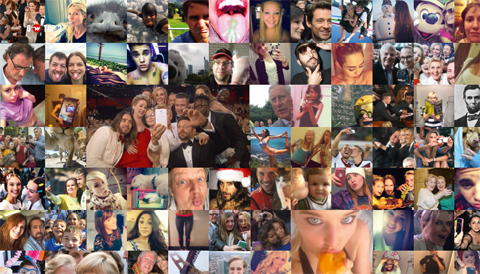
Selfies: advertising for self-promoters

Everyone takes selfies. Could these digital self-portraits also be used as a database for personalized advertising and marketing? And is it permissible to simply exploit private photos for commercial purposes? *Werbewoche* asked around.

Unbenannt-5_44

Some people indulge in this new passion to excess, others find it annoying: selfies. The fact is: selfies are being snapped, uploaded and shared everywhere, by women and men, young and old, secretaries and federal councillors, celebrities and cervelat celebrities. Often with embarrassing consequences. Selfies, or classically: self-portraits, are actually nothing new. Even in ancient times, artists portrayed themselves; the self-portraits of Albrecht Dürer, Rembrandt, Lovis Corinth and Vincent van Gogh are among the most famous works of art ever created. And just as artists back then consciously wielded a paintbrush to stage themselves, a selfie is usually preceded by a lengthy styling process and the search for the right background - because even if the selfie suggests spontaneity, it is a deliberate self-staging of the person depicted, in which they have everything under control. And only then takes the picture. And only then uploads the picture. Selfies represent a new need for self-presentation, for a controlled, idealized image of others: I'll show you how you should perceive me. "Selfies have a very unique, new visual aesthetic that strongly reflects today's zeitgeist," says David Schärer, co-founder and managing director of the Zurich agency Rod. "They look random and create a feeling of closeness to the person depicted, which is particularly true of celebrity selfies. After all, the person so far away from us took the picture themselves, and you can often still see the arm holding the smartphone." Whether celebrity or normal person: the controlled shots give everyone the opportunity to present themselves in the desired light. And they give even the smallest number the feeling of being interesting to others. Exhibitionism for a society of voyeurs - whatever you like is allowed.

Look, that's me

The first digital portraits under the name "selfie" appeared on Flickr and MySpace in 2002. Since then, pseudo-snaps have conquered the internet. Every day, around 1.8 billion photos are uploaded to Facebook, Instagram, Flickr, Snapchat and WhatsApp, and no longer just by teenagers. This is confirmed by a study by venture capital firm Kleiner Perkins Caufield & Byers. "When even National Councillor Geri Müller posts a nude selfie of himself, selfies have obviously become common sense," says Schärer. Selfies are so trendy that they are probably more than just a brief, fashionable twitch. And new trends often hold new potential for advertising and marketing. Does this also apply to selfies? Opinions are divided. Schärer clearly says: "Yes!" Martina Schorn, research associate at the Vienna Institute for Youth Culture Research and co-director of the recently published study "Generation Selfie", also says "yes". Andrea Iltgen, co-founder and managing partner of the Zurich-based online marketing and social media agency Xeit, thinks: not so much. And then there are also genuine legal concerns. Because not everything that works is allowed.

Expense versus income

Anyone who posts a selfie reveals information about themselves: when the photo is taken, the location where the picture was taken and the device used is saved. The photo itself also reveals a lot: is the photographer on the ski slopes or on the beach, in the changing room or buying a car, on the playground or in the office? Once image recognition technology has matured to the point where millions of selfies can be analyzed within a very short time, the way would be clear for advertising tailored to consumers: one person receives offers for ski resorts and ski equipment, another for bikinis and beach fashion. The next receives shopping tips, the fourth offers for the cheapest leasing rates. Almost anything is possible.

"To do that, you would first have to develop software for image analysis," Andrea Iltgen from Xeit points out. "In my opinion, that's not the smartest way to go. There are already very good targeting options today, such as behavioral targeting or Facebook. A lot of information about users is readily available there. Analyzing selfies would be a huge detour to get information that we have had for a long time." Iltgen considers selfies to be a current trend that will soon be over again. "In Switzerland, a very limited group takes selfies," she says. "There are around 500,000 people on Twitter, only some of whom take selfies and upload them. The effort involved in evaluating these images is simply not worth it."

The future of advertising

David Schärer sees things differently: "The great thing about today's world is that any vision you have is probably already technically feasible. You can certainly take selfies as an indication of a certain lifestyle, which can then be used for advertising and marketing. I do believe that this will happen." The analysis of image data for potential advertising customers could be particularly interesting for social networks such as Instagram, Pinterest and Snapchat, which have so far provided comparatively little data about their users.

Scientist Martina Schorn, who recently co-published a study on "Generation Selfie", says: "Selfies are no longer just a youth culture phenomenon, but are also a marketing gimmick." And she goes even further: "As soon as there is software that systematically evaluates selfies for certain aspects, it is quite realistic that the data obtained will be used as a basis for advertising and marketing. Someone who takes a photo of themselves in a bar with a bottle of vodka would then receive advertising for spirits, and someone who takes a selfie on the beach would receive advertising from travel providers. Technically, this would all be feasible, if not now then in a few months' time. From an ethical perspective, however, such a use of selfie image data would be controversial."

According to Lucerne advertising and media law expert Ueli Grüter, the analysis of images for advertising purposes is not only controversial, but not permitted at all. "Purpose limitation plays a major role in data protection," explains Grüter. "The law prohibits data processing that is not earmarked for a specific purpose. If Geri Müller and his girlfriend send photos with the purpose of showing them to each other, no one is allowed to use them for anything else, not even for data analysis. The terms and conditions of WhatsApp, for example, stipulate that the data is only used for this transmission." In theory. In practice, cookies already collect various data about different users on the internet. That's why the author is still receiving maternity wear ads when her sons are already out of the house - just because she clicked on mommy clothes at some point. According to Grüter, this is not allowed, but it is done anyway. Until someone complains. Which, however, rarely happens, as Grüter confirms. It will probably be similar with the advertising analysis of selfies.

Closer instead of on the outside

The use of selfies as advertising subjects is permitted and apparently popular. They create closeness between the person depicted and the viewer. For example, the selfie medium brings companies into contact with their customers and turns them into stakeholders. Two examples: in 2011, Rod initiated a campaign with user-generated content for Hotelplan: the agency called on people to share their vacation photos with others. Two weeks after the campaign was launched, 4,000 people had already uploaded more than 70,000 vacation photos to the Hotelplan website, including a number of selfies. Rod is currently running a campaign for SBB that uses selfies of train passengers as subjects. This campaign is also going well: around 600 selfies were uploaded to the SBB platform in the first week.

It is very likely that the selfie trend will continue. It is already reflected in the hardware: camera manufacturer Rollei has just launched a "selfie stick" with a smartphone holder, a kind of arm extension that allows you to take selfies without twisting.

If advertising and marketing want to take advantage of the new openness of potential consumers, they need to be clever about it and accompany advertising with exclusive discounts, for example. Because once selfie-takers feel harassed or even abused by advertisers, they will migrate to other platforms, create new channels, withdraw or - worst case scenario - sue. That's the beginning of the end. "The biggest risk for a company is reputational damage, especially in social media," says lawyer Grüter. Because the path to another platform is very short.

Anne-Friederike Heinrich
 

99 design proposals

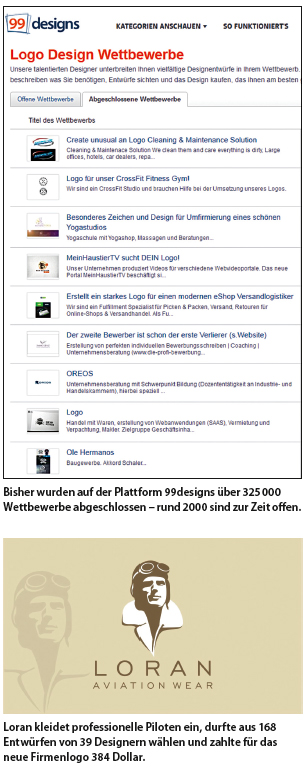
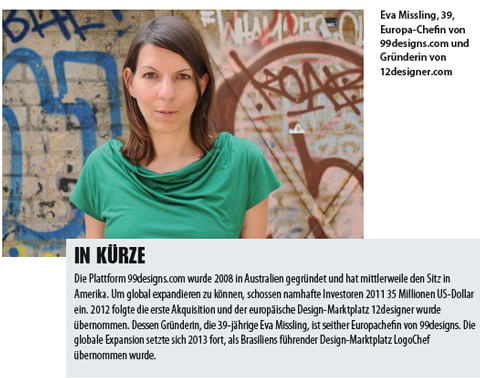
On the design marketplace 99designs.com, more than 320,000 freelance designers from around the world offer their services at low prices. This is especially good news for customers on a tight budget. Nevertheless, the crowdsourcing platform is not without its critics.

The principle of 99designs is as simple as it is obvious: The customer describes in detail what he needs on the platform. The range of offers is broad: logos, websites, business cards, mobile apps, book covers, illustrations... anything to do with design is traded on 99designs. After the briefing, the competition for the financial award starts. Designers interested in the job now submit their creations. After seven days, the client chooses the proposal he likes best, signs the usage rights transfer contract and can use the purchased graphics. In most cases, the participants who are not considered are left empty-handed.

The customer can influence the number of proposals and the quality of the designers: From four categories - bronze to platinum - he chooses the amount of prize money. The cheapest option costs 279 francs and promises about 30 designs from "good" designers. A "gold" competition generates about 90 proposals and usually mobilizes the "very good" designers. In the platinum version, only designers selected by 99designs are let loose on the project. Cost: 1099 Swiss francs. In platinum contests, designers who are not considered also share in the prize money.

Unbenannt-8_34

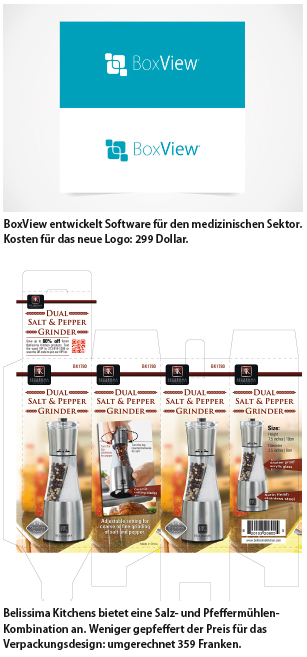
In addition, the customer can increase the attractiveness of the competition by waiving the "money back" clause and awarding the prize money even if none of the proposals satisfies him. The advantages from the customer's point of view are obvious: in addition to the speed and variety of the selection, he receives a product that meets qualitative standards for a fraction of the usual cost. Since numerous talented designers from low-wage countries also take part in the competitions, the chances of success are great even for low budgets. In most of the competitions, the number of submitted works is significantly higher than the benchmarks given by 99designs. Eva Missling, General Manager Europe, confirms, "The prize money is naturally more interesting for designers from countries with a lower cost of living, so you can get designs from all over the world." However, Missling says that communication with the designer and the potential to work together on follow-up orders also play an important role in the selection process. This, of course, is where designers from the home country benefit. Around 4,500 graphic artists and designers from Switzerland participate in the digital marketplace, and 30,000 in the DACH region. The German-language version of 99designs was launched in September 2012. The domain 99designs.ch together with the currency Swiss Franc has been offered since September 2013. For good reason. "The Swiss market is a very open-minded market, so many Swiss entrepreneurs used 99designs even before September 2012, before 99designs became active in Europe," reveals Missling. In total, he says, more than 3000 design competitions have already been carried out by Swiss people.

One of them is David Christen, founder and COO of Receipt.ch. The portal makes it possible to correctly insure household helpers and settle the contributions with just a few clicks. The company commissioned an infographic from 99designs. Although Quitt.ch works in-house in the web area or falls back on classic graphic designers for print jobs, it sees 99designs as the ideal complement for some work. "Full-service agencies are too expensive for a start-up," Christen says. He finds the design marketplace business model exciting because it offers some disruptive aspects. "They're sure to generate some conversation among graphic designers," he is convinced. In addition, he says, the company has no fear of crowdsourcing, as it itself handled part of the financing round via a crowdfunding platform.

Unbenannt-8b_0

Christen sees difficulties, for example, in writing invitations to tender in English in such a way that they are correctly understood despite cultural differences. In the case of Quitt.ch, for example, a certain understanding of what the Swiss mean by "dä AHV" is important. On the other hand, he was positively surprised by the personal support in German. This would have a completely different quality than other international crowdsourcing offerings.

Max Meister from the start-up Incuray, which was launched in 2012, had logos created at 99designs. As a follower of the lean start-up approach, i.e. a start-up with the leanest possible processes, they wanted a good and cost-effective result in a short time. The cost/benefit evaluation spoke in favor of 99designs at this early stage, he said. "Unfortunately, there are few agencies that are willing to offer special conditions for startups ", says Meister. "When it comes to a specific, rudimentary need, 99designs offers a viable alternative." However, the more a start-up develops in the direction of a "strong brand," the more it should work with a good agency, in his opinion, since 99designs does not offer all-round support. This often goes hand-in-hand with a startup's financial capabilities, he said. "Agencies should adjust their pricing according to the lifecycle of the venture. " Which in turn means a certain risk for the agencies, he says, since many start-ups quickly disappear again. The management consultant and HWZ lecturer sees "CI fo equity" approaches, for example, as a possible solution - agencies would be paid for their expenses in shares in the company. European head Eva Missling does not see 99designs as direct competition for classic agencies, but rather as a supplement: "We specialize in selected products such as logos, web design, infographics, and business stationery - our designers are very good at this and our briefing process is also optimized for this. However, the customer has to know what he wants - the process of developing the idea first is a typical agency task that we don't perform."

Unbenannt-9_35

Curse and blessing for designers

The platform also likes to emphasize the advantages for the supply side: Since only one's own creativity counts, even designers without a network can get orders from all over the world. "Not every designer lives in a bigger city with access to diverse companies that need design," Missling says. "For designers from more rural areas, we offer unlimited access to clients and opportunities to pursue their passion." This also applies to designers who are time-bound by children, for example, and don't want the 40-plus hour work week of an agency, he said. The argument for total creative transparency should be obvious even to critics. The best will prevail - what counts is professional ability, not networking or self-marketing. Independent designers can concentrate on their actual work. Ratings, history and statistics additionally ensure that they can build up a reputation.

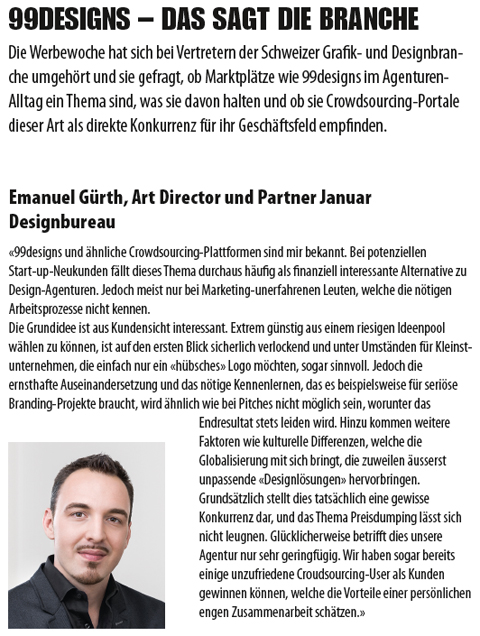
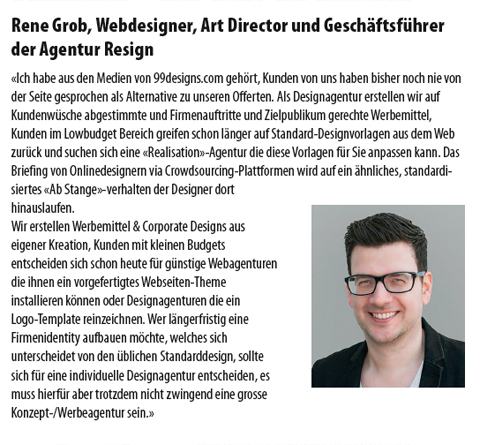
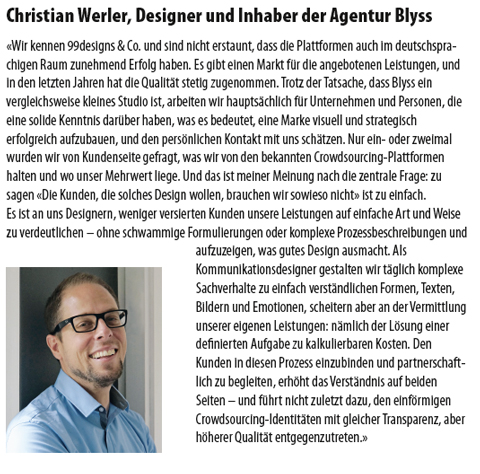
However, there are many critics of crowdsourcing platforms like 99designs.com. The main criticism is the accusation of price dumping and "exploitation" of independent designers. If there is a report online about 99designs, negative reader comments are not long in coming. The tone ranges from critical to spiteful. "Who can still afford to simply be creative today and come away empty-handed in many competitions?" wonders one designer who can "only shake her head" at the business model. "Sometimes one gets the 200-euro contract and the other participants get nothing. Do the participating designers, creatives or programmers have then no mindfulness before their achievement and the investment of their life time?", so the critical statement on the Website Gruenderzeit.de further. User Silvia even calls for a boycott of the platforms and forgets netiquette in the emotion: "You deviant exploiters should all go broke!"

Eva Missling takes criticism from all sides seriously, but doesn't think that 99designs is destroying the market in terms of price. She emphasizes that 99designs is far from being the cheapest provider of design services. Rather, she says, there is an oversupply of graphic designers today, and this becomes transparent on the platform. "We hear from clients that they appreciate the variety of designs they can choose from - even though they have a cheaper quote, they want to try crowdsourcing." The market for design is very opaque and has a wide price range, he said.

Missling also does not want to accept the argument that the competitions are unfair because many designers are not paid for their proposals. "I think designers weigh up whether they want to try for new commissions themselves - after all, there is often a lot of unpaid work to be done here for a self-employed designer, starting from self-marketing to the presentation appointments and the preparation of proposals. And then sometimes you're still waiting to get paid after the work is done." 99designs takes care of client acquisition and guarantees payment security, she says. From her many years of agency experience, Missling remembers paid agency pitches, but they in no way covered the expenses incurred at the agency if you wanted a chance to impress a client and stand out from the competition.

Cooperation with agencies and large companies

While many designers and graphic artists tend to take a rather cool view of 99designs, the platform also seems to be attracting interest from advertising agencies. Agencies use 99designs to outsource tasks that are not part of their core area of expertise, to find new freelancers, and also to simply have things done, such as images cropped. For agencies that outsource to external parties for graphic design, 99designs launched a special tool in spring 2013. At the time, CEO Patrick Liewellyn explained that the company was overwhelmed by the popularity it was receiving from agencies and larger companies and therefore wanted to make collaboration as convenient as possible. Because even though the platform is particularly popular with start-ups and individual companies due to its attractive price-performance ratio - the customer base is diverse. "From self-employed carpenters to start-ups and large corporations," says Eva Missling.

"Medium-sized and large companies often use us to get new ideas and get in touch with many creatives - for example, to build a freelancer pool." The Pro tool offers simplified processing and, most importantly, protected privacy. The private "invite only" contests make it possible to assemble a pool of designers for a call for entries with whom one would like to collaborate in the future. Only the graphic designers see the RFPs, they cannot be accessed outside the community - the contests cannot be found via search engines. Confidentiality agreements must be signed. By request, designers do not see competitors' proposals. So it seems that the development potential of crowdsourcing portals like 99designs is far from exhausted. Whether the virtual design marketplaces will continue to act as a supplement rather than direct competition to established agencies remains to be seen.

Thomas Häusermann

Unbenannt-10_28
Unbenannt-10b
Unbenannt-11_29


The big #ALSIceBucketChallenge

Since early August, a tailor-made, never-ending viral social media campaign has been running under the hashtag ##ALSIceBucketChallenge. It is unprecedented. *WerbeWoche* explores the reasons behind its success.

TO BEGIN: On August 1st at 12:58 am Pete Frates wrote on Facebook: "So I am nominating myself for the #icebucketchallenge cut I can... ice water and ALS are a bad mix, so I got my friend Rob Van Winkle to help me out (the names of 9 users follow) you have 24 hours to dump a bucket of ice over your heads!!! #StrikeOutALS #Quinnforthewin."

TO THE ISSUE: ALS is an insidious disease that irreversibly damages the motor nervous system of those affected and leads to death. The feeling of paralysis in patients is similar to the feeling of having ice water poured over your head. Hence the challenge from the US ALS Association: you have the choice of either pouring ice water over your head and posting the picture on the web or donating 100 dollars to the ALS Foundation. You can then name three people who can take part within 24 hours.

TO SUCCESS: According to CommunityNZZ in Storify, the challenge has brought the foundation 739,275 new donors and $41.8 million in donations since it began, compared to $2.1 million in the same period in 2013."

THE RECIPE FOR SUCCESS: The idea of the ice bucket has obviously given this fundraising campaign magical powers. You need to know that there are thousands of such fundraising campaigns worldwide every year. We go in search of the magic potion recipe and find ingredients. I would like to explain five of them.

1. CONTENT. This is a topic that affects everyone. ALS is an insidious disease for which there is still no cure. It is an appeal for donations, and the funds go entirely to research. Not every company can come up with a setting like this. But it's about the question of meaning. There is simply far too much advertising junk in the social media feeds. The ideas lack insight. Posts that combine seriousness and humor are successful and tolerable. By seriousness, we mean a benefit that offers the prospect of real added value. In this case, this is the appeal for donations, combined with raising awareness of the disease. The campaign itself provides amusement, in a wonderful way, by pouring ice water over itself - which brings us to the second success factor.

Unbenannt-13_21

2. ENGAGEMENT. It is a mixture of shock therapy and a snowball system. People pour ice water over themselves and then ask three other people to do the same within 24 hours and make a donation at the same time. And it works. The users get actively involved. Calls to action like this are crucial. After all, the effectiveness of advertising on the social web can only really be reliably proven on the basis of engagement values.

Unbenannt-13b_0

3. VIDEO. The use of videos plays an important role in achieving the viral effect. Firstly, the video in the IceBucketChallenge provides proof that the challenge has been accepted. The video is part of the game. In addition, the mere idea of being filmed seems to inspire the players' creativity. The contributions are a must-see. The participants fly helicopters and bring in excavators with powerful shovels. But there is another reason for the dominance of video. All relevant social media platforms now offer the option of uploading videos directly via app from mobile devices and playing them in the so-called newsfeed stream. This is now possible on Twitter, Facebook, Instagram, Google+ and Vine. Technology is advancing in leaps and bounds here. Of course, sooner or later the videos will also end up on YouTube and from there back in the social media feeds. But the importance of YouTube in the app age is declining - at least as a driver of virality. That's also an interesting observation. In the past, the motto was always: let's make a viral movie on YouTube. Today, YouTube is a playback and embedding channel, but less and less a starting point.

4. AMPLIFIER. Facebook mogul Mark Zuckerberg was one of the first ice-cold showers to take to the social media stage. Naturally, this launched the story on the social web. The request to Zuckerberg came from a prominent politician - the Governor of New Jersey, Chris Christie. Zuckerberg's performance on August 14 has since been shared 48,000 times and liked 358,572 times. Zuckerberg called on none other than Bill Gates to take an ice shower, who then actually stood under the ice shower on August 15 and has so far achieved 950,000 likes, 40,000 comments (!) and 262,570 shares with his post. Other celebrities who have taken ice showers include Mickey Rourke at the request of footballer Robbie Kean, Justin Timberlake, TV talk show host Jimmy Fallon and the@ greysABC crew from "Greys Anatomy". Football and field hockey teams proved to be particularly contagious. The use of influencers as distribution amplifiers, i.e. people who have large networks and can mobilize them, is a recipe for success that is still used far too rarely. Such distribution amplifiers can be identified for every brand. Building a high-quality network with ambassadors can take months and a lot of time. Despite the latest monitoring tools, the manual search via networks is the most important thing. Working with lists (Twitter) or groups (LinkedIn, Facebook) is particularly recommended. The best bait for ambassadors is a good story that delivers what it promises. Success comes to those who get the right mix of seriousness and humor.

5 STORIFY: The most renowned premium publishers, brands and organizations are now writing heaps of news and background reports by combining social media content from various users into stories on Storify. On the social web, the voice of the user enjoys the highest level of credibility. This realization has now also reached the editorial offices and communications departments. The amazing thing about Storify is its simplicity. Posts, tweets and videos from all social media and web sources can be compiled into stories using the drag-and-drop method. An account can be opened in five minutes. The stories can be shared and the source code can be used to integrate the story into web platforms such as websites and blogs. Such simple integration and distribution methods give social media content additional wings. The communityNZZ has certainly contributed to the ice bucket hype via Storify with its story "Selfies for cool heads".

Beat Hürlimann

At Storify.com/beathuerlimann you will find the story of the challenge with lots of performances, statistics and other stories about the #ALSIceBucketChallenge.
Let us inspire you - or even better: motivate you to act!
 

The Impact Check of Werbewoche

We show how current campaigns are performing with consumers.

In terms of awareness, the Anna’s Best ad by the Leo Burnett advertising agency ranks first, followed by the Swisscom ad by the Heimat advertising agency and the McDonald’s ad by the TBWA agency. In the “Uniqueness” category, the Babybel ad by the advertising agency Havas takes first place, followed by the McDonald’s ad and the Battery Man ad by the advertising agency Polyconsult. The ranking for the “Brand Fit” criterion is led by Anna’s Best, followed by Battery Man and the McDonald’s ad. In the “Likeability” category, McDonald’s comes in first, ahead of Babybel and Battery Man.

The Impact Check from *Werbewoche*, August 2014 (PDF)
Detailed results (PDF)


Brand perception 2.0

Expectations of a brand are strongly influenced by the availability of information. The more information there is, the more diverse the values that guide consumer demand become. The more varied these expectations are, the more difficult it becomes to successfully position a brand.

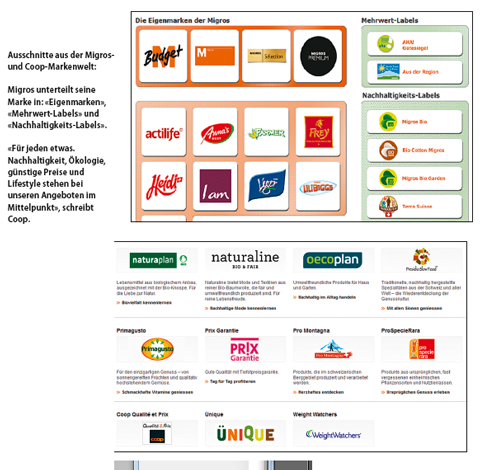
Too many opportunities and demands are putting pressure on our youngest generation, as well as fewer apprenticeships and the financial crisis in surrounding countries. The desire for security, for conservative values such as family, security and success, is increasing, says Alain Messerli, Head of Zurich at the marketing research and consulting company Happy Thinking People, describing the general situation of "Generation 2.0. But sustainability is also an important point of reference - people today want to buy "justifiable" products, contrary to the "cheap is cool" mentality. This is nothing new, as can be seen in Migros' product range, for example, which has been available for some time. On its own website, for example, the retailer lists the values "Swissness," "regionality," "sustainability," "freshness," and "value for money. With this positioning, Migros follows the values described above, and already with good success. It is not for nothing that Migros was perceived as the strongest brand in Switzerland by the Brand Asset Valuator of the Y&R Group in 2013. However, Migros' success cannot be attributed solely to the adaptation of the above values, but above all to another factor: The retailer is consistently addressing the shift in values of Swiss consumers toward individual ideals. In concrete terms, this means not adapting the brand and products to the respective - sometimes fast-moving and divergent - change in values, but instead expanding the entire product range. The right thing for every value, so to speak.

One brand for all

In the case of the retail trade, a possible promising adaptation to the individualized expectations can be seen in the expansion of its product range. Werner Schaeppi, founder of MRC Marketing Research & Consulting, also cites the retailers Migros and Coop as shining examples of a reaction to the individualized value attitude. Here, the customer finds not only organic/ecological product lines, but also savings offers and lines for consumers with a higher demand for quality, according to Schaeppi. In addition, the two are also involved in the cultural sector - for example with the Migros Culture Percentage. And both also offer fair trade products. Migros and Coop obviously want to appeal to all value groups - environmentalists as well as thrifty people, cultural supporters as well as gourmets. Everyone can shop at the two large Swiss retailers without neglecting their ideals. Or to put it briefly: they have taken up the change in values toward more individuality and implemented it very successfully. Coop has also been revealing this strategy for some time in the baseline "for me and you" - in other words, for everyone. According to Schaeppi, the adaptation to the change in values took place through a targeted differentiation of the brand architecture: "Instead of adapting the brand core to the respective change in values through constant adaptations, Migros and Coop simply expanded the brand, respectively united further subbrands and categorized labels under the umbrella brand." In this way, Migros and Coop succeed in gathering all claims under one roof.

Werner Schaeppi clearly sees a shift in values toward individualized consumer perception and expectations. This change, he says, is due not least to the increasing digital abundance of information, because anyone can obtain information anywhere at any time. This gives rise to different opinions, values and perceptions. But individualization is also accompanied by an increased influence on production conditions, emphasizes Schaeppi: "If I search the Internet for information, for example for pictures of the new iPhone, I will find 50 different pictures," says Schaeppi. Which source should you trust? Accordingly, the abundance of information has three effects: On the one hand, consumers are very well informed. They can no longer be fooled, and they know very precisely whether their values are actually represented by the product. Secondly, each consumer can now follow his or her own values exactly; develop an individualized value system. And thirdly, a stronger brand loyalty develops as soon as the consumer has found a brand that he believes he can trust. Schaeppi explains that it is not enough to simply expand one's own range of products according to values in order to appeal to a broad customer base, because consumers are always in a position to obtain precise information about products, their production conditions and the background of companies - and they have become more critical.

As an example, Schaeppi refers to the technology industry: "The joy of my new digital device is dimmed when I learn of unfair production conditions for the manufacturer's employees." Today, he says, companies need to respond very quickly to customers' needs, and not just by cosmetically adjusting their brand image. Changes would have to happen directly to the product. "Because the consumer informs himself," he reasons. And a brand very quickly ends up offside if it does not take into account the values of its customers. In concrete terms, this means more responsibility not only for the producer, but also for the consumer.

This is also the thesis of Peter Michael Bak in his newly published book "Business and Corporate Ethics". He points out that consumers today have a very strong say through their demand. "Through our consumer behavior, we play a major role in shaping economic processes," he writes. Accordingly, he says, we are also responsible for the way in which we do business and the associated consequences.

For this reason, more and more customers are focusing on a particular brand whose values match their own and which they can trust, says Schaeppi. This is also an effect of the fact that anyone can find out about anything, anywhere, at any time. Today, more and more companies that represent a smaller group of customers with a specific set of values are expanding their product range into various segments. This means, for example, that the customer of an organic store can also buy clothes produced on the basis of the same value attitude in the same store under the same brand, as well as perhaps stationery accessories. This trend leads in the direction of specialization, except that the company does not specialize in a particular product, but in a particular value attitude. In line with this attitude, the brand then offers products from different segments. In other words, the opposite of the Migros strategy.

Individual herd behavior

Having confidence in a brand and the certainty that one's own values are really reflected in the choice of a brand - this seems to be an important factor, especially for the generation of unlimited information. Brand trust is apparently also a primal value in the fashion sector. Cécile Moser, Junior Consultant at Concept Communication and Master's student in Cultural Analysis, also sees a general shift in values toward more individualization. In the style area, however, she sees more of a herd behavior than an individualization. The fixed value of "security" is pretty strongly anchored here, says Moser, herself a representative of "Generation 2.0" and a fashion blogger. Fashion customers tend to be reserved, don't dare to do much, and are more concerned with security and acceptance. She cites the hipster retro movement in Zurich as an example. She gives the impression that they know the values of the original movement, but don't live them - a rather superficial representation of values that only affects clothing fashion, without any further impact. On the blog of the Concept agency, she even writes: "Hipsterism has absolutely nothing to do with individuality. The hipster is in a completely passive follower role. As a counter-trend, Moser sees the prosumer, a consumer and producer in equal measure, who helps to shape his products himself. And this is where Moser's view of the current attitude toward values coincides with the findings of the researchers: Today, it's all about inscribing oneself in the right discourse, defining one's style and positioning oneself. Everything runs and defines itself through consumption, says Moser. She thus also confirms the trend mentioned by Schaeppi that changes have to happen directly to the product. This is primarily due to a rapidly growing exchange of information and the urge of "Generation 2.0" to position itself clearly and individually through consumption - but at the same time on the safe side, under the protective hand of a trustworthy, strong brand.

Storytelling with stringent values

But how can trust still be built up with such individualized values? And what does this mean in concrete terms for brand positioning? On the one hand, one could of course claim that value attitudes today are too complex and brand perceptions too arbitrary to allow a brand to adapt to a change in values at all. The "freedom generation" of the 1960s or the "conservative generation" of the 1920s would have been easier to assess and address, says Alain Messerli. And yet, clear leaders in brand perception can be identified, such as Migros or the modern leader Google. However, their brand perception can no more be successfully imitated than an abrupt adaptation of the brand to a change in values would make sense. However, according to Messerli, it is possible to adapt the story that the brand tells to current value attitudes, as long as the story telling remains stringent. In other words, the brand story can be retold to suit the prevailing mood of the times, and the charisma of the original story can be recharged again and again, as long as it does not contradict itself. According to Messerli, story telling in itself has a much stronger binding effect than, for example, adapting to a new set of values.

Messerli is thus addressing brain research on episodic memory: "Our brain creates meaning by shaping the stimuli to which the individual reacts emotionally into episodes that combine to form an autobiographical story," Messerli recalls from his article in the VSMS Yearbook 2010. In other words, we remember primarily in the form of stories, and often unconsciously. This is because the above-mentioned stimuli from our environment are filtered by the adaptive subconscious without the aid of the conscious mind, as Timothy Wilson already pointed out in "Strangers to Ourselves".

Consequently, stimuli are selected and interpreted, and actions are derived from the resulting patterns. This could be, for example, the unconsciously controlled decision to reach for a product at a shelf or not, explains Alain Messerli. It is possible that this decision has more to do with a smell, a childhood memory or an impulse than with a conscious purchase decision.

Trend research trend

Individualization, specialization, hipsters, prosumers, bloggers - trend research works out pretty well for individual brands or products, as you can see. Alain Messerli also believes that trend research is relatively easy to implement for individual brands. However, it becomes a little more complicated and also more unmanageable as soon as one deals more concretely with individual values. Messerli explains: "Trend research is primarily concerned with tracing current trends and sales hits back to sociocultural and psychological backgrounds. These findings then allow conclusions to be drawn about general value attitudes and trend phenomena that are stable over time. In this way, it is not only possible to identify trends, but also to make forecasts for the future. Sounds logical and relatively easy to implement. Now for the part that is difficult to grasp: individualization, for example. Generation 2.0" may want values such as sustainability, family and career, but for each consumer "sustainable" means something different, explains Alain Messerli: Is it the production conditions, or is it the environmental impact of transport, breeding or wild catch? The questions surrounding sustainability are so complex that many don't like to deal with them. As a result, the very concept of "sustainable" is divergently understood. In other words, those who want sustainability do not necessarily mean "sustainably produced". Werner Schaeppi also sees a fundamental problem with trend research here: not only does the customer surveyed often not even know which "sustainable" is meant exactly; ecological, economic, social - or whatever the customer has in mind. In addition, the conditions for quantitative market research are relatively poor. Because of the enormous time and cost pressure, not only the quality of the individual surveys suffers, but also the training of the surveyors themselves.

Many such factors could influence a quantitative study. MRC is therefore increasingly relying on qualitative surveys, emphasizes Schaeppi. Although these then only operate with small samples, it can no longer be assumed in principle that a representative group has been reached even with quantitative surveys. This is because of the variety of relevant communication channels and the marketing-critical attitude of the population. As an example, Schaeppi cites a study with the main question "Advertising in public spaces" and asks rhetorically: "Don't you think that the very group that doesn't want to be advertised to is more likely not to be found in the telephone directory? In general, this survey is more likely to reach that part of the population that has nothing against advertising in principle or at least does not vehemently seek to distance itself from it. Another part would have to be reached through other channels. For this reason, social media channels and other new communication platforms will probably be increasingly included in market research in the future. Even if this is ultimately no guarantee of having reached a representative part of every population group.

Ursina mason

Unbenannt-7_40
 

SRF practices self-criticism

Swiss Radio and Television SRF criticized itself at a media breakfast on Thursday. It was a pity that the documentary about the Zurich juvenile prosecutor focused too much on the individual case of "Carlos".

"I regret that we - SRF and the author - have stopped at this individual case in the discussion," said Marius Born, Head of Documentary Film and Reportage, at a media breakfast organized by SRF's Culture department on Thursday. At the same time, he announced a new documentary for October 2 entitled "Von Carlos und anderen jugendlichen Straftätern" (Of Carlos and other juvenile delinquents).

With this new report on the topic that caused such a stir a year ago, SRF wants to make the discussion more objective. "This time, it's more about the background and putting things into context," said Born. The aim is to show that there are many different stories in this area - and that it is dealt with somewhat differently in other countries.

The Head of Documentary Film explained why SRF had not dealt with the much-criticized topic again earlier: "When emotions run high, it is difficult to keep the discussion objective," said Born.

The "Carlos case" began exactly one year ago. On August 25, 2013, SRF's "Reporter" programme featured a portrait of Zurich juvenile prosecutor Hansueli Gürber. He presented his then 17-year-old protégé "Carlos" and his special setting. As a result, there was a storm of indignation everywhere. (SDA)
 

Stinky finger included

With the rise of emojis, pictograms are being used more and more frequently online—and this new form of communication is already being utilized in advertising.

Five thousand years of cultural history are coming full circle: one of the oldest writing systems known to mankind, Egyptian hieroglyphics, initially functioned purely as a pictographic script. And here we are again: on June 16, 2014, the Unicode Consortium announced version 7.0 of the Unicode standard, which enables the uniform use of characters on all computers. In addition to over 110,000 characters from all over the world and from all eras, it also contains several hundred pictograms, which are now being expanded by around 250 characters - including "Reversed Hand With Middle Finger Extended" at position U+1F595, which is nothing other than a symbol for the stinky finger that can now also be used on the keyboard in future.

These symbols are known as emoji and originally come from Japan. In the 1990s, the leading cell phone provider NTT DoCoMo designed a set of 172 pictograms that could be used on its iMode platform. The Japanese loved it, and the other mobile phone providers soon followed suit and created their own emoji symbols. However, the different emoji sets were not fully compatible with each other, and they didn't work at all outside of Japan. The problem was solved in 2010 when several hundred emoji characters were included in the Unicode 6.0 standard and could therefore be used everywhere, provided that a corresponding character set was installed on the computer, tablet or smartphone.

Still hardly to be found in German

And they are being used more and more: not only in the Far East, where the use of emblematic characters is culturally anchored, and not only on cell phones. Emojis are becoming increasingly common in social media and messaging services such as WhatsApp because they can be used to convey messages quickly and succinctly, which can be an advantage on Twitter in particular with its 140-character limit. If you want to get closer to the emoji phenomenon, we recommend a visit to Emojitracker.com. Here you can track the use of emoji on Twitter in real time, with the various characters listed according to frequency. At the top of the list is not the smiley, but - not surprisingly - a red heart. The journey of discovery continues when individual symbols are clicked on, which displays the tweets containing the respective character in real time. It soon becomes clear that the use of emojis is accompanied by a lack of rules on grammar and syntax. The charm and fun of using emojis lies in this ambiguity. Anyone who spends more time with the individual symbols will realize that some, such as the peach, strawberry or eggplant, have additional meanings from the field of human anatomy. This inevitable semantic flexibility often leads to ad hoc rules in groups, for example when work colleagues or pupils agree on a certain (facial) symbol to designate the boss or a teacher. And when exploring emojis on Twitter, it also becomes clear that there are hardly any German-language tweets in which they appear.

Many contemporaries find it difficult to express emotional messages in writing, and so emojis are used (not only by teenagers) to enrich texts. But it is also possible to communicate exclusively with emojis. Although this form of expression is still in its infancy (as far as our modern age is concerned), it has already produced a masterpiece in the form of "Emoji Dick". The American Fred Benenson has translated the 900-page novel "Moby Dick" by Herman Melville into an emoji monumental work that has been included in the Library of Congress catalog. It was first created with a tender on Kickstarter, the largest crowdfunding platform for creative projects. Thanks to 83 donors, 3676 dollars were raised, which were used to employ an army of 800 translators (via Amazon's Mechanical Turk). Individual sections were translated several times and the best version was then selected. So that Werbewoche readers can assess and expand their own emoji competence, we have prepared the first sections together with the German translation:

Unbenannt-14_23

From advertising to customer service

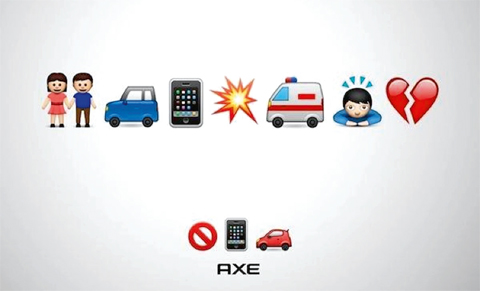
There are already the first examples of advertising campaigns designed exclusively with emojis. Unilever, for example, has used emojis with its AXE brand, which produces cosmetics aimed at a younger male audience, to convey the message to millennials that texting while driving can end in tragedy.

Unbenannt-15_16

And the American animal welfare organization PeTA, People for the Ethical Treatment of Animals, which has attracted attention with various controversial campaigns, has created animated video spots using only emojis.

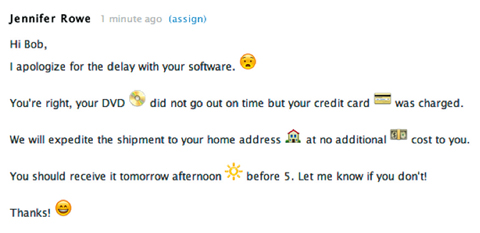
In customer service, messages to customers that are accompanied by emojis are intended to help relax the sometimes emotionally heated situation. Here is an example of how such communications could come about:

Unbenannt-16_14

It is therefore not surprising that social networks are emerging in which people can only communicate using emojis. Makemoji has managed to raise one million dollars in start-up capital and has recently become available in the Apple App Store. It can be used to create new, custom emojis and share them with other users on Facebook, Twitter or Instagram. Meanwhile, the two Brits Matt Gray and Tom Scott are focusing on the official Unicode symbols with their Emoji.li project. Here is a sample conversation as envisioned by the two initiators:

Unbenannt-17_13
Translation: "Ouch!" "Oh no! What's wrong?" "I've been swimming a lot and now I have sore muscles." "Oh dear. I'm sorry about that." "Thank you!"

It is clear that even if older generations in particular complain about the increasingly infantile behavior of adults and the loss of precise and nuanced expression, emojis are here to stay. In the digital age, they appear as a new form of written communication, free of syntax and grammatical rain, but open to interpretation. And words may gain in meaning when they are supplemented with emojis.

Christoph J. Walther
 

To the point: Summer theater 2

Since Patrik Müller brought the Geri Müller sex selfies, at least verbally, into the newspaper Schweiz am Sonntag on Sunday a week ago, not a day went by where the affair was not reported somewhere in Switzerland, but also abroad.

The moral aspects repeatedly mentioned by Müller (during working hours, in the office, from the National Council chamber) led to the fact that very (all too?) quickly there was no longer much discussion about whether the publication of the story was legal or not.

The usual media hype broke out. After all, everything was there: older political celebrity, much younger woman, sex. The media trumped each other with new findings - often these were just copied and slightly rephrased. But there were also new findings: at least Blick, SonntagsZeitung and Weltwoche - so it was said - had the story for a long time, but did not break it. The age of the chat partner was changed from 21 to 33, because the SDA apparently got things mixed up. The chat partner was also talked to, she was quoted extensively. There were indications that she was suicidal, and the police intervened in response to corresponding telephone calls from Geri Müller and questioned the lady. Politicians and opinion leaders were concerned and astonished, media critics expressed themselves, psychologists tried to explain. SRF ran a media club after just two days, and social media went wild. Geri Müller appeared with his lawyer at a press conference where no questions were allowed.

The whole thing developed into a media tsunami that no one could control. Google News now has more than 38,000 hits under the keyword Geri-Selfies, and the Swiss media database has 135.

So it's one of the usual media embarrassment stories? You could have thought that for a long time. But it doesn't stop there, it continues. When Geri Müller tried to involve Josef Bollag, the president of the Jewish Community of Baden, everything took on another dimension. A political one. It turns out that some well-known politicians knew the story more or less in detail. When Sacha Wigdorovits, ex-journalist, today owner of a communication agency, declared friend of Israel and therefore also Geri Müller's enemy, appeared around the story, it got completely out of hand. The word Jew opened the floodgates. Anti-Semitic statements were published on social networks under full name recognition, which clearly violate criminal law. The first indictments are already underway.

The discussion about quality must continue. Sex images are harmless - anti-Semitism is not. Instrumentalization and spin doctors must become an issue.

Pierre C. Meier, Editor-in-Chief

[email protected]
 

get_footer();