Five thousand years of cultural history are coming full circle: one of the oldest writing systems known to mankind, Egyptian hieroglyphics, initially functioned purely as a pictographic script. And here we are again: on June 16, 2014, the Unicode Consortium announced version 7.0 of the Unicode standard, which enables the uniform use of characters on all computers. In addition to over 110,000 characters from all over the world and from all eras, it also contains several hundred pictograms, which are now being expanded by around 250 characters - including "Reversed Hand With Middle Finger Extended" at position U+1F595, which is nothing other than a symbol for the stinky finger that can now also be used on the keyboard in future.
These symbols are known as emoji and originally come from Japan. In the 1990s, the leading cell phone provider NTT DoCoMo designed a set of 172 pictograms that could be used on its iMode platform. The Japanese loved it, and the other mobile phone providers soon followed suit and created their own emoji symbols. However, the different emoji sets were not fully compatible with each other, and they didn't work at all outside of Japan. The problem was solved in 2010 when several hundred emoji characters were included in the Unicode 6.0 standard and could therefore be used everywhere, provided that a corresponding character set was installed on the computer, tablet or smartphone.
Still hardly to be found in German
And they are being used more and more: not only in the Far East, where the use of emblematic characters is culturally anchored, and not only on cell phones. Emojis are becoming increasingly common in social media and messaging services such as WhatsApp because they can be used to convey messages quickly and succinctly, which can be an advantage on Twitter in particular with its 140-character limit. If you want to get closer to the emoji phenomenon, we recommend a visit to Emojitracker.com. Here you can track the use of emoji on Twitter in real time, with the various characters listed according to frequency. At the top of the list is not the smiley, but - not surprisingly - a red heart. The journey of discovery continues when individual symbols are clicked on, which displays the tweets containing the respective character in real time. It soon becomes clear that the use of emojis is accompanied by a lack of rules on grammar and syntax. The charm and fun of using emojis lies in this ambiguity. Anyone who spends more time with the individual symbols will realize that some, such as the peach, strawberry or eggplant, have additional meanings from the field of human anatomy. This inevitable semantic flexibility often leads to ad hoc rules in groups, for example when work colleagues or pupils agree on a certain (facial) symbol to designate the boss or a teacher. And when exploring emojis on Twitter, it also becomes clear that there are hardly any German-language tweets in which they appear.
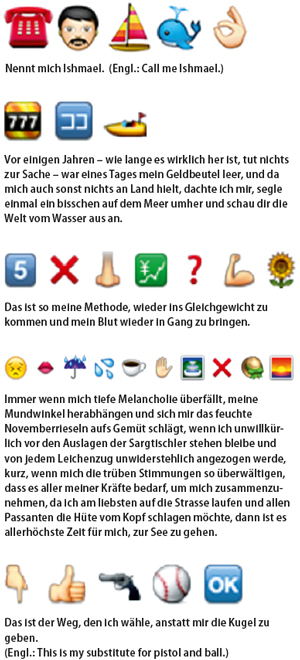
Many contemporaries find it difficult to express emotional messages in writing, and so emojis are used (not only by teenagers) to enrich texts. But it is also possible to communicate exclusively with emojis. Although this form of expression is still in its infancy (as far as our modern age is concerned), it has already produced a masterpiece in the form of "Emoji Dick". The American Fred Benenson has translated the 900-page novel "Moby Dick" by Herman Melville into an emoji monumental work that has been included in the Library of Congress catalog. It was first created with a tender on Kickstarter, the largest crowdfunding platform for creative projects. Thanks to 83 donors, 3676 dollars were raised, which were used to employ an army of 800 translators (via Amazon's Mechanical Turk). Individual sections were translated several times and the best version was then selected. So that Werbewoche readers can assess and expand their own emoji competence, we have prepared the first sections together with the German translation:
From advertising to customer service
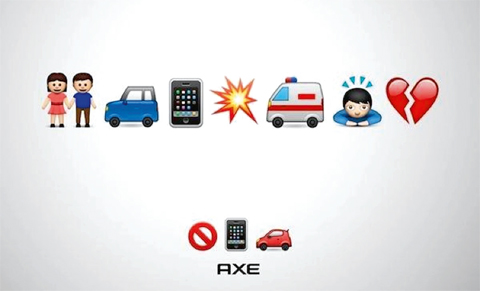
There are already the first examples of advertising campaigns designed exclusively with emojis. Unilever, for example, has used emojis with its AXE brand, which produces cosmetics aimed at a younger male audience, to convey the message to millennials that texting while driving can end in tragedy.
And the American animal welfare organization PeTA, People for the Ethical Treatment of Animals, which has attracted attention with various controversial campaigns, has created animated video spots using only emojis.
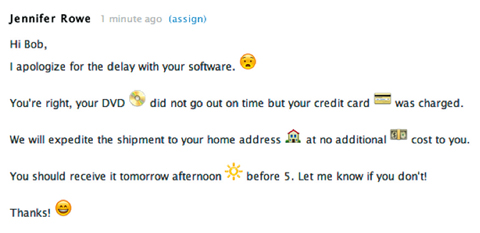
In customer service, messages to customers that are accompanied by emojis are intended to help relax the sometimes emotionally heated situation. Here is an example of how such communications could come about:
It is therefore not surprising that social networks are emerging in which people can only communicate using emojis. Makemoji has managed to raise one million dollars in start-up capital and has recently become available in the Apple App Store. It can be used to create new, custom emojis and share them with other users on Facebook, Twitter or Instagram. Meanwhile, the two Brits Matt Gray and Tom Scott are focusing on the official Unicode symbols with their Emoji.li project. Here is a sample conversation as envisioned by the two initiators:
Translation: "Ouch!" "Oh no! What's wrong?" "I've been swimming a lot and now I have sore muscles." "Oh dear. I'm sorry about that." "Thank you!"
It is clear that even if older generations in particular complain about the increasingly infantile behavior of adults and the loss of precise and nuanced expression, emojis are here to stay. In the digital age, they appear as a new form of written communication, free of syntax and grammatical rain, but open to interpretation. And words may gain in meaning when they are supplemented with emojis.
Christoph J. Walther