Losses increase

Even the redesigned MACH Basic does nothing to halt the ongoing decline in the reach of print publications. Compared to the previous year, no fewer than 53 publications have seen a significant decline in reach, 43 of which are German-language publications.

With MACH Basic 2014-2, comparative figures from two completely independent surveys are now available for the first time. After all, the results of MACH Basic 2014-1 still consisted of 50 percent of the same figures as those of MACH Basic 2013-2 (see also box "The MACH Basic 2014-1"). And in exactly the same way, around half of the data in the latest study is already represented in the 2014-1 evaluation. For this reason, the emphasis in this number is on the previous year's comparisons. And these now show that a total of more than 2.5 million contacts have been lost across all titles covered by Media Trend Journal during this period. That corresponds to a drop of 5.9 percent.

All title groups lose

As the chart "Changes in contact totals" shows, the most striking swings are in southern Switzerland. Here, the daily press gained 5.0 percent, while the Sunday press lost 13.6 percent. However, the increase in the daily press is not due to significant deviations from individual titles and is therefore rather random. Underlying the loss of the Sunday press, however, is a significant drop in the reach of Caffè della Domenica. However, this is the only title in Ticino with a significant change. In French-speaking Switzerland, there are nine titles with significant and all negative changes: two dailies, the only Sunday newspaper, five titles in the general-interest press and one in the special-interest press. In German-speaking Switzerland, on the other hand, no fewer than 43 publications have lost significant ground. 7 in the daily press, 3 in the Sunday press, 23 in the general-interest press and 12 in the special-interest press. In contrast, only two titles made significant gains: the St. Galler Tagblatt, due to the "bought-in" readers of head papers, and the high-flyer Landliebe from Ringier.

kontaktsummen

Unchanged free shares

The contact totals of free titles have declined in all title groups, but less sharply than for paid publications. Therefore, with the exception of the Sunday press, the free share has generally increased slightly and now stands at 47.2 percent across all language areas and title groups.

As the chart "Free shares by title group and language region" shows, only Ticino has free contacts on Sunday. In this case, it is 100 percent - exactly the same as for the general-interest and special-interest press. Overall and in the two other language regions, however, the free share is still highest in the general-interest press. As a general rule, the smaller the language area, the higher the proportion of free copies. However, there are also major differences depending on the title segment. For example, in the "national topics" segment with the illustrated magazines, consumer topics and large-scale distributors in French-speaking Switzerland, it is almost 90 percent, which comes exclusively from the two cooperative titles of Coop and Migros.

Gratisanteile

Combinazione reaches 50 percent

In at least two language regions, six offerings each achieve at least five percent reach. They are listed in the "National Offerings" chart in order of national reach. With the exception of Ringier's KombiNation SwissWomen with Schweizer Illustrierte, Glückspost, L'Illustré and TV8, and the NZZ Business Combi from NZZ and Le Temps, all these offerings are represented in all three language regions. Ringier's third-place CombiNation Swiss- Family, with SonntagsBlick, Schweizer Illustrierte, L'Illustré, L'Hebdo, TV8 and Il Caffè della Domenica, achieved the second-highest reach in French-speaking Switzerland. The leading offer, Kombinazione, with all three Migros weeklies, shows a marked difference between the three language regions. In Switzerland as a whole, however, it still reaches just under half of the language-assimilated population aged 14 and over. Ringier's two CombiNation offerings are both significantly stronger in French-speaking Switzerland than in the other language areas and the Swiss average. Two of the national combinations are offered by Migros and Ringier, and one each by Tamedia and NZZ/Ringier.

nationale-angebote

Migros and Coop dominate

The "Reach hunter German-speaking Switzerland" chart now lists all sites that reach at least 25 percent of the population in the language area. The minimum threshold of 30 percent set a year ago is now exceeded by only three publications. In both major language regions, the titles from Migros and Coop continue to occupy the top positions. This is followed in German-speaking Switzerland by 20 Minuten, which leaves all combinations of paid titles behind and is also the only offering whose reach is currently not significantly lower than a year ago. In French-speaking Switzerland, where the minimum threshold for inclusion is 30 percent, the weekday/Sunday combination of Le Matin and RomandieMAX with the same Ringier magazines as the CombiNation SwissFamily are ahead of the commuter paper, but must be occupied across all language regions. Here, all offerings with the exception of 20 minutes and Coopération have lost significant reach compared to the previous year.

Reichweitenjaeger
reichweitenjaeger-westschweiz

Ringier dominates paid

In any case, paid-for single titles have no place in the concert of the big combinations and free titles. Le Matin Dimanche in French-speaking Switzerland is the exception here, confirming the rule - even though, according to the latest certification, over a quarter of the circulation is distributed free of charge or at a discount of over 50 percent. The Sunday edition of Le Matin is still the leader among paid-for top titles (see chart). Here, the lower limit had to be lowered to 15 percent, as the previous limit of 20 percent is now only exceeded by four titles. The order has not changed. The dominant publisher is Ringier with the four titles L'Illustré, SonntagsBlick, Schweizer Illustrierte and TV8. Tamedia, with the two Le Matin titles, has the same number of publications in this ranking as Konsumenteninfo with Bon à savoir and K-Tipp. Finally, Axel Springer is also represented with the Beobachter. Only the French titles Bon à savoir, L'Illustré and TV8 have not lost any significant ground compared with the previous year.

toptitel-bezahlt

Ueli Custer

Basic information

The analyses are based on the tables from the report volume, which were made available by WEMF in advance with a blocking period. All daily newspapers published at least five times a week (excluding large circulation titles), all general-interest, financial, business and special-interest press titles were evaluated. Local and regional weekly titles are not included. In the case of daily newspapers, only the largest unit is included. Header pages and partial editions are not listed, regardless of ownership.
 
Also not included in the WEMF tables are the results of newspaper supplements Z - the beautiful pages as a supplement to NZZ and NZZ on Sunday and the Vista-The figures for the newspaper combination were calculated as a supplement to a whole series of daily newspapers. This is because their values were not surveyed separately, but only shown as a calculated combination of the carrier titles. They can therefore in no way be compared with those of separately surveyed supplements such as Das Magazin, NZZ Folio, Télétop Matin, Femina or the evening supplement Extra of Corriere del Ticino. As the results of these titles show, their usage is significantly lower than that of the carrier titles in each case. The values reported in MACH Basic for Z - die schönen Seiten and Vista-Zeitungombi are therefore certainly inflated.

Extrapolation basis

It is based on the statistics on population and households of the Swiss Federal Statistical Office (STAT-POP) and the structural survey of the Swiss Federal Office. The population of MACH Basic 2014-2 is identical to that of MACH Basic 2014-1 and is structured as follows:

- German language group: 4,631,000 (+38,000 or 0.8%)
- French language group: 1 503 000 (+10 000 or 0.7%)
- Italian language group: 288 000 (+3000 or 1.1%)
- Total population: 6 422 000 (+52 000 or 0.8%)

The increase relates to the comparison with MACH Basic 2013-2.

Sampling

It includes not only registered landline numbers, but also people in households without a registered number (15 % of all households) or without a landline (5 % of all households).

Sample size

It is 19,276. Survey Procedure In a first call, the target person is recruited and then interviewed either by telephone or online with a second call.

Survey period

The results of the MACH Basic 2014-2 were surveyed between April 10, 2013 and April 5, 2014. Around half of the values are identical to those of MACH Basic 2014-1, which was collected between October 1, 2012 and October 6, 2013.

Pointing material

Respondents are provided with pointing material (title logo and possible response specifications) for both the telephone interview and the online questionnaire.

Incentivization

Participants in the interview receive a small gift worth ten francs, which increases the willingness to participate.

Communication spaces

52 combined communication areas (zKommR) fill the gap between economic areas and counties, which often have very small caseloads.

Coverage of newspapers with a circulation of less than 20,000 copies
In the 2014-2 evaluation, the values are based on the average readership over the entire 24 months, which were collected using the new method. This enlarges the data basis and reduces the range of variation. Further details can be found in the report volume or on Wemf.ch to find.

hinweis-printausgabe


Spinas: Apple almost stole the show

Last but not least: Animal touching

It's never too late to become a vegetarian: Ruf Lanz has found a lion who can convey this message quite well as an advertising ambassador.

Who needs persuasion when you have a vegetarian lion? Ruf Lanz proves this in a commercial for Hiltl. The commercial is the continuation of the Hiltl campaign "It's never too late to become a vegetarian" (Werbewoche.ch reported). In the new TV and viral spot, a lion and an antelope are one heart and one soul. The unusual pair conveys the message in a particularly touching way. (uma)
 

//vimeo.com/105765106

Responsible at Hiltl: Rolf Hiltl (overall responsibility), Marsha Lehmann (marketing + communication). Responsible at Ruf Lanz: Markus Ruf, Danielle Lanz (Creative Direction), Marcel Schläfle (Art Direction), Florian Birkner (Text), Laura Hofer (Graphics), Christian Brütsch (Consulting). Film production: Stories AG (Anna Lehmann, Gian Dolder, Billy Bains).

Radio and TV fees: temporary exemptions

No agreement appears to be in sight between the chambers regarding radio and TV license fees. The Council of States wants every household to pay the fees in the future; the National Council, on the other hand, voted in favor of temporary exemptions for the second time on Thursday.

The decision was made by 110 votes to 74 with 3 abstentions. According to this proposal, households that do not have radio and television reception are to be exempt from the fee for five years after the introduction of the new system upon request.

The Council of States had clearly opposed this so-called opting-out, as did the Federal Council. "By opting out, we would be prolonging the current system at great expense," said Federal Councillor Doris Leuthard. There are only a few people who do not have a television, radio or Internet access. Around 20,000 households are involved.

Fairness more important than efficiency

Proponents from the SVP, FDP and Greens, on the other hand, argued that it would be unfair if these people - especially the elderly - were asked to pay. A law should be as fair as possible to minorities; this is more important than efficiency, said Kurt Fluri (FDP/SO).

Apart from the controversial exemption, the councils have already agreed in principle that all Swiss households will pay radio and TV fees in future - regardless of whether they have a radio set or a television. This is to take account of the fact that radio and TV broadcasts can now be consumed via the internet on computers, tablets or smartphones.

Higher share for private individuals

The National Council resolved two other differences. It followed the line of the Council of States on the question of how high the fees for private radio and television stations should be. The National Council voted 112 to 71 against the wishes of the SVP, BDP and parts of the FDP in favor of 4 to 6 percent, after initially advocating 4 to 5 percent.

"This one percent is of great importance for private radio and television stations," said Markus Lehmann (CVP/BS). According to Federal Councillor Doris Leuthard, a maximum of CHF 14 million more will be paid out as a result.

Surpluses for training and technology promotion

The National Council also voted in favor of the Council of States' variant regarding the use of the surplus from fee splitting - according to Leuthard, this amounts to around CHF 45 million. By 98 votes to 90, it voted in favor of using these funds for the training and further education of employees and to promote new broadcasting technologies.
The Federal Council had proposed that the surpluses be refunded to fee payers - that would be around CHF 14 per household. A minority led by Natalie Rickli (SVP/ZH) campaigned in vain for this option.

Back to the Council of States

This means that the bill will return to the Council of States with one difference. However, even if the Councils have resolved this, the amendment to the Radio and Television Act (RTVA) is not yet in the bag.

The trade association, among others, had already threatened a referendum in the past. It opposes the fact that companies with an annual turnover of CHF 500,000 or more would have to pay a device-independent levy in future. The GLP has already announced that it will therefore reject the deal in the final vote.

In addition, the collection periods for two popular initiatives calling for the abolition of Billag fees for radio and television are currently running. (SDA)
 

The bride who marries

They didn't just want a registered partnership—they wanted a real wedding. Last week, the two agencies, FCB Zurich and /Department, tied the knot in a formal wedding ceremony. This happy ending is expected to bring nothing but benefits for everyone involved.

Unbenannt-5_46

WW: How long have you known each other?
Cornelia Harder: We got to know each other two years ago.

Where did you meet?
Oliver Brunschwiler: At the Haute restaurant. So it's true when they say that the way to a man's heart is through his stomach.

What did you like about each other?
Dennis Lück: Many couples get together because they like the same things. In our case, it was more a case of us liking each other because we have different passions that complement each other. What we particularly liked about /Department was its design expertise and broad portfolio. We now have a new, creative wonder weapon.
Johannes Eisenhut: What we liked about Draft FCB back then was that an agency had fought its way to the top and behaved as if it were owner-managed. That impressed us, and we were sure that we could do even more together.

What brought you closer together?
Brunschwiler: A few glasses of wine, a solid plan and the good feeling right from the start that a lot of things fit together here.

Who took the initiative?
Harder: From the man, of course.

When was the first kiss?
Wolfsbane: Even before the first word. A gentle peck on the cheek when greeting her. Cornelia was perhaps even a millisecond quicker.

Did the driving force have to woo for a long time or was it clear from the start?
Wolfsbane: No, it went back and forth for a while, and we weren't completely faithful at the beginning, it was an open relationship. Just like in real life: we all wanted to be 100 percent sure.

Did you have premarital sex?
Lück: Intercourse only after marriage.

How did you explain this to your children?
Brunschwiler: We prepared all employees in advance for what was to come in group and individual meetings. But to be honest, it was no big deal. Most of them were looking forward to the expansion of the teams and now feel right at home in the new household.

What do the relatives think?
Lück: I think our clients can really look forward to the new constellation, because it will offer our clients added value. Design and digital meets advertising is an approach that already worked perfectly in our first pitch for a globally active client from Switzerland. Unfortunately, we are not yet allowed to say who we were able to win over.

Unbenannt-6_45

You moved in together like a real couple: Has the planning of the interior always been harmonious?
Wolfsbane: We all actually relied on Cornelia's taste. We lost a real interior designer in her.

What will you do with the name?
Harder: We will use all of our expertise under the name FCB Zurich. We have a fantastic connection to the FCB network, and we certainly want to continue to benefit from this in the future.

Who brings what to the Mitgilft?
Lück: Both sides bring a lot of talent, great clients and great passion to the table. We will certainly continue to attract a lot of attention on the market and build on the successes of the recent past - for example, best Swiss agency in Cannes 2014.

How should we imagine the distribution of roles in this couple?
Wolfsbane: The woman wears the pants.
Brunschwiler: Cornelia is our CEO. She's better at it than anyone else. Johannes Eisenhut takes care of strategy, Dennis Lück and I look after the creative output of the rascals.

Unbenannt-7_43

You have invited someone to a real wedding reception: Who performed the ceremony?
Lück: That was Daniel Rohr, the director of the Rigiblick Theater. So we were married by one of our customers. I'd like to take this opportunity to say hello to the freelance pastor once again: Daniel, that was a really great performance!

What style did you celebrate in?
Wolfsbane: First with a lot of style - then wild and rampant. At 4 o'clock in the morning, the last ones went out to eat a Gerold burger together.

Were there any wedding gifts?
Harder: A bike, lots of fine wines and chocolates and even a few briefings are still to come.

Interview: Andreas Panzeri

Prix Média: Science journalists honored

Five science journalists are receiving this year’s Prix Média from the Swiss Academies of Arts and Sciences. They were honored on Thursday for «their successful communication of scientific knowledge» during the Swiss Media Congress in Interlaken.

The prizewinners are Julie Zaugg and Clément Bürge (technical sciences), Catherine Riva (medicine), Mathias Plüss (humanities and social sciences) and Nik Walter (natural sciences), as the academies write in a press release. The total prize money amounts to 40,000 Swiss francs.
 
Julie Zaugg and Clément Bürge are honored for a two-part article on fracking in the weekly magazine L'Hebdo. Catherine Riva is honored for her two-part article on mammography screening on SEPT.info. Mathias Plüss receives the prize for the article "Thirteen popular misconceptions about intelligence" in the magazine. Nik Walter's award-winning article in the Sonntagszeitung is about a debate on animal experiments among researchers.
 
Journalists and researchers who present complex topics to a broad audience foster dialog between science and society, the academies write. The Prix Média honors this mediation work. (SDA)

Le Matin Dimanche appears in a new layout

The French-speaking Swiss newspaper Le Matin Dimanche will appear in a revised layout from next Sunday. In addition, the Sunday paper will include the new bundle "Le Mag" with information on social issues and culture.

The supplements will also be revised, as the publishing house Tamedia announced on Thursday. The magazine Femina, for example, will appear on more valuable paper and will have new sections such as "Parlez-moi d'amour.

Following the paper version, the digital presence is also to be redesigned in the fall. Thanks to a new web application, all formats such as computers, tablets and cell phones will then be supported. (SDA)
 

"Twitter helps me avoid journalists"

They get hacked, stolen, and posted online for everyone to see. And yet A-, B-, and C-list celebrities just can't stop taking selfies (with or without clothes). Why do they even do it? By Manuel P. Nappo

James Franco (@James- FrancoTV on Twitter) put it in a nutshell in an article in the New York Times: What is the most precious commodity for film studios, writers, directors, stars - in fact, for everyone? Attention. Attention is what everyone wants. Attention is power. With the increasing networking of new media, the cost of information and entertainment is falling ever lower. It is no longer access that is limited, but attention. And this attention is now regarded by practically everyone as a scarce commodity, making it a power factor.

Studio bosses and their Hollywood stars have also realized this. For one thing, it's clear that having your own fan base is now a key success factor, and maintaining a healthy online presence is practically essential for this. Secondly, traditional pre-release audience surveys have often proved unreliable in recent months and expensive productions have often flopped miserably. Social media buzz, on the other hand, is more honest and direct and therefore often much more reliable. Having a large and strong social presence therefore often also means direct success at the box office. This is because fans are more likely to watch a movie if the star asks them to than if they are bombarded with promotional material by a Hollywood studio.

In terms of platforms, there are three megaplatforms on which the celebs cavort. The highest density is probably on Facebook. However, these are mostly classic promo pages that are used by the PR department for official communication. Twitter and Instagram are where things get really interesting for fans. This is where the stars themselves report on their everyday lives, creating a workaround for the paparazzi and the media. True to the motto: "Here I give you a glimpse into my private life."

It is therefore hardly surprising that the so-called celebrity selfie, a self-portrait usually taken by hand with a smartphone, is the non plus ultra among posts. The selfie has value regardless of the quality of the photos because it is supposedly an intimate snapshot of someone the public is very interested in. But that's not all: the selfie is probably also the picture the paparazzi would kill for because they could make good money with it. Because it's the kind of picture that magazines and blogs want today. A few years ago, however, things looked very different, as this type of communication was unthinkable. In addition to expressing personal opinions in interviews, the main aim was to gain as much attention as possible through public appearances or a scandal. British actor Stephen Fry (@stephenfry) sums up this change well: "Twitter helps me avoid journalists."

Whether it's Demi Moore (@justdemi), her ex-husband Aston Kutcher (@aplusk) or sex symbol Ryan Gosling (@RyanGosling) - the list of social media celebrities is long. However, Hugh Jackman (@RealHughJackman) is particularly worth mentioning. Firstly, because the Australian shared very personally that he had been diagnosed with malignant cancer cells and urged: "Please don't be foolish like me. Get yourself checked. And USE sunscreen!!!". Secondly, because Jackman embodies Wolverine, one of the most popular comic book characters in the geek world, and his charisma in the social networks has been really magnified as a result.

Most stars manage the platforms themselves. Which is the whole point. Some, however, such as the late Paul Walker (@RealPaulWalker), the beautiful Channing Tatum (@channingtatum) or Zac Efron (@ZacEfron), have their own social media managers who constantly provide their fans with fresh backstage news. In this case, it is important that it is clearly communicated who is tweeting. This demarcation creates clarity for the fans, as their favor can quickly tilt.

Although all studio bosses would probably like their stars to have large social media followings, there are still many Twitter refuseniks. These include high-profile talents such as George Clooney, Daniel Craig and Johnny Depp, who have decided to stay out of the digital spotlight for various reasons. Daniel Craig's motivation sounds almost romantic: "I am bloody not [on Facebook]. And I'm not on Twitter either . . . 'Woke up this morning, had an egg'? What relevance is that to anyone? Social networking? Just call each other up and go to the pub and have a drink." Kristen Stewart, on the other hand, points out the dark side of social media: "Twitter f-s me over every day of my life. Because people go, 'I'm sitting next to Kristen Stewart right now' and then [the paparazzi] show up." This omnipresence can also be quite exhausting. Where stars used to only have to take criticism via the film magazine Variety, today every Hans Muster can express his opinion publicly. US presenter Jimmy Fallon demonstrated what this means in a very entertaining way on his show, when celebrities had to read out nasty tweets about themselves. (Celebrities Read Mean Tweets on YouTube).

Manuel P. Nappo, Director of Studies CAS Social Media Management HWZ Zurich University of Applied Sciences. www.fh-hwz.ch/smm
 

"Center for Digital Business" launched

The Zurich University of Applied Sciences (HWZ) has launched Switzerland’s first «Center for Digital Business.» Under the direction of Manuel P. Nappo, the center offers degree programs, supports companies with consulting and project services, conducts research projects, and provides the business community with free expertise.

Unbenannt-21_5

WW: What was the need that gave rise to the "Center for Digital Business"?
Manuel P. Nappo: Digital transformation is one of today's most important topics, which also affects many Swiss companies. We have found that the Swiss economy has a lot of catching up to do when it comes to digitization - and at a wide variety of levels. In the SME sector, the medium-sized ones even more than the small ones. Many of these companies have had to overcome other challenges in recent years. There is a lack of application-oriented knowledge in the digital sector. At the flight level of top companies, dealing with digital challenges is also top. But the marketing manager of a medium-sized company would have to have something tangible. That's why we came up with the idea of creating a center out of our Master's in Digital Business, which has now been running successfully for a year, that really takes care of the Swiss economy and wants to accompany these companies on the digital path.

What topics are covered?
The Center for Digital Business prioritizes digital transformation topics: digital leadership, mobile strategy, finance 2.0, HR 2.0, mobile-first culture, digital change management, digital stakeholders, social media, multichannel experience, data and analytics.

How does that sound in new German?
Courses, in-house training, coaching and workshops are realized for SMEs, associations and administrations to facilitate their entry into the digital world. The center is also responsible for the part-time master's program in digital business at the HWZ. This is made up of five certificate courses (CAS), three of which can be selected and which lead to a master's degree in conjunction with major practical work.

How big is the center?
The center will have three main pillars: organizing the master's program, offering consulting services for external parties and, thirdly, providing free know-how in the form of white papers, checklists, events, etc. At the moment, we are three people. In addition to my management, two employees. We want to be start-up style. We are also still looking for more partners or private sponsors. In this sense, we are very much oriented towards the model of American universities, where integration with partners from the business world is completely commonplace.

What can you offer these sponsors?
There are to be four main sponsors. These will benefit from the first mover advantage in the digital sector and from the clear commitment to Swiss companies. In addition, they have a clear image transfer as a partner of a top university of applied sciences and certainly also a media outcome through our studies and rankings. Specifically, they also receive the organization of a Tailor Made Study Tour to Silicon Valley, secured places in our study programs and a contingent of consulting hours for themselves or their own clients. The package is very attractive and is tailored to the needs of the partners.

Are there already first customers?
Yes. Some of the existing ones we already accompany like Universal Music, Cargologic, Das Zelt or the canton of Aargau. We are constantly getting new inquiries. Apparently, the topic is hot and our knowledge is in demand.

What could be a specific request?
A concrete problem is quite banal: How do I make a social media strategy? How can I meet the mobile challenge? How do I deal with the issue of multichannel? Data analysis is very topical; everyone is talking about Big Data. An SME has data about its customers, which is collected in various forms. What can I glean from it in a standardized way? In all cases, it should be about working in a solution-oriented way. That is also the strength of our university of applied sciences.

Interview: Andreas Panzeri
 

VSM: Multi-year advertising offensive planned

At the traditional Swiss Media Congress, the Swiss Media Association announced that it will launch a multi-year advertising offensive at the beginning of October to impressively demonstrate the strength of print in combination with online.

The campaign will enjoy a high level of visibility throughout Switzerland, as the association wrote in a press release on Thursday. Its interactive nature shows that print advertising has a strong impact on people, brands and markets. The campaign will be complemented by other measures such as a scientifically supported advertising market study.

Abolition of indirect press subsidies would be the death of small newspapers

With regard to the current media policy debate in Switzerland, the VSM is deeply irritated in two respects by the report recently published by the Federal Media Commission (FMEC). The VSM strongly disagrees with the Commission's opinion that the reduction in postal taxes for the distribution of newspapers is ineffective and no longer in keeping with the times. The existence of a large number of regional and local newspapers would be directly threatened if this subsidy were abolished. The smaller and medium-sized newspapers make just as important a contribution to Switzerland's culture of direct democracy as the larger ones, the press release continues. The fact that a report claiming to want to promote the media focuses on a measure that contributes to the death of newspapers seems more than strange. "The association is just as astonished as the FMEC is at the clichés about the quality of the media," writes the VSM. Journalists have never been as well trained as they are today and the range of information on offer has never been as diverse as it is today.

Cooperation with SRG

The introduction of a media tax as part of the current revision of the RTVA means that in future every household in this country and all larger companies will have to pay for the SRG's public service - regardless of usage, writes the VSM. The content produced by SRG for TV and radio will thus become a common good financed by everyone. This content must therefore also be available to the general public. SRG, on the other hand, would like to monetize the services it has already paid for: By making the moving image content available to private broadcasters for their news sites and being financially compensated for this in the form of a share of the private broadcasters' online advertising revenue. This would mean that SRG would receive money twice for this content: via the media tax and via sales. The VSM is firmly opposed to this. What is paid for by the public should also be available to the widest possible public.

Talks with the trade unions

In the spirit of social partnership, the VSM is currently in talks with the trade unions on the issue of recording working hours. The association is in favor of a modern form of recording and is opposed to a rigid model that would in no way meet the needs of journalists. The discussion surrounding the recording of working hours is independent of any new collective labor agreement and must first lead to a solution that is accepted by all sides.
 

The radio advertiser

Ralf Brachat has successfully completed his first six months as Managing Director at swiss radioworld - and sees a bright future for the medium of radio.

Unbenannt-22_7
"It was totally exciting to be able to join an already well-functioning company at swiss radioworld and yet still have my own room for maneuver. Together with my team, we analyze where there is still room for improvement. Radio advertising can do much more than what we know from the usual commercials. I have a creative team here that accepts ideas, develops them further and implements them with great motivation. Together, as swiss radioworld, we want to be the central link between advertisers and all private radio stations in Switzerland and create new forms of advertising with high impact and acceptance among listeners."

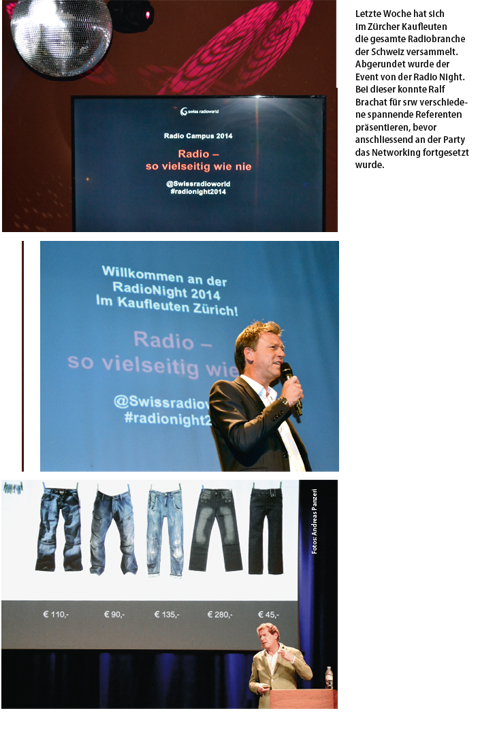
The summer was rainy. But instead of low pressure, the Swiss radio scene experienced an all-time high. From May to July, swiss radioworld (srw) achieved an average 16 percent year-on-year increase in sales. In July alone, it was 30.5 percent. "We are confident of working out a golden autumn 2014 for advertising customers and radio stations," Ralf Brachat is therefore optimistic. As of March 1, 2014, the former Co-Managing Director at Warner Music Switzerland assumed responsibility as the new Managing Director of srw. Ralf Brachat succeeded Bruno Oetterli, who remains Delegate of the Board of Directors. swiss radioworld emerged from the Radio Unit of Goldbach Media on July 1, 2013, and now operates as an independent intermediary with headquarters on Seestrasse near the train station in Wollishofen. The organization, with 13 employees, has since operated as a subsidiary of the Goldbach Group. The establishment of srw was intended to bundle the expertise that Goldbach Media had acquired as an intermediary for all private radio stations in Switzerland up to that point and to take account of the growth potential of the radio genre.

Radio can look back on a history of over 100 years - and even in the age of the Internet, it is still the most widely used medium: starting when you get up, then on the way to the office and back - all day long. In order to keep its appeal high in the future, the specialists at srw are working with partner radio stations to demonstrate its impact as well as current and future usage, and to create offers for advertisers based on this. "Radio customers should be able to concentrate on their core business, and we are happy to take the detailed planning of their advertising activities off their hands. We offer individual solutions in standardized processes, which achieve measurable results even in interaction with other advertising media," explains Brachat. With his team, he wants to establish products that go beyond the pure radio spot. "Although we are of course aware that spot campaigns are our main business. We are very active in genre marketing and want to reinforce to our clients that radio is one of the most effective media due to its speed, flexibility and intensity." The media experts at srw search for, analyze and communicate trends in the business ecosystem "radio". They are the experienced partners of private radio stations and accompany them into the digital future with customized solutions. "New technologies offer new opportunities. We see ourselves as trend scouts in the digital market, always on the lookout for new opportunities. We adapt these to the needs of the local market and develop attractive new advertising platforms together with our partner stations ", is how Brachat describes his task. "There's still room to grow," he says on the question of whether the market will stagnate or continue to grow. "Interesting new customers have currently been added to our existing and long-standing partnerships, because we have been able to prove that radio can make a difference for good brands. So we've also managed to get customers back on board who haven't thought about radio for a long time." This certainly has something to do with the fact that Ralf Brachat personally visits the agencies with his sales team. "I'm on an intensive roadshow with my sales team, we present ourselves and our vision," says the Managing Director, explaining an important part of his activities in his new role.

"The image of the medium of radio needs a brush-up, and I want to actively work for this rejuvenation," promises the man born in 1971. This also includes continuing the major genre marketing campaign "Marketing Rppen," which srw launched back in 2012. Stations pay one centime per advertising customer referred and SRW then doubles the sum. The funds raised in this way are then used for generic advertising, market research and portals set up specifically for this purpose, such as the radio spot archive.

The time is ripe, because the medium of radio is experiencing a revival in combination with the Internet. Radio consumption via cell phone or web radio will play an increasingly important role in the future. "This is where the great potential lies. Web radio combines the strengths of radio and the Web and opens up new target groups with little wasted coverage." Another way to access the new radio world is with the "Radiocircus". Here, swiss radioworld has achieved the almost impossible: For the first time for Switzerland, more than 30 radio stations are united on the largest Swiss private radio platform. Content such as news feeds, playlists, event calendars and podcasts are offered. The audio advertising format, including banners, can be booked. The original audio advertising of the individual stations is broadcast unchanged, but can now be supplemented by the placement of a pre-roll ad. "There will be other platforms entering the market. Pandora, for example, has shaken up the radio market in the U.S. - similar offerings will be added in Europe," Brachat sees in his analysis. He is also convinced: "Young radio listeners today no longer want to own their music, but to consume it. For such opportunities, they are also willing to pay something for it." Upheavals in existing markets, Ralf Brachat could observe in the course of his career from the most different waits, because before he joined srw, he got to know the audio industry in changing functions at Warner Music.

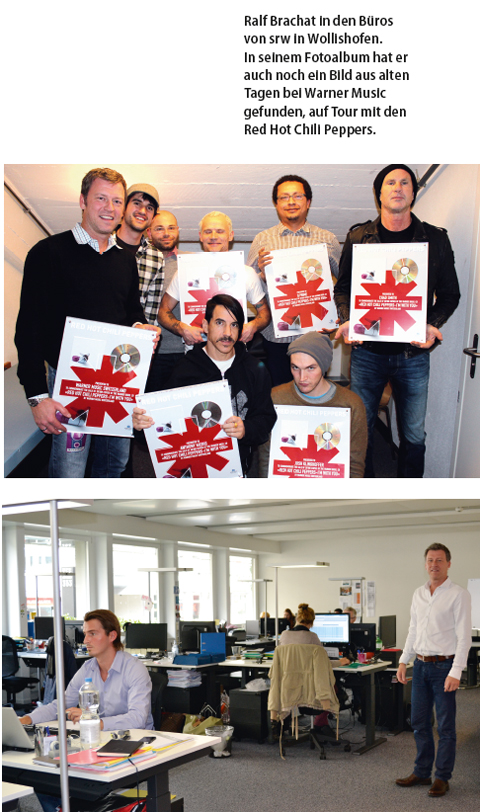
"In the music industry, a career usually begins as a promotion manager. That means you bring artists to Switzerland and offer them to the media for interviews," the sales specialist recalls of his career start at Warner Music. He then briefly switched to the financial sector, to Eurocard. "But this detour into the financial world wasn't my thing. Just the fact that everyone was on first name terms was kind of a culture shock for me." At Warner, things were more relaxed in that regard. "The music business is primarily a people business," he says, describing the atmosphere. "But you don't have to master an instrument to be able to promote a band; good contacts with journalists are more helpful. There it depends on the own personality and not on a technical education. "Nevertheless, Ralf Brachat also earned a federal diploma as a sales manager during this phase.

He remembers his time with music stars from all over the world fondly. "Even if some of them were divas." For one rock star, for example, only a very special suite came into question; with another, he had to play chess for two days in every free minute. But if the chess opponent is a member of the Scorpions, one accepts as a "youngster " this "sacrifice" of course gladly. "Experiencing stars that others only know from TV up close and personal and accompanying them through Switzerland, that's what I liked back then," says Ralf Brachat, looking back on his wild years at Warner.

However, even dream jobs are not immune to real-life problems. Along with the digital transformation, a decline in sales also began in the music industry in 2001. For Ralf Brachat, this meant "struggling" at first. For the promotion manager was promoted to Sales Director in 2004, with the task of building up the digital business at Warner. In 2003, iTunes had entered the Swiss market. "With this legal download method, we now had to try to make up somewhat for the sales slump that piracy had brought us."

At that time, up to 36 people worked at Warner Switzerland. When an investor bought the Swiss branch out of the Time Warner Group in 2004, the workforce had to be cut in half from one day to the next. "I'll never forget that Monday in the office," Brachat muses. For him, however, this cut resulted in a positive outcome; he was promoted to co-managing director at Switzerland's third-largest label.

"I enjoyed the job until the last day. A super environment with all the artists and the international managers and labels. In the train of musical and technical development, something new has been added all the time." Those around him would also never have thought that he would want to give up this prestigious "dream job" as CEO of a music label. "But after 15 years and at my age of 43, the point finally came where I had a great desire for a change and wanted to get to know something new," says Ralf Brachat, explaining his "departure at the peak" and the switch to the advertising industry.

Andreas Panzeri
 

Unbenannt-23_6
Unbenannt-24_7


Make skiers melt

The «Happy up» campaign by the Weisse Arena Group Laax ski resort ran through March of this year. The results are now in: Video ads helped attract 87 percent new unique users to the Laax website.

Winter sports resorts, which are very dependent on the economy and the weather, are finding it increasingly difficult: it's not just that winter no longer seems to be reliable. Due to the strong franc, many skiers also prefer to go skiing in Germany or Austria, or they spontaneously decide to ski for just a few hours in good weather instead of committing to a destination for a whole week as they used to and taking the weather as it comes. Skiing is becoming less and less predictable. In particular, new customers visiting a ski resort for the first time are increasingly staying away - even in the Weisse Arena, the Flims, Laax, Falera piste network. This is why the Weisse Arena Gruppe (WAG) ran the "Happy up" campaign in the 2012/2013 season. The lead agency was Rod Kommunikation from Zurich. The aim of the campaign was to boost cross-media lift ticket sales and increase interest in longer-term stays. In addition, potential new customers were to be addressed, especially in the target groups of families and freestylers.

Click record thanks to video advertising

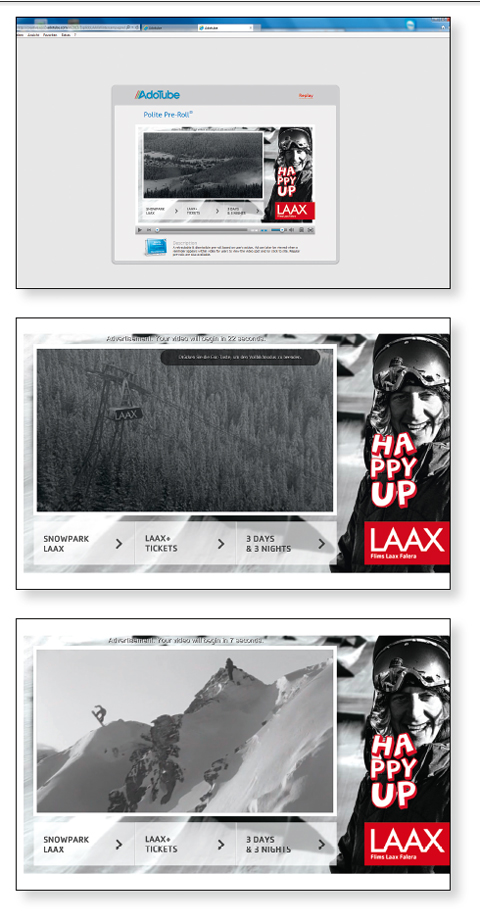
The campaign also included pre-roll video ads, in which the advertising message is placed before the editorial video content. As soon as the user clicks on the desired content, the video ad is played automatically and a countdown shows when the editorial content starts. Because the user cannot simply skip the video ad, advertising effectiveness is guaranteed. WAG worked with two partners to implement this part of the campaign: Explido, a German agency for digital marketing and sales, and Exponential Interactive, a provider of advertising intelligence and creative rich media solutions. For the in-stream advertising Photo: Keystone, Exponential used AdoTube's Polite Pre-Roll. Exponential created pre-rolls that were tailored to the two target groups with different motifs. They showed scenes from everyday life in Laax and were primarily used to build up the image. The pre-rolls also contained three call-to-action buttons: If a prospective customer pressed one of the elements, they were forwarded directly to the corresponding offer on the Laax website.

87 percent new unique users

WAG had great success with the pre-roll video ads: it placed specific product offers and gained 87% new unique users for Laax.com. Almost 190,000 ad impressions were delivered to the families target group, and around 273,000 to the freestylers target group. The dwell time for the families target group was 24 seconds, and 23 seconds for the freestylers target group - even though the video ad could be skipped after 15 seconds. The call-to-action buttons were also successful: The video ad encouraged 1150 users to click on the "Family Deal 7 Nights" offer and find out more about it. 1030 users were interested in the Freestyler offer "3 nights with 3-day lift ticket". "This measure enabled us to increase our onsite values and successfully approach new customers," says Markus Schleger, Online Media Planner at Explido. Kristian Paasila, Team Leader Web Management and E-Commerce at WAG, is also very satisfied: "We were able to combine our videos, which focus on brand awareness, with specific product offers, and we were able to do this specifically for two very different target groups. The results far exceeded our expectations."

Anne-Friederike Heinrich

Unbenannt-16_16
 

get_footer();