The Impact Check of Werbewoche

We show how current campaigns are performing with consumers.

Polyconsult’s campaign for Swiss meat resonated with consumers. It ranked first in the categories of uniqueness, brand fit, and likeability, and fourth in awareness. The Migros campaign by Jung von Matt Limmat is the undisputed leader in awareness. This comes as no surprise, as both the advertising intensity and media coverage of the new campaign were extremely high. It ranks second in brand fit and uniqueness. It ranked third in the “Uniqueness” category. The Bell campaign by Werbeanstalt took second place in spontaneous awareness and third place in the “Brand Fit” category.
> Results at a glance
> Detailed results

Question and methodology
Method: Computer Assisted Web Interviews (CAWI).
Instrument: Online interviews via the Marketagent.com reSEARCH platform.
Target group: web-active people from German-speaking Switzerland between the ages of 14 and 59.
Sample size: n = 500 net interviews, random selection by quota.
Survey period: 21.04.2009-28.04.2009, field duration: 7 days.
Questions:
- We introduced you to some ads at the beginning of today's survey.
Which of these ads do you remember? Please name the advertising companies or the brands advertised. (Awareness)
- In your opinion, to what extent do these ads stand out from other advertising in newspapers, magazines and journals? Please rate each from 1 (= does not stand out at all) to 6 (= stands out very much). (Uniqueness)
- To what extent do these ads fit the image you have of the respective brands/companies? Please rate each from 1 (= does not fit my image of this brand at all) to 6 (= fits my image of this brand very well). (Brand Fit)
- To what extent do you like the following ads? Please rate each from 1 (= I don't like them at all) to 6 (= I like them very much). (Likeability)
The values printed are in each case the top box ratings "stands out very strongly" "fits very well with my image of the brand", "I like it very much".
The remaining values can be found on werbewoche.ch.
Marketagent.com Schweiz AG is a subsidiary of Marketagent.com online reSEARCH GmbH, Austria's leading online market and opinion research institute and a pioneer in Internet-based data collection and analysis. The specially recruited online access panel currently comprises around 20,000 Swiss panelists (plus 178,000 in Germany and Austria). Swiss references include Coca-Cola, L'Oréal, Nestlé, Parship.ch and Advico Young & Rubicam.

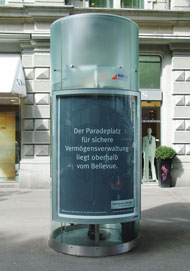
Ruf Lanz: Poster placed on Paradeplatz for Lienhardt & Partner

In addition to the ongoing advertising campaign, Ruf Lanz designed a poster for the Zurich-based private bank Lienhardt & Partner and placed it around Zurich’s Paradeplatz. The poster was also displayed at select locations around Bellevue.

Ruf Lanz has designed a poster for Zurich-based private bank Lienhardt & Partner alongside the current advertising campaign and placed it around Zurich's Paradeplatz. In this way, the poster is intended to address the target group in places where potential customers are to be found in large numbers, the agency writes in a press release. The poster was also placed in selected locations around Bellevue.
Responsible at Lienhardt & Partner Privatbank Zurich: Markus Graf (CEO, Director Private Banking), Christian Lienhardt (Managing Partner, Director Risk Management & Finance). Responsible at Ruf Lanz Zurich: Danielle Lanz, Markus Ruf (Creative Direction), Markus Ruf (Text), Lorenz Clormann (Art Direction), Michael Gassler, Michèle Leibacher (Consulting).
1290581743_img090506_privatbankplakat

Preventing bullying means saving a lot of money

Victims of intrigue and bullying in the workplace suffer massively and often become ill. However, the destructive processes also harm the companies that do not put a stop to the evil machinations. By Irmtraud Bräunlich Keller, lic.rer.pol., editor and employment law expert at Beobachter-Beratungszentrum.

According to a 2002 study by the State Secretariat for Economic Affairs (Seco), around one in 13 people in Switzerland suffers from bullying at work. These figures are likely to increase during the crisis. What is often forgotten is that it is not only the victims of harassment and exclusion who suffer. Companies that allow bullying to take place incur massive costs in terms of sick leave, reduced performance and unnecessary staff turnover. "Experts estimate that one case of bullying costs around one year's salary," can be read on the Seco website. Costs that no company can afford in difficult times.
How can companies effectively prevent bullying? How do you behave when tensions in the team lead to unfair machinations and fights to oust others? Here are the most important practical tips:
- Ensure a culture of open discussion. Let your employees know that they can address problems and express criticism without fear of negative consequences.
- Ensure that new employees receive thorough induction training. Provide them with a contact person, a "godfather", who will help the new team member to integrate as well as possible.
- Formulate your expectations of employees clearly and unambiguously. Provide information about upcoming changes as early and as openly as possible. Uncertainty, fears and rumors are an "ideal" breeding ground for bullying.
- In qualification interviews, also ask about the well-being of employees and their general satisfaction.
- Express justified criticism of an employee in private and not in front of the entire team.
- Address employees directly if there are signs of tension. For example: "I've had the impression recently that you don't get on particularly well with Mr. X. What do you think? How do you see that?"
- Take complaints of bullying, sexual harassment or other harassment seriously and ensure an impartial investigation. Designate a contact point for those affected.
- Allow those involved in bullying, both victims and perpetrators, to actively participate in the search for possible solutions. Do not talk about those involved, but with them. Protect victims of bullying from further exposure and retaliation, for example by separating them or transferring them.
- Be honest with yourself if you are unable to resolve a conflict or if you yourself are involved. Consult an (internal or external) specialist.
- Take time for a personal conversation with departing employees and encourage them to speak openly: How did they experience the working atmosphere? What problems may have led to their resignation?
Book tip
Mobbing - what to do? by Irmtraud Bräunlich Keller This comprehensive handbook provides information on the manifestations of bullying and explains the causes, consequences and legal aspects. It contains numerous tips for those affected and managers.
With many links, sample texts and annotated court rulings.
216 pages, paperback,
1st edition, April 2006, Beobachter-Buchverlag, ISBN: 978-3-85569-348-1, Fr. 34.?
1290581746_img090506_buchtipp_beobachter
New for SMEs: legal advice on issues affecting your company
The Beobachter's new service: competent legal advice for SMEs and their employees. 6 months for only Fr. 99.- (introductory price).
You can reach the legal experts Monday to Friday from 9 a.m. to 1 p.m. on 043 444 54 09. You also have full access to the advice platform Helponline.ch and an Beobachter magazine every 14 days. The price also includes a gift: the standard work for SMEs from Beobachter-Buchverlag,
"How to get your money", worth CHF 48.
Order the consulting subscription for SMEs at: www.werbewoche.ch or by phone: 0800 83 0800.

Last but not least: unbearable boredom

Why haven't we all packed up our belongings and emigrated? Why do we persevere in this wasteland, in this hole, in this dreariness, in this imposition of a city? Is it self-mortification? - According to a new survey, Zurich is the second most boring city in Europe...

Why haven't we all packed up our belongings and emigrated? Why do we persevere in this wasteland, in this hole, in this dreariness, in this imposition of a city? Is it self-mortification? - After Zurich had already received a heavy blow in the quality of life study by the consulting firm Mercer and was relegated to second place by Vienna, it is now even worse: our beautiful city is said to be boring, boring to death. This was the result of a survey of 2,400 tourists conducted by the travel portal Tripadvisor. The second most boring city in Europe! According to the users, only the Belgian capital Brussels is even more boring than Zurich. London and Paris are considered to be much dirtier. The baguette metropolis was also awarded the title of "most overrated city in Europe". Before we plunge into the nightlife, we claim the title of "most underrated city". Then we are somewhat appeased again. Let the tourists go to Olten, St. Gallen or Wil!

Leap into higher realms

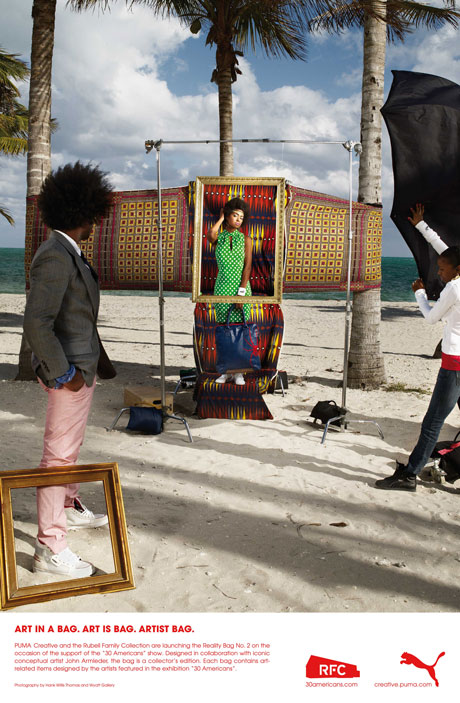
Neutral Zurich is creating an exclusive campaign for Puma International.

Advertising that you shouldn't just skip over: Neutral Zurich teamed up with Puma to develop a limited-edition product range, the Reality Series, designed to establish Puma in top fashion magazines and equally top stores. The aim was to "make Puma a topic in the influential fashion and art world", as Michelle Nicol at Neutral explains. The Reality Series is a series of collaborations with artists and designers to develop limited editions that are integrated into existing product lines.
The Reality Bag no. 2 was designed by Swiss artist John Armleder, who is also responsible for the bag's contents: "A bag without content is empty." The bag was launched in December 2008 at the Art Basel Miami Beach art fair in partnership with the world-famous Rubell Family Collection and the "30 Americans" exhibition.
The global campaign was photographed by the American artists Hank Willis Thomas and Rashid Johnson. The Zurich agency is also responsible for the distribution and sale of the limited edition series to selected dealers and galleries worldwide. In Switzerland, for example, Trois Pommes and Galerie Andrea
Caratsch. pan
1290581748_img090423_puma2
1290581748_img090324_puma4
1290581748_img090423_puma3
img090423_puma1

Only creativity can do that

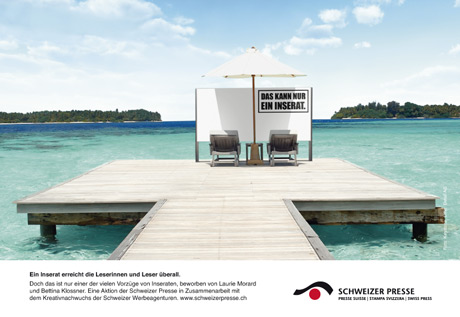
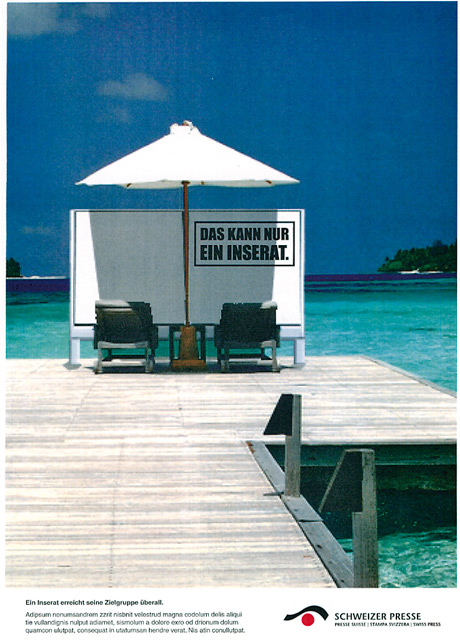
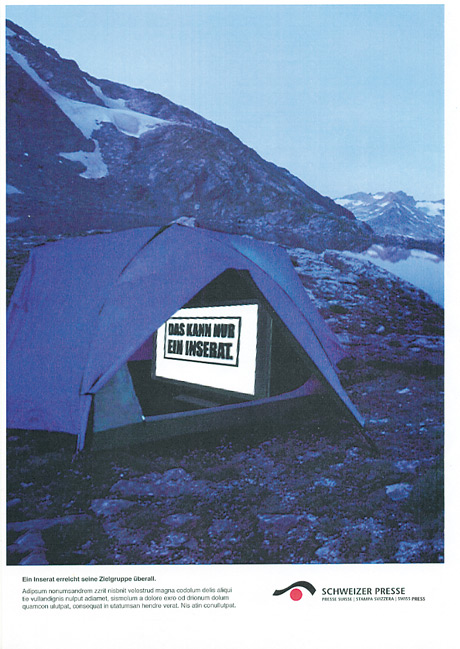
Since early May, the first of the two winning campaigns from the «Das kann nur ein Inserat» contest has been running in newspapers and magazines. For the first time, the young talents were required to create not just an ad, but an entire campaign.

Teams: 39, campaigns: 85, subjects: 368 - never before in the past four years has the Swiss Press Association's Das-kann-nur-ein-Inserat jury had to choose between so many witty and captivating ideas. In the end, Laurie Morard from Advico Young & Rubicam and Bettina Klossner from OgilvyOne were able to convince the jury with their campaign "Ein Inserat bringt's immer und überall" and Silvio Seiler from Wegelin & Co., Privatbankiers, with his work "In einer Anzeige steckt mehr als nur Werbung". The winning campaigns had to meet Michael Conrad's ten judging criteria: startling, destructive, non-competitive, cliché, innovative strategy, fresh idea, excellent execution, new standard in the category, new standard in advertising, world class. The rewards for the excellent work are CHF 10,000 prize money each, an additional fee for the realization, the placement of the campaign in around 100 magazine and newspaper titles and an invitation to the Europe-wide creative competition BestYet 2009* in London. "In terms of reach, 'Das kann nur ein Inserat' is once again likely to be the biggest campaign of the year," says jury president Andreas Prokesch.
> The nominees
The winners of the competition have been known since the end of January. In the meantime, Laurie Morard and Bettina Klossner have optimized the campaign subjects, clarified the rights and designed the final version. The revised campaign was launched at the beginning of May, and Silvio Seiler's campaign will be revised and then realized by the autumn.
Anne-Friederike Wilhelm
> The very personal Advertising Week rating
1290581750_img090506_daskannnur
What does an advertisement do on the azure blue South Sea, in a tent high up in the mountains or in the shower? - Advertising. Laurie Morard and Bettina Klossner were able to convince the jury with this idea and its implementation in the image. Above, the first motif of the professionally prepared campaign. Below, four of the designs submitted by Morard and Klossner. They are currently being revised and professionally implemented.
1290581750_img090506_sieger12
1290581750_img090506_sieger13
1290581750_img090506_sieger14
1290581750_img090506_sieger15

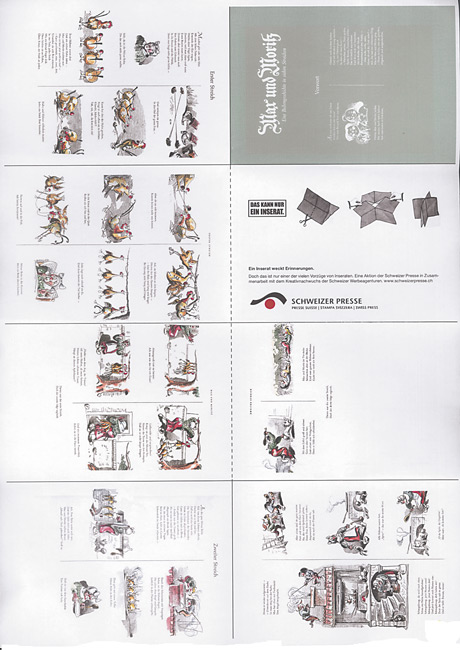
Below: Silvio Seiler scored points with his leaflet idea. His thesis: there is so much in some advertisements that they could also be found in the Brockhaus, Max und Moritz, Knigge, the Bible or even the Swiss passport.

1290581750_img090506_sieger21
1290581750_img090506_sieger22
1290581750_img090506_sieger23
1290581751_img090506_sieger24

To the point: It's that simple

Everyone seems to know what the daily newspaper of the future should look like. In countless presentations, at congresses, on the Internet, in interviews with experts or in articles by self-proclaimed media experts - everywhere it sounds the same. The newspaper of the future must be more relevant, more emotional, with more background, less news-heavy, more surprising, more explanatory, more beautiful, more service-oriented, more suitable for the target group and, above all, better written. Well, well!

Everyone seems to know what the daily newspaper of the future should look like. In countless presentations, at congresses, on the Internet, in interviews with experts or in articles by self-proclaimed media experts - everywhere it sounds the same. The newspaper of the future must be more relevant, more emotional, with more background, less news-heavy, more surprising, more explanatory, more beautiful, more service-oriented, more suitable for the target group and, above all, better written. Well, well!
Like a mantra, the desired qualities are repeated. Again and again and everywhere. Qualities that may sound good at first glance, but on closer inspection are nothing more than banal, traditional and hackneyed buzzwords. All those who make newspapers every day with their heart and soul and many years of experience have not fallen on their heads. If it were that simple, the newspaper of tomorrow would have been invented long ago, and the decline in readers of subscription daily newspapers would be a thing of the past. Or even more likely, it would never have come to this.
But it's not that simple. There is the problem of price. There is a market problem, and there is also a problem with the business model.
People, especially the young, are used to getting all the information they need for free on the Internet. This statement is nonsense per se, because the Internet is not free. Access very much has to be paid for, what doesn't have to be paid for is the content used. The only problem is that the user does not realize that it costs him something. This is how free commuter newspapers were invented. A flop in many countries, a success in Switzerland. Well, a relative success! The first-mover 20 minutes is a success, Heute mutated into Blick am Abend, Cash Daily was discontinued, .ch was buried in the short term, 20 minutes and Matin bleu will be merged, if the Weko agrees. Whether the costs for the News newspaper will be borne by Tamedia for much longer remains to be seen. This is rather unlikely now that all competitors have gone.
All of these papers have or had appealing user numbers. As long as the economy was doing well, some of them had enough revenue from ads. But now, in the crisis, the revenues are not coming in. So the business model is only working to a very limited extent. Subscription daily newspapers have the same problem. Here, too, the business model is showing itself to be a fair-weather model. But what might a crisis-resistant business model look like? Answers to these questions would be interesting, but they are not so simple.
Pierre C. Meier, Editor-in-Chief
[email protected]

Walter Althaus resigns from Publicitas

Advertising sales and training specialist Walter Althaus is stepping down as Head of Training and Development at the Publicitas Group in the middle of the year. He will become an independent consultant and trainer from July 1.

Advertising sales and training specialist Walter Althaus is stepping down as Head of Training and Development at the Publicitas Group in the middle of the year. He will become an independent consultant and trainer from July 1. The 60-year-old was with P for 19 years, including 14 years in a management role. Before that, he spent 19 years at Ringier, also on the publishing side. Althaus writes in a press release that now is exactly the right time to take off on his own. "In tougher times, companies of all sizes need support for projects and in the event of problems, but they don't want fixed costs if possible."
Walter Althaus has many years of experience as a board member and has been a member of various boards of directors of further education institutions in the media industry for many years. He is a lecturer and course leader at the Media Institute of the Swiss Press Association and at Sawi. His core areas include management and leadership in advertising marketing, training and further education, training and coaching of commercial publishing specialists as well as projects in the areas of management development and assessment.

Lorenz Keller new at Business Campaigning Switzerland

Lorenz Keller has joined Business Campaigning Switzerland, effective immediately. He oversees political campaigns and election campaigns, as well as projects at the intersection of politics and business.

Business Campaigning Switzerland will be strengthened with immediate effect by Lorenz Keller. He handles political campaigns and election campaigns as well as mandates at the intersection of politics and business. Keller brings experience from federal politics, a national young voter mobilization campaign and the 2006 U.S. election campaign, the agency said in a statement.
Business Campanigning Switzerland is part of an international campaigning agency network.

Quo vadis, PR?

Tighter budgets, more know-how, higher quality - the BPRA presented what PR agencies will have to deal with in the future at its annual media conference. The BPRA market statistics are regarded as an early indicator of general economic development.

The good news first: the Swiss PR industry is on the upswing. According to the BPRA's market statistics, however, this only applies to the big players among the BPRA agencies: the top 5 Farner Consulting, Trimedia, Burson-Marsteller, Freicom and Communicators Zurich recorded growth of 5.1 to 7.4 percent in 2008 and generated net fee income of between CHF 4.4 and 14.4 million. The top 4 even took on new staff last year. Overall, however, only one in two of the 16 BPRA agencies achieved revenue growth in 2008, namely between 2.7 and 9.1 percent. Fee income stagnated at a high level in 2008: 255 employees generated a net fee volume of CHF 61.6 million (2007: CHF 61.5 million). And this is likely to continue: Only every third agency expects its fee income to increase in 2009.
The middle class is breaking away
Medium-sized BPRA agencies in particular have been dealt a severe blow by the economic downturn. Their turnover fell sharply in 2008, in some cases by double-digit figures. Of all BPRA agencies, Knobel was hit the hardest with a drop of 33.5 percent. One positive exception is the Basel agency Intext Communications, which recorded the highest fee growth of all BPRA agencies in 2008 at 9.1 percent.
"Medium-sized agencies now have to decide whether they want to grow or shrink," says BPRA board member Roman Geiser from Burson-Marsteller. "Full service no longer works because there are too many highly specialized small agencies. In the medium term, there will only be a few medium-sized agencies left in Switzerland." So the air is getting thin in the middle. Peter P. Knobel, owner of Knobel and President of the BPRA since 2006, considers the situation for medium-sized agencies to be very difficult. He himself is faced with the decision to grow his ten-man agency or to specialize in a niche with a small team. His gut reaction is naturally to opt for growth, but this is anything but easy with owner-managed agencies. "Owner-managed agencies have a special culture," explains Knobel. "Everyone works with everyone else and a lot of things go through the owner's desk, especially the acquisition of new clients." Of course, this only works up to a certain company size.
For owner-managed agencies, growth through an increase in personnel means that they have to implement a new corporate culture, new processes and possibly also new hierarchies. This is a development that the core team, which has worked together for years and is tied to the owner, does not necessarily support. An attractive alternative for Knobel is therefore a merger with another medium-sized, owner-managed agency. This would create a company with one turnover and a uniform external image, but two teams that function relatively independently of each other operationally. It is possible that such a structure will develop into the business model of the future for medium-sized agencies.
Small ones need specialist knowledge
Like the turnover of medium-sized agencies, that of small agencies is currently stagnating. Small agencies can only score points if they offer a high level of expertise and clearly specialize in a specific topic, such as pharmaceuticals or energy - two of the sectors that the BPRA predicts will grow. However, small agencies must be able to offer the full range of communication services. Even though companies are increasingly tending to allocate their budgets on a project-by-project basis, they still like to obtain their communication from a single source.
A head start in terms of knowledge and experience is becoming an important selection criterion for agencies of all sizes. "More and more people who have good PR know-how are working on the client side," emphasizes Roman Geiser. "PR absolutely has to follow suit. Training and professionalization will become increasingly important in the future." Because more and more highly specialized communication products are being created, functional expertise is particularly in demand, for example knowledge of investor relations, change management or media training. Some agencies surveyed by the BPRA also see themselves forced to focus on one sector. They rate the energy sector, politics, the real estate and construction industries as well as pharmaceuticals, biotechnology, medical technology and chemicals as sectors with good to reasonable growth potential. Unsurprisingly, from the PR professionals' point of view, financial service providers and, lagging far behind, ICT guarantee losses.
Battle for the best
The demand for specialist knowledge also has an impact on the employees that the PR industry is looking for. Compared to previous generations, the next generation of PR professionals is under even more pressure to perform: the egg-laying, wool-milk sow - or PR all-rounder, as it is more commonly known - has always been in demand among young professionals, and that is nothing new. Now, however, young PR professionals should not only have excellent knowledge from their specialist studies and a high level of communication competence, but also be able to demonstrate sound experience with all communication channels. They should also be prepared to work on call due to the increasing number of project assignments.
It remains to be seen how realistic these demands are. In a market where knowledge is once again gaining in value, it is not entirely unfounded to hope that companies and agencies will at some point start spending money again to attract and retain proven experts. This is the only way they can stand out from the crowd. Eliane Birchmeier, owner of Birchmeier Partner and member of the BPRA Board, talks about the "war of talent". "Highly qualified employees, permanent investment in PR knowledge and familiarity with the latest PR tools will determine the survival of agencies in the future."
Speed increases
In addition to the professionalization of PR, the BPRA has observed other trends: Agencies are receiving significantly fewer direct commissions. More and more often, they have to compete for budgets in pitches, and with increasingly shorter deadlines. "The importance of relationships and agencies' known market positions is decreasing," says Geiser. In addition, the budgets allocated for PR measures are shrinking noticeably as a result of the crisis and business is becoming more volatile. Companies are increasingly buying PR project capacities, consulting or strategy expertise on a selective basis. They are hoping that marketing communication will cushion the losses caused by the reduction in advertising. Another trend is the stagnation of internationalization. It is true that 9 of the 16 BPRA agencies are part of an international network. "Nevertheless, as in the previous year, there was no pronounced trend towards further internationalization of the PR business in 2008," emphasizes BPRA President Knobel.
Quality makes the best business
Even though the PR industry as a whole is anything but doing well, BPRA agencies recorded 26.8 percent higher added value in 2008 than market participants not organized in the BPRA. "This is a clear indication that the particularly demanding PR tasks are preferentially awarded to BPRA member agencies," said Roman Geiser. In 2005, the BPRA introduced the Consultancy Management Standard CMS II quality audit in Switzerland, in which dimensions such as project and campaign management, customer satisfaction, personnel management, leadership, corporate and financial planning and the development of new business are assessed. All 16 BPRA agencies are CMS II-certified, making Switzerland the country with the highest rate in Europe. "Obviously, the value of our certification is rated highly by companies and institutions," says BPRA President Knobel. "The federal government, federal government-run companies and the cantons require proof of CMS II or a comparable certificate as a prerequisite for participation in tenders." This is probably one of the reasons why the BPRA regularly welcomes new members, such as Jung von Matt/Public Relations and Pleon C-Matrix recently.
BPRA agencies and service providers are expecting double-digit growth in 2009. "I think this forecast is very ambitious," says Eliane Birchmeier. "But optimism is good for the industry." The BPRA experts agree that marketing communication will be the main driver of sales in the future. The prerequisite for this is unprejudiced cooperation with advertising. "The broader PR agencies are positioned in the future and the more integrated communication solutions they offer from a single source, the more crisis-resistant they will be," emphasizes Birchmeier. "PR agencies also need to question their pricing so that they don't lose smaller clients to PR service providers." In future, clients will demand one more thing from their PR agencies: proof that their PR measures are effective. New survey instruments will be needed to prove this - which will create new business areas for PR effectiveness research.
Anne-Friederike Wilhelm
BPRA diagrams
BPRA in brief
The BPRA is an association of leading PR agencies that is affiliated to the International Communications Consultancy Organization ICCO. Since 1976, the BPRA has represented professional policy concerns, ensured market transparency and promoted quality in PR. The association offers its members a fee schedule, sample contracts, a checklist for competitive presentations and lists warning of clients who have had negative experiences with PR agencies. Every year, the BPRA also compiles audited market statistics that reflect trends and developments in the industry - and which are regarded as an early indicator of general economic development in Switzerland.

Agence Trio wins "Verbier - St-Bernard" as a new client

Agence Trio prevailed in a pitch against three competitors and won the account for «Verbier – St-Bernard.» Going forward, the agency will be responsible for the communications campaign and corporate identity of these Swiss vacation destinations.

Agence Trio prevailed against three competitors in the pitch and won the mandate for "Verbier - St-Bernard". In future, the agency will be responsible for the communication campaign and corporate identity of the Swiss vacation destination. "Verbier - St-Bernard" chose the agency for central communication after the three Valais regions of Verbier/Val de Bagnes, La Tzoumaz and Pays du St-Bernard merged. The agency's first works can be seen from summer 2009.

UN becomes more important as a news source in the media crisis

When media outlets cut back, the UN becomes all the more important as a news source. Switzerland presented this position to the UN Committee on Information in New York.

When the media cut back, the UN becomes all the more important as a news source.
This was Switzerland's position before the UN Information Committee in New York. The media have also been affected by the biggest economic crisis since the UN was founded, said Simon Pidoux from Political Affairs Division III in the Federal Department of Foreign Affairs (FDFA) on Tuesday at the UN headquarters in New York. Wherever you look, media companies are having to lay off staff, cut back and save money.
In many places, newspapers - the backbone of an open, pluralistic democracy - are threatened with extinction. Pidoux said the familiar ways of gathering, processing and disseminating news were being changed by new technology in ways that were not yet fully understood. "We are moving into a new information age that is creating additional confusion and gaps on the world map of knowledge and understanding," Pidoux said. The UN Department of Information must therefore make a special effort to deliver the best quality news directly.
Humanitarian disasters such as those in the Congo, Darfur, Burma, Georgia or Sri Lanka show the public how timely, fair and complete the UN reports on events. In such crises, the organization has to prove its credibility as a global news source.
get_footer();