Among other things, *Werbewoche* noted a guide to the design and fashion event «Kreislauf 4 + 5» and a campaign for natural gas.
Editorial
-
May 6, 2009
Smoke Signals of the Times People who smoke behave illogically. That’s the message—for those who haven’t noticed yet—of the Swiss Federal Office of Public Health’s (FOPH) nationwide tobacco prevention campaign, which was conceived and implemented by the Zurich-based agency By Heart/cR Kommunikation. Ten TV spots and seven print ad campaigns in German, French, and Italian aim to encourage smokers to quit and reinforce non-smokers« decision to stay smoke-free. With the help of this campaign, that could work—and, given the harm caused by smoking, it’s »actually logical.” No wonder the cigarette is now on the decline.
The Designers on Langstrasse The «Kreislauf 4 + 5» design and fashion event will take place for the third time on the weekend of May 9 and 10. Together, more than 70 designers, studio owners, and shop owners along Langstrasse will be showcasing their work. Part of the project is an illustrated guide that provides comprehensive information about the design scene in Zurich’s city districts 4 and 5. Many creatives are based not in central, high-traffic locations, but in neighborhoods with more affordable rent. The multicultural Langstrasse neighborhood is highly valued by designers and considered a source of inspiration.
Natural Gas for Greater Climate Protection Following its successful launch last year, the new natural gas campaign is entering its second phase. Once again, it highlights the environmental and economic benefits of natural gas. The campaign operates on two communication levels: Broadcast, featuring TV spots, print ads, and rail posters; and narrowcast, featuring banners and classified ads for investors placed in the real estate sections of newspapers. Interview-style advertorials also play an important role. The account is managed by Matter & Gretener.
Input expands its workforce
The business and marketing consulting firm Input continues to expand its team. Following the hires of Lars Längauer and Jörg Staudacher, the firm has now brought on Wolfgang Schuster as a project manager.
Editorial
-
May 6, 2009
The Swiss consultancy Input, founded by Richard Kühn, is continuing to expand its team. Following the recent appointment of Lars Längauer as a new partner and Jörg Staudacher as project manager, the agency has now hired Wolfgang Schuster as a further project manager. After studying business administration, Schuster worked for Migros as Head of Market Development Supermarket.
Moonsticker.com wants to conquer the world from Switzerland
A fire-eater for a TV commercial, 15 can-can dancers for a trade show booth, a copywriter for a witty speech, a substitute drummer for a rock band, or even a balloon artist for a kids’ party: Moonsticker.com is the go-to site for finding all kinds of people from the entertainment industry.
Editorial
-
May 6, 2009
Models, musicians, presenters, actors and all other kinds of people from showbiz have a new home. The international show business portal Moonsticker.com was officially launched today in Zurich. Moonsticker.com was launched in Switzerland with the sponsorship of Viktor Giacobbo and aims to conquer the world with the help of Xing co-founder Bill Liao. "I'm just the ratings celebrity here," joked Viktor Giacobbo in his presentation. However, the cabaret artist and Chairman of the Board of Directors of the Casino Theater Winterthur is fully convinced by the idea. On Moonsticker, every artist from professional to jekami clown can present themselves to their potential market free of charge. "There is no free access to performance opportunities for artists, and we are at the mercy of the whims of the powerful few who decide who is allowed on which stage," say the initiators of Moonsticker. As a free platform, Moonsticker is also intended to become a newly functioning network for agencies. Swiss portal with global ambitions The idea for a now "free platform for everyone" has matured for satirist Andreas Thiel and his friend and IT entrepreneur Fabian Hediger. In Viktor Giacobbo, the two have brought an investor and board member onto the team alongside their figurehead. Around 1000 artists are already listed on the beta version of the Moonsticker.ch platform. And because the operators quickly realized that the idea could be exported abroad with just a little more effort, Moonsticker.de and Moonsticker.com have already been launched. The Swiss have been able to recruit none other than Xing co-founder Bill Liao for the now realistically targeted global platform. He was present at the presentation in Zurich and explained his convincing business model: "Xing was founded to help its members. That is why we have become so successful. Other models that were only invented to make money have since had to be discontinued." Various financing options Moonsticker is free for all providers - at least in the standard version. Texts, photos, audio documents and videos can be uploaded here. For a small membership fee, you can also benefit from additional services such as managing your own website. Future sources of income for the platform are e-commerce, a possible placement fee for engagements that is below the industry average - and of course advertising. For the time being, this will be acquired by the operators themselves. However, they are in contact with appropriate specialists. Two engineers are already employed full-time in Zurich to maintain the site. The filling of key positions at the Moonsticker branches in Los Angeles and Mumbai "is looking promising", said Giacobbo without a trace of humor. However, the punch line that he could one day become a big winner on the stock market with Moonsticker could only elicit a modest smile from him. "So far, I've invested more in all my projects than I've earned from them," said the comedian. Bill Liao, on the other hand, is already convinced: "Moonsticker is the right idea at the right time, which is why the right people are jumping on board." Incidentally, the name "Moonsticker" comes from the idea that the moon, with its projection surface for dreaming of a great career at night, could be the first stop on the way to the big world of stars. Andreas Panzeri
A suitcase full of ideas
In Berlin, the ADC has declared a «creative revolution.».
Editorial
-
May 6, 2009
Entries for the ADC Germany competition have fallen from around 9,000 to 7,000 this year. Many of the previous sponsors have also dropped out. As a result, the traditional exhibition no longer featured all the works, but only the award-winning ones. "Renting a larger hall for a whole week was simply no longer an option." The exhibition and congress took place in the old Kosmos cinema. However, the center in the old East presented itself as an extremely atmospheric replacement. And despite cost-cutting measures, the speakers at the workshops were very well-known, creatively selected and competent. In a presentation on "Revolutionary sponsoring", for example, it was revealed that Allianz already has a team of ten people working to bring the company's brand and messages to the "new media". "Those who act boldly will be given more trust", was the message in a panel on the topic: "How do I sell a cheeky idea to the customer?" A professional surfer from Hawaii discussed this with a creative director. In terms of Internet development, it was estimated that today three years are enough for a community to become as popular as Facebook. In the pioneering days, six years were needed for this leading portal. "Messaging is dead" was another insight. In future, consumers will want to receive information from advertising instead. "Social networks are the field in which brands operate today." An interesting figure that was offered was that classic advertising has a maximum return of 18 percent in terms of perception. Trust in such advertising is even based on just 14 percent. In contrast, 78 percent of people trust recommendations - and these are "best found in a dialog with consumers". Despite the exciting names, a panel with some of the most famous top creatives did not provide any important insights. Instead, there was a lot of innovation in a showcase of "New German Directors". For the first time, this was compiled by Saatchi & Saatchi for the first time with exclusively German filmmakers, following the example of their Cannes role. A booklet with the contact details of the 14 new talents was also provided. Andreas Panzeri
Not one, but two crises at the same time
"I registered for the congress to watch the newspaper industry die," said an online representative. He may have been mistaken. The 10th European Newspaper Congress in Vienna highlighted ways to make newspapers more appealing to readers.
Editorial
-
May 6, 2009
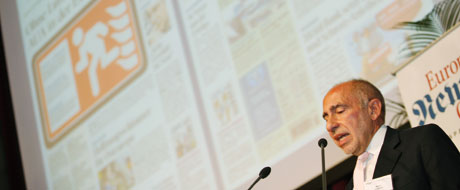
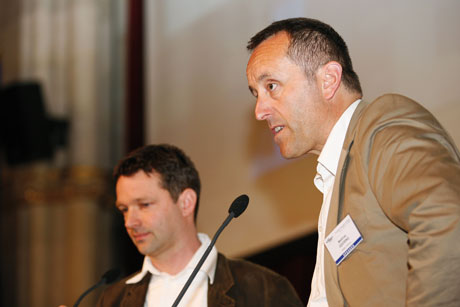
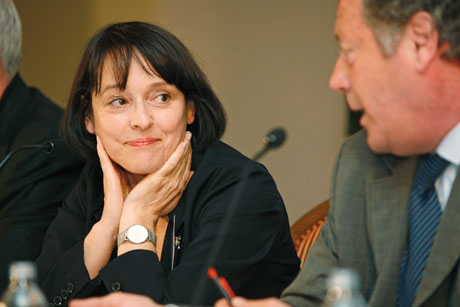
Of course, the crisis in the newspaper industry was a pervasive topic at the anniversary conference held in the ballroom of Vienna’s New City Hall and a major point of discussion among the more than 500 participants from 16 countries. The grim news from the U.S. delivered by Professor Russ-Mohl of the University of Lugano—such as the bankruptcy of once-prominent newspapers like the Chicago Tribune, the decline in circulation, ad revenue and stock market valuations, and editorial staff cuts of up to 30 percent—have long since caught up with Europe. In reality, this isn’t just one crisis—it’s two. The current economic crisis, which even the most innovative newspaper concepts can’t solve. And the structural crisis facing the industry: changing consumer behavior, with readers migrating from newspapers to news websites. But there’s one thing no one can take away from the newspaper: its role as a medium that provides an overview. Erich Ortner, editor-in-chief of the Vorarlberger Nachrichten, summed it up: In 30 minutes, print gives you an overview of 40 topics. By that time, you’ve barely clicked through one or two websites online. And his colleague at the Frankfurter Rundschau is convinced that if only the web existed today, whoever invented the newspaper as a medium for providing an overview would be revered as a pioneer. «Less talk, more action» So there isn’t necessarily any reason to be as pessimistic as Matthias Geering, editor-in-chief of the *Basler Zeitung*, who expects circulation figures to continue falling. And it’s certainly more than just a voice crying out in the dark forest when men like Rupert Murdoch continue to invest in newspaper publishers. Or when a company like Antonio Giner’s Innovation International Media Consulting Group launches a new print product somewhere in the world every two weeks. What do these men believe in? What does it take to succeed with a newspaper today? Giner says «less talking, more doing» and agrees with all the other speakers: Cost-cutting alone won’t save the industry. It needs innovation. And it needs quality. Today, it’s more important to be the best than the fastest—provided you’ve cut costs quickly enough to still be around to experience the economic recovery when it comes. “Better” doesn’t mean smarter, more elitist, or more traditional. Better means relevant to the reader, visually appealing, enticing, diverse, surprising, well-written, service-oriented, more professional, and media-appropriate—that is, tailored to the consumption habits of the respective target audience. For example, this includes today’s 20-year-olds, who have never known a life without the web and the Game Boy. And the newspaper will be more compact, because it’s a fact: Traditional media are losing advertising revenue because more and more brands are investing an ever-larger portion of their advertising budgets in their own media assets—such as BMW in corporate publishing (BMW Magazine), web TV, blogs, Facebook groups, the iTunes Channel, and corporate TV. All of that money is lost to traditional media. “Compact” doesn’t mean “bite-sized.” Long-form articles are what define the newspaper and are important—provided the story is compelling and well-written. “Compact” means focusing on the important, engaging topics. Online – on time – full time Tomorrow’s newspaper is no longer just a print medium. It stays in touch with its target audience throughout the day—as a print product, an online channel, via iPhone, cell phone, and blog. And it doesn’t primarily deliver news, but rather what lies behind it. After all, today anyone can get news anytime, anywhere. For Giner, therefore, publishing yesterday’s news is a surefire way to hasten the demise of newspapers (see box on the left). He says: «We are not in the news business. We are in the understanding business.» Renowned media designer Mario Garcia sees it exactly the same way, and from this he derives a news cycle: Web – Print – Web. The initial news appears on the Web, the in-depth story in the newspaper, and further variations back on the Web, along with feedback and suggestions from readers. The Basler Zeitung also values reader participation; during extraordinary events, it has repeatedly published pages full of cell phone photos submitted by its readers—comprehensive photo coverage that the BaZ photo editorial team could not have achieved on its own. Experts also agree that newspapers should not look like websites. Only the issue of navigation—formerly known as reader guidance—has taken on even greater importance due to the habits of the Internet generation and now makes use of the presentation techniques found on websites. Multifunctional Officials Under Scrutiny The speakers disagreed on how online content should be created. While at the Austrian *WirtschaftsBlatt* every journalist produces content for all platforms, *20 Minuten* believes in specialization. A good print journalist simply has neither the time nor the expertise to adapt their story for several different platforms—as text, a streamed interview, a podcast, or a video clip. The online offering is not simply an additional distribution channel for print; it runs its own stories or expands on print stories. That is why 20 Minuten does not have a joint newsroom. As a result, the print and online editorial teams work in competition with one another, albeit in coordination. This way, the print editorial team knows at all times how online stories are performing; it can thus assess—better than a traditional daily newspaper editorial team—how a topic is resonating with readers, whether the story should be pursued further, and what priority it should be given in the print edition. Conversely, the print editorial team drives traffic to the online platform or develops new relatable characters for that purpose. Print and online are two manifestations of the same overall brand for the same target audience, but using different methods. According to print editor-in-chief Marco Boselli, it is crucial for the brand to maintain a presence across all channels—from print to iPhone. It’s unclear today which of these channels will prevail in the future, but the publication is well-positioned for anything. Of course, this comes at a price, as evidenced by the size of the two editorial teams alone: About 60 people currently work on the print edition, and 40 on the online edition. "20 Minuten" and the "WirtschaftsBlatt" have found success with their concept: "20 Minuten" is now profitable online, says Hansi Voigt, head of online operations. The "WirtschaftsBlatt" not only generates twice as many print subscriptions online, but also sells significantly more of its paid online newsletters today than before. A pile of crumbs instead of a slice of cake Tomorrow’s newspaper is closely connected to its target audience through feedback channels—such as Twitter, forums, or online platforms. That’s why it knows exactly what content the community is engaged with at any given time, as Dieter Rappold of the agency Knallgrau, New Media Solutions, puts it. For example, some newsrooms let their readers help decide which questions to ask the interviewee in a major newspaper interview, and can therefore be confident that the printed interview will be of interest. In addition, they offer their readers the opportunity to interact with one another on these platforms. Established editors-in-chief have called this «nonsense.» The fact is that people of all ages and social classes interact in this way—which isn’t a bad thing if the newspaper is represented in this community, says Rappold—and the ORF editorial team, for example, takes this approach. The online channel offers another advantage: Newspapers are, by their very nature, designed to reach larger audiences with identical content—and this at a time when the market is shifting from a mass market to a mass niche market. The online platform makes it possible to address this fragmentation—that is, to offer small and very small groups a “special dish” in addition to the standard menu. Rappold says it’s becoming increasingly difficult for newspapers to carve out a whole slice of the market. So they’ll just have to make do with a pile of crumbs. Trends in Newspaper Design The editors agree that newspaper design is becoming more magazine-like. Large images dominate the pages—even on the front pages of quality newspapers. The front page is turning into a poster. In addition, there are more infographics and a greater focus on the day’s key issues. «More of less,» says Giner. Since the Vienna conference was attended by newspaper producers rather than publishers, the discussion focused less on funding models and more on how to create a truly good, engaging newspaper. The Vienna conference was attended by newspaper editors, not publishing executives. That is why there was more discussion about what tomorrow’s newspapers should look like than about how they will be financed. It was also striking that many of the beautiful newspapers that won awards in Vienna contain virtually no advertisements. They rely on other sources of funding—large publishing houses that provide cross-subsidies behind the scenes, as well as direct or indirect government press subsidies. Whether these sources will continue to flow in the future is uncertain. We can only hope that the strategies outlined for attracting readers to print products and retaining their loyalty will prove successful. For if there is one logic in the media business, it is that products with more and more satisfied readers have a better chance of generating advertising revenue. The idea that newspapers might end up begging for government aid, much like the auto industry, was certainly on everyone’s mind in the room, but no one wants that to happen—because it would likely mean government influence over editorial content, and that would spell the death of free journalism. Urs Zeier
Star designer Mario Garcia describes scenarios for newspapers to survive in the multimedia age.
The Basler Zeitung wins the European Regional Newspaper of the Year award (from right: Michael Admas, Art Director; Matthias Geering, Editor-in-Chief).
Ursula Fraefel, editor-in-chief of the Thurgauer Zeitung, can imagine that online content might eventually require a fee. Trends in Newspaper Design Networking Print and online are two different manifestations of the same media brand for the same target audience. Focus Print isn't the place for a little bit of everything. It's the place for a lot of one thing. Some front pages are dedicated to a single topic. Design The newspaper's layout is becoming more magazine-like. A newspaper, If it isn't beautiful, it's dead. Navigation What used to be called "reader guidance" is now emphasized even more and makes use of techniques from the Internet. Interaction Readers and the newspaper are in contact with one another. This increases the editorial staff's understanding of readers' interests and strengthens their bond. Background Print is the place for well-written, relevant stories. News is everywhere. Relevance Readers want to be taken seriously in all their areas of interest. Topics such as family, relationships, social circles, and services—for example, related to video games—are becoming more important.
Neue Luzerner Zeitung cuts 20 jobs
Neue Luzerner Zeitung AG is cutting 20 jobs by the end of the year, including 10 editorial positions. In future, the Neue Luzerner Zeitung will only be published in four volumes. The reason for this is the continuing decline in income in the advertising market and the prospects for subscription-based daily newspapers.
Editorial
-
May 6, 2009
In future, the Neue Luzerner Zeitung (NLZ) will only be published in four volumes and will cut 10 of its 130 jobs by the end of the year. A total of 20 jobs will be cut at NLZ AG. The reason for this is the continuing decline in income in the advertising market and the prospects for subscription-based daily newspapers, as the publisher of the quasi-monopolist in Central Switzerland announced on Tuesday evening. Despite the cost-cutting measures, the impact on the editorial offering would be "not dramatic", said Managing Director Jürg Weber. According to the press release, the newspaper is also reviewing its supplements. The concept of "Zentralschweiz am Sonntag", which has been published since September 2008, will not be changed. The job cuts will take the form of retirements, early retirements, reduced workloads and redundancies. Where redundancies are unavoidable, the affected employees will benefit from socially responsible solutions, according to the press release. The media company intends to make savings in processes, purchasing and sponsoring. The publishers are not only reacting to the advertising slump with the cost-cutting measures. Weber said that newspapers are likely to face tougher times in the medium term. That is why it is also a goal to make Neue LZ lean. Neue Luzerner Zeitung AG is a subsidiary of LZ Medien Holding AG. In addition to the NLZ and its regional editions, it publishes Zentralschweiz am Sonntag. It also publishes the Obwaldner Wochenblatt, the Nidwaldner Wochenblatt and the Zuger Presse with the local edition Zugerbieter. The Neue Luzerner Zeitung also offers Zisch, the largest online platform in Central Switzerland. Radio Pilatus is also part of the media company, as is the regional television station Tele 1, which has now been granted a license.
Top of the week: Peter Hartmeier is communicator of the month for May
Former *Tagi* editor-in-chief Peter Hartmeier has been named "Communicator of the Month" by *Schweizer Werbung*. According to the statement, part of his success is attributed to his communication skills.
Editorial
-
May 6, 2009
Former Tagi editor-in-chief Peter Hartmeier has been named communicator of the month by Schweizer Werbung. According to the citation, part of his success can be attributed to his communication skills. For almost seven years, Peter Hartmeier has had the not-so-easy task of managing what is probably the country's edgiest newspaper editorial team. And this was after he had previously mainly headed up more like-minded business publications. Quite a few people gave the charismatic Schaffhausen native little chance of leading the heterogeneous personalities at Werdstrasse in a consistent direction. But the gifted communicator, who is said to have personally soothed disgruntled readers, proved all his critics wrong. One of the great talents of the outgoing editor-in-chief is undoubtedly his motivational power. His arguments seem to brook no argument, and his persuasiveness took the wind out of some people's sails. Hartmeier was also not afraid to use clear words, and he was also committed to unpopular topics with striking comments.
Flop of the week: Free newspaper .ch is discontinued
Publication of the free newspaper .ch has been suspended effective immediately; the last issue was published on Monday, May 4. The Board of Directors of Punkt ch AG made this decision following an in-depth discussion of the very difficult economic environment and the uncertain outlook.
Editorial
-
May 6, 2009
Publication of the free newspaper .ch has been discontinued with immediate effect, with the last issue appearing on Monday, May 4. This decision was taken by the Board of Directors of Punkt ch AG after intensive discussions about the very difficult economic environment and the uncertain outlook. The extent of the recessionary development was not foreseeable during the relaunch in October 2008. According to the press release. In view of the severity of the economic crisis and the uncertainty about its duration, the Board of Directors no longer considers it realistic that .ch will reach the profit zone by the end of 2011 as planned. Investors would now have to inject sums in the high double-digit millions. They are not prepared to do this, Buob told SDA. The decision to definitively discontinue .ch is now subject to the participation rights of employees, who can make suggestions to save the newspaper. The closure affects 69 employees. A total of 61 jobs will be cut. The free newspaper .ch, which is one hundred percent financed by advertising, was first published in mid-September 2007.
SFLB promotes Emmental Switzerland
Following a competitive pitch, Emmentaler Schweiz has decided to work with the advertising agency Spillmann/Felser/Leo Burnett. The agency was commissioned to develop the entire new brand identity, from packaging and the website to image advertising.
Editorial
-
May 6, 2009
Following a competitive presentation, Emmentaler Switzerland decided to work with the advertising agency Spillmann/Felser/Leo Burnett. The agency was commissioned with the entire new brand identity, from the packaging to the homepage and image advertising. According to a statement from the agency, the first implementations of the campaign will be seen this fall.
One mess after another
The transitions are seamless, the timing is brilliant: symptoms of an epidemic have pushed crisis commentary and a few venomous (read: infected) people out of the headlines, along with billions in toxic securities. The main thing is that this latest media virus doesn’t mix money and blood—and thus conjure up the evil spirits of the past. Guest commentary by Oliver Classen, media spokesperson for the Berne Declaration.
Editorial
-
May 6, 2009
In view of the anti-crisis babble broadcast from the Davos Giga Summit, it was complained here in February that the arsonists of the global economy had disguised themselves as firefighters. Now an even more resourceful spin doctor has apparently thought that fire must be fought with fire. In any case, swine flu has easily overtaken the banker pigs in the ranking of the greatest possible evil. The latest media virus is the epidemic of the crisis. Whereas in recent months there has been talk on all channels of toxic securities that need to be decontaminated, today every sombrero wearer is a potential messenger of death. The metaphor of toxic money products confirmed all those who decorated their kitchen cupboards with Chief Seattle's prophecy in the 1980s: "Only when the last tree has been cleared, the last river poisoned, the last fish caught, will people realize that money cannot be eaten." True: derivatives have become toxic overnight and the cycle of money is in danger of dying of sepsis. However, when money and blood are mixed together - even if "only" linguistically - anti-Semitism is unfortunately still a virulent danger, as conservative anti-capitalism of the lower class TV target audience, so to speak. But at least: the fact that no one from the right-wing bourgeois camp has yet tried to score points with this ever-available reflex suggests a minimal learning effect since the last global economic crisis. One side effect of swine fever that is probably not undesirable is a cross-generational feeling. Not all humans become brothers, but all humans become ill. At least potentially, and that's enough to make for moronic headlines such as "the epidemic is here" (Blick). What is undeniably there is an irresponsible lust for disaster, and not just in the tabloids. And this is bringing a society divided by bankers, bonuses and narrow-minded politicians closer together again. The prospect of millions of live deaths, shown in close-up on Flu TV (formerly CNN) and expertly commented on by its Chief Medical Correspondent, creates a pleasantly creepy feeling - and makes elected representatives around the world calculate how the death toll would affect their election chances. There's no question about it: the pig is the ideal heraldic animal for the complex current human disaster (remember: before the financial crisis, there was already a climate crisis, a water crisis and a food crisis). The calves on spindly legs at the time of mad cow disease were perhaps something for empathetic Wes¬tern friends. And the dead swans on the island of Rügen at the premiere of Avian Influenza elicited tears of emotion from die-hard Lohengrin fans at best. But there's a little bit of pig in all of us. It's not for nothing that we're called lucky if we think we've got away with it again. Which this time remains to be seen. And agricultural lobbyists once advertised with a slogan that was sensational in its simplicity: "Pig must be - have a bite." Fortunately, it seems unlikely that cervelat eaters and world travelers from Washington to Windhoek to Wettingen will soon have to bite the dust. Instead, everything will probably soon be back to normal: "bad bank" will become the bad word of the year, the barbecue season will be a huge success thanks to Mexican sausages and face masks will be all the rage at Carnival 2010. Otherwise, people will die as usual: from dirty water, malnutrition or AIDS, but above all in private.
High court reduces sentence against SF employee
In its second ruling, the Zurich High Court has once again sentenced several employees of Swiss television to suspended fines. The case involved secret filming of the program *Kassensturz*. The sentences were slightly reduced compared to those handed down in the first trial before the High Court in 2007.
Editorial
-
May 6, 2009
The Zurich High Court has once again sentenced several Swiss television employees to conditional fines at the second attempt. The case concerned secret filming of the program Kassensturz. As the SDA writes in a press release, the sentence has now been slightly reduced compared to the first trial before the high court in 2007. At that time, the defendants received conditional fines of up to 15 daily rates. The reduced sentence is due to the acquittal of the accusation of violation of confidentiality and privacy. Editor-in-chief Ueli Haldimann received a conditional fine of twelve daily rates of CHF 350, former editorial director Hansjörg Utz twelve daily rates of CHF 200 and a female editor twelve daily rates of CHF 100 on probation. A part-time employee got off the lightest. According to the verdict published on Wednesday, she received a conditional fine of four daily rates of 30 francs. The TV employees had lodged an appeal against the first High Court ruling with the Federal Supreme Court. Last fall, the Federal Supreme Court confirmed the ruling of the High Court in principle, but sent it back to the High Court for a reassessment of the sentence. However, the Supreme Court held that the journalists' actions could not be justified on the grounds of professional journalistic duties or the protection of legitimate interests. For example, it would not have been necessary to secretly record the conversations with insurance agents. In February 2003, Kassensturz secretly filmed consultations between insurance agents and a decoy in a private apartment. The aim of the broadcast was to expose shortcomings in insurance advice.
Quartet: The ADC now has a co-presidium
After the «Association of Leading Advertising Creatives» achieved even greater public impact than ever before during its 2008/09 fiscal year, Jean Etienne Aebi stepped down and handed over leadership to a four-member co-presidency. At the general meeting on May 5, the Art Directors Club decided to adopt this collective leadership structure for the future.
Editorial
-
May 6, 2009
After the "Association of Leading Advertising Creatives" once again achieved more public impact than ever in its 2008/09 association year, Jean Etienne Aebi is stepping down and handing over the leadership to a co-presidency made up of four members. At the general meeting on May 5, the Art Directors Club decided on this future collective leadership. It represents the spectrum of interests of the diverse members from freelancers to major agency representatives. Markus Gut, Alexander Jaggy, Markus Ruf and Martin Spillmann will assume the joint presidency. Board members with departmental responsibility are Geri Aebi, Valentina Herrmann, Daniel Krieg, Andreas Prokesch and Urs Schrepfer. Helen Müller will continue to manage the company. David Allemann, Michael Conrad, Marion Marxer and Hanspeter Schweizer are stepping down from the Board - together with the Chairman Jean Etienne Aebi. Instead of the usual farewell speech, the ADC President departed with a "fable of architects and the drug of fame" set to music, a mischievous parody of ADC history and the idiosyncrasies of these intelligent creative minds.