Fruit dwarfs in their sights
Children and teenagers are consumers with significant purchasing power. That’s reason enough to target them specifically with advertising. But how? Stickers, comics, private labels, youth slang? And where do the lines between this and marketing to adults lie?


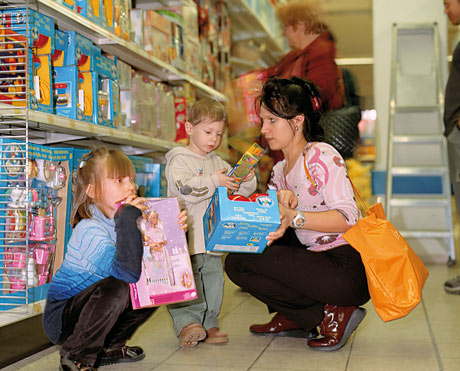
Children and young people are not the consumers of tomorrow, they are the consumers of today: even the youngest ones control the purchasing decisions of their parents in quenching mode, young people have enough sack money to fulfill their own wishes. If they run out of stutz, they too work the dear producers. "Not only with products for daily needs, but also with home electronics, car purchases and the choice of vacation destination, children demonstrably have a say," says Stefan Vogler, marketing expert at the Zurich agency Matrixs. And: children and young people are very receptive to advertising messages: even two- to three-year-olds recognize brands and products. Under the age of seven, the little ones react above all to logos and mascots; as they get older, they no longer eat nut nougat spread, but Nutella.
"Young people are very brand-conscious," says Bernhard Heinzlmaier, author of the book "Youth Marketing - Put Your Products on Stage" and managing director of Tfactory, a Vienna- and Hamburg-based specialist agency for youth market research and youth marketing. "Young people use brands to construct identity. Brands have an explicit communicative function for them: they signal attitudes and affiliations to certain groups. Product benefits are secondary." This is especially true for boys under 20. The less educated they are, the more important the brand. Girls deal with brands much more rationally and critically, they are more price-conscious and attach importance to their own style at an early age.
Children become customers
A precise definition of until when one is a child and from when one is an adolescent is difficult. "The youth phase is expanding more and more, children are sliding into adolescence earlier and earlier. Today, even eight-year-olds read Bravo," Heinzlmaier says. "The transition from childhood to adolescence is where you start following youth-cultural values and lifestyles." For his research, Heinzlmaier draws an artificial line at age eleven: from four to eleven, you're a child; after that, until 29, you're an adolescent.
Children and young people are becoming increasingly important as consumers. Companies that specifically target young people with marketing and advertising use the opportunity to condition their young target group at an early stage and shape their later purchasing decisions. This is because adults often consume brands that they got to know as children. Because of this influence and early imprint on even the youngest children, marketing to children and young people is criticized by consumer protectionists and family associations. Nevertheless, companies are focusing on kids and teens. A prime example of successful children's and youth marketing is McDonald's children's menu. What kid eats a plain burger at the fast-food giant? It has to come with fries, a drink and a toy.
Advertising with jöh effect
The two largest Swiss retailers, Migros and Coop, also have their sights set on the little ones and the middle-aged: Migros created the Lilibiggs cartoon characters Hugo and Nina and the dog Tobi around five years ago. They are aimed at four- to twelve-year-olds and identify products that meet special nutritional guidelines. Starting in July, Migros will gradually introduce more Lilibiggs products, and by the beginning of 2010 the range will include around 50 Lilibiggs products. Since 2006, there has also been a matching website and a Lilibiggs Club for children up to the age of 12. The club currently has around 30,000 members, who are supplied with a club magazine. In addition, Hugo, Nina and Tobi the dog are regularly the focus of campaigns, for example last year's Murmelmania and currently the Stickermania, where children can collect stickers with animals from the rainforest and stick them in an album. For every purchase of 20 francs or more, five stickers are given for free. Migros appeals to young people only with sporadic campaigns, for example, until last year with M-Budget parties or events around Euro 08.
In 2007, Coop created a child-friendly symbol in the fight against obesity: The Jamadu monkey identifies food, toys, care products, tableware and party goods from the normal Coop range that are said to be particularly suitable for children. And of course, the monkey also shimmies through the Internet: Jamadu.ch offers background information for the grown-ups as well as play fun for the little ones. Jamadu is aimed at children aged four to nine and young families. For youngsters, Coop compiles seasonal products on specific themes and promotes them in its own brochures, for example for the start of school.
Action for the whole family
Andrea Schönholzer, project manager for children's marketing at Migros, does not want to see the Lilibiggs figures and the campaigns associated with them as a way of enticing children to consume. She says Migros wants to build an emotional bond with children: "We consider children an important target group, but not in a monetary sense. For us, it's about building a customer relationship. Children are the customers of tomorrow. If you can establish an emotional bond with them at an early age, you will win their sympathy - with repercussions for later adulthood as well. In addition, parents appreciate meaningful, sympathetic and appreciative interaction with children." The Stickermania stickers are not only collected by children, but also by parents, grandparents, aunts and uncles, says Schönholzer. They would be exchanged by children among themselves, and some teachers would even use them in class, leading to social interaction and the playful passing on of knowledge. Nice side effect. Nevertheless, customer loyalty never happens l'art pour l'art. It aims, if not to increase sales, then at least to secure sales, even at Migros. After all, the company is a retail group and not a social institution. And whether the purchasing power of children is tapped directly or that of their parents via their offspring, the role of the child as a sales driver changes little.
Migros uses specialized agencies such as Alborghetti Communications and Wirz to support its campaigns for children; Flowcube was at work for Murmelmania. In the conception, the company says it takes care to direct commercial messages only to parents. Schönholzer: "We don't want to instrumentalize children. That would lose all goodwill with parents and is certainly not Migros' goal. Children are more persuaded by emotions and dreams than by logical arguments. However, the purchasing power clearly lies with the parents."
Clear increase in sales
Coop also wants to reach children through their parents - and parents through their children: "With Jamadu, the adults have to be addressed first, and the added value of the campaign explained to them: balanced and healthy nutrition, products with reduced fat or sugar content, no flavor enhancers, dermatological safety, etc.," explains Lydie Goltdammer-Fourkal, Head of Advertising Retail at Coop. "Only then do we address the children themselves, who after all should also prefer these good products." In fact, on the Jamadu website, it's predominantly "gesiezt" and explaining, rather than "duzt" and conversing. If the children are addressed directly, the parents are always addressed as well. But this is also due to the situation: A large proportion of four- to nine-year-olds cannot yet read, or can only just begin to do so.
Coop works with KSBSJ to plan and develop its campaigns. The retail group attaches particular importance to the precise definition of the target group - precisely parents and children - and to media values. Neither Migros nor Coop reveal how much they invest per year in marketing measures for children and young people. But Coop's sales growth shows that spending money in this area is worthwhile: "We launched Jamadu in April 2007. In 2008, we achieved sales of 22 million francs, about double the previous year," says Goltdammer-Fourkal. "With the twenty superpoint promotions associated with Jamadu, sales increased significantly."
Pictures are kids stuff
Both Migros and Coop use images and characters to appeal to their youngest customers. This is no coincidence: studies show that children up to the age of seven react particularly well to logos and mascots. Bernhard Heinzlmaier modifies this sweeping assessment: "There is nothing to be said against the statement that people are able to perceive more complex facts from a certain stage of development. But the approach of necessarily serving the youngest with pictures is outdated and lacks an empirical basis: on the free market, comics are in a serious crisis. The fact that Migros' campaign nevertheless works so well indicates that its buyers come from a middle educational class and have a strong family background. With such a target group, the concept of collecting and swapping also goes down well."
Crazy, crass and cool
One way to appeal to young customers is to use their language. However, the use of youth language for advertising purposes is controversial and can backfire badly. Because when adults use youth language, young people often find it chumming up and embarrassing. Corpora such as the Lexikon der Jugendsprache (Dictionary of Youth Language) from Dudenverlag or www.szenesprachenwiki.de suggest that the language of young people can be fixed at a certain moment and that you only have to use this vocabulary to appeal to young people. But that is exactly what does not work. Youth language is constantly changing and varies from peer group to peer group. Some terms disappear from the language after just a few months. That's why it's difficult to speak authentically in youth language without belonging to the group of speakers yourself.
Coop tries its hand at the slippery slope of youth language - and slips: "Whether crazy, sporty or cool, the trendy notebooks, pens and backpacks bring color into everyday life," reads a current brochure from the retailer. Ouch. "With every advertising campaign, we adapt the tone to the target group," explains Coop advertising manager Lydie Goltdammer-Fourkal. Unfortunately, that has failed thoroughly in this case.
"Language is the easiest way for adults to be embarrassing," is Heinzlmaier's verdict on Coop's attempt to curry favor with young people. "There was certainly a 50-something copywriter at work." What's more: most of the time, the things touted as "cool" or "hip" are anything but. It would be better to show a really cool backpack in large format, possibly combined with a snappy slogan. At the same time, it is by no means forbidden to make use of the special lexicons of the young - if you look them in the mouth and remain authentic. But a vague memory of how you spoke when you were young is by no means enough to avoid breaking a leg or even a neck.
With its focus on children between four and twelve, Migros avoids the pitfalls of youth language. "Nothing annoys children more than when adults try to copy them," says Andrea Schönholzer. "Children want and need to be different in order to develop their own personality. That's why it's a fine art to communicate with them in a way that is appropriate for children and yet 'normal'. For us, the only conditionally human Lilibiggs comic characters are the key to success."
Language gives wings
But young language doesn't just appeal to young people. Well-crafted youth language slogans appeal to all age groups. A closer look reveals that the language of the young has long dominated advertising - and that for adults. The more society ages, the stronger the trend toward juvenilization, toward rejuvenation; the more our lives progress, the more we dream of staying young. Advertising must cater to this dream if it is to make an impact. "In the future, only those who offer a young product and advertise it in a young way will succeed on the mass market," predicts Bernhard Heinzlmaier. "Experiential knowledge is losing relevance, innovations are becoming increasingly important, staying young is the trend. Consumers want young brands and young aesthetics. Juvenilization will therefore increasingly become a relevant metric in marketing communications. Companies and agencies should address this development early on."
The Media Markt slogan from 2003, "Geiz ist geil," works with youth language. And it works: The claim is authentic and picks up on the language (and attitude to life) that was circulating on the streets among young people at the beginning of the new millennium. Adults wanted to be part of it and jumped on the slogan. Red Bull's "Verleiht Flügel" also comes across as crisp, fresh and youthful in its abbreviation. And it is by no means embarrassing. That's why the energy drink is not only drunk by young people, but is also revered as a cult drink by adults well into their fifties. The dream of flying slumbers in the same drawer as that of being young.
Advertising as a fountain of youth
But how do you communicate "young"? Non-verbal communication will become more important, pictures will be more important than texts, and feelings and thoughts will be more important than arguments, Heinzlmaier outlines the future. "Products for children are a world of their own. But in the future, advertising for music or sneakers will have to fit the lifeworld of young people aged 15 or 16 and up, as well as the lifeworld of 40-year-olds." Heinzlmaier advises companies and agencies that want to rejuvenate their advertising to seek contact with young people and listen to them carefully. "A good access point to young lifeworlds can also be the younger employees in the company," he says. "Draw from your own pool. Advertising has to go far. It must provoke, develop explosive power and not be too conformist. And yet people must recognize themselves in it."
Of course, there will continue to be markets for subcultures that function differently from the mass market: luxury goods such as Porsche, Breitling, or Château Rothschild follow their own logic and are aimed at a select group of consumers. Advertising for such products must focus on exclusive messages. But those who advertise to the mass market will have to come across as young in the future, also with regard to the communication channels. The goal is to become the talk of the town, not only on TV, the Internet, radio and billboards, but also on Twitter and Facebook. If you're not there, you'll lose opportunities.
Anne-Friederike Wilhelm