Pfizer Journalist Award: Pharmaceutical company against obesity

Three journalists will share the 2009 Journalism Prize, worth 10,000 Swiss francs and launched by the pharmaceutical company Pfizer, for their contributions on the subject of obesity.

"Thick. Or thin" was the title of a very personal portrait of an overweight young woman written by Zurich journalist Nicole Zurbuchen. Zurbuchen is now being honored for the article, which appeared in the magazine Annabelle. She has to share the prize with the Valais TV journalists Stéphane Wicky and Pierre-Armand Dussex. With their contribution "Surpois et Obésité" (Overweight and Obesity), broadcast on the Valais regional TV station Canal 9, they were also selected for the prize. Their film shows the causes and consequences of overweight in children.
The jury, headed by Felix Gutzwiller, a preventive medicine expert from Zurich and member of the Council of States for the Free Democratic Party (FDP), selected the two works from 19 applications. The prize will be presented on Wednesday evening at a public event in Zurich's Kongresshaus. With the annually awarded journalism prize, the Swiss branch of the pharmaceutical company Pfizer wants to raise public awareness of health-related topics, according to the press release. Next year, the topic will be "Fear".


Last but not least: Hostel or brothel?

What’s the first thing that comes to mind when you see a poster featuring a woman’s lower abdomen in a thong? At the level of her pubic area, the slogan «24 h open» is visible, and at the edge of the image, the poster also promises «sexy prices»… Of course—a brothel. Presumably, that’s what the agency that designed the poster had in mind, too.

It's conceivable that something went wrong during the briefing. How else could you explain such a subject? The A&O hostel chain placed the order for an advertisement. In any case, it must have been discussed that the subject should be sexy. But what else does the company do? Hostel, brothel, it all sounds about the same. So the agency concentrates on the "sexy" aspect. The motif is quickly found, then a cheap slogan on top, et voilà, minimum effort with maximum attention. Exactly, sex sells. Mission accomplished, the hostel chain is sure to attract attention. The only question is what effect the poster will have on their image. Not only are there a huge number of complaints about the motif in Germany, but hotel staff are probably also wondering where exactly they work when they have to explain to guests that they can't expect to see a half-naked girl in their room...

1290581294_img091110_hostel

Anthrazit is looking for "The 200 best websites in Switzerland"

For the seventh time, the Swiss magazine Anthrazit is choosing "The 200 best websites in Switzerland 2010". Websites can be entered until the end of November 2009. The award-winning websites will be presented in the February 9, 2010 issue.

For the first time, a jury of experts and Anthrazit members will decide on the usefulness, usability, innovation, content and design of the websites. An online system was developed for the evaluation that can be used with computers, cell phones and other mobile devices. This year there is also a new category "mobile websites". Pure e-shops will no longer be judged. Websites that primarily sell products or services online and are registered for the selection of the 200 best websites in Switzerland will be reallocated to the selection of the 100 most useful Swiss e-shops.

> To the registration

Murdoch wants to block websites for Google

Rupert Murdoch wants to block his media outlets' websites from search engines and news aggregators. In addition to Google, Microsoft and Ask.com are also facing criticism.

"These are people who just pick up everything and steal our stories," complained the entrepreneur, whose media empire includes the Wall Street Journal in the US and The Times in the UK, in an interview with Sky News Australia. Although the search engines ensured that more people clicked on the respective pages, they did not attract loyal readers. "We would rather have fewer users, but ones who pay," Murdoch continued. In his opinion, users should never have received journalistic content on the Internet for free. The Wall Street Journal already offers its content for a fee. If a user is referred to a newspaper article via Google search, they can view the first paragraph, but are asked to pay for the rest.

Netzeitung to be discontinued at the end of the year

The Berlin-based online publication Netzeitung is set to close. According to the DuMont Schauberg publishing group, the project will be discontinued as of December 31, 2009. Financial reasons are cited as the cause.

For industry experts, the bankruptcy is an expression of the difficulty news publishers have in finding a suitable business model for the internet age, as Pressetext.ch reports. In addition, Netzeitung was underfunded from the outset in order to provide enough interesting content. The significant increase in competitive pressure on the online news market also played its part. In future, Netzeitung will be used as an "automated news portal", according to the publisher. Exact details are not yet known.

Radio 1: Broadcasting operations expanded - expansion of personnel

Radio 1 has expanded its broadcasting area for the second time. The "radio for adults only" started broadcasting from Üetliberg at 9 a.m. on Monday. The number of staff has also been increased.

Sandro Brotz is taking over as Editor-in-Chief. The 40-year-old is part of the founding team of Radio 1 and will take on additional programming tasks in his new role alongside managing the editorial team. His deputy will remain 39-year-old Iwan Santoro. The Radio 1 team is also receiving several new additions: Samuel Volken (31), previously Head of Duty at Radio Top, will strengthen the editorial team. Presenter Sharon Zucker (37) is also coming from Radio Top. Further personnel reinforcements are being planned, the station announced on Monday.
Last week, the radio station began broadcasting in the Winterthur region. The next step will be to launch operations on the Etzel for the entire Zurich Oberland. The final expansion is scheduled for mid-2010.

Winterthur International Short Film Festival

The 13th Winterthur International Short Film Festival ended with a record number of visitors. The young Irish filmmaker David OReilly won the grand prize with "Please Say Something". The prize for the best Swiss film went to Nicolas Steiner with his film "Ich bin's Helmut".

The competition jury awarded prizes to a total of four films. The main prize of 12,000 francs went to the animated film "Please Say Something" by David OReilly. The Swiss prize of 8,000 francs went to Valais filmmaker Nicolas Steiner for "Ich bin's Helmut". The award for a talented director, endowed with 10,000 francs, went to Scottish filmmaker Paul Wright for his film "Believe".
The film "Wagah" by Supriyo Sen received the most votes from the audience. It received the Audience Award, which is endowed with 8,000 francs. Lorenz Merz received the Camera Prize, awarded for the first time this year, for his camera work in the film "Schonzeit" by Irene Ledermann, winning non-cash benefits worth 8,000 francs. The prize for the best Swiss school film, already awarded on Thursday and endowed with 5,000 francs, went to Anja Kofmel with "Chrigi". Another new award, the Shortrun Prize, which includes post-production benefits in kind worth CHF 12,000 for a screenplay project, went to Sahar Suliman for her project Muselé.
14,000 people visited the festival from Wednesday to Sunday, setting a new attendance record for the Short Film Festival. The 14th edition of the Winterthur International Short Film Festival will take place from November 10 to 14, 2010.

(Image: David OReilly wins the main prize at the International Short Film Festival Winterthur 2009).

Schlaefli and Maurer: New location, new large-format sheet-fed printing press

Schlaefli and Maurer plan to revitalize the market starting in January 2010 with the first XL 145 sheetfed press for commercial printing to be installed in Switzerland. The new printing facility in Uetendorf near Thun will be presented in collaboration with media artist Chantal Michel.

Media artist Chantal Michel accompanies the process of evaluating, ordering, delivering, installing and commissioning the new printing equipment as part of a cultural sponsorship by Schlaefli & Maurer AG. The 200-ton Heidelberg Speedmaster XL 145 large-format press will be transported to Switzerland in twelve heavy loads at the beginning of December. Following installation and testing, the new press will be available for the first print jobs from mid-January 2010. The other facilities in the new Uetendorf printing center will also be ready for production start-up by the same date.

1290581297_img091109_druck_schaefli
Image: Chantal Michel and the printers, Part. II (The first printed sheet).

Effact: Drawing attention to Pro Juventute in a striking way

A new poster campaign from Effact for Pro Juventute draws attention to the foundation's commitment and presence. Slightly provocative, problematic situations involving children and young people are visualized.

Topics such as bullying, computer addiction or sex are staged with a visual language at the place where they occur. The respective question raised, as a direct address to the observer, is resolved by the new claim "There for you! " is resolved. In addition to raising awareness of the help on offer and understanding for the young target group, the aim of the campaign is to make young people's concerns a social issue. Pro Juventute is largely financed by private donations and the sale of its own products and is therefore dependent on nationwide awareness.

Responsible at Pro Juventute: Stephan Oetiker (CEO), Matthias Wipf (Head of Communication & Brand Management), Matthias Delafontaine, Denise Schlumpf (Sales). Responsible at Effact: Tim Zahlten (consulting), Nino Haslach (CD), Britta Brauner (AD), Christian Müller (Junior AD), Alain Picard (text), Henri Meier (picture).

1290581298_img091109_pj1
1290581298_img091109_pj2
1290581298_img091109_pj3
1290581298_img091109_pj4

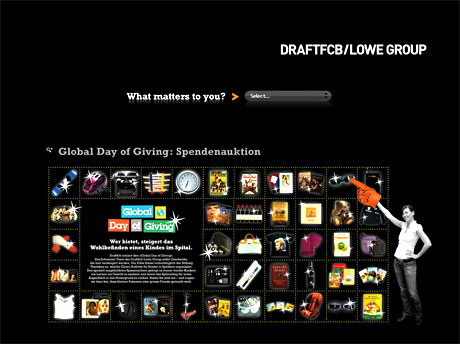
Draftfcb: Donation auction for children's foundation

The Draftfcb agency network has launched the «Global Day of Giving» to support organizations that help children. In Switzerland, the Draftfcb/Lowe Group team has donated gifts that are now being auctioned off on the website.

All proceeds will go to the Theodora Foundation, which aims to make the stay of children in hospitals easier. The online programming was carried out by Eyemedia Zurich.

1290581298_img091109_draft

20 Minuten Online with record number of users

The national news platform 20 Minuten Online continues to grow and consolidates its leading position. The website sets new records with 2,530,000 unique clients (Net-Metrix audit) and around 1,124,000 unique users (Net-Metrix profiles).

With a share of 54%, 20 Minuten Online has the largest share of the advertising-relevant target group of 14-34-year-olds in Switzerland and, at 42%, has the highest proportion of women of all Swiss news platforms. According to Net-Metrix profiles, it also has around 437,000 unique users with a high level of education. This socio-demographic development is also supported by the fact that the site has been able to increase the number of double users compared to NZZ Online from 23 percent to 40 percent since the first survey in 2007, as the company writes in a press release on Monday. Almost half of all NZZ Online users are also users of 20 Minuten Online. Online editor-in-chief Hansi Voigt attributes the good result to the strengthening of the editorial team and the broad spectrum of information.

Last but not least: Commercial break, hurray!

Commercial breaks—what a nuisance! They always pop up at the worst possible moment and seem to go on forever. No one really wants to watch them. Wrong—that’s not entirely accurate. The widespread assumption that people only reluctantly put up with commercial breaks has recently been disproved.

record programs and then consume them without commercial breaks. Digital video recorder (DVR) manufacturers launched their devices on the market with this argument, which led to many advertisers, broadcasters and customers worrying whether the commercials would be watched at all. Now the US media research institute Nielsen has given the all-clear: almost half of those who watch TV programs on the DVR still consume the advertising.
There are various explanations for the unexpected usage behavior of viewers: One possibility is that the television viewer is a passive user who does not want to intervene in the action. An alternative is, of course, that people naturally have a need for a break. Also conceivable - habit. The consumer has learned to deal with the commercial breaks and can no longer do without them, as they use them to get a cold beer or potato chips in the kitchen, for example. Whereby the latter of course also makes the advertising effect impossible...

get_footer();