SR DRS: Demand for podcasts more than doubles

More and more people are consuming radio broadcasts as podcasts. Swiss Radio DRS recorded a total of around 35 million downloads of broadcasts in mp3 format in 2009, 130 percent more than in the previous year.

SR DRS offers a total of 74 podcasts for free download on its homepage. By far the most successful radio podcast was the news program "Echo der Zeit", which was downloaded around 9,600 times a day on average. The most successful weekly program was "DRS 3 Digital" with an average of around 14,500 downloads, followed by the DRS 3 programs "Input" with 14,300 and "Focus" with 11,300 downloads.
The culture and knowledge program DRS 2 doubled its podcast usage in 2009. The most-used podcast was "Kontext," with 7,400 downloads per program. The biggest percentage increase, over 300 percent, was recorded by "100 Seconds of Knowledge". The increase for "Musikmagazin" was over 230 percent, and for the DRS 2 film podcast 198 percent. At DRS 1, "Doppelpunkt," "Persönlich" and "Espresso" were among the most downloaded programs.

Music shows also on offer
For about a year now, SR DRS has also been offering music programs as podcasts - there are currently 19 of them. This has become possible thanks to a copyright agreement with the IFPI (International Federation Of Producers Of Phonograms And Videograms), according to a statement from SR DRS.

Art from the vending machine

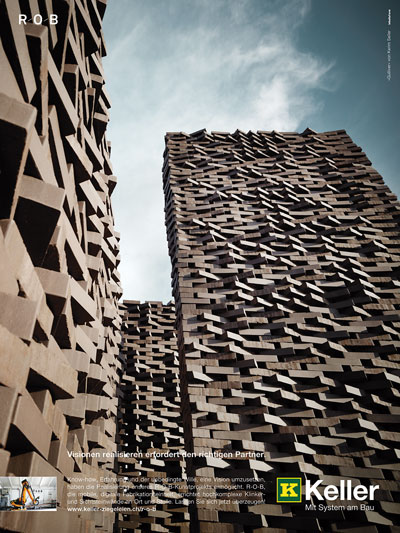
Inhalt & Form has created an artistic campaign for Keller-Ziegeleien featuring a practical robot.

The project made its first major appearance at the Architecture Biennale in Venice in 2008. Gramazio & Kohler, Architecture and Digital Fabrication, ETH Zurich and Keller-Ziegeleien worked together to develop a robot that can build freely selectable motifs on the move using clinker and exposed bricks. How do we communicate such a new possibility? This became a tricky question for the advertising agency Inhalt & Form. The task was solved with two artists. They were commissioned to create a work of art that would generate international attention among experts. Since then, the agency has had a variety of visual material at its disposal. A film was also made "because the way the R-O-B industrial robot works and the dimensions of its work were difficult to put into words", according to the advertisers. This film was shown at the last Swissbau and can still be viewed on the Internet. The accompanying music was created by Richard Dorfmeister of Kruder, Dorfmeister. The communication will be supplemented in fall 2010 by an illustrated book with lots of art and photos. pan
1290581093_img100205_inhaltform1
img100205_inhaltform2

Lower advertising pressure

Media Focus Advertising pressure fell by 4.3% in 2009. Compared to 2008, gross advertising pressure in the print media fell by 10.1%.

This corresponds to a decrease of over CHF 230 million. The "TV, radio" media group and, above all, "online advertising" achieved a year-on-year increase. Advertising pressure in April (-13.3%) and May (-17%) was particularly low compared to the previous year. The fact that advertising pressure for the year as a whole was "only" 4.3% lower than in 2008 is partly due to the slight increase of 2.2% in December. A small increase was also recorded in March (+1.6%) and August (+1.4%). Otherwise, advertising pressure declined in all months. In 2009, the key market of "energy" grew particularly strongly (+16.3%; +4.2 million francs). "Tobacco products" recorded the sharpest decline in percentage terms (-41.4%; -6.1 million francs).
img100205_mediafocus

Serbian drug lord bribes media and political parties

The drug boss Darko Saric, who is wanted on an international arrest warrant, is said to have bribed parts of the media and some political parties in Serbia. Slobodan Homen, State Secretary in the Serbian Ministry of Justice, told the Belgrade newspaper Press on Friday.

According to consistent reports in the local media, Saric, who is said to have gone into hiding as a Serbian citizen in neighboring Montenegro, had earned hundreds of millions of euros with drugs. He is said to have invested this money in the purchase of companies and huge tracts of farmland in numerous Balkan countries. Now the public prosecutor for organized crime must make an example of Darko Saric, demanded the State Secretary. "The connection between drug crime and big business, political structures, parties and individual media in Serbia and the region must be broken."
"Total war against organized crime"
The Belgrade newspaper Blic published a report on its front page on Friday according to which there is a connection between the head of the Serbian interior minister's cabinet and the drug boss Saric. This week, Serbian President Boris Tadic once again declared "total war" on organized crime in the country.

New advertising combination in Aargau

The five weekly newspapers in Aargau—General-Anzeiger, Der Landanzeiger, Rundschau Nord, Rundschau Süd, and Wiggertaler—have joined forces to form an advertising pool.

The "AaragauCitys+" combination covers the area to the south and north of the A1, according to a press release. The new product is aimed at anyone who wants to place their communication message on a large scale, effectively and at an attractive price.
The publishers themselves are responsible for advertising. "AaragauCitys+" advertisements can now be placed with the Zofinger Tagblatt, Effingerhof or any Publicitas branch.

Top of the week

Top of the Week 1: Communicator of the Month, Top of the Week 2: Tele 1's Debut.

Top of the week 1: Communicator of the month
Hanspeter Lebrument, President of Schweizer Presse and publisher of Südostschweiz, has been named Communicator of the Month for January by Schweizer Werbung (SW). Lebrument earned the award for his speech at the Epiphany Conference on January 5. Hanspeter Lebrument had finally delivered a presidential speech. And this after he had incomprehensibly assumed the role of entrepreneur in recent years and talked about the sensitivities in his company. According to the association in a communiqué, this naturally did not interest the audience, even alienating them and repeatedly causing them to shake their heads. It was not the publisher president's job to point out his own needs, but to speak "for his clientele", the press. And he has done this clearly and unambiguously this year. He castigated the masochism of publishers who cheered a Federal Councillor at their annual congress after the latter had previously accused them of how unspeakably unprofessional the Swiss media were.
Top of the week 2: Start of broadcasting for Tele 1
The new Central Switzerland regional television station Tele 1, which belongs to the LZ Group, has been on air since Monday evening. Tele 1's program focuses on information and culture as well as regional reports. Editor-in-chief of the new station is Oliver Kuhn. Once a week, he will host the program "Kontrovers" and discuss topics from politics, business and society with guests. A total of 53 employees work for Tele 1, 40 of whom are permanently employed by Zentralschweizer Fernsehen. In order to fulfill the performance mandate from OFCOM, Tele 1 places great importance on the training of its employees, the broadcaster writes in a press release. They are therefore accompanied by experts. The MAZ is a partner in training and junior staff. CHF 5 million was invested in the technology and a further CHF 4 million in the construction of the Central Swiss television station. The broadcaster's annual budget amounts to a good CHF 8 million. CHF 2.3 million of this is concession money, the rest has to be earned through advertising money, as Managing Director Bruno Hollenweger emphasizes.

Hopp Schwiiz!!!

Republica at the Olympics.

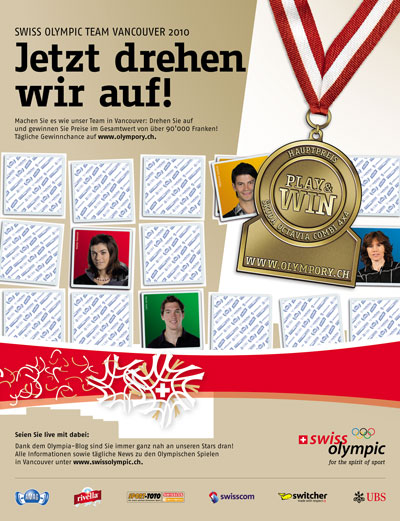
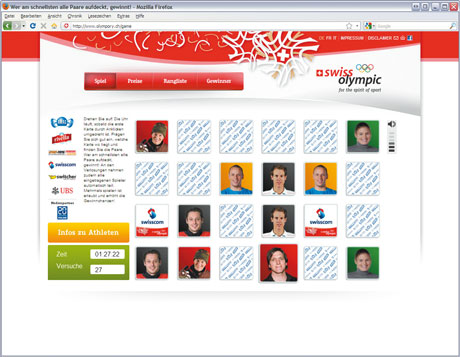
The Winter Olympics in Vancouver get underway on February 12. Republica in Berne already had its first victory in late summer 2009. The agency won the Swiss Olympic budget in a pitch. Since then, the team has been in top form. "Now we're turning up the heat!" is also behind the idea for the campaign. It is intended to arouse great anticipation for as many medals as possible. The communication will be cross-media. The focus is on the information and competition platform www.olympory.ch. This is accompanied by banners, advertisements, postcards and a new game. This card game is based on the memory system and has now been adapted as "Olympory". The game can be played both online and with physical cards. There is a competition: anyone who can uncover the matching pairs of pictures of the athletes with a click of the mouse will be entered into a prize draw to win prizes worth a total of 90,000 francs. Well over 100,000 supporters have already signed up to take part, and the fan base is also growing on Facebook. The Swiss Olympic Leading Partners are also involved.
Andreas Panzeri
1290581092_img100205_republica1
1290581092_img100205_republica2
img100205_republica3

"The Good Corporate Citizen" - coming soon to this community

The role of businesses in the community is becoming increasingly important—sponsorship helps establish a sustainable position.

No sector of the economy was spared the aftershocks of the global crisis last year, and the sponsorship industry was also hit hard: "The IEG-International Event Group's Sponsorship Report, which has been publishing an overview of the industry at the beginning of each year for the past 25 years, had to report a decline in sponsorship spending in the USA and Canada for the first time (-$100 million to $16.51 billion). This is remarkable for an industry that has always recorded double-digit growth rates in recent years," explains sponsorship specialist Elisa Bortoluzzi (see "Clear messages are more important than ever"). However, according to the IEG, total global spending is expected to rise again this year to 46 billion dollars.
And what happened in Switzerland? Did the sponsorship business also suffer? The mood was certainly negative. The prominent withdrawals of well-known sponsors such as UBS, Carlsberg, Swisscom and Credit Suisse, which alone withdrew around 110 million francs in contributions in 2009, were exploited in bold headlines. The fact that Bank Bär took over the sponsorship of the festival in Verbier from UBS, or that Axpo has recently started supporting the SAC, was at best worthy of a news item. This is why Remo Rusca (see "Sponsorship must be part of overall planning"), Deputy Managing Director of the communications agency Felten & Compagnie, states: "In contrast to traditional advertising and probably also event marketing, the Swiss sponsorship market has developed quite positively. In 2009, more new contracts were signed in the domestic sponsorship market than were terminated."
Professionals have no problems
The situation for successful and professionally managed events remained unchanged. These had and still have no problems finding sponsors, such as the Arosa Humor Festival, for which Axa Winterthur has been the main sponsor for eleven years. For Tom Markwalder (see "Events must reflect our core values"), Head of Event Marketing & Promotion at Axa Winterthur, the following applies: "The Arosa Humor Festival has become the best-known comedy event in Switzerland and is also known beyond the country's borders. For us, the focus is on the good hospitality opportunities, where we can offer individual programs for various distribution channels." But the insurance company's commitment does not end with financial support. Markwalder: "Thanks to the good cooperation with the organizer, we are constantly trying to further develop the festival together, for example with a new tent a few years ago or with the new Axa Outdoor Lounge in 2009."
The trend this year is towards greater integration of sponsorship activities into the overall corporate strategy. Gone are the days when the bosses of two companies came to an agreement over a nice glass of wine based on their personal preferences. Of course, good personal contacts are still the be-all and end-all in the business world, but in 2010 community marketing and the role of companies as "good corporate citizens" will take center stage. Only if the sponsorship of an event also makes sense on a strategic level and can be understood internally, especially by companies, will it continue in the future.
Marc Bodmer

Professionalize the chain of experiences

René Allemann and his agency Branders develop the basis for further communication tasks and look for the right profile for the brands.

Brands and market shares require more and more specialists for their proper care. These do neither PR nor advertising. "Branding from A to Z" is the core competence of such CI agencies. One of the younger but already leading ones in Switzerland is called Branders. A strong name, which is complemented in the claim with the perfect subline: "identity works".
The branders, with offices right next to Zurich's Bellevue, develop the foundations for all disciplines of brand communication that follow later. "We position our clients' brands in the competitive environment," summarizes CEO René Allemann. What is unique about a brand? Where are differentiation factors? Which of these factors are relevant? Which brand should survive when two companies merge? How can advertising sharpen the brand? Branders aims to find answers to such questions on behalf of its clients, and thus also messages for a wide variety of media.
Communication and media have been a passion of René Allemann's since a young age. He sought publicity as early as middle school, for example by organizing charity events for development aid. During such a sponsored run for Bangladesh under the patronage of the Swiss Agency for Development and Cooperation, Allemann gained his first experience with PR. In addition, he was able to supplement his pocket money as a freelance journalist.
Later, the current CEO of Branders studied business administration in Zurich with a focus on marketing and communications. To broaden his horizons even further, Allemann added psychology, sociology and art history. Because writing was the best way for him to express himself creatively at that time, a first job in the PR industry naturally followed.
At Loepfe & Partner, an office that later merged with Büttikofer, Allemann found the ideal start in a small team. "I was thrown in at the deep end fresh out of school." On one of his very first days, he had to coach the then head of Sat.1 for an interview with the "Tagesschau." Later, he was entrusted with Unilever and other big brands. "In a small agency, the tasks are not so split, and you can quickly take on responsibility," says Allemann, looking back on his first five years as "a super learning experience." He was allowed to build up the corporate identity within the PR agency. The first CI projects were for public institutions. "In the 1980s, municipalities wanted to give themselves a professional image for the first time."
Allemann's specialized experience led him to Interbrand Zintzmeyer & Lux. At the then trendsetter for corporate identity, he worked for six years in various functions until he became head of a unit. In addition to the interesting clients and international contacts, Allemann now thinks back fondly on his personal collaboration with Jörg Zintzmeyer. "A charismatic personality from whom I was able to learn a great deal."
In the course of his multifaceted work, René Allemann developed more and more of his own ideas, which in turn awakened his very own understanding of branding. He wanted to approach the topic of consulting in an even more personal and, in addition, more "holistic" way. After five years in a steadily growing agency, he was convinced that the best way to bring his ideas to maturity and effect was again in a small but independent agency. So he founded the Branders Group. An office in Zurich's Seefeld. With five workstations, but still without employees and, above all, without clients. But the alternative of seeking his new path as an individual consultant never interested the young entrepreneur. "For good brand design and comprehensive strategic consulting, you need an interdisciplinary team. Much better solutions can grow out of a discussion."
The courage to think generously paid off. After two weeks, the first customer in the construction sector was acquired. Shortly thereafter, Novartis came forward. The pharmaceutical group is still an important pillar in the Branders portfolio today. Other well-known clients soon followed, such as Swiss Post, Bernische Kraftwerke, Basellandschaftliche Kantonalbank, Energie Wasser Bern, NZZ, Frutiger, PostAuto and PostFinance or the Danish-German Nycomed.
Soon, the Branders had to move from Seefeld to larger offices on Rämistrasse. Today, 15 employees work here, a strikingly large number of whom are female. "Women simply very often had the better qualifications," says the CEO. With a 50 percent share, Branders also employs strikingly more consultants than classic advertising and CI agencies. Some of them have already gained experience in international agencies, for example in New York. Others, like Allemann, come from the field of corporate communications or from psychology or art studies.
The agency's offices are spread over three floors in the building complex of the legendary "Kronenhalle. Nevertheless, the regular restaurant has not become the in-house "canteen" for many advertisers. The Branders have not had the time for lavish lunch breaks, because they have to be able to serve their international clients at different times. For Novartis, for example, with branches in 140 countries, the Branders look after a hotline where inquiries about the brand appearance as well as the design and strategy of the brand are answered around the clock. "As a lead agency, we take care of all branding issues together with our clients." Thus, Branders not only develops strategic brand concepts for most of its clients, but also new brand presences, guidelines and templates for print media, illustrations, imagery and more.
However, Branders does not only work for big brands. Many clients belong to the SME category. But here, too, it can take on international dimensions. A small watch brand from Grenchen has achieved cult status in China, perhaps also because Branders from Zurich redesigned the comprehensive visual image with logo, POS and - for once - an entire campaign.
For the Neue Zürcher Zeitung, Branders analyzed the positioning of the umbrella brand during the redesign of the newspaper together with a partner agency and the management. What should the NZZ brand stand for in the future? Which products from the publisher's broad portfolio should be linked to the ¬brand NZZ? In this assignment, Bran¬ders developed the claim "Joy of Quality" and created the strategy and the idea for a new -brand "NZZ Mediengruppe".
Branding must have an effect both internally and externally. Employer branding stands for the effect of the brand on potential employees. Here, Branders has implemented a comprehensive concept for Swiss Post, for example. This is intended to lead Switzerland's second-largest employer away from its somewhat "dusty image as a monopolist" and reposition it in the labor market. At the same time, the mandate includes internal communication. How can the brand content be experienced internally? René Allemann sees a lot of potential for this topic in many brands. "It has been realized that many companies still have far too little understanding of what a company and thus the brand actually stand for."
And what does Branders want to stand for in the future? René Allemann plans primarily qualitative rather than quantitative growth. "We want to remain a boutique." To this end, however, new areas such as social media and communication with moving images are to be expanded. "Branders wants to professionalize the entire experience chain." To this end, it is self-explanatory with the successes to date that Branders also wants to be on the road a bit more internationally in the future.
Andreas Panzeri

To the point: We congratulate

For the 33rd time, *Werbewoche* is presenting the «Advertiser of the Year» award. The winners were chosen by the subscribers of Werbewoche. Five figures from the Swiss advertising scene were nominated, selected by a distinguished selection committee consisting of former “Advertiser of the Year” winners.

This year, two women finally made it among the nominees. After last year's male-heavy selection, a pleasant surprise.
The 2010 Advertiser of the Year is Regula Fecker from Rod Kommunikation. Regula Fecker was able to accept the trophy named Egon, designed by Swiss artist Max Grüter, at Zurich's Lake-Side. It was a clear victory: almost 26 percent of all votes went to Regula Fecker, partner and co-founder of Rod Kommunikation. In 2007, she founded the Rod Kommunikation agency with art director Oliver Fennel and PR consultant David Schärer. In 2008, Rod Kommunikation was named Newcomer Agency of the Year by the Jahrbuch der Werbung, and today Rod provides the Advertiser of the Year. That's how fast it goes.
With just under 21 percent of the votes, Alexander Jaggy landed in second place. This is not the first time the Executive Creative Director of Jung von Matt/Limmat and recent MBA has been nominated. He has headed the creative work of the Zurich agency since 2004. He is a member of the presidium of ADC Switzerland.
Third place, with just under 20 percent of the votes, went to Markus Gut, Chief Creative Officer of the Young & Rubicam Group. This is not the first time he has been nominated either. Last year, as in 2008, the Y&R Group took first place in Werbewoche's creative ranking. Gut produces his own wine and an award-winning grappa on his estate. He is also a member of the presidium of ADC Switzerland.
For the eleventh time, a broad jury presents the "Campaign of the Year" award. Twelve important works from twelve agencies were up for selection. In addition to the readership of Werbewoche, StarTV viewers were also able to participate in the voting this year. The jury's verdict was clear: Claudio Zuccolini as the kitchen fairy Margrit was the audience's favorite: with 42 percent of all votes, the jury chose Maggi's campaign as the winner. It was conceived and realized by the Publicis advertising agency. In second place with 21 percent of the votes was the campaign for the fruit association by the advertising agency Unikat. With 9 percent, the zoo posters of the Y&R Group made it to third place. You can read which favorites the expert jury had within the overall jury in the issue on page 5.
Pierre C. Meier, Editor-in-Chief
[email protected]

Berner Amtsanzeiger become more entertaining

In the future, the official gazettes of the Canton of Bern will allow for entertaining content such as recipes or crossword puzzles. In doing so, the Grand Council’s preliminary review committee has softened the wording of an ill-formulated section of the law.

The municipal law, which regulates the gazette system among other things, was already a topic of discussion in the Bernese cantonal parliament in the January session. It struggled with the question of whether the official gazettes should be allowed to publish editorial articles in future. In the end, the ban was upheld. However, the parliament demanded that the relevant section of the law be reworded. The wording went far beyond the target, so that even crossword puzzles or similar entertaining articles would no longer be permitted in future.
The commission has now adopted this new wording, as can be seen from a communication from the cantonal parliament on Friday. For the second reading of the law in March, it is now proposing that editorially prepared, opinion-forming texts and comments are not permitted in the non-official section of the gazette. Other text contributions and advertisements that endanger public peace and order and are discriminatory or immoral are also prohibited. Entertaining articles such as crossword puzzles, cartoons, event information, leisure tips or publicity reports are expressly permitted in the non-official section.

Apple restricts location-based advertising on the iPhone

Apple is limiting developers' ability to monetize their free iPhone apps through ads.

Anyone using the iPhone user's current location will in future only be allowed to do so for "useful" (beneficial) purposes, as Heise online reported on Friday. Applications that use location-based information primarily for the delivery of advertisements will no longer be admitted to the Appstore.
Apple recently acquired the company Quattro, which specializes in the mobile advertising business, for USD 275 million. Some iPhone experts therefore suspected that the current ban is the first step towards a mobile advertising service operated by Apple itself.
get_footer();